AI-Powered Decision Making: Strategic Leadership Framework

Turn this article into takeaways for your work.


Each assistant summarizes the article only for you and suggests best practices for your work.
What You'll Get From This Guide
- 5-Level Maturity Model: Progressive AI decision-making capabilities from basic analytics to autonomous strategic intelligence
- Human-in-the-Loop Framework: Clear protocols for when AI should inform versus decide, maintaining appropriate human oversight
- Bias Mitigation Strategies: Practical approaches to identifying and eliminating algorithmic bias in organizational decisions
- Trust-Building Roadmap: Step-by-step process for building organizational confidence in AI recommendations
- Implementation Playbook: Real-world use cases across predictive analytics, scenario modeling, and recommendation systems
The Evolution from Data-Driven to AI-Powered Decisions
The transition from data-driven to AI-powered decision making represents a fundamental shift in how organizations process information and act on insights. Traditional data-driven approaches relied on human analysts to interpret historical data and identify patterns. AI-powered decision making goes further by processing vast datasets in real-time, identifying non-obvious correlations, and generating predictive recommendations that humans alone couldn't produce.
McKinsey's 2025 Global AI Survey found that organizations with mature AI decision-making capabilities achieve 35% faster strategic decisions and 28% better outcomes measured by financial performance and market positioning. These organizations don't just automate existing processes. They rethink how decisions get made at every level.
The business case is clear. In markets where competitive windows shrink from months to weeks, the ability to synthesize massive information flows and act decisively creates measurable advantage. Deloitte research indicates that AI-enabled decision makers capture market opportunities 47% faster than competitors relying solely on traditional analytics.
But speed without accuracy creates risk. The real power of AI-powered decision making lies in combining computational scale with human judgment. Organizations that master this combination don't just decide faster - they decide better.
AI-Powered Decision Making as an organizational competency encompasses the enterprise's systematic ability to integrate artificial intelligence into strategic and operational decisions while maintaining appropriate human oversight, ethical standards, and accountability structures.
The Business Impact of AI-Powered Decisions
Organizations with mature AI decision-making capabilities demonstrate:
- Decision Speed: 35% faster time from insight to action on strategic opportunities
- Better Accuracy: 28% improvement in decision outcomes measured by financial and operational metrics
- Resource Optimization: 42% improvement in capital allocation efficiency through predictive modeling
- Risk Reduction: 31% decrease in decision-related losses through scenario analysis and early warning systems
- Customer Outcomes: 39% improvement in customer-facing decisions through personalization engines
- Competitive Response: 47% faster reaction to market changes through real-time intelligence synthesis
- Innovation Success: 33% higher success rate on new initiatives through AI-enhanced feasibility analysis
The 5 Levels of AI-Powered Decision Making Maturity
AI decision maturity expands the organization's field of view and authority in five distinct stages, moving from historical reporting to governed autonomous intelligence.
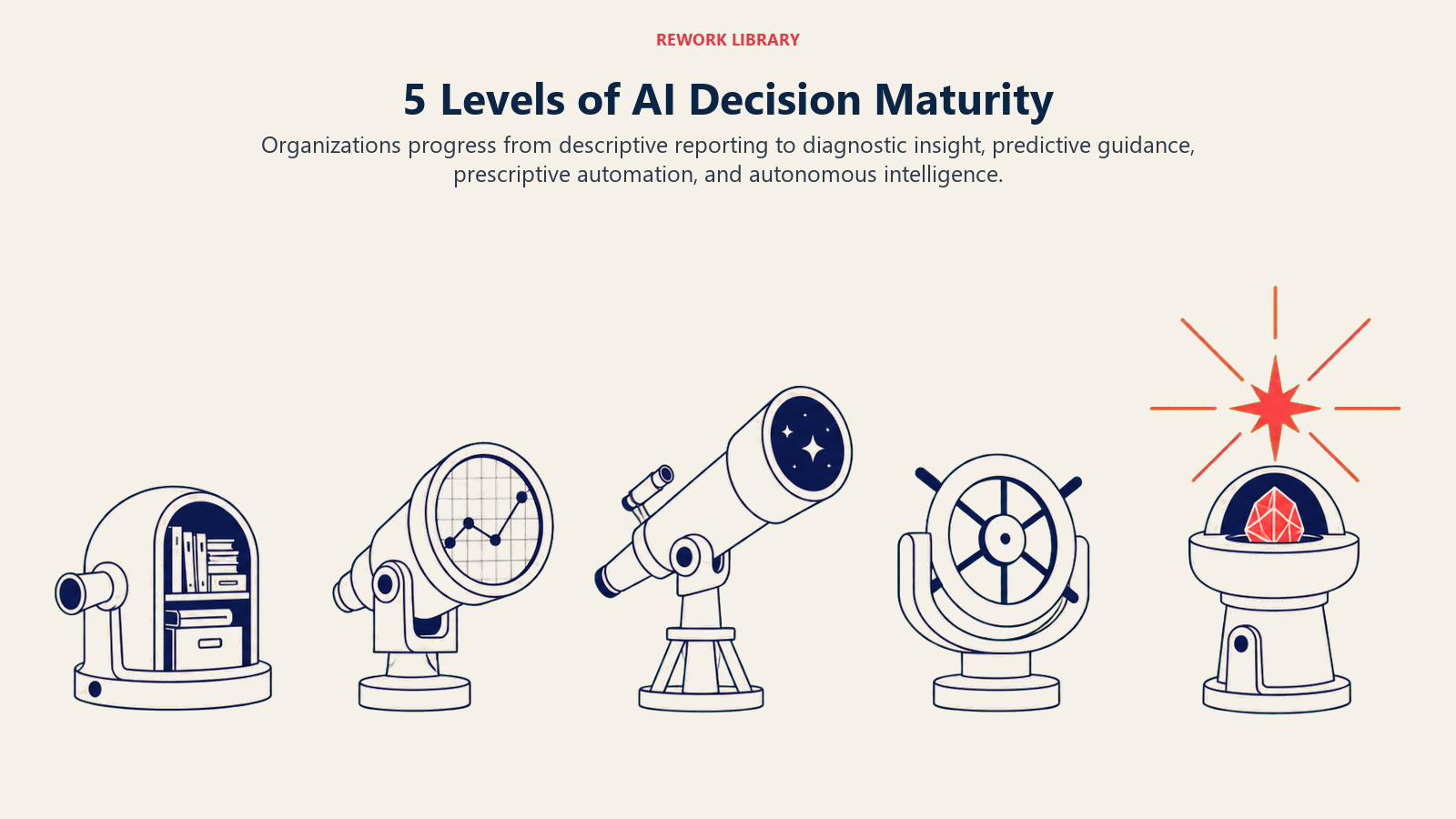
Level 1: Descriptive - Historical Analytics Foundation (Bottom 25% of Organizations)
Organizational Characteristics:
- Decision making relies mostly on historical reports and backward-looking metrics
- AI and machine learning are confined to IT experiments without business integration
- Leadership views AI as a technology initiative rather than a decision-making capability
- Data exists in silos without the integration needed for meaningful AI applications
- Analytics teams produce reports that inform decisions but don't generate recommendations
Capability Indicators:
- Business intelligence tools provide dashboards and historical trend analysis
- Decisions are made based on what happened, not what will happen
- AI initiatives have less than 20% adoption rate among business decision makers
- Data quality and accessibility issues limit analytical depth
Business Impact:
- Decision cycles average 2-3 weeks for strategic choices due to manual analysis requirements
- Competitive responses lag market changes by significant margins
- Resource allocation relies on historical patterns that may not predict future needs
- Customer-facing decisions lack personalization and can't predict behavior
Real-World Examples:
- Sears (2010-2018): Relied on traditional retail analytics while Amazon and Walmart built AI-powered supply chain and customer intelligence capabilities
- Blockbuster (2007-2010): Used historical rental data while Netflix developed recommendation algorithms that transformed customer engagement
Investment vs. Return:
- Investment of 1-2% of revenue in basic analytics infrastructure
- Returns limited by inability to translate insights into predictive capabilities
Benchmark: Bottom 25th percentile - Organizations make decisions based on where they've been, not where the market is heading
Level 2: Diagnostic - AI-Assisted Analysis (25th-50th Percentile)
Organizational Characteristics:
- AI tools help analysts understand why outcomes occurred through pattern recognition
- Machine learning models identify correlations and anomalies in business data
- Leadership receives AI-generated insights as inputs to human decision processes
- Data integration initiatives create unified views for analytical purposes
- Pilot programs demonstrate AI value in specific decision domains
Capability Indicators:
- AI tools explain root causes and contributing factors to business outcomes
- Machine learning identifies patterns that human analysts might miss
- Decision makers use AI insights as one input among many in their processes
- AI adoption reaches 40-60% in departments with analytical maturity
Business Impact:
- Decision cycles reduce to 1-2 weeks through faster root cause identification
- Problem diagnosis accuracy improves by 35% through AI pattern recognition
- Customer churn prediction enables proactive retention interventions
- Operational issues are identified earlier through anomaly detection
Real-World Examples:
- JPMorgan Chase (2018-2022): Implemented AI-assisted fraud detection that identified suspicious patterns 40% faster than rule-based systems
- UPS (2015-2020): Used diagnostic analytics to understand delivery performance drivers before advancing to predictive route optimization
Investment vs. Return:
- Investment of 2-4% of revenue in AI analytics infrastructure and talent
- Returns of 25-40% improvement in analytical depth and diagnostic speed
Benchmark: 25th-50th percentile - Organizations understand their data better but still count on human judgment for forward-looking decisions
Level 3: Predictive - AI-Generated Forecasts and Recommendations (50th-75th Percentile)
Organizational Characteristics:
- AI models generate predictions about future outcomes that inform strategic decisions
- Recommendation systems suggest actions based on predicted impacts
- Human-in-the-loop protocols ensure appropriate oversight of AI recommendations
- Data analytics capabilities mature to support real-time predictive modeling
- Cross-functional teams integrate AI predictions into operational workflows
Capability Indicators:
- AI generates 72-hour to 12-month forecasts with documented accuracy rates
- Recommendation engines suggest specific actions with predicted outcome ranges
- Decision makers routinely incorporate AI predictions into strategic planning
- Model performance is tracked and algorithms are refined based on outcomes
Business Impact:
- Decision cycles compress to 3-7 days for strategic choices through predictive intelligence
- Forecast accuracy reaches 75-85% for core business metrics
- Resource allocation improves by 35% through predictive demand modeling
- Customer lifetime value increases by 28% through predictive engagement
Real-World Examples:
- Netflix (2016-2023): Predictive content recommendations drive 80% of viewing hours, with algorithms forecasting audience response to new productions
- Starbucks (2019-2024): Deep Brew AI predicts store-level demand, optimizing inventory and staffing decisions across 35,000 locations
Investment vs. Return:
- Investment of 4-6% of revenue in predictive analytics infrastructure and AI talent
- Returns of 60-80% improvement in decision quality and speed
Benchmark: 50th-75th percentile - Organizations anticipate the future and make decisions accordingly
Level 4: Prescriptive - AI-Driven Decision Automation (75th-95th Percentile)
Organizational Characteristics:
- AI systems not only predict outcomes but prescribe optimal actions within defined parameters
- Automated decision systems handle routine choices while humans focus on strategic exceptions
- Real-time scenario modeling enables rapid evaluation of decision alternatives
- Strategic thinking shifts to focus on AI governance and exception handling
- Organizational trust in AI recommendations reaches levels supporting partial autonomy
Capability Indicators:
- AI systems autonomously execute decisions within approved boundaries
- Scenario modeling evaluates thousands of alternatives in minutes
- Human oversight focuses on strategic decisions and edge cases
- Decision automation delivers 90%+ accuracy on routine operational choices
Business Impact:
- Strategic decision cycles compress to 24-72 hours through real-time modeling
- Operational decisions achieve 90%+ accuracy through automation
- Capital allocation efficiency improves by 50% through optimization algorithms
- Competitive response becomes near-instantaneous for market-monitored decisions
Real-World Examples:
- Amazon (2015-2025): Automated pricing decisions across millions of products, with AI adjusting prices in real-time based on demand, competition, and inventory
- Ant Financial (2018-2024): AI systems approve 95% of loan applications autonomously, processing applications in 3 seconds with fraud rates below traditional underwriting
Investment vs. Return:
- Investment of 6-9% of revenue in advanced AI infrastructure and decision automation
- Returns of 150-250% improvement in decision efficiency and outcome quality
Benchmark: 75th-95th percentile - Organizations operate at machine speed for routine decisions while preserving human judgment for strategic choices
Level 5: Autonomous - AI-Orchestrated Strategic Intelligence (Top 5% of Organizations)
Organizational Characteristics:
- AI systems participate in strategic planning, identifying opportunities and risks humans might overlook
- Autonomous agents manage entire decision domains with human governance oversight
- Continuous learning systems improve decision quality through outcome feedback loops
- Organization has mastered the balance between AI autonomy and human accountability
- AI decision capabilities become competitive moats that reshape industry dynamics
Capability Indicators:
- AI systems identify strategic opportunities before human analysts recognize patterns
- Autonomous decision domains operate with minimal human intervention for years
- Decision quality exceeds human-only benchmarks across measured dimensions
- AI capabilities attract talent and partnerships due to demonstrated excellence
Business Impact:
- Strategic decisions leverage AI-identified opportunities invisible to competitors
- Operational efficiency reaches theoretical limits in AI-managed domains
- Market position strengthens through decision advantages that compound over time
- Organization shapes industry evolution through superior decision intelligence
Real-World Examples:
- Google/Alphabet (2018-2025): AI systems manage ad auction decisions at scale beyond human comprehension, processing billions of decisions daily with continuous optimization
- Renaissance Technologies (1990-2025): Medallion Fund's AI-driven investment decisions delivered 66% average annual returns over three decades through pattern recognition beyond human capability
Investment vs. Return:
- Investment of 10-15% of revenue in AI research and autonomous decision infrastructure
- Returns of 400-800% improvement in decision-driven competitive advantage
Benchmark: Top 5th percentile - Organizations achieve decision capabilities that fundamentally change competitive dynamics
Use Cases: Where AI-Powered Decisions Create Value
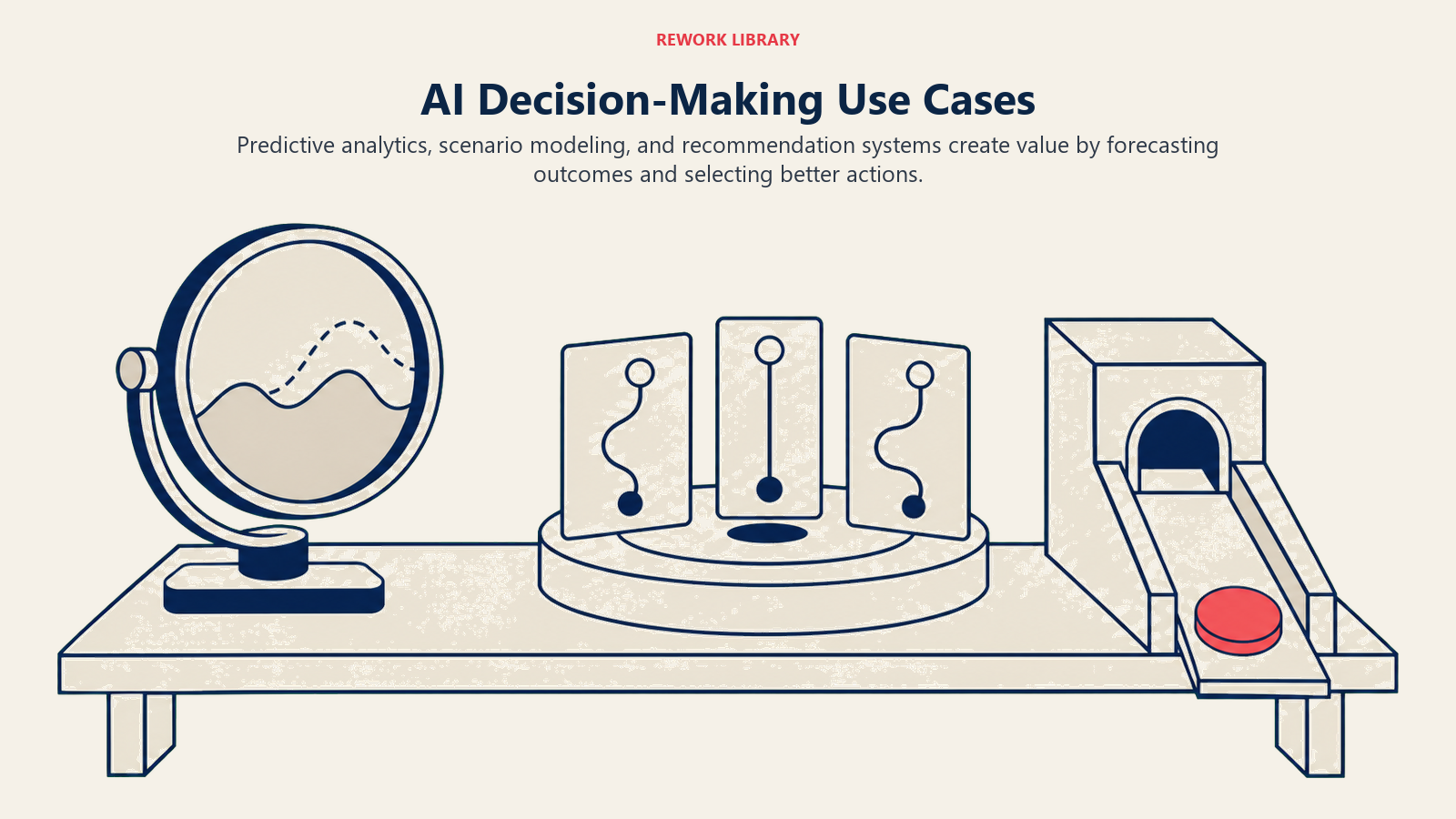
Three application families create most of the value: forecasting what will happen, modeling alternative futures, and recommending the best available action.
Predictive Analytics Applications
Demand Forecasting: AI models predict customer demand by analyzing historical patterns, seasonality, economic indicators, and real-time signals. Walmart's AI predicts store-level demand for 500,000 SKUs across 4,700 stores, reducing stockouts by 30% while cutting inventory carrying costs.
Churn Prediction: Machine learning identifies customers likely to leave before they show obvious signals. Telcos using AI churn prediction reduce customer losses by 15-25% through proactive retention interventions.
Equipment Failure Prediction: Predictive maintenance AI analyzes sensor data to forecast equipment failures before they occur. Airlines using predictive maintenance reduce unscheduled maintenance by 35% and improve fleet availability.
Scenario Modeling Applications
Strategic Planning: AI evaluates thousands of strategic alternatives against multiple future scenarios. Shell's AI scenario planning helped identify the shale revolution opportunity years before competitors positioned for it.
M&A Evaluation: Machine learning models assess acquisition targets across hundreds of variables. Private equity firms using AI target screening improve investment returns by 20-30% through better deal selection.
Supply Chain Resilience: Scenario modeling identifies supply chain vulnerabilities and optimal mitigation strategies. Companies using AI supply chain modeling recovered 60% faster from pandemic disruptions.
Recommendation System Applications
Pricing Optimization: AI recommends optimal prices based on demand elasticity, competitive positioning, and margin requirements. Airlines and hotels using dynamic pricing AI improve revenue per available unit by 8-15%.
Talent Decisions: AI recommends candidates based on success predictors beyond resume keywords. Organizations using AI-assisted hiring improve new hire performance by 25% and reduce turnover by 35%.
Investment Allocation: Portfolio optimization AI recommends asset allocations based on risk tolerance and market conditions. Robo-advisors using AI allocation outperform traditional balanced portfolios by 2-4% annually on risk-adjusted basis.
Human Oversight: The Human-in-the-Loop Framework
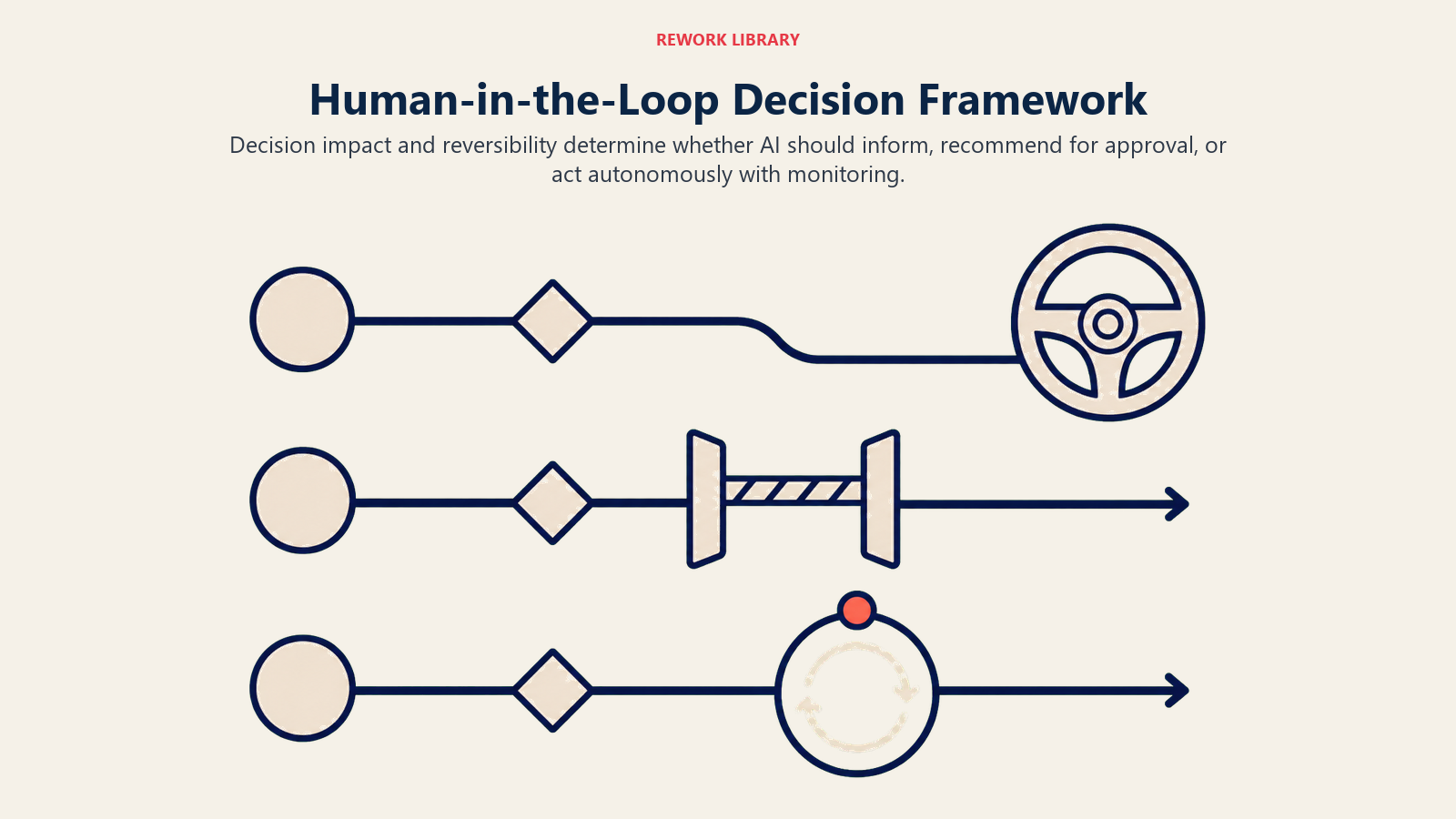
Even the most sophisticated AI systems still need human oversight. The question isn't whether humans should be involved, but how and when. Effective human-in-the-loop frameworks set clear boundaries for AI autonomy while keeping humans accountable for outcomes.
When AI Should Inform vs. Decide
AI Should Inform (Human Decides):
- Decisions with major ethical implications or stakeholder impact
- Strategic choices that shape organizational direction for years
- Situations where AI training data may not reflect current conditions
- Decisions affecting employee careers, compensation, or termination
- High-stakes customer relationships where trust requires human judgment
- Novel situations outside the AI model's training distribution
AI Should Recommend with Human Approval:
- Resource allocation decisions above defined thresholds
- Pricing changes that could significantly impact customer relationships
- Operational decisions with potential safety implications
- Customer communications that represent the organization's voice
- Decisions where regulatory requirements demand human accountability
AI Can Decide Autonomously (with monitoring):
- High-volume routine decisions within proven accuracy parameters
- Real-time operational adjustments requiring speed beyond human capability
- Personalization decisions where outcomes are easily measured and corrected
- Fraud detection responses where false positive costs are manageable
- Inventory replenishment within established supplier relationships
Oversight Governance Structures
Tiered Review Protocols: Establish decision tiers based on impact magnitude and reversibility. Routine decisions may require no human review, moderate decisions require spot-checking, and significant decisions require human approval before execution.
Exception Handling: Define clear criteria for when AI decisions should escalate to human review. Confidence thresholds, outcome magnitudes, and pattern anomalies should all trigger human involvement.
Audit Trails: Maintain comprehensive logs of AI decisions, the data inputs that informed them, and the outcomes that resulted. These records support both compliance requirements and model improvement.
Override Authority: Designate clear authority for humans to override AI decisions and document the rationale. Track override patterns to identify model weaknesses or changing conditions.
Building Organizational Trust in AI Recommendations
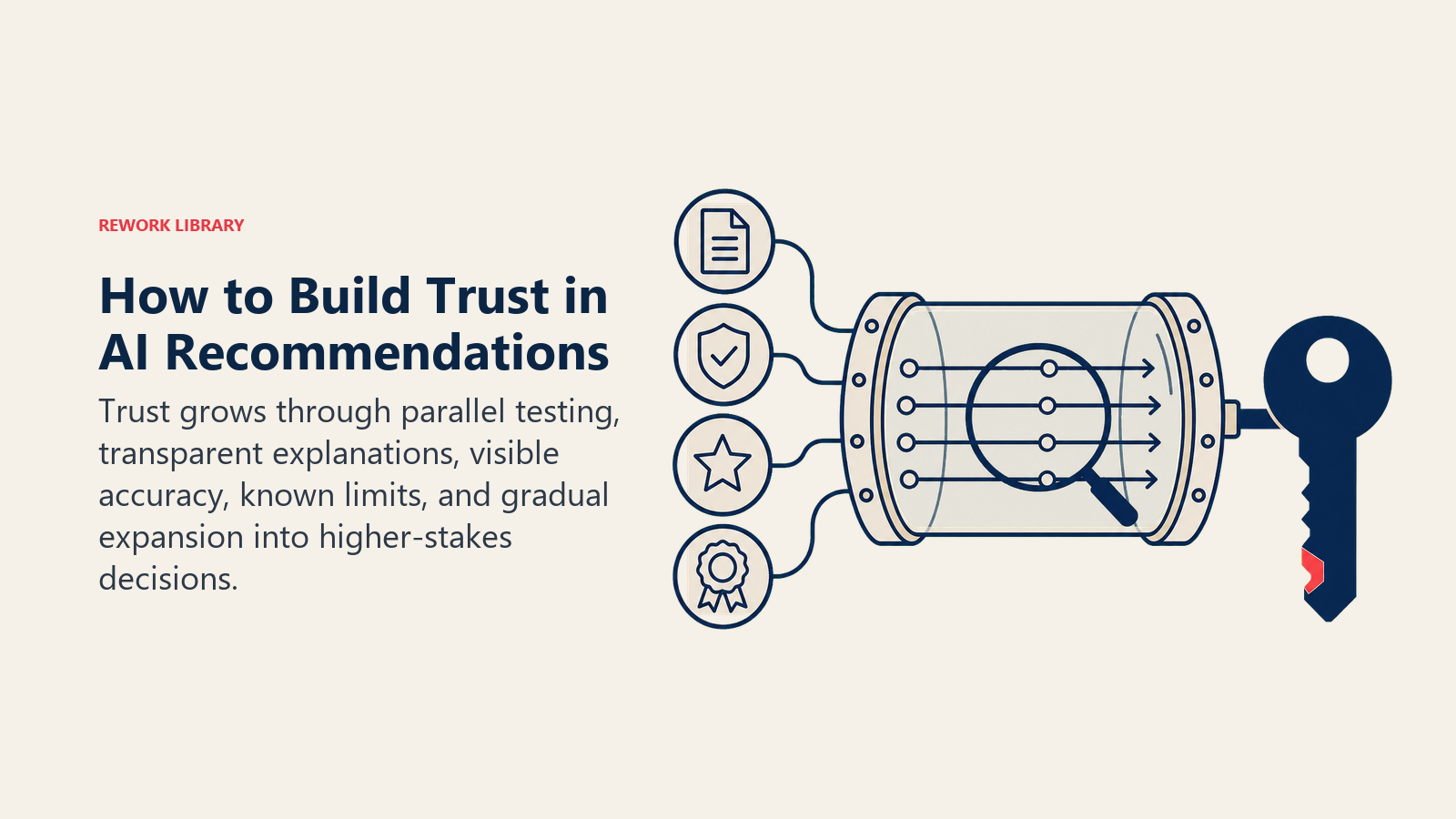
Trust in AI doesn't develop on its own. It takes deliberate effort through transparency, demonstrated accuracy, and setting the right expectations.
The Trust-Building Journey
Phase 1: Demonstrate Accuracy (Months 1-6) Run AI recommendations alongside existing decision processes. Track comparative accuracy to build evidence of AI value. Share results openly, including failures, to establish credibility.
Phase 2: Expand Scope Gradually (Months 6-12) As accuracy proves out, expand AI involvement to adjacent decision domains. Start with lower-stakes decisions where learning from mistakes is affordable.
Phase 3: Establish Track Record (Months 12-24) Document AI decision outcomes carefully. Build case studies showing specific value creation. Celebrate successes while honestly addressing limitations.
Phase 4: Institutionalize Confidence (Months 24+) Integrate AI recommendations into standard operating procedures. Train new employees on AI-assisted decision processes. Make AI tools intuitive enough for non-technical users.
Transparency Practices That Build Trust
Explainability: AI systems should explain their recommendations in terms business users can understand. "This customer will likely churn because their usage dropped 40% and they contacted support three times last month" builds more trust than "the model assigns 78% churn probability."
Confidence Intervals: Present predictions with appropriate uncertainty ranges. Decision makers trust AI more when they understand its confidence levels and can adjust their own certainty accordingly.
Known Limitations: Document and communicate what the AI doesn't do well. Acknowledging blind spots actually increases trust because it shows intellectual honesty.
Continuous Validation: Publish regular accuracy reports comparing predictions to outcomes. This shows commitment to improvement and alerts users to any degradation.
Avoiding Algorithmic Bias in Decisions
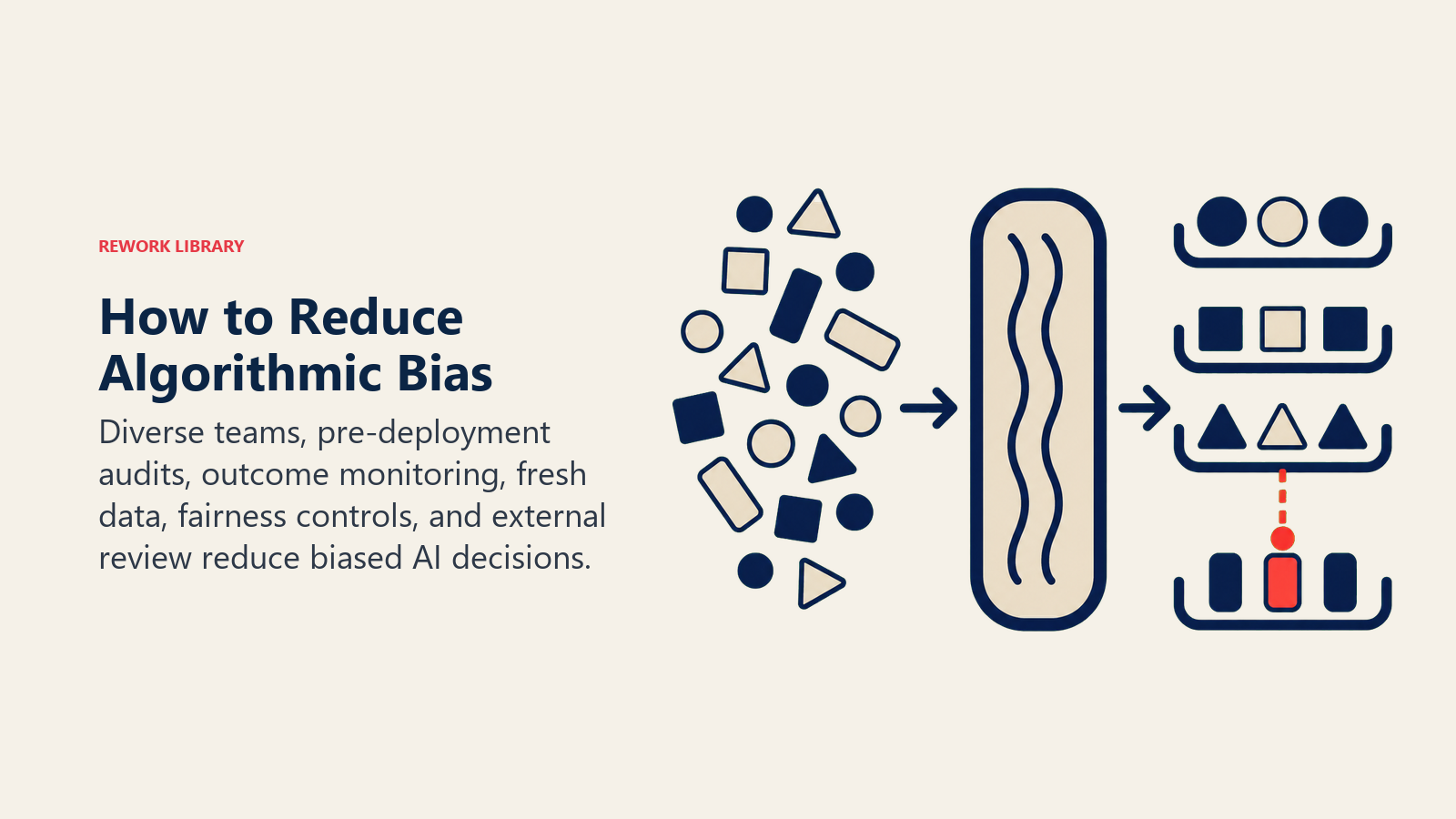
AI systems can carry forward or amplify biases present in training data. Organizations need to actively identify and address these biases, especially in decisions that affect people's opportunities and outcomes.
Sources of Algorithmic Bias
Historical Data Bias: If past decisions were biased, AI trained on that history will replicate those biases. Hiring algorithms trained on historically male-dominated workforce data may undervalue female candidates.
Sample Selection Bias: Training data may not represent the full population the AI will serve. Credit scoring models trained primarily on suburban homeowners may poorly serve urban renters.
Measurement Bias: Proxy variables may inadvertently encode protected characteristics. Zip codes can proxy for race, alma mater can proxy for socioeconomic background.
Algorithmic Amplification: Machine learning can amplify small biases into large disparate impacts through feedback loops. Recommendation algorithms may increasingly show certain content to certain demographics, reinforcing initial pattern differences.
Bias Mitigation Strategies
Diverse Development Teams: Teams with diverse backgrounds are more likely to recognize potential bias issues. Include perspectives from populations affected by AI decisions.
Pre-Deployment Auditing: Test AI systems across demographic groups before deployment. Compare outcomes across protected classes to identify disparate impact.
Ongoing Monitoring: Continuously track decision outcomes by demographic characteristics. Statistical process control can identify bias drift over time.
Regular Model Retraining: Update models with fresh data that reflects current populations and conditions. Historical bias can be diluted over time with deliberate data curation.
Algorithmic Fairness Techniques: Apply technical approaches like re-weighting training data, constraining model optimization for fairness metrics, or post-processing decisions to achieve demographic parity where appropriate.
External Audits: Engage third parties to evaluate AI systems for bias. External auditors bring perspectives internal teams may lack and provide credibility for stakeholders.
Your Roadmap: How to Advance Through Each Level
Current State Pain Points: Most organizations struggle with disconnected analytics that inform but don't change how decisions get made. Common challenges include data silos that prevent comprehensive analysis, lack of AI talent to build sophisticated models, organizational resistance to trusting machine recommendations, and unclear governance for AI-assisted decisions. These issues compound as AI becomes more central to competitive success.
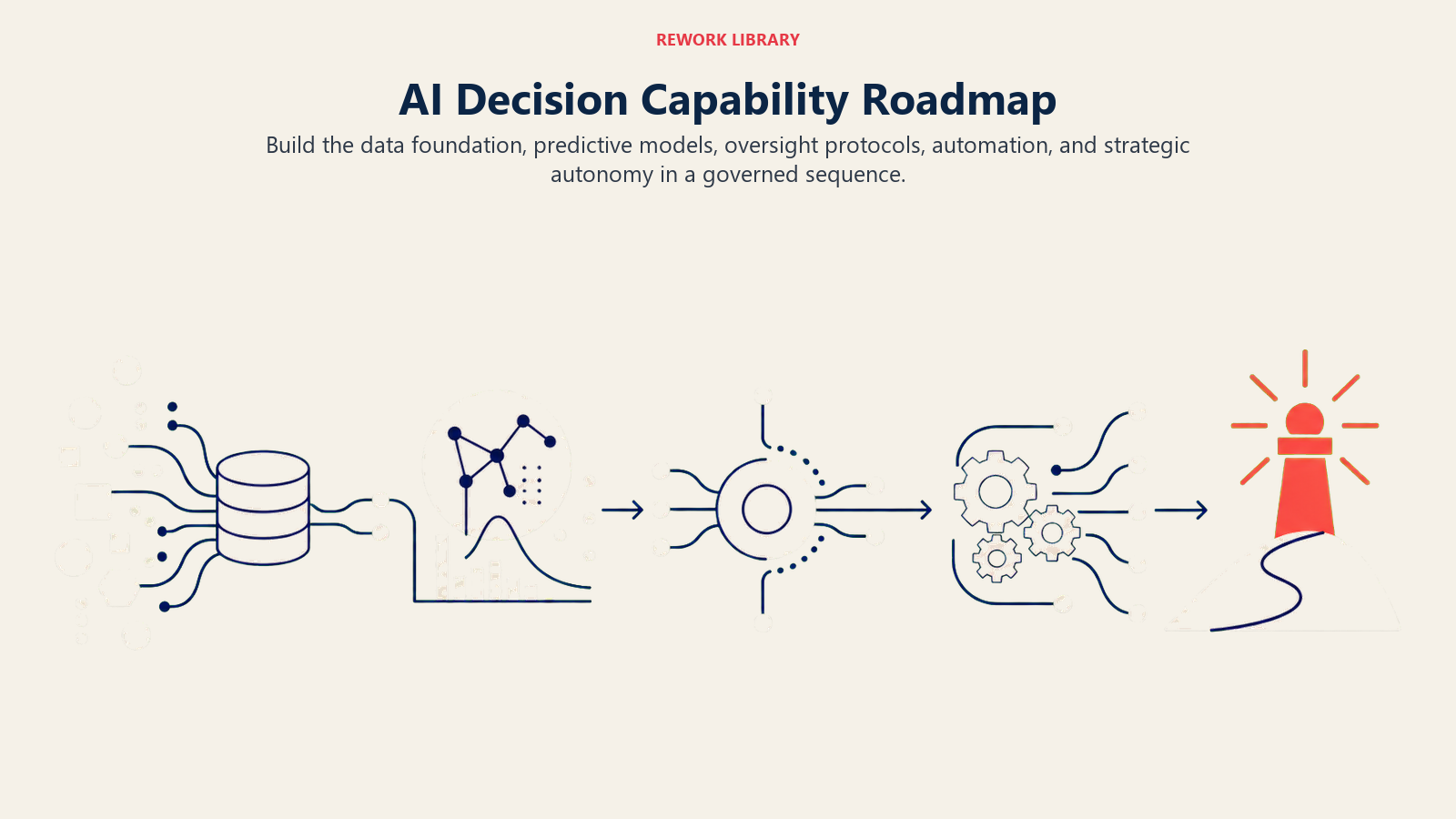
Target Outcomes: Advanced AI-powered decision making helps organizations process information at a scale that's impossible for humans alone, spot patterns and opportunities invisible to traditional analysis, and act on insights fast enough to capture fleeting market windows. The goal is building decision capabilities that create lasting competitive advantage.
Level 1 to Level 2: Building Diagnostic Capability (6-12 months)
Step 1: Data Foundation (4 months) - Integrate key data sources into unified analytical infrastructure. Set up data quality standards and governance. This foundation makes meaningful AI analysis possible. Invest $300K-600K in data infrastructure and integration.
Step 2: AI Pilot Projects (4 months) - Launch 2-3 AI pilot projects in areas with clean data and measurable outcomes. Focus on diagnostic applications like customer segmentation or operational anomaly detection. Budget $200K-400K for pilots including talent and tooling.
Step 3: Organizational Learning (4 months) - Train business analysts on AI-assisted analysis techniques. Build internal capability to interpret and act on AI insights. Develop case studies demonstrating pilot value. Allocate $150K-300K for training and change management.
Level 2 to Level 3: Developing Predictive Capability (12-18 months)
Step 1: Predictive Model Development (6 months) - Build predictive models for high-value decision domains. Establish accuracy benchmarks and validation protocols. Create feedback loops to improve model performance. Investment of $600K-1.2M for model development and infrastructure.
Step 2: Human-in-the-Loop Protocols (4 months) - Define governance for AI recommendations, including oversight requirements, escalation triggers, and accountability structures. Train decision makers on working with AI predictions. Budget $200K-400K for governance development and training.
Step 3: Organizational Integration (6-8 months) - Embed AI predictions into operational workflows and decision processes. Set up performance monitoring and continuous improvement practices. Investment of $400K-800K for integration and change management.
Level 3 to Level 4: Achieving Prescriptive Capability (18-24 months)
Step 1: Decision Automation (8 months) - Identify decision categories suitable for automation based on volume, reversibility, and accuracy requirements. Build automated decision systems with appropriate human oversight. Investment of $1M-2M for automation development.
Step 2: Scenario Modeling Capability (6 months) - Develop real-time scenario modeling for strategic decisions. Enable rapid evaluation of decision alternatives. Budget $800K-1.5M for advanced modeling infrastructure.
Step 3: Trust and Governance Maturation (6-10 months) - Build organizational confidence through demonstrated accuracy. Refine governance for expanded AI autonomy. Develop exception handling expertise. Investment of $600K-1M for this phase.
Level 4 to Level 5: Achieving Autonomous Intelligence (24-36 months)
Step 1: Autonomous Decision Domains (12 months) - Expand AI autonomy to entire decision domains where track record supports confidence. Implement advanced monitoring and continuous learning systems. Investment of $2M-4M for autonomous decision infrastructure.
Step 2: Strategic AI Integration (12 months) - Integrate AI into strategic planning processes. Develop AI capabilities for opportunity identification and risk sensing beyond human analysis. Budget $2M-4M for strategic AI development.
Step 3: Competitive Advantage Consolidation (12-18 months) - Build AI decision capabilities that create sustainable competitive moats. Develop proprietary data assets and model capabilities. Investment of $4M-8M for competitive advantage infrastructure.
Quick Assessment: What Level Are You?
Level 1 Indicators:
- Analytics mostly describe historical performance without predictive capability
- AI initiatives are confined to IT experiments without business integration
- Decision makers rarely reference AI insights in their processes
- Data exists in silos without integration for comprehensive analysis
- Leadership views AI as future possibility rather than current capability
Level 2 Indicators:
- AI tools help understand why outcomes occurred through pattern recognition
- Machine learning identifies correlations that inform human analysis
- Pilot projects demonstrate AI value in specific decision domains
- Data integration enables cross-functional analytical views
- Leadership receives AI insights as inputs to decision processes
Level 3 Indicators:
- AI models generate predictions that inform strategic and operational decisions
- Recommendation engines suggest specific actions with predicted outcomes
- Human-in-the-loop protocols govern AI recommendation usage
- Model performance is tracked and algorithms are refined based on outcomes
- Decision makers routinely incorporate AI predictions into planning
Level 4 Indicators:
- AI systems prescribe optimal actions within defined decision parameters
- Automated decision systems handle routine choices with minimal human intervention
- Real-time scenario modeling enables rapid evaluation of alternatives
- Organizational trust supports significant AI autonomy for appropriate decisions
- Human oversight focuses on strategic exceptions and governance
Level 5 Indicators:
- AI systems play a real role in identifying strategic opportunities
- Autonomous agents manage entire decision domains with governance oversight
- Decision quality exceeds human-only benchmarks across measured dimensions
- AI capabilities create competitive advantages that reshape industry dynamics
- Organization has mastered the balance between AI autonomy and human accountability
Industry Benchmarks and Best Practices
Technology Sector Benchmarks
- Average AI Decision Maturity: Level 3-4
- AI Decision Investment: 8-12% of revenue
- Automation Rate: 60-80% of operational decisions
- Leading Organizations: Google, Amazon, Microsoft (Level 4-5 capabilities)
Financial Services Benchmarks
- Average AI Decision Maturity: Level 3
- AI Decision Investment: 6-10% of revenue
- Automation Rate: 50-70% of routine decisions
- Leading Organizations: JPMorgan, Goldman Sachs, Ant Financial (Level 3-4 capabilities)
Retail and E-commerce Benchmarks
- Average AI Decision Maturity: Level 2-3
- AI Decision Investment: 4-7% of revenue
- Automation Rate: 40-60% of pricing and inventory decisions
- Leading Organizations: Amazon, Alibaba, Walmart (Level 3-4 capabilities)
Healthcare Benchmarks
- Average AI Decision Maturity: Level 2
- AI Decision Investment: 3-6% of revenue
- Automation Rate: 20-40% of administrative decisions
- Leading Organizations: Kaiser Permanente, Mayo Clinic (Level 2-3 capabilities)
Strategic Considerations for Leadership
How should the board evaluate our organization's readiness for AI-powered decision making?
Boards should assess readiness across four dimensions: data infrastructure maturity, AI talent and capabilities, organizational culture toward technology-assisted decisions, and governance readiness. Key questions include whether data assets are integrated and accessible, whether the organization can attract and retain AI talent, whether leadership trusts data-driven insights, and whether governance structures can adapt to AI involvement. A realistic readiness assessment prevents over-investment before foundations are solid and identifies specific gaps that need attention.
What decision domains should we prioritize for AI enhancement?
Prioritize based on three criteria: decision volume, data availability, and reversibility. High-volume decisions with abundant historical data and easily correctable outcomes are ideal starting points. Customer-facing personalization, operational optimization, and fraud detection often fit these criteria. Avoid starting with high-stakes irreversible decisions where AI errors could cause serious harm. Success in lower-stakes domains builds the track record and organizational confidence needed for higher-stakes applications.
How do we maintain accountability when AI influences or makes decisions?
Accountability requires clear documentation of AI's role in each decision type. For AI-informed decisions, humans remain accountable but should document how they weighted AI input. For AI-automated decisions, accountability shifts to those who approved the automation parameters and those who monitor outcomes. Set up audit trails that capture AI recommendations, human interventions, and resulting outcomes. Make sure governance structures evolve as AI involvement expands, with regular reviews of accountability assignments.
What are the biggest risks of AI-powered decision making, and how should we mitigate them?
Primary risks include algorithmic bias producing unfair outcomes, model degradation as conditions change, over-reliance on AI in situations that need human judgment, and opacity that prevents understanding when AI errs. Mitigate through diverse development teams, continuous accuracy monitoring, clear human override protocols, and explainability requirements. And don't forget: the risk of not adopting AI-powered decisions is just as important to consider as competitors gain decision advantages.
How should we think about the build vs. buy decision for AI decision capabilities?
Build when AI capabilities create competitive differentiation, when proprietary data creates unique training advantages, or when commercial solutions don't address your specific decision context. Buy when solutions exist for well-defined problems, when speed to capability matters more than customization, or when your scale doesn't justify development costs. Many organizations pursue hybrid approaches, buying foundational platforms while building custom models for differentiated applications.
How do we build trust in AI recommendations among skeptical decision makers?
Trust develops through demonstrated accuracy over time. Start with parallel running where AI recommendations are tracked against human decisions without changing behavior. Share comparative results openly, including both AI successes and failures. Involve skeptics in defining success criteria so they own the evaluation framework. Expand AI involvement gradually as the track record builds. Never force AI adoption. Let evidence create pull rather than push.
What skills does our workforce need to work effectively with AI decision systems?
Three capability categories matter: AI literacy for all decision makers so they understand what AI can and can't do; analytical skills to interpret AI outputs and recognize when to question recommendations; and judgment skills to handle the exceptions and edge cases that AI can't address. Technical AI expertise is needed in smaller quantities for model development and maintenance. Invest in training programs that build all three categories based on each role's AI interaction level.
How do we balance speed of AI decisions with appropriate human oversight?
Design tiered oversight based on decision impact and reversibility. Low-impact, easily reversed decisions can be fully automated with periodic auditing. Medium-impact decisions may need human approval above certain thresholds. High-impact decisions should use AI for recommendation generation while preserving human decision authority. The goal is applying the right level of oversight without eliminating the speed advantage that makes AI valuable. Review tier assignments regularly as AI accuracy improves.
How should we measure ROI on AI decision-making investments?
Measure both decision quality improvements and efficiency gains. Quality metrics include accuracy rates versus human-only baselines, speed from insight to action, and outcome improvements in revenue, cost, or risk. Efficiency metrics include decisions per analyst, cycle time reduction, and human effort shifted to higher-value activities. Set up baselines before AI deployment and track improvements over 12-24 month periods. Include qualitative benefits like competitive positioning that may not have immediate financial metrics.
What governance structures work best for overseeing AI decision systems?
Effective governance includes an AI ethics committee for policy decisions, technical review processes for model approval, ongoing monitoring functions for accuracy tracking, and clear escalation paths for concerns. Governance should balance enabling AI value creation with ensuring responsible use. Include diverse perspectives: legal, compliance, affected stakeholder representatives, and technical experts. Review governance structures annually as AI capabilities and organizational experience evolve.
Your First 30 Days: Getting Started
Week 1: Current State Assessment
Take stock of existing AI and analytics capabilities across the organization. Identify decision domains where data is available and outcomes are measurable. Interview key decision makers about their current processes and openness to AI assistance. Document pain points in decision speed, accuracy, or resource intensity.
Week 2: Opportunity Prioritization
Evaluate potential AI decision applications against prioritization criteria. Assess data readiness for top candidates. Estimate effort and investment required for initial pilots. Build preliminary business cases for leadership review.
Week 3: Leadership Alignment
Present findings and recommendations to executive team. Build consensus on pilot priorities and investment levels. Address concerns about AI risks and governance requirements. Secure commitment for initial pilot funding and sponsorship.
Week 4: Pilot Launch Planning
Define scope and success metrics for initial AI decision pilot. Identify team members and external resources required. Establish data access and infrastructure requirements. Create project plan with 90-day milestones and governance checkpoints.
Conclusion: The AI Decision Imperative
AI-powered decision making has gone from competitive advantage to competitive necessity. Organizations that integrate AI effectively into their decision processes move faster, see further, and act more precisely than those relying solely on human analysis. The gap between AI leaders and laggards will only widen as AI capabilities advance and top organizations build decision advantages that compound over time.
But AI-powered decision making isn't about replacing human judgment. It's about adding computational scale and pattern recognition that no human team could match. The most successful organizations will be those that master the collaboration between human wisdom and artificial intelligence.
The evidence is clear: organizations with mature AI decision capabilities achieve 35% faster decisions, 28% better outcomes, and 47% faster competitive response. They deploy capital more efficiently, serve customers more precisely, and identify opportunities before competitors recognize them.
The investment is significant. Leading organizations commit 8-15% of revenue to AI capabilities. But the returns are substantial for those who execute well. And the cost of inaction grows as competitors pull ahead.
The question for leadership teams isn't whether to build AI decision capabilities, but how quickly to move before the decision advantage gap becomes unbridgeable.
Learn More
Enhance your understanding of AI-powered decision making and related organizational capabilities:
- Strategic Thinking - Build the strategic frameworks that guide AI application priorities
- Data Analytics - Build the analytical foundation that enables AI decision capabilities
- Digital Fluency - Build the organizational technology comfort that supports AI adoption
- Innovation Management - Apply AI insights to accelerate innovation success
Related Organizational Competencies

Senior Customer Retention Strategist
On this page
- The Evolution from Data-Driven to AI-Powered Decisions
- The Business Impact of AI-Powered Decisions
- The 5 Levels of AI-Powered Decision Making Maturity
- Level 1: Descriptive - Historical Analytics Foundation (Bottom 25% of Organizations)
- Level 2: Diagnostic - AI-Assisted Analysis (25th-50th Percentile)
- Level 3: Predictive - AI-Generated Forecasts and Recommendations (50th-75th Percentile)
- Level 4: Prescriptive - AI-Driven Decision Automation (75th-95th Percentile)
- Level 5: Autonomous - AI-Orchestrated Strategic Intelligence (Top 5% of Organizations)
- Use Cases: Where AI-Powered Decisions Create Value
- Predictive Analytics Applications
- Scenario Modeling Applications
- Recommendation System Applications
- Human Oversight: The Human-in-the-Loop Framework
- When AI Should Inform vs. Decide
- Oversight Governance Structures
- Building Organizational Trust in AI Recommendations
- The Trust-Building Journey
- Transparency Practices That Build Trust
- Avoiding Algorithmic Bias in Decisions
- Sources of Algorithmic Bias
- Bias Mitigation Strategies
- Your Roadmap: How to Advance Through Each Level
- Level 1 to Level 2: Building Diagnostic Capability (6-12 months)
- Level 2 to Level 3: Developing Predictive Capability (12-18 months)
- Level 3 to Level 4: Achieving Prescriptive Capability (18-24 months)
- Level 4 to Level 5: Achieving Autonomous Intelligence (24-36 months)
- Quick Assessment: What Level Are You?
- Industry Benchmarks and Best Practices
- Technology Sector Benchmarks
- Financial Services Benchmarks
- Retail and E-commerce Benchmarks
- Healthcare Benchmarks
- Your First 30 Days: Getting Started
- Week 1: Current State Assessment
- Week 2: Opportunity Prioritization
- Week 3: Leadership Alignment
- Week 4: Pilot Launch Planning
- Conclusion: The AI Decision Imperative
- Learn More
- Related Organizational Competencies