Productivity Timeline: From the Water Clock to the Pin Factory to AI
Turn this article into takeaways for your work.


Each assistant summarizes the article only for you and suggests best practices for your work.
Picture a stone tomb-workers' village on the west bank of Thebes, in the twenty-ninth year of Ramesses III. The grain that pays the crew is late. The men put down their tools and walk to the temples. A scribe writes down what happens.
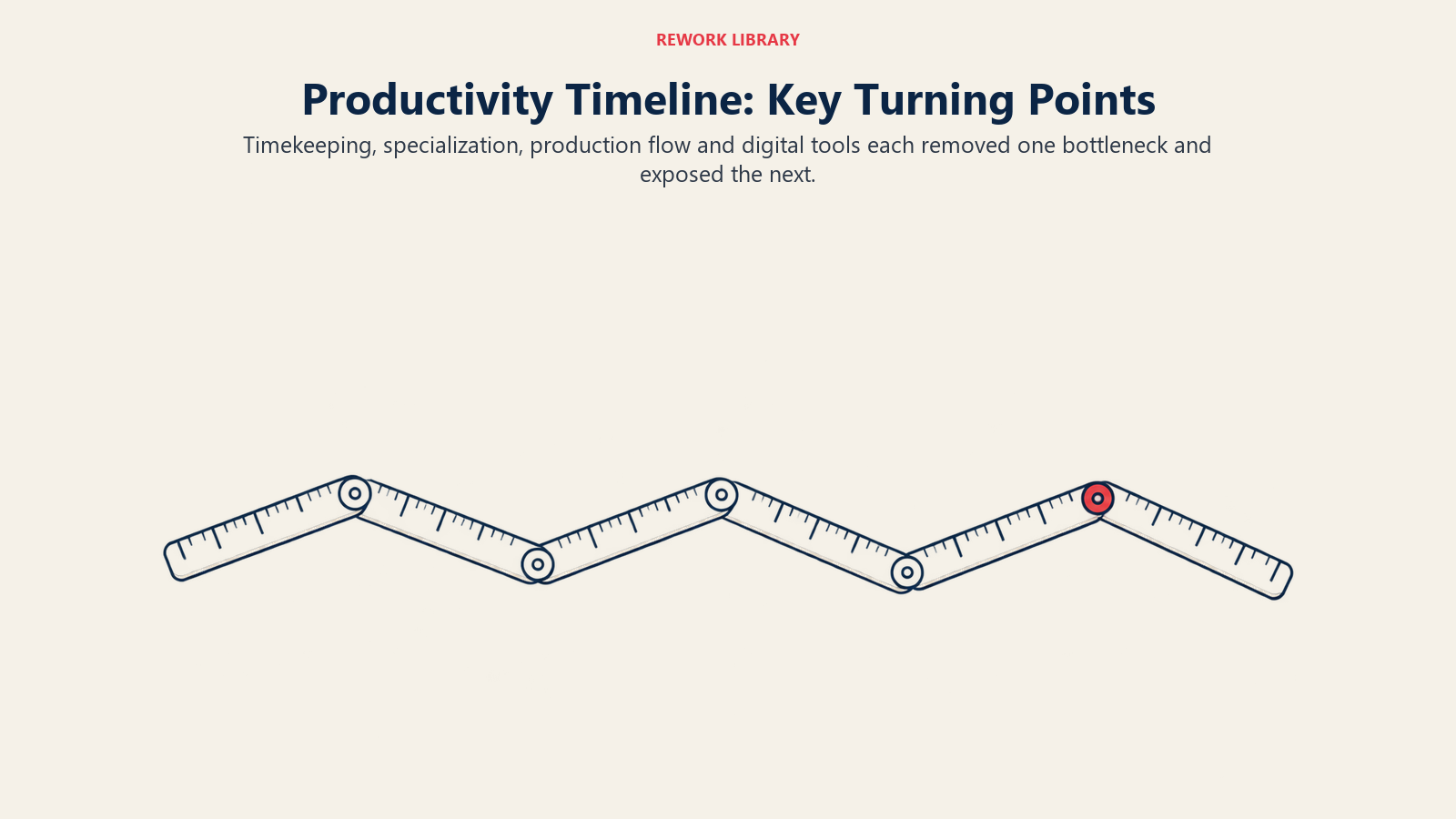
Nobody in that village used the word productivity, which Peter Drucker wrote in 1999 was "barely fifty years old." The first tools for raising output were ways of telling time: a stone water clock made in the reign of an Egyptian pharaoh, and a sixth-century monastery rule that set the day by hours. Adam Smith's pin factory arrived in 1776. Frederick Taylor and Henry Ford rebuilt factory work between 1911 and 1913, and Toyota, personal computers and AI came after. The throughline: each milestone removed one bottleneck in how work gets done and exposed the next.
This page walks the full chronology, then each era in order. For the interpretive overview, start with the history of productivity.
Timeline at a Glance
| Year | Milestone | Why It Mattered |
|---|---|---|
| New Kingdom, reign of Amenhotep III | The Karnak outflow water clock is made | The earliest surviving Egyptian outflow water clock carries hour marks for each month of the year. |
| Year 29 of Ramesses III (reign 1187-1157 BCE) | Tomb workers at Deir el-Medina stop work over unpaid grain rations | A written record of workers withholding labor over pay shows output depended on supply and trust. |
| About 530 CE | The Rule of St Benedict is composed in Italy | A written daily timetable splits the day into hours of prayer, labor and reading. |
| 1776 | Adam Smith publishes The Wealth of Nations | The pin factory makes division of labor the first big explanation for rising output. |
| 1819 | John H. Hall signs a War Department contract for 1,000 rifles | Interchangeable parts become an explicit goal of production at Harpers Ferry. |
| 1911 | Frederick Taylor publishes The Principles of Scientific Management | Work becomes something managers study task by task. |
| October 1913 | Ford operates a moving assembly line at Highland Park | Work comes to the worker, and the Model T's price falls. |
| 1924-1933 | The Hawthorne studies at Western Electric | Researchers ask how workers' needs and motivation relate to output. |
| 1940s | Wartime shipyards build Liberty ships on production lines | Mass production is applied to ships, and build times collapse. |
| 1950 | W. Edwards Deming speaks to Japanese industrial leaders at Mt. Hakone | Quality is argued as a management responsibility, not an inspection task. |
| 1963 | Toyota adopts its kanban system at all plants | Pull-based flow becomes a production system. |
| 11 May 1979 | VisiCalc is demonstrated publicly on the Apple II | The personal computer becomes a business tool. |
| 1987 | Robert Solow quips about the computer age and productivity statistics | The "productivity paradox" puts IT spending under scrutiny. |
| 1989 | Stephen Covey publishes The 7 Habits of Highly Effective People | Personal effectiveness becomes a mainstream management topic. |
| 1999 | Jack Triplett reviews seven explanations of the paradox | Mismeasurement and slow diffusion are set out as rival answers. |
| 1999 | Peter Drucker calls knowledge-worker productivity the biggest challenge | Management's next job is raising output where the task is unclear. |
| 2001 | David Allen publishes Getting Things Done | Capturing open loops becomes the dominant personal system. |
| March 2013 | The Ctrip home-working experiment appears as an NBER working paper | First randomized evidence on remote work and output. |
| April 2021 onward | Work from home settles at about a quarter of paid workdays | The pandemic shock hardens into a permanent working pattern. |
| April 2023 | "Generative AI at Work" reports gains for 5,179 support agents | First large field evidence of AI's effect on worker output. |
The Clock and the Ration (Antiquity-1775)
Societies learn to count the hours and feed the crew
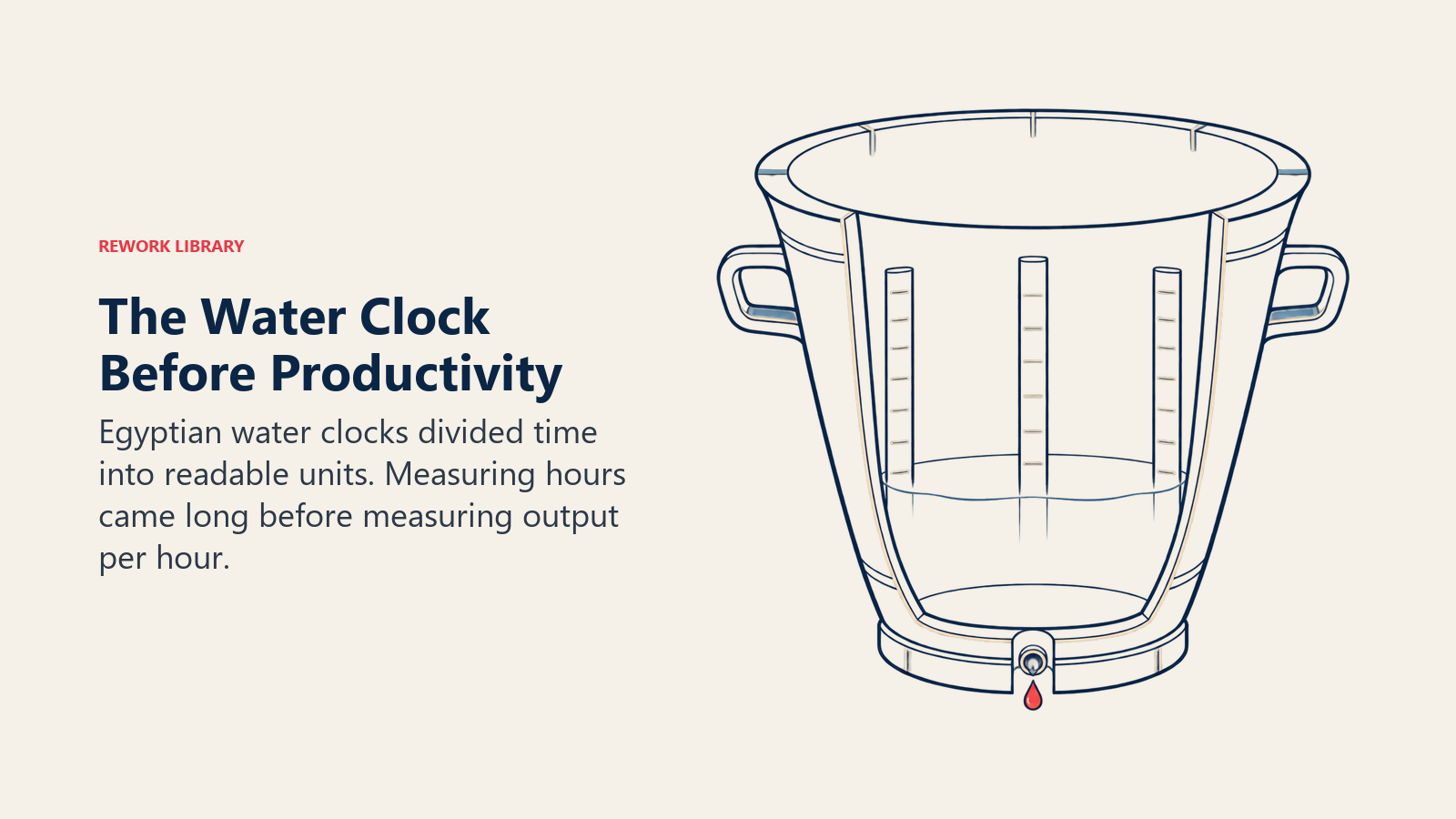
Start with a calcite vessel from a burial cachette in the court of the seventh pylon at Karnak, and the McMaster archaeoastronomy database classifies it as an outflow water clock from the reign of Amenhotep III, the earliest surviving example of its kind. Its inside wall carries twelve columns of small round holes, each column matched to a month name on the rim. The hours were now something an object could show.
The second record is about pay. The Museo Egizio describes the Turin Strike Papyrus as a report from the 29th year of Ramesses III, written by the tomb scribe Amunnakht. Political and economic difficulties had suspended grain rations to the workmen of Deir el-Medina. In November the workmen stopped work and spent days in the Theban necropolis and then at the temples of Thutmose III and Ramesses II, demanding the unpaid grain. The authorities paid it, but several days later the men struck again and took refuge in the temple of Seti I, refusing to go back to the village. It is the oldest account on this page of a hard truth: a crew produces only while the supply line behind it works.
Then comes the monastery. The Rule of St Benedict, which Fordham's sourcebook dates to Italy about 530 and based on earlier compilations, set the day by hours: services at matins, the first, third, sixth and ninth hours, vespers and completorium. Chapter 48 opens with "Idleness is the enemy of the soul", then lays out which hours go to manual work and which to reading, with different timetables from Easter to October, from October to Lent, and in Lent. It also says to do everything "with measure on account of the weak." That is a written work schedule, with a built-in allowance for the person who can't keep it.
Put the three side by side. A vessel marked the hours of the night, a scribe wrote down a work stoppage, and an abbot set out a daily timetable. These are precursors, not productivity as we use the word. Nobody was asking how much more one worker could produce in an hour. The questions of the age were when work starts, who pays for it and how much rest it needs, and they have not gone away. The new problem was that time could now be measured, but nobody knew yet how to use the measurement to change the work.
For teams today: the oldest lesson is also the plainest. A crew that has a written schedule and reliable inputs outperforms one that has neither. If work stops on your team, check the supply line before the people.
Smith's Pin Factory (1776-1910)
Splitting the job beats working harder
Fast forward to a pin works in the example Adam Smith chose to open The Wealth of Nations in 1776. The work is, in Smith's words, "divided into about eighteen distinct operations". A lone untrained worker, he wrote, "certainly could not make twenty" pins in a day, while ten people dividing the operations could make "upwards of forty-eight thousand pins in a day". Same people, same wire. The gain came from how the work was arranged.
The next step was to make the parts alike, so any part would fit any gun. In 1811 John H. Hall designed and patented a breechloading rifle, and in 1819 he signed a contract with the War Department to produce 1,000 of them. He moved to Harpers Ferry and occupied an old Armory sawmill on the Shenandoah River, where he spent several years building workshops and precision machinery. The National Park Service calls making rifles with interchangeable parts a "boldly ambitious goal." On December 20, 1822, Hall wrote to Secretary of War John Calhoun that he had "succeeded in establishing methods for fabricating arms exactly alike" using common workmen. The rifle is a footnote now. The idea behind it, that precise tools and gauges can let ordinary workers produce identical parts, runs through every assembly line that followed.
Both ideas solved the same problem, which was how to get more from the same workforce without asking for more hours. And both created the next one. Specialized workers are fast but dependent on everyone upstream and downstream, so a stalled handoff now stops everybody. The stopwatch and the conveyor were attempts to solve that.
For teams today: before buying a tool or asking for more effort, look at the shape of the work and where it changes hands. If the same deal or release crosses three departments, the handoffs are probably where the hours are going.
The Stopwatch and the Line (1911-1945)
Measured work, moving work, and the human objection
By 1911 the factory floor was the laboratory. Frederick Winslow Taylor's book The Principles of Scientific Management, published that year, told the story of a pig-iron gang at Bethlehem Steel. About 75 men were loading roughly 12.5 tons per man per day. Taylor concluded that a first-class handler could move 47 to 48 tons, picked about one man in eight as physically suited to it, and directed him with a stopwatch through set periods of lifting and rest. The man Taylor calls "Schmidt" reached about 47.5 tons a day, and his pay rose from about $1.15 to just over $1.85. Taylor stated the goal as "the maximum prosperity for the employer" coupled with the same for each employee. Peter Drucker, writing in 1999, called Taylor the first person to work as a manual worker and then study manual work, and said manual-worker productivity has gone up at about 3% a year compounded, fifty-fold since Taylor. The full story, including the critics, is in scientific management.
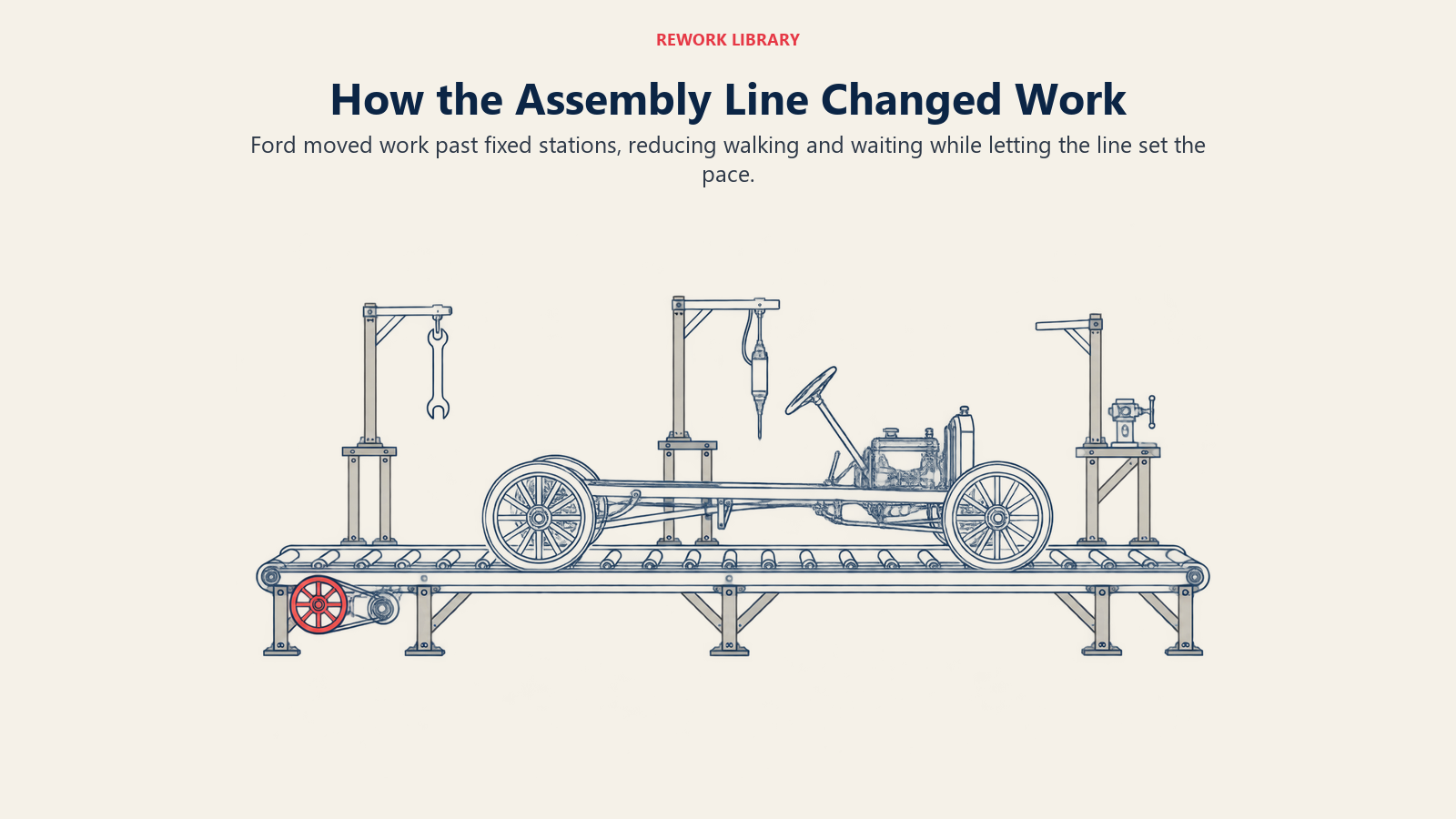
Two years later the work itself began to move. Ford's moving assembly line for automobiles was first operated at Highland Park in October 1913. Model T production went from hundreds a day to thousands, and Ford paired it with a $5 day in 1914. The Model T's price fell from $850 to $260. Highland Park's employment peaked at almost 70,000 in 1925. The line solved the walking, waiting and carrying that had hidden inside "work." It also set the pace by the machine instead of the person; the Henry Ford leadership profile covers both the achievement and its costs.
An objection came from inside the research itself. From 1924 to 1933 Harvard Business School's Elton Mayo and Fritz Roethlisberger led a nine-year study at Western Electric's Hawthorne Works outside Chicago. Baker Library holds an "exhaustive archival record" of it, from hourly performance charts to interviews with thousands of employees. The studies raised questions about how productivity relates to workers' needs and motivations, and the page presents them as a shift in management study from a scientific to a multi-disciplinary approach. The Hawthorne years overlap the line's peak, and the two ran side by side: one treated the worker as a motion to optimize, the other as a person to understand.
Then the war made the line national. A page from the museum ship SS John W. Brown reports that Kaiser's No. 2 Yard in Richmond, California, took the Liberty ship Robert E. Peary from keel laying to launch in 4 days 15 hours and 30 minutes, and that at Bethlehem-Fairfield build times fell to as little as 28 days once production lines got under way. The same page puts an average Liberty at 592,000 man-hours. The record is the headline, but the lesson sits in the second figure: organized as production lines, the same ship could be built far faster than the early yards managed.
For teams today: measure the work, not the worker's visible activity. Counting helps when the task is repeatable and breaks down when it's applied to judgment. And pair every process change with an explanation, since a well-designed system still fails if people don't see why it matters.
Quality and Lean (1950-1979)
Toyota pulls work through the plant instead of pushing it
In 1950, at the Mt. Hakone Conference Center, W. Edwards Deming spoke to a room of Japanese industrial leaders. The Deming Institute's account says the talk was sponsored by JUSE, the Union of Japanese Scientists and Engineers, and covered statistical product quality administration, now called statistical process control. It argued that leadership must act on quality improvement, because speaking about quality without doing it produces nothing. The talk put quality on the desk of top management. Our Deming leadership profile covers the rest of his thinking.
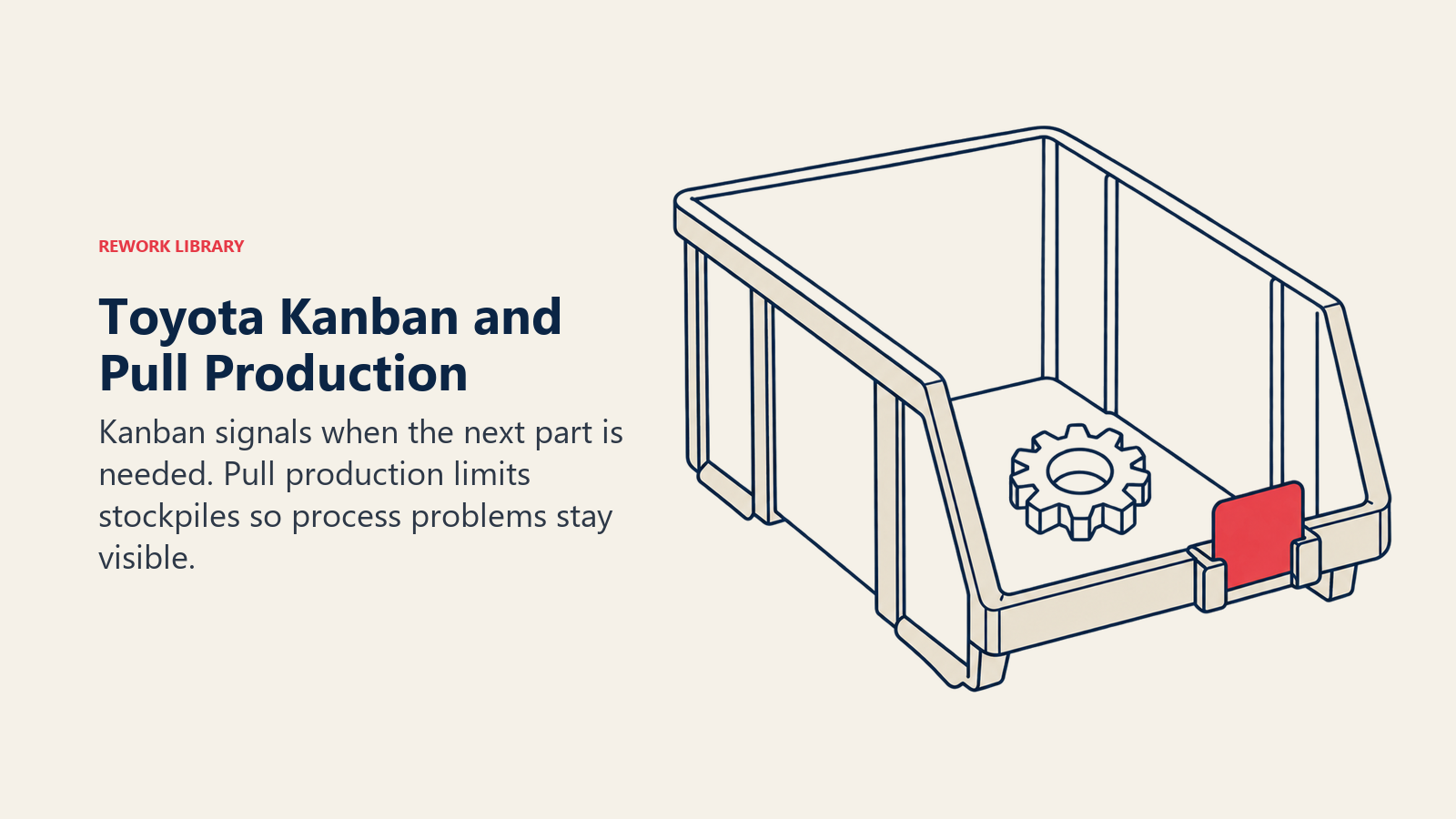
Toyota built a production system on the same idea of removing waste from the process. Toyota's own history says the Toyota Production System rests on Just-in-Time and jidoka, which it translates loosely as "automation with a human touch." Kanban were introduced into the existing supermarket style of production to reinforce Just-in-Time, were first tested in the Honsha Plant Machining Division, and the new kanban management system was adopted at all plants in 1963. By 1965 kanban were also used to retrieve parts from suppliers, and in 1966 andon were installed at the Kamigo Plant. Production items and volumes were equalized so no process was overburdened. The result was a way to keep work flowing without a stockpile hiding the problems. For how the ideas travel, read lean methodology.
The new problem was that all of this still assumed work you can see and count: parts, cars, defects. The next era's constraint was work you can't.
For teams today: use lean ideas where work is repeatable. A card that signals "make the next one" works for tickets and approvals as well as for engine parts, as long as someone is willing to act on what the queue reveals.
The Paradox Years (1979-2019)
Computers arrive, and the numbers wait
On May 11, 1979, Daniel Bricklin and Robert Frankston gave the first public demonstration of VisiCalc on the Apple II. The Computer History Museum says more than 100,000 copies sold in its first year. The personal computer had become a business machine. The wider chain of machines is in the computer timeline.
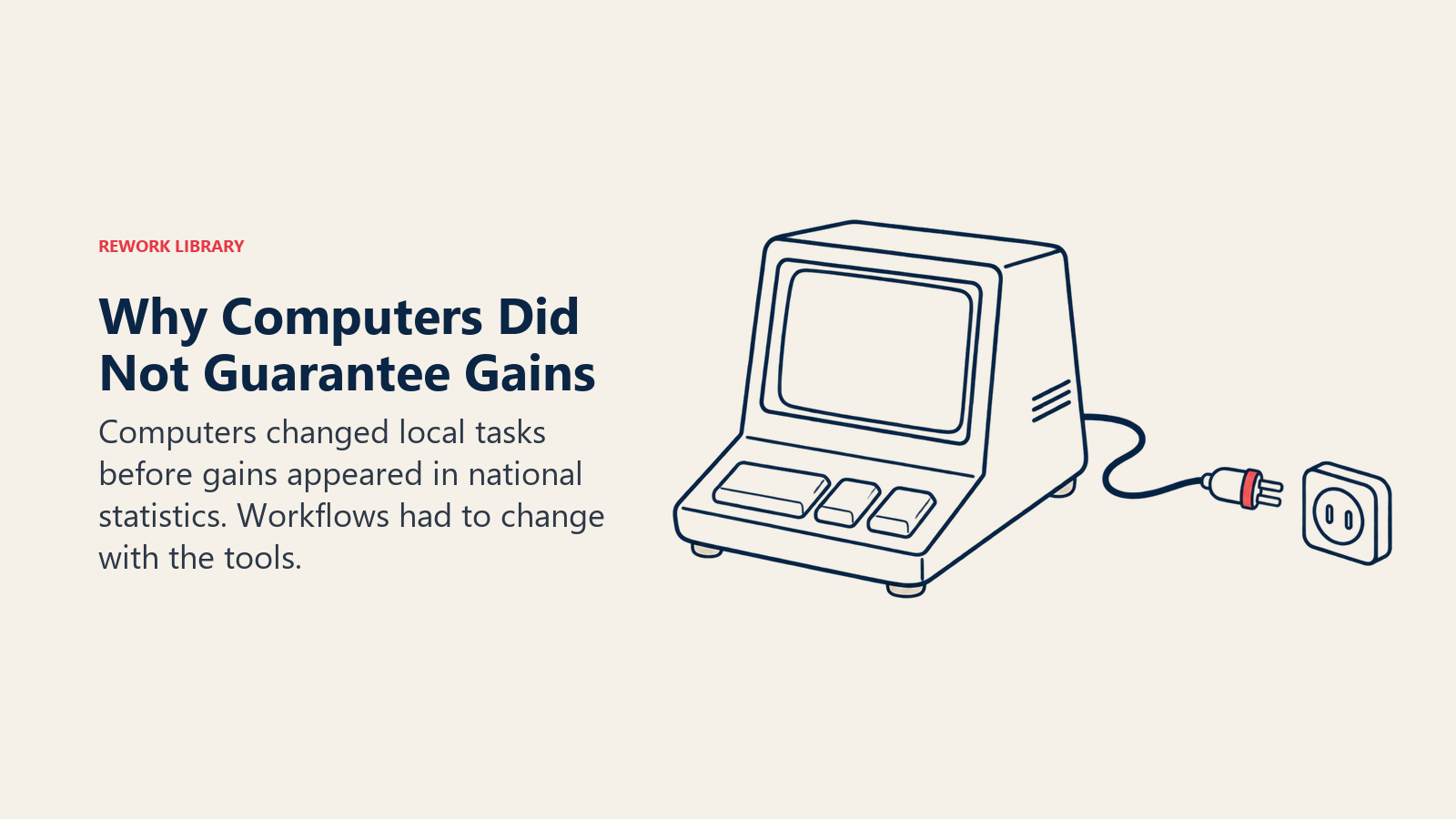
But the national numbers barely moved. In 1987 the economist Robert Solow remarked that you could "see the computer age everywhere but in the productivity statistics". In a 1999 Brookings piece, Jack Triplett reviewed seven explanations: computers are too small a share of the economy, price indexes for computers fall too fast, output in heavy IT-using sectors such as finance is poorly measured, some benefits go uncounted, the effects haven't shown up yet but will as with electricity, computers may be less productive than assumed, or there is no paradox. Triplett's point about electricity is the one managers remember: a new technology's gains can take a long time to appear in the statistics.
Management thinking meanwhile turned toward the individual. Stephen Covey's The 7 Habits of Highly Effective People appeared in 1989 and made personal effectiveness a boardroom topic, and the distinction between urgent and important work lives on in tools such as the Eisenhower matrix. In 2001 David Allen published Getting Things Done, built around capturing every open commitment outside your head, which is covered in getting things done. Drucker's 1999 paper named the new target: knowledge-worker productivity, which he called the biggest challenge. He wrote that the term "productivity" itself was "barely fifty years old," and that for knowledge work the first question is "What is the task?"
The 2010s added the cloud, shared documents and chat, and with them the first rigorous evidence on where work gets done. In March 2013 Nicholas Bloom, James Liang, John Roberts and Zhichun Jenny Ying released an NBER paper on Ctrip, a 16,000-employee, NASDAQ-listed Chinese travel agency. Volunteer call center employees were randomly assigned to work from home or in the office for nine months. Home working led to a 13% performance increase and less turnover, though the home workers' promotion rate conditional on performance fell. The paper later appeared in the Quarterly Journal of Economics in 2015.
For teams today: judge a tool by whether the workflow changed, not by whether the licenses were bought. And hand people a personal system only after you've fixed the shared causes, such as unclear priorities and constant interruptions. A framework can't fix a broken week.
The Remote and AI Turn (2020s-present)
Location stops mattering and drafting gets cheap
In 2020 millions of offices emptied within weeks, and the Ctrip experiment became everyone's reality. The pattern stuck. In an NBER paper titled "Why Working from Home Will Stick," José María Barrero, Nicholas Bloom and Steven Davis report that work from home has stabilized at about 25% of all paid workdays as of 2025, 3.5 times its 2019 level. In their 2023 paper the same authors found that full days at home accounted for 28 percent of paid workdays among Americans aged 20 to 64. The constraint that became visible was coordination: written decisions, clear owners, and meetings with a purpose. Our guide on remote work productivity covers the working habits.
Generative AI is the first productivity technology that works directly on drafting, summarizing and answering. In April 2023, Erik Brynjolfsson, Danielle Li and Lindsey Raymond issued the NBER paper "Generative AI at Work", covering 5,179 customer support agents. The paper reports that access to the tool increased issues resolved per hour by 14% on average, 34% for novice and low-skilled workers, with minimal impact for experienced and highly skilled ones. It was later published in The Quarterly Journal of Economics in 2025.
Look at that result next to Triplett's. A technology can show large effects in one workflow and still be hard to see in the aggregate, because the aggregate depends on how many workflows were redesigned around it. The AI productivity paradox picks up that argument.
For teams today: pick one workflow, measure it before and after, and redesign the handoffs around the tool. Put the time saved to a named use, or it will quietly disappear into the next round of work.
Key People
| Name | Role | Contribution | Year |
|---|---|---|---|
| Amenhotep III | Egyptian pharaoh | His reign produced the Karnak outflow water clock | New Kingdom |
| Amunnakht | Tomb scribe, Deir el-Medina | Wrote the Turin Strike Papyrus report | Year 29 of Ramesses III |
| Benedict of Nursia | Monastic rule-giver | Wrote a daily timetable of prayer, labor and reading | About 530 CE |
| Adam Smith | Economist | Used the pin factory to explain division of labor | 1776 |
| John H. Hall | Gunmaker | Pursued interchangeable rifle parts at Harpers Ferry | 1819-1822 |
| Frederick Taylor | Engineer | Studied manual work task by task | 1911 |
| Henry Ford | Manufacturer | Ran the moving assembly line at Highland Park | 1913 |
| Elton Mayo and Fritz Roethlisberger | Harvard Business School researchers | Led the Hawthorne studies | 1924-1933 |
| W. Edwards Deming | Statistician and consultant | Argued for quality as a management duty in Japan | 1950 |
| Daniel Bricklin and Robert Frankston | Software creators | Demonstrated VisiCalc | 1979 |
| Robert Solow | Economist | Quipped about computers and productivity statistics | 1987 |
| Jack Triplett | Economist | Reviewed seven explanations of the paradox | 1999 |
| Peter Drucker | Management writer | Named knowledge-worker productivity the biggest challenge | 1999 |
| Nicholas Bloom, James Liang, John Roberts, Zhichun Jenny Ying | Researchers | Ran the Ctrip home-working experiment | 2013 |
| Erik Brynjolfsson, Danielle Li, Lindsey Raymond | Researchers | Studied an AI assistant among support agents | 2023 |
Key Facts
- Adam Smith's pin-factory example claimed ten workers dividing the operations could make upwards of forty-eight thousand pins in a day, against a lone worker's twenty at most.
- Taylor's pig-iron gang at Bethlehem Steel loaded roughly 12.5 tons per man per day, against the 47 to 48 tons he concluded a first-class handler could manage.
- The Model T's price fell from $850 to $260 after the moving assembly line began at Highland Park.
- The Liberty ship Robert E. Peary went from keel to launch in 4 days 15 hours and 30 minutes at Kaiser's No. 2 Yard.
- In 1999 Drucker put manual-worker productivity gains at 3% a year compounded, fifty-fold since Taylor.
- An AI assistant raised issues resolved per hour 14% on average and 34% for novices among 5,179 support agents.
The Pattern Behind the History
Our synthesis, not published research: the milestones above repeat a loop we call Count, Redesign, Rebound.
- Count what can be counted. Hours, rations, pins, tons, minutes, tickets. The first measurement is whatever is easiest to read off.
- Redesign the work, not the worker. Smith's operations, Hall's machinery, Ford's line and Toyota's cards all changed the arrangement, and each beat asking for more hours.
- Expect the rebound. Deir el-Medina and Hawthorne are 3,000 years apart, but both records show output tied to how people are supplied and managed.
- Tools pay late. Spreadsheets and AI assistants show gains in one workflow long before the aggregate moves, as Triplett's electricity analogy suggests.
- The frontier moves to what can't be counted. Pins became cars, cars became decisions, and Drucker's question about the task is now the hardest one.
What It Teaches Teams Today
- Check the supply line first. When a team stalls, look at late inputs, unclear owners and waiting before blaming effort.
- Redesign handoffs, then buy tools. Smith's gain came from arrangement, and so did Ford's and Toyota's.
- Measure repeatable work and ask different questions of the rest. A stopwatch fits a pig-iron gang. For judgment work, ask Drucker's question: what is the task?
- Expect lag. Triplett's seven explanations are a checklist for why a new tool's results haven't appeared yet.
- Protect the human side. Hawthorne's lasting lesson is that a perfect process still fails if people don't trust it.
For the full story of how the shift from factories to knowledge work changed what a day looks like, read the evolution of productivity. For where the word itself came from, read the origin of productivity, and for how output gets counted, the history of productivity measurement.

Co-Founder, Rework.com
On this page
- Timeline at a Glance
- The Clock and the Ration (Antiquity-1775)
- Smith's Pin Factory (1776-1910)
- The Stopwatch and the Line (1911-1945)
- Quality and Lean (1950-1979)
- The Paradox Years (1979-2019)
- The Remote and AI Turn (2020s-present)
- Key People
- Key Facts
- The Pattern Behind the History
- What It Teaches Teams Today