The History of the 8-Hour Workday and 40-Hour Week
Turn this article into takeaways for your work.


Each assistant summarizes the article only for you and suggests best practices for your work.
In January 1914, Ford made an announcement about its Highland Park plant. Workers there would get a flat daily wage for an eight-hour day. They had been quitting so fast that the plant could barely keep a crew.
The 8-hour day was demanded long before it was law. In the United States, the first national call for it came from the National Labor Union in Baltimore in 1866. The first federal rule covered only government workers in 1868. The 40-hour week became the legal threshold for overtime through the Fair Labor Standards Act of 1938, phased in by 1940. The throughline is simple: a number that began as a slogan became a union demand, then a strike threat, then an employer experiment, and finally a price tag on overtime.
Ford's offer was five dollars for an eight-hour day, against an old rate of $2.34 for nine hours. By late 1913, labor turnover at Ford had reached 380 percent. That offer is one of the best-known moments in the story, but it sits in the middle of a very long one, and most of what came before it was about who controlled time, not how many hours a person should work.
Timeline at a Glance
| Year | Milestone | Why It Mattered |
|---|---|---|
| c. 1156 BCE | Tomb workers at Deir el-Medina stop work over late pay, the first recorded labor strike | Shows that fixed work crews and fixed pay already produced disputes |
| 6th century | The Rule of St Benedict sets seasonal hours for labor, reading and rest | An early written timetable that divides the day into work and non-work |
| 1593 | A Spanish university abstract cites an edict of Philip II setting eight-hour days | A possible early legal limit, though its scope is not established here |
| 1816 | Robert Owen opens his Institution for the Formation of Character at New Lanark | Links a mill owner to the slogan "eight hours labour, eight hours recreation, eight hours rest" |
| Aug 20, 1866 | The National Labor Union calls for an 8-hour day | First national call in the United States |
| Jun 25, 1868 | Congress makes eight hours a day's work for federal laborers and mechanics | First federal hours rule, limited to government workers |
| May 1-4, 1886 | About 35,000 Chicago workers strike; the Haymarket bombing follows | A deadly bombing becomes a setback for the eight-hour movement |
| Jan 1914 | Ford announces $5 for an eight-hour day | A major employer shortens hours and raises pay at once |
| Sep 1916 | Congress passes the Adamson Act for interstate railroad workers, effective Jan 1, 1917 | First federal eight-hour standard for private-sector employees |
| Oct 1919 | The ILO conference in Washington adopts Convention No. 1: eight in the day, forty-eight in the week | An international standard for industry |
| Sep 1926 | Ford announces a five-day, 40-hour week for its plants | The two-day weekend becomes thinkable at scale |
| Jun 25, 1938 | FLSA signed; it takes effect Oct 24, 1938 | Overtime at time and a half, with hours stepping down to 40 |
| 1941 | The Supreme Court upholds the FLSA | Settles that Congress may regulate hours in commerce |
| 2022 | UK four-day week pilot: 61 companies, about 2,900 workers | The first large test of moving the 40-hour baseline |
The Daylight Day (c. 1156 BCE-1800s)
Work follows the sun, the season and the task
Picture a village of tomb builders in the hills near Thebes, where food, tools and household goods arrived from the city every month as payment for labor. The men at Deir el-Medina cut the royal tombs, and the records describe a rhythm: a stretch of days at the tomb, then a short break at home. One popular history reports that they worked an eight-hour day with two days off in every ten. Treat that as one account of the schedule, not a statute. What is better documented is the pay dispute. Around 1156 BCE, under Ramesses III, a late monthly payment led to the first recorded labor strike in history.
That detail matters because it shows the oldest version of the argument. The question was never only "how many hours?" It was "who sets the hours, and what happens when the employer breaks the deal?"
Much later, a different kind of timetable appeared. The Rule of St Benedict, written in the sixth century for monasteries, opens its chapter on daily labor with a line that reads like a management principle: "Idleness is the enemy of the soul." For the summer months it sets out a day with labor after the morning office, then reading, then rest after midday, then more work until Vespers. The day was built around prayer and the season, not around a count of hours worked. Nobody called it a workday limit, but it was a written schedule that gave reading and rest a protected place.
Outside the cloister, most people's hours followed daylight and the job in front of them. The historian E. P. Thompson described this pattern as task orientation in his 1967 essay on time and work-discipline: a shoemaker working to an order worked until it was finished, then eased off. Once labor was paid by the hour, employers gained a strong reason to squeeze effort from every minute.
There are hints of explicit limits too. A university repository abstract refers to an edict of Philip II of Spain in 1593 setting eight-hour working days. The abstract does not say which workers it covered, so it is best read as a lead for further research rather than the birth of the 8-hour day.
What it means for teams today: hours were never a natural unit. They were agreed between a worker and whoever paid them. If your team's expectations are vague ("whenever the work needs it"), you are living in the task-oriented model, which can work, but only when someone defines what "done" means.
Owen's Slogan (1800-1865)
A mill owner puts three eights on a poster
In 1800, Robert Owen bought the New Lanark mills in Scotland from his father-in-law, David Dale. New Lanark's own history says he cut the working day to 10.5 hours and stopped employing orphans in the mills.
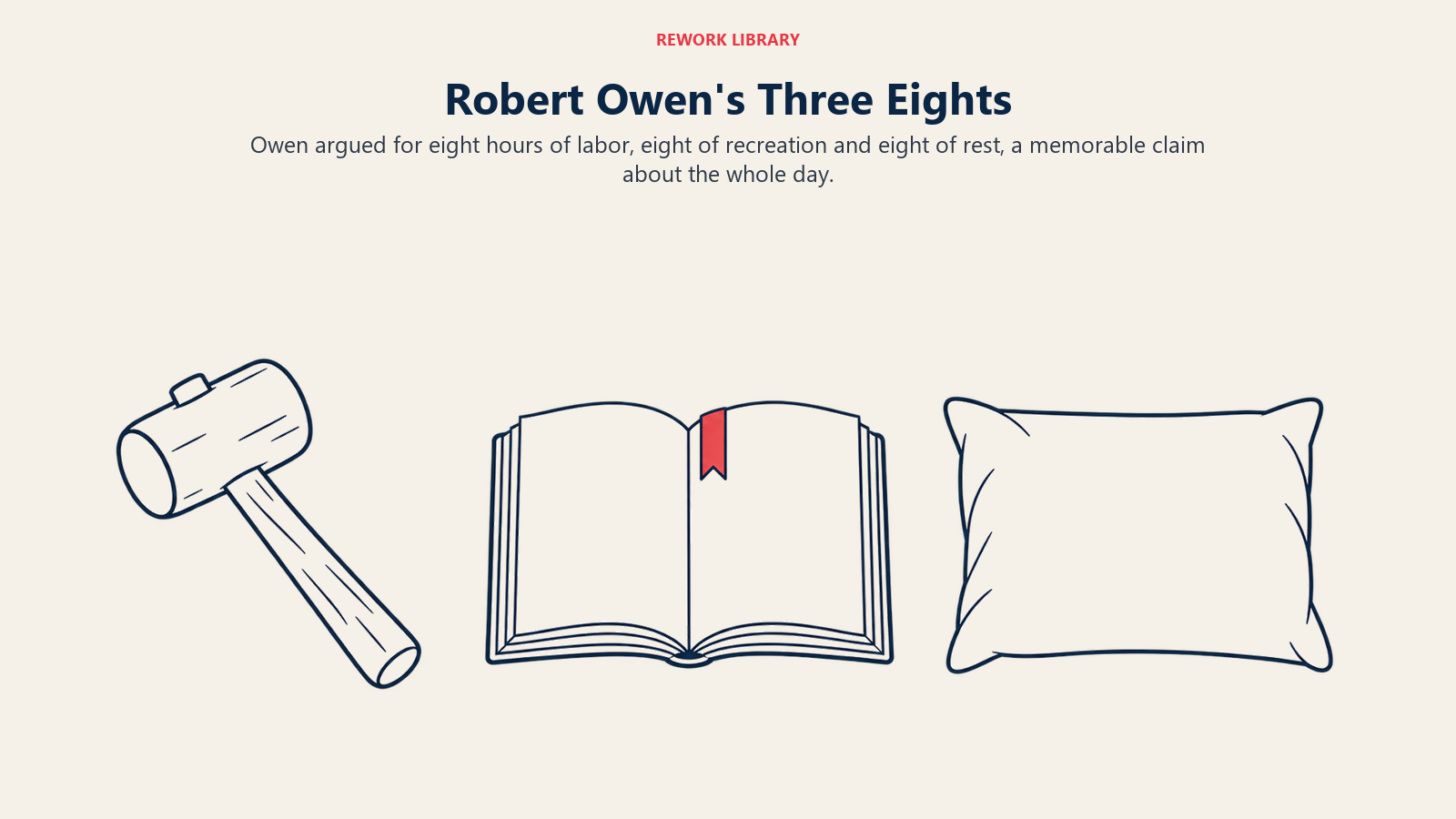
The slogan came later and is tied to his name: "eight hours labour, eight hours recreation, eight hours rest." The Royal Collection catalogue entry goes further and says he introduced an eight-hour day at the mill in 1810. That conflicts with the 10.5-hour figure from New Lanark itself, so records differ on what the mill's day really was, and the slogan is best read as the day Owen argued for. What lasted was the three-part split of the day, which is easy to remember and easy to put on a banner.
What it means for teams today: a number needs a name before it can become a norm. Owen's slogan worked because it described the whole day, not just the work part. Teams that talk about "focus time" and "recovery time" in the same breath are using the same idea.
The Eight-Hour Fight (1866-1919)
Unions, strikes and a railroad crisis make eight hours a demand
In Baltimore, on August 20, 1866, delegates formed the National Labor Union. A committee on "eight-hours in all its respects" made a recommendation, and the resolution that followed was described as the first national call for an eight-hour workday. William H. Sylvis, president of the Ironmoulders' International Union, was one of three union leaders who had met in early 1866 to call the meeting.
Two years later, Congress acted for its own workers. An act of June 25, 1868, made "eight hours a day's work" for laborers, workmen and mechanics employed by or for the federal government. President Ulysses Grant's proclamation the next year said the government could not cut daily pay because of the shorter hours. It was a start, but it covered a sliver of the workforce.
The movement peaked and broke in Chicago. On Saturday, May 1, 1886, about 35,000 workers walked off their jobs, and many adopted the demand of "eight hours' work for ten hours' pay." On May 3, police fired on strikers at the McCormick reaper plant, killing at least two. The next evening, at a protest in Haymarket Square, someone threw a bomb. Eight police officers died, and the number of civilians killed or wounded is unknown. History writers describe the bombing as a setback for the movement.
The first federal eight-hour law for private industry, limited to one industry, came from a threatened railroad strike. In 1916, railroad employees demanded that eight hours count as a day for runs of 100 miles or less, with overtime at time and a half. As the Supreme Court later recounted, the employers refused and a general strike was called. President Wilson suggested the eight-hour standard, the employees accepted it and the employers rejected it, so he asked Congress to write it into law. The Adamson Act, enacted in September 1916, declared that from January 1, 1917, eight hours would be deemed a day's work for railroad employees on interstate carriers. Note the wording: it set the standard for reckoning pay, not a hard cap on hours worked. The Court upheld it in Wilson v. New, decided March 19, 1917.
The idea also went global. The International Labour Organization conference, convened in Washington on October 29, 1919, adopted Convention No. 1. Its Article 2 says industrial working hours "shall not exceed eight in the day and forty-eight in the week," with listed exceptions.
| Standard | Year | Who it covered | What it set |
|---|---|---|---|
| Federal eight-hour act | 1868 | Federal laborers, workmen, mechanics | Eight hours a day's work |
| Adamson Act | 1916 | Interstate railroad employees | Eight hours as the standard day for pay, overtime above it |
| ILO Convention No. 1 | 1919 | Industrial undertakings | Eight in the day, forty-eight in the week |
What it means for teams today: the eight hours were won by people who could stop a railroad or a factory. Limits on hours tend to hold when someone has leverage to enforce them. If your team has a "no weekend work" rule that no one can act on, it is a wish.
The Ford Years (1914-1926)
A carmaker shortens the day, then the week
This era overlaps with the last, because Ford moved while the law was still catching up. Highland Park's moving assembly line had started running in October 1913, and the line was hard on the people who worked it. The Henry Ford museum notes that by late 1913, labor turnover was 380 percent. In January 1914 the company announced $5 for an eight-hour day, against the previous rate of $2.34 for nine hours. Eligibility was not automatic: workers were subject to inspections by the company's Sociological Department. The museum's view is that the high wage made many workers willing to accept the line's discipline, which makes the shorter day as much a retention move as a reform.
The five-day week took longer. In March 1922, Edsel Ford told the New York Herald that a forty-hour week was practical, as the Library of Congress recounts. The company announced a five-day, 40-hour week for its plants in September 1926, and a Ford News piece described it as five days of eight hours, with no overtime. Edsel had put the case plainly, saying every man needs more than one day a week for rest and recreation, and the company also admitted that productivity was part of the reason.
Not everyone cheered. The same Library of Congress post notes that economists were divided, some executives called the move a bad idea, and some labor advocates said it benefited Ford more than workers. Kellogg's chose six-hour shifts instead.
What it means for teams today: Ford's experiment was a business case, not a favor: lower turnover, steadier output, a bigger market of customers with leisure time. If you want shorter hours to survive a budget review, show the retention and output numbers, not just the goodwill.
The New Deal Settlement (1933-1941)
Depression politics turn 40 hours into the law
The Depression gave shorter hours a new argument: spread the work. In 1933, the National Recovery Administration's reemployment agreements covered workweeks of 35 to 40 hours, and the Cotton Textile Code set a 40-hour week. The Supreme Court struck down the National Industrial Recovery Act in 1935, and the Walsh-Healey Public Contracts Act of 1936 then required most government contractors to follow an eight-hour day and 40-hour week.
Frances Perkins, the Secretary of Labor, wanted a broader statute. The Black-Connery bill, backed by Senator Hugo Black, a supporter of a 30-hour week, passed the Senate 56 to 28 on July 31, 1937 and then stalled in the House Rules Committee. Perkins's own department drafted the general fair labor standards bill that became the basis for the law, and Solicitor Gerard Reilly cut it from 40 pages to 10.
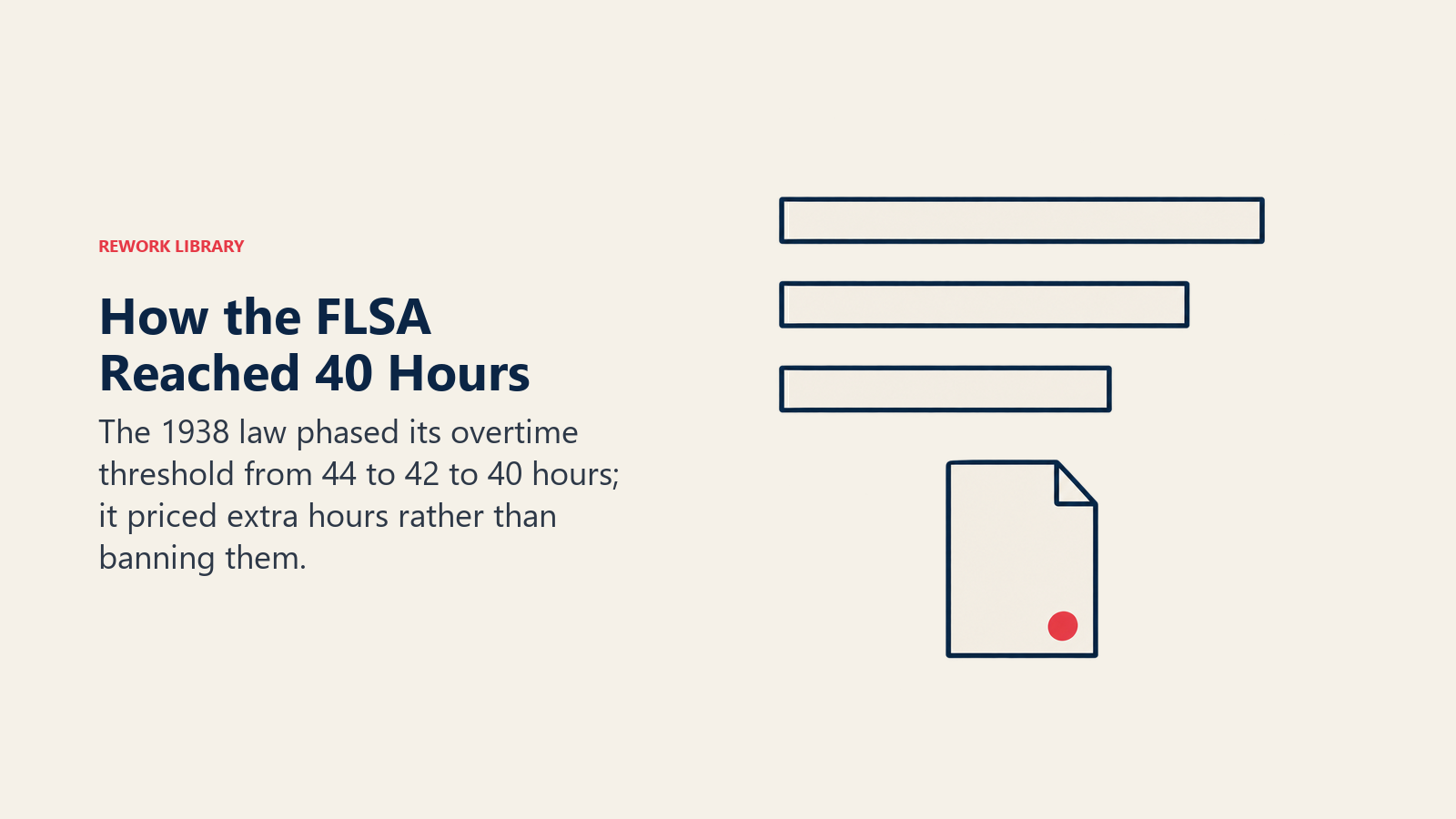
President Roosevelt signed the Fair Labor Standards Act on June 25, 1938; it took effect October 24, 1938. Section 7 shows how the 40-hour week actually arrived: no workweek over 44 hours in the first year, 42 in the second, and 40 after that, unless the employee was paid at least one and one-half times the regular rate for the extra hours. Two years after the section took effect, the 40-hour threshold applied, which put it in force in late 1940. The act covered industries employing roughly one-fifth of the labor force, so it was far from universal. In 1941 the Supreme Court upheld its constitutionality.
| Year of the FLSA | Overtime begins after |
|---|---|
| First year from the effective date | 44 hours |
| Second year | 42 hours |
| After the second year | 40 hours |
Look closely at the design. The statute does not forbid long weeks. It makes them expensive. That choice, price rather than prohibition, still defines how most American workplaces treat hours.
What it means for teams today: overtime rules are a price signal. If working late costs a manager nothing, expect more of it. Teams that measure hours against output, as in labor productivity metrics, see the cost sooner.
The Unmoved Week (1941-present)
The number stays fixed while the work changes
After 1941, the legal baseline barely moved. The Department of Labor's current FLSA page still states that covered, nonexempt employees get at least one and one-half times their regular rate for hours over 40 in a workweek, and that federal law sets no weekly cap for workers 16 and older. Meanwhile, the work changed out from under it. The 40-hour framework came from an era of factory shifts. In knowledge work, the day can stretch through messages, not machine time.
In 1930 the economist John Maynard Keynes had predicted the opposite. In "Economic Possibilities for our Grandchildren," he wrote that "Three-hour shifts or a fifteen-hour week may put off the problem" for a great while. Working weeks did not fall that far. A 2021 joint study by the WHO and ILO estimated that about 745,000 deaths in 2016 from stroke and ischemic heart disease were linked to working 55 or more hours a week, with a 35% higher stroke risk compared with 35-40 hours. About 9% of the global population works long hours. The same dynamic shows up in modern offices, where overwork becomes the norm without anyone writing it down, and where AI tools can raise the pace rather than lighten the load.
The first large test of changing the baseline arrived in 2022. In the UK pilot, 61 companies and around 2,900 workers moved to a four-day week from June to December, with researchers from Autonomy, the University of Cambridge and Boston College. Fifty-six of the 61 companies (92%) were continuing afterwards, 18 confirmed it as permanent, and before-and-after data showed 39% of employees less stressed and 71% with reduced burnout. Those are self-reported measures from companies that chose to take part, so they show what is possible for willing employers, not what every business would see.
What it means for teams today: the 40-hour week is a default from 1938, not a law of nature. You do not need a pilot to ask the useful question: what is the output we need, and what hours does the work really take? Start with time management and the real task list.
Key People
| Name | Role | Contribution | Year |
|---|---|---|---|
| Robert Owen | Mill owner and reformer, New Lanark | Reduced the mill day to 10.5 hours and is linked to the "eight hours" slogan | 1800s-1810s |
| William H. Sylvis | Ironmoulders' union president | Helped call the meeting that founded the National Labor Union | 1866 |
| Ulysses S. Grant | U.S. President | Proclaimed that federal workers' daily pay would not be cut under the eight-hour act | 1869 |
| Woodrow Wilson | U.S. President | Proposed the eight-hour standard in the railroad dispute and asked Congress to enact it | 1916 |
| Edsel Ford | Ford Motor Company president | Argued publicly for a 40-hour week in 1922 | 1922 |
| Henry Ford | Founder, Ford Motor Company | Announced the $5, eight-hour day and the five-day, 40-hour week | 1914, 1926 |
| Frances Perkins | U.S. Secretary of Labor | Pushed for the hours law and had the bill drafted in advance | 1933-1938 |
| Hugo Black | U.S. Senator | Sponsored the Black-Connery hours bill | 1937 |
| Juliet Schor | Boston College sociologist | Part of the research team on the UK four-day week pilot | 2022 |
Key Facts
- The National Labor Union's 1866 resolution is described as the first national call for an eight-hour day in the United States.
- The Adamson Act made eight hours the standard day for railroad pay from January 1, 1917, with overtime above it.
- ILO Convention No. 1 of 1919 set a limit of eight hours a day and forty-eight a week for industry.
- Ford's pre-1914 turnover hit 380 percent before the $5, eight-hour day.
- The FLSA stepped overtime from 44 to 42 to 40 hours over its first two years.
- In the 2022 UK pilot, 56 of 61 companies were continuing a four-day week after the trial.
The Pattern Behind the History
This is our synthesis of the timeline, not a published model. We call it The Hours Ratchet: each gain was locked in by something sturdier than goodwill, and then it stayed where it was locked.
- A number gets a name. Owen's three eights, the National Labor Union's 1866 call and the ILO's 1919 convention all gave people a figure to rally around.
- A crisis makes it urgent. Chicago in 1886 and the railroad strike threat of 1916 made it costly to ignore.
- A proof of concept makes it practical. Ford showed in 1914 and 1926 that a big employer could shorten hours and keep running.
- A rule sets the price. The Adamson Act and the FLSA attached overtime pay to the limit instead of banning long days.
- The number freezes while work changes. The 40 hours stayed fixed while factory shifts gave way to knowledge work and always-on messaging.
What It Teaches Teams Today
Hours are a design choice, and every design choice has a cost. Three practical takeaways follow from the history.
First, define output before hours. The task-oriented model and the clock model both fail without a clear idea of what "done" looks like. Second, make limits enforceable. The eight-hour day held where someone could enforce it, through a union, a statute or a business case. A norm without a mechanism fades. Third, watch the unwritten rules. The history of the clock at work is also the history of the time clock and the assembly line, both of which turned time into something a manager could count. Today the equivalent is response time on messages.
If you manage a team, a short audit helps: list the hours your team actually works, the hours you promise them and the hours the output needs. Gaps between those three numbers show where the culture, not the contract, sets the real workday. For the longer view of how productivity has been defined and counted, start with the history of productivity and how productivity is measured. Frederick Taylor's stopwatch is the other half of this story, covered in the history of scientific management, and Henry Ford's leadership profile covers the man behind the $5 day.

Co-Founder, Rework.com