The History of the Time Clock: From Egyptian Absence Rosters to Remote Clock-In
Turn this article into takeaways for your work.


Each assistant summarizes the article only for you and suggests best practices for your work.
In August 1887, Willard L. Bundy of Auburn, New York, filed an application for a machine. He wrote that its point was to make employees record their own arrival at the place of business. That would save the expense of watchmen or timekeepers that factories were paying for.
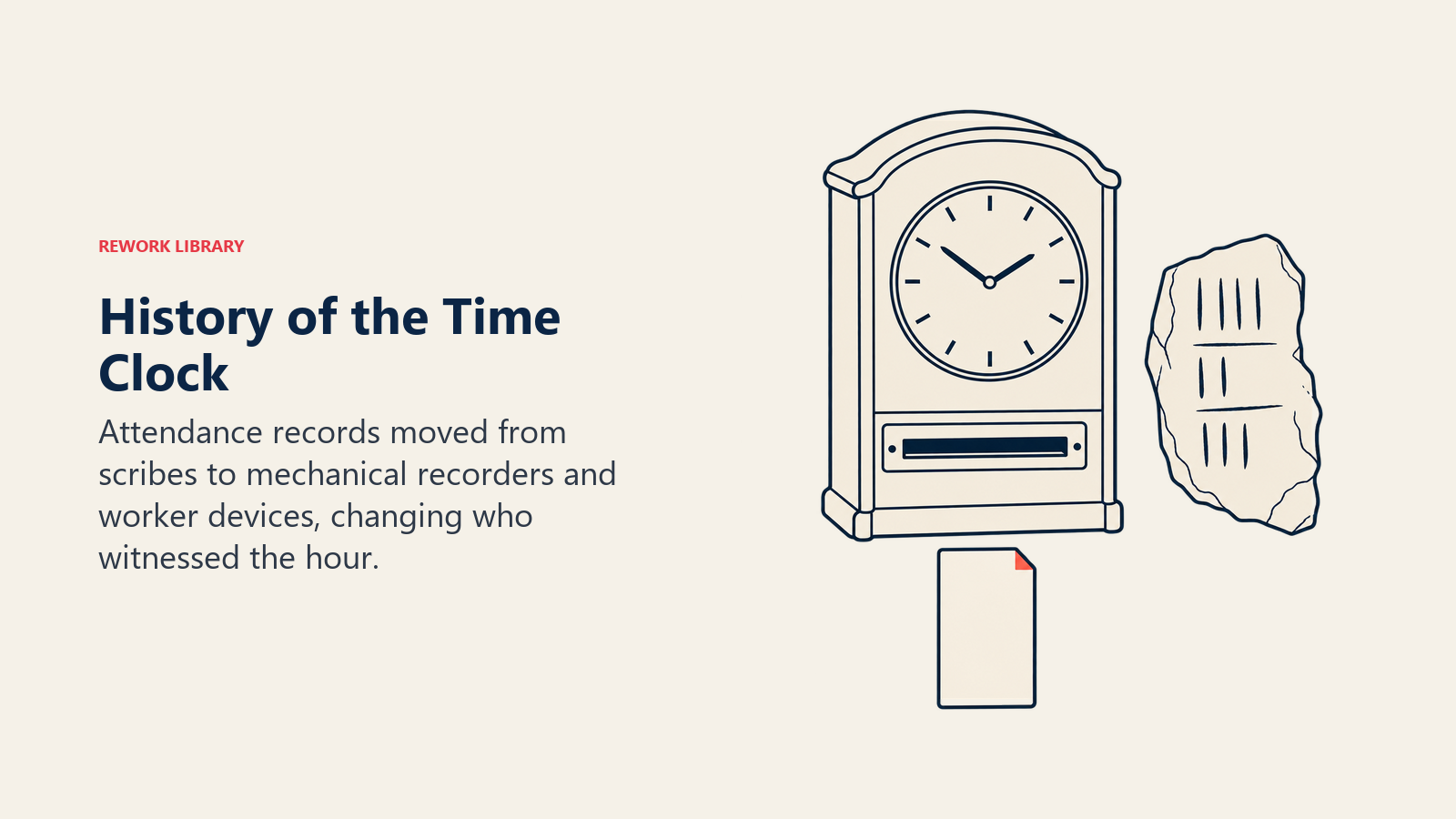
That was the problem in a sentence: someone had to watch the hour, and watching cost money and started arguments. The time clock, a machine that lets a worker record the moment they start and stop, was patented in November 1888, on an application Bundy had filed in August 1887. Its parents are much older: a scribe's record of who was absent, and a bell that told everyone what hour it was. The machine's real novelty was moving the record out of a supervisor's hands and into the worker's own.
This article follows that problem across more than 3,000 years, from a limestone roster in Egypt to the remote-work question employers are asking now.
Timeline at a Glance
| Year | Milestone | Why It Mattered |
|---|---|---|
| c. 1250 BCE | A scribe at Deir el-Medina records 40 workmen's absences, with reasons, for Year 40 of Ramesses II | The earliest documented attendance register in this story, kept by an official, not by the worker |
| 6th century CE | The Rule of St Benedict ties the monastic day to a signal and penalizes latecomers | A signal sets the hour for a whole community, and lateness becomes a visible, public matter |
| 1700 | John Crowley's iron works orders a daily time-sheet "entered to the minute" and a bell for work hours | An early large employer writes timekeeping into its rules, and workers dispute the clock |
| Aug 3, 1887 | Willard L. Bundy files his time recorder patent in Auburn, New York | The worker, not a supervisor, produces the record |
| Nov 20, 1888 | The Bundy patent is granted | The key recorder becomes a protected, sellable machine |
| 1888 | Alexander Dey introduces the Dial Recorder | A second design shows the idea is ready, not unique |
| Oct 30, 1894 | Daniel M. Cooper receives a patent for a card-based recorder | The record moves from a paper strip to an individual card |
| 1900 | George W. Fairchild creates the International Time Recording Company | Time recording becomes a consolidated industry |
| Jun 16, 1911 | Computing-Tabulating-Recording Company is incorporated | The time clock maker becomes one third of the company that turns into IBM |
| Jun 25, 1938 | The Fair Labor Standards Act is signed | A federal law now turns hours worked into a legal record |
| 1958 | IBM sells its Time Equipment Division to Simplex | The company that began with time clocks exits the business |
| Oct 3, 2006 | A networked time-keeping system patent (filed Jan 31, 2005) is granted | The clock becomes a small networked device feeding software |
| Aug 24, 2020 | The Labor Department issues guidance on tracking teleworkers' hours | Hours worked at home become an employer's recording problem |
The Scribe and the Bell (c. 1250 BCE-1600s)
A scribe counts absences and a bell sets the hour
Picture the walled village of Deir el-Medina, on the west bank of Thebes, where the craftsmen who cut and painted the royal tombs lived with their families. A scribe sits with a flat slab of limestone, black ink for the names and red ink for the reasons. This is one of the largest administrative documents from Deir el-Medina, a register of workmen's absences from Year 40 of Ramesses II, around 1250 BCE.
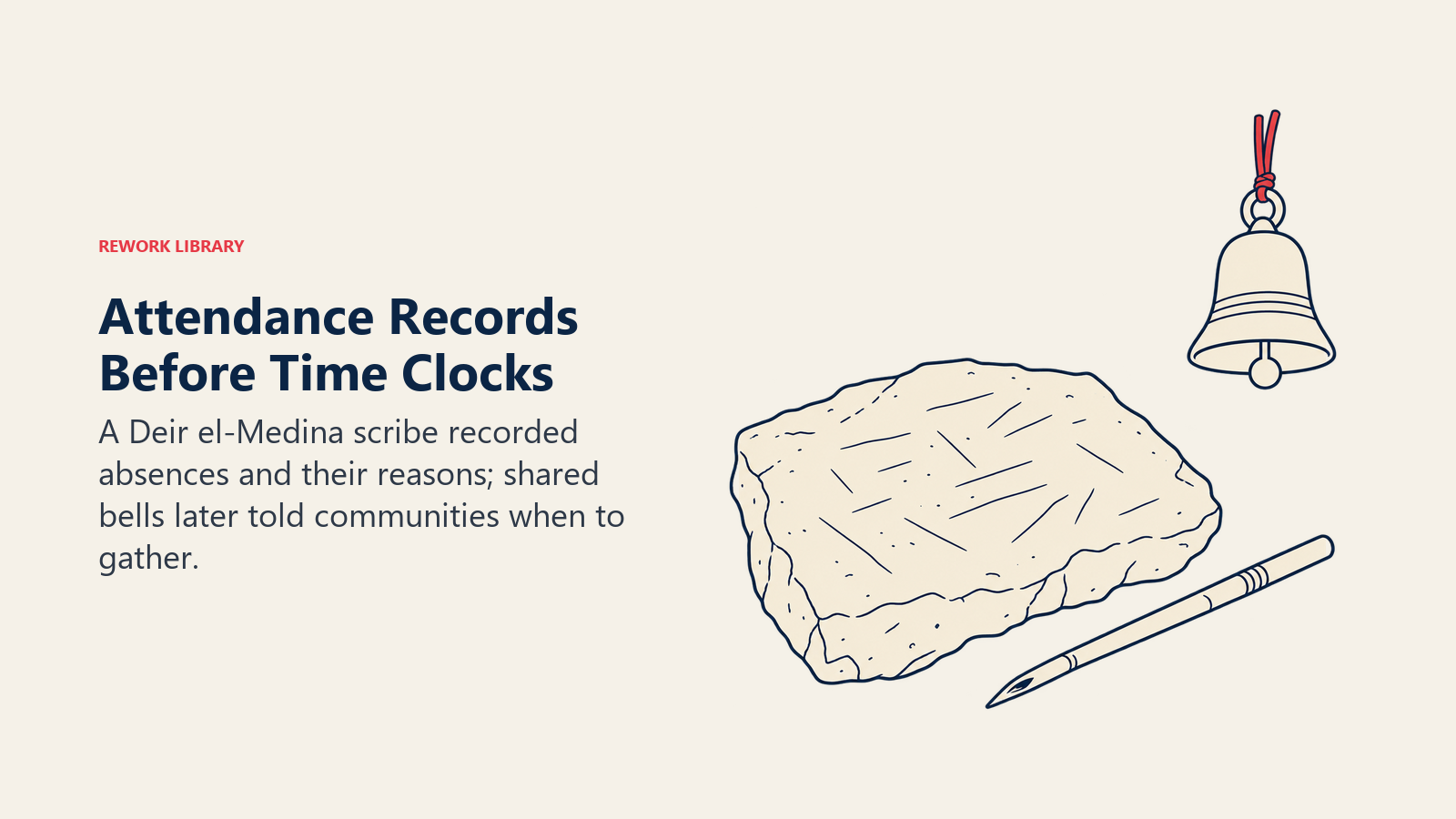
The British Museum's description says it covers 280 days and names forty workmen, with only about 70 of those days looking like full working days. The reasons are very human. Illness is by far the most common one. Men are away for deaths in the family and for village festivals. One is away "building his house." One is away "drinking with Khonsu." According to the University of Hamburg's Artefact of the Month write-up, a worker named Paherypedjet has the most entries, almost all of them for tending the sick and making remedies, and two of the forty men never missed a day.
This is a precursor, not a time clock. The scribe recorded days missed and why. He did not record when a man walked through the gate, and the worker had no hand in the record. But the core of the problem is already here: a crew of workmen, a supervisor who needs to know who showed up, and a written record that settles arguments later.
The second ancestor is the signal. In the Rule of St Benedict, the monastic day runs on a sound. The Rule tells monks that when the signal for the Divine Office is heard, they should drop whatever they have in hand and hurry, and that "Let nothing, therefore, be put before the Work of God." Latecomers to the night prayers are placed at the back, in view of everyone, so that being seen will make them amend. The same Rule states that "Idleness is the enemy of the soul" and divides the day into fixed hours for labor and reading. Here is a community that shares one clock and treats lateness as something everyone can see. Nobody called it time discipline yet, and nobody was paying wages by the hour.
The bell then spread beyond the cloister. In his essay on time and work-discipline, the historian E.P. Thompson notes that in the seventeenth century people left land in trust so that a sexton would ring early morning and curfew bells, one example being Richard Palmer of Wokingham, who did so in 1664. Villages already shared an hour, set by a bell that anyone within earshot could hear.
What this means for teams today: a time record has two jobs that were separate for most of history: knowing who was there, and agreeing on what hour it is. When your team argues about attendance, check which of the two is actually in dispute.
The Mill Bell Years (1700-1880s)
Employers write the hour into the rules, and workers contest the clock
The turning point is a book of rules. John Crowley's iron works, which Thompson calls the "very birth of the large-scale unit" in manufacturing, produced a law book of more than 100,000 words to govern its workforce. It ordered the Warden of the Mill to ring the bell at 5 a.m. to begin work, with set bells for breakfast, dinner and leaving. It ordered clerks to keep a daily time-sheet entered to the minute, with columns headed "Come" and "Run." The monitor delivered his account of time every Tuesday with an affidavit that it was honest, and nobody but the clock-keeper was allowed to alter the clock. Thompson sums it up: by 1700 the "familiar landscape" of the time-sheet, the time-keeper, the informer and the fine had arrived.
Notice why the clock keeper needed to be locked down. The Crowley rules complain that clerks had been reckoning by clocks running fast when workers left and slow when they arrived, with the bell sounding early or late to match. The record was only as honest as the people who kept it, and each side suspected the other. That suspicion is the market a machine would one day sell into.
Josiah Wedgwood met the same problem in his Staffordshire potteries. Thompson notes that the historian Neil McKendrick has shown how Wedgwood wrestled with the problem at Etruria and introduced the first recorded system of clocking-in. It did not last. According to Thompson, once Wedgwood's own strong presence was withdrawn, the potters drifted back to their old ways. A system that depends on one forceful person fades when that person leaves.
By the early nineteenth century, factory clocks had become a battleground. Thompson quotes a Dundee witness who said the factory clocks were often put forward in the morning and back at night, and that workers were afraid to carry a watch. A witness before a parliamentary committee described managers who shaved minutes from the dinner hour. The measuring instrument was in the employer's hands, so the worker's own time claim could never be proven.
What this means for teams today: whoever controls the record controls the argument. If a timesheet is edited after the fact by the person who benefits from the edit, trust will fall faster than any policy can rebuild it.
The Key Recorder Age (1887-1900)
Bundy's key hands the record to the worker
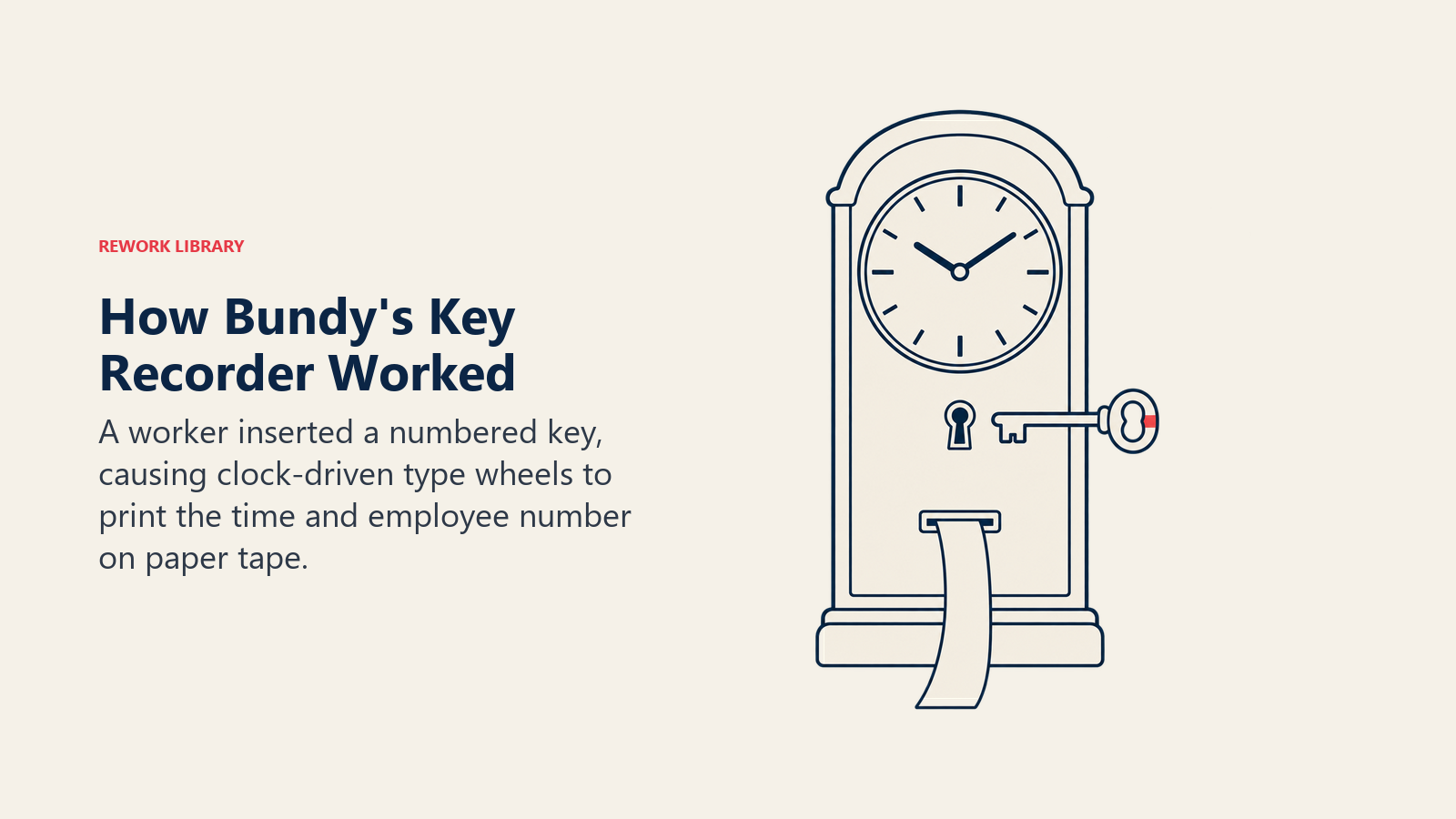
Willard L. Bundy, described by the Library of Congress as a New York jeweler and watchmaker, filed a time recorder patent on 3 August 1887 and was granted it on 20 November 1888. IBM's own history dates the Bundy Key Recorder to 1888. It used a series of type-wheels driven by a clock movement, and when a worker inserted a specially made key, it printed the exact time and the employee's number on a paper tape. A later Bundy patent, filed in December 1890 and issued 26 May 1891 from Binghamton, spells out the goal: each workman has his own key, known by a number, and records his own arrival and departure, "thereby preventing all disputes."
Two other designs arrived at nearly the same moment, which tells you the idea was ready. The same IBM history says Alexander Dey introduced his Dial Recorder in 1888, with employee numbers around a large ring: the worker swung a pointer to his number and pressed it into a hole, printing the time on a sheet inside the machine. Then came the card. Daniel M. Cooper's patent, filed 14 May 1894 and granted 30 October 1894, had a worker record the times on his own individual card, so that weekly wages could be computed without copying entries off one continuous strip of paper. IBM calls Cooper's Rochester Recorder the first card-based attendance system.
The machines found a market in the large factories of the day. The Library of Congress notes that as American factories grew to hundreds of workers, employers adopted time recorders as an efficient, accurate and standardized way to track attendance, and payroll departments used the results to calculate wages. Bundy started the Bundy Manufacturing Company to sell his invention, and rival firms such as Willard & Frick competed with it.
Notice what changed and what did not. The ancient scribe and the Crowley clerk were people, and people can be pressured, bribed or suspected. A mechanical recorder prints the same minute for everyone. It also still needs a human to carry the key, and a human to read the tape. The machine removed one source of dispute and left the rest.
What this means for teams today: when a record is produced by the person it describes, at the moment it happens, with no one in the middle, arguments about it drop. That principle is why self-service timesheets and clock-in apps, whatever their design, beat after-the-fact reconstruction.
After the Merger (1900-1958)
Time recorders become one division of a data company
Consolidation came next. IBM says the Bundy Manufacturing Company spun out its time recording business at the urging of George W. Fairchild, who is credited with creating the International Time Recording Company (ITR) in 1900 and became its president. In 1907, the financier Charles R. Flint convened the heads of ITR, the Computing Scale Company and the Tabulating Machine Company to propose a merger, and after four years of talks the Computing-Tabulating-Recording Company was incorporated on 16 June 1911. Flint's interest was in what the three businesses had in common: they all dealt in data.
The time clock was a founding member of the business that became IBM, and then a minor one. Thomas J. Watson became general manager in 1914. IBM's account says he focused on the tabulating machine and de-emphasized the scale and the time clock, and renamed the company International Business Machines in 1924. The clocks kept selling for decades. IBM's history lists attendance and job recorders, a time stamp, a clock system and a program machine for operating audible signals. The Library of Congress adds a link between the businesses: Hollerith's punched cards, famous for the 1890 US census, were later used in punch time clocks, which is why "punching" entered the vocabulary of work. It holds a photograph of Thomas Edison punching a time clock on 11 February 1921.
Then the law arrived. President Roosevelt signed the Fair Labor Standards Act on 25 June 1938. It took effect on 24 October 1938, and set a minimum wage of 25 cents an hour and a maximum workweek of 44 hours, the step that the history of the 8-hour workday traces down to 40. The Labor Department describes the act as one that establishes recordkeeping standards along with minimum wage and overtime. Overtime needs hours, and hours need a record. Here the time clock stopped being only an employer's tool and became evidence.
The law did not require the machine, though. The Labor Department's recordkeeping guidance says time clocks are not required: employers may use any timekeeping method they choose, as long as the records are complete and accurate.
What this means for teams today: the tool and the legal record are two different things. A clock gives you data, but the obligation to keep an accurate record sits with the employer whatever tool is used.
The Quiet Decades (1958-2019)
The clock leaves IBM and learns to talk to payroll
No single invention marks this long stretch, which is why it is named for its mood. In 1958, with the Time Equipment Division accounting for less than 3 percent of gross revenue, Thomas Watson Jr. arranged its sale to the Simplex Time Recorder Company. His reasoning, in IBM's account, was that the division's products had become less compatible with the work of the larger divisions. The machine that gave IBM its start was now too small to matter to IBM.
What happened to the clock after that was a slow migration from the wall into software. A 2005 patent application by Stratitec for a networked time-keeping system describes the path in its background section: first employee time was recorded by hand, then punch in and punch out systems, then software installed on a company's own computers. The patent's own answer was a small network appliance with a built-in web server, fed by a card reader, keypad, bar code reader or proximity badge, so a supervisor could see irregularities without waiting for someone to add up the week's cards. It was filed on 31 January 2005 and granted on 3 October 2006.
The questions that survived all that change were old ones. How do you treat a worker who punches in early? The Labor Department's interpretation says that if employees voluntarily come in early or stay late and do no work, their punches may be disregarded. How do you treat minutes? The same regulation, 29 CFR 785.48, notes that in some industries, especially where time clocks are used, there has long been the practice of recording start and stop times to the nearest 5 minutes, or to the nearest tenth or quarter of an hour. The Department says it will accept rounding for enforcement purposes only if it does not, over time, fail to compensate employees for all the time they actually worked. The rule does not say rounding is wrong. It says rounding has to average out so that employees are paid for all the time they worked.
What this means for teams today: audit your rounding rule before a regulator or a plaintiff's lawyer does. If the rounding always trims minutes in the employer's direction, it fails the test the regulation sets. The practical tools for this are covered in our guides to time tracking software and timesheet software.
The Remote Question (2020-present)
When work leaves the building, so does the clock
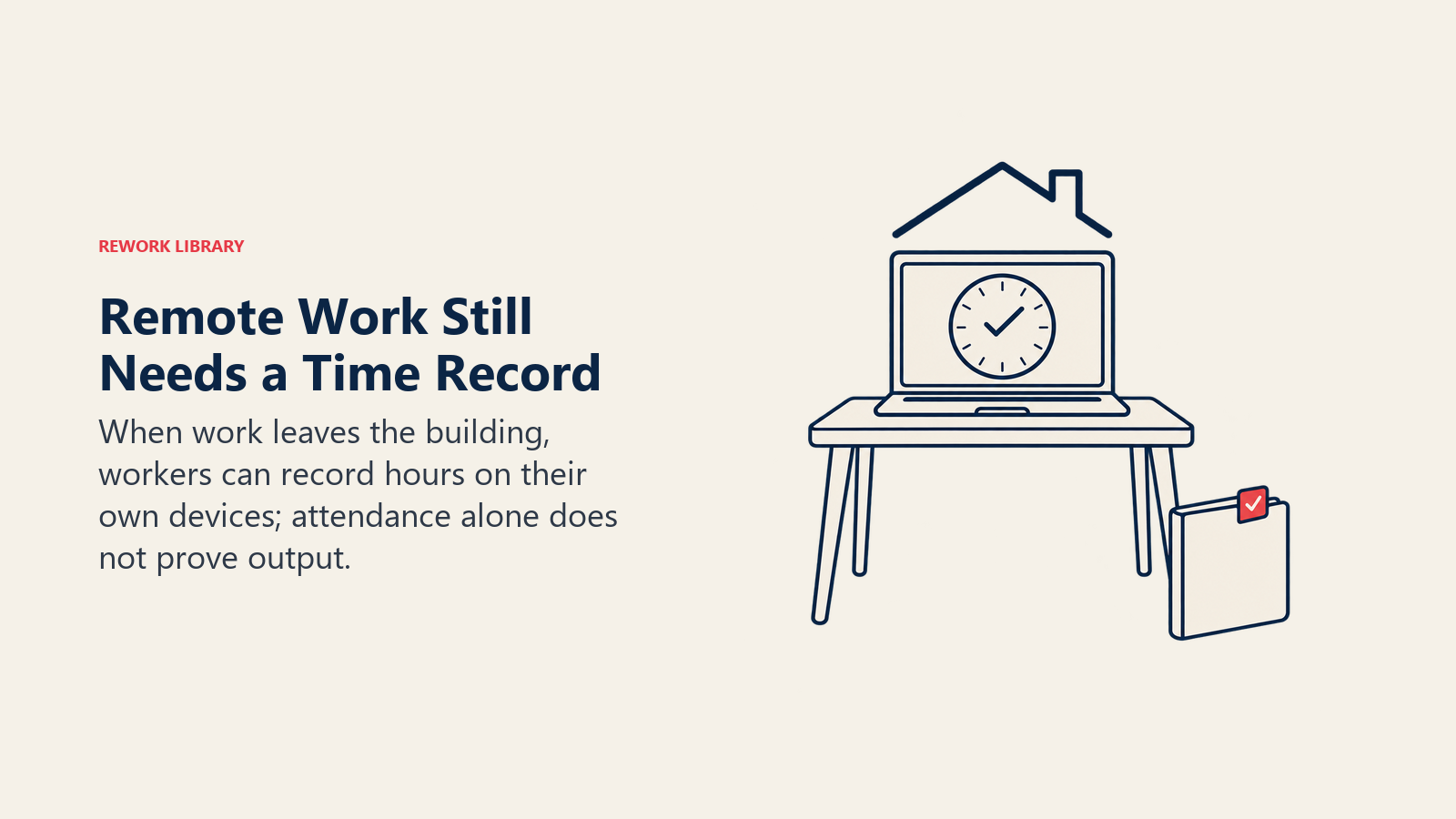
In 2020 the factory gate stopped being the place most knowledge workers clocked in. On 24 August 2020, the Labor Department's Wage and Hour Division issued Field Assistance Bulletin 2020-5 on an employer's obligation to exercise reasonable diligence in tracking teleworking employees' hours. The bulletin restates an old principle for a new setting: an employer must pay for all hours worked, including work done at home, and if the employer knows or has reason to believe that work is being performed, the time must be counted. The Egyptian scribe would have recognized the issue. Who is here, and for how long, when the crew isn't in one place?
The management side of the same question showed up in survey data. Microsoft's 2022 Work Trend Index pulse report found that 87% of employees say they are productive at work, while 85% of business leaders say the shift to hybrid work has made it hard to feel confident that their people are. Microsoft's term for the leaders' worry is "productivity paranoia." The survey measures perception, not output, and it comes from a vendor that sells collaboration software, so read it as a statement of the leaders' worry and not as proof of anything about actual work. The worry is real, though, and it is the Crowley worry again: the people who pay for time cannot see the time being spent.
Some employers answer with monitoring and some with trust. The history here says only that every previous upgrade, from the bell to the key to the badge, gave the employer a little more certainty and left the underlying disagreement standing. If you want to understand where the output side of this story went, our history of how productivity is measured picks up where the stopwatch left off.
What this means for teams today: decide which record you actually need. For legal compliance you need accurate hours for hourly workers. For managing salaried knowledge work, hours are a weak signal, and the better question is whether the outputs and commitments are clear.
Key People
| Name | Role | Contribution | Year |
|---|---|---|---|
| Paherypedjet | Workman and apparent healer at Deir el-Medina | Appears most often on the absence roster, mostly for tending the sick and preparing remedies | c. 1250 BCE |
| Benedict of Nursia | Monastic lawgiver | His Rule ties the day to a signal and penalizes lateness | 6th century CE |
| John Crowley | Ironmaster | His law book orders a bell, a clock-keeper and daily time-sheets | 1700 |
| Josiah Wedgwood | Potter and manufacturer | Per McKendrick, introduced the first recorded clocking-in system at Etruria | 18th century |
| Willard L. Bundy | Jeweler and inventor | Patented the key recorder | 1887-1888 |
| Alexander Dey | Inventor | Introduced the Dial Recorder | 1888 |
| Daniel M. Cooper | Inventor | Patented the card-based recorder | 1894 |
| George W. Fairchild | Executive | Credited with creating ITR and serving as its president | 1900 |
| Charles R. Flint | Financier | Assembled C-T-R from three companies | 1911 |
| Thomas J. Watson | Executive | Hired in 1914, renamed C-T-R as IBM and de-emphasized the time clock | 1914-1924 |
| Thomas Watson Jr. | IBM executive | Arranged the sale of the Time Equipment Division | 1958 |
Key Facts
Key Facts: The Time Clock
- A limestone roster from Deir el-Medina records 40 workmen's absences with their reasons across 280 days of Year 40 of Ramesses II, about 1250 BCE.
- Bundy's first time recorder patent was filed on 3 August 1887 and granted on 20 November 1888.
- The time clock business was one of three companies merged to form C-T-R on 16 June 1911, renamed IBM in 1924.
- By 1958 the Time Equipment Division produced less than 3% of IBM's gross revenue and was sold.
- Under US wage law, time clocks are not required, but records must be complete and accurate.
- Microsoft's 2022 pulse report found 87% of employees say they are productive while 85% of leaders struggle to be confident of it.
The Pattern Behind the History
The Moving Witness is our synthesis of the pattern, not a published model. Someone always has to witness the hour, and each era hands that job to a new witness.
- The witness changes. First a scribe, then a bell and a clerk, then a key, a card, a badge, a network, and now the worker's own device.
- Disputes drive the upgrade. Crowley's clocks were argued over, and Bundy's patent promised to prevent disputes. Each new witness is built to settle the last one's quarrel.
- The dispute moves, it doesn't disappear. A machine cannot be bribed to move a clock hand, but it can be given a rounding rule, an edit permission or a location setting.
- The law trails the tool by decades. The Fair Labor Standards Act came 50 years after Bundy, and telework guidance came more than 130 years after.
- The record is always about trust. Every era ends up asking whether the party that holds the record is believed by the party it describes.
What It Teaches Teams Today
- Separate attendance from output. The time clock was built for work where hours are the product. For work where results are the product, keep the record light and make the outcomes clear. Our guide to time management in the workplace covers the personal side.
- Let the person who did the work make the first entry. That is the idea Bundy patented in 1887, and it still reduces disputes.
- Write down your rounding and edit rules. Who may change a punch, why, and who is told, should be a policy, not a habit.
- Know why you're measuring. If the reason is payroll compliance, accurate hours are enough. If it is productivity, hours are a proxy at best, and labor productivity metrics are the better place to look.
- Place it in the long story. The time clock sits between the stopwatch of scientific management and the factory floor of the assembly line. The wider arc is in the history of productivity, with the origin of productivity and a productivity timeline for context, and the company that began with time clocks is part of the history of computers.

Co-Founder, Rework.com