The History of the Assembly Line: From Qin Crossbows to Ford's Moving Line and Robots
Turn this article into takeaways for your work.


Each assistant summarizes the article only for you and suggests best practices for your work.
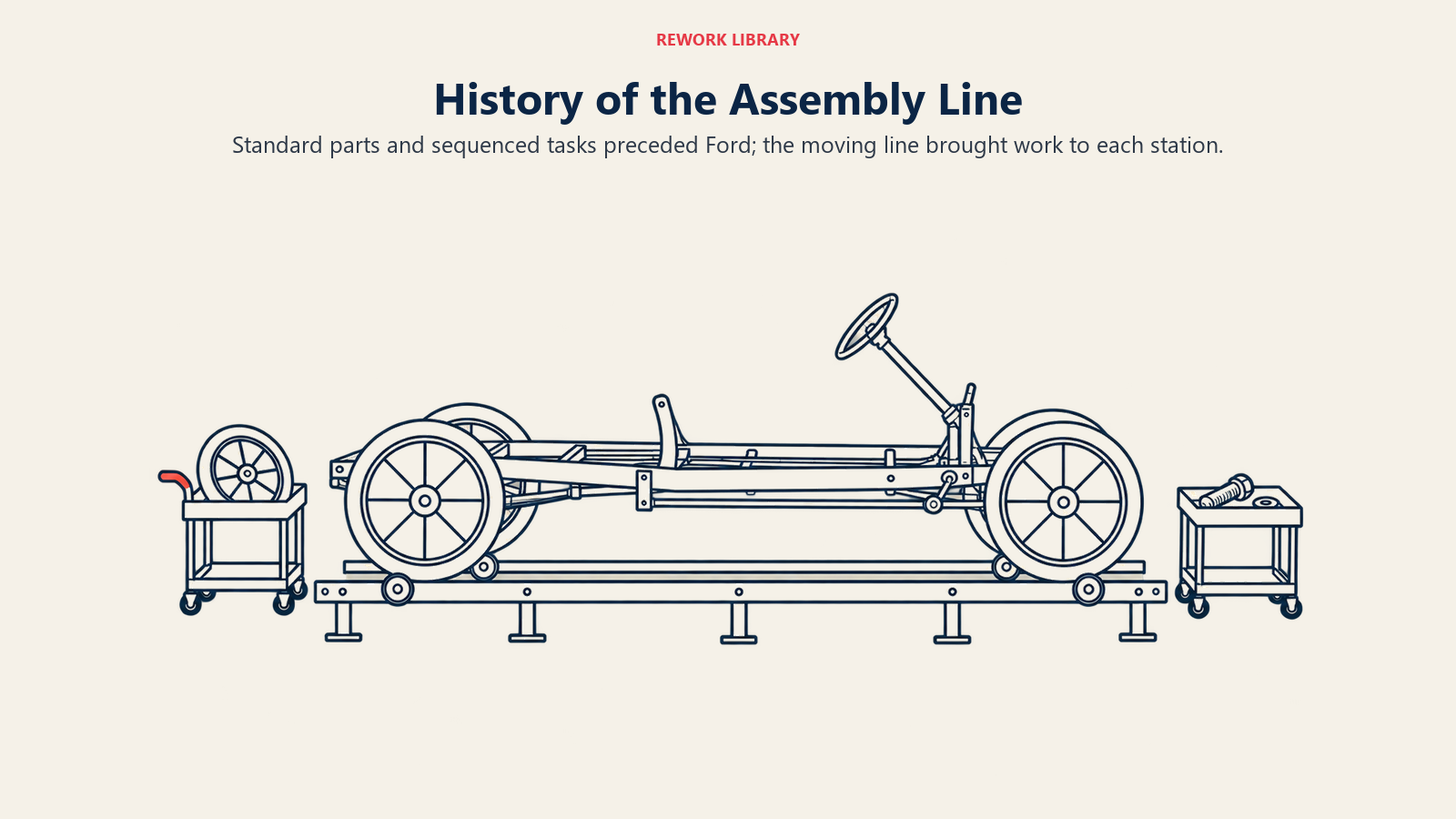
Before the moving line, Ford's assemblers built each chassis in place. The parts were brought to them in piles along the floor. The time went on handling and waiting, and nobody had yet arranged the work to remove it.
The moving assembly line was first tried at Ford's Highland Park plant in Michigan in 1913. The idea behind it is far older: standard parts, one task per worker, and work that travels from station to station. Henry Ford's team put those pieces together and added the conveyor. The best Ford had managed before was an average of twelve hours and twenty-eight minutes per chassis, in Ford's own account. The line cut labor time on a Model T chassis to about an hour and a half. The throughline is that every gain in flow moved the strain somewhere else: the worker's pace, the factory's rigidity, or the next machine.
Timeline at a Glance
| Year | Milestone | Why It Mattered |
|---|---|---|
| Qin dynasty (221-206 BCE) | Crossbow triggers cast in workshop cells, marked to match parts at assembly | Standard parts and quality marks appear 2,200 years before Ford |
| 1104 | The Venetian Arsenal is first established | Ships move shed to shed, built from stored prefabricated parts |
| 1776 | Adam Smith describes the pin factory in The Wealth of Nations | Division of labor is named as the source of output |
| 1790 | Oliver Evans receives a patent for his automatic flour mill (Dec 18) | Grain moves through the mill without hands: a continuous process |
| 1801 | Eli Whitney demonstrates interchangeable musket locks in Washington | Interchangeable parts become a national goal |
| 1802-1808 | Brunel and Maudslay's block-making machines at Portsmouth, 130,000 blocks in 1808 | Machine tools make identical parts at scale |
| 1901 | Ransom Olds makes the first major bid for the mass market with the Curved Dash | Volume car production begins |
| About April 1, 1913 | Ford tries a moving line on flywheel magnetos | The first moving line cuts one assembly from 20 minutes to 13 |
| October 1913 | First moving automobile line at Highland Park | The car comes to the worker |
| January 5, 1914 | Ford announces the $5 day | A response to turnover that ran near 370 percent |
| 1936 | Chaplin releases Modern Times | The line becomes a symbol of dehumanizing work |
| 1944 | Willow Run builds one bomber every 63 minutes at peak | The line scales to aircraft |
| 1961 | First Unimate robot takes a place on a GM line | Automation reaches the line itself |
| 1963 | Toyota adopts kanban at all plants | The line starts to be pulled by demand and stopped by defects |
| March 1972 | UAW strikes for 18 days at Lordstown | Line speed becomes a labor dispute |
The Early Workshops (c. 220 BCE-1776)
Standard parts and sequenced work, long before the name
In the Qin workshops of the third century BCE, bronze crossbow triggers were made in quantity. The trigger, a small three-part mechanism, was cast in moulds, filed, and assembled, and some matching parts carry marks, in one case painted in ink, that let assemblers pair them again. Archaeologists working on the Terracotta Army found over 200 crossbow triggers in Pit 1, and report that they are highly standardised in overall shape, with small differences that point to parts made in the same moulds by particular workshop cells. Some marks refer to the Sigong, the central workshop, which suggests an official layer of quality control. This was a precursor, not an assembly line: parts were standardized and tracked, but the work did not move on a line, and nobody called it a production system.
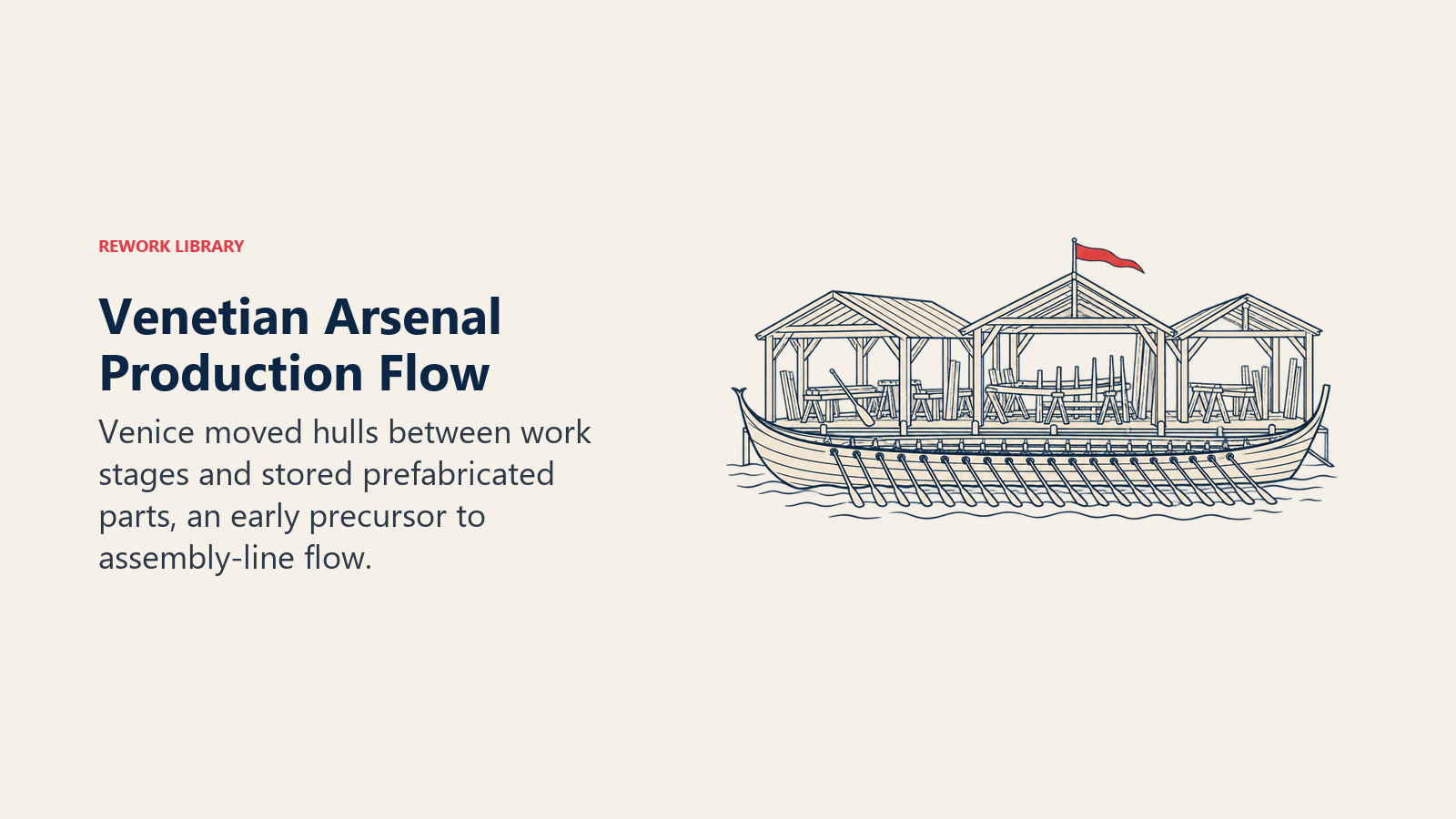
Venice did something closer to flow. The Arsenal, first established in 1104, floated hulls from one covered shed to the next as each crew finished its stage, and stored prefabricated parts so warships could be assembled quickly when war threatened. Historian Teresa Fava Thomas writes that the process operated like an assembly line, and tells how King Henry III of France was walked through it in 1574 to show that lost ships could be replaced fast.
Then came the idea that explained why this works. In The Wealth of Nations (1776), Adam Smith divided pin-making into about eighteen distinct operations and wrote that ten people could make upwards of forty-eight thousand pins in a day. The deeper background is in our history of the division of labor. The new problem was that specialists depend on each other: a stalled step upstream stops everyone downstream.
What it means for teams today: a standard part and a clear handoff are older than any software tool. If two people on your team do the same task differently, you don't yet have a process to speed up.
The Interchangeable Dream (1780s-1850s)
Mills and machine tools learn to work without hands
By the mid-1780s on Red Clay Creek in Delaware, Oliver Evans had rebuilt a flour mill so that grain was lifted by waterpower and moved by gravity through drying, grinding, spreading, cooling and sorting. Joseph Gies, writing in Invention & Technology, says the flour was made by mechanical means alone, without ever touching human hands, and quotes historian Eugene Ferguson calling it a continuous manufacturing process. Evans received a patent on December 18, 1790, the third under the first U.S. patent law. Evans is the first documented case in this story of material flowing through a whole process under its own momentum.
Next, the Royal Navy needed pulley blocks, thousands of them. At Portsmouth Dockyard, Samuel Bentham backed a design by Marc Brunel, and Henry Maudslay built the machinery. The Admiralty ordered the works on August 2, 1802. Historic England's research report says the machines were installed between 1802 and 1805, that the mills produced 130,000 blocks in 1808, and that it was claimed ten unskilled men could replace 110 skilled blockmakers. Historic England calls it the first use of all-metal machine tools for mass production.
In the United States the goal was interchangeable parts for muskets. On June 14, 1798, Eli Whitney received a War Department contract for 10,000 muskets in two years. In 1801 he showed officials in Washington ten interchangeable musket locks. The Library of Congress notes that it remains unclear whether Whitney planned on interchangeable parts from the beginning, that the idea is credited to Honore Blanc, and that he did not fulfil the contract until 1809. The dream arrived before the practice, which is a pattern worth remembering. Historians still debate how interchangeable the early parts truly were.
What it means for teams today: the interchangeable part is the quiet hero of every line. If your team's work products (a lead record, a ticket, a spec) differ in shape each time, nothing downstream can be automated cleanly.
The Magneto Experiment (1901-1913)
A car in volume, then a line that moves
Ransom Olds changed the scale of car-building first. Britannica says he made the first major bid for the mass market with the curved-dash Oldsmobile in 1901, though it adds that the car was too lightly built to withstand rough use. Ford took a different order of operations: Britannica says he designed the car first and then considered how to produce it cheaply. The Model T went on sale in 1908.
The trial began small. Ford wrote in My Life and Work that along about April 1, 1913, we first tried the experiment of an assembly line, on the flywheel magneto, and added: "I believe that this was the first moving line ever installed." The idea came in a general way from the overhead trolley that the Chicago packers use in dressing beef. One workman had turned out 35 to 40 magnetos in a nine-hour day, about twenty minutes each. Split into twenty-nine operations, the time fell to thirteen minutes and ten seconds.
| Magneto assembly (Ford's account) | Time per magneto |
|---|---|
| One worker does the whole job | About 20 minutes |
| 29 operations on a moving line | 13 min 10 sec |
| Line raised eight inches (1914) | 7 minutes |
| Speed adjusted | 5 minutes |
Ford's team also tested line speed by trial: sixty inches a minute was too fast, eighteen too slow, forty-four was right. Ford wrote that the principle was the reduction of the necessity for thought on the part of the worker. That sentence names both the gain and the later complaint.
What it means for teams today: Ford tried the idea on one component before betting the plant. Pilot a new flow on a single small workflow and time it, rather than reorganizing everything at once.
The Highland Park Years (1913-1927)
The chassis line, the $5 day, and the Rouge
In October 1913 Ford's Highland Park plant ran its first moving assembly line for automobiles. Britannica adds that the method was first tested in assembling magnetos. The chassis result is the most quoted number in the story, and Ford gave it himself.
| Chassis assembly (Ford's account) | Labor time per chassis |
|---|---|
| Best stationary assembly | 12 hours 28 minutes |
| Rope and windlass down a 250-foot line, six assemblers | 5 hours 50 minutes |
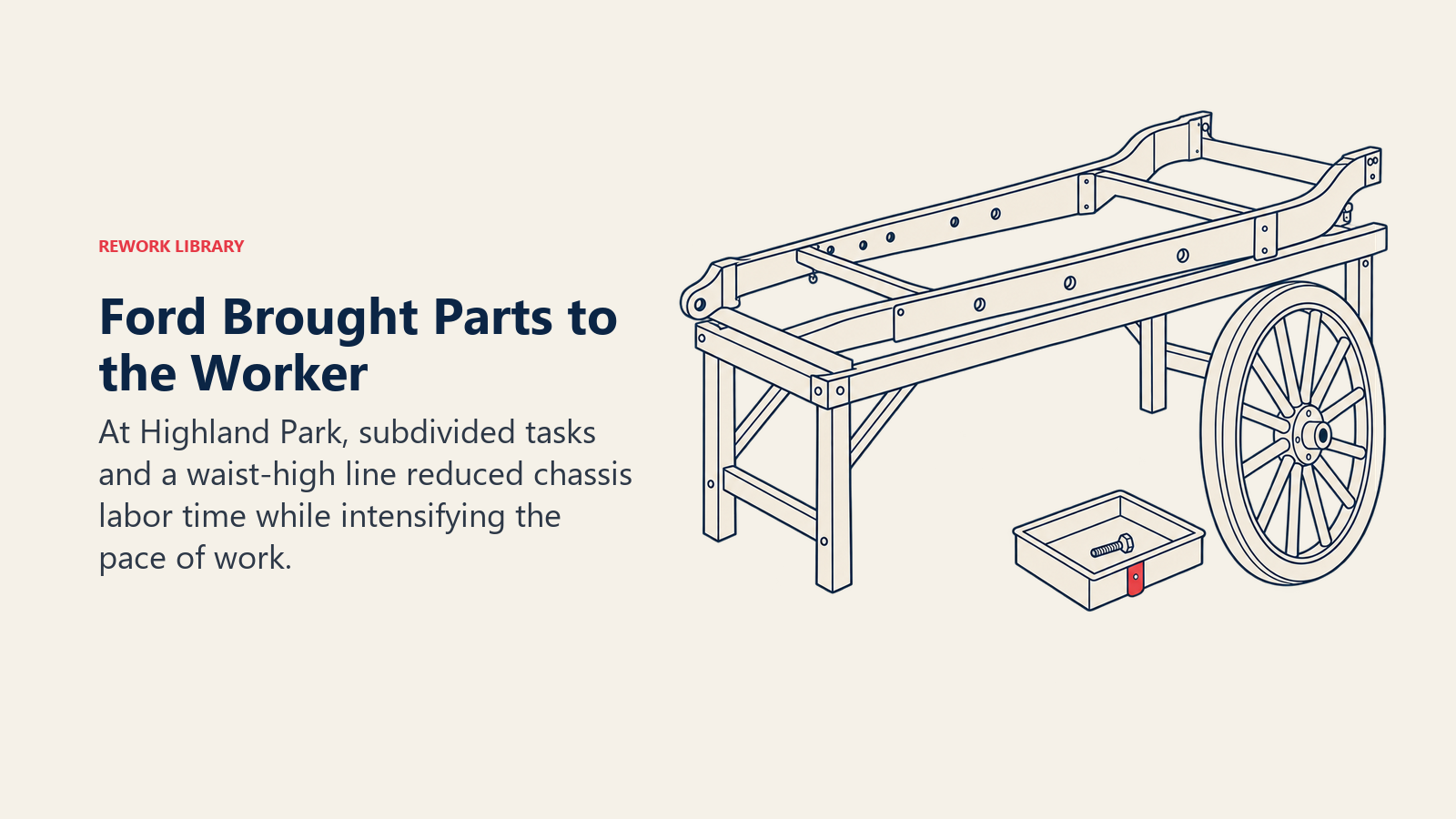
| Waist-high line, early 1914, more subdivided work | 1 hour 33 minutes |
Ford says the pace of the chassis line was six feet per minute, with forty-five separate operations. The man who placed a part did not fasten it, and the man who put in a bolt did not put on the nut. Production climbed from hundreds a day to thousands, and Ford says the Model T's price fell from $850 to $260. Britannica counts more than 15 million Model Ts built before it was discontinued in 1927.
The line had a cost, and it showed up in the workforce. EBSCO's account of the period says Ford hired 50,448 workers in 1913 against an average labor force of 13,623, a turnover rate of 370 percent. Ford's own version is that he had to hire about 53,000 a year to hold a constant force of 14,000. On January 5, 1914 the company announced a five-dollar, eight-hour day, starting January 12, against a previous wage of a little more than two dollars for nine hours. Ford writes that in 1915 he needed to hire only 6,508 men. The plan came with conditions: a sociological department checked workers' home lives, and the rules excluded some men for drinking, gambling or a dirty home. Our profile of Henry Ford's leadership covers the man and the trade-offs, and the history of the 8-hour workday follows how that shorter day spread from one factory into law. Shorter, fixed shifts also made start and stop times worth recording, which is the story of the time clock.
Ford then made the line a whole system. In 1927 final assembly moved from Highland Park to the River Rouge complex, which Michigan's historic preservation office describes as a continuous work-flow from iron ore and other raw materials to finished automobiles. The line's rigidity was the next problem: Britannica notes that the first Ford line allowed only very minor variations in the basic model.
What it means for teams today: a faster process changes the human job. If you shorten a handoff chain, check turnover, errors and burnout as well as throughput. The same era produced scientific management, which asked the same question about each task.
War and Backlash (1936-1972)
The line scales to bombers, and workers push back
Hollywood noticed the strain first. Britannica describes Modern Times (1936) as a film that highlights the dehumanizing impact of technology, with Chaplin haplessly trying to keep pace with the assembly line as a classic sight gag. The film is a comedy, and the joke works because audiences recognized the pace.
Then war made the line enormous. At Willow Run, Ford's bomber plant, The Henry Ford records that at its peak the plant averaged one bomber every 63 minutes, in a photograph dated October 13, 1944. A method built for cars was now turning out bombers.
The backlash peaked in a different car plant. Joseph Arena's 2009 Ohio State thesis on Lordstown, Ohio, describes how General Motors designed the Chevrolet Vega for fast production. The line hit the projected speed of 100 cars an hour on May 1, 1971. Workers there were also on mandatory overtime, with six-day, sixty- to seventy-hour weeks after a 1970 strike. In March 1972 the UAW struck for eighteen days, which Arena says ended on March 22. Business Week called the discontent the Lordstown Syndrome. Arena also says the settlement was inconclusive.
What it means for teams today: targets that look fine on a dashboard can be unbearable on the floor. When you raise a pace, listen to the people at the stations before the grievances become a stoppage.
The Smart Line (1961-present)
Robots, pull signals and stop cords reshape the line
This era overlaps the backlash and answers it. In 1961, a Unimate robot took its place on the assembly line of General Motors' Ternstedt plant, in Trenton, N.J., according to Allison Marsh in IEEE Spectrum. It unloaded finished castings from a die-cast press, a job the article calls dirty, dreary and dangerous. George Devol had filed the patent in 1954, and he and Joseph Engelberger founded Unimation after meeting in 1956. The Henry Ford holds the first Unimate used on an assembly line.
By 1971 Lordstown was a showpiece of automation. In Arena's account, 26 Unimate robots performed 95 percent of the 3,900 welds on the Vega.
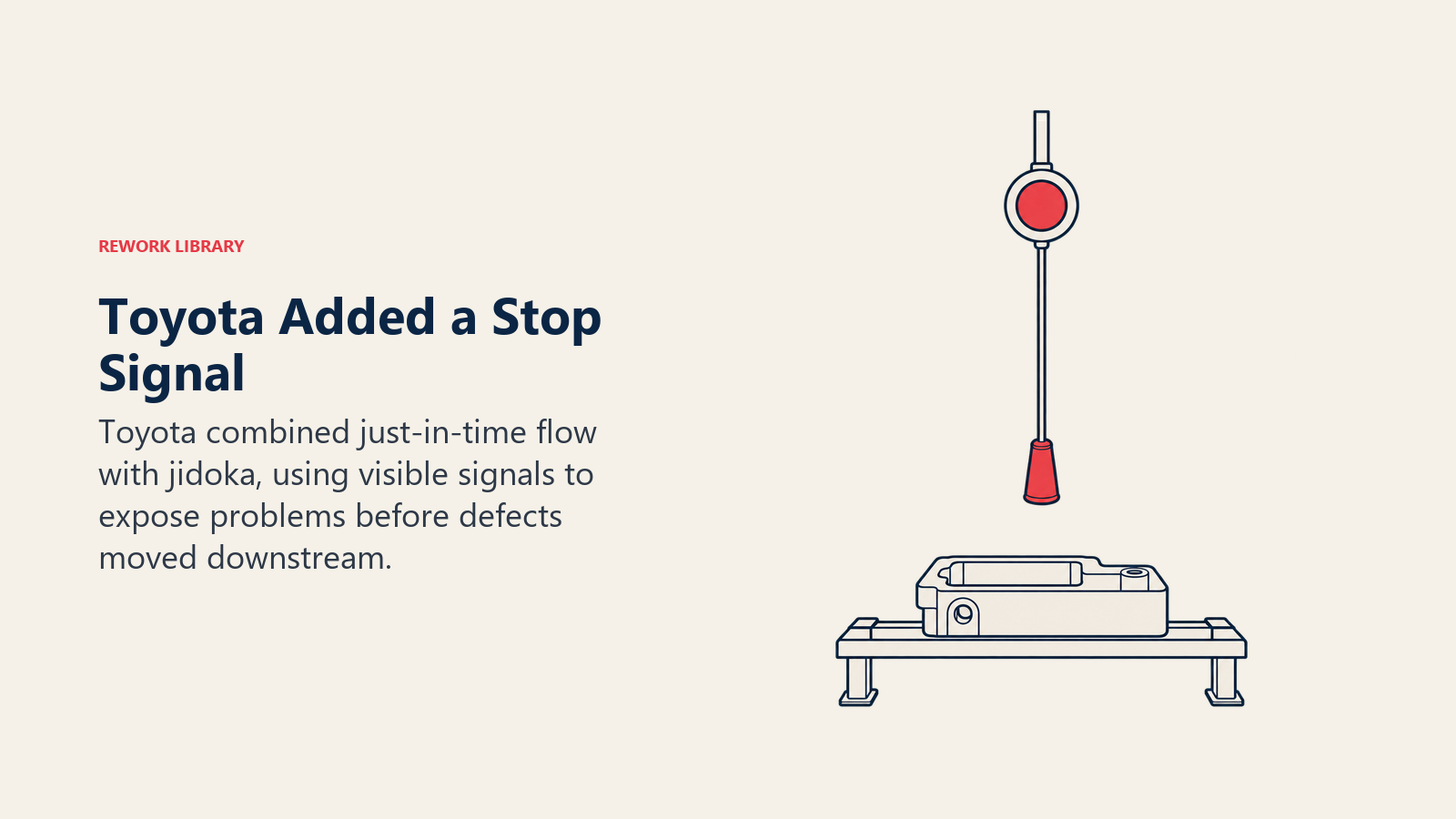
At Toyota, a different answer to the same line was forming. Toyota's own history says the Toyota Production System rests on two core concepts, Just-in-Time and jidoka, described as "automation with a human touch." Kanban was adopted at all plants in 1963, and andon boards were installed at the Kamigo Plant in 1966, so a supervisor could go to the source of a problem. Toyota credits its vice president Taiichi Ohno with establishing the system around those two concepts. Our guides to just-in-time production, lean manufacturing principles and Toyota Kata pick up the story from here.
The line never went away. The International Federation of Robotics reported on September 24, 2026 that factories worldwide ran a record 5 million industrial robots in 2025, up 9 percent in a year.
What it means for teams today: the best modern lines add a way to stop and signal. For any shared workflow, give people a visible way to flag a problem before it passes downstream.
Key People
| Name | Role | Contribution | Year |
|---|---|---|---|
| Adam Smith | Moral philosopher and economist | Described the pin factory and division of labor | 1776 |
| Oliver Evans | Delaware millwright | Built a continuous automatic flour mill | 1780s, patent 1790 |
| Marc Brunel | Engineer | Designed the Portsmouth block-making machines | 1802 |
| Henry Maudslay | Engineer | Built Brunel's machinery | 1802-1805 |
| Samuel Bentham | Inspector-General of Naval Works | Backed mechanization of the royal dockyards | 1795 |
| Eli Whitney | Inventor and contractor | Musket contract and interchangeable-lock demonstration | 1798, 1801 |
| Ransom Olds | Automaker | First major bid for the mass car market | 1901 |
| Henry Ford | Founder, Ford Motor Company | Moving assembly line, $5 day | 1913-1914 |
| Charlie Chaplin | Film maker | Modern Times made the line a cultural symbol | 1936 |
| Taiichi Ohno | Toyota executive | Built TPS around just-in-time and jidoka | 1960s |
| George Devol and Joseph Engelberger | Inventor and entrepreneur | Unimate robot and Unimation | 1954-1961 |
Key Facts
Key Facts: The Assembly Line
- Ford's team cut chassis labor time from 12 hours 28 minutes to 1 hour 33 minutes, by Ford's own account.
- Ford's first moving line was tried on flywheel magnetos in about April 1913, and spread to chassis in October.
- Turnover at Ford reached about 370 percent in 1913, before the $5 day.
- Willow Run averaged one bomber every 63 minutes at its 1944 peak.
- The Lordstown line reached 100 cars an hour in May 1971, and the plant struck for 18 days in 1972.
- Factories ran 5 million industrial robots in 2025.
The Pattern Behind the History
We call this the Flow-and-Fallout Cycle. It is our own synthesis of this timeline, not a published model.
- Parts before the line. Standard, matchable parts came first: Qin triggers, Brunel's blocks, Whitney's locks.
- Flow beats effort. Rearranging work, not working harder, took the Ford chassis from 12.5 hours to 1.5.
- The pace moves to the worker. Once the line sets the speed, people absorb the strain: turnover in 1913, Lordstown in 1972.
- Pay and policy patch the fallout. The $5 day cut turnover but did not change the line.
- The next fix is a signal. Jidoka, andon and robots try to take defects and drudgery out of the human job.
What It Teaches Teams Today
- Standardize the part before you speed the flow. Agree on what a finished handoff looks like.
- Pilot on one component. Ford timed one magneto before he changed a chassis.
- Measure the human cost along with throughput. Turnover, errors and absenteeism show the strain.
- Give people a stop signal. The andon idea works for software teams and sales desks too.
- Revisit pace targets with the people who meet them. Our history of scientific management and the broader history of productivity show the same tension repeating, and the productivity timeline puts it in context.
The assembly line was never one invention. It was a pile of ideas, from marked Qin parts to Ford's conveyor, that each solved a bottleneck and created the next. Teams that remember that tend to fix flow without forgetting the people on it.

Co-Founder, Rework.com