Direct vs Indirect Feedback Across Cultures
Turn this article into takeaways for your work.


Each assistant summarizes the article only for you and suggests best practices for your work.
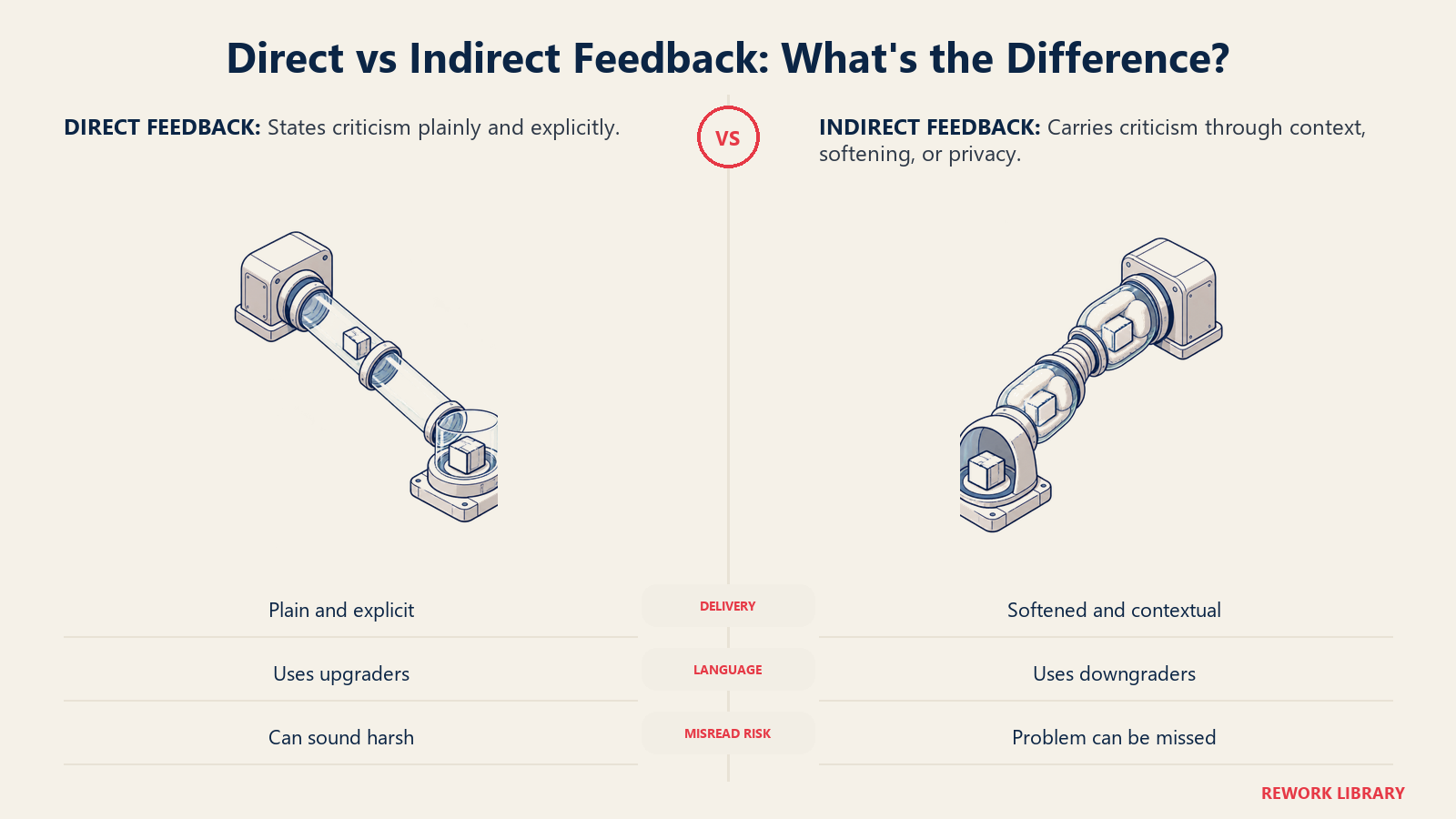
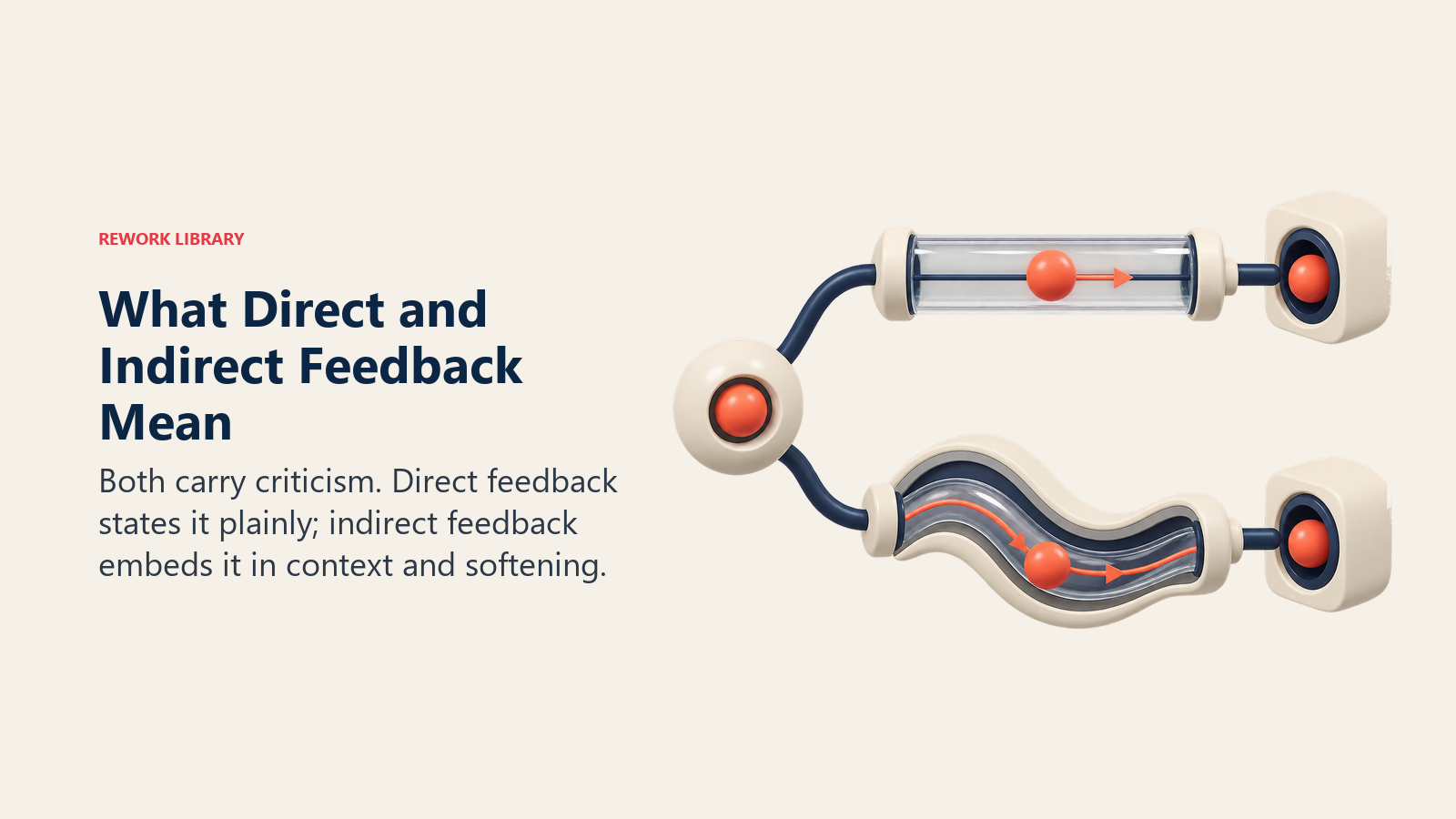
Direct feedback names the problem plainly, without much cushioning. Indirect feedback delivers the same critical information wrapped in context, softened language, or a question that lets the other person reach the conclusion themselves. Neither style is more honest. They are two delivery systems for the same content, and most cross-cultural feedback disasters happen when a leader assumes their own system is the only honest one.
What Direct and Indirect Feedback Actually Means
Every culture gives negative feedback. What varies is whether the criticism stands alone, plainly stated, or gets embedded in praise and softened phrasing so it survives without sounding harsh out loud.
Erin Meyer's Evaluating Scale
The clearest research tool for this question is Erin Meyer's Evaluating scale, one of 8 scales in her book The Culture Map. It runs from Direct negative feedback (criticism is delivered frankly and stands on its own) to Indirect negative feedback (criticism is softened, embedded in positive messages, or implied rather than stated outright). Countries toward the direct pole in Meyer's research include Russia, Israel, the Netherlands, and Germany. Countries toward the indirect pole include Japan, Thailand, Indonesia, and Brazil. The United States and the United Kingdom sit closer to the middle, with the UK leaning more indirect than most Americans expect. We cover all 8 of Meyer's scales, including how Evaluating relates to Deciding and Trusting, in The Culture Map explained.
Meyer also names the specific linguistic devices that make direct or indirect feedback recognizable in the room. Direct cultures lean on "upgraders," words like absolutely, totally, and completely, that intensify a critical statement. Indirect cultures lean on "downgraders," words like kind of, a little, and maybe, that soften the same statement so it lands as a suggestion rather than a verdict. A Dutch manager who says a report is "absolutely not ready" and a Japanese manager who says it is "maybe not quite there yet" can be pointing at the exact same set of problems.
The Surprising Decoupling: Why Low-Context Does Not Mean Direct Feedback
Here is the part that trips up most leaders who have only studied high-context vs low-context culture: Evaluating and Communicating are separate axes, and they do not move together the way intuition suggests.
France is the clearest case. French business culture sits toward the high-context end of Edward Hall's framework, where a lot of everyday meaning gets carried by tone and what is left unsaid. Yet on Meyer's Evaluating scale, France sits firmly on the direct side, and a French manager can deliver blunt, unsoftened criticism, sometimes in front of the team, while still communicating everyday business in a layered way outside that specific moment.
The United States runs the mirror-image surprise. Americans communicate in a famously low-context, explicit style, so it is reasonable to assume that explicitness carries over to negative feedback. It mostly does not. American workplace feedback is well known for the "feedback sandwich," criticism wrapped in two layers of praise, plus a heavy reliance on upgraders attached to praise and downgraders attached to criticism, language that never appears in an ordinary status update. This is exactly why giving feedback as a skill has to be learned separately from general communication style rather than assumed to follow from it.
Direct Feedback Cultures: How They Actually Work
In a direct feedback culture, stating a problem plainly is treated as a form of respect, not an attack.
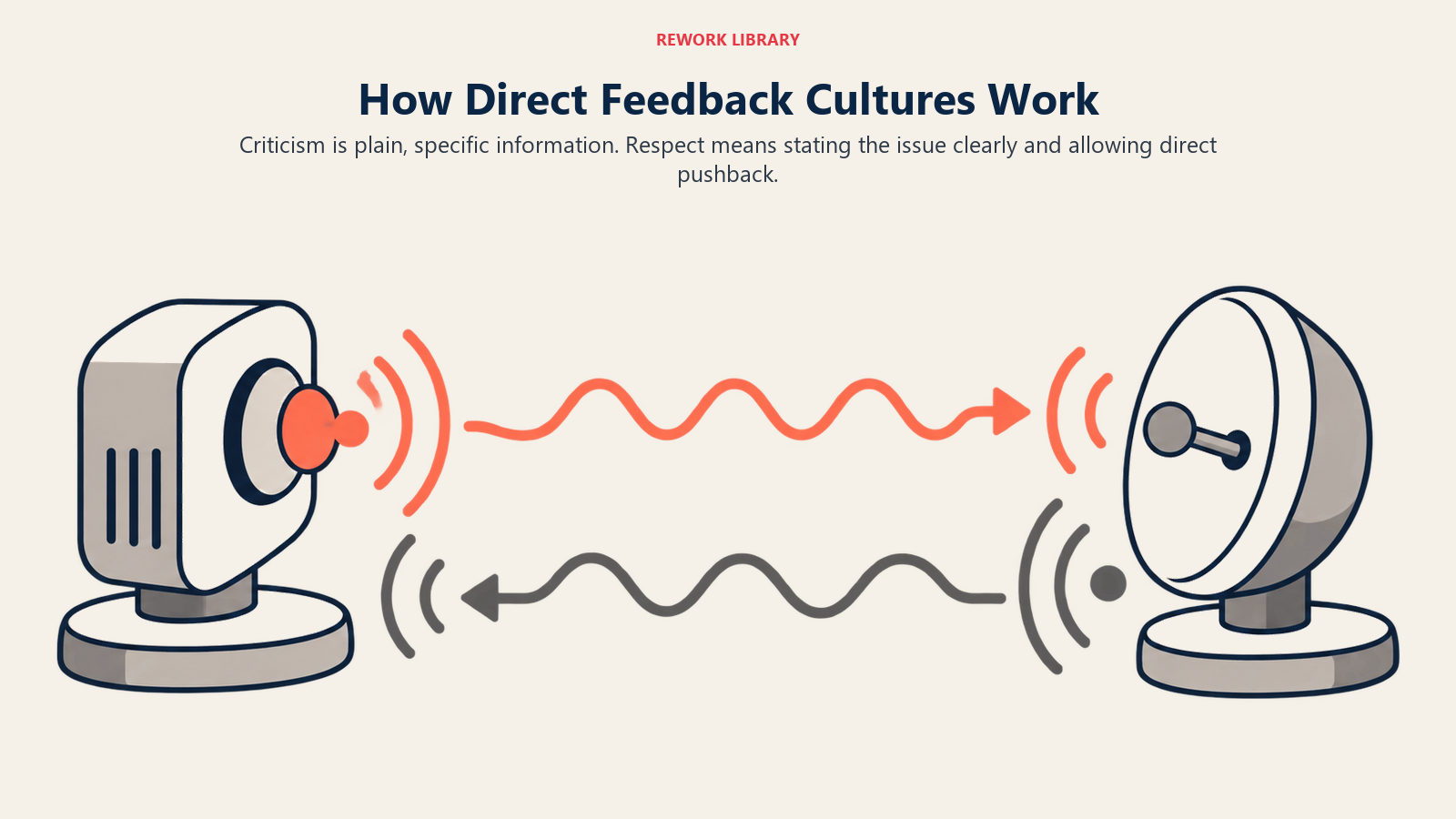
The Netherlands gives criticism as information, not judgment. A Dutch colleague who tells you a plan will not work is handing you a fact to act on, not a verdict on your competence, and expects the same bluntness back without taking offense.
Germany pairs directness with structure. German feedback arrives organized around specific, itemized points stated plainly with no hedging, and a report is expected to push back if they disagree, not just accept it, consistent with the country's low Power Distance and low-context communication.
Russia treats softened feedback as a form of dishonesty. Criticism is typically delivered privately, a real courtesy in Russian business culture, but once delivered it tends to be blunt and specific, closer in tone to the Netherlands than to Western Europe's more diplomatic styles.
Israel is often cited as the most direct feedback culture in Meyer's research, sometimes described locally as "dugri" speech. Disagreement and blunt questions in a meeting read as normal engagement, and a manager who never pushes back is more likely read as disengaged than polite.
Indirect Feedback Cultures: How They Actually Work
In an indirect feedback culture, the goal of a critical conversation is to fix the problem without costing the other person their standing in the room.
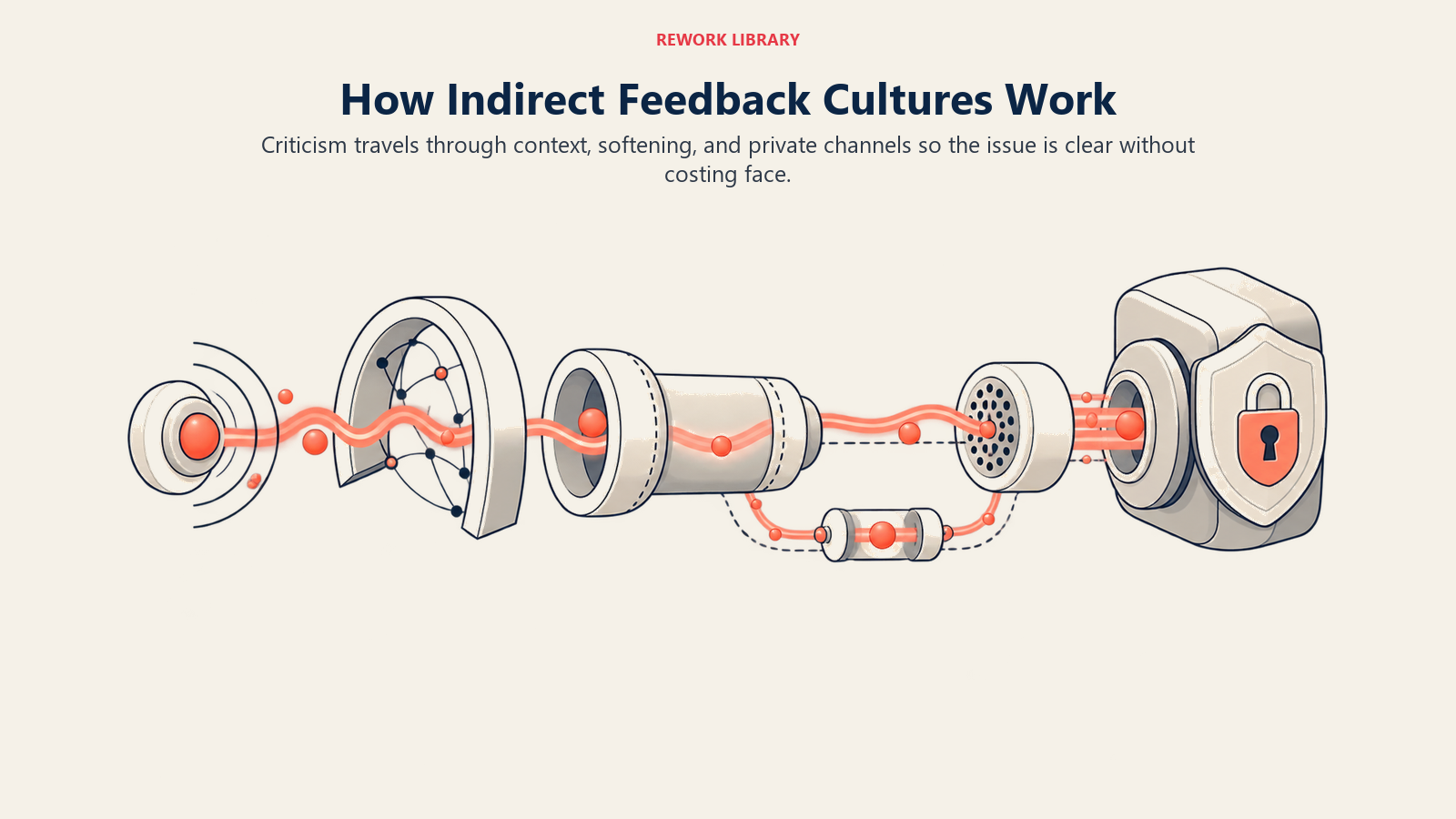
Japan builds feedback into context rather than stating it as a verdict. A phrase like "that might be a little difficult" is frequently a firm no dressed as an open question, and reading it as genuine uncertainty is one of the most common mistakes foreign managers make, a pattern covered further in business culture in East Asia.
Thailand embeds feedback in kreng jai, a reluctance to impose discomfort on someone else. Direct public criticism, especially from a junior employee toward a senior one, is avoided almost entirely; negative feedback more often travels through a trusted intermediary or gets folded into a broader, softer conversation.
Indonesia favors feedback that preserves the other person's comfort and standing, sometimes summarized as avoiding making someone feel tidak enak (uncomfortable). A manager correcting a mistake tends to frame it as a shared problem, a pattern that shows up across much of Southeast Asian business culture.
Brazil and Mexico lean indirect too, closer to the American middle than to Japan's extreme. Feedback gets wrapped in positive framing and delivered privately, and a manager who imports a blunt Northern European style into a Brazilian team can quietly undermine trust for months without ever hearing about it directly.
Country Comparison: Feedback Style at a Glance
The table below plots Meyer's Evaluating scale against Hall's Communicating scale, since the two do not move together.
| Country | Evaluating (Meyer) | Communicating (Hall) | What it actually sounds like |
|---|---|---|---|
| Netherlands | Direct | Low-context | "This has three problems, here they are" |
| Germany | Direct | Low-context | Plain, itemized critique with no hedging |
| Russia | Direct | Higher-context | Blunt criticism, delivered privately first |
| Israel | Direct | Low-context | Open pushback and pointed questions in the room |
| France | Direct | High-context | Blunt criticism, sometimes in front of the group |
| United States | Moderate, leaning indirect | Low-context | The feedback sandwich, upgraders on praise |
| United Kingdom | Indirect | Low-to-mid context | Diplomatic understatement ("not quite there") |
| Japan | Indirect | High-context | Criticism embedded in context, rarely named outright |
| Thailand | Indirect | High-context | Kreng jai, feedback softened or relayed through a third party |
| Indonesia | Indirect | High-context | Feedback framed as a shared problem, not an individual fault |
| Brazil | Indirect | High-context | Feedback wrapped in positive framing, delivered privately |
The pattern worth remembering: Communicating and Evaluating correlate loosely, not perfectly. France and the Netherlands land on the same side of Evaluating while sitting far apart on Communicating, and the United States sits closer to the indirect side of Evaluating despite anchoring the low-context end of Communicating. Reading one scale as a proxy for the other is the single most common misread in cross-cultural feedback.
Key Facts
- Erin Meyer's Evaluating scale, one of 8 scales in The Culture Map, places Russia, Israel, the Netherlands, and Germany toward the direct pole and Japan, Thailand, Indonesia, and Brazil toward the indirect pole. Source: Harvard Business Review, "Navigating the Cultural Minefield," May 2014
- Meyer describes direct cultures using "upgraders" (absolutely, totally, completely) to intensify criticism and indirect cultures using "downgraders" (kind of, a little, maybe) to soften it. Source: erinmeyer.com, "Giving Negative Feedback Across Cultures"
- France sits at the high-context end of Hall's Communicating scale but at the direct end of Meyer's Evaluating scale, one of the clearest examples that the two dimensions operate independently. Source: erinmeyer.com, "Giving Negative Feedback Across Cultures"
- Only 14% of employees strongly agree that the performance reviews they receive inspire them to improve, regardless of which culture's feedback style delivered the review. Source: Gallup, "Give Performance Reviews That Actually Inspire Employees"
- A 2025 Stanford and BetterUp study of 1,150 U.S. desk workers found roughly 40% had received AI-generated "workslop," polished but substance-light output, costing an estimated $9 million a year for a 10,000-person organization. Source: BetterUp Labs, "Workslop: The Hidden Cost of AI-Generated Busywork"
- Google's Project Aristotle study of 180 teams found psychological safety, the ability to speak up including with hard feedback, was the strongest predictor of team effectiveness. Source: Google re:Work, "Understand team effectiveness"
Workplace Impact: Performance Reviews, 360s, and Misreadings
This gap shows up in three specific processes almost every global company runs.
Performance Reviews Across the Gap
A written review template built by a direct-feedback culture (itemized weaknesses, a numeric rating, a clear "needs improvement" line) can feel unnecessarily harsh to an employee from an indirect-feedback culture, sometimes hard enough that they read it as a sign they are about to be managed out. The reverse breaks the other way: a review written in careful, indirect language for a direct-feedback employee can fail to register as a problem at all, and the employee walks out believing everything is fine.
360-Degree Feedback and Cultural Blind Spots
A 360 process assumes peers will surface honest concerns anonymously. In an indirect-feedback culture, anonymity does not automatically produce candor, since softening criticism is usually about preserving group harmony, not fear of being identified, so scores can still cluster near the top even when real concerns exist. In a direct-feedback culture, the opposite risk shows up: blunt written comments that read as constructive can land as unusually harsh once reviewed by an HR team calibrated to a more indirect norm. One global template without adjustment produces data that looks consistent across offices but means very different things in each one.
How Feedback Gets Misread
The most common failure is not malice, it is a category error. A leader raised in a direct culture can read a softened comment as vague or unhelpful rather than a signal that took real social effort to deliver. A leader raised in an indirect culture can read blunt feedback as personal criticism rather than the routine, almost neutral correction it was intended to be. Both misreads erode trust for reasons that have nothing to do with the substance of the feedback, which is exactly the dynamic behind why teams stay silent in meetings once someone has been burned by a misread.
How a Leader Calibrates Feedback Per Person
Calibrating feedback style is a skill, not a script, adjusted person by person, not just country by country.
Diagnose before you deliver. Ask a trusted colleague from an unfamiliar culture how criticism usually lands there, or simply ask the person directly. Assuming a national default without checking is only marginally better than assuming everyone follows your own.
Adjust the packaging, not the substance. What changes is how much context and softening surrounds the message, not the content itself. A direct-feedback employee working with an indirect-feedback manager may need to hear explicitly, "I am going to be blunt because that is useful, not because I am upset," so the delivery does not get misread as anger. Watch the opposite trap too: softening a serious issue so much it disappears entirely, so the problem never registers.
Build the individual relationship over time. The best predictor of whether feedback lands well across a cultural gap is not the delivery style, it is whether the relationship already has enough trust to absorb a hard message, covered in building trust in the workplace. This calibration is one piece of the larger skill in how to build a feedback culture: feedback only works if the delivery style actually reaches the person receiving it.
Common Cross-Cultural Feedback Clashes
A direct-feedback manager gives blunt written feedback to an indirect-feedback report, who reads it as a warning they are about to be fired. The manager thought they were being efficient. The employee spends the next month anxious and disengaged, and the manager has no idea a routine comment did that much damage.
An indirect-feedback manager gives carefully softened feedback to a direct-feedback report, who never registers there was a problem. Three months later the same issue resurfaces at review time and the employee feels blindsided, insisting nobody ever told them, while the manager insists they raised it clearly, once, in the gentlest way their own culture considers unambiguous, a mismatch covered further in managing a multicultural team.
Direct vs Indirect Feedback and AI
AI-drafted feedback introduces a new version of the same problem. A tool trained mostly on generic, Western, feedback-sandwich patterns tends to read as diplomatic in a direct-feedback culture and either too soft to register, or jarringly blunt, in an indirect-feedback one, because it flattens the cultural texture out of the message along with the effort of writing it. That flattening is a specific case of the broader "workslop" problem: content that looks like considered feedback but was never shaped for the person receiving it, which recipients notice and quietly discount.
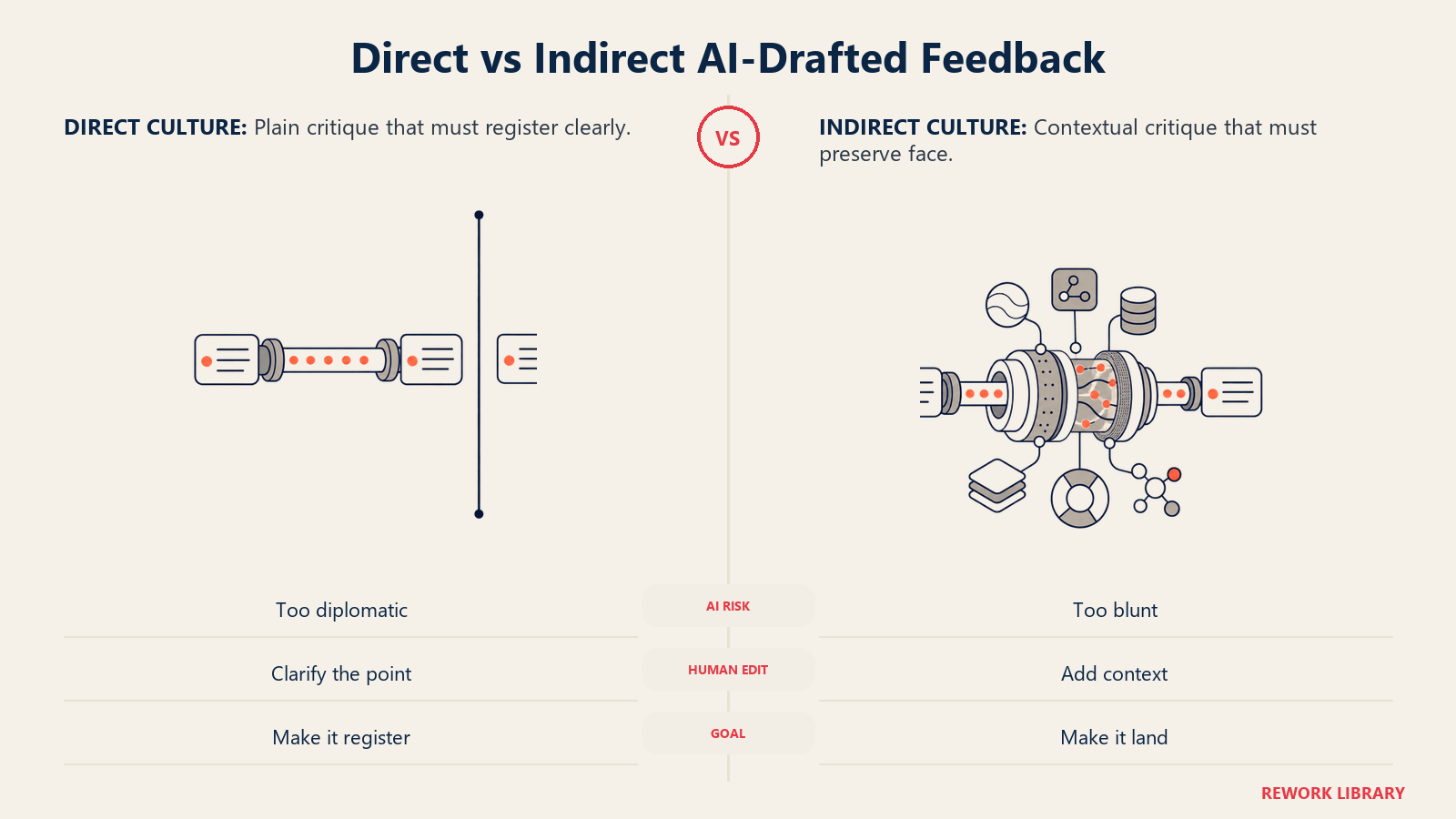
The fix is not to avoid AI drafting help, it is to treat a generated draft as a first pass a human who knows the recipient adjusts before it goes out. Leaders extending feedback norms to AI-assisted communication, and eventually to agents reporting their own status, are running into the same calibration question covered in what AI-native culture actually looks like: the technology changes who is doing the talking, not the fact that the message still has to land with a specific human, in their specific register.
Where to Go Next
Direct versus indirect feedback is one piece of a bigger picture. From here:
- The Culture Map explained, for all 8 of Erin Meyer's scales
- High-context vs low-context cultures, for Edward Hall's framework behind the Communicating scale
- How to build a feedback culture, for making feedback continuous, two-way, and safe
- How business culture differs across the world, for the wider map of national culture differences
Frequently Asked Questions about Direct vs Indirect Feedback Across Cultures
What is the difference between direct and indirect feedback?
Direct feedback states a problem plainly and lets it stand on its own. Indirect feedback delivers the same critical information wrapped in context, softened language, or a question, so the other person can arrive at the conclusion without it being stated outright. Neither approach is more honest, they are different delivery systems for the same content.
What is Erin Meyer's Evaluating scale?
The Evaluating scale is one of 8 scales in Erin Meyer's The Culture Map, measuring whether a culture delivers negative feedback directly and standing alone, or indirectly and softened. Russia, Israel, the Netherlands, and Germany sit toward the direct pole, while Japan, Thailand, Indonesia, and Brazil sit toward the indirect pole.
Is a low-context culture always direct with feedback?
No. Communicating (how much meaning lives in the words) and Evaluating (how bluntly criticism is delivered) are separate scales. France is high-context in general communication but direct in feedback, while the United States is low-context in communication but leans indirect in feedback, using devices like the feedback sandwich.
Which countries give the most direct feedback, and which give the most indirect?
Russia, Israel, the Netherlands, and Germany are commonly cited as the most direct feedback cultures, with Israeli feedback tending toward openly confrontational and Dutch or German feedback blunt but calm and itemized. Japan, Thailand, Indonesia, and Brazil sit toward the indirect end, where feedback is often embedded in context or relayed through a trusted intermediary to protect someone's standing in the room.
How should a manager give feedback to someone from a different feedback culture?
Diagnose the person's preference rather than assuming a national default, keep the substance the same while adjusting how much softening or context surrounds it, and watch for the trap of softening a serious issue until it disappears entirely. Building trust with the individual matters more than getting the delivery style perfect on the first try.
Does AI-generated feedback handle these cultural differences well?
Not by default. Most AI drafting tools default to a generic, moderately softened style that can read as too weak in an indirect-feedback culture or land fine in a direct one, without ever being calibrated to the specific recipient. Treating a draft as a first pass a human adjusts before sending is safer than sending it unedited.
Why does 360-degree feedback often produce misleading results across countries?
Because anonymity does not remove cultural habits. Indirect-feedback cultures can still cluster scores near the top out of a preference for preserving harmony, not fear of being identified, while direct-feedback cultures produce a wider, blunter spread. Comparing raw scores across offices without adjusting for feedback style produces a false picture of performance.
Direct and indirect feedback are not a scale of honesty, with one end telling the truth and the other hiding it. They are two equally legitimate systems for making a hard message survivable for the person receiving it. The leaders who get this right do not pick a single style and apply it everywhere. They learn to read which system the person in front of them is running, then deliver the same honest substance in whichever packaging actually gets heard.

Co-Founder, Rework.com
On this page
- What Direct and Indirect Feedback Actually Means
- Erin Meyer's Evaluating Scale
- The Surprising Decoupling: Why Low-Context Does Not Mean Direct Feedback
- Direct Feedback Cultures: How They Actually Work
- Indirect Feedback Cultures: How They Actually Work
- Country Comparison: Feedback Style at a Glance
- Key Facts
- Workplace Impact: Performance Reviews, 360s, and Misreadings
- Performance Reviews Across the Gap
- 360-Degree Feedback and Cultural Blind Spots
- How Feedback Gets Misread
- How a Leader Calibrates Feedback Per Person
- Common Cross-Cultural Feedback Clashes
- Direct vs Indirect Feedback and AI
- Where to Go Next