Business Culture in Southeast Asia: A Leader's Guide
Turn this article into takeaways for your work.


Each assistant summarizes the article only for you and suggests best practices for your work.
Business culture in Southeast Asia shares a recognizable pattern across Vietnam, Malaysia, the Philippines, Indonesia, and Thailand: high power distance, collectivist decision-making, relationship before task, and a strong emphasis on protecting face and group harmony. Singapore is the regional outlier, blending the same hierarchy with far more individualist, process-driven norms.
That single pattern explains more than most leaders expect. A manager who gets silence instead of pushback in a Hanoi standup, a Manila team that agrees to a deadline everyone privately knows is impossible, a Jakarta report that reads more positive than the underlying numbers support: these are not isolated quirks. They are the same regional default showing up in different rooms. This guide covers what that shared pattern is, where the six major Southeast Asian economies sit on it, the local concepts that give it different flavors country to country, and a working playbook for leading a team that spans several of them at once.
A note on scope before we go further. This is a regional map, not a country-by-country manual. Vietnam, Thailand, Indonesia, the Philippines, and Malaysia each have their own history, religion, language, and business norms that a single article cannot do justice to. Treat what follows as the shared starting hypothesis; deeper, country-specific guides are coming as this collection grows.
The Shared Pattern: High Hierarchy, Collective, Relationship-First
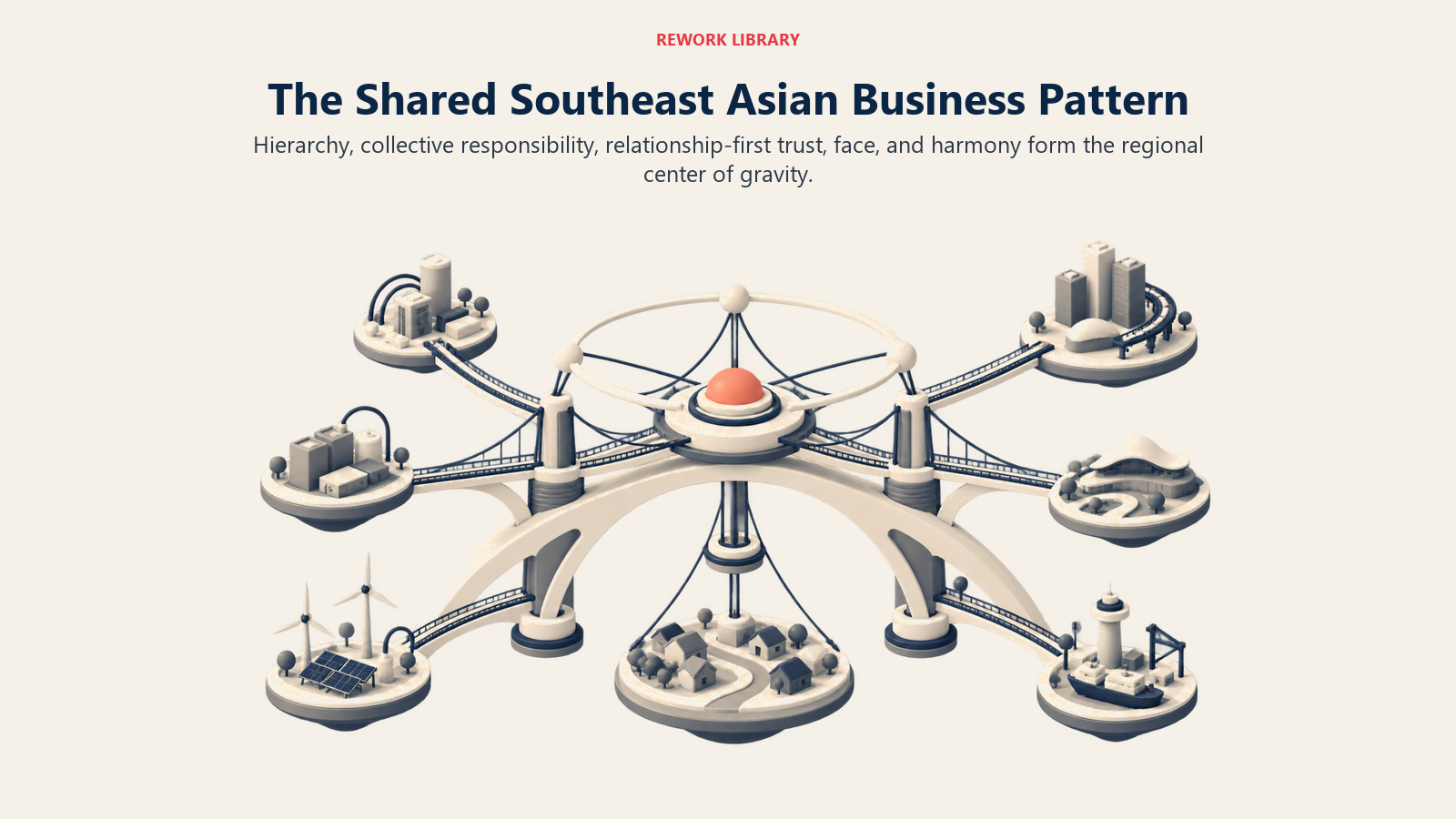
Southeast Asia is not culturally uniform. It spans Buddhist-majority Thailand, Muslim-majority Indonesia and Malaysia, Catholic-majority Philippines, and a historically Confucian-influenced Vietnam. Despite that range, five of the six major economies in the region cluster tightly on the two dimensions that predict the most about how business actually gets done: Hofstede's Power Distance (PDI) and Individualism versus Collectivism (IDV).
| Country | Power Distance (PDI) | Individualism (IDV) | Pattern |
|---|---|---|---|
| Malaysia | 100 | 26 | Hierarchical, collective |
| Philippines | 94 | 32 | Hierarchical, collective |
| Indonesia | 78 | 14 | Hierarchical, collective |
| Singapore | 74 | 20 | Hierarchical, collective, but low-friction |
| Vietnam | 70 | 20 | Hierarchical, collective |
| Thailand | 64 | 20 | Hierarchical, collective |
Source: geerthofstede.com, Hofstede's published country data. For the full six-dimension model behind these two scores, see Hofstede's cultural dimensions explained. For how this region compares to the rest of the world, see how business culture differs across the world.
Every country in this table sits well above the global PDI midpoint of roughly 50, and every one sits well below the global IDV midpoint. That combination produces a set of defaults a Western or global leader should expect walking into any of these markets:
Decisions defer upward. The most senior person in the room, or the person that person answers to, is expected to make the call. Proposing a decision without visible senior sign-off can read as overstepping rather than initiative.
Disagreement rarely surfaces in open meetings. Junior employees are not being passive when they stay quiet after "does anyone disagree?" They are following a well-understood norm that open pushback against a superior, especially in front of peers, is disrespectful, not honest.
The group outranks the individual. Credit, blame, and even basic feedback get processed at the team or department level far more than in individualist cultures. Singling one person out, even to praise them, can create as much discomfort as public criticism does.
Face and harmony guide how things get said. Nobody wants to be the person who caused someone else to lose standing in front of others, whether that is a subordinate correcting a boss or a vendor telling a client their timeline is unrealistic. Protecting face is not evasiveness. It is the actual mechanism that keeps the relationship, and the working arrangement, intact.
Why the Region Clusters This Way
Historical and religious threads run through this pattern without fully explaining it on their own. Confucian-influenced respect for hierarchy and elders shaped much of mainland Southeast Asia, colonial administrative structures left their own hierarchical residue across the archipelago nations, and the region's dominant religious traditions, Buddhism, Islam, and Catholicism, each carry a strong communal, group-first ethic in their own way. No single cause explains a shared pattern like this. What matters for a working leader is that the pattern is consistent enough, and different enough from Western defaults, to plan around deliberately rather than by trial and error.
Singapore: The Regional Outlier
Singapore sits in an unusual spot on the map: a PDI of 74 that is closer to its ASEAN neighbors than to the West, paired with an IDV of 20 that also lands squarely in collectivist territory. On paper, it looks like the rest of the region. In practice, decades of British administrative legacy, an English-first business environment, and one of the world's lowest Uncertainty Avoidance scores have produced a business culture that still respects hierarchy and group harmony, but resolves disagreement faster, documents decisions more explicitly, and tolerates direct written feedback more comfortably than Jakarta, Hanoi, or Manila typically do. Leaders often treat Singapore as a bridge market between Western and Southeast Asian business norms, and the Hofstede numbers back that read.
Key Facts
- Malaysia holds one of the highest Power Distance scores Hofstede has measured globally, at 100, while Indonesia (14) and Vietnam (20) sit among the lowest Individualism scores recorded, together defining the region's hierarchical, collective center of gravity. Source: geerthofstede.com
- Singapore's Power Distance score (74) sits closer to its Southeast Asian neighbors than to the low-PDI cultures of the US (40) or UK (35), even though its business practices often read as more Western. Source: Hofstede Insights country comparison tool
- ASEAN's ten member states have a combined population of more than 680 million people, making Southeast Asia one of the largest single economic regions global leaders manage teams across. Source: ASEAN Secretariat
- The GLOBE study, one of the largest cross-cultural leadership research projects ever conducted, surveyed roughly 17,000 middle managers across 950 organizations in 62 societies, including several Southeast Asian nations, to map how culture shapes leadership expectations. Source: globeproject.com
- A Harvard Business Review analysis found 89% of white-collar workers surveyed across 90 countries said they at least occasionally work on global virtual teams that cross national borders, the exact setting where Southeast Asia's regional pattern most often meets a Western manager unprepared for it. Source: hbr.org
The Local Concepts Behind the Pattern
The shared regional pattern is real, but it does not mean these five countries are interchangeable. Each has its own word for how face, harmony, and hierarchy actually operate day to day, and a leader who learns even one of these terms will read a room more accurately than one who only knows the Hofstede scores.
In Vietnam, the operative concept is thể diện, usually translated as face. Losing thể diện in front of colleagues, especially in a public correction, does lasting damage to how a person is seen and treated afterward, which is why criticism tends to move through private, one-on-one channels rather than group settings.
In Thailand, the closest concept is kreng jai, a reluctance to impose on someone else, ask them for something, or cause them discomfort, even at real cost to the person feeling it. A Thai colleague who says nothing when a deadline is unworkable may be exercising kreng jai rather than agreeing that the deadline is fine.
In Indonesia, the phrase asal bapak senang (literally "as long as the boss is happy") describes the tendency to tell a superior what keeps them satisfied rather than what is strictly accurate. It is spoken about critically inside Indonesia itself, a recognized failure mode rather than an aspiration, but it shapes how much a leader should discount uniformly positive status updates.
In the Philippines, pakikisama describes the value placed on smooth interpersonal relations and getting along with the group, even when that means going along with a decision a person privately disagrees with. It is closely tied to why open dissent in a Filipino team meeting is rare even when real concerns exist.
In Malaysia, budi bahasa refers to courtesy, refined manners, and the etiquette expected in how people speak to and about each other, particularly across a hierarchy. A well-known Malay saying, budi bahasa mencerminkan bangsa ("courtesy reflects the nation"), captures how much weight the culture places on polished, face-preserving language even when delivering difficult news.
These five terms are not simply local flavor text. They are the actual mechanisms that produce the shared regional pattern in the table above, and understanding even one of them tends to make the other four easier to recognize. Country-specific guides covering each of these dynamics in depth, along with the practical playbooks for managing teams in Vietnam, Thailand, Indonesia, the Philippines, and Malaysia individually, are planned as spokes off this regional overview.
A Leader's Playbook for Managing Southeast Asian Teams
Knowing the pattern only helps if it changes what happens in your next meeting, your next piece of feedback, and your next decision. Here is how to apply it.
Running Meetings: Read Silence Correctly
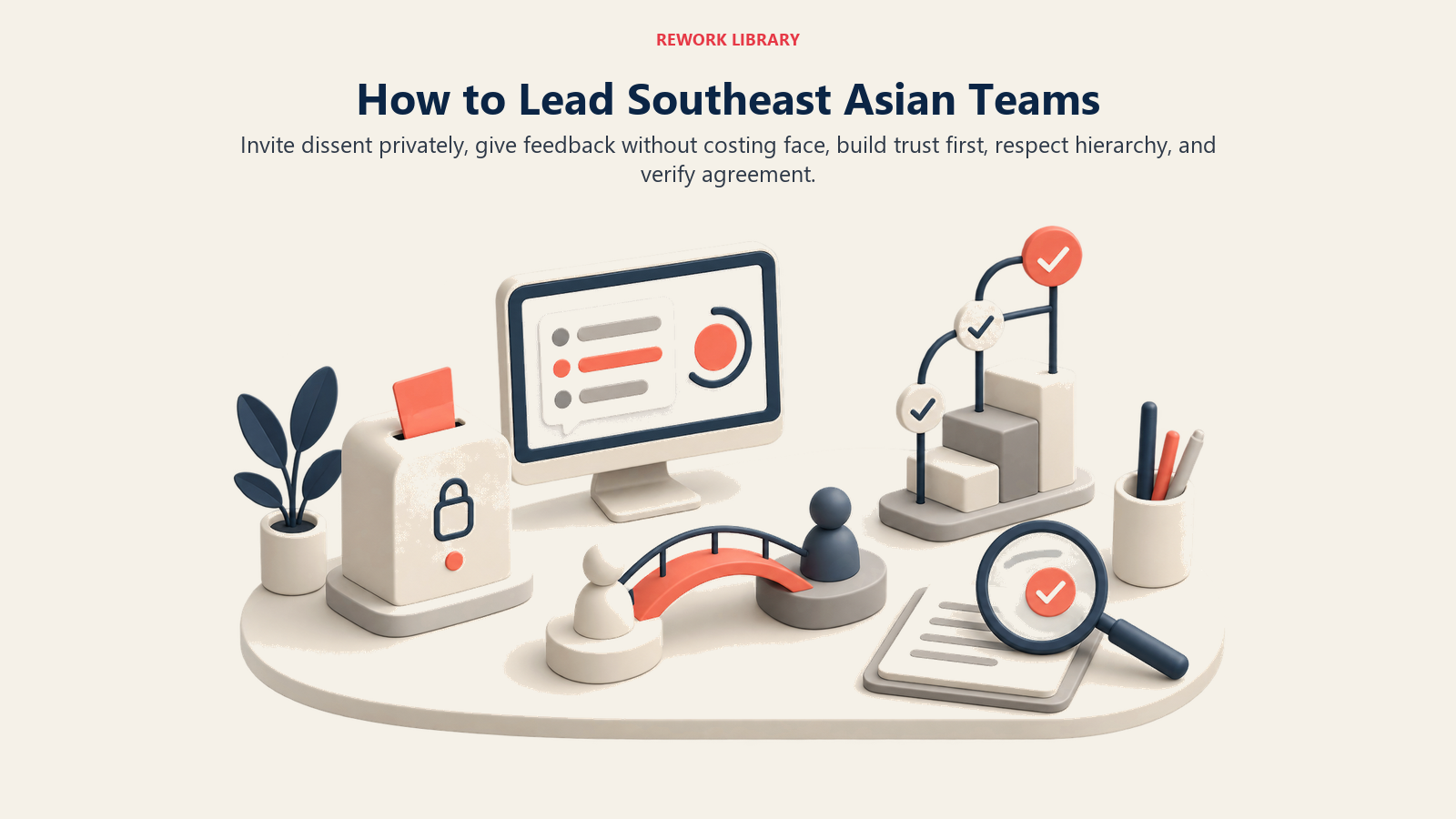
In a high-PDI, collectivist culture, silence after "any objections?" is one of the least reliable signals a leader can rely on. It is far more often a sign that dissent is being routed somewhere other than the room than a sign of genuine agreement. Build a parallel channel for concerns to surface: a private message after the call, a short one-on-one before a decision is finalized, or an anonymous form for sensitive topics. This is the same dynamic covered in depth in why teams stay silent in meetings, and it is worth treating as a structural feature of the meeting, not a personality trait of the people in it.
Giving Feedback Without Costing Someone Face
Direct, in-the-moment feedback that works well in a low-context, individualist culture can land as a public loss of face across most of Southeast Asia. Keep the standard high, but change the delivery: give the same substance privately, lead with something that is genuinely working, and leave the person a way to correct course without an audience. Where possible, route sensitive feedback through the person's direct manager rather than skipping a layer, since the hierarchy itself is often the channel people expect feedback to travel through. Radical candor as a framework still applies; what changes is the delivery mechanism, not the honesty.
Building Trust Before the Business Case
Relationship-first cultures build trust through time spent together before the transaction, not after it. A meal, unhurried small talk, or a genuine question about someone's team before the agenda starts is not a delay in Southeast Asia. It is the actual process by which two parties decide they can rely on each other. Skipping straight to the ask, which reads as efficient in a task-first culture, can read as presumptuous or even disrespectful here.
How Decisions Actually Get Made
Expect decisions to move through the hierarchy rather than around it. A proposal that looks fully formed to a Western leader may still need visible sign-off from someone more senior before a Southeast Asian team will treat it as real, even if that person said little in the meeting where it was discussed. Build in time for that consultation rather than treating it as friction; skipping it can produce a decision that technically got approved but never actually gets executed, because the people expected to carry it out never saw it endorsed by the right person.
Common Mistakes to Avoid
A few habits cause the most damage with Southeast Asian teams specifically. Publicly correcting someone in front of peers, even gently, tends to cost more trust here than almost anywhere else. Treating an enthusiastic "yes" as a firm commitment without checking for the softer signals of reluctance (a delayed response, a vague qualifier, a change of subject) leads to deadlines that quietly slip. And assuming Singapore's more Western-facing business style extends to its neighbors is one of the most common and most costly generalizations a leader visiting the region makes.
Business Culture in Southeast Asia in the Age of AI
Southeast Asia, particularly the Philippines and Vietnam, has become one of the world's largest hubs for remote and outsourced knowledge work, from customer support to software engineering to back-office finance. That means a growing share of Southeast Asian professionals now work inside distributed, asynchronous teams alongside colleagues in the US, Europe, and Australia, often with AI tools and increasingly AI agents doing part of the work alongside them.
This shift does not erase the region's cultural defaults; it changes where they show up. A written Slack message or a code review comment can carry the same face-preserving caution as a spoken one, sometimes more, since there is no tone of voice to soften a blunt line of text. And an AI teammate that never worries about hierarchy or face can behave in ways that read as refreshingly neutral to some Southeast Asian employees and jarringly abrupt to others, an early, honest open question rather than a settled answer. Leaders building ai-native culture across a Southeast Asian team should expect the region's usual face and hierarchy dynamics to resurface in async and human-AI interactions, not disappear because a human is no longer the one delivering the message. The risk of AI cultural debt accumulating quietly, unclear norms about when an AI teammate speaks for the team versus when a human should, is arguably higher in high-context cultures where so much is normally communicated indirectly in the first place. For the broader shift toward human-agent teams reshaping how work gets organized, see the Frontier Firm and the agent boss.
For organizations running distributed teams across the Philippines, Vietnam, and the rest of the region, the operational side of this, consistent onboarding across time zones, visible attendance and timesheet records, and clean handoffs between HR and local managers, is easier to run well when it is not scattered across five disconnected tools per country office. That is the kind of unglamorous consistency Rework's People app is built to support; it does not replace the cultural judgment above it.
Where to Go Next
This regional overview sits alongside the broader cross-cultural pillar in this collection. From here:
- How business culture differs across the world, for the full global map and a general leader's playbook
- Hofstede's cultural dimensions explained, for all six dimensions and scores across more countries
- The Culture Map, explained, for Erin Meyer's framework on reading feedback and communication style
- Why teams stay silent in meetings, for the specific pattern behind Southeast Asia's quiet meetings
- Country-specific guides for Vietnam, Thailand, Indonesia, the Philippines, and Malaysia are planned as this collection expands
Frequently Asked Questions about Business Culture in Southeast Asia
What do Southeast Asian business cultures have in common?
Vietnam, Malaysia, the Philippines, Indonesia, Thailand, and, to a lesser degree, Singapore share a high power distance, collectivist pattern: decisions defer to seniority, open disagreement rarely surfaces in group settings, and protecting face and group harmony shapes how feedback and disagreement get communicated.
Is Southeast Asian business culture the same across every country in the region?
No. The five hierarchical, collective countries share a statistical pattern on Hofstede's Power Distance and Individualism scores, but each has its own history, religion, and specific cultural concepts, thể diện in Vietnam, kreng jai in Thailand, asal bapak senang in Indonesia, pakikisama in the Philippines, and budi bahasa in Malaysia, that shape how the shared pattern actually plays out day to day.
Why does Singapore not fit the regional pattern as closely?
Singapore's Power Distance score (74) is close to its neighbors, but decades of British administrative legacy, an English-first business environment, and one of the world's lowest Uncertainty Avoidance scores have produced a more Western-facing, process-driven business style that tolerates direct feedback and faster decision-making more comfortably than most of the rest of the region.
How should a leader interpret silence in a meeting with a Southeast Asian team?
Silence after a question like "does anyone disagree?" is rarely a reliable sign of agreement in high power-distance cultures. It usually means dissent is being routed somewhere other than the open meeting, so leaders should build a private channel, a one-on-one, a message, or an anonymous form, where concerns can surface without contradicting a senior person publicly.
How should feedback be delivered to Southeast Asian teams?
Keep the standard high, but change the delivery. Give feedback privately rather than publicly, lead with what is working before addressing what needs to change, and where possible route it through the person's direct manager rather than skipping a layer of hierarchy, since the reporting line itself is often the channel people expect feedback to travel through.
Does hierarchy in Southeast Asian business culture mean employees are less capable or less willing to work hard?
No. High power distance describes how authority and disagreement are expressed, not competence or effort. Southeast Asian professionals are as capable and motivated as any other region; the difference is that dissent, ambition, and disagreement tend to travel through indirect, relationship-preserving channels rather than being voiced openly in a group setting.
How is AI changing business culture in Southeast Asia?
Southeast Asia, especially the Philippines and Vietnam, is a major hub for remote and outsourced knowledge work, so a growing share of the region's professionals now collaborate asynchronously with global teams and, increasingly, AI agents. The region's face-preserving and hierarchy-driven communication norms carry over into written and human-AI interactions rather than disappearing, so leaders should extend the same cultural awareness to async channels and AI teammates that they apply in person.
What is the biggest mistake a Western leader makes managing a Southeast Asian team?
Treating an agreeable "yes" as a firm commitment without checking for softer signals of reluctance, and publicly correcting someone in front of peers, are two of the most damaging habits. Both cost more trust in a face-conscious, high power-distance culture than they typically would in a low-context, individualist one.
Southeast Asia is not one culture wearing six different flags, but it is close enough to one pattern that a leader who understands hierarchy, collectivism, and face across the region will get more right walking into Hanoi, Jakarta, Manila, Kuala Lumpur, or Bangkok for the first time than one who treats each market as a total unknown. The pattern is the starting hypothesis. The specific team in front of you, and the country-specific dynamics still to come in this collection, will always fill in the rest.

Co-Founder, Rework.com
On this page
- The Shared Pattern: High Hierarchy, Collective, Relationship-First
- Why the Region Clusters This Way
- Singapore: The Regional Outlier
- Key Facts
- The Local Concepts Behind the Pattern
- A Leader's Playbook for Managing Southeast Asian Teams
- Running Meetings: Read Silence Correctly
- Giving Feedback Without Costing Someone Face
- Building Trust Before the Business Case
- How Decisions Actually Get Made
- Common Mistakes to Avoid
- Business Culture in Southeast Asia in the Age of AI
- Where to Go Next