Business Culture in Western Europe: Germany, France, the UK, and the Netherlands
Turn this article into takeaways for your work.


Each assistant summarizes the article only for you and suggests best practices for your work.
Updated August 2026
Business culture in Western Europe shares a loose family resemblance across Germany, France, the UK, and the Netherlands: lower power distance than most of the world, an individualist, task-based orientation, and a preference for structured process over improvisation. That resemblance is real but shallow. The four countries run on noticeably different rules for hierarchy, directness, and how decisions actually get made, and treating them as one interchangeable "European" style is one of the most common mistakes a global leader makes.
A German project plan that specifies every dependency two months out, a French meeting where junior staff openly argue a point with a senior director, a British email that says "you might want to consider" when it means "do this," a Dutch colleague who tells you flatly that your idea is not good enough: these are not random quirks. Each is the visible edge of a distinct national pattern that a single "Western Europe" label flattens out. This guide covers the pattern the four countries share, where they diverge once you look closer, and a practical playbook for leading a team that spans some or all of them.
A note on scope: this is a map across four of Western Europe's largest economies, not a full survey of the region. Belgium, Austria, Switzerland, and Ireland have their own dynamics that deserve their own treatment. Treat what follows as a starting hypothesis for Germany, France, the UK, and the Netherlands, detailed enough that you do not walk into Frankfurt expecting Amsterdam.
The Shared Pattern, and Why It Is Thinner Than It Looks
Compared to the rest of the world, Germany, France, the UK, and the Netherlands do cluster on a few dimensions. All four sit well below the global midpoint on Hofstede's Power Distance Index, meaning subordinates generally expect to be consulted rather than simply told, and challenging a decision is not automatically read as disrespect the way it often is in higher-hierarchy regions. All four also lean individualist: performance is evaluated at the level of the person, not just the team, and a direct report is expected to advocate for their own view rather than defer to group consensus by default. And all four run on relatively structured, task-based norms, agendas, written follow-ups, defined roles, compared to relationship-first cultures where a meeting exists mostly to build trust before the real decision happens elsewhere.
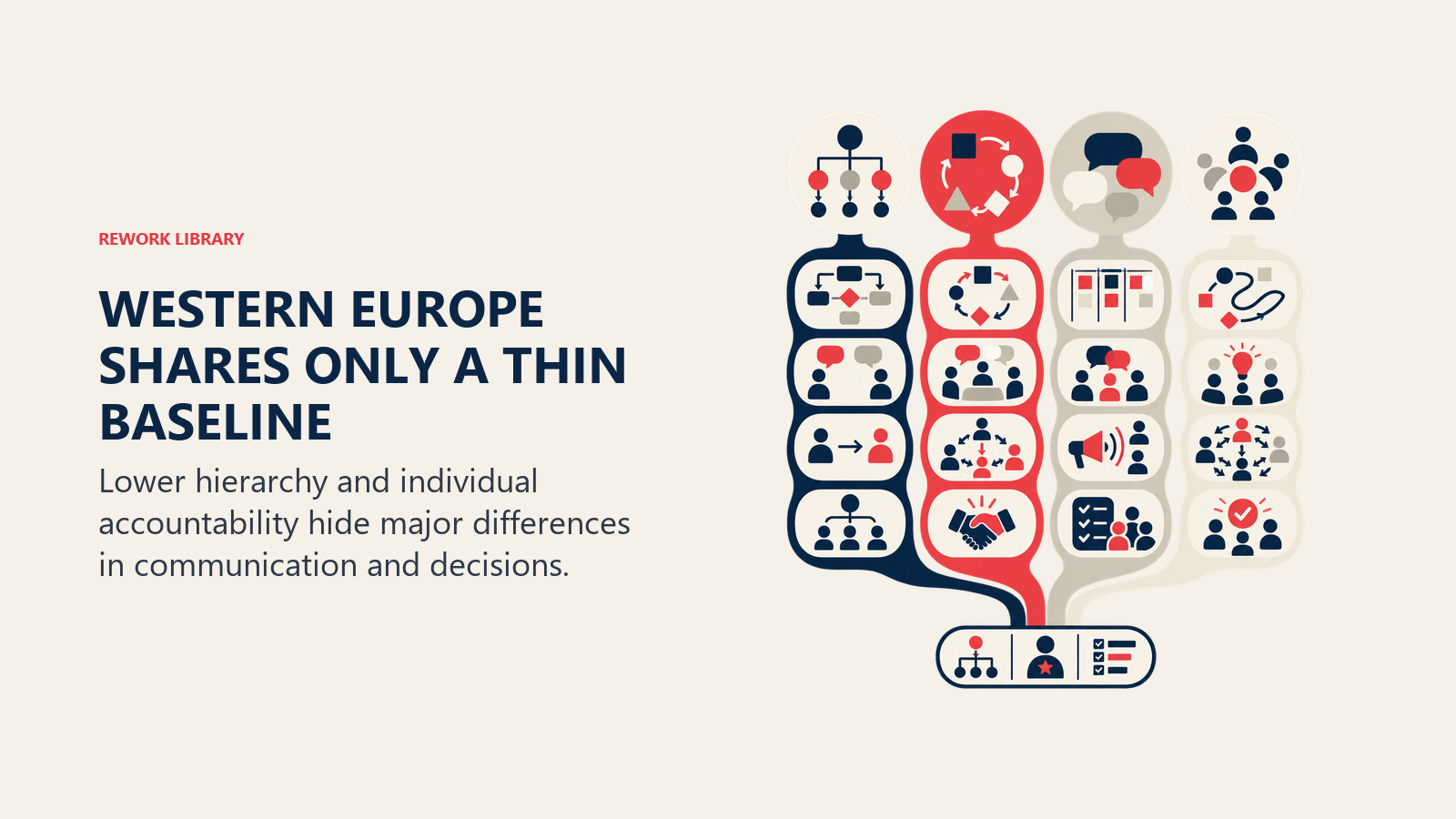
That is a genuinely useful starting point for a leader arriving from a high power-distance, collectivist, relationship-first market. It tells you, correctly, to expect more open disagreement, more individual accountability, and less ritual relationship-building than in Southeast Asia or much of East Asia. But it is also where most observers stop looking, and it is exactly where the costly differences begin. For the six-dimension model behind these comparisons, see Hofstede's cultural dimensions explained, and for how this cluster sits against the rest of the world, see how business culture differs across the world.
Why "Western Europe" Is Not One Culture
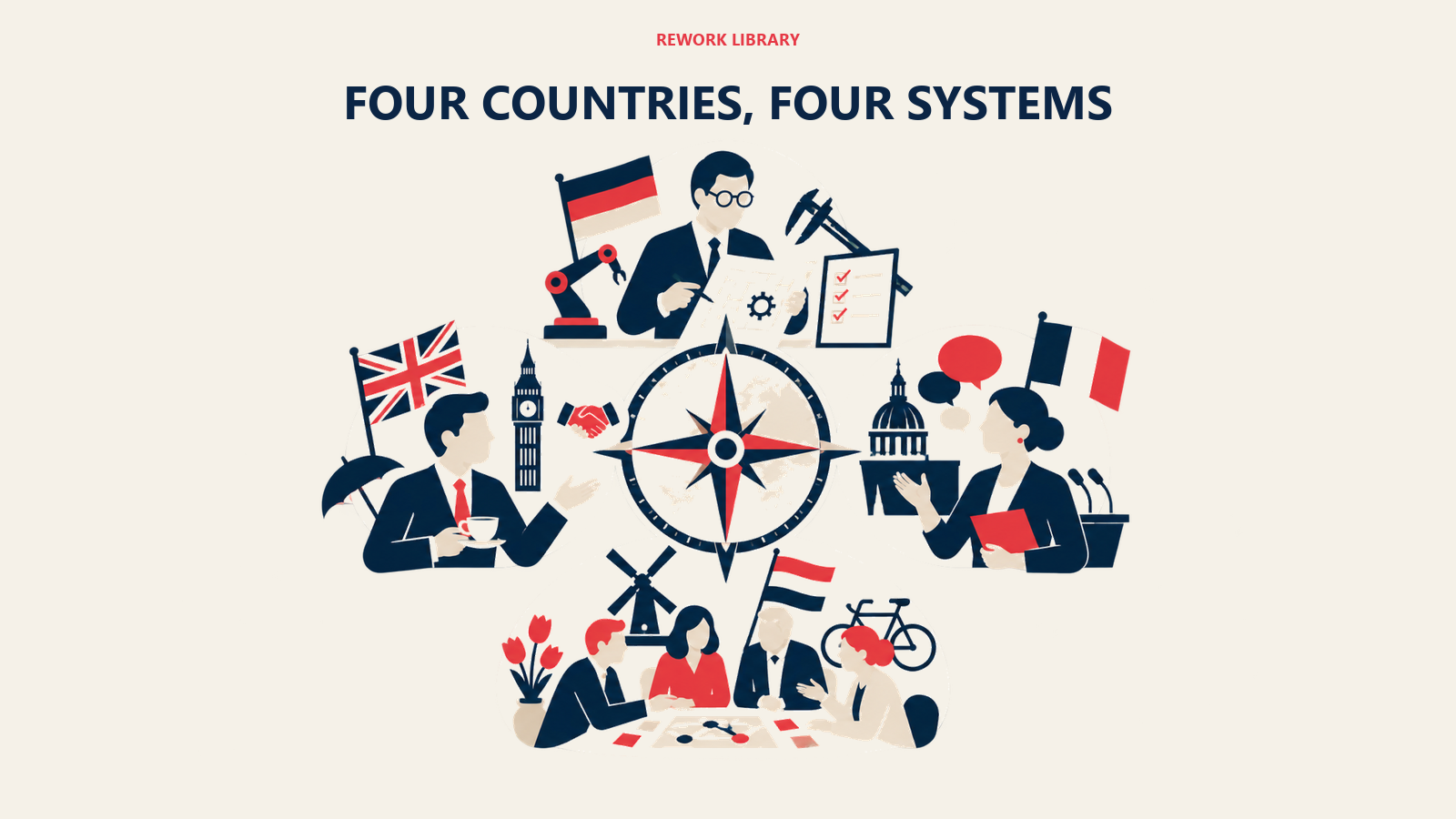
The four countries share a rough neighborhood and centuries of overlapping trade, but each built a different administrative tradition on top of that shared history. Germany's codified civil law and postwar culture of industrial codetermination produced a style built around precision and formal process. France's centralized state and grandes écoles pipeline into leadership produced a style that is hierarchical in structure but combative in discussion. Britain's common law tradition, built case by case rather than from a comprehensive code, produced a pragmatic, understated style. The Netherlands' history as a small, trade-dependent, religiously plural nation produced the polder model: building consensus among groups who fundamentally disagree, because no single faction could simply win. None of that shows up in a Power Distance score. All of it shows up in how a meeting actually runs.
Hofstede Scores: Where the Four Countries Sit
| Country | Power Distance (PDI) | Individualism (IDV) | Uncertainty Avoidance (UAI) | Pattern |
|---|---|---|---|---|
| Germany | 35 | 67 | 65 | Low hierarchy, individualist, plans in detail |
| France | 68 | 71 | 86 | Higher hierarchy, individualist, rule-bound |
| United Kingdom | 35 | 89 | 35 | Low hierarchy, most individualist, comfortable with ambiguity |
| Netherlands | 38 | 80 | 53 | Low hierarchy, individualist, consensus-driven |
Source: geerthofstede.com.
Two things stand out once you read the third column, Uncertainty Avoidance, alongside the first two. France's score of 86 is the outlier of the group, and it is not a coincidence that French business culture leans on detailed contracts and codified procedure even inside a culture that also loves open debate. The UK's score of 35, the lowest of the four by a wide margin, tracks with a style built on precedent and "figure it out as we go" pragmatism rather than comprehensive upfront rulebooks. Power Distance and Individualism explain who gets to speak and who gets individually credited. Uncertainty Avoidance explains how much structure a culture needs before it moves, and it does a lot of the work in why these four countries feel so different despite similar PDI and IDV numbers.
Key Facts
- Germany's Uncertainty Avoidance score (65) sits closer to France's (86) than to the UK's (35), helping explain why German and French planning both lean toward detailed upfront process despite differing sharply on Power Distance. Source: geerthofstede.com
- German law requires board-level employee representation, codetermination, at companies above defined size thresholds, giving works councils a formal voice in major decisions inside a country with a relatively low Power Distance score. Source: worker-participation.eu
- Under France's 35-hour standard work week, set by the Aubry laws of 1998 and 2000, hours beyond the statutory threshold generally trigger overtime pay or compensatory time off, a structural constraint on how French companies plan project timelines. Source: service-public.fr
- The Netherlands' Works Councils Act requires companies with 50 or more employees to maintain a works council (ondernemingsraad) with real co-decision rights over working conditions and major organizational changes, formal machinery behind the country's consensus-driven reputation. Source: government.nl
- A Harvard Business Review analysis found 89% of white-collar workers surveyed across 90 countries said they at least occasionally work on global virtual teams that cross national borders, the exact setting where differences inside "Western Europe" most often catch a leader off guard. Source: hbr.org
Where the Four Countries Diverge
The shared pattern above is a real starting point, but it is the differences that actually determine whether a meeting, a piece of feedback, or a negotiation lands the way you intend. Here is the short version of each country's distinct style. Deeper, country-specific guides are planned as spokes off this regional overview.
Germany: Precision, Low-Context Directness, and the Plan
German business culture runs on Sachlichkeit, a matter-of-fact, substance-over-style approach that treats a well-argued disagreement about the work as separate from personal warmth. Meetings start on time, follow a distributed agenda, and end with clear, written next steps. Feedback is direct and specific, close to the Netherlands on Erin Meyer's low-context, direct-negative-feedback end of the scale, and it is not intended as a personal judgment even when it lands that way to someone used to softer delivery. Planning happens in detail and in advance; a German counterpart who pushes back hard on a rushed timeline is usually protecting the plan's integrity, not being difficult. For the framework behind reading directness like this, see high-context vs low-context cultures at work.
France: Hierarchical Structure, Combative Debate
France's higher Power Distance score shows up in formal titles, a clear chain of command, and a strong expectation that the most senior person in the room makes the final call. What surprises outsiders is that the same meeting can be openly, even fiercely, argumentative before that call happens. French professional culture, shaped by the grandes écoles tradition of rigorous intellectual training, treats vigorous debate as a sign of engagement and competence, not insubordination, provided it does not challenge the decision-maker's authority to actually decide once discussion is over. The result is a culture that looks hierarchical on paper and feels combative in the room, a combination that trips up leaders expecting hierarchy to mean quiet deference. For more on how authority and dissent interact across cultures, see hierarchical vs egalitarian cultures.
The United Kingdom: Indirect Politeness Meets Pragmatism
The UK has the highest Individualism score of the four and one of the lowest Power Distance scores globally, which would predict a direct, low-context communication style. It is not one. British business communication runs on understatement and diplomatic hedging: "quite good" can mean genuinely impressive, "with the greatest respect" often signals disagreement, and "you might want to think about" can be a firm instruction. Erin Meyer's Culture Map research places the UK toward the indirect end of the negative-feedback scale despite its individualist, egalitarian defaults, a reminder that Hofstede's dimensions predict who gets to speak, not how bluntly they phrase it. Underneath the politeness sits a pragmatic, precedent-driven decision style, closer to "try it and adjust" than to detailed upfront planning, consistent with the UK's low Uncertainty Avoidance score.
The Netherlands: The Bluntest Culture in the Group
Dutch business culture is frequently cited, alongside Germany and Israel, as one of the most direct in the world for negative feedback: a Dutch colleague telling you your proposal has real problems is being helpful, not hostile, and softening that message reads as evasive rather than kind. What separates the Netherlands from Germany is how decisions get made once that direct feedback is on the table. The polder model, a national habit of building consensus among stakeholders who fundamentally disagree, means Dutch teams often spend more time than outsiders expect getting everyone's honest input before finalizing a decision, even though the feedback along the way is blunt. Directness and consensus-seeking coexist here in a way that surprises leaders who assume the two are opposites. See consensus vs top-down decision cultures for how that habit compares to more hierarchical decision styles elsewhere.
A Leader's Playbook for Western Europe
Knowing the pattern only matters if it changes what you do in your next meeting, your next piece of feedback, and your next deadline conversation with each of these teams.
Running Meetings Across the Four Countries
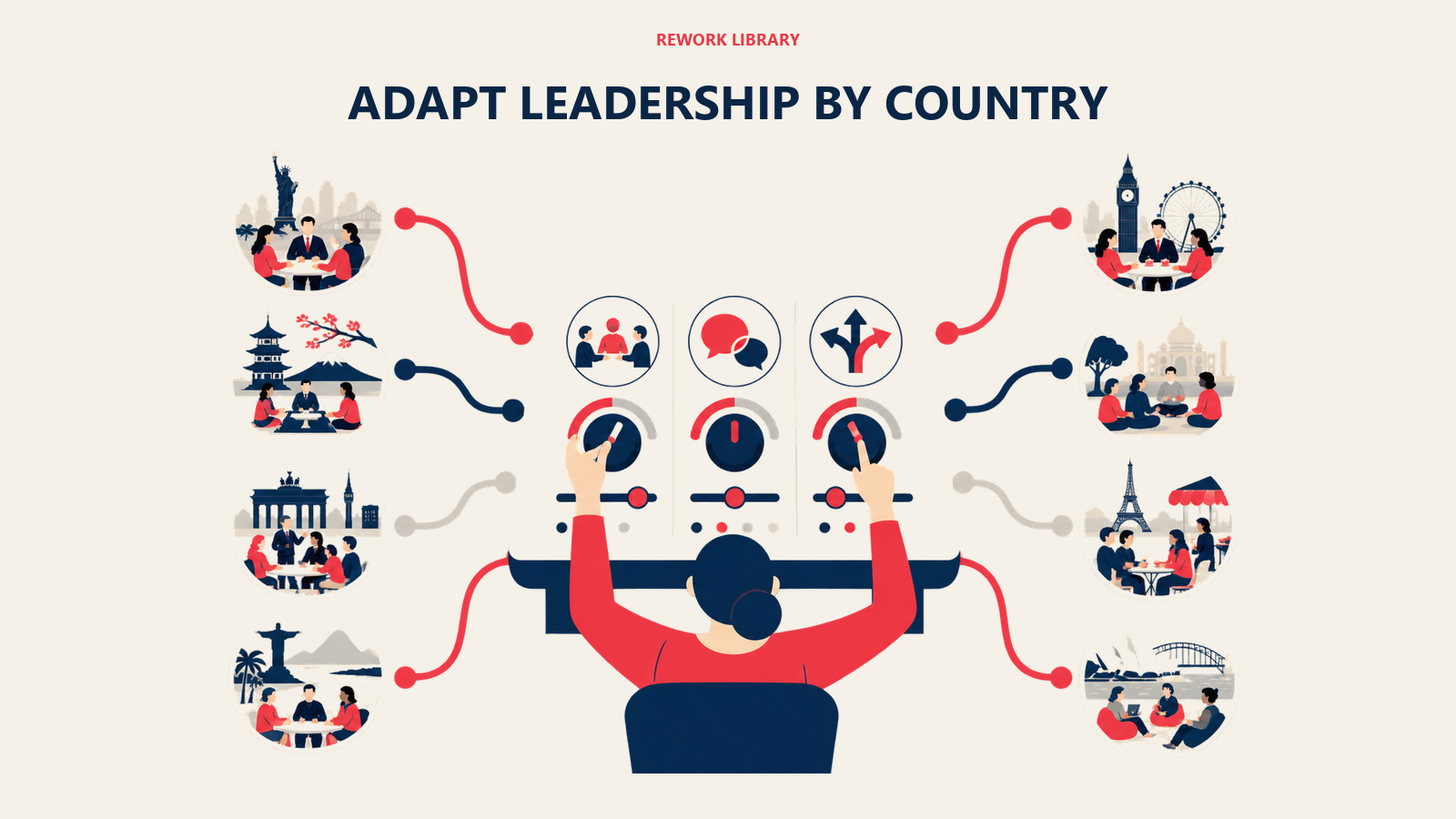
Do not export one meeting style across all four markets. With a German team, circulate the agenda in advance and expect the meeting to follow it closely; deviation reads as unprepared. With a French team, welcome pointed disagreement during discussion, but be clear about who has final decision authority once debate ends. With a British team, listen for the hedge; a soft-sounding objection may be a firm one. With a Dutch team, ask directly for the blunt version of an opinion rather than assuming silence means agreement, and build in time for the consensus step before expecting a final answer.
Giving Feedback That Actually Lands
Direct, specific feedback works well with German and Dutch colleagues and rarely needs softening; over-cushioning it can read as insincere or unclear about the actual problem. With French colleagues, direct feedback on the substance is welcome, but tone and register matter more than with the Germans or Dutch, especially across a hierarchy gap. With British colleagues, calibrate for understatement in both directions: deliver clear feedback yourself, and do not mistake a mild-sounding response for full agreement. Radical candor as a framework travels reasonably well across all four, but the volume dial needs resetting for each one.
Making Decisions Without Losing Time or Trust
Expect German and Dutch teams to want visible process and stakeholder input before a decision is final, even though the underlying style differs, precise and structured in Germany, consensus-seeking in the Netherlands. Expect French teams to debate vigorously, then defer the final call to the senior owner once debate closes. Expect British teams to move faster on less complete information, then adjust as new facts arrive, treating that adjustment as normal rather than a sign the original decision was wrong.
Common Mistakes to Avoid
Treating British politeness as agreement is one of the costliest habits outsiders bring into UK meetings; so is treating French debate as personal conflict rather than professional engagement. Softening feedback to German or Dutch colleagues out of good intentions often reads as vague or patronizing rather than kind. And assuming any one of these four countries represents "how Europe does business" is the root mistake underneath most of the others; each built a genuinely distinct operating system on a loosely shared foundation.
Business Culture in Western Europe in the Age of AI
Western Europe is also where some of the world's most detailed regulatory thinking about AI at work is happening, and it shapes how these cultures adopt AI tools and agents differently from the US or Asia. The EU AI Act, in force since 2024 as the first comprehensive legal framework of its kind, classifies AI systems by risk level and imposes real obligations on how companies deploy them in hiring, performance management, and other workplace uses. Source: artificialintelligenceact.eu.
That regulatory backdrop interacts with the national differences above rather than replacing them. Germany's codetermination structures mean works councils often have a formal say in how AI tools enter a workflow, not just whether they get purchased, an extension of the same board-level employee voice into ai-native culture decisions. The Netherlands' Works Councils Act creates a similar lever. France's higher Uncertainty Avoidance score shows up as a preference for documented AI policy before broad rollout. The UK's more pragmatic style produces faster, less formally governed pilots, adjusted after launch rather than fully specified before it. Leaders managing human-agent teams across all four should expect the AI conversation to run through each country's existing decision-making habits, not around them.
For organizations running distributed teams across these four countries, the operational side, consistent onboarding, clean HR records, and visible attendance data works councils can review, is easier to manage well when it is not scattered across separate tools per office. That is the kind of unglamorous consistency Rework's People app is built to support; it does not replace the cultural judgment above it.
Where to Go Next
This regional overview sits alongside the broader cross-cultural pillar in this collection. From here:
- How business culture differs across the world, for the full global map and a general leader's playbook
- Hofstede's cultural dimensions explained, for all six dimensions and scores across more countries
- The Culture Map, explained, for Erin Meyer's framework on reading feedback and communication style across borders
- Hierarchical vs egalitarian cultures, for the Power Distance dynamic underneath France's hierarchy
- Consensus vs top-down decision cultures, for the Dutch polder model in a broader context
- How to manage a multicultural team, for a practical playbook that spans this region and beyond
- Business culture in Southeast Asia and business culture in East Asia, for the contrast with higher power-distance, more collectivist regions
- Country-specific guides for Germany, France, the UK, and the Netherlands individually are planned as this collection expands
Frequently Asked Questions about Business Culture in Western Europe
What do Germany, France, the UK, and the Netherlands have in common in business culture?
All four sit well below the global average on Hofstede's Power Distance score, lean individualist rather than collectivist, and favor structured, task-based business norms over relationship-first ritual. That shared pattern means more open disagreement and more individual accountability than in higher power-distance regions, but it is a thin resemblance once you look at how each country actually communicates and decides.
Why is French business culture both hierarchical and argumentative?
France's higher Power Distance score (68) reflects a clear chain of command and a strong expectation that the senior person makes the final call. But the country's intellectual tradition, shaped by the grandes écoles system, treats vigorous debate before that final call as a sign of competence and engagement rather than insubordination, so hierarchy and open argument coexist rather than cancel each other out.
Why does the UK read as polite but is also highly individualist?
Hofstede's Individualism score measures whether people are expected to advocate for themselves and be judged individually, which the UK does at one of the highest levels globally (89). It does not measure how bluntly people phrase disagreement, and British communication layers diplomatic understatement on top of that individualism, so direct advocacy often arrives wrapped in soft language.
Why is Dutch business culture considered so direct?
The Netherlands is frequently cited alongside Germany and Israel as one of the most direct cultures for negative feedback; a blunt critique is considered helpful rather than rude. What makes Dutch culture distinct is that this directness is paired with the polder model, a consensus-building habit that means decisions still involve visible input from disagreeing stakeholders before they are finalized.
How should a leader adjust feedback style across these four countries?
Direct, specific feedback generally works well and needs little softening with German and Dutch colleagues. French colleagues expect direct substance but with more attention to tone and hierarchy. British colleagues often deliver and receive feedback indirectly, so leaders should calibrate for understatement in both directions rather than assuming a soft-sounding response means full agreement.
How is AI regulation shaping business culture in Western Europe?
The EU AI Act, in force since 2024, imposes real obligations on how companies use AI in workplace decisions like hiring and performance management, and it interacts with each country's existing habits: German and Dutch works councils often get a formal say in AI rollouts, French teams tend to want documented policy before broad adoption, and UK teams tend to pilot faster and adjust afterward.
What is the most common mistake leaders make managing across these four countries?
Treating "Western Europe" as one culture. The failure varies by pair: mistaking British politeness for agreement, reading French debate as personal conflict, over-softening feedback to German or Dutch colleagues, or assuming one country's meeting style will transfer cleanly to its neighbors.
Western Europe is not one business culture wearing four flags. The shared Hofstede profile is a useful starting hypothesis, especially for a leader arriving from a higher power-distance, more collectivist region. But the four countries built genuinely different operating systems on that shared foundation, precision in Germany, hierarchical debate in France, indirect pragmatism in the UK, blunt consensus in the Netherlands, and the leader who learns which system they are standing in will get more right in the next meeting than one who treats "European" as a single instruction manual.

Co-Founder, Rework.com
On this page
- The Shared Pattern, and Why It Is Thinner Than It Looks
- Why "Western Europe" Is Not One Culture
- Hofstede Scores: Where the Four Countries Sit
- Key Facts
- Where the Four Countries Diverge
- Germany: Precision, Low-Context Directness, and the Plan
- France: Hierarchical Structure, Combative Debate
- The United Kingdom: Indirect Politeness Meets Pragmatism
- The Netherlands: The Bluntest Culture in the Group
- A Leader's Playbook for Western Europe
- Running Meetings Across the Four Countries
- Giving Feedback That Actually Lands
- Making Decisions Without Losing Time or Trust
- Common Mistakes to Avoid
- Business Culture in Western Europe in the Age of AI
- Where to Go Next