US Business Culture: A Guide for Global Leaders and Teams
Turn this article into takeaways for your work.


Each assistant summarizes the article only for you and suggests best practices for your work.
Updated August 2026
American business culture runs on individual initiative, comparatively flat hierarchy, fast top-down decisions, and open self-promotion, all delivered with a layer of positivity that can make hard feedback sound softer than it actually is. It is one of the most individualist cultures Hofstede has ever measured, tolerant of ambiguity and risk, and quick to decide and adjust rather than plan exhaustively before acting.
Most non-US professionals learn this the hard way. A candidate from a modest, credential-first culture watches an American peer confidently claim credit for a team win and reads it as arrogance, when the American sees it as simply describing their contribution. A manager from a job-for-life market gets blindsided the first time a strong performer is let go with two weeks' notice. A colleague from a direct-feedback culture takes an American "this is great, just one small thing" at face value and misses that the small thing is the actual verdict. These are not personality quirks. They are the same national pattern showing up in different rooms.
This guide covers the US pattern according to the research, where it sits on Hofstede's scores and Erin Meyer's Culture Map, what catches outsiders off guard, an honest caveat about how much the pattern varies inside the country, and a playbook for leading American teams, and for Americans leading everyone else.
The US Pattern: Individualist, Low Hierarchy, Fast-Moving
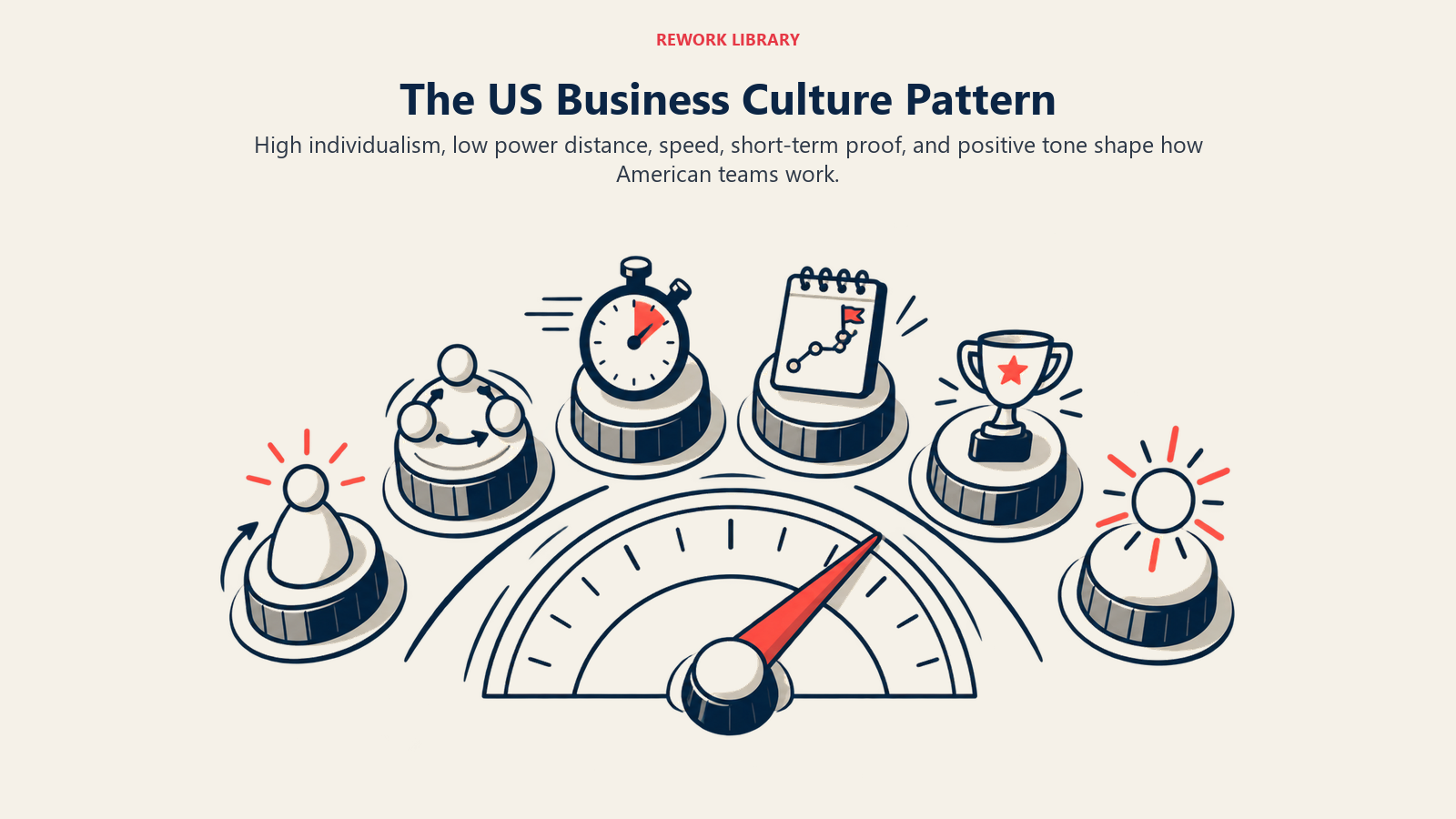
Hofstede's research puts the United States near the extreme on two of six dimensions and mid-range on the rest, and that specific combination is what produces the pattern people recognize as "American business culture."
| Dimension | US score | What it means at work |
|---|---|---|
| Power Distance (PDI) | 40 | Below the global midpoint. Authority is expected to explain itself; junior employees are expected to speak up. |
| Individualism (IDV) | 91 | Among the highest ever recorded. Individual credit, individual blame, individual accountability. |
| Motivation Toward Achievement (MAS) | 62 | Moderately high. Competition, visible achievement, and assertiveness are rewarded. |
| Uncertainty Avoidance (UAI) | 46 | Below the global midpoint. Comfortable improvising, changing course, and acting before every detail is settled. |
| Long-Term Orientation (LTO) | 26 | Low. Favors near-term results and quarter-over-quarter proof over multi-year commitment. |
| Indulgence (IVR) | 68 | Above the global midpoint. Leisure, personal freedom, and positive emotion carry real weight. |
Source: geerthofstede.com, Hofstede's published country data. For the full six-dimension model and more country scores, see Hofstede's cultural dimensions explained. For how this compares to the rest of the world, see how business culture differs across the world.
Low Power Distance: Authority Has to Explain Itself
A PDI of 40 puts the US well below hierarchical economies like Malaysia (100) or China (80). A junior employee who disagrees with a senior leader's plan is expected to say so in the room, and a leader who cannot explain the reasoning behind a call loses credibility fast. Hierarchy is not absent; titles and reporting lines still matter. The distance between the top and bottom of an org chart is just smaller, and crossing it in conversation is normal rather than transgressive. See hierarchical vs. egalitarian cultures for the fuller picture.
Very High Individualism: Your Name Is on the Work
An IDV of 91 is close to the ceiling of Hofstede's scale, and it is arguably the single most explanatory number in this table. Performance reviews, compensation, and promotion default to attributing outcomes to individuals rather than teams. "I closed the deal" is a normal, expected way to describe work that almost certainly involved other people, and a colleague from a collectivist culture who instinctively says "we" instead of "I" in a US review can end up under-credited for it.
Moderate Achievement Orientation: Competition Is a Feature, Not a Bug
At 62, the US sits above the global midpoint on what Hofstede originally called Masculinity and now frames as Motivation Toward Achievement and Success. Sales leaderboards, stack-ranked performance systems, and public recognition of top performers are common and well received. The same tools can land as needlessly aggressive in lower-scoring cultures that favor a quieter, consensus-based definition of success.
Below-Average Uncertainty Avoidance: Ship It, Then Fix It
A UAI of 46 explains a habit that frustrates partners in more process-heavy cultures: American teams are comparatively willing to launch before every edge case is documented, treating a plan as a living draft rather than a contract. That instinct produces real speed, and real friction with counterparts from high-UAI cultures like Japan (92) or Germany (65), who read the same behavior as under-prepared rather than decisive.
Low Long-Term Orientation: Prove It This Quarter
At 26, the US skews toward near-term results, which shows up in how companies structure board reporting and marketing budgets around quarterly, not multi-year, proof of return. A partner from a high-LTO market like South Korea (100) or Germany, used to justifying an investment over a five-year horizon, can find an American demand for quarter-over-quarter validation short-sighted, when it is simply a different, equally deliberate default.
High Indulgence: Positive Emotion Is Expected, Not Extra
An IVR of 68 quietly explains a lot of American workplace tone. Optimism, enthusiasm, and a visible good mood are treated as close to a professional obligation, not an occasional bonus. That expectation feeds directly into the feedback pattern covered next: American directness rarely arrives without a positive frame wrapped around it.
How Erin Meyer's Culture Map Reads the US
Hofstede's scores describe society broadly. Erin Meyer's Culture Map is built for the workplace, and it captures a nuance Hofstede misses: the US is direct in some ways and surprisingly indirect in others, and conflating the two is where most misreads of American colleagues start.
Communicating: low-context, but not the lowest. The US leans explicit and literal, put it in the email, but not as extreme as Germany or the Netherlands. See high-context vs. low-context cultures for the full scale.
Evaluating: this is where Americans surprise people. Meyer places the US as more indirect on Evaluating, how criticism gets delivered, than its low-context Communicating score would predict. Managers sandwich negative feedback between positives and frame problems as "opportunities." A Dutch or Israeli colleague, used to blunt criticism without a wrapper, can miss the message entirely, hearing "good, with room to improve" when the real content was "this needs to change now."
Trusting: task-based. Confidence is earned by delivering work, not shared meals or personal history; do what you said you would do, and trust follows quickly. Relationship-first vs. task-first cultures covers the country data.
Deciding: top-down, but fast. Once accountability is assigned, a leader is expected to decide quickly rather than build broad consensus, and the org respects that speed over further group debate.
Leading: egalitarian in style, not always in substance. Managers often present as facilitators, first-name basis, open-door, while retaining real authority. A colleague from a hierarchical culture can misread the informal style as license to bypass the chain of command, which it usually is not.
What Surprises Outsiders About American Business Culture
The dimension scores explain the pattern. These are where it actually catches people off guard.

Friendly, but Transactional
American warmth in a first meeting, genuine enthusiasm, quick first-name familiarity, an easy "let's grab coffee sometime," is real, but it is not a deep personal bond. A colleague from a relationship-first culture can mistake early friendliness for the kind of trust that takes months to build elsewhere, then feel blindsided when a warm first call is followed by a purely transactional email chain.
Hire and Fire at Will
Most US employment is "at-will," meaning either party can end the relationship at almost any time, for almost any legal reason, without the extended notice periods, severance formulas, or works-council consultation common across much of Europe and Asia. For a leader from a job-for-life or heavily protected labor market, this is often the single biggest operational shock of doing business in the US.
Self-Promotion Is Expected, Not Arrogance
Because credit defaults to the individual (that IDV of 91 again), describing your own contribution plainly, in a resume, a review, or a meeting, is the professional norm rather than a red flag. A candidate raised to let the work speak for itself can be systematically under-credited in American settings simply for not stating what they did.
Speed Over Exhaustive Consensus
Low Uncertainty Avoidance plus fast, top-down deciding produces a bias toward launching, testing, and iterating rather than finishing a fully vetted plan first. Partners from planning-heavy cultures read this as under-preparation. It is really a different theory of risk: the US default treats a wrong early decision as cheap to fix and a slow one as the expensive mistake.
Relentless Positivity, Even in Bad News
High Indulgence plus Evaluating-scale softness trips up almost every non-American professional at some point: American communication stays upbeat even when the message is serious. "Let's circle back" can mean the idea is dead. "That's an interesting approach" can mean it will not work. Reading the literal words instead of the pattern is one of the most costly mistakes in cross-cultural work with American colleagues.
Key Facts
- The United States scores 91 on Hofstede's Individualism dimension, among the highest ever recorded, while sitting at just 40 on Power Distance, a combination behind its flat-feeling hierarchy and strongly individual credit. Source: geerthofstede.com
- On Long-Term Orientation, the US scores 26 versus Germany's 83 and South Korea's 100, why American partners often expect quarter-over-quarter proof where those counterparts budget in years. Source: Hofstede Insights country comparison tool
- Most US states follow the at-will employment doctrine, under which either party can end employment without cause or advance notice, subject to legal exceptions like discrimination. Source: U.S. Department of Labor
- The GLOBE study surveyed roughly 17,000 middle managers across 950 organizations in 62 societies, including the US, to map how national culture shapes leadership expectations. Source: globeproject.com
- A Harvard Business Review analysis found 89% of white-collar workers surveyed across 90 countries at least occasionally work on global virtual teams, the exact setting where American directness and positivity most often meet an unprepared counterpart. Source: hbr.org
- Erin Meyer's The Culture Map, built from her research and teaching at INSEAD, is the source for the Evaluating-scale finding that American feedback reads more indirect than its low-context Communicating score alone predicts. Source: erinmeyer.com
The US Is Not One Culture: Regional and Sector Variety
Everything above describes a national average, and the country is large enough that the average hides real, working differences. A finance or law firm in New York runs on more formal hierarchy and slower, more risk-averse decisions than the pattern above suggests. A Bay Area startup often pushes individualism, informality, and speed further past the national baseline. A unionized manufacturing plant in the Midwest, or a regulated industry like healthcare or banking, layers formal process and job protection on top of the general pattern, closer to a moderate-UAI, moderate-PDI culture than the country score implies. Company, industry, and region all bend the national default; treat this guide as a starting hypothesis, not a fixed script for every American you will work with.
A Playbook for Leading Across US Business Culture
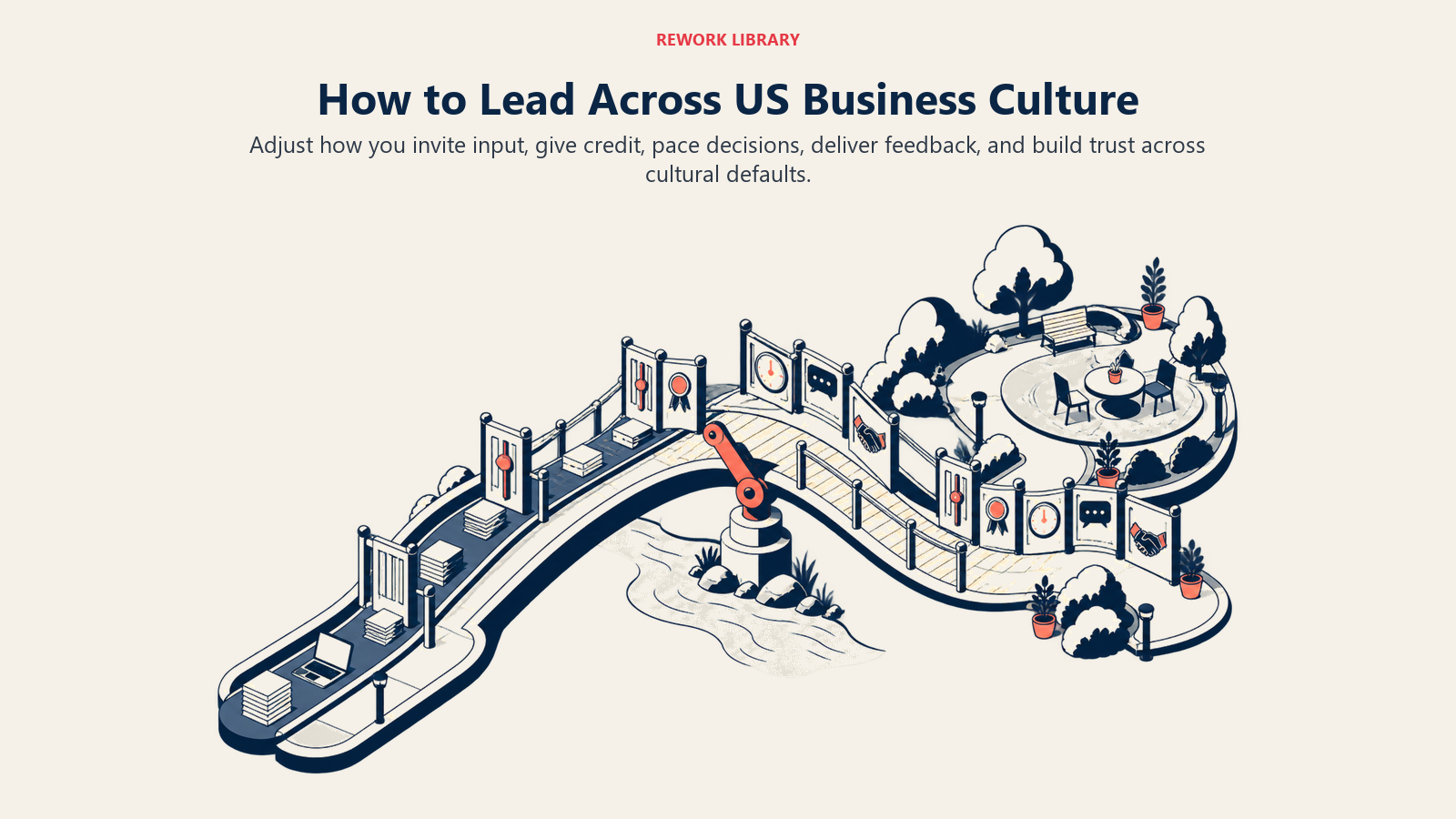
Knowing the pattern only helps if it changes how you run your next meeting, deliver your next piece of feedback, or read your next status update.
For Non-US Leaders Managing American Teams
Expect direct input in meetings, and treat silence as a real signal rather than deference. Give credit by name, since a team-only acknowledgment can read as overlooking whoever did the work. Decide with confidence and speed rather than building full consensus first, and when reading feedback from an American colleague, listen past the positive framing for the substance underneath it.
For American Leaders Managing Global Teams
Do not assume silence after "any questions?" means agreement everywhere; in higher-Power-Distance cultures it usually means the opposite (see why teams stay silent in meetings). Slow the pace of decisions with partners from high-Uncertainty-Avoidance or high-Long-Term-Orientation cultures, since a plan that reads as decisive at home can read as reckless abroad. And know that the same warm, upbeat feedback style can read as insincere to a colleague expecting plain, literal language. The underlying honesty should not change by audience; only the delivery does.
Building Trust Across the Gap
Because American trust is task-based, the fastest way to build credibility with a US counterpart is to deliver reliably, not to invest heavily in relationship-building first. The reverse holds for a US leader working with a relationship-first culture, covered in relationship-first vs. task-first cultures: budget real time for rapport before the business conversation lands. Neither approach is more professional, just a different default.
Common Mistakes to Avoid
Mistaking early American friendliness for deep personal trust, then feeling betrayed when the relationship stays transactional. Reading upbeat, softened feedback as a minor note rather than the actual verdict. Assuming an at-will termination reflects poor performance rather than a labor market with different notice norms. And treating the coastal, venture-funded version of American business culture as the whole country, when regulated and unionized sectors run a more formal variant of the same baseline.
Business Culture in the US in the Age of AI
American companies are adopting AI and AI agents into daily workflows faster and more publicly than almost any other market, and the cultural defaults above are shaping that adoption rather than being replaced by it. Low Uncertainty Avoidance and low Long-Term Orientation produce a familiar pattern: ship the AI feature, tell the team to work with it, fix problems as they surface, the same launch-and-iterate instinct applied to a new class of tool. Low Power Distance means an employee who disagrees with an AI-generated recommendation is generally expected to say so rather than defer silently.
The individualism that shapes American credit and blame is colliding with an open question in ai-native culture: who gets credit, and who owns the mistake, when a person's output was substantially produced with an AI teammate. That is a live source of AI cultural debt, unclear norms about disclosure and ownership, and part of the broader shift toward human-agent teams reshaping how American companies organize work. To be honest about where this stands: most writing on "AI and American work culture" right now is closer to prediction than settled research, this section included.
For organizations running distributed US teams alongside offices elsewhere, consistent onboarding, accurate time and attendance records, and clean HR-to-manager handoffs across states with different employment rules are easier when not scattered across disconnected tools. That is the unglamorous consistency Rework's People app is built to support; it does not replace the cultural judgment above it.
Where to Go Next
This guide sits alongside the broader cross-cultural pillar in this collection, what is business culture. From here:
- How business culture differs across the world, for the full global map and a general leader's playbook
- Hofstede's cultural dimensions explained, for all six dimensions and scores across more countries
- The Culture Map, explained, for Erin Meyer's full framework on reading feedback and communication style
- Relationship-first vs. task-first cultures, for the trust-building axis covered above
- Business culture in Southeast Asia and business culture in East Asia, for the regional patterns most often contrasted with the US default
Frequently Asked Questions about American Business Culture
What are the main traits of American business culture?
Highly individualist, comparatively low in hierarchy, moderately competitive, tolerant of ambiguity, focused on near-term results, and delivered with a strong layer of positivity even when the message is critical. Hofstede puts the US at 91 on Individualism and 40 on Power Distance, among the more distinctive combinations in the model.
Why do Americans give feedback that sounds more positive than it is?
Erin Meyer places the US as more indirect on the Evaluating scale than its low-context style would predict. Managers lead with positives and frame problems as "opportunities," so a colleague expecting blunt feedback can miss the actual message.
Is it true that American companies can fire employees without notice?
Most US employment follows the at-will doctrine: either party can end the relationship at almost any time without cause, subject to legal exceptions like discrimination. This differs sharply from countries with mandated notice periods or works-council consultation.
Why do Americans talk about their own achievements so directly?
The US scores 91 on Individualism, among the highest recorded, which makes individual credit and accountability the professional norm. Stating your own contribution plainly is expected, not arrogant, which can disadvantage candidates from more modest or collectivist cultures.
Is American business culture the same everywhere in the US?
No. A New York finance firm, a Bay Area startup, and a unionized Midwest manufacturer each run meaningfully different variants, with different formality, hierarchy, and risk tolerance. Industry, company, and region all bend the national default.
How should a non-US leader run meetings with an American team?
Expect and invite direct input, treat silence as a genuine signal rather than polite deference, and give credit by name rather than only to the team. Decide with confidence and speed, since American teams read clear, fast direction as competence.
How is AI changing American business culture?
US companies are adopting AI and AI agents quickly, and the country's low Uncertainty Avoidance and Long-Term Orientation shape that into the same launch-and-iterate pattern applied to other tools. Strong individualism raises open questions about credit and ownership when work is produced with an AI teammate, an area closer to prediction than settled research.
American business culture is a specific, well-documented combination: individual credit, flat-feeling hierarchy, fast decisions, and a habit of saying hard things in a soft voice. Leaders who know the pattern, and where it bends by region and industry, will read an American meeting, resume, or "let's circle back" far more accurately than anyone treating the country as a single, uniform script.

Co-Founder, Rework.com
On this page
- The US Pattern: Individualist, Low Hierarchy, Fast-Moving
- Low Power Distance: Authority Has to Explain Itself
- Very High Individualism: Your Name Is on the Work
- Moderate Achievement Orientation: Competition Is a Feature, Not a Bug
- Below-Average Uncertainty Avoidance: Ship It, Then Fix It
- Low Long-Term Orientation: Prove It This Quarter
- High Indulgence: Positive Emotion Is Expected, Not Extra
- How Erin Meyer's Culture Map Reads the US
- What Surprises Outsiders About American Business Culture
- Friendly, but Transactional
- Hire and Fire at Will
- Self-Promotion Is Expected, Not Arrogance
- Speed Over Exhaustive Consensus
- Relentless Positivity, Even in Bad News
- Key Facts
- The US Is Not One Culture: Regional and Sector Variety
- A Playbook for Leading Across US Business Culture
- For Non-US Leaders Managing American Teams
- For American Leaders Managing Global Teams
- Building Trust Across the Gap
- Common Mistakes to Avoid
- Business Culture in the US in the Age of AI
- Where to Go Next