Relationship-First vs Task-First Business Cultures
Turn this article into takeaways for your work.


Each assistant summarizes the article only for you and suggests best practices for your work.
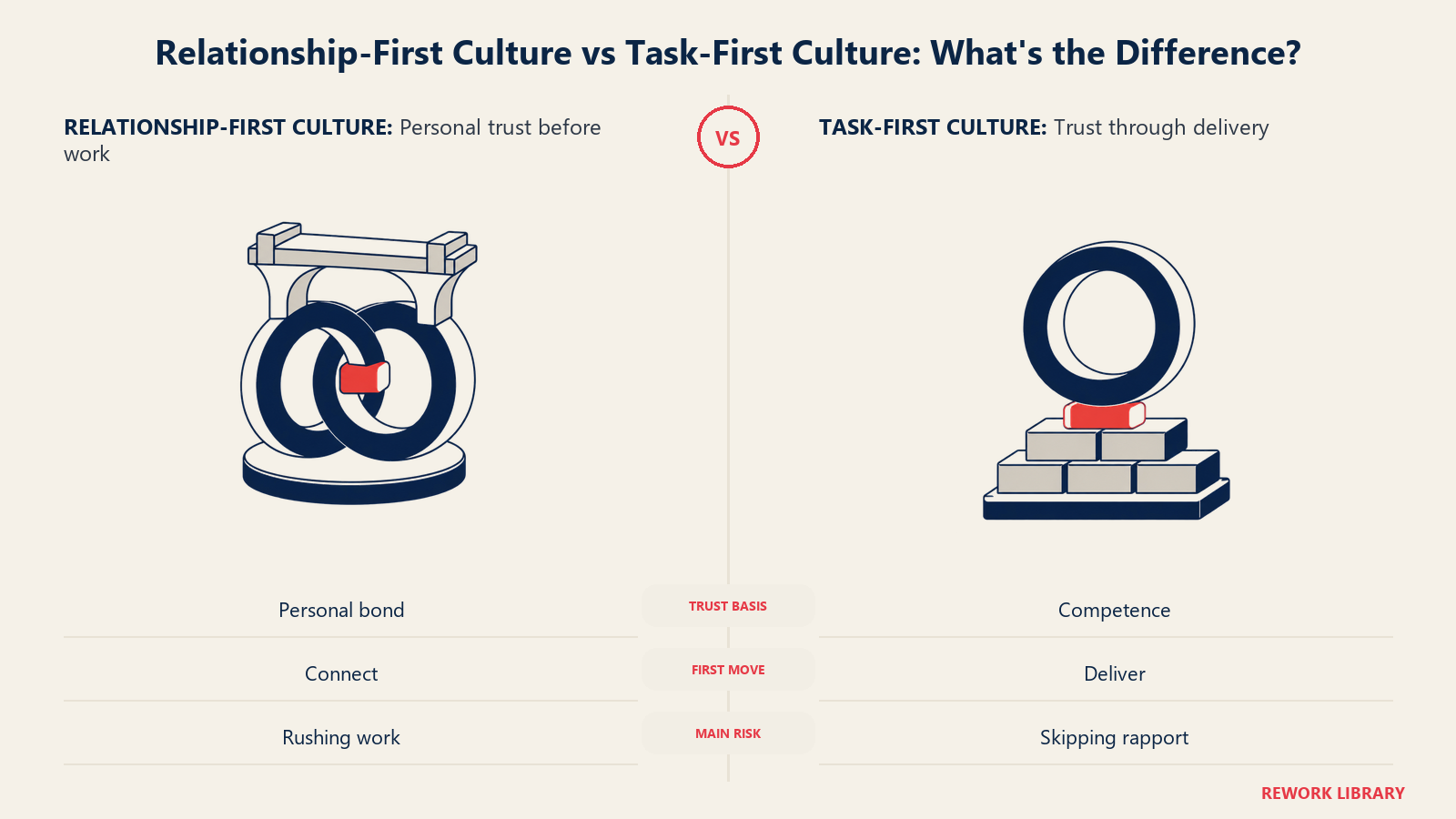
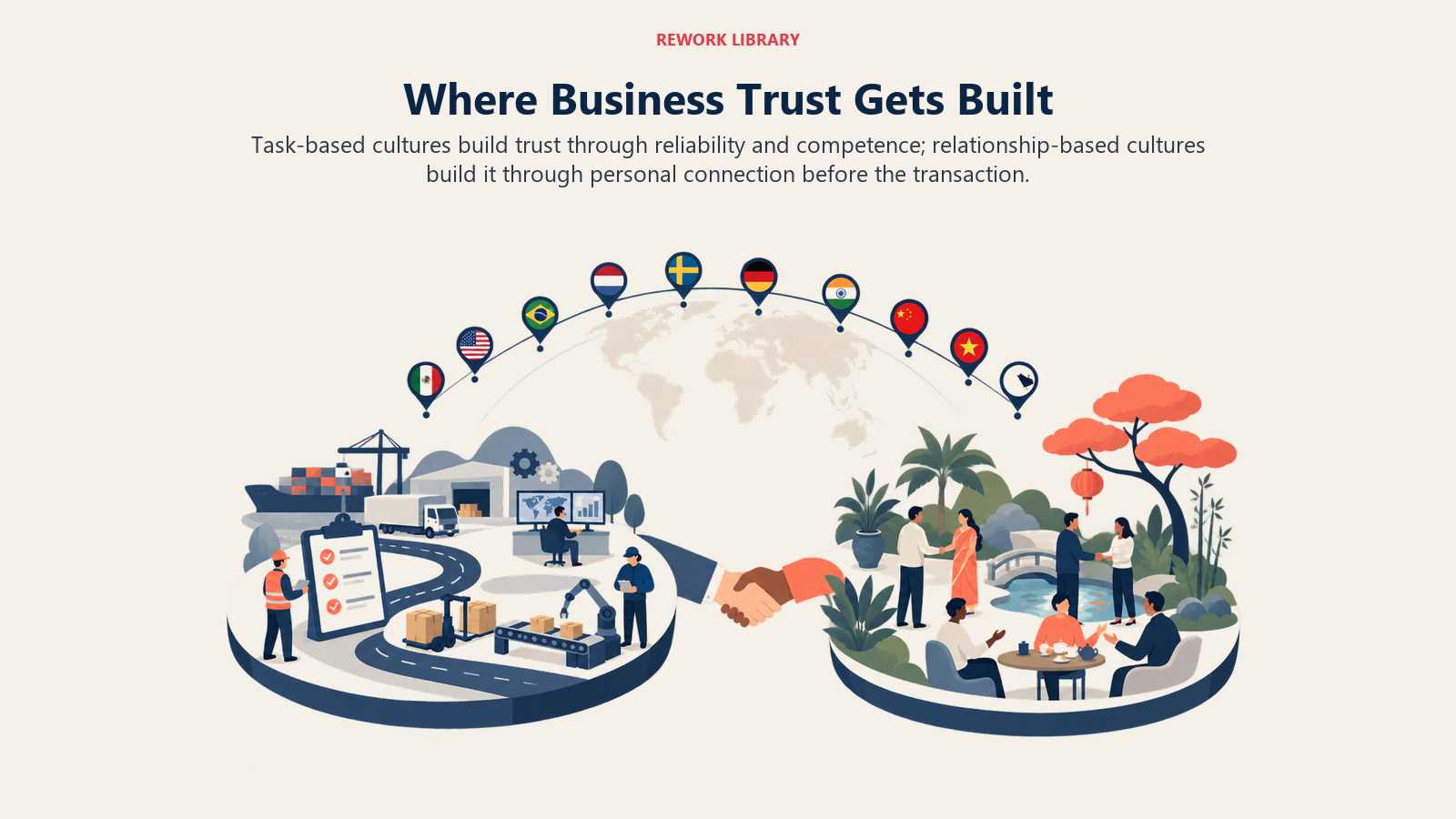
In a task-based trust culture, confidence is earned through competence and reliability: do good work, hit your commitments, and trust follows. In a relationship-based trust culture, confidence is earned through personal connection first: people need to know and like you before they will fully trust your work. Neither builds trust faster. They build it in a different order, and mixing up that order is one of the most common ways cross-cultural deals and hires go sideways.
Most of the friction on global teams and in international sales traces back to this gap. A seller from a task-first culture walks into a first meeting in Jakarta, skips straight to the deck, and reads polite distance as disinterest. It usually isn't. A relationship-first negotiator sits across from a counterpart in Frankfurt, spends the first twenty minutes on rapport, and watches the other side check their watch. Both are behaving exactly as their home culture trained them to, and both are about to lose ground if they don't recognize what they're looking at.
The Research Behind Task-Based vs Relationship-Based Trust
This isn't a soft observation about "some cultures are warmer than others." It comes from a specific, named scale in one of the most cited frameworks in cross-cultural management, with a real, practical test attached: what actually has to happen before someone will rely on you.
Erin Meyer's Trusting Scale
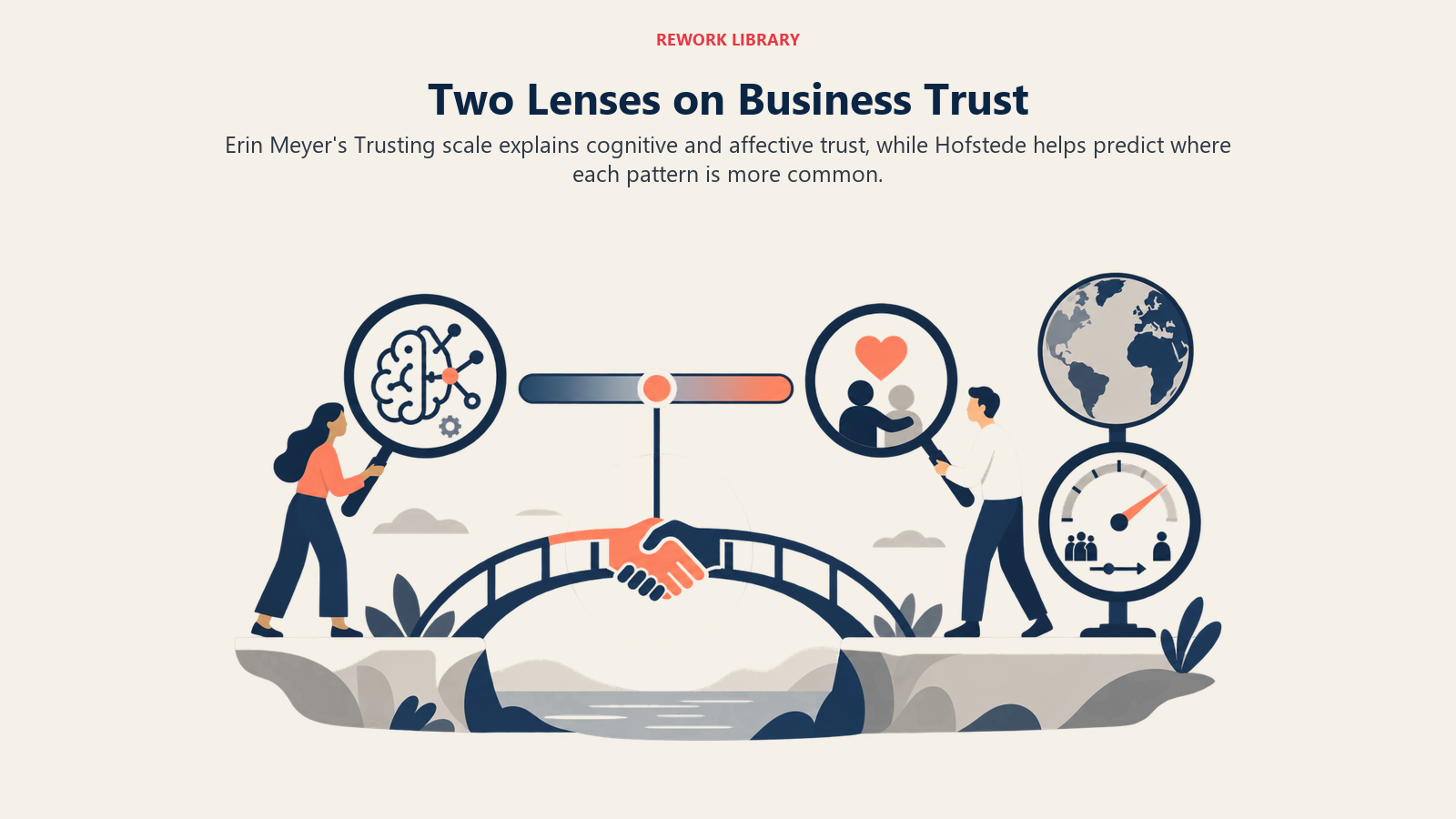
Erin Meyer's The Culture Map names this dimension Trusting, one of 8 scales in the book, running from Task-based (trust built through the work itself: reliability, competence, delivering on commitments) to Relationship-based (trust built through personal connection: shared meals, time together, goodwill that exists apart from any one transaction). We cover all 8 scales, including how Trusting interacts with Leading and Deciding, in The Culture Map, explained.
Meyer frames the two poles as "cognitive trust" (I trust your judgment because I've seen your track record) and "affective trust" (I trust you because we have a relationship and I believe you have my back). Task-based cultures lean almost entirely on cognitive trust in business. Relationship-based cultures expect both, and won't fully extend cognitive trust until affective trust exists first.
Where This Sits Relative to Hofstede's Individualism
Meyer's Trusting scale isn't the same instrument as Hofstede's six dimensions, covered in Hofstede's cultural dimensions explained, but the two correlate usefully. Low-Individualism (IDV) cultures, where people identify with an in-group rather than as free-standing individuals, tend to sit toward Relationship-based, because trust has always run through the group and whoever vouches for you inside it. High-IDV cultures lean Task-based, because trust attaches to an individual's own record rather than who introduced them. It's a strong pattern, not a formula: India scores only moderately collectivist on IDV yet reads clearly relationship-based in practice, which is why Meyer built a dedicated scale instead of leaving leaders to infer Trusting from Individualism alone.
Task-Based Trust: How It Works
In a task-based culture, the fastest way to earn confidence is to be good at your job and consistent about it. Personal warmth is welcome but optional.
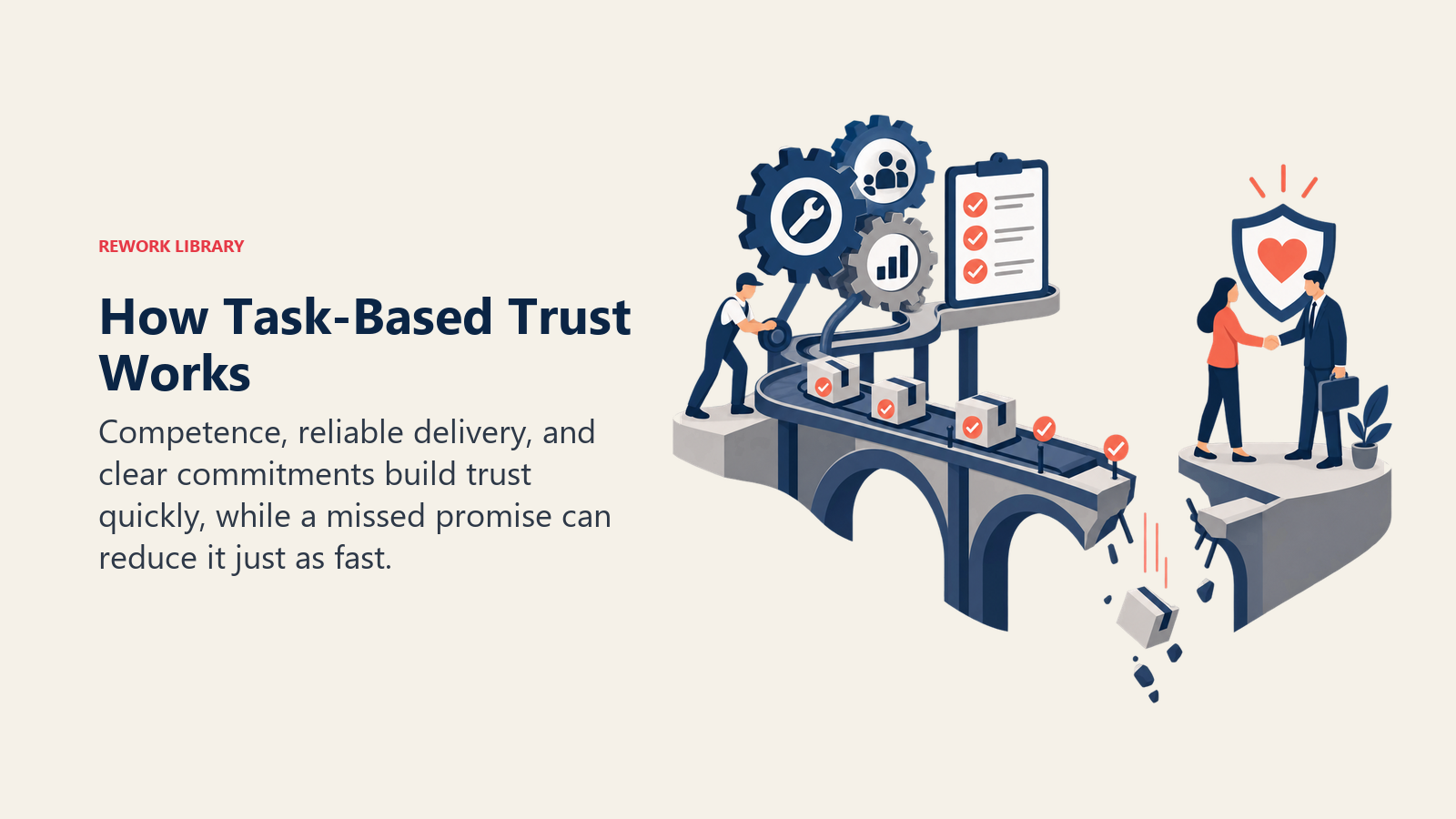
The work speaks first. A new vendor, hire, or counterpart earns trust by delivering what they said they would, on time, without drama. The United States, Germany, the Netherlands, and the Nordic countries (Sweden among them) sit toward this end of the Trusting scale. A stranger with a strong track record can be handed real responsibility on day one, before anyone has shared a meal.
Trust is a running tally that resets less often than people fear. Once you've shown competence and reliability, that credit carries forward across projects and companies, because it lives in your record, not in a relationship that needs constant tending. A reference check or a clean pilot does most of the trust-building work.
Business and personal life stay in separate lanes. Small talk before a meeting is a courtesy, not a prerequisite. Germany and the Netherlands, which also lean low-context, treat skipping straight to the agenda as respect for everyone's time, and a counterpart who lingers on their weekend can come across as unprepared rather than warm.
A broken commitment costs more than a personal slight. Missing a deadline or overselling a capability does more damage than an overly blunt conversation. The fastest way to lose a task-first counterpart's confidence isn't offending them; it's underdelivering on something you committed to.
Relationship-Based Trust: How It Works
In a relationship-based culture, competence is necessary but not sufficient. Nobody extends real trust, the kind that survives a mistake or a hard negotiation, to someone they don't yet know as a person.
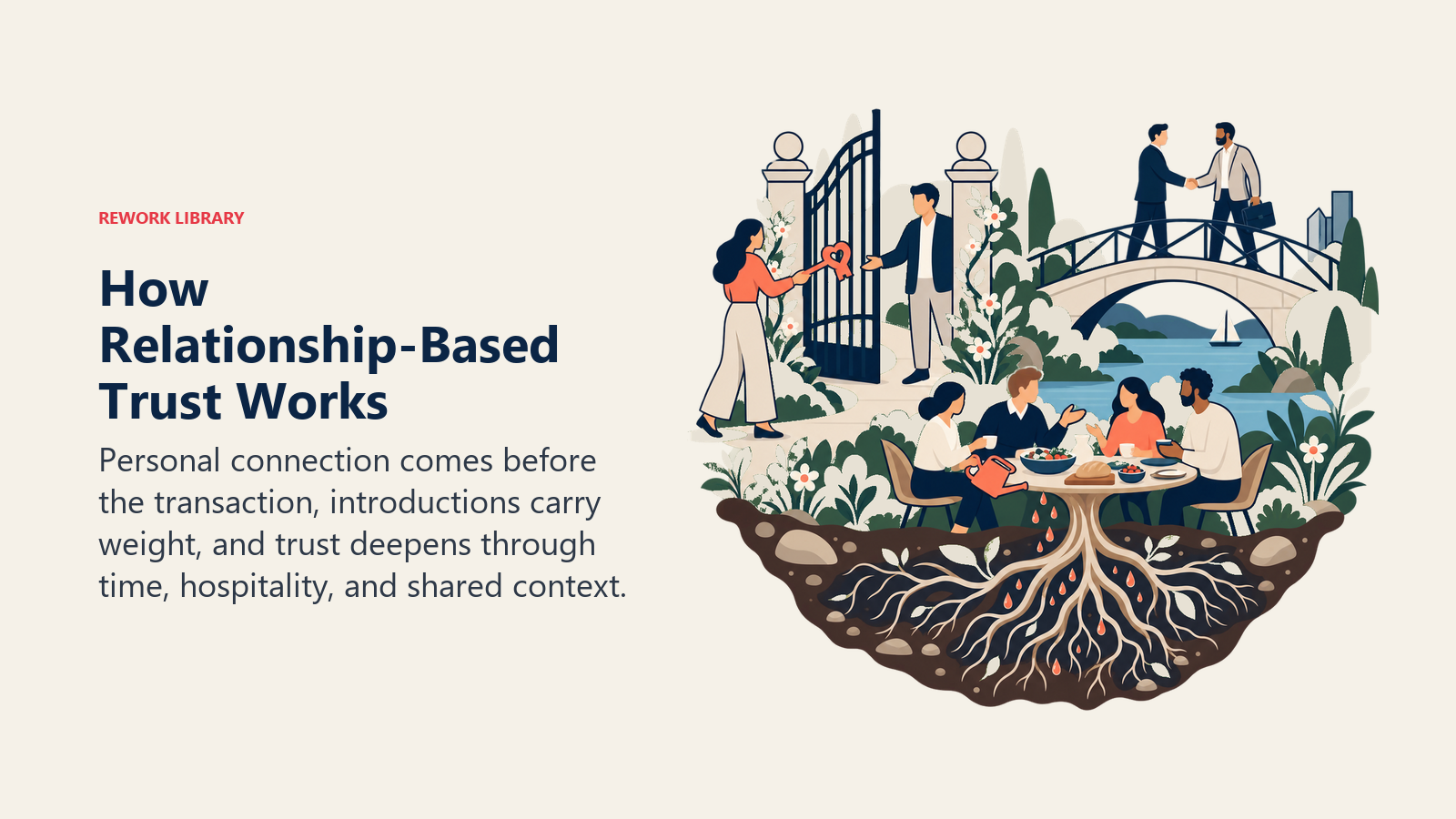
The relationship comes before the transaction. China, Southeast Asia, the Middle East, Latin America, and India all sit toward this end of the scale, though the rituals differ by region. Time spent outside the task itself, a meal, an unhurried conversation about family, a meeting that covers no new business, isn't a delay before the real work starts. It's the mechanism by which two people decide whether the other can be relied on.
Trust is personal and doesn't fully transfer. A strong reputation with one employer or region doesn't automatically extend to a new contact the way it often does in a task-based culture. Each relationship has to be built directly, which is why relationship-based cultures put such weight on introductions: the introducer lends their own trust capital to the new contact.
Once earned, it runs deep and covers more ground. Task-based trust is narrow and job-specific. Relationship-based trust tends to be broader and more durable, extending to favors and benefit of the doubt when something goes wrong, and often survives a mistake that would sink a purely transactional relationship elsewhere.
Face and harmony are part of how trust gets protected. Across much of Southeast Asia and East Asia, publicly correcting someone or forcing a confrontational negotiation can damage the relationship more than the disagreement itself, a dynamic covered in business culture in Southeast Asia. Preserving the other person's standing in front of others is part of maintaining trust, not a separate soft skill.
Country Comparison: Where Trust Gets Built
The table below places nine countries and regions on Meyer's Trusting scale, alongside Hofstede's Individualism (IDV) score as a directional reference, not a substitute measurement. Verify or explore either dataset with Meyer's Country Mapping Tool or the Hofstede country comparison tool.
| Country / region | Trusting style (Meyer) | Individualism (IDV, Hofstede) | Practical signal |
|---|---|---|---|
| United States | Task-based | 91 | A strong track record earns trust fast, often before an in-person meeting |
| Netherlands | Task-based | 80 | Direct, low-context communication paired with trust built on delivered work |
| Sweden | Task-based | 71 | Nordic pattern; competence and reliability outweigh personal rapport |
| Germany | Task-based | 67 | Trust follows structure, documentation, and consistent execution |
| India | Relationship-based | 48 | Moderate on Individualism but reads clearly relationship-first in practice |
| Brazil | Relationship-based | 38 | Warm, high-touch relationship-building expected before serious talk |
| Arab World (incl. Saudi Arabia, UAE) | Relationship-based | 38 | Hospitality and personal rapport are part of doing business, not separate from it |
| Mexico | Relationship-based | 30 | Personal connection and trust in the individual often outweigh paperwork |
| China | Relationship-based | 20 | Guanxi, a network of mutual obligation, underpins most serious business trust |
| Vietnam | Relationship-based | 20 | Trust builds through repeated contact and introductions, not a single pitch |
A pattern worth flagging: the correlation with Individualism is real but not exact. India sits only moderately collectivist on Hofstede's scale yet is one of the more clearly relationship-based cultures in practice, exactly the nuance a single IDV number misses and Meyer's Trusting scale was built to capture. For the fuller regional pattern, see business culture in Southeast Asia, and for the wider set of axes where culture varies by country, see how business culture differs across the world.
Key Facts
- Erin Meyer's Trusting scale, one of 8 scales in The Culture Map, distinguishes cognitive trust (earned through competence and reliability) from affective trust (earned through personal connection). Source: erinmeyer.com
- The United States scores 91 on Hofstede's Individualism Index, among the highest ever recorded, reflecting a culture where trust attaches to an individual's own track record. Source: geerthofstede.com
- China and Vietnam both score 20 on Individualism, among the most collectivist cultures Hofstede has measured, where trust runs through personal networks rather than individual credentials alone. Source: geerthofstede.com
- Arab World cultures, including Saudi Arabia and the UAE, score 80 on Power Distance and 38 on Individualism in Hofstede's regional research, consistent with relationship-first, hospitality-centered business norms. Source: geerthofstede.com
- Erin Meyer is a professor at INSEAD, where she directs the "Leading Across Borders and Cultures" executive program. Source: INSEAD faculty page
Workplace and Sales Implications
The trust gap isn't abstract. It shows up in how a meeting opens, how long a sale takes to close, and whether a meal counts as business or a break from it.
Meetings: Getting Down to Business vs Warming Up First
In a task-first culture, a meeting that opens with two minutes of small talk before the agenda is normal and appreciated; longer feels like wasted time. In a relationship-first culture, the same fast pivot can read as cold, because the opening conversation isn't filler, it's where both sides decide whether they want to work together. A counterpart who spends the first twenty minutes asking about your flight isn't stalling. They're doing the trust-building work before the transaction starts.
Meals and Small Talk Are Not a Delay
Nowhere does the gap show up more clearly than around a shared meal. In relationship-based cultures across Latin America, the Middle East, and much of Asia, a dinner with no agenda, sometimes running for hours, is often the highest-leverage move available to a negotiator, because it's where affective trust actually forms. Declining or checking a phone through it can cost more credibility than a weak point in the proposal. In task-based cultures, the same meal is shorter, touches the deal directly, and rarely counts as a make-or-break moment on its own.
Why "Let's Get to Business" Fails in Relationship-First Rooms
A task-first negotiator who opens with "let's get straight to the numbers" is trying to show respect. In a relationship-first room, it often reads as an attempt to skip the step where the other side decides whether they can trust you at all. The deal doesn't get faster this way. It gets slower, because the relationship-first side now has to build trust mid-negotiation with a counterpart who just signaled that step doesn't matter to them.
Why Endless Small Talk Frustrates Task-First Counterparts
The failure runs both ways. A relationship-first negotiator who spends three separate meetings building rapport before mentioning terms can look evasive to a task-first counterpart, who is quietly wondering why nobody has put a number on the table. In a task-based culture, dragging out the relationship phase past what the situation calls for reads as a lack of substance, not diligence.
How a Leader or Seller Adapts
Neither style is more sophisticated. Adapting means recognizing which room you're in and adjusting the sequence, not the substance.
Selling or leading into a relationship-based culture as a task-first operator. Budget real time before the first ask, ideally a meeting or meal with no agenda attached. Invest in a warm introduction from someone the other side already trusts rather than a cold, deck-first outreach; the introduction carries weight your track record alone can't. Resist speeding up once rapport feels established. This is also where a longer view on managing a multicultural team pays off: the trust you build now is what your team draws on when something goes wrong.
Selling or leading into a task-based culture as a relationship-first operator. Come prepared to discuss substance early, and treat a fast pivot to specifics as professionalism, not a sign the other side doesn't want a relationship. Let the relationship build through delivered work over time instead of trying to accelerate it socially; a task-first counterpart will trust you more after a project goes well than after a long dinner.
In both directions, watch what silence and warmth actually mean. A relationship-first counterpart's warmth isn't automatically a signed deal, the same way silence in a hierarchical meeting isn't automatically agreement, a pattern covered in why teams stay silent in meetings. A task-first counterpart's brevity isn't automatically disinterest either. Both sides read their own culture's default signals as universal, and both are wrong to.
The Mistakes Each Side Makes With the Other
Most of the friction here is avoidable. Task-first operators walking into relationship-first settings treat the relationship phase as a formality to rush through, lead with the deck instead of the introduction, and mistake early warmth for a done deal, then get blindsided when the other side keeps testing the relationship well after the paperwork looks settled.
Relationship-first operators walking into task-first settings read a fast, businesslike opening as disinterest in a real partnership, when it's just the culture's normal pace. They over-invest in social rapport with a counterpart quietly waiting for specifics, and assume one good meeting has built lasting trust, when a task-first counterpart is still watching for the first delivered result.
Building Trust Across Cultures in the Age of AI
Video calls, async messaging, and now AI agents drafting the first-pass outreach have all made it easier to skip the in-person parts of trust-building, which raises a real question for relationship-first cultures: can affective trust actually form without a shared meal or a face-to-face room?
The honest answer is partially. A well-run video call carries some of the same signal a meal can, tone, attentiveness, follow-through, but it strips out the unscripted time relationship-based trust has always leaned on, and it makes an AI-drafted message that skips straight to the ask land even worse in a relationship-first culture than a human doing the same thing would. An AI agent can help a task-first team move faster once trust already exists, drafting, scheduling, summarizing, but it's a poor substitute for the human warm-up a relationship-first counterpart expects. The deeper shift, treating AI output as an input to human judgment rather than a replacement for the relationship itself, is the same theme covered in what is AI-native culture.
For a distributed team split across a relationship-first region and a task-first headquarters, the fix isn't choosing one norm. It's building relationship-first time in deliberately, an unstructured first few minutes on a recurring call, an early in-person visit, rather than assuming a shared tool and deadline are enough. Standardizing that ritual is the operational side of culture a platform like Rework's Work Ops is built to support; the relationship work itself still has to be done by people.
Trust, in either direction, is never free. Task-based cultures spend it on the work itself; relationship-based cultures spend it on time together first. Leaders and sellers who read the room correctly aren't more culturally sensitive in some abstract sense. They're just paying trust's price in the currency the other side actually accepts.
Frequently Asked Questions about Relationship-First vs Task-First Culture
What is the difference between relationship-based and task-based culture?
In a task-based culture, trust is built through competence and reliability: doing good work and keeping commitments earns confidence. In a relationship-based culture, trust is built through personal connection first, such as shared meals and time together, before the working relationship is expected to move forward. Both are legitimate, stable ways of deciding who to rely on.
What is Erin Meyer's Trusting scale?
The Trusting scale is one of 8 scales in Erin Meyer's book The Culture Map. It runs from Task-based (cognitive trust, earned through delivered work) to Relationship-based (affective trust, earned through personal connection), and explains why the same negotiation tactic lands completely differently depending on the culture.
Which countries have task-based business cultures?
The United States, Germany, the Netherlands, and the Nordic countries, including Sweden, sit toward the task-based end of Meyer's Trusting scale. A strong track record and reliable delivery earn real trust quickly, often before much personal rapport has been built.
Which countries have relationship-based business cultures?
China, the countries of Southeast Asia, the Middle East (including Saudi Arabia and the UAE), Latin America, and India sit toward the relationship-based end of the scale. Time spent together outside the immediate task, not just a strong proposal, is usually required before real trust and a serious deal follow.
Why do meals and small talk matter so much in some business cultures?
In relationship-based cultures, an unhurried meal or extended small talk isn't a delay before real business starts. It's the mechanism by which two people or organizations decide they can rely on each other. Skipping it to save time, normal and even respectful in a task-based culture, can read as presumptuous in a relationship-based one.
How should a seller from a task-first culture approach a relationship-first market?
Budget real time before the first substantive ask, ideally an unhurried meeting or meal with no agenda attached, and prioritize a warm introduction over a cold, deck-first approach. Compressing the relationship-building phase to move faster usually slows the deal down instead.
Is one trust style faster or better than the other?
Neither is inherently faster or better; they're different sequences for the same outcome. Task-based trust can move quickly with a stranger who has a strong track record, while relationship-based trust takes longer to establish but often runs deeper once it exists.
Can relationship-based trust be built remotely, without meeting in person?
Partially. Video calls and consistent follow-through carry some of the same signal an in-person meeting does, but they strip out much of the unscripted time relationship-based trust has always relied on. Teams working across this gap do better by deliberately building in unstructured relationship time, such as an unscheduled first few minutes on a call, rather than assuming a shared tool and deadline are enough.

Co-Founder, Rework.com
On this page
- The Research Behind Task-Based vs Relationship-Based Trust
- Erin Meyer's Trusting Scale
- Where This Sits Relative to Hofstede's Individualism
- Task-Based Trust: How It Works
- Relationship-Based Trust: How It Works
- Country Comparison: Where Trust Gets Built
- Workplace and Sales Implications
- Meetings: Getting Down to Business vs Warming Up First
- Meals and Small Talk Are Not a Delay
- Why "Let's Get to Business" Fails in Relationship-First Rooms
- Why Endless Small Talk Frustrates Task-First Counterparts
- How a Leader or Seller Adapts
- The Mistakes Each Side Makes With the Other
- Building Trust Across Cultures in the Age of AI