Business Culture in the Middle East and the Gulf
Turn this article into takeaways for your work.


Each assistant summarizes the article only for you and suggests best practices for your work.
Updated August 2026
Business culture across the Arab Gulf states and the Levant shares a recognizable pattern: high power distance, relationship before task, meaning carried in context and honor as much as in words, and a collectivist, family- and tribe-oriented sense of loyalty. Islam and a flexible relationship with time shape the workday underneath all of it. Saudi Arabia and the UAE sit closest to the extreme on hierarchy; Lebanon and the rest of the Levant carry the same pattern through a more diverse, trade-oriented, institutionally strained lens.
A Riyadh deal that closes only after three unhurried coffee meetings, a Dubai org chart where the founder still signs off on decisions three layers below him, a Beirut relationship that survives a currency collapse because two families have known each other for thirty years: these look unrelated to an outsider, but they run on the same regional pattern. This guide covers what holds that pattern together, where Saudi Arabia and the UAE actually sit on the research, how the oil-wealthy Gulf differs in practice from the more diverse, constrained Levant, and a working playbook for doing business across either one.
A scope note first. "The Middle East" is a loose, contested label that, taken literally, spans Iran (Persian, not Arab), Turkey, Israel, and North Africa, each with its own distinct culture. This guide focuses on the part of the region most global businesses actually deal with: the Arab Gulf states (Saudi Arabia, the UAE, Qatar, Kuwait, Bahrain, Oman) and the Levant (Lebanon, Jordan, and their neighbors). Treat what follows as a starting hypothesis, not a substitute for knowing the specific country, sect, and company in front of you.
The Shared Pattern: Hierarchy, Honor, Context, and the Group
Despite real differences in wealth and governance, the Arab Gulf and the Levant converge on defaults a leader can plan around.
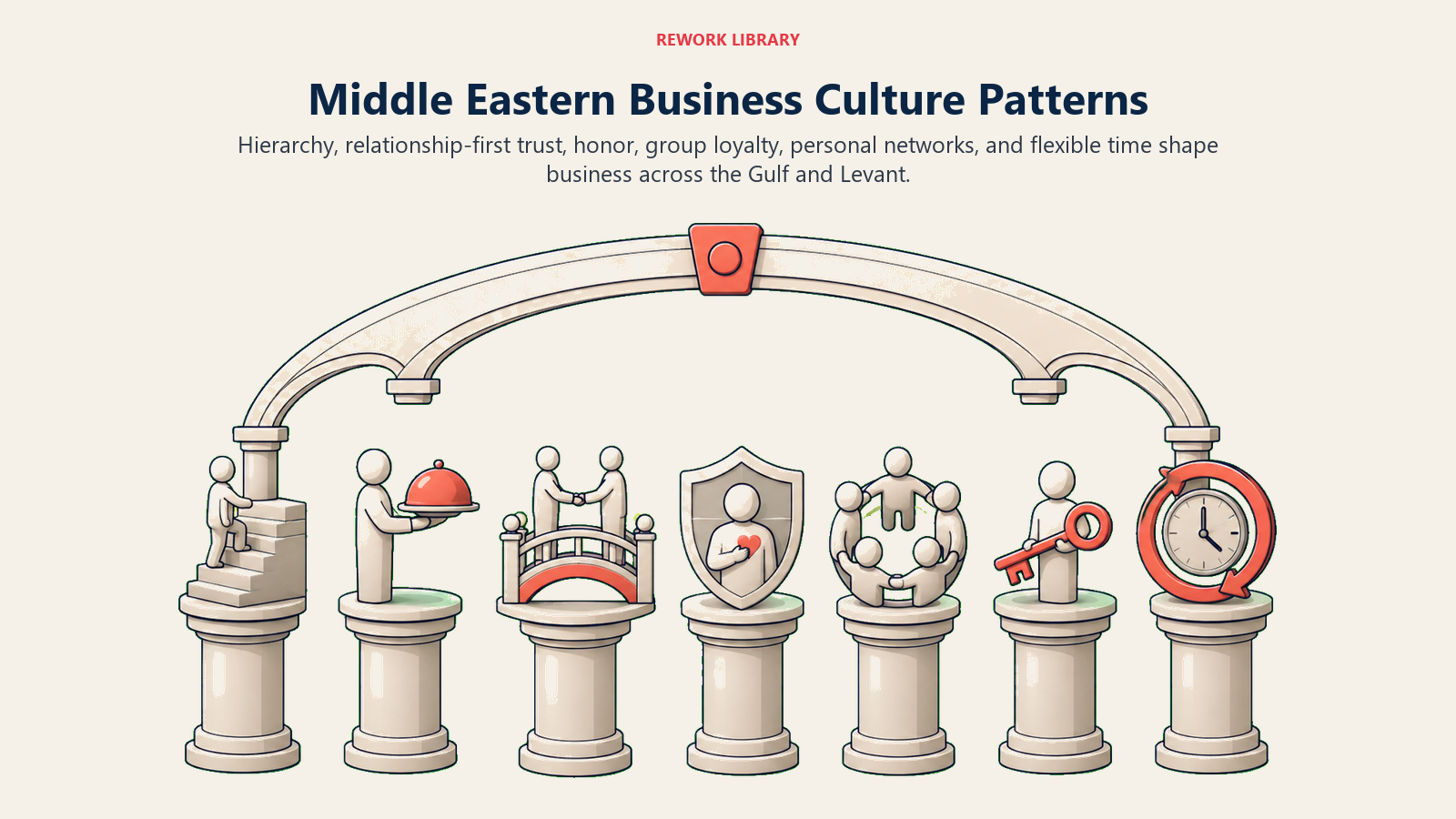
Decisions concentrate at the top. Titles and age carry real weight, and a decision rarely feels final until the most senior person present has visibly signed off, even if they said little during the meeting itself. Proposing a plan without a clear line to that approval can read as naive rather than confident.
Relationships come before the transaction. Trust gets built through time spent together and hospitality extended and returned, well before a contract gets discussed in detail. Skipping straight to terms, efficient in a task-first culture, can read as presumptuous here.
Honor and face govern how things get said. A subordinate correcting a superior, or a partner naming a missed deadline in a group setting, does lasting damage a direct culture wouldn't anticipate. Criticism and bad news travel through private, indirect channels far more often than blunt statements in open meetings.
The group outranks the individual. Family name, tribe, sect, and company reputation are inherited and shared in a way individualist cultures rarely experience. A person's conduct reflects on relatives and associates well beyond the transaction, which is part of why introductions matter more here than a cold pitch.
Wasta runs quietly underneath it. Wasta, personal connections used to get something done, a job, a permit, an introduction, is a well-documented, normalized feature of business across the region, not a fringe practice. It works as a trust shortcut where formal institutions can be slow or inconsistent, though it's openly criticized inside the region too when it crowds out merit.
Time bends around the relationship. Meetings start late, run long, and get interrupted by prayer or an unannounced visitor without anyone treating it as rude. A monochronic, one-thing-at-a-time schedule is the outsider's expectation, not the local default. See high-context vs low-context cultures at work and hierarchical vs egalitarian cultures for how this plays out elsewhere.
Why the Pattern Holds
Tribal and Bedouin social structures, centuries of crossroads trade, and Islam's emphasis on hospitality and respect for elders all run through this pattern, without any single thread fully explaining it. Colonial-era legacies, French in the Levant, British across much of the Gulf, added their own layer of formal hierarchy. None of this makes the region monolithic: Sunni and Shia communities, Gulf and Levantine Arabs, and dozens of nationalities in the same Dubai office all experience it differently, but the defaults are consistent enough to plan around.
Hofstede's Scores for the Region
Hofstede's original research grouped Egypt, Iraq, Kuwait, Lebanon, Libya, Saudi Arabia, and the UAE into a single "Arab World" cluster, since individual country-level data for most of these markets didn't exist when the study was built. Saudi Arabia has since been measured individually; the UAE has not, so most trackers still use the regional Arab World score for the Emirates.
| Cluster / Country | Power Distance (PDI) | Individualism (IDV) | Motivation to Achieve (MAS) | Uncertainty Avoidance (UAI) | Long-Term Orientation (LTO) |
|---|---|---|---|---|---|
| Arab World (cluster, incl. UAE) | 80 | 38 | 52 | 68 | 23 |
| Saudi Arabia (individual) | 95 | 25 | 60 | 80 | 36 |
Source: geerthofstede.com and the Hofstede Insights country comparison tool. For the full six-dimension model and more country data, see Hofstede's cultural dimensions explained. For how this region compares against the rest of the world, see how business culture differs across the world.
Both figures sit far above the roughly 50-point global PDI midpoint and well below the global IDV midpoint, the statistical signature of the hierarchical, collectivist pattern described above. Saudi Arabia's individual score of 95 is among the highest Power Distance figures Hofstede has ever recorded, meaningfully higher than the Arab World average. Treating "the Gulf" as one homogenous score understates how concentrated authority is in Saudi organizations specifically, a reminder that a cluster score is a starting hypothesis, not a substitute for country-level data where it exists.
Key Facts
- Saudi Arabia's individual Hofstede Power Distance score is 95, among the highest ever recorded, versus 80 for the broader Arab World cluster that still covers the UAE. Source: Hofstede Insights country comparison tool
- The Arab World cluster (Egypt, Iraq, Kuwait, Lebanon, Libya, Saudi Arabia, and the UAE) scores 38 on Individualism against a global average closer to 64, firmly collectivist territory. Source: geerthofstede.com
- Saudi Arabia's female labor force participation rate reached 36.2% in 2024, up from 21.2% in 2017, blowing past the original Vision 2030 target of 30% and prompting a revised goal of 40%. Source: GASTAT, via Arab News
- Expatriates made up roughly 88.5% of the UAE's population as of 2025, so the private-sector workforce most global businesses meet there is overwhelmingly foreign-born. Source: Global Media Insight
- The UAE's National Strategy for Artificial Intelligence 2031 targets 20% of non-oil GDP from AI, backed by Microsoft's $1.5 billion stake in Abu Dhabi's G42, with plans toward roughly $15 billion by 2029. Source: Microsoft, CSIS
- UAE Labour Law (Federal Decree Law No. 33 of 2021, Article 17) mandates a two-hour daily cut in working hours for private-sector staff during Ramadan, applied equally to Muslim and non-Muslim employees. Source: UAE Ministry of Human Resources and Emiratisation
How the Gulf Differs from the Levant
The shared pattern above is real, but the Gulf and the Levant arrived at it from opposite economic directions, and that shows up constantly in how business runs.
The Gulf: State Wealth, Monarchies, and a Majority-Expatriate Workforce
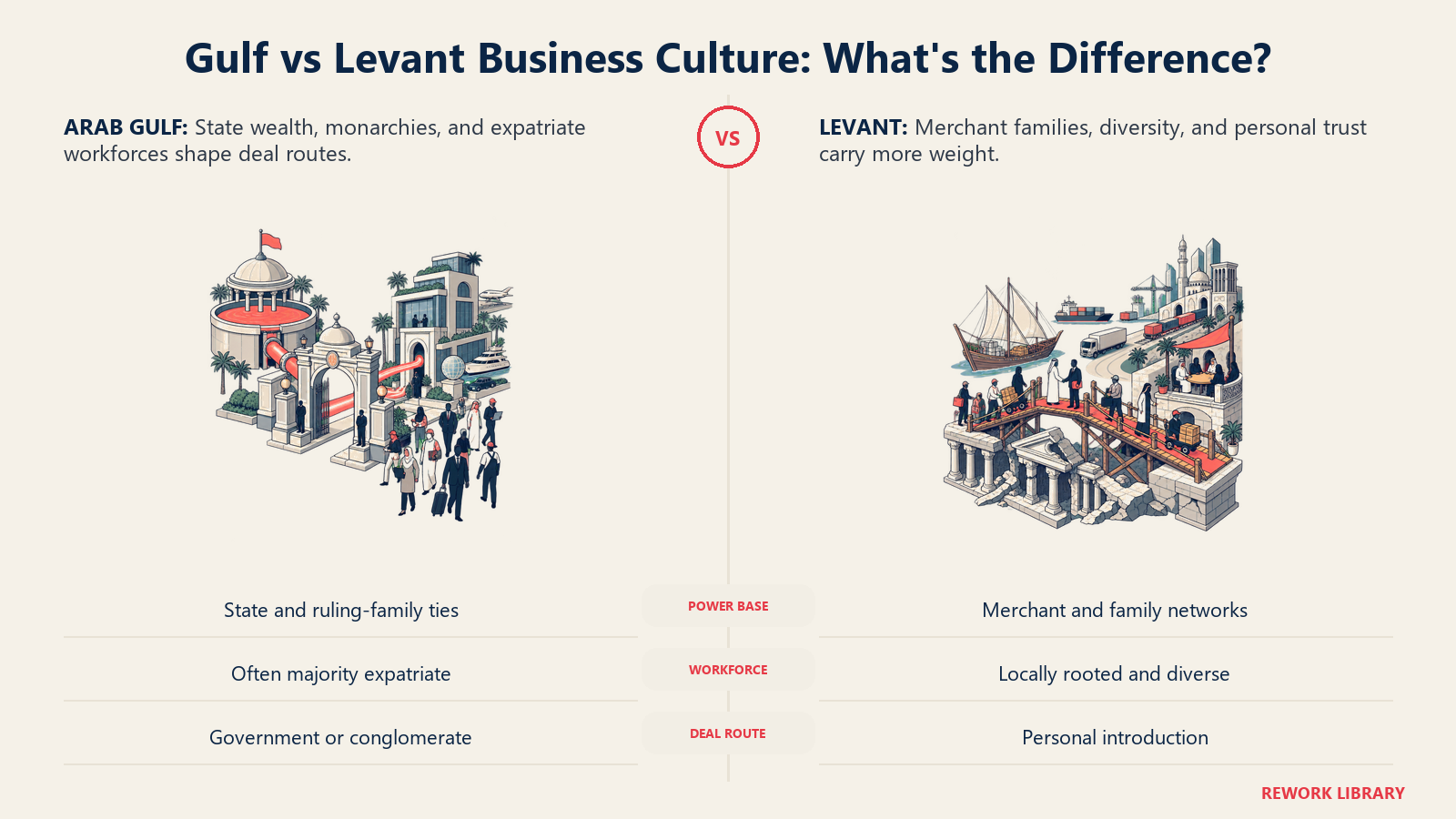
Saudi Arabia, the UAE, Qatar, Kuwait, Bahrain, and Oman are monarchies whose modern economies were built on oil and gas wealth, now redirected through sovereign wealth funds such as Saudi Arabia's PIF and the UAE's Mubadala. The state itself is often the largest employer and investor in the room, so government relationships and ruling-family sponsorship matter more here than almost anywhere else a Western company operates. Private-sector workforces, especially in the UAE and Qatar, are majority expatriate, so the "local business culture" a foreign leader meets in a Dubai office is often filtered through expatriate managers working under a smaller number of national owners at the top.
The Levant: Merchant Tradition, Diversity, and Institutional Strain
Lebanon, Jordan, and their neighbors sit at the other end of the economic story. Beirut built its identity over centuries as a Mediterranean trading and banking city, a meeting point between Arab, French, Armenian, and European commercial influence, and that merchant tradition, family firms, personal trust, multilingual dealmaking, still shapes how business gets done. Lebanon's roughly eighteen recognized religious sects make it a genuinely multi-confessional society, a layer of complexity the Gulf's more homogenous ruling structures don't face. Weaker, more volatile state institutions, sharpened by Lebanon's financial crisis since 2019, have made personal networks and wasta even more load-bearing here than in the wealthier, centrally administered Gulf.
The practical upshot: a Gulf deal often routes through a government relationship or a family conglomerate with royal ties, while a Levantine deal more often routes through a personal introduction into a specific merchant family. Both are relationship-first. They are not the same relationship to build.
Business Norms You'll Actually Encounter
The Majlis and Relationship-First Dealmaking
The majlis, a gathering space rooted in Bedouin tradition, is the clearest physical expression of Gulf business culture. Historically where a tribal elder heard grievances and received guests, it now functions as the informal venue where relationships get built and real decisions often happen, well before or separate from a formal boardroom meeting. An invitation into someone's majlis, or its modern equivalent, an unhurried coffee meeting or long lunch, isn't a delay before business. It is the business.
Hospitality as Protocol, Not Just Courtesy
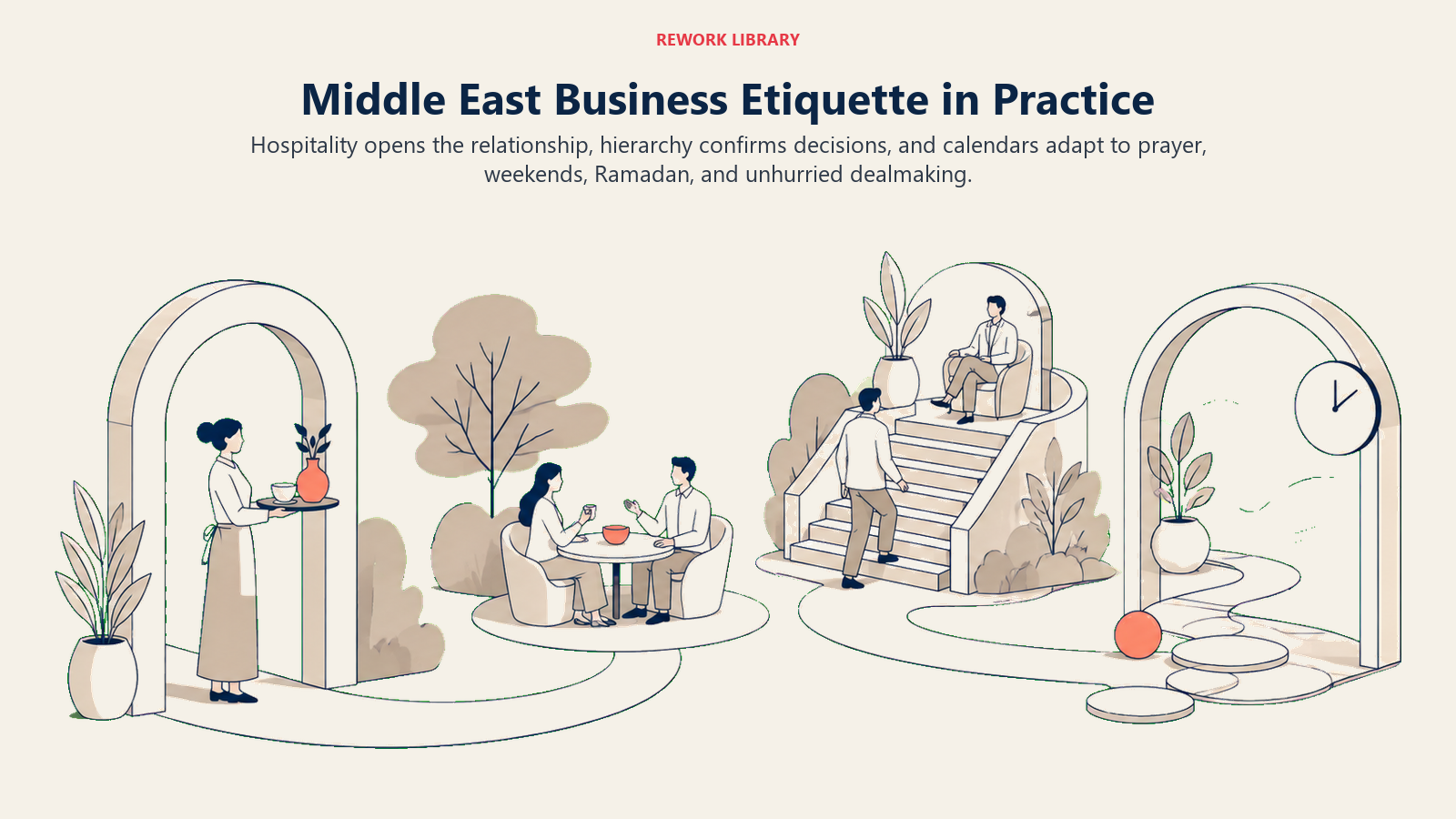
Coffee, dates, and an unhurried welcome are close to mandatory at the start of any meeting, and declining them too quickly can read as brusque. Extending hospitality well signals you take the relationship seriously; reciprocating it is expected, not optional.
Hierarchy and Titles
Address people by title and, where known, honor family or tribal standing in how you introduce them. Decisions should visibly route through the most senior person in the room; a plan that skips a layer of hierarchy to move faster often stalls anyway, because the people expected to execute it are waiting to see it endorsed by the right person first. See hierarchical vs egalitarian cultures and why teams stay silent in meetings for why open dissent in a group setting is so rare.
Timing, the Weekend, and Ramadan
Fridays remain the primary day of communal prayer, and most Gulf states keep a Friday-Saturday weekend, though the UAE shifted to Saturday-Sunday (with a shortened Friday) in January 2022 to align with global markets. During Ramadan, expect shorter hours (a legally mandated two-hour daily cut in the UAE), a slower pace, and meetings built around fasting and prayer times. Scheduling an aggressive close during Ramadan, or expecting a full workday from a fasting colleague, is a common, avoidable mistake.
A Leader's Playbook for Doing Business in the Region
Knowing the pattern only helps if it changes what you do before your next meeting, proposal, or piece of feedback.
Invest in the relationship before you need it. Meet in person where possible, accept hospitality graciously, and expect the first meeting or two to be about the people, not the deal. Compressing this into one transactional call is the most common way a Western leader stalls a relationship before it starts. See relationship-first vs task-first business cultures for the broader trade-off.
Route decisions and feedback through the hierarchy, not around it. Identify the real decision-maker early, make sure your proposal has a visible path to their sign-off, and deliver difficult feedback privately through the right layer of management rather than in an open meeting.
Read indirect signals, not just direct answers. A polite "insha'Allah" or "we'll see" often carries more information than a flat yes or no. Treat ambiguity as worth a private follow-up, not a commitment to bank on. Managing a multicultural team goes deeper on reading these signals.
Understand wasta without trying to import it badly. Build genuine local relationships and accept warm introductions; don't assume you can shortcut trust with a transactional favor, which tends to backfire with people who take the underlying obligation seriously.
Plan your calendar around the region. Build Ramadan and, in most of the Gulf, a Friday-Saturday weekend into project timelines from the start, rather than discovering the mismatch mid-negotiation.
Rapid Modernization: Vision 2030 and Beyond
The Gulf states are changing faster than a static cultural score can capture. Saudi Arabia's Vision 2030 program has pushed female labor force participation from 21.2% in 2017 to 36.2% in 2024, blowing past its original 30% target five years early and prompting a revised goal of 40%. The UAE's 2022 shift to a Saturday-Sunday weekend was a deliberate move to align its business rhythm with the markets it trades with. State-directed diversification into tourism, finance, and technology has pulled in millions of expatriate professionals and reshaped what a "typical" workplace in Riyadh or Abu Dhabi looks like compared to a decade ago.
None of this erases the underlying pattern. Hierarchy, relationship-first dealmaking, and honor-conscious communication remain deeply embedded even in the most modernized Gulf workplaces; what changes is who's in the room, not the pattern itself. A regional score like Hofstede's is a starting hypothesis, not a fixed verdict, a point worth carrying into business culture in Southeast Asia and business culture in East Asia as well.
Business Culture in the Gulf in the Age of AI
The Gulf states are among the most aggressive AI investors in the world relative to their size, and this isn't marketing. The UAE's National Strategy for Artificial Intelligence 2031 targets a fifth of non-oil GDP coming from AI, backed by Microsoft's stake in Abu Dhabi's G42 and Mubadala's $100 billion MGX investment vehicle. Saudi Arabia is pursuing a parallel build-out through its own state funds, industrial policy at a scale few other regions can match.
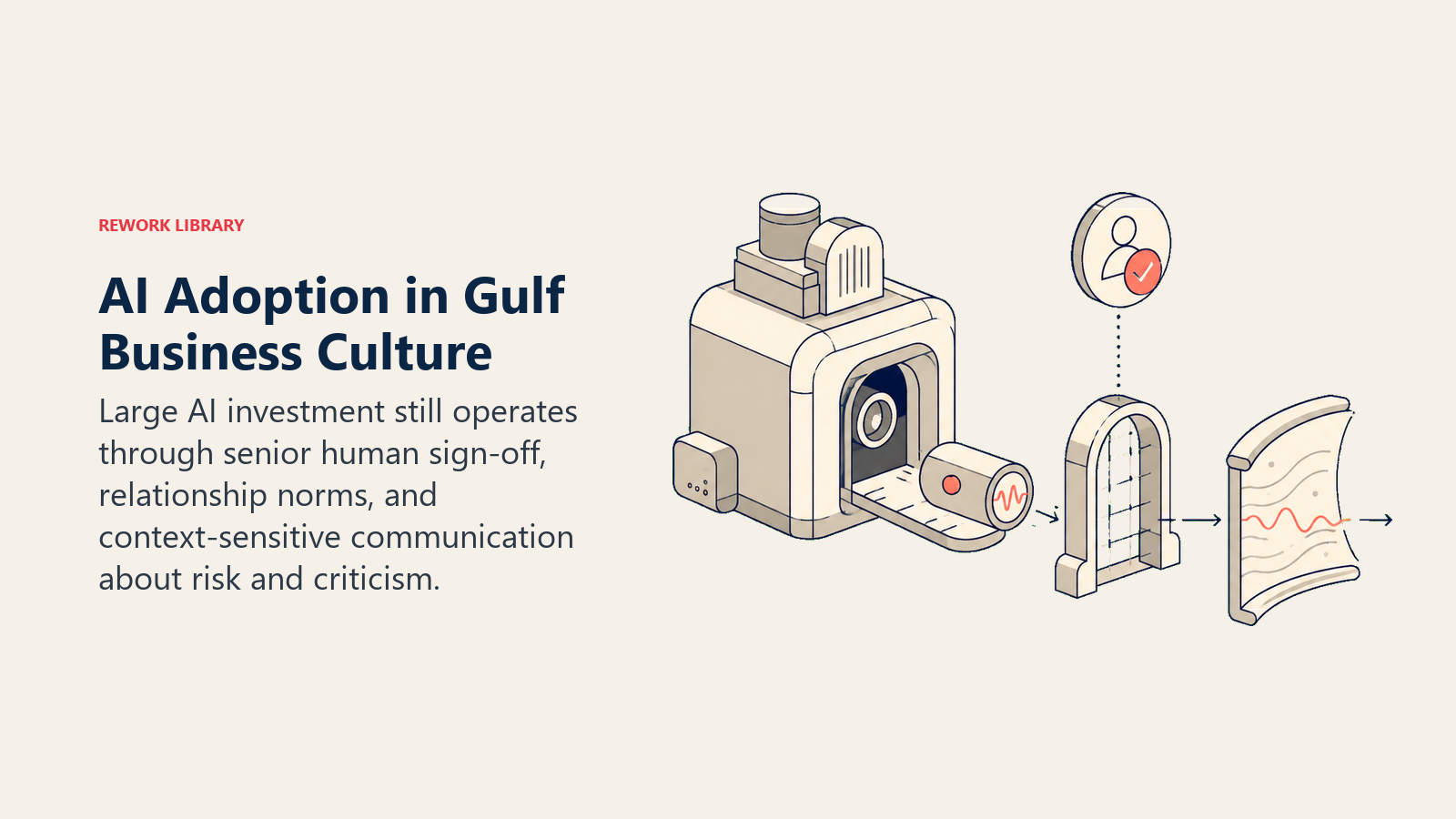
What it doesn't automatically change is the underlying culture an AI system, or an AI-fluent expatriate hire, has to operate inside. A decision-support tool's recommendation still needs a visible, senior human sign-off before a Gulf team treats it as real, the dynamic described in the Frontier Firm and the agent boss. An AI teammate delivering blunt, context-free feedback in a culture where honor governs how criticism travels is a genuine mismatch, one form of AI cultural debt: the gap between the norms a tool assumes and the norms a workplace runs on. Leaders building ai-native culture here should expect hierarchy and honor to shape how AI output gets delivered, not to disappear because a system sent it instead of a person.
For organizations running a majority-expatriate Gulf workforce, consistent onboarding and clean HR handoffs are easier when they aren't scattered across disconnected country-by-country tools. That's the kind of unglamorous consistency Rework's People app supports; it doesn't replace the judgment above it.
Where to Go Next
This regional overview sits alongside the broader cross-cultural pillar in this collection. From here:
- How business culture differs across the world, for the full global map
- Hofstede's cultural dimensions explained, for all six dimensions and more countries
- High-context vs low-context cultures at work, for the communication axis behind the region's indirectness
- Relationship-first vs task-first business cultures, for the trust-building trade-off behind the majlis
- Country-specific guides for Saudi Arabia, the UAE, and Lebanon are planned as this collection expands
Frequently Asked Questions about Business Culture in the Middle East and the Gulf
What do Middle Eastern and Gulf business cultures have in common?
A high power distance, relationship-first, high-context pattern: decisions concentrate with the most senior person present, trust builds through time and hospitality before terms get discussed, and honor shapes how feedback and disagreement travel.
Is business culture the same across the entire Middle East?
No. This guide covers the Arab Gulf states and the Levant, which share a cultural pattern but arrived at it from different economic paths: oil-wealth monarchies with majority-expatriate workforces versus a more diverse, merchant-tradition set of economies under more institutional strain. The wider "Middle East" also includes Iran, Turkey, and Israel, not covered here.
What is wasta and how should an outsider handle it?
Wasta means using personal connections to get something done, a job, an introduction, a favorable decision, and it's a normalized, widely documented feature of regional business rather than a fringe practice. Build genuine local relationships and accept warm introductions rather than manufacturing a shortcut, which tends to backfire.
What is a majlis and why does it matter in business?
The majlis is a traditional Gulf gathering space rooted in Bedouin custom, historically where a tribal elder received guests and settled disputes. In business, an invitation into one, or its modern form as an unhurried coffee meeting, is where relationships actually get built, often before a formal boardroom discussion.
How does Saudi Arabia's Hofstede score compare to the rest of the region?
Saudi Arabia's individual Power Distance score is 95, among the highest Hofstede has ever recorded, noticeably higher than the Arab World cluster average of 80 that still applies to the UAE, since the UAE hasn't been measured individually.
How should a leader plan around Ramadan and the regional weekend?
Expect a legally mandated reduction in working hours during Ramadan (two hours daily in the UAE), a slower pace, and meetings scheduled around fasting and prayer times. Most Gulf states keep a Friday-Saturday weekend, though the UAE moved to Saturday-Sunday in 2022; build both into timelines up front.
Does rapid modernization in Saudi Arabia and the UAE mean the old cultural pattern no longer applies?
No. Reforms like rising female labor force participation and the UAE's 2022 weekend change are real, but hierarchy, relationship-first dealmaking, and honor-conscious communication remain deeply embedded even in the most modernized Gulf workplaces.
How is AI changing business culture in the Gulf?
The UAE and Saudi Arabia are investing tens of billions of dollars in AI as state policy, but a tool's output still needs visible senior human endorsement before a Gulf team treats it as real, and blunt AI-generated feedback can clash with a culture where honor governs how criticism travels.
The Gulf and the Levant are not one culture split across a map of oil wells and trading ports. They are one recognizable pattern, hierarchy, relationship, honor, and context, expressed through two different economic stories: one built on state wealth and rapid reform, the other on centuries of merchant trade and harder-won resilience. A leader who understands that pattern, and knows which economic story they're standing inside, will get more right walking into Riyadh, Dubai, or Beirut than one who treats the region as a single block.

Co-Founder, Rework.com
On this page
- The Shared Pattern: Hierarchy, Honor, Context, and the Group
- Why the Pattern Holds
- Hofstede's Scores for the Region
- Key Facts
- How the Gulf Differs from the Levant
- The Gulf: State Wealth, Monarchies, and a Majority-Expatriate Workforce
- The Levant: Merchant Tradition, Diversity, and Institutional Strain
- Business Norms You'll Actually Encounter
- The Majlis and Relationship-First Dealmaking
- Hospitality as Protocol, Not Just Courtesy
- Hierarchy and Titles
- Timing, the Weekend, and Ramadan
- A Leader's Playbook for Doing Business in the Region
- Rapid Modernization: Vision 2030 and Beyond
- Business Culture in the Gulf in the Age of AI
- Where to Go Next