More in
Sales Leadership Insights
Why Sales Org Design Is the Most Under-Rated Growth Lever
Mar 16, 2026
What Great Sales Leaders Actually Do in Their First 90 Days
Mar 10, 2026
Why Sales Retention Is the New Sales Hiring
Feb 4, 2026 · Currently reading
Forecasting Discipline: What Separates 90% Callers from 50% Callers
Jan 19, 2026
Why Sales Retention Is the New Sales Hiring
Turn this article into takeaways for your work.


Each assistant summarizes the article only for you and suggests best practices for your work.
Every VP of Sales has a hiring plan. The number of open reqs, the sourcing strategy, the comp bands, the interview process. It's usually documented, budgeted, and reviewed quarterly.
Almost none of them have a retention strategy. Not a real one, not something that's tracked, owned, and treated with the same rigor as pipeline.
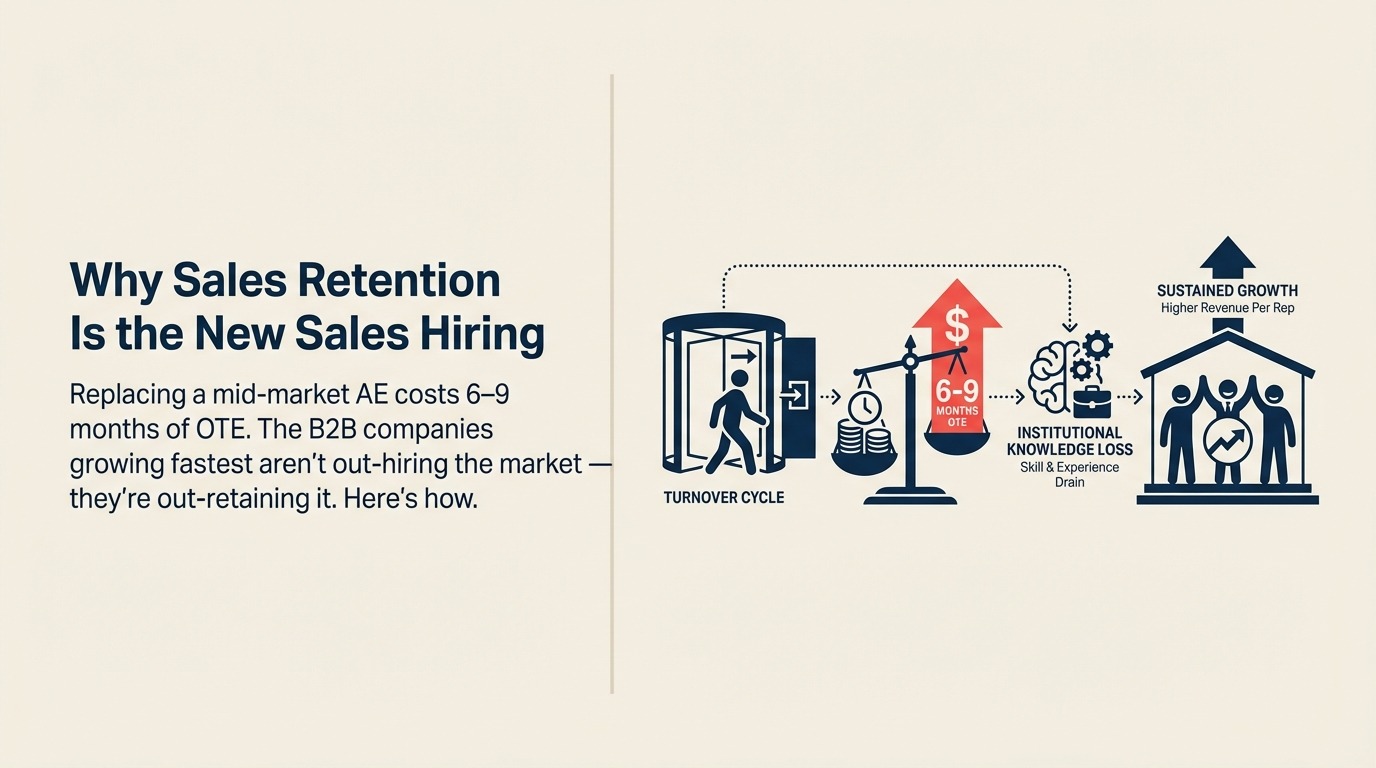
This is a serious and mostly unexamined mistake, because the math is unambiguous: replacing a mid-market AE costs somewhere between six and nine months of their on-target earnings when you account for recruiting fees or internal time, the ramp period before a new hire is fully productive, the pipeline that dissipates when the account is in transition, and the manager bandwidth absorbed by the replacement process. For an AE with a $200K OTE, that's $100K to $150K per departure. And that's a conservative model that ignores the knowledge transfer cost and the subtle team morale effects of watching a high performer leave.
The companies growing fastest in B2B SaaS right now aren't out-hiring the market. They're out-retaining it.
The retention math most sales leaders haven't run
Let's put specific numbers to it, because vague cost estimates don't change behavior.
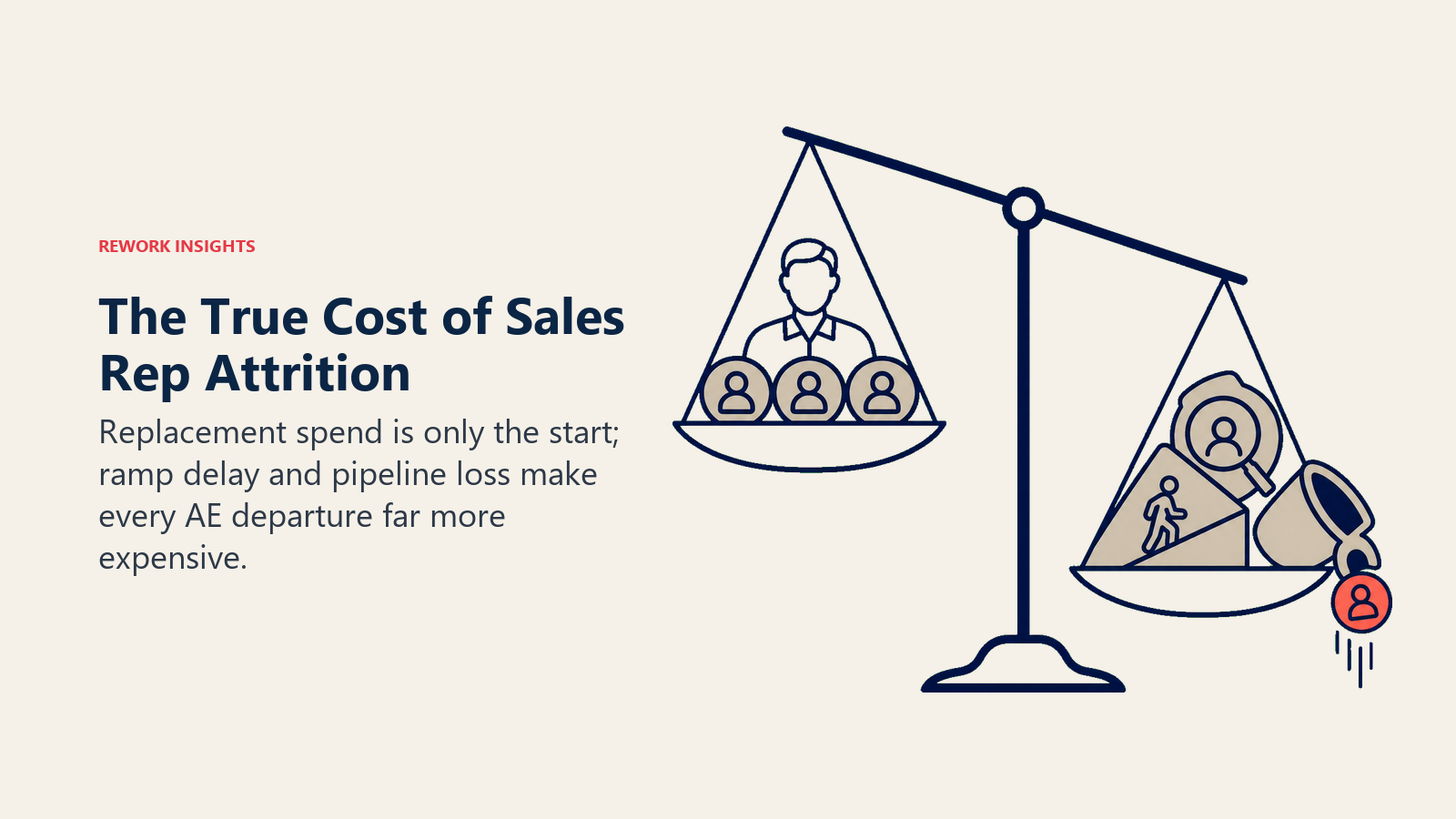
Take a 20-person sales team with average AE OTE of $180K. Industry-average sales attrition runs around 35% annually in SaaS. That's 7 departures per year. At a replacement cost of 7 months of OTE ($105K per rep), that's $735K in annual churn cost, before accounting for the pipeline gap. The Bridge Group's SaaS AE Metrics Report puts voluntary AE turnover across SaaS companies at 34% annually, and that number has been climbing for three consecutive years.
Pipeline gap is the part that's rarely quantified. A fully ramped AE typically carries $1.5M to $2M in pipeline at any given time. When they leave, that pipeline doesn't transfer cleanly. Some deals go cold. Some prospects start over with the new rep. Some quietly go to a competitor while the territory is in transition. Even if half the pipeline survives the transition, that's $700K to $1M in deals at risk per departure. Multiply by 7 departures, and you're looking at $5M to $7M in pipeline exposure annually from attrition alone on a 20-person team.
Most sales leaders have never run this number. When they do, the framing changes immediately. Retaining one more AE per quarter isn't a nice HR outcome. It's a $100K cost save and a $1M pipeline protection, and it's often achievable with investments that cost a fraction of that. Understanding your ramp metrics, how long it actually takes a new hire to reach full productivity on your team, makes the replacement cost math even harder to ignore.
Why top reps leave (and it's rarely money)
When a high performer resigns, the exit interview almost always surfaces compensation. This is usually a proximate cause, not a root cause. The compensation conversation becomes viable when the rep is already considering leaving for other reasons. The money is what closes the decision, not what opens it.
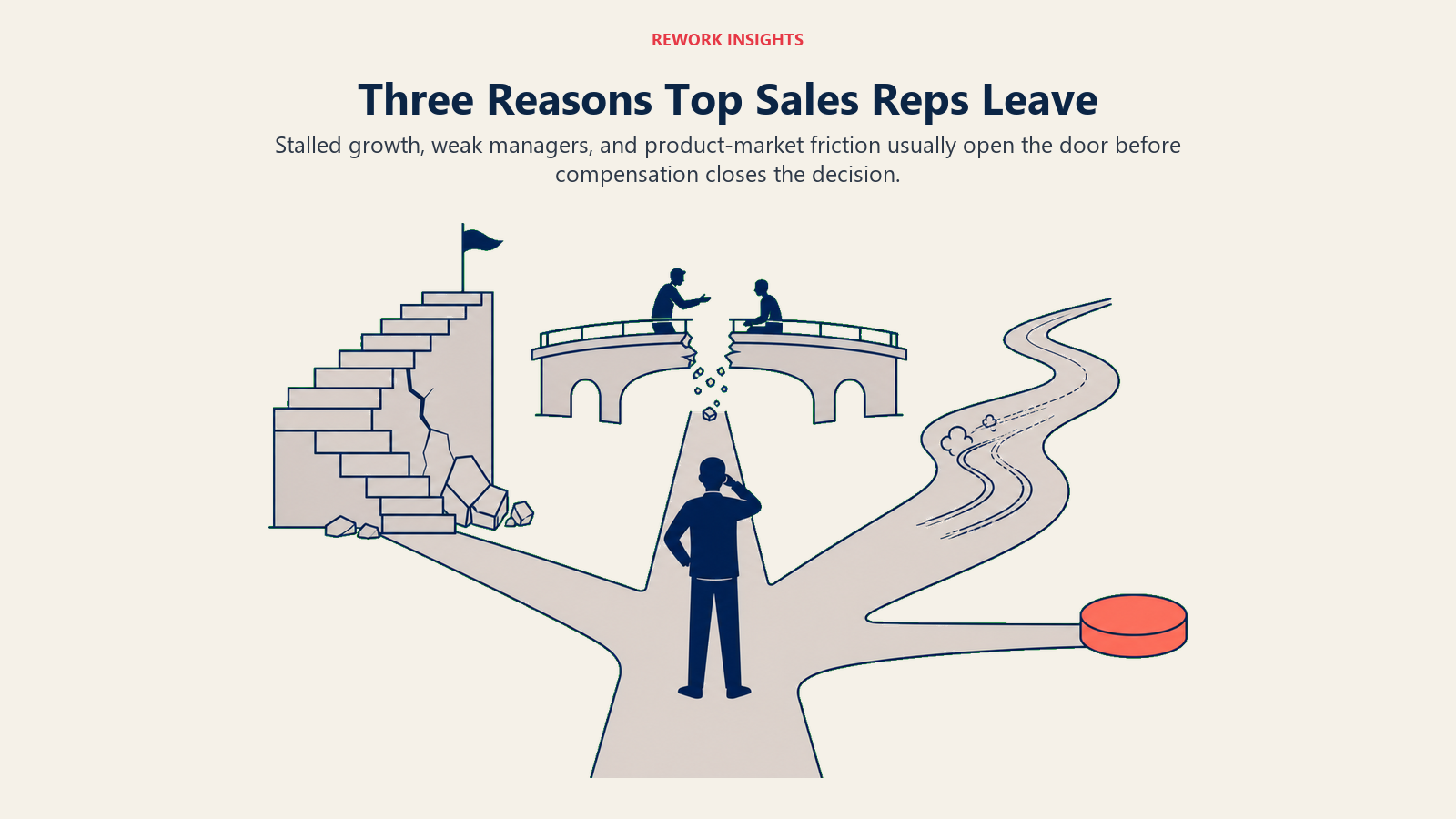
Three things actually drive departure decisions in high-performing sales reps:
Lack of growth path. High performers are, by definition, people who push against limits. When they've mastered their current role and can't see where they go next, they start looking. This is particularly acute in the 18 to 30 month window, when a rep has fully ramped, hit their stride, and starts asking "what's after this?" If the answer is "keep doing what you're doing," the best ones leave. The mediocre ones stay.
The growth path doesn't have to be management. Many high performers explicitly don't want to manage. But they want expanded scope: larger accounts, new segments, lead status on strategic deals, involvement in product feedback loops. If none of that is available, a competitor offering a more senior title at similar comp will win. The distinction between leadership and management matters here, what high performers often want is more leadership scope without necessarily taking on the management overhead.
Manager quality. This is the most consistently underweighted factor. Research on employee retention across industries consistently shows that the front-line manager relationship is the primary driver of voluntary turnover. Not pay, not company direction, not career path in the abstract. In sales, where a manager's behavior is visible daily (in coaching calls, in deal reviews, in forecast conversations), the effect is even more concentrated. Gallup's State of the American Manager report found that managers account for at least 70% of the variance in employee engagement scores, and that the single largest driver of voluntary turnover is not compensation but the quality of the direct manager relationship.
A bad sales manager loses reps in a specific pattern: the first departure happens 12 to 18 months in, often attributed to "better opportunity." The second follows 6 months later, often attributed to a "great comp package elsewhere." By the third departure, the manager's team is structurally below capacity and the CRO is finally asking questions. Three strong reps gone before anyone connected the common variable.
Product-market misalignment. This one is less talked about and genuinely hard to fix. When a rep joined the company, they were selling into a market with clear pain, competitive differentiation, and reasonable deal velocity. When that changes (through a product pivot, competitive compression, or market saturation), reps absorb the friction first. They hear the objections, lose the deals that used to close, and feel the comp impact before leadership does.
High performers who've experienced selling something that worked don't stay long when what they're selling no longer works. They know the difference between a skill problem and a product problem, even if leadership is still debating which it is. McKinsey's research on B2B commercial excellence confirms that reps with strong prior track records are 2.5x more likely to leave when they perceive a product-market fit problem than when they see it as a skills gap, because they have the self-awareness to know which problem they can solve themselves.
The performance plateau problem
There's a specific attrition risk that's almost invisible until it converts: the high performer who's 18 to 24 months in, hitting quota consistently, and quietly checking out.
These reps are dangerous to ignore because they're not flagging. They're not missing quota. They're not complaining. They're performing at a level that doesn't trigger management attention. But their engagement has peaked, their comp growth has plateaued (because they're hitting the same quota at the same rate with incrementally better efficiency), and nobody is proactively talking to them about what's next.
CRM activity data can surface this before it becomes a departure. A rep who's logging 10% fewer outbound touches per week, whose deal velocity is stable but whose multi-threading behavior (the number of stakeholders they're building relationships with per account) has dropped, whose close rate is steady but whose average deal size has stopped growing. These are signals. They won't show up on a quota dashboard, but they'll show up in the data.
Companies using Close, Pipedrive, or HubSpot with structured activity tracking can spot this pattern if they're looking for it. If you're evaluating which CRM best supports rep-level behavioral analytics, activity tracking depth varies significantly across platforms and is worth checking before you're trying to build this diagnostic after the fact. The problem is that most pipeline reviews focus on deal-level outcomes rather than rep-level behavioral patterns. You see that the numbers are fine without seeing that the engagement driving those numbers is declining.
Manager quality as the primary retention lever
If you're a CRO trying to improve retention and you have limited time, prioritize your front-line managers before anything else.
The leverage math is simple. A strong front-line manager typically runs a 6-8 person team. Their coaching behavior, accountability style, and communication quality affects retention probability for every rep on that team. One great manager protecting a team of 7 has more retention impact than any org-wide retention initiative.
The problem is that most sales managers were promoted for rep performance, not management skill. The top AE became the manager. They're good at selling. They're often inconsistent at developing others, holding uncomfortable conversations about performance, or creating an environment where reps feel safe surfacing problems early.
Bad managers lose reps in ways that are hard to attribute. The rep who left "for a better opportunity" may have actually left because every deal review felt like an interrogation, because coaching conversations never happened, or because the manager took credit for deals in front of leadership. None of that appears in the exit interview.
Identifying manager quality as a retention lever means measuring it directly: tracking attrition by manager (not just team), asking reps directly in skip-levels about their management experience, and treating a manager who's lost three strong reps in 18 months as a system problem rather than a talent problem.
The Retention Risk Matrix
Before a rep starts looking, the signals are usually visible. The challenge is having a structure to surface them before they become decisions.
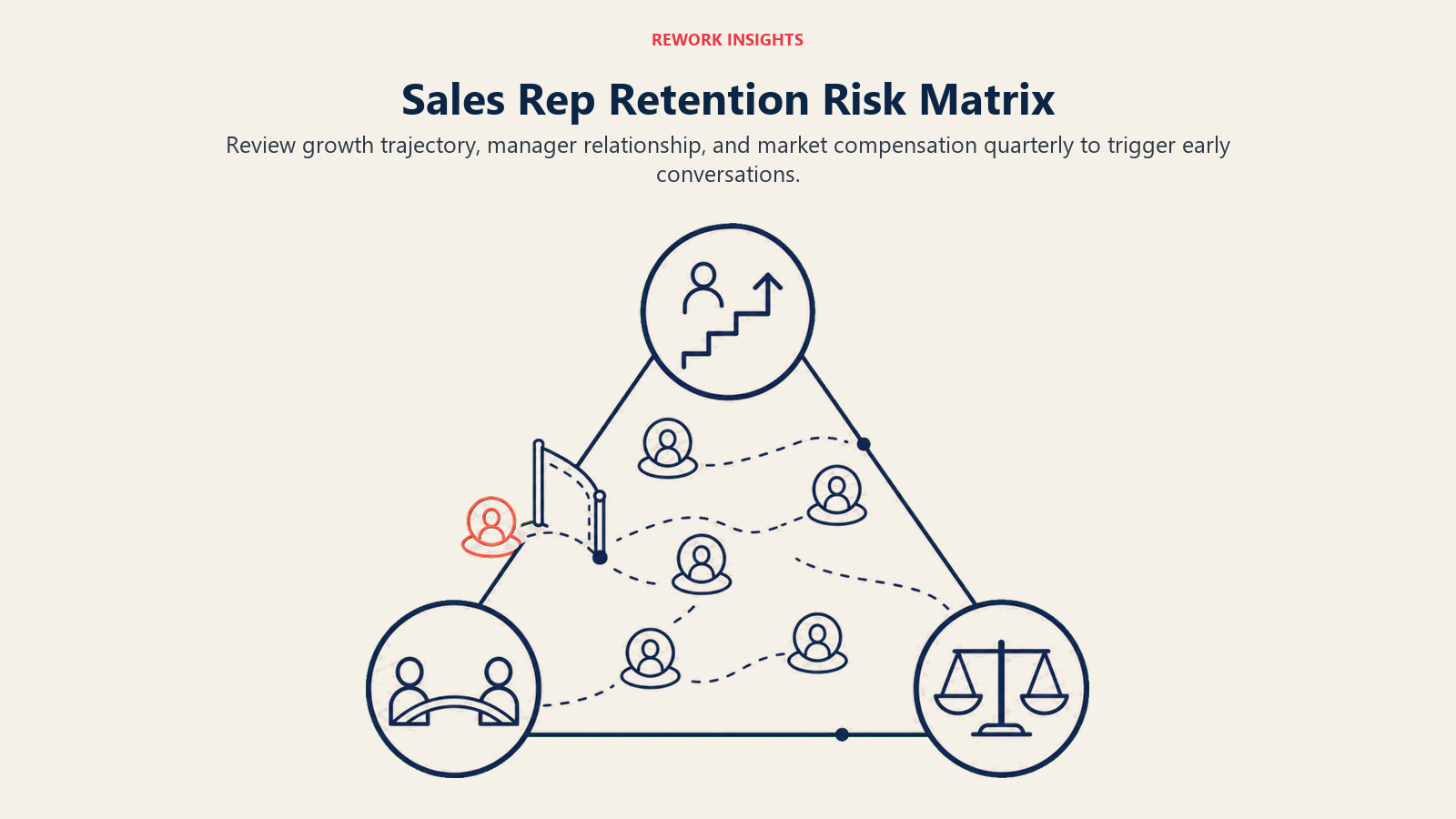
Score each rep across three dimensions quarterly:
Growth trajectory: Is this rep's role expanding or static? Have they gotten new scope, account complexity, or leadership opportunities in the last six months? Score 1 (static) to 3 (clearly expanding).
Manager relationship: Based on 1:1 quality, coaching frequency, and skip-level feedback, does this rep have a strong relationship with their manager? Score 1 (at risk) to 3 (strong).
Comp-to-market ratio: Is this rep's total compensation competitive with what they'd get hired for at a comparable company today? Score 1 (below market) to 3 (at or above market).
Reps who score below 2 on two or more dimensions are at elevated departure risk. That's not a conclusion. It's a trigger for a real conversation.
The matrix isn't meant to be a precise prediction tool. It's meant to create a regular cadence of structured thinking about rep-level retention risk, which most sales leaders do only reactively when someone has already accepted an offer elsewhere.
A retention conversation that actually works
Most retention conversations happen too late: after a rep has mentally decided to leave, or worse, after they've already signed somewhere else.
A proactive retention conversation takes about 20 minutes and should happen quarterly for every rep who's been in the role 12 months or more. If you're building the structural cadence for this alongside a formal onboarding framework, the 30-60-90 plan is a useful foundation; it sets the expectation early that growth conversations are a recurring part of how the org operates, not a one-time milestone. The agenda is simple:
- Where do you want to be in 18 months, and does your current path get you there?
- What's working in your role that you'd want to protect?
- What's the one thing that, if changed, would make a significant difference for you?
The third question is the most useful. It's not asking them to complain. It's asking them to surface one high-leverage change. Reps who are genuinely at risk will often tell you directly if you ask in a way that feels safe rather than performative.
The goal isn't to solve every problem in the conversation. It's to demonstrate that you're paying attention before they've stopped paying attention. That alone moves retention probability.
Learn More