Marco de Definición de MQL: Cómo Escribir una Definición de MQL Que Ambos Equipos Respetarán
Turn this article into takeaways for your work.


Each assistant summarizes the article only for you and suggests best practices for your work.
Cada trimestre ocurre la misma reunión. Marketing reporta que alcanzó los objetivos de MQL. Ventas reporta que el pipeline es escaso. Ambos números son precisos. Ningún equipo está mintiendo.
El problema es la definición de MQL. Si es laxa (un solo formulario enviado, un score que cualquiera puede alcanzar leyendo dos publicaciones de blog), marketing alcanzará su número mientras genera leads que ventas no puede cerrar. Si es poco realista, que requiera cuatro acciones de alta intención y un ajuste firmográfico perfecto, marketing nunca alcanzará los objetivos de pipeline y empezará a jugar con los criterios en silencio. Para las definiciones autoritativas de MQL, SAL, SQL y términos relacionados del funnel, consulte el glosario de marketing-sales alignment.
Una mala definición de MQL es un impuesto silencioso sobre la calidad del pipeline. No ve el costo en el conteo de MQL. Lo ve seis semanas después en tasas bajas de SAL, altos conteos de rechazo y representantes que dejan de trabajar la cola porque han aprendido a no confiar en ella.
Por Qué las Definiciones de MQL Se Deterioran
La mayoría de las definiciones de MQL comienzan con buenas intenciones y se erosionan con el tiempo. El deterioro sigue un patrón predecible.
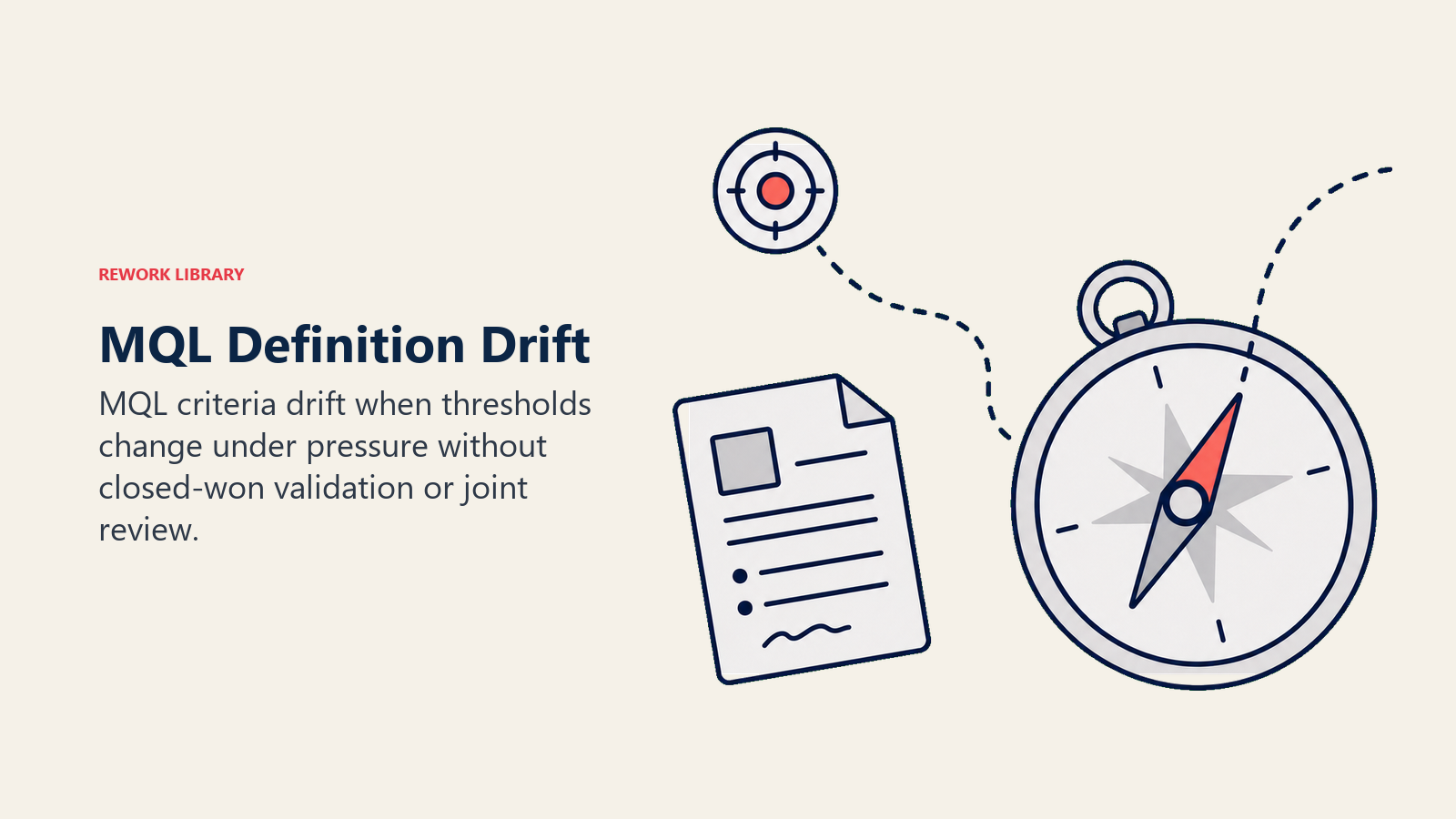
Marketing escribe la definición solo, típicamente durante la planificación, sin extraer datos de negocios ganados de ventas. Los criterios reflejan lo que marketing puede medir (formularios enviados, descargas de contenido, aperturas de email) en lugar de lo que realmente predice un lead listo para ventas.
La definición nunca se valida contra el historial de negocios ganados. Nadie ejecuta un backtest para preguntar: "De los leads que cerraron el año pasado, ¿cuántos habrían calificado como MQL bajo esta definición en ese momento?" Si la respuesta es el 30%, la definición es demasiado laxa. Si la respuesta es el 95%, puede ser demasiado estricta o su muestra está sesgada hacia capturas de última etapa.
Luego ocurre un mal trimestre. El pipeline falla. La presión del liderazgo aumenta. Alguien ajusta el umbral de MQL a la baja, reduciendo el requisito de score o eliminando un criterio, para alcanzar un objetivo de volumen a corto plazo. La definición cambia unilateralmente, sin una revisión conjunta, sin actualizar los criterios en la documentación del modelo de scoring.
Doce meses después, nadie sabe cuál es la definición actual de MQL, y ambos equipos están trabajando desde diferentes supuestos.
Datos Clave: Calidad de MQL y Tasas de Rechazo
- La tasa media de rechazo de MQL B2B (MQL que ventas se niega a perseguir) es del 40–70%, según la investigación de SiriusDecisions que abarca miles de empresas B2B. La mayoría de las empresas está gastando presupuesto de marketing en leads que ventas no tocará.
- Las empresas con criterios de MQL definidos conjuntamente ven una conversión de pipeline a ingresos un 26% mejor que las que definen el MQL unilateralmente, según la investigación de Revenue Operations de Forrester.
- Solo el 27% de las empresas B2B tienen una definición de MQL documentada formalmente y acordada conjuntamente, según la investigación de referencia de SiriusDecisions sobre el Demand Waterfall.
- El 79% de los leads de marketing nunca se convierten en ventas, siendo la "baja calidad de leads" y los "criterios de handoff no definidos" las dos razones principales, según MarketingProfs.
- Cuando las empresas realizan una revisión trimestral de la definición de MQL, reducen su tasa de rechazo promedio en un 18% en dos trimestres, según la investigación publicada por TOPO (ahora Gartner).
La tasa media de rechazo de MQL B2B es del 40–70%, lo que significa que la mayoría de los equipos de marketing están gastando presupuesto generando leads que ventas no perseguirá, principalmente porque la definición de MQL fue escrita por marketing solo sin validación de negocios ganados, según la investigación de SiriusDecisions en miles de empresas B2B.
Las empresas con criterios de MQL definidos conjuntamente ven una conversión de pipeline a ingresos un 26% mejor que las que definen el MQL unilateralmente, según la investigación de Revenue Operations de Forrester. La diferencia no es la calidad de la definición, es la propiedad conjunta. Cuando ambos equipos ayudan a escribir los criterios, ambos los defienden bajo presión en lugar de jugar con ellos.
Los equipos de ingresos que realizan revisiones trimestrales de la definición de MQL reducen su tasa de rechazo promedio en un 18% en dos trimestres, según TOPO (ahora Gartner). Una revisión trimestral no es una redefinición completa, es una verificación de 30 minutos de la tasa de SAL y los patrones de razones de rechazo en relación con los criterios actuales.
Los Tres Componentes de una Definición de MQL Duradera
Una definición de MQL duradera, que ambos equipos defenderán en lugar de socavar, tiene tres componentes que deben estar todos presentes.
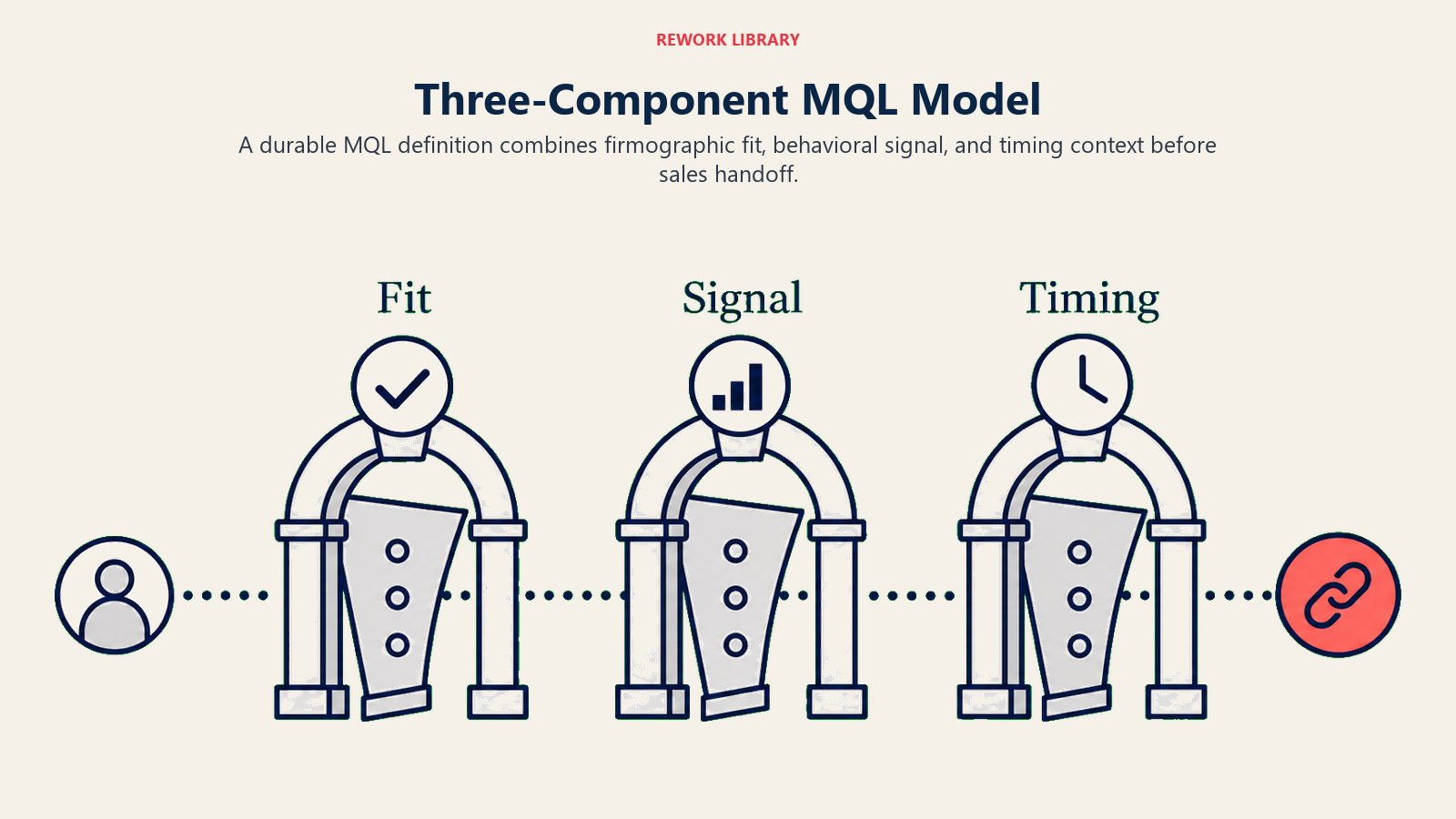
El Modelo de MQL de Tres Componentes define lo que un lead de marketing listo para ventas debe satisfacer antes de entrar a la cola de ventas. Los tres componentes son: Ajuste Firmográfico (¿esta empresa coincide con el ICP?), Umbral de Señal Conductual (¿ha demostrado este contacto un interés genuino de compra, no solo curiosidad?) y Indicador de Timing/Urgencia (¿hay una señal que sugiera que ahora es el momento correcto para perseguirlo en lugar de nutrir?). Los tres deben estar presentes. Un lead con alta interacción conductual en la empresa del tipo incorrecto no es un MQL. Una empresa de ajuste perfecto sin señal conductual no es un MQL. Un lead con tanto ajuste como señal pero cuya interacción ocurrió hace tres meses necesita validación de recencia antes de ser enrutado a ventas.
Componente 1: Ajuste Firmográfico
¿La empresa de este lead coincide con el ICP? El ajuste firmográfico es la puerta, no el calificador. Si la empresa no encaja con el ICP, el alto compromiso conductual no hace que el lead esté listo para ventas. Lo convierte en un lead comprometido en el mercado equivocado.
Los criterios de ajuste firmográfico deben ser binarios donde sea posible: tamaño de empresa por encima del umbral mínimo, industria en los verticales objetivo, geografía en los mercados objetivo, modelo de negocio que coincida con el caso de uso del producto. Pasa/falla, no puntuado. El marco de ICP de Gartner describe esto como la puerta de "atributos ambientales y firmográficos", las cuentas que no la superan no deben entrar al pipeline de calificación independientemente de las señales conductuales. Una empresa que está fuera del ICP en los criterios firmográficos no debería convertirse en un MQL independientemente del score de interacción.
Sea específico con los criterios. "B2B de mid-market" no es una definición. "Empresas B2B con sede en EE.UU., 50–500 empleados, con un CRM existente, modelo de negocio SaaS o servicios profesionales" es una definición. Escriba los rangos reales. Ambos equipos deben poder aplicar el mismo filtro de forma independiente y obtener el mismo resultado. El marco de ICP compartido muestra cómo construir ese filtro conjuntamente a partir de los datos de ambos equipos.
Componente 2: Umbral de Señal Conductual
¿Ha demostrado este lead suficiente interacción para indicar un interés genuino, no solo consumo de contenido? El umbral conductual distingue el interés activo de la navegación pasiva.
Señales conductuales débiles: abrió un email, descargó un contenido de la parte superior del funnel, visitó la página de inicio. Cualquier visitante aleatorio o investigador curioso genera estas señales sin ninguna intención de compra.
Señales conductuales fuertes: visitó la página de precios, vio un video de demo del producto, interactuó con contenido de implementación o integración, usó un trial gratuito o una calculadora de producto, asistió a un webinar y envió una pregunta, solicitó contacto directo.
El umbral debe requerir una combinación de señales, no una sola acción. "Score de 40 puntos conductuales o superior, incluyendo al menos una señal de alta intención (precios, demo, contacto directo o trial)" es más duradero que "score superior a 30 puntos". El requisito de combinación evita que los leads alcancen el umbral con interacción de baja intención.
El modelo de scoring conductual de su MAP es tan bueno como las señales que ha ponderado. Asegúrese de que las señales con mayor peso sean las que su equipo de ventas ha confirmado que se correlacionan con el pipeline en los datos de negocios ganados. Consulte scoring de ajuste vs. intención para saber cómo ponderar correctamente cada tipo de señal.
Componente 3: Indicador de Timing/Urgencia
Algún contexto sobre por qué este lead debe perseguirse ahora en lugar de volver a nurture. El contexto de timing no tiene que ser explícito ("tenemos un plazo en Q3"), pero algo en el conjunto de señales debe sugerir que el lead está en una ventana de compra razonable.
Indicadores de timing: solicitó una demo o contacto (intención explícita), recientemente contrató para un rol que típicamente desencadena esta compra (señal de datos de intención), publicó una descripción de trabajo en una categoría adyacente a su producto, asistió a un evento en vivo (menor latencia que las descargas de contenido), interactuó con contenido de comparación competitiva.
Los indicadores de timing son el componente que la mayoría de las empresas dejan fuera de su definición de MQL. Sin ellos, termina pasando leads cuya interacción ocurrió hace semanas y cuyas señales de intención se han enfriado. El Score Decay (reducir los scores con el tiempo cuando la interacción se detiene) es parte de la respuesta, pero añadir un requisito de recencia al umbral conductual es más limpio.
Escribir la Definición Juntos: Formato de Sesión Conjunta
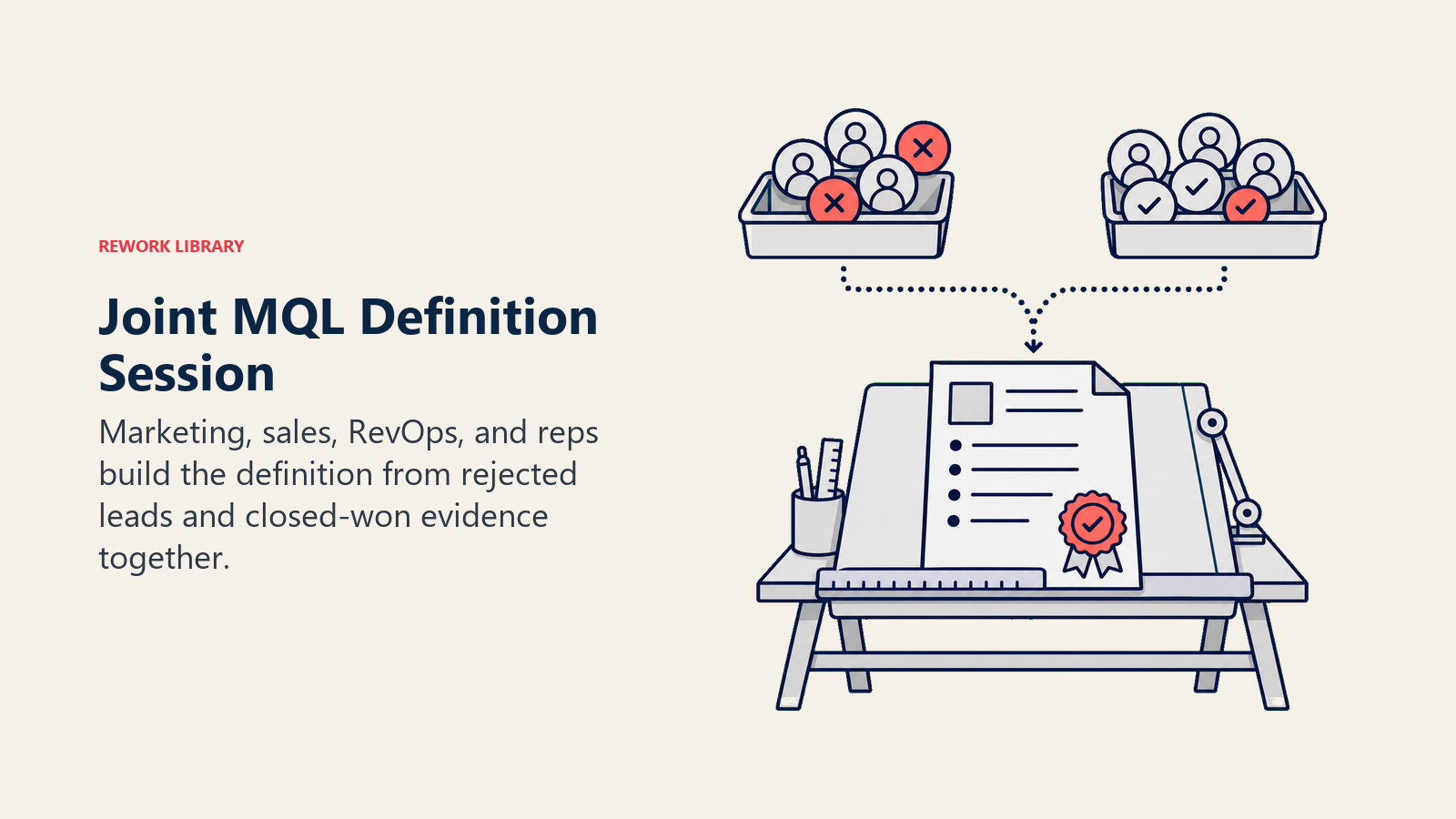
La definición de MQL debe ser co-autorada. Marketing solo escribe definiciones que maximizan el volumen. Ventas solo escribe definiciones que son imposibles de alcanzar. La definición correcta vive en la tensión entre los intereses de ambos equipos, y requiere a ambos en la sala.
Quién debe asistir:
- CMO o VP de Marketing (o el director de marketing con responsabilidad sobre demand gen)
- CRO o VP de Ventas (o el director de ventas con visibilidad sobre la calidad de leads)
- RevOps o Marketing Ops (quien sea responsable del modelo de scoring y la configuración del CRM)
- Un AE o SDR que trabaja la cola de MQL diariamente (ellos saben cómo se ve "bueno" en la práctica)
Qué datos traer:
Extraiga el perfil de ICP de negocios ganados del CRM: ¿cómo se veían los últimos 20 negocios cerrados-ganados en el momento de la creación del MQL? ¿Cuáles eran sus scores? ¿Qué señales activaron el MQL? ¿Había patrones en las señales que predecían la conversión versus los MQL que fueron rechazados?
Extraiga la cohorte de MQL rechazados de los últimos 90 días: ¿qué criterios cumplieron esos leads que activaron el estado de MQL? ¿Qué criterios les faltaban que causaron que ventas los rechazara? Los códigos de razón de rechazo (si los ha estado rastreando) son oro aquí. Si aún no los ha rastreado, el workflow de rechazo y reciclaje de leads explica cómo configurar el ciclo de retroalimentación.
Estructura de la sesión:
Comience con los leads rechazados, no con el documento de definición. Muestre al grupo los últimos 30 MQL rechazados y las razones de rechazo. Pida a ventas que describa qué faltaba. Esa lista de criterios faltantes es su brecha de definición.
Luego mire los datos de negocios ganados y pregúntese: si hubiéramos aplicado los nuevos criterios a estos leads en el momento de la creación del MQL, ¿habrían calificado? Si la respuesta es sí, la definición es viable. Si el 60% de sus leads de negocios ganados no habrían calificado bajo los nuevos criterios, ha ajustado demasiado y necesita revisarlos.
Documente cada decisión y el razonamiento detrás de ella. Un documento de definición sin razonamiento es vulnerable a ser anulado por quien sea más senior en una reunión futura.
Errores Comunes en la Definición de MQL
Activadores de acción única. "Descargó un ebook = MQL." Este activador confunde la curiosidad con la intención. Un competidor, un estudiante o un lead a tres años de comprar pueden descargar un ebook. Los activadores de acción única inflan el volumen de MQL mientras destruyen la credibilidad del MQL.
Definiciones solo firmográficas. "Todos los contactos de empresas que coincidan con nuestro ICP = MQL." Esto ignora la interacción por completo. Un contacto en una empresa de ajuste perfecto que no ha mostrado ningún interés no está listo para ventas. Es un prospecto frío que resulta trabajar en la empresa correcta.
Fórmulas sobrecomplicadas que nadie puede explicar. Si el modelo de scoring requiere 15 criterios, tres multiplicadores conductuales ponderados y una función de decay que nadie en el equipo puede resumir en una oración, no se confiará en él. Ventas rechazará leads cuyos scores no puedan entender, y marketing optimizará para métricas de score en las que nadie cree.
Umbral establecido para alcanzar los objetivos de pipeline en lugar de predecir la calidad. Cuando los cambios de umbral son impulsados por la presión del pipeline trimestral ("necesitamos un 20% más de MQL este trimestre así que bajemos el umbral de 70 a 55"), la definición pierde su significado. Los cambios de umbral deben estar impulsados por datos de calidad (resultados de backtests, análisis de tasa de SAL, revisión de patrones de rechazo), no por objetivos de volumen.
Documentar y Publicar la Definición
Una vez acordada, la definición necesita vivir en un lugar donde ambos equipos puedan encontrarla y consultarla, no en la presentación de la reunión de planificación.
Formato recomendado: un documento compartido (Google Doc, página de Notion o página de Confluence) con tres secciones: la definición en español claro, los criterios específicos mapeados a su modelo de scoring y el historial de versiones incluyendo la fecha y la razón de cada cambio.
Quién la posee: RevOps o quien mantenga la configuración del MAP. Esta es la persona que implementará los cambios del modelo de scoring y confirmará que el sistema coincide con la definición documentada.
Dónde vive: vinculada desde el CRM (para que los representantes puedan acceder a ella al revisar un lead), vinculada desde la configuración del MAP (para que marketing ops pueda consultarla al ajustar el modelo) e incluida en el onboarding de nuevos empleados tanto de marketing como de ventas. La plantilla de SLA de marketing-ventas es el documento complementario que rige lo que ventas hace una vez que recibe el MQL.
La versión en lenguaje claro debe ser lo suficientemente corta para que cualquier representante o marketer pueda describir la definición de MQL en menos de 30 segundos. Si no pueden, es demasiado compleja para ser operativa.
Probar la Definición Contra la Historia
Antes de finalizar una definición de MQL nueva o revisada, realice un backtest con 6 meses de datos históricos. La prueba responde dos preguntas:
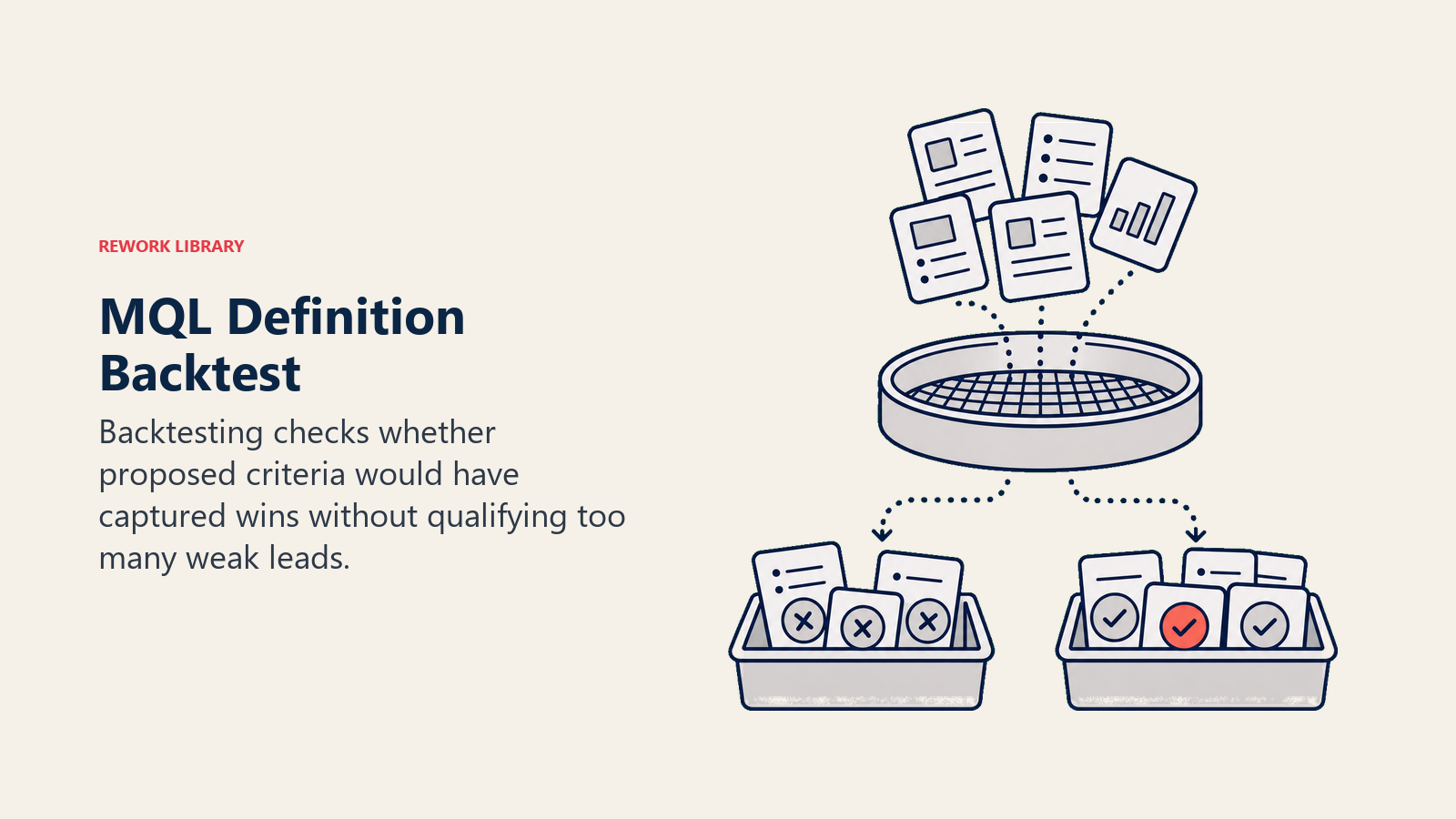
Prueba de cobertura: De los leads que se convirtieron en negocios cerrados-ganados en los últimos 6 meses, ¿qué porcentaje habría calificado como MQL bajo la nueva definición? Si la respuesta está por debajo del 70%, su definición filtrará demasiados buenos leads.
Prueba de precisión: De todos los leads que habrían calificado como MQL bajo la nueva definición en los últimos 6 meses, ¿qué porcentaje se convirtió en negocios cerrados-ganados (o al menos SAL)? Si la tasa de precisión está por debajo del 15%, su definición sigue siendo demasiado laxa.
El backtest no necesita ser exhaustivo. Tome 6 meses de datos de negocios ganados (mínimo 20 negocios) y 6 meses de datos de leads rechazados (mínimo 40 rechazos) y ejecute ambas cohortes a través de los criterios propuestos manualmente. Dos horas de análisis previenen seis meses de desalineamiento.
Cadencia de Revisión
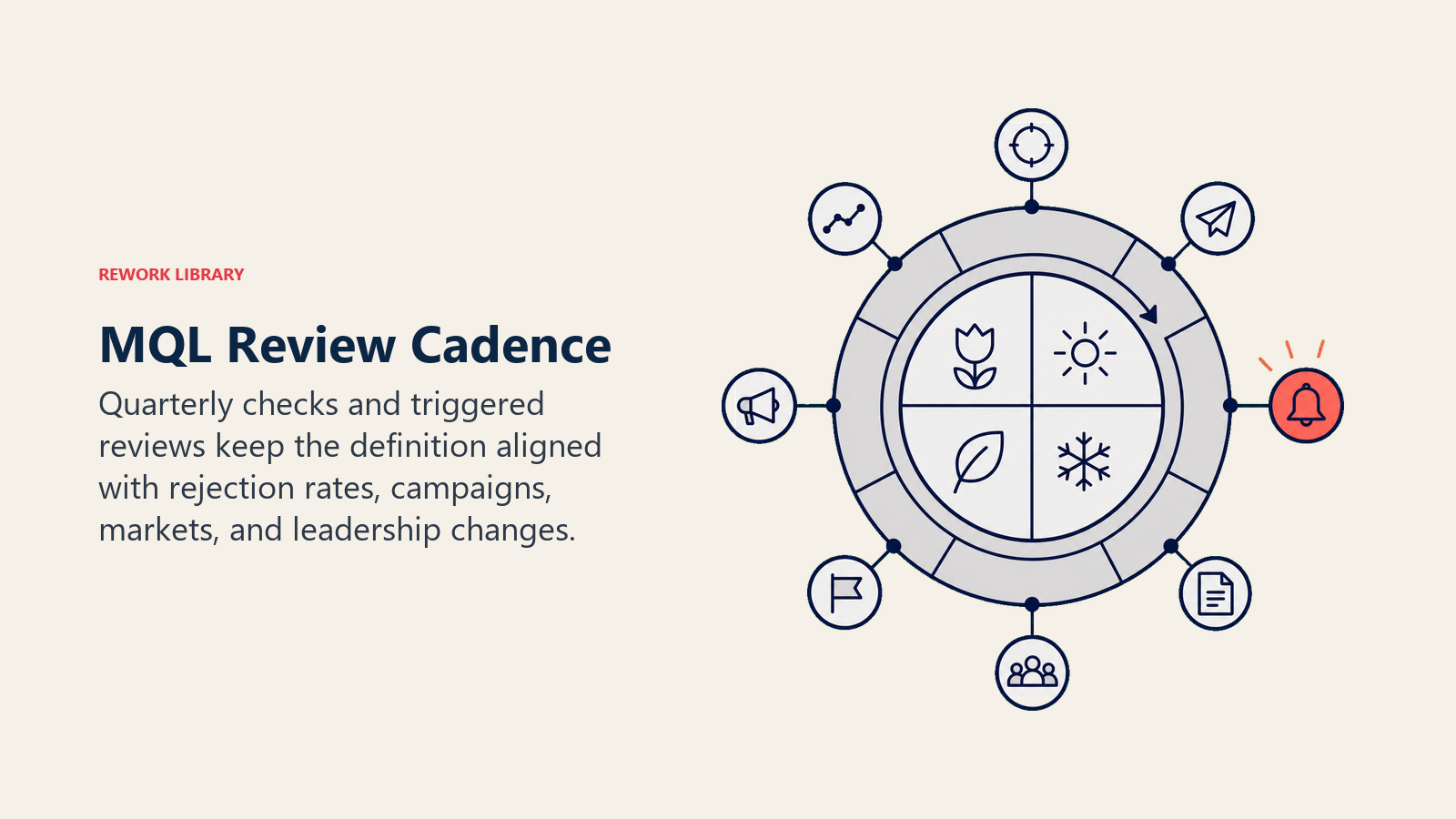
| Desencadenante | Tipo de Revisión | Acción |
|---|---|---|
| Revisión trimestral (predeterminada) | Revisión ligera | Comparar la tasa de SAL y la tasa de rechazo con la línea de base. Ajustar el umbral si ha derivado más de 5 puntos del objetivo. |
| La tasa de rechazo de MQL sube por encima del 35% | Sesión de revisión completa | Volver a ejecutar el backtest. Identificar qué criterios están produciendo falsos positivos. Ajustar el umbral conductual o el filtro firmográfico. |
| Aumento de MQL post-campaña | Revisión puntual | Verificar si el aumento es volumen de calidad o volumen de una fuente fuera del ICP. Prevenir que el aumento temporal de campaña desencadene un falso cambio de definición. |
| Nuevo mercado o línea de producto | Sesión conjunta completa | Volver a ejecutar el proceso de definición completo. Diferentes productos a menudo tienen diferentes ICP y diferentes señales de conversión. |
| Se une un nuevo CMO o CRO | Reconciliación de definición | Los nuevos líderes traen definiciones de empresas anteriores. Alinéese explícitamente en la definición actual antes de que operen bajo diferentes supuestos. |
Cuando Marketing y Ventas No Pueden Acordar
A veces la sesión conjunta saca a la luz un desacuerdo genuino que una reunión de 90 minutos no resolverá. Así es como manejarlo.
Ruta de escalada: Si el CMO y el CRO no pueden acordar el umbral, lleve los datos al CEO o al líder de RevOps. Presente los resultados del backtest. La decisión debe estar impulsada por datos, no por jerarquía. El benchmark de tiempo de respuesta al lead es un punto de referencia útil, un umbral de MQL más laxo solo ayuda si ventas realmente hace seguimiento antes de que la intención se enfríe.
Métricas proxy intermedias: Si no puede acordar la definición completa, acuerde en una métrica proxy para rastrear durante 90 días: la tasa de SAL. Establezca un objetivo de tasa de SAL (el 70% es razonable para la mayoría de los equipos) y defina que cualquier cambio de definición que haga caer la tasa de SAL por debajo del objetivo se revierte. Esto crea un mecanismo de responsabilidad compartida incluso cuando los equipos no están de acuerdo en los inputs.
Período piloto: Cuando los equipos no están de acuerdo en el umbral, ejecute los criterios propuestos como un track paralelo durante 60 días. Marque los leads que calificarían bajo la nueva definición sin enrutarlos de inmediato. En el día 60, revise la cohorte piloto: ¿se convierten en SAL y SQL a tasas más altas que la población actual de MQL? Use los datos para terminar el debate.
El desacuerdo que no puede resolverse es casi siempre un problema de datos. Alguien no confía en el modelo de attribution, o los datos del CRM no están suficientemente limpios para analizarlos, o los equipos están mirando diferentes ventanas de tiempo. Arregle el problema de datos antes de intentar resolver el argumento de definición. El B2B Revenue Waterfall de Forrester ofrece un enfoque estructural: pasar del rastreo basado en leads al basado en grupos de compra, lo que evita el argumento individual del MQL al medir el compromiso a nivel de grupo en su lugar.
Plantilla de Definición de MQL de Muestra
Aquí hay una plantilla que su equipo puede adaptar. Complete los campos en cursiva con sus criterios específicos.
Definición de MQL v1.0: [Nombre de la Empresa] Última revisión: [Fecha] | Responsable: [Nombre de RevOps/Marketing Ops]
Criterios firmográficos (debe cumplir TODOS):
- Tamaño de empresa: [número mínimo de empleados] a [número máximo de empleados]
- Industria: [verticales específicos]
- Geografía: [mercados objetivo]
- Modelo de negocio: [B2B SaaS / servicios profesionales / otro]
Umbral conductual (debe cumplir TODOS):
- Lead score de [piso de score] o superior
- Al menos una señal de alta intención en los últimos [X días]: [liste señales específicas: página de precios, solicitud de demo, registro de trial, etc.]
- Sin señales descalificadoras presentes: [liste cualquier señal que anule un score positivo: dominio de competidor, email personal, título conocido incorrecto, etc.]
Timing / recencia:
- La interacción ocurrió dentro de los últimos [X días] O el lead tiene una solicitud explícita activa
Criterios de exclusión:
- Número de empleados de la empresa por debajo de [mínimo]
- Dominio de email gratuito (gmail, yahoo, hotmail)
- Título de trabajo en la lista de exclusión: [pasante, estudiante, competidor, etc.]
Objetivo de tasa de SAL: [X%]. Revise la definición si la tasa real de SAL cae por debajo de este umbral durante dos meses consecutivos.
Para las definiciones canónicas de MQL, SAL, SQL y términos relacionados, consulte el Glosario de Marketing-Sales Alignment.
Análisis de Rework: El Backtest como el Camino Más Rápido al Acuerdo
En nuestra experiencia con las sesiones de alineación, la forma más rápida de romper un impasse de definición entre marketing y ventas es un ejercicio de backtesting ejecutado antes de la reunión, no durante ella. Tome 6 meses de datos de negocios cerrados-ganados y 6 meses de datos de MQL rechazados. Aplique la definición propuesta a cada cohorte manualmente. Si menos del 70% de los negocios cerrados-ganados habrían calificado bajo la nueva definición, los criterios son demasiado estrictos. Si la tasa de precisión (negocios ganados como porcentaje de todos los posibles MQL) está por debajo del 15%, la definición es demasiado laxa. Presentar estos dos números al inicio de la sesión conjunta convierte un debate de valores ("necesitamos más leads" vs. "necesitamos mejores leads") en un ejercicio de interpretación de datos. Es más difícil defender un umbral que habría rechazado el 40% de las victorias del año pasado.
Preguntas Frecuentes sobre el Marco de Definición de MQL
¿Qué es un MQL y en qué se diferencia de un lead?
Un Marketing Qualified Lead (MQL) es un contacto que marketing ha evaluado según los criterios acordados, ajuste firmográfico, señal conductual y contexto de timing, y ha determinado que está listo para el seguimiento de ventas. Un lead sin calificar es cualquier contacto que proporcionó información o fue identificado como comprador potencial, sin calificación implícita. La distinción importa porque enrutar leads no calificados a ventas desperdicia el tiempo del representante y erosiona la confianza en la cola generada por marketing.
¿Cuál es la diferencia entre un MQL y un SQL?
Un MQL es un juicio de marketing basado en señales de datos de que un contacto está listo para el alcance de ventas. Un SQL (Sales Qualified Lead) es una determinación realizada después de una conversación de calificación humana de que el contacto cumple los criterios de calificación de su equipo, típicamente presupuesto, autoridad, necesidad y timeline. Cada SQL comienza como un MQL, pero no todo MQL se convierte en SQL. La tasa de conversión de SAL a SQL mide cuántas conversaciones de calificación resultan en una oportunidad de ventas confirmada.
¿Cómo se escribe una definición de MQL que tanto marketing como ventas respetarán?
Una definición de MQL que ambos respetan requiere co-autoría conjunta. La sesión debe incluir marketing, liderazgo de ventas, RevOps o marketing ops y al menos un representante que trabaje la cola diariamente. Comience desde los datos de MQL rechazados (¿qué faltaba?) y los datos de negocios ganados (¿qué tenían en común las victorias?). Documente no solo los criterios sino el razonamiento detrás de cada uno, para que cualquier cambio de definición futuro tenga una carga de evidencia en lugar de ser decidido por quien sea más senior en la sala.
¿Cuál es la tasa de rechazo de MQL correcta?
Una tasa de rechazo del 20–30% señala una definición saludable, ventas está revisando los leads cuidadosamente y rechazando los que no califican, pero la mayoría está pasando. Una tasa de rechazo superior al 35–40% indica que la definición es demasiado laxa: marketing está generando leads en los que ventas ha aprendido a no confiar. Una tasa de rechazo por debajo del 10% puede indicar que la definición es demasiado estricta o que los representantes están aceptando leads para alcanzar los objetivos de SAL sin revisarlos genuinamente. Rastree la tasa de rechazo mensualmente y trate la desviación sostenida del rango objetivo como un desencadenante para una revisión de definición.
¿Cuál es el método de backtest para validar una definición de MQL?
Un backtest aplica los criterios de MQL propuestos retroactivamente a 6 meses de datos históricos para verificar dos ratios. La prueba de cobertura pregunta: ¿qué porcentaje de los últimos 6 meses de negocios cerrados-ganados habrían calificado bajo la nueva definición? Si la respuesta está por debajo del 70%, la definición es demasiado restrictiva. La prueba de precisión pregunta: de todos los leads que habrían calificado como MQL, ¿qué porcentaje se convirtió en negocios ganados (o al menos un SAL)? Si está por debajo del 15%, la definición es demasiado laxa. Ejecutar ambas pruebas antes de finalizar la definición convierte un debate de preferencia en una decisión basada en evidencia.
¿Qué tan larga debe ser un documento de definición de MQL?
Lo suficientemente corto para que cualquier representante o marketer pueda recitar los criterios clave en menos de 30 segundos. El documento de trabajo (con historial de versiones y razonamiento) puede ser más largo, pero la definición operativa, los criterios que se integran en el modelo de scoring del MAP, debe caber en una sola pantalla. Una definición que requiere una presentación para explicarse es una definición que no sobrevivirá un cambio de liderazgo.
¿Cuándo debe una empresa cambiar su definición de MQL?
Desencadene una revisión cuando: la tasa de rechazo de MQL sube por encima del 35% durante dos meses consecutivos; se añade una nueva línea de producto o segmento de mercado; un nuevo CMO o CRO se une al equipo; o una revisión trimestral del pipeline revela que el pipeline generado por marketing está convirtiendo a una tasa sustancialmente menor que el período anterior. No cambie la definición en respuesta a la presión de volumen a corto plazo (un mal trimestre). Los cambios de umbral impulsados por los objetivos del pipeline en lugar de datos de calidad producen una definición que se vuelve progresivamente más laxa con el tiempo. ---
Más Información

Principal Solution Architect
On this page
- Por Qué las Definiciones de MQL Se Deterioran
- Los Tres Componentes de una Definición de MQL Duradera
- Componente 1: Ajuste Firmográfico
- Componente 2: Umbral de Señal Conductual
- Componente 3: Indicador de Timing/Urgencia
- Escribir la Definición Juntos: Formato de Sesión Conjunta
- Errores Comunes en la Definición de MQL
- Documentar y Publicar la Definición
- Probar la Definición Contra la Historia
- Cadencia de Revisión
- Cuando Marketing y Ventas No Pueden Acordar
- Plantilla de Definición de MQL de Muestra
- Más Información