Seasonal & Promotional Strategy: Building an Annual Ecommerce Calendar
Turn this article into takeaways for your work.


Each assistant summarizes the article only for you and suggests best practices for your work.
A merchant we'll call Dana ran a home goods store. Every few weeks, sales dipped. Every time they dipped, she ran a sale. By August, her customers had stopped buying at full price. They just waited.
That's the trap most ecommerce brands fall into. Promotions get scheduled reactively, one slow week at a time, until the calendar is really just a string of emergencies. A seasonal and promotional strategy fixes that by mapping every discount, flash sale, and holiday push onto a single annual calendar built around clear objectives instead of clear panic.
This guide covers how to build that calendar: which moments in the year deserve a promotion, how to size each offer without wrecking margin, and how to sequence everything so customers see a rhythm instead of a fire sale every month.
Why an Annual Calendar Beats Reactive Discounting
Most ecommerce teams plan promotions one quarter at a time, sometimes one week at a time. That works until slow months start looking a lot like every other month, and the only lever anyone reaches for is a bigger discount.
An annual calendar forces a different question upfront: what is each promotion supposed to do? Some periods exist to acquire new customers. Others exist to lift average order value, clear aging inventory, or reward existing customers without discounting to strangers. When you plan a full year in one sitting, you can spread these objectives across the calendar instead of stacking three "clearance" events into the same six weeks.
There's also a customer-behavior reason to plan ahead. Most online shoppers now check for a discount code before they check out, so promotions aren't a bonus anymore. They're an expectation.
Key Facts: Seasonal & Promotional Planning
- Holiday-period sales (November and December) have averaged about 19% of total US annual retail sales over the past five years, according to the National Retail Federation.
- 64% of online shoppers search for a coupon or discount code before completing a purchase, per Capital One Shopping research.
- Referral traffic converts at roughly 2.5% to 3.5%, compared with 0.5% to 1% for paid social, according to Elogic Commerce benchmarks reported by Shopify, which is one reason loyalty-driven calendar moments deserve a slot alongside discount-driven ones.
That NRF figure matters for calendar design specifically: if a fifth of your annual revenue lands in an eight-week window, the other 44 weeks need their own plan, not leftover attention after Q4 is booked.
Customers who search for a code before checkout aren't necessarily bargain hunters. Many simply expect a mid-funnel offer to exist, because most brands have trained them to expect one. A documented calendar lets you decide when that expectation gets met on your terms rather than every time someone opens an empty promo field at checkout.
Mapping Your Annual Promotional Calendar
Building the calendar starts with laying every candidate moment on a single timeline, then filtering hard. Not every retail holiday belongs on your calendar. Only the ones that match your category, your margin structure, and your customer's actual buying pattern do.
Universal anchor points. Black Friday and Cyber Monday, the broader December gift season, back-to-school, and a January reset period apply to almost every category. Your holiday and seasonal promotions plan should already own the tactical execution of the biggest of these; the annual calendar's job is deciding how much runway and budget each one gets relative to everything else.
Category-specific moments. A supplements brand cares about January resolutions far more than a furniture brand does. A gift-heavy category cares about Valentine's Day, Mother's Day, and graduation season. Pull two to three years of your own sales data and look for repeatable spikes that don't show up on a generic retail calendar. If a spike shows up reliably, it earns a calendar slot even if no other retailer talks about it.
White space weeks. These are the weeks with no major shopping event and no historical spike. This is where reactive brands panic-discount. On an annual calendar, white space weeks get one of three assignments: a planned evergreen offer (free shipping threshold, bundle, loyalty perk), an intentional "quiet period" with no promotion at all, or dedicated content and acquisition work that doesn't rely on discounting.
Once you've placed every moment, tag each one with a single primary objective: acquisition, AOV lift, clearance, or retention. A calendar where every slot says "drive revenue" isn't a strategy, it's a list of dates. A calendar where each slot has one job is something your team can actually plan creative, inventory, and staffing against.
The Promotion Ladder: Matching Offer Type to Objective
Here's a framework worth naming, because it solves the most common calendar mistake: using the same offer structure for every moment regardless of what that moment is supposed to accomplish.
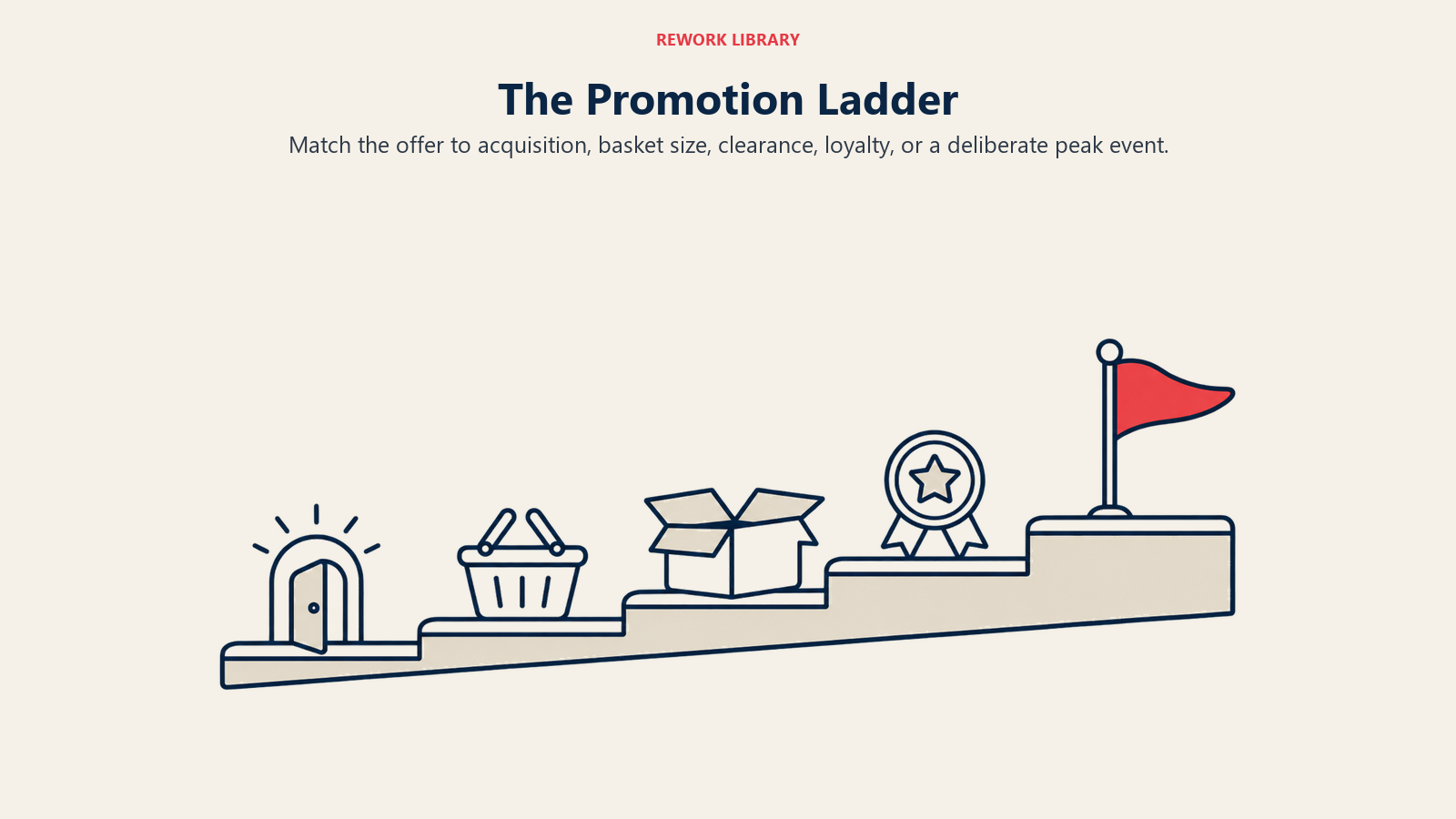
Call it the Promotion Ladder. Each rung matches an offer mechanic to a business objective, and it only works if you resist the temptation to run every rung as "20% off everything."
| Rung | Objective | Offer Mechanic | Best Calendar Fit |
|---|---|---|---|
| 1 | New customer acquisition | First-order discount or free shipping, no sitewide markdown | Evergreen, always-on |
| 2 | Average order value | Tiered discount or free shipping threshold | Slow months, white space weeks |
| 3 | Inventory clearance | Deep, category-specific markdown | End of season, post-holiday |
| 4 | Retention and loyalty | Early access, bonus points, gift with purchase (no public discount code) | Anniversary dates, VIP-only windows |
| 5 | Peak-event revenue | Sitewide percentage off with urgency messaging | Black Friday/Cyber Monday, one or two other peaks per year |
Rung 5 should appear on your calendar only a handful of times a year. Every time you run a sitewide markdown, you reset the price anchor in your customer's head for every rung below it. A brand that runs "30% off everything" monthly has no room left to make Black Friday feel different from a random Tuesday in March.
Your discount strategy work should already define the break-even math for each rung. The calendar's job is deciding when each rung fires, not recalculating the math every time.
Protecting Margin Across the Calendar
An annual calendar without a margin ceiling is just a spending plan waiting to happen. Before you fill in dates, set two numbers: your annual promotional discount budget as a percentage of revenue, and a per-event cap on markdown depth by rung.
Set the annual ceiling first. Look at last year's actual promotional discount cost as a percentage of gross revenue. Most ecommerce brands land somewhere between 8% and 15% depending on category and competitive intensity. Whatever your number is, that's your budget to allocate across every rung on the ladder, not just the big Q4 events.
Budget peak events separately from everything else. Because major holiday promotions concentrate so much revenue into a short window, they naturally absorb an outsized share of the annual discount budget. That's fine as long as it's deliberate. A common split is 40% to 50% of the annual promotional budget going to Rung 5 events, with the rest spread across acquisition, AOV, and clearance moments the rest of the year.
Coordinate depth with your pricing baseline. Your pricing strategy for e-commerce sets the price you're discounting from. If list prices creep upward every time a big promotional event approaches, customers eventually treat your "regular" price as fictional. Keep list price stable and let the calendar's promotional cadence do the work of creating urgency, not artificial price inflation before a sale.
Watch for cannibalization across adjacent slots. If a clearance event sits two weeks before a peak event, you're training customers to wait for the bigger discount, which quietly kills your clearance event's effectiveness. Space rungs that compete for the same customer intent at least four to six weeks apart wherever the retail calendar allows it.
Sequencing and Cadence Rules
The order promotions appear in matters as much as their size. A calendar that alternates intensity keeps each event feeling distinct. A calendar that runs the same intensity every few weeks trains customers to stop paying attention until the discount gets deep enough to notice.

Build in quiet periods on purpose. Every big promotional push should be followed by two to four weeks with no sitewide offer. This isn't wasted time, it's the period where full-price buyers reset their expectations and your dynamic pricing work can operate without discount noise interfering with signal.
Vary the mechanic, not just the date. Running "20% off" every six weeks trains customers on a number. Alternating between percentage discounts, free shipping thresholds, bundles, and gift-with-purchase across different calendar slots keeps the offer feeling fresh even at similar depth.
Stagger email and paid intensity to match calendar phase. Pre-season awareness, launch, peak, and taper each need a different cadence, mirroring the seasonal product planning timeline for inventory. Marketing intensity that stays flat all year either under-delivers during real peaks or fatigues your list during quiet ones.
Give VIP customers an early, discount-free lane. Retention-focused rungs on the ladder work best when they don't overlap with a public discount code. Early access to new arrivals or a peak-event preview window rewards loyalty without training your best customers to wait for a public markdown either.
Coordinating the Calendar With Inventory and Demand
A promotional calendar that isn't synced to inventory reality creates two expensive failure modes: promoting products you can't fulfill, and sitting on stock nobody's incentivized to buy.
Tie every calendar slot to a demand signal before you commit to it. Demand forecasting should feed the calendar, not the other way around. If your forecast shows a product category running long on inventory heading into March, that's the signal to schedule a clearance-rung promotion in February rather than waiting until the product is six months old and needs an even deeper discount to move.
Your inventory management system should flag two conditions against the calendar: products projected to sell out before a scheduled peak event (reduce marketing weight or reorder before the event), and products projected to carry excess stock into a quiet period (schedule a clearance-rung offer instead of waiting for the next big date).
This coordination also protects your flash sales and limited offers strategy. Flash sales work because they're scarce and unpredictable. If your calendar schedules them only when inventory data actually supports urgency, that scarcity is real. If they get scheduled purely because a week looks slow on the revenue chart, customers eventually notice the pattern and stop believing the countdown timer.
Measuring Whether Your Calendar Is Working
A promotional calendar succeeds or fails on one question: did the promotion generate revenue you wouldn't have gotten anyway? Answering that requires tracking beyond the immediate sales bump.
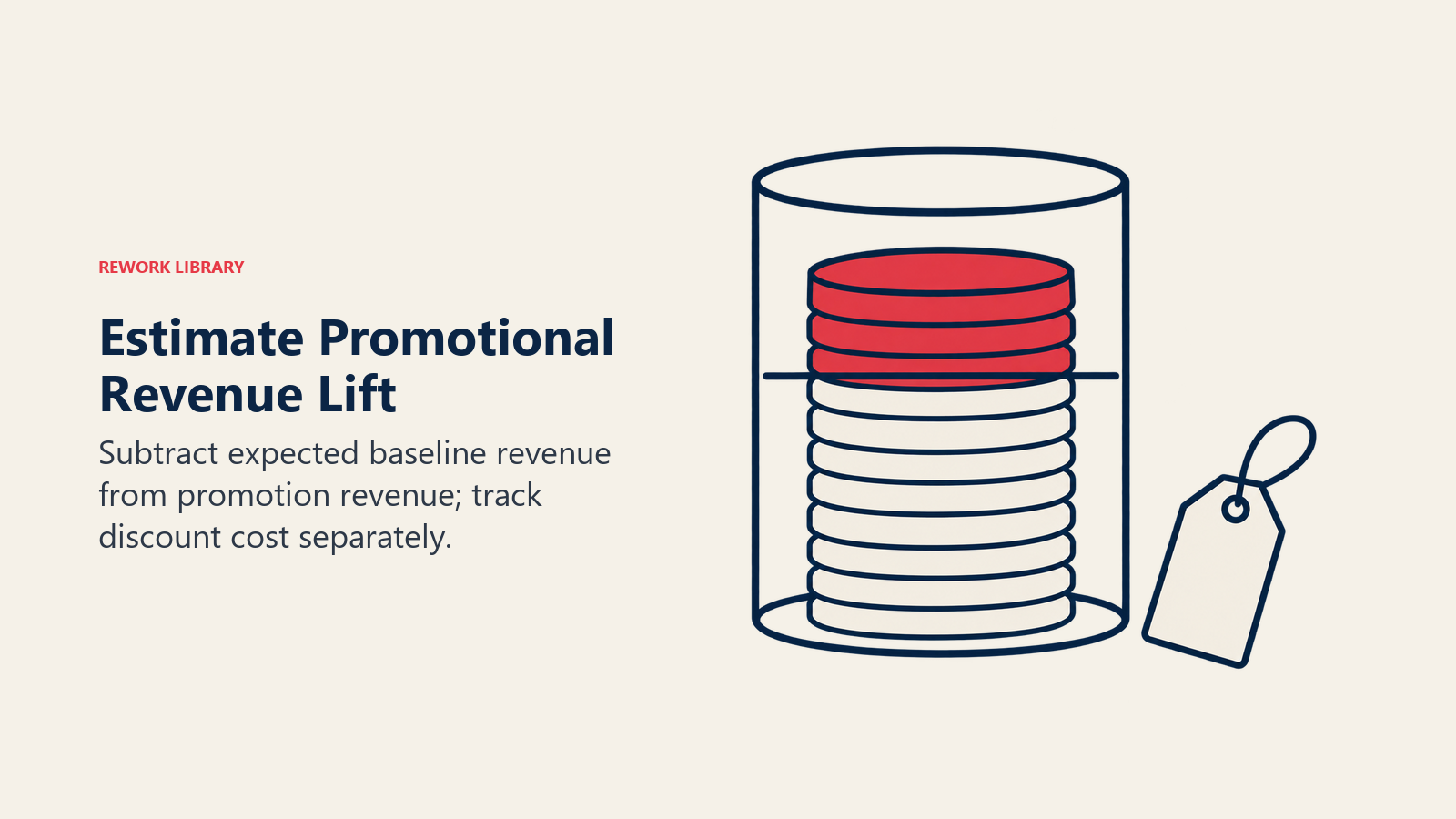
Incrementality over gross revenue. Compare each calendar slot's actual revenue against a baseline forecast built from non-promotional weeks. If a promotion generates $50,000 in revenue but your forecast shows $38,000 would have happened anyway, the true incremental lift is $12,000, not $50,000. Review this using the same metrics dashboard you use for baseline performance so the comparison is apples to apples.
Discount cost as a share of promotional revenue. Track total dollars discounted against total revenue generated in that slot. A rung that costs 25% of its own revenue in discounts needs a different mechanic or a smaller audience next year.
Repeat purchase rate by acquisition slot. Customers acquired during a deep clearance event often behave differently from customers acquired through a free-shipping or bundle offer. If Rung 1 or Rung 2 slots consistently produce higher repeat rates than Rung 5 events, that's a signal to shift calendar weight toward acquisition-focused moments over time.
Year-over-year calendar accuracy. At the end of the year, compare planned slots against what actually happened. Which white space weeks turned out to need a promotion you didn't schedule? Which planned events underperformed because they competed with an unplanned one? Feed every answer back into next year's calendar draft.
The businesses that get the most out of seasonal and promotional strategy treat the calendar as a living document, not a one-time planning exercise. Review it quarterly, adjust based on what the data says, and resist the urge to add "just one more sale" every time a week looks quiet on the dashboard.
Dana's home goods store eventually fixed its discount spiral by doing exactly this: mapping a full year, assigning one job to each promotional slot, and holding the line on quiet weeks even when the temptation to discount was strongest. Full-price sales came back within two quarters. The calendar didn't need to be perfect. It just needed to exist.
Frequently Asked Questions about Seasonal and Promotional Strategy
What is a seasonal and promotional strategy in ecommerce?
It's an annual calendar that plans every discount, flash sale, and seasonal push in advance, with each promotional slot assigned a specific objective like acquisition, AOV lift, clearance, or retention rather than being scheduled reactively when revenue dips.
How many promotions should an ecommerce brand run per year?
There's no universal number, but most brands reserve deep sitewide markdowns for just a handful of peak moments per year (often Black Friday/Cyber Monday plus one or two others) while filling the rest of the calendar with lighter-touch offers like free shipping thresholds, bundles, and loyalty perks.
How do I stop customers from waiting for the next sale?
Vary the offer mechanic and depth across calendar slots instead of repeating the same percentage discount every few weeks, build in genuine quiet periods with no promotion, and reserve your deepest discounts for a small number of clearly differentiated peak events.
What percentage of revenue should go toward promotional discounts?
Most ecommerce brands budget somewhere between 8% and 15% of gross revenue for promotional discounting annually, though the right number depends on category margins and competitive intensity. Set this ceiling before building the calendar, then allocate it across events rather than deciding event by event.
How does demand forecasting fit into promotional calendar planning?
Demand forecasting should tell you which products are running long on inventory or projected to sell out, and the calendar should schedule clearance or acquisition promotions around those signals rather than around the generic retail calendar alone.
How do I measure if a seasonal promotion actually worked?
Compare the promotion's actual revenue against a forecasted baseline for what would have happened without it, track discount cost as a percentage of the revenue that slot generated, and follow repeat purchase rates for customers acquired during that specific promotion.
Related Resources
Build out your complete promotional planning system with these guides:
- Discount Strategy - The break-even math and segmentation approach behind every rung on the Promotion Ladder.
- Holiday & Seasonal Promotions - Tactical execution for your calendar's biggest peak events.
- Seasonal Product Planning - Inventory and marketing lead times that keep the calendar fulfillable.
- Demand Forecasting - The forecasting methods that should feed every calendar decision.
- Dynamic Pricing - Coordinate price changes with promotional timing without confusing customers.
- Flash Sales & Limited Offers - Use scarcity-driven promotions inside white space weeks without training customers to distrust urgency.

Sales Operations Practice Lead
On this page
- Why an Annual Calendar Beats Reactive Discounting
- Mapping Your Annual Promotional Calendar
- The Promotion Ladder: Matching Offer Type to Objective
- Protecting Margin Across the Calendar
- Sequencing and Cadence Rules
- Coordinating the Calendar With Inventory and Demand
- Measuring Whether Your Calendar Is Working
- Related Resources