AI Tools for Business Operations: A Practical Guide for Operations Leaders
Turn this article into takeaways for your work.


Each assistant summarizes the article only for you and suggests best practices for your work.
Business operations is where AI investment either generates real returns or disappears into shelfware. The reason is simple: operations is the part of the business where processes are repetitive, the costs of inefficiency are measurable, and the results of improvement show up in the numbers.
But "AI for operations" is also one of the most over-hyped categories in enterprise technology. The vendor demos show best-case scenarios. The implementation reality is more complicated. And the organizations that get the most value are those that approach AI tools as operational problems to solve rather than technology to deploy.
This guide covers where AI tools are creating genuine operational value, how to evaluate them, and how to avoid the traps that most implementations fall into.
Key Facts
- McKinsey's 2024 Global AI Survey found that 65% of organizations now regularly use AI in at least one business function, up from 33% in 2019. Operations, supply chain, and service operations rank among the top three functions for AI deployment.
- AI-powered invoice processing automation reduces processing cost per invoice by 70-80% in high-volume environments, with straight-through processing rates of 70-90% for standard invoices, according to Deloitte's shared services research.
- Gartner's supply chain research found that AI-driven demand forecasting reduces forecast error by 20-50% compared to traditional statistical models, with corresponding reductions in safety stock requirements of 10-30%.
What Makes Operations a High-Value Target for AI
Operations functions share a set of characteristics that make them particularly well-suited to AI augmentation:
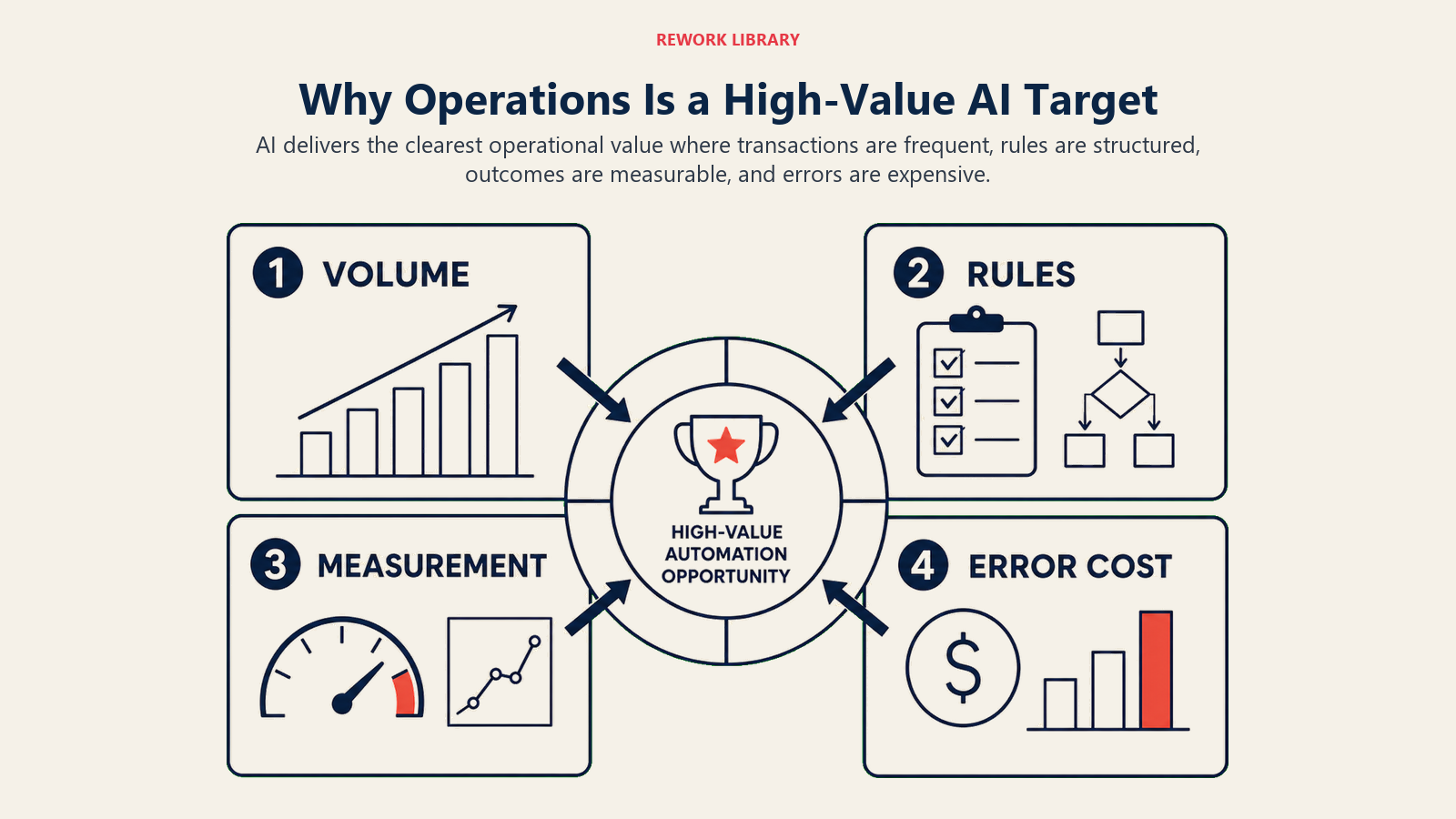
High transaction volume. Operations functions process enormous volumes of similar transactions: invoices, purchase orders, support tickets, scheduling requests, compliance reviews. AI tools that handle a portion of that volume with minimal human intervention can create large efficiency gains at scale.
Structured processes with defined rules. Many operational processes follow rules that can be learned and automated. Invoice approval routing, expense categorization, initial customer inquiry handling, new hire document collection: these have defined inputs, defined steps, and defined outputs. They're good candidates for AI augmentation.
Measurable outcomes. Operations functions typically have clear metrics: cost per transaction, processing time, error rate, employee utilization. This makes it possible to measure whether an AI tool is actually delivering value, which is harder in functions like marketing or strategy where outputs are more ambiguous.
High cost of human error. In finance, compliance, supply chain, and HR, mistakes are expensive. An error in payroll processing, a missed contract compliance requirement, or a supplier payment sent to the wrong account all have concrete consequences. AI tools that improve accuracy in these contexts have a clear value case.
AI Tools by Operations Function
Finance Operations
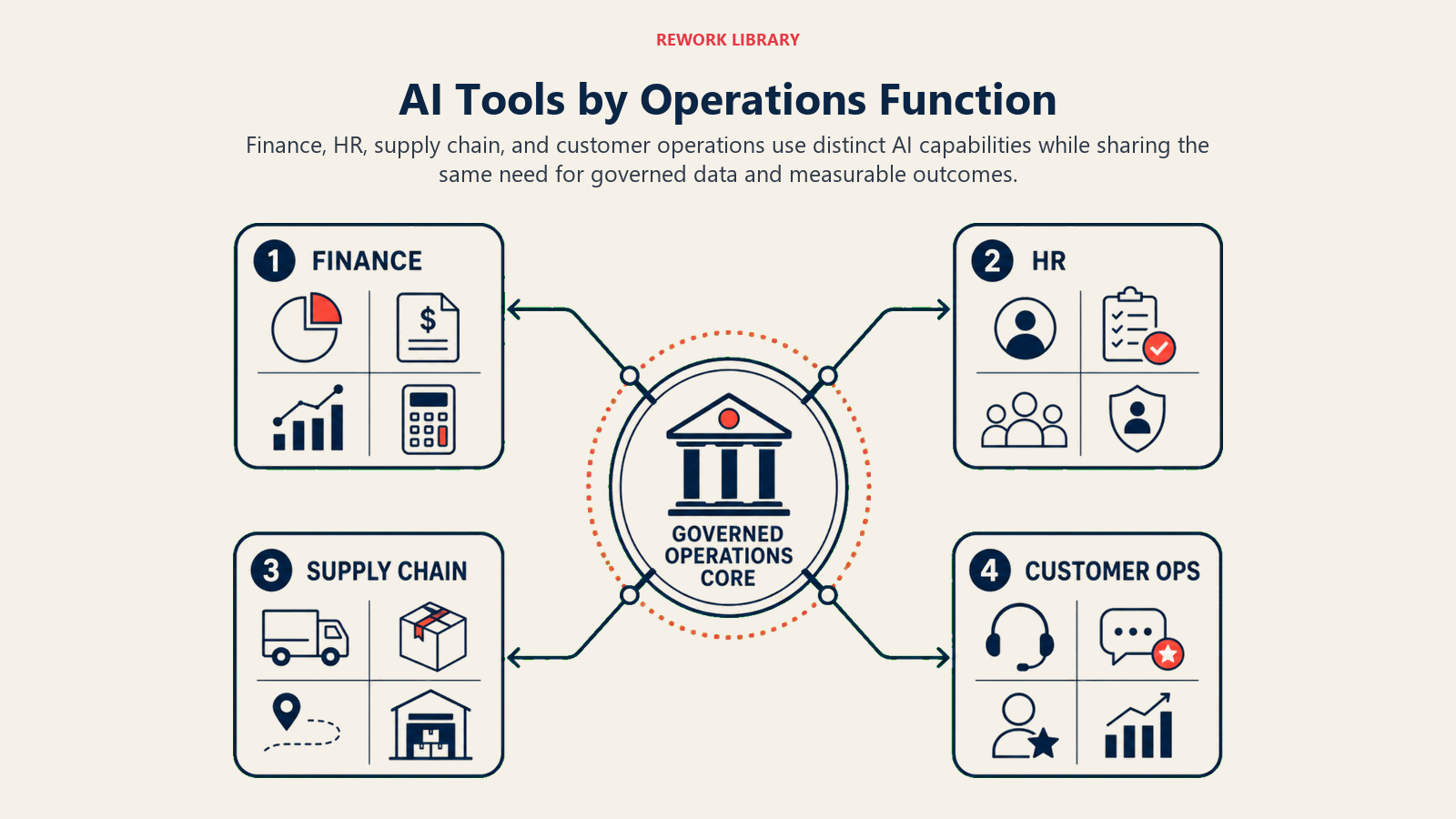
Finance operations has seen some of the highest-impact AI deployments because the processes are well-defined and the volumes are high.
Accounts payable automation is the most widely deployed use case. AI-powered document processing tools (ABBYY, Rossum, Hypatos) can extract data from invoices in multiple formats, match them to purchase orders, route exceptions for human review, and process straight-through in 70-90% of cases. A finance team processing 10,000 invoices per month with 4 minutes of manual processing each is consuming 667 person-hours monthly. Automating 80% of that creates real capacity.
Expense management tools like Expensify, Ramp, and Brex use AI to categorize expenses automatically, flag policy violations, and surface patterns in spending that humans would miss reviewing expense reports manually. The value isn't just efficiency: AI-flagged anomalies catch policy violations and sometimes fraud that manual review misses because the volume is too high.
Financial close automation tools like BlackLine and Trintech use AI to automate reconciliation matching, identify and explain variances, and accelerate the month-end close process. For companies where close takes 10-15 days, technology-driven acceleration to 5-7 days has real downstream value: earlier reporting, faster decision-making, and reduced crunch on finance teams.
Cash flow forecasting models using machine learning can incorporate more variables than traditional spreadsheet models and update more frequently. Tools like Cashforce and Float aggregate real-time data from ERP systems, banks, and AR/AP systems to produce more accurate short-term cash forecasts than most finance teams can produce manually.
Human Resources Operations
HR operations handles high-volume, process-intensive work that touches every employee. AI is changing several of the most time-consuming elements.
Recruiting and talent acquisition is one of the most competitive categories. AI tools screen resumes (HireVue, Paradox), schedule interviews (Calendly's AI features, Ashby), and draft job descriptions and outreach messages (Otta, LinkedIn's AI tools). The value case is clear in high-volume hiring contexts where sourcing and screening is a genuine bottleneck. The risk is equally clear: AI screening can encode existing biases if not carefully designed and monitored.
Onboarding automation tools like WorkBright, BambooHR, and Rippling automate the administrative elements of new hire onboarding: document collection, system provisioning requests, compliance training assignment, and first-week scheduling. What previously required an HR coordinator's full attention for 4-6 hours per new hire can be handled largely automatically, with the coordinator's attention reserved for the elements that benefit from human judgment.
HR service delivery through AI-powered chatbots (Leena AI, ServiceNow HR Service Delivery) handles the high volume of repetitive employee inquiries that consume HR team time: benefits questions, policy lookups, time-off balances, payroll inquiries. These are questions that are asked the same way hundreds of times and that have knowable, correct answers. AI handles them well; the alternative is HR staff answering them manually.
People analytics tools like Visier, Orgnostic, and Workday's analytics suite use machine learning to identify workforce trends: attrition risk, engagement patterns, diversity metrics, compensation equity. The value is shifting HR from reactive (we lost someone, now what?) to predictive (these employees show the same patterns as people who left, let's intervene).
Supply Chain Operations
Supply chain is where AI has some of the longest history and highest-stakes deployments.
Demand forecasting tools using machine learning consistently outperform traditional statistical models in forecast accuracy, particularly for items with irregular demand patterns, seasonal variation, or sensitivity to external signals like weather or competitor promotions. Blue Yonder, o9 Solutions, and Kinaxis are the enterprise players; smaller companies can access similar capability through cloud-based forecasting APIs.
Inventory optimization is directly downstream of demand forecasting. Better forecasts mean lower safety stock requirements without higher stockout risk. For companies carrying $10M in inventory, a 10% reduction in safety stock through better forecasting frees $1M in working capital.
Supplier risk monitoring tools like Resilinc, Coupa, and Riskmethods aggregate supplier financial data, news, and operational signals to identify supply chain risks before they materialize. The value case accelerated after 2020-2021 disruptions, when companies discovered how little visibility they had into the second and third tiers of their supply chains.
Logistics optimization tools for routing, carrier selection, and load planning have been using AI for years. The incremental improvements from newer AI approaches in this space tend to be meaningful: 5-8% reduction in transportation cost is a significant number for companies with large freight spend.
Customer Operations
Customer operations (support, service delivery, account management) has seen rapid AI deployment, with results that vary significantly depending on how it's implemented.
Customer service automation through AI chatbots and virtual agents (Intercom, Drift, Zendesk AI) can handle a significant proportion of inbound customer inquiries without human involvement. The appropriate scope is inquiries with clear, correct answers: order status, account information, standard troubleshooting steps. The failure mode is routing inquiries to automation that actually requires human judgment, which creates customer frustration.
Agent assist tools augment human agents rather than replacing them. Tools like Gong, Chorus, and Salesforce Einstein serve up relevant information, suggested responses, and customer context while a human agent is on a call or working a ticket. Response time decreases, first-contact resolution improves, and new agents ramp faster. This is often higher-value than full automation because it addresses the complexity cases that chatbots can't handle.
Proactive operations using AI to anticipate customer issues before they become complaints is an emerging pattern. Predicting churn risk, identifying products likely to need warranty service, or alerting customers about potential supply delays before they have to call creates better customer experiences and reduces inbound volume.
How to Prioritize AI Tool Investments in Operations
The organizations that generate the most value from AI tools in operations aren't necessarily the ones that deploy the most tools. They're the ones that deploy the right tools against the right problems.
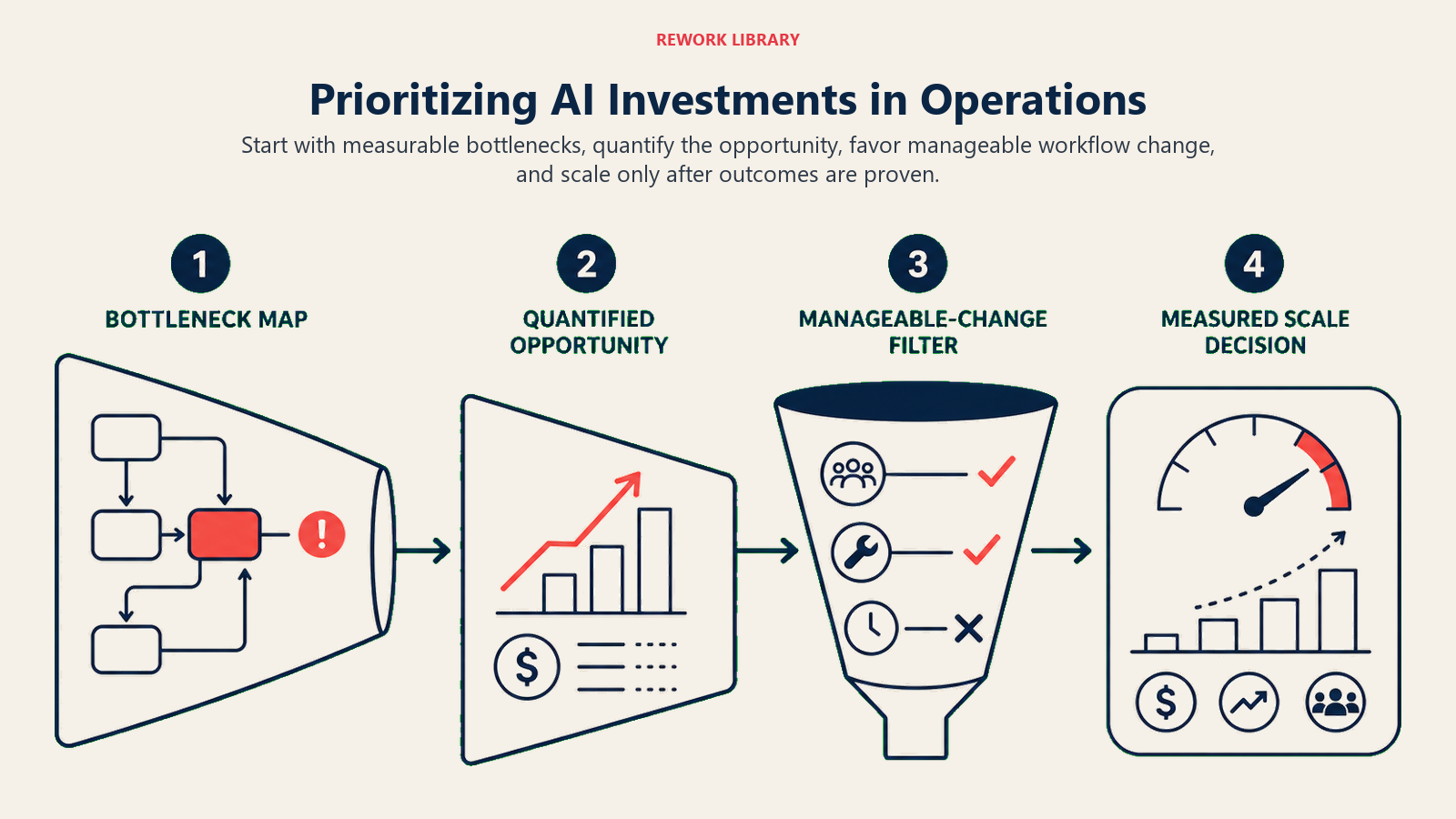
A practical prioritization approach:
Map your operational bottlenecks. Where are your operations teams spending time on work that doesn't require human judgment? Where are errors most common and most costly? Where are turnaround times slowest and customer impact highest? These are your high-priority areas.
Quantify the opportunity. For each bottleneck, estimate the cost of the current state: staff time, error correction cost, customer impact. This is the numerator for your ROI calculation. If you can't quantify the opportunity, either the problem isn't well-defined or it isn't a high-priority problem.
Start where the change management is simplest. The hardest part of AI tool deployment isn't the technology. It's getting people to change how they work. Start with tools that augment existing workflows rather than requiring entirely new ones. Finance teams comfortable with accounts payable are better candidates for AP automation than teams being asked to rethink the entire process at once.
Measure outcomes, not activity. Define success metrics before you deploy: what will be different in the business 6 months after this tool goes live? Track those metrics. If the metrics don't move, either the tool isn't working or the adoption isn't happening, and both are fixable if you're measuring.
The operational AI tools landscape will continue to evolve, but the evaluation discipline doesn't change. Clear problem, quantified opportunity, realistic cost, adoption plan, measurable outcome. Organizations that apply that discipline consistently will build an operations function that compounds advantage over time.
Related reading:
- What are AI Productivity Tools: A Foundation for Understanding the Category
- AI Workflow Automation Overview: Beyond Rules-Based Automation
- AI Tool Selection Framework: How to Evaluate AI Tools Systematically
- AI Tool Implementation Roadmap: Getting from Pilot to Production
- AI Change Management Strategies: Making AI Adoption Stick
- AI Performance Measurement: Tracking What Actually Matters