Toggl Track vs Harvest: Which Time Tracker Fits Your Team in 2026?
Turn this article into takeaways for your work.


Each assistant summarizes the article only for you and suggests best practices for your work.
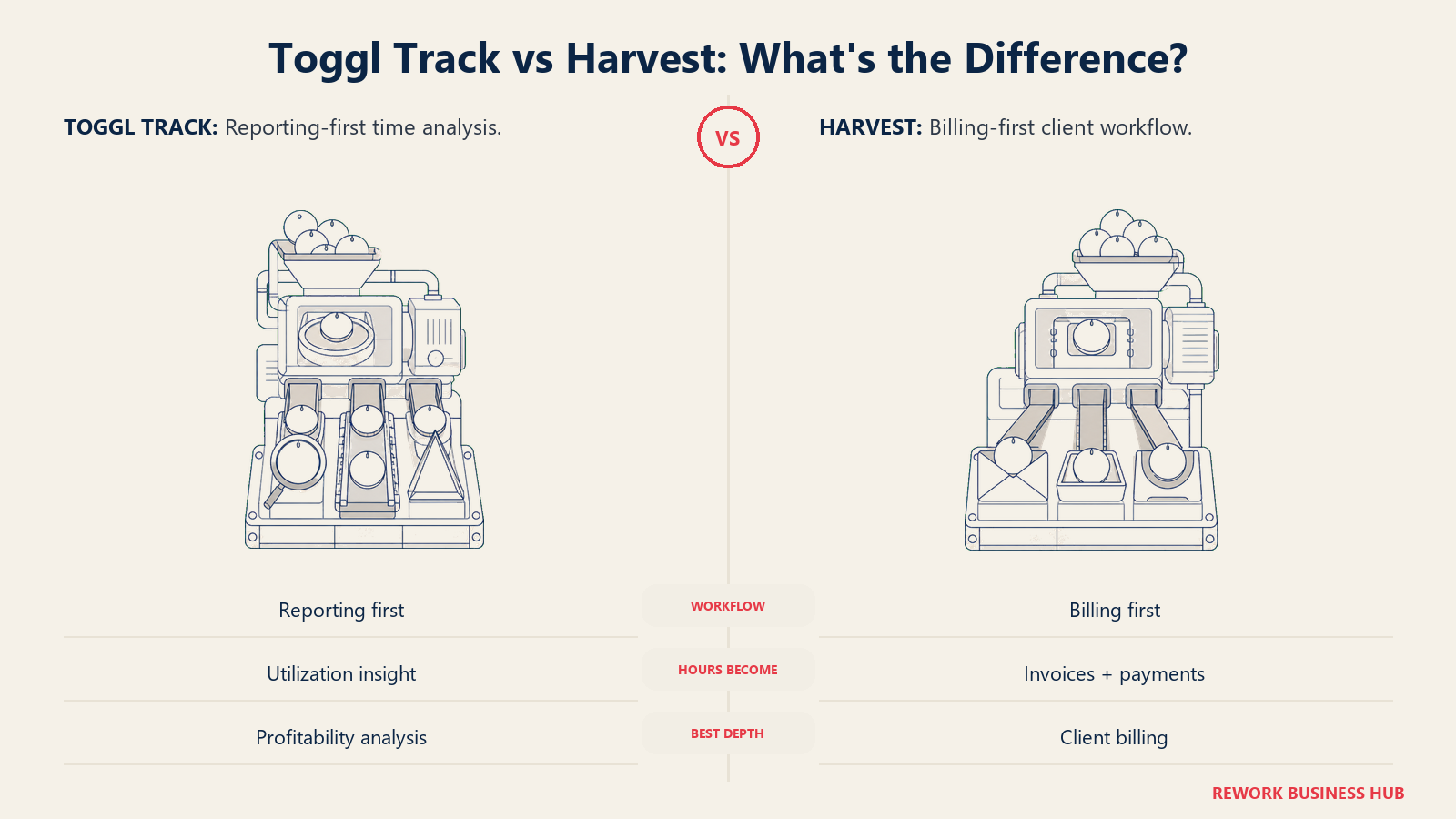
This comparison usually gets framed as "which timer is better," and that framing hides the real decision. Both tools start and stop a clock competently. What differs is where an hour goes after somebody logs it. In Toggl Track, it flows into reporting: profitability by project, client, task and team member, delivered as reports you can schedule or share. In Harvest, it flows onto an invoice, with expense receipts attached, a Stripe or PayPal payment link on it, and the result synced to QuickBooks Online or Xero. One product ends at insight. The other ends at money in the bank.
So the useful question is what your team does on the last Friday of the month. If that day goes to reading a utilization report, you're shopping for Toggl Track. If it goes to assembling client invoices and chasing unpaid ones, you're shopping for Harvest. Two naming notes first, because both companies sell more than one thing. The product here is Toggl Track, not Toggl Plan (project planning) or Toggl Hire (skills assessment), which share a brand and a login but are sold separately. And Harvest's scheduling product, Harvest Forecast, is a separate purchase with its own per-person price, so "Harvest" in a budget conversation means time tracking and invoicing only.
TL;DR
| Toggl Track | Harvest | |
|---|---|---|
| What it really is | A timer plus a reporting engine | A timer plus invoicing, expenses and client billing |
| Free tier | $0 for a limited number of users, unlimited projects and clients | $0 forever but 1 seat and 2 projects, a trial more than a team plan |
| Entry paid plan, billed annually | Starter, $9/user/month ($108 per seat a year) | Teams, $9/seat/month ($108 per seat a year) |
| Top published plan, billed annually | Premium, $18/user/month ($216 per seat a year) | Enterprise, $14/seat/month ($168 per seat a year) |
| The pricing catch | Premium is promoted at $14 for year one, then renews at $18 | Seat rate is a floor: extra invoices, projects, clients and tasks bill on usage |
| Approvals sit on | Premium, the top published tier | Enterprise, the top published tier |
| Genuinely stronger at | Timer feel, custom reporting, profitability, background auto tracking | Turning hours into sent, paid, reconciled invoices |
| Best for | Teams optimizing utilization and margin | Client-billing teams wanting time, expenses and invoices in one place |
Who Each Tool Is Built For
Toggl Track's product identity rests on one belief: a tracker only works if people actually use it. Its pages lead with custom reports built from your team's time data and with lines like "time tracking without the micromanagement." The natural buyer has usually already failed a rollout, watched a cheaper tracker sit unopened, and concluded that adoption is the variable that matters.
Harvest's identity is the sentence on its homepage: "Over 70,000 companies use Harvest to turn tracked hours into paid invoices." Tracking is the input, not the product. Its natural buyer is an agency, studio or consultancy where an untracked hour is unbilled revenue, and where whoever picks the tool is often whoever sends the invoices.
| Toggl Track | Harvest | |
|---|---|---|
| Buying trigger | Nobody can say what utilization or project margin actually is | Invoicing eats days each month and hours slip through unbilled |
| Usual champion | Ops lead, team lead, or a founder watching capacity | Finance, practice lead, or the owner who sends invoices |
| Wins the demo on | The reporting screen | The invoice screen |
| Loses the demo on | "Can it send the invoice and take the payment?" | "What's our real utilization by person?" |
| Fits best | Agencies, consultancies, product teams, distributed knowledge workers | Design studios, law and accounting practices, contractors |
The overlap is real. Both sell mostly to professional services teams under a few hundred people. But the split is sharp enough that teams who pick wrong usually end up buying a second tool to cover the gap.
Key Facts
- Harvest publishes Teams at $9 per seat a month, or $108 per seat billed annually, and Enterprise at $14 per seat a month, or $168 per seat billed annually, and states on its pricing page that on top of the base rate "additional invoices, projects, clients, and tasks are billed based on what you use."
- Toggl Track's pricing page promotes Premium annual at $14 per license a month for the first year and says it "then renews at $18 per license per month," so the advertised number is a first-year rate, not the standing price.
- Harvest states on its homepage that "Over 70,000 companies use Harvest to turn tracked hours into paid invoices," putting billing rather than measurement at the center of the product.
- Billable utilization across professional services firms fell to 66.4% in 2025, the lowest point in SPI Research's surveying history, per the 2026 Professional Services Maturity Benchmark analyzed by Certinia, which is why utilization reporting became a buying criterion rather than a nice-to-have.
- Under the Fair Labor Standards Act, US employers must record "hours worked each day" and "total hours worked each workweek," preserve payroll records for at least three years, and keep time cards for two years, per the Department of Labor's recordkeeping fact sheet.
Time Tracking and Timer UX
Toggl Track's timer is what it's known for, and everything around it exists to remove excuses. One click starts a timer from the web app, desktop, mobile, or a browser extension that drops a start button inside more than 100 other tools. Timeline quietly records which apps and browser tabs you spent time in, so a forgotten afternoon gets reconstructed instead of guessed at, with the user deciding what becomes an entry. Calendar View pulls Google and Outlook events onto the same grid, so a meeting-heavy day can be logged by dragging.
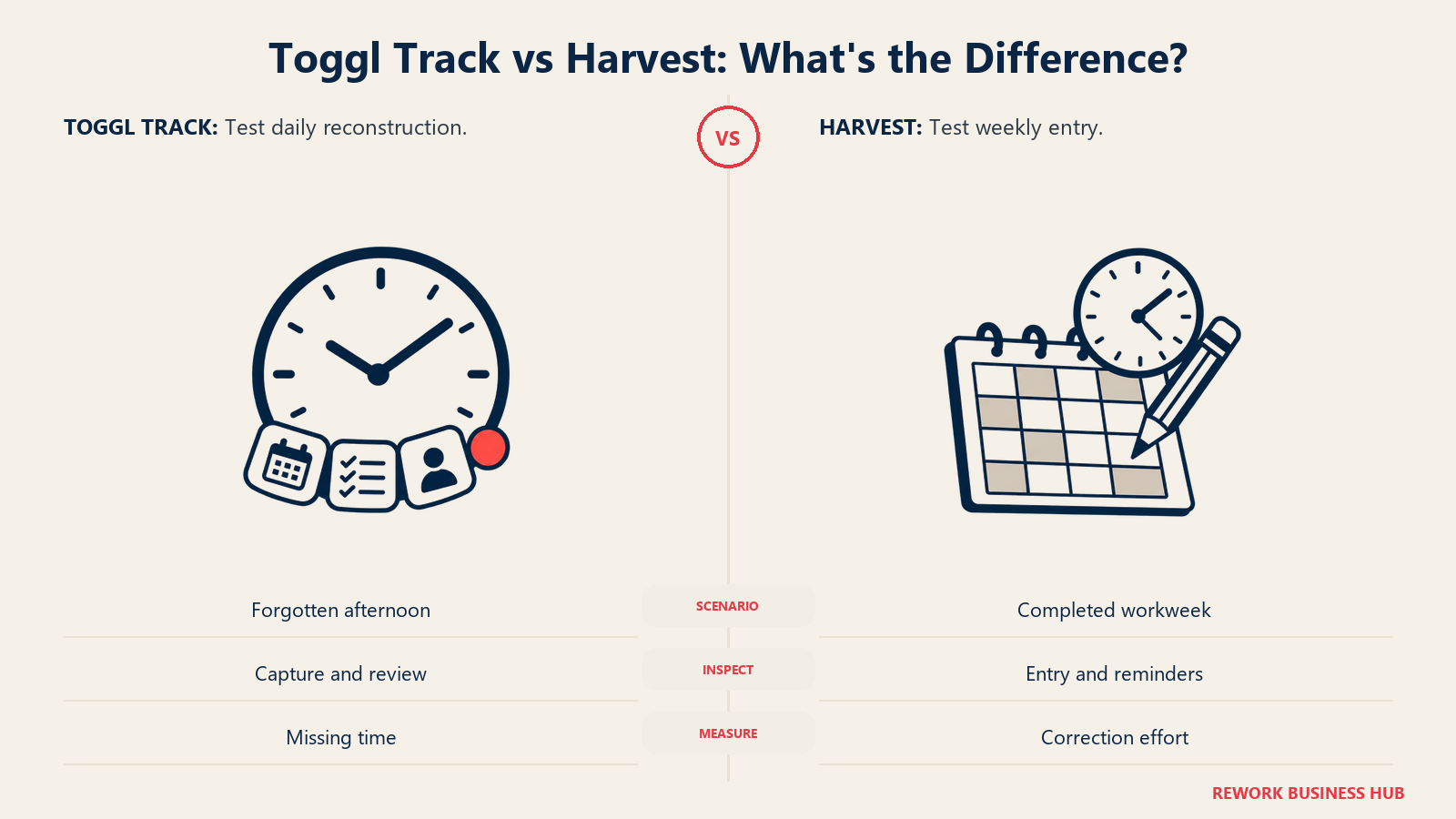
Harvest's tracking is deliberately plainer: start a live timer or type hours into a day or week view, from browser, desktop or mobile. For plenty of teams that's enough. What Harvest never advertises is passive capture. No background activity recorder, no idle detection, no GPS. If people forget to start the timer, Harvest gives you reminders and a grid to fill in from memory, while Toggl Track gives you a record of what was actually open.
| Capability | Toggl Track | Harvest |
|---|---|---|
| One-click start/stop timer | Yes, across web, desktop, mobile, extension | Yes, live timers |
| Manual entry | Yes | Yes, day or week view |
| Background activity capture | Yes, Timeline records apps and browser use | Not offered |
| Calendar-based logging | Yes, Calendar View with Google and Outlook | Calendar integrations only |
| Offline tracking with sync | Yes | Not advertised |
| Idle detection | Yes | Not advertised |
| Shared time entries | Yes | Not advertised |
| Reminders to track | Yes, Team Reminders | Yes, custom reminders |
| GPS or kiosk clock-in | No | No |
Neither does workforce attendance. No kiosk, no PIN punch, no geofence on either side, so a warehouse or retail floor is out of scope for both. If that's your requirement, start from the best timesheet software roundup instead, because you're shopping in a different aisle.
Invoicing, Expenses and Getting Paid
This is the section that settles most Toggl Track versus Harvest arguments, and it isn't close.
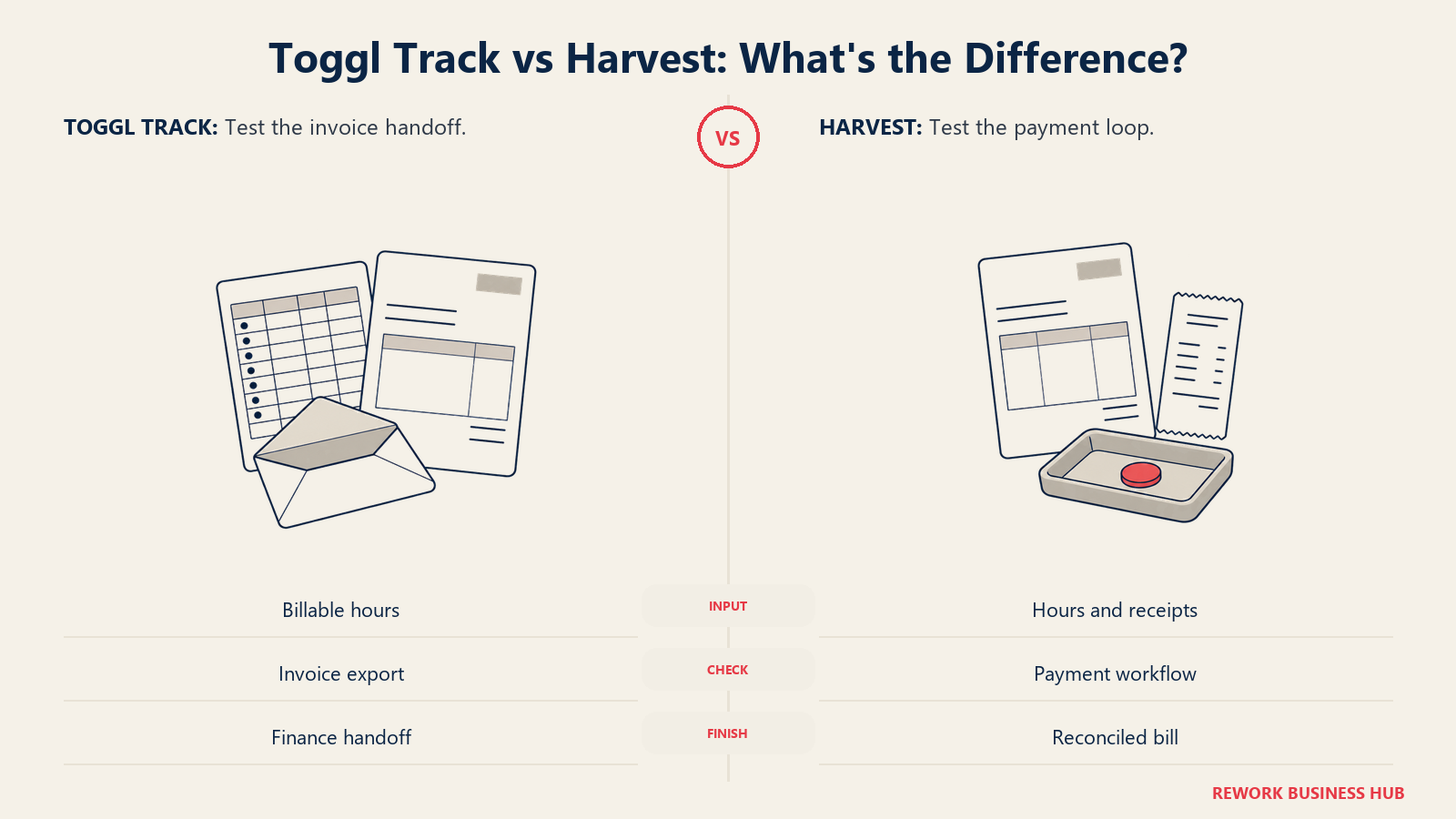
Harvest builds invoices directly from tracked time and tracked expenses, so logged hours and photographed receipts land on the same client bill without re-keying. Clients pay online through PayPal or Stripe, and the resulting invoices and payments sync to QuickBooks Online or Xero, which keeps the bookkeeper out of a spreadsheet at month end. Expenses are a first-class module, not a note field, which matters for anyone passing travel, software or subcontractor costs through.
Toggl Track does have invoicing. You can generate an invoice from billable time and send it to QuickBooks Online. What's missing is the machinery around it: no native payment gateways, no expense module feeding costs onto the bill, no Xero path. Toggl Track's invoicing gets billable hours out of the system. Harvest's invoicing is an accounts-receivable workflow.
| Billing capability | Toggl Track | Harvest |
|---|---|---|
| Generate invoice from tracked time | Yes | Yes |
| Expense tracking with receipts | Not a module | Yes, native expenses module |
| Expenses flow onto client invoices | No | Yes |
| Online client payment (Stripe) | No | Yes |
| Online client payment (PayPal) | No | Yes |
| QuickBooks Online sync | Yes, invoice sending | Yes, invoices and payments |
| Xero sync | No | Yes |
| Fixed fee or retainer projects | Yes, Fixed Fee Projects (Premium) | Yes, via project budget types |
If your monthly pain is "we tracked the hours, then spent two days turning them into invoices," Harvest closes that loop natively and Toggl Track doesn't. That one fact outweighs any feature-count tally. To see how the rest of the category handles billing, the best Harvest alternatives roundup uses invoicing depth as its main axis.
Reporting and Profitability
Now flip it. Reporting is where Toggl Track earns its higher price.
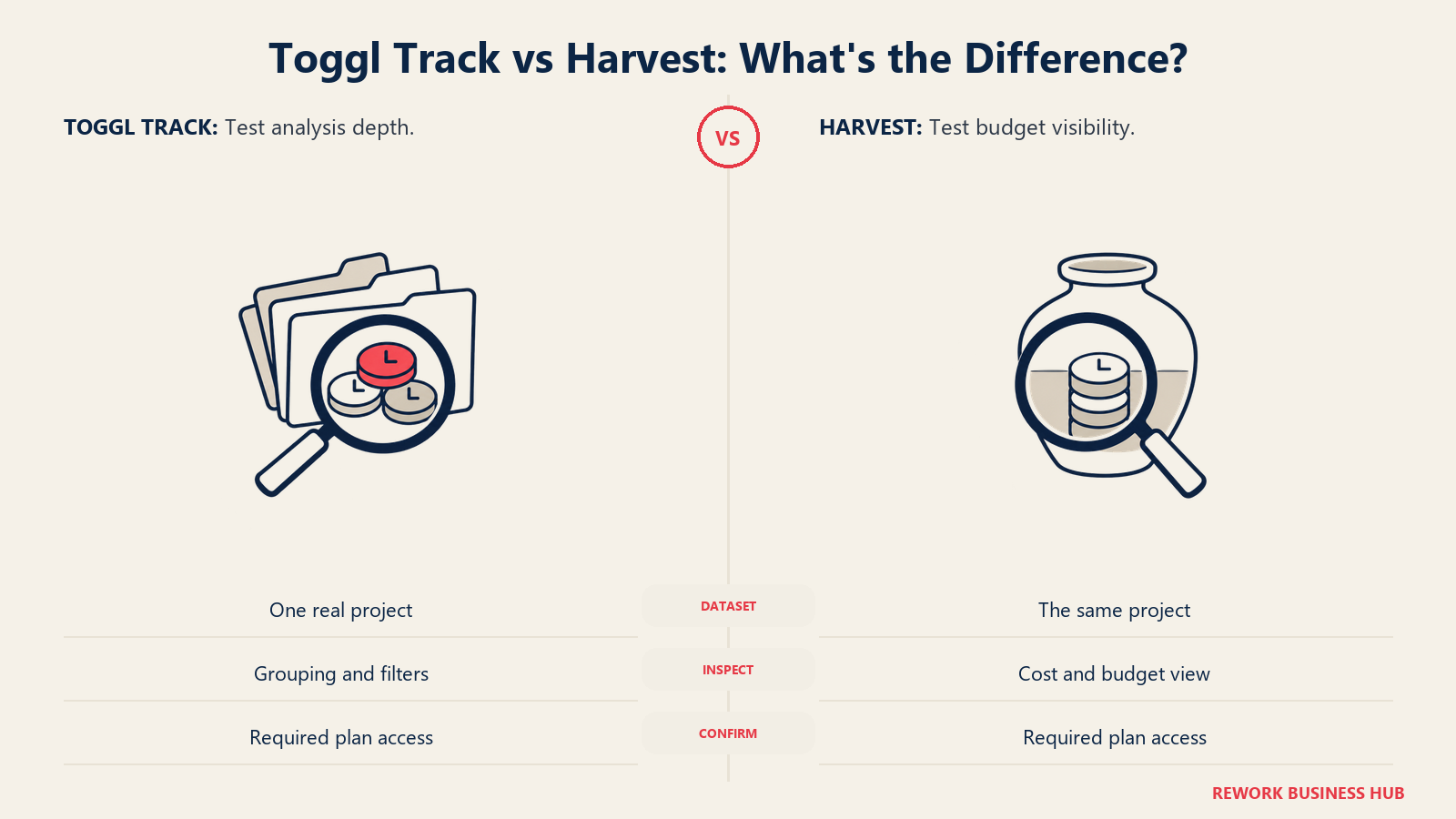
Toggl Track's reports are customizable, filterable and groupable, with profitability tracked at project, task, client, member and team level. Premium adds scheduled reports emailed to stakeholders, so the weekly utilization review doesn't depend on someone remembering to export it. The Project Dashboard compares estimated against actual hours and fires Project Alerts as a project nears its budget, which is the difference between catching scope creep in week three and catching it at invoicing.
Harvest reports on time by project and task, on cost, on budget burn and on team capacity, and lets you build and share custom reports. Two structural limits matter. Free and Teams cap you at four custom reports; unlimited is Enterprise. And profitability reporting itself is Enterprise-only, described on the pricing page as tracking profitability for specific clients, projects, tasks and teams. The plan most small Harvest teams buy is not the plan with the profitability view.
| Reporting capability | Toggl Track | Harvest |
|---|---|---|
| Time reports by project, task, client | Yes | Yes |
| Custom report builder | Yes, filter and group | 4 reports on Free and Teams, unlimited on Enterprise |
| Profitability by project, client, task | Yes | Enterprise only |
| Team capacity and utilization | Yes, workload dashboards | Yes, capacity reporting |
| Estimates versus actuals | Yes, plus Project Alerts | Yes, budgets update automatically |
| Scheduled report delivery | Yes, Premium | Not advertised |
| Time rounding for billing | Yes, Starter and up | Not advertised |
| Under/over-tracking audits | Yes, Team Member Audits | Activity Log, Enterprise |
The pattern repeats on both sides: the analytical layer people cite as the reason to buy sits one tier above the entry plan. Price the tier you'll use, not the tier on the ad.
Timesheets and Approvals
Both tools run a weekly timesheet with a manager sign-off, and both put that sign-off on their top published tier.
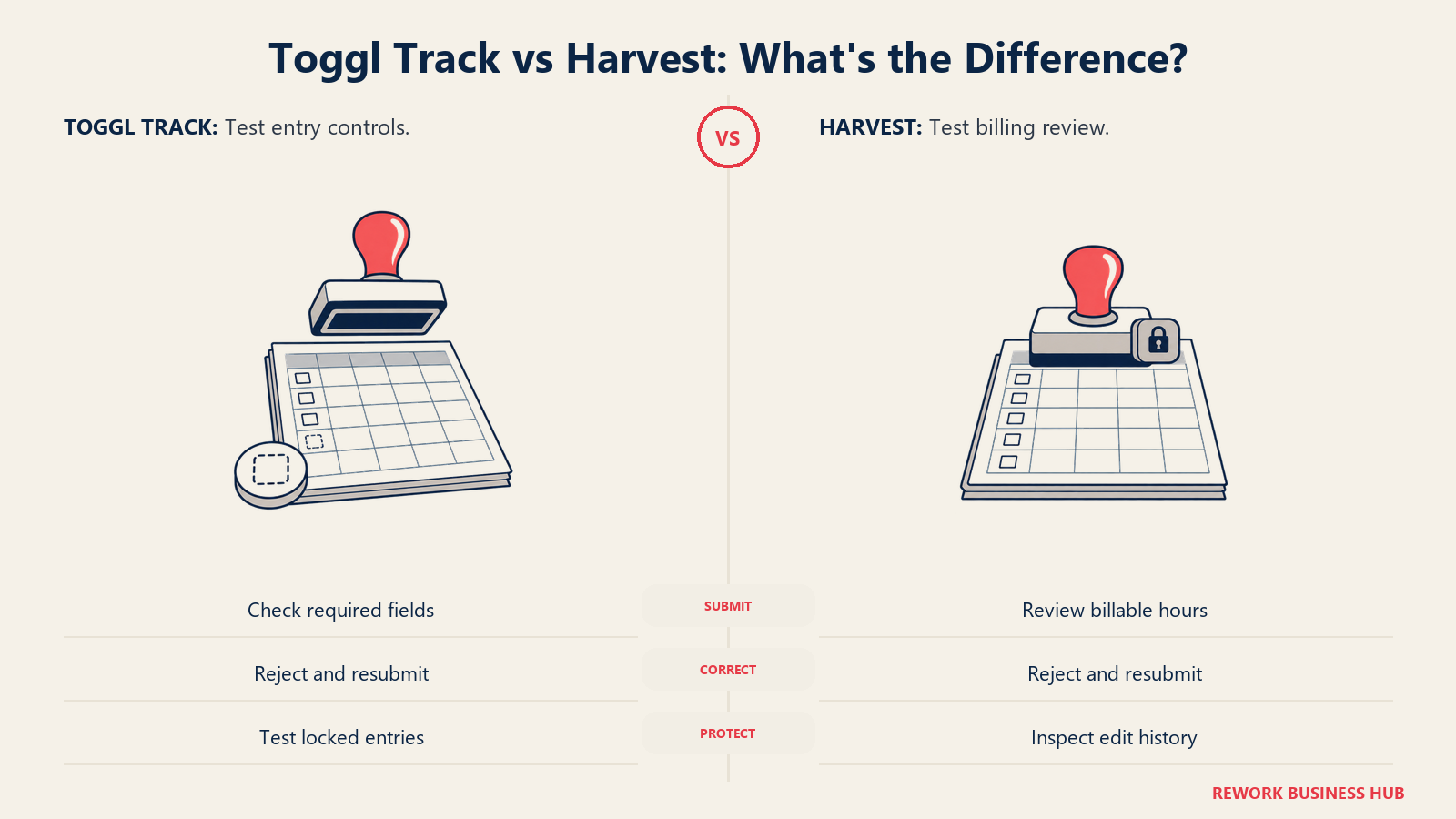
Toggl Track's Timesheet Approvals live on Premium: required weekly submission, admin approve or reject, locked entries that can't be edited after a cutoff, and required fields so an entry missing a project or description can't be submitted. That last one is the quiet workhorse, since most timesheet disputes come from vague entries rather than wrong ones.
Harvest's Timesheet Approvals are Enterprise, described as reviewing and approving hours before they're billed. Enterprise also adds the Activity Log, an audit trail of every entry and edit, plus Require Notes. Teams customers get reminders and the timesheet, but not the sign-off step.
| Timesheet capability | Toggl Track | Harvest |
|---|---|---|
| Weekly timesheet view | Yes, all plans | Yes, day or week view |
| Manager approval workflow | Premium | Enterprise |
| Locked entries after cutoff | Premium | Via approvals, Enterprise |
| Required fields on entries | Premium | Require Notes, Enterprise |
| Full audit trail of edits | Team Member Audits | Activity Log, Enterprise |
| Submission reminders | Yes | Yes |
| Annual cost of the approval-capable tier | $216 per seat a year | $168 per seat a year |
Read that last row twice, because it inverts the usual assumption. If approvals are non-negotiable, Harvest's approval tier costs less per seat annually than Toggl Track's, even though the two entry plans are priced identically.
Project Budgets and Billable Rates
Toggl Track assigns billable rates at workspace, member, project or task level, and supports historical rate edits so raising a rate today doesn't silently rewrite what an old project should have billed. Recurring Projects reset estimates on a schedule for retainer work; Fixed Fee Projects track a monetary budget instead of hours.
Harvest tracks budgets that update automatically as time is logged, tracks internal cost alongside billable rates so margin is visible rather than just revenue, and supports both hours-based and fee-based budgets. The catch is visibility: on Teams you see budget burn, but the profitability rollup across clients and teams is Enterprise.
| Budgeting capability | Toggl Track | Harvest |
|---|---|---|
| Rates by workspace, member, project, task | Yes | Yes |
| Internal cost rate tracking | Yes | Yes |
| Historical rate edits | Yes | Not advertised |
| Automatic budget burn tracking | Yes | Yes |
| Budget or deadline alerts | Yes, Project Alerts | Yes, budget notifications |
| Retainer or recurring setup | Yes, Recurring Projects | Yes, via project settings |
| Margin rollup across clients and teams | Yes | Enterprise only |
Integrations
Both plug into the tools your team already lives in the same way: a browser extension that injects a start-timer button elsewhere, plus native connections and an automation layer.
| Integration | Toggl Track | Harvest |
|---|---|---|
| Apps reachable via extension | 100+ | 70+ integrations listed overall |
| Browser extensions | Chrome, Firefox, Edge | Chrome, Firefox, Edge |
| Project tools | Asana, Jira, Trello and more | Asana, Jira, Trello, Monday.com, ClickUp, Linear |
| CRM | Salesforce native | Zendesk Sell, Salesforce via HarvestSync |
| Accounting | QuickBooks Online | QuickBooks Online, Xero |
| Payments | None native | Stripe, PayPal |
| Automation platforms | Zapier, Make | Zapier, IFTTT, Make |
| Developer access | API and webhooks | API, Python library |
Toggl Track's extension reach is wider on raw count; Harvest's list is narrower but skewed toward the finance end of the stack. Neither will decide this for you unless a specific tool in your stack has a connector on only one side, so check that before the demo.
Scheduling, Capacity and Time Off
Here's where a Harvest quote quietly gets bigger than the pricing page suggests.
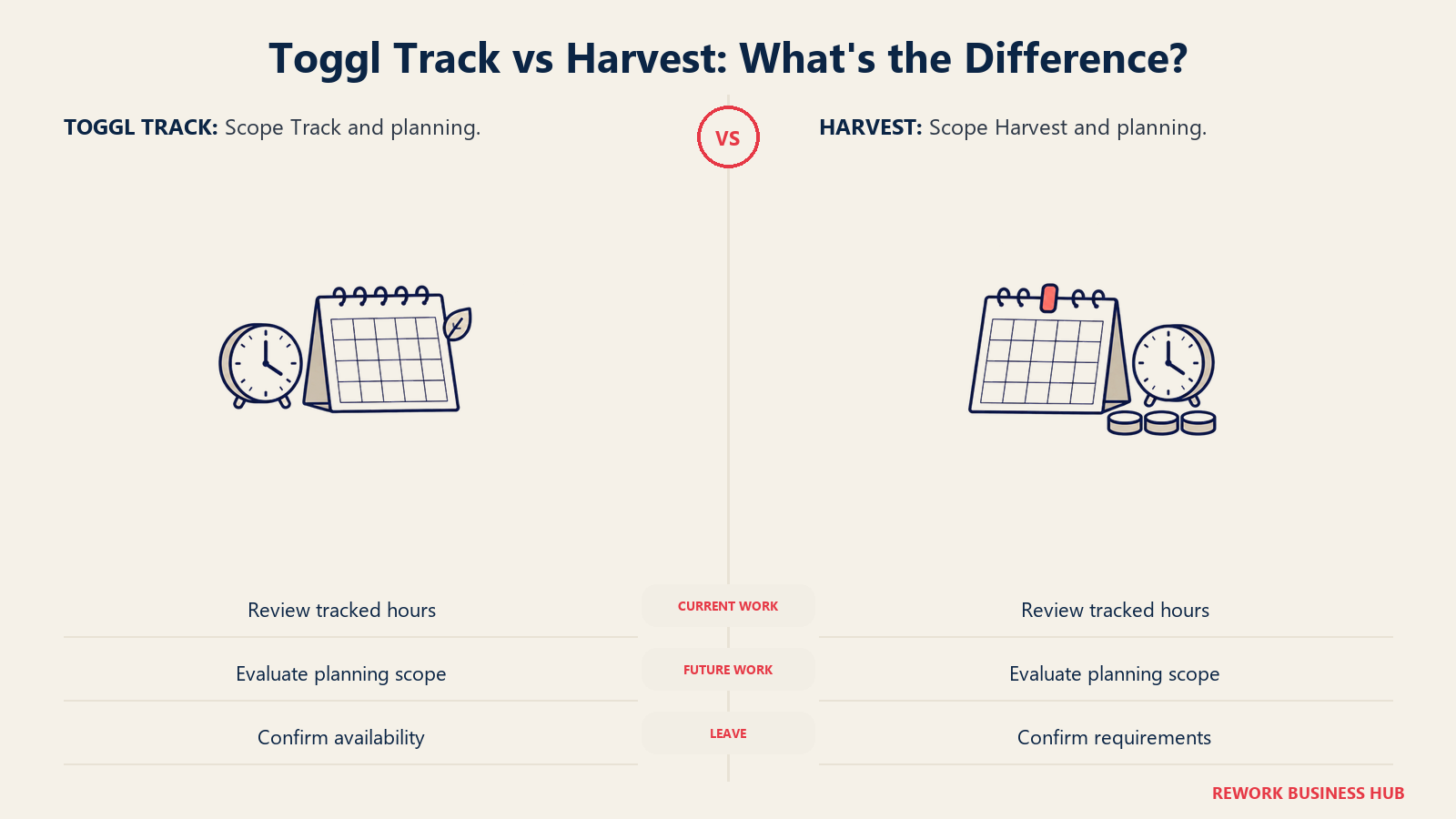
Harvest's core product reports on team capacity, but scheduling people across projects is Harvest Forecast, a separate product at $6.25 per person a month billed monthly, or $5 per person a month billed annually. It connects back to Harvest so scheduled time can be compared against tracked time, but it's a second line item, and a 25-person team wanting both is buying two subscriptions.
Toggl Track has no resource scheduling inside Track either; that role belongs to Toggl Plan, again sold separately. What Toggl Track does have is Time Off management for vacation, sick days and leave policies, with requests, approvals and a team availability view. The catch is access: Toggl's own documentation notes it's enabled manually on request rather than switched on by default, so confirm it during your trial.
| Capability | Toggl Track | Harvest |
|---|---|---|
| Team capacity or workload view | Yes, inside Track | Yes, capacity reporting |
| Schedule people onto future projects | No, that's Toggl Plan (separate) | No, that's Harvest Forecast (separate) |
| Cost of the scheduling product | Priced separately as Toggl Plan | $5 per person a month annually ($6.25 monthly) |
| PTO policies and balances | Yes, Time Off, enabled on request | Not offered |
| Time off requests and approvals | Yes | Not offered |
If leave tracking is a genuine requirement, neither of these is an HR system, and bolting PTO onto a time tracker ages badly as headcount grows. The best HR software roundup covers what that decision looks like when it's made properly.
Admin, Permissions and Compliance
Toggl Track structures access into three levels (basic member, project manager, administrator) and puts SSO on Premium. Harvest offers SAML-based SSO through providers like Okta and Microsoft on Enterprise, alongside the Activity Log. Both hold hours-worked data, which for US employers is regulated, and neither is a compliance product, so if your timesheets double as your wage-and-hour record, settle your export and retention plan before standardizing.
| Admin capability | Toggl Track | Harvest |
|---|---|---|
| Role-based access | Member, project manager, admin | Roles and permissions, deeper on Enterprise |
| SSO | Premium and Enterprise | SAML SSO, Enterprise |
| Audit trail of edits | Team Member Audits | Activity Log, Enterprise |
| Data export | CSV/PDF export, on the free plan too | Custom CSV exports, Enterprise |
| Enforced entry completeness | Required fields, Premium | Require Notes, Enterprise |
Platform coverage is near identical: web, Windows, macOS, iOS, Android and Chrome, Firefox and Edge extensions on both sides, with no native Linux desktop on either. The one real gap is offline tracking, which Toggl Track supports and Harvest doesn't advertise, and that matters more than it looks for anyone billing hours from planes or client sites with bad wifi.
How the Two Pricing Models Differ
These vendors charge in structurally different ways, and the difference doesn't surface until month three.
Toggl Track charges a flat per-user rate: whatever you do inside the product, the bill is seats times rate. The variable to watch is the promotion. Premium annual is currently shown at $14 per license a month for the first year, and Toggl's own page says it then renews at $18. Budget the $18, because a 100-seat team planning around $14 will be $4,800 short in year two.
Harvest charges a base seat rate and meters some usage on top. Its pricing page states that "additional invoices, projects, clients, and tasks are billed based on what you use," so the published per-seat figure is a floor rather than a total. For a team running a handful of long engagements that's probably invisible. For a team spinning up dozens of small projects at high invoice volume, it deserves a direct question before signing.
| Toggl Track | Harvest | |
|---|---|---|
| Free | $0, limited number of users, unlimited projects and clients | $0 forever, 1 seat, 2 projects |
| Entry paid, annual | Starter, $9/user/month ($108/seat/year) | Teams, $9/seat/month ($108/seat/year) |
| Entry paid, monthly | Starter, $12/user/month | Teams, $9/seat/month |
| Top published tier, annual | Premium, $18/user/month ($216/seat/year) | Enterprise, $14/seat/month ($168/seat/year) |
| Top published tier, monthly | Premium, $20/user/month | Enterprise, $14/seat/month |
| Custom tier | Enterprise, custom quote, volume discounts | Enterprise Plus, custom quote |
| Annual discount | "3 months free" banner on annual billing | 20% discount for paying yearly |
| Live promotion | Premium at $14/license/month for year one, renewing at $18 | None beyond the yearly discount |
| Usage charges on top of seats | None | Yes, on extra invoices, projects, clients and tasks |
Annual Cost at 5, 25 and 100 Seats
The table uses annual per-seat list rates times seat count, with nothing negotiated and no usage-based Harvest charges included. Basis per seat per year: Toggl Starter $108, Toggl Premium $216 at list ($168 during the year-one promotion), Harvest Teams $108, Harvest Enterprise $168.
| Seats | Toggl Starter | Toggl Premium (list) | Toggl Premium (year one promo) | Harvest Teams | Harvest Enterprise |
|---|---|---|---|---|---|
| 5 | $540/year | $1,080/year | $840/year | $540/year | $840/year |
| 25 | $2,700/year | $5,400/year | $4,200/year | $2,700/year | $4,200/year |
| 100 | $10,800/year | $21,600/year | $16,800/year | $10,800/year | $16,800/year |
Three things fall out of that arithmetic. At the entry paid tier these tools cost exactly the same, $108 per seat a year on either side, so price is no tiebreaker until you need a higher tier. At the top published tier Harvest is cheaper at list, $168 against $216, a $48 per seat gap that becomes $4,800 a year at 100 seats. And Toggl Track's promoted Premium rate lands exactly on Harvest Enterprise, making them equal for twelve months before Toggl Track becomes 29% more expensive per seat.
Two adjustments before you treat these as a budget: add Harvest Forecast if you need scheduling, and treat the Harvest totals as floors because of the usage-based component.
| Add-on or adjustment | 5 seats | 25 seats | 100 seats |
|---|---|---|---|
| Harvest Forecast (scheduling), annual | $300/year | $1,500/year | $6,000/year |
| Harvest Enterprise plus Forecast | $1,140/year | $5,700/year | $22,800/year |
| Toggl Premium, year two at list | $1,080/year | $5,400/year | $21,600/year |
With Forecast in the mix, a Harvest Enterprise team that also needs scheduling lands roughly level with Toggl Track Premium at list. That's the version most teams should run, since scheduling is usually what someone asks for three months in. For a wider price sweep, the best time tracking software roundup puts both next to the cheaper options.
When Toggl Track Is the Right Call
- Your last rollout failed because people didn't start the timer, and you need background capture, calendar logging and offline tracking to make the habit stick
- The report is the deliverable: profitability by project, task, client, member and team, delivered on a schedule to people who won't log in to fetch it
- You want scope creep caught in flight through estimates versus actuals, not discovered at invoicing
- Nobody sends client invoices out of the time tracker, because billing already lives in a finance system that works
- You want unlimited projects and clients on a free plan while piloting with a small group
When Harvest Is the Right Call
- Hours become invoices, and the gap between those two things costs you days of admin every month
- You pass expenses through to clients and want receipts on the same bill as the hours
- Clients should pay online through Stripe or PayPal without a separate workflow
- Your books live in QuickBooks Online or Xero and you want invoices and payments syncing without manual entry
- You need approvals and an audit trail, and would rather pay $168 per seat a year for Enterprise than $216 for Toggl Track Premium at list
If Neither Fits
Some teams work through all of this and realize the problem isn't which tracker they picked. It's that hours sit in one system, the project those hours belong to sits in a second, and the employee who logged them sits in a third, so every billing and payroll cycle starts with somebody exporting three files and matching them by hand. A better timer doesn't fix a reconciliation problem.
Rework's Timesheet module is part of the People line, running on the same platform as Rework's Work Ops projects and its HRIS, so a logged hour is already attached to the same record as the project it was spent on and the person who spent it, with no export step between. It isn't a lightweight timer and isn't trying to be: no free tier, no single-seat plan, and it won't out-invoice Harvest for a five-person studio or out-report Toggl Track for a team that wants prettier charts. It's built for mid-size teams already consolidating operations onto one platform. Pricing for the People line, including Timesheet, isn't published as a per-seat rate; it's quoted per organization, so see rework.com/pricing for current details.
If that's not your situation and the question is whether a cheaper tool covers enough of what Harvest does, Harvest versus Clockify is the closer fight on price. If you came from the Toggl side, the Toggl Track alternatives roundup covers what else competes on timer quality, and Clockify versus Toggl Track covers the budget end.
Decision Framework
| If you are... | Pick |
|---|---|
| Turning tracked hours into sent, paid, reconciled invoices | Harvest |
| Passing client expenses through with receipts on the same bill | Harvest |
| Syncing to Xero, or letting clients pay via Stripe or PayPal | Harvest |
| Buying the tier with approvals and watching cost per seat | Harvest ($168 vs $216 per seat a year) |
| Fixing a failed rollout where people wouldn't track time | Toggl Track |
| Needing profitability by project, client, task, member and team | Toggl Track |
| Tracking offline, from a plane or a site with bad wifi | Toggl Track |
| Sending scheduled reports to stakeholders automatically | Toggl Track |
| Piloting free with unlimited projects before committing budget | Toggl Track (Harvest free is 1 seat, 2 projects) |
| Needing hours tied to the same record as the project and the employee | Rework (see rework.com/pricing) |
| Still comparing the wider category | See the best timesheet software roundup |
The verdict: Harvest wins if an hour's destination is an invoice, and it wins on price at the tier where approvals live. Toggl Track wins if an hour's destination is a report, and it wins on daily adoption, which quietly decides whether any of this data is trustworthy. Pick on what your month-end actually looks like, not on which product page reads better.
What to Do Next
- Run your last completed month through both trials with real client data, not a demo project. The difference shows up in how long it takes to produce something you'd actually send or present.
- Price the tier you need, not the entry tier. If approvals or profitability reporting are requirements, you're comparing Premium at $216 per seat a year against Harvest Enterprise at $168, not two identical $108 plans.
- Ask Harvest for a quote that includes usage, since the seat rate excludes additional invoices, projects, clients and tasks.
- Get Toggl Track's renewal rate in writing. The promoted $14 Premium rate is year one only and renews at $18.
- Still narrowing the field? Best QuickBooks Time alternatives covers payroll-adjacent tracking, best Everhour alternatives covers tracking embedded in your PM tool, and best Replicon alternatives covers the enterprise end.
Frequently Asked Questions about Toggl Track vs Harvest
Is Toggl Track or Harvest cheaper?
At the entry paid tier they cost the same: Toggl Track Starter is $9 per user a month billed annually and Harvest Teams is $9 per seat a month, both $108 per seat a year. At the top published tier Harvest is cheaper, with Enterprise at $14 per seat a month ($168 a year) against Toggl Track Premium at $18 per user a month ($216 a year) at list.
What is the $14 Toggl Track price I keep seeing?
That's a first-year promotion on annual Premium billing, not the standing rate. Toggl's pricing page shows $14 per license a month and says it "then renews at $18 per license per month," so plan year two at $18 and get the renewal rate confirmed before signing.
Does Harvest have a real free plan?
Not for a team. Harvest's free plan is $0 forever but limited to 1 seat and 2 projects, which works as an extended trial for a solo user rather than a team plan. Toggl Track's free plan covers a limited number of users with unlimited projects and clients, making it the more usable of the two for a pilot.
Can Toggl Track send invoices and take client payments?
Toggl Track can generate an invoice from billable time and send invoices to QuickBooks Online, but it has no native Stripe or PayPal payment integrations, no expense module feeding costs onto the bill, and no Xero sync. Harvest covers all of those, which is the main structural difference between the products.
Which one has better reporting?
Toggl Track, comfortably. It tracks profitability at project, task, client, member and team level, supports scheduled report delivery on Premium, and adds estimates with alerts. Harvest caps Free and Teams at four custom reports, and profitability reporting across clients and teams is Enterprise only.
Do both tools include timesheet approvals?
Both include them, and both put them on their top published tier. Toggl Track's approvals, locked entries and required fields are Premium features. Harvest's approvals, Activity Log and Require Notes are Enterprise features. Neither ships approvals on its entry paid plan.
Does either tool handle scheduling or resource planning?
Not inside the tracker. Harvest sells scheduling as Harvest Forecast, a separate product at $6.25 per person a month billed monthly or $5 billed annually. Toggl's planning product is Toggl Plan, also sold separately from Toggl Track. Budget a second subscription if scheduling matters.
Can either one replace an attendance or payroll system?
No. Neither offers kiosk clock-in, PIN or QR punch, or GPS location tracking, so shop-floor and field attendance is out of scope for both. They also aren't wage-and-hour compliance products, so if your timesheets double as your legal record, plan exports and retention separately.
Which is easier to get a team to actually use?
Toggl Track, mainly because it removes the excuses. Background capture through Timeline, calendar-based logging, offline tracking and one-click starts inside 100+ other tools mean a forgotten afternoon gets reconstructed rather than guessed at. Harvest assumes people start a timer or fill in a week grid from memory.
Related Resources:

Senior Customer Retention Strategist
On this page
- TL;DR
- Who Each Tool Is Built For
- Key Facts
- Time Tracking and Timer UX
- Invoicing, Expenses and Getting Paid
- Reporting and Profitability
- Timesheets and Approvals
- Project Budgets and Billable Rates
- Integrations
- Scheduling, Capacity and Time Off
- Admin, Permissions and Compliance
- How the Two Pricing Models Differ
- Annual Cost at 5, 25 and 100 Seats
- When Toggl Track Is the Right Call
- When Harvest Is the Right Call
- If Neither Fits
- Decision Framework
- What to Do Next