Clockify vs Time Doctor vs Toggl Track: How Much Oversight Does Your Team Actually Need in 2026?
Turn this article into takeaways for your work.


Each assistant summarizes the article only for you and suggests best practices for your work.
Type "Clockify vs Time Doctor vs Toggl Track" into a search bar and most results treat this as one shopping list: three timers, slightly different logos. It isn't. Toggl Track has spent years building a brand around a timer people actually want to open, and it has never shipped the screenshot or activity-scoring features that would let it compete head to head with Time Doctor. Time Doctor builds the opposite product on purpose: screenshots from its cheapest paid tier, productivity ratings, idle detection, and an AI layer that flags a mouse jiggler before a manager has to notice one by hand. Clockify sits in the middle, and not by accident. Monitoring exists in the product, but it's fenced off behind a paid tier most small teams never reach, while the free plan, once genuinely unlimited, now capped at 5 users, still does the job of getting a team off spreadsheets for nothing.
So before comparing feature lists, answer a question none of these pricing pages ask directly: how much oversight is this team going to tolerate, and what happens to trust the day someone notices the tool watching them? That's not a question with one right answer. A BPO paying offshore contractors by verified hour has a real, defensible reason to want screenshots. A ten-person product team on salary usually doesn't, and the research on what heavy monitoring does to morale and honesty isn't close. This comparison prices all three tools at 10, 25, and 100 seats, then spends real time on the part most buying guides skip: what you're actually agreeing to, culturally and legally, the moment monitoring gets turned on.
TL;DR
| Clockify | Time Doctor | Toggl Track | |
|---|---|---|---|
| What it is | Budget time tracker with monitoring fenced off behind a paid tier | Time tracker built around proof of work: screenshots, productivity ratings, AI anomaly detection | Timer-first tracker that markets itself on having zero monitoring, by design |
| Monitoring by default | Off. Screenshots and GPS don't exist below Pro | On. Screenshots run from the cheapest paid tier (Basic) | Never. No screenshots, activity score, or GPS at any tier or price |
| Free plan | Up to 5 users (capped April 2026; previously unlimited) | None. 14-day free trial of Premium only, no credit card | Up to 5 users, unlimited projects and clients |
| Cheapest paid seat, billed annually | Basic, $3.99/user/month ($47.88/year) | Basic, $6.67/user/month ($80.04/year) | Starter, $9/user/month ($108/year) |
| Tier where its real story lives | Pro, $7.99/user/month ($95.88/year): screenshots, GPS, scheduling | Standard, $11.67/user/month ($140.04/year): productivity ratings, attendance, payroll | Premium, $18/user/month ($216/year) list: approvals, profitability, still zero monitoring |
| Genuinely stronger at | Price, plus attendance and kiosk clock-in for hourly staff | Verified proof of work for contractors and outsourced teams | Timer adoption and reporting polish; the tool people don't resent |
| Best for | Cost-conscious teams that want monitoring optional, not central | Agencies and BPOs paying by verified hour, with a real monitoring mandate | Salaried knowledge-work teams where trust is the point, not just the hours |
What Each Tool Is Actually Built For
Clockify comes from CAKE.com, the same company behind the Plaky project-management tool and the Pumble team chat app, and it's priced like a company that wants time tracking to be the thing that gets a small business in the door. Its free plan was famous for years for having no user cap; CAKE.com capped it at 5 users on April 21, 2026 and moved billable hours, kiosk clock-in, and exports to paid plans. Monitoring was never central to the pitch. Screenshots and GPS only exist from the Pro tier up, three tiers above free, which tells you where CAKE.com thinks that feature belongs: an upsell, not the hook.
Time Doctor has been in this category for more than a decade, built for remote and outsourced teams where someone, somewhere, needs proof the tracked hours are real. It holds a 4.4 out of 5 rating across 476 reviews on G2, and its pricing structure confirms the positioning directly: screenshots ship on the cheapest paid plan, not as an add-on, and the AI-driven Unusual Activity Report, which flags things like mouse jigglers and irregular keyboard input, is a named, marketed Premium feature, not a hidden setting.
Toggl Track's identity rests on the opposite bet: a tracker only works if people actually use it, and people don't enjoy being watched. Across every tier its pricing page lists, from Free through Enterprise, there's no screenshot feature, no activity percentage, and no GPS row anywhere. That's not an oversight; it's the product decision the company is built around, and it shows up in reviews too. Toggl Track holds a 4.6 out of 5 rating across more than 1,500 reviews on G2, a strong score in a category where "feels like surveillance" is a recurring complaint about the alternatives.
| Clockify | Time Doctor | Toggl Track | |
|---|---|---|---|
| Natural buying trigger | Team wants the cheapest tool that still covers attendance, monitoring optional later | Paying contractors or an outsourced team and need verifiable proof the hours are real | Team tried a monitored tool, adoption failed, and trust is now part of the requirement |
| Team maturity assumed | Comfortable configuring more surface area for a lower price | Comfortable running a real monitoring program: policy, disclosure, a reason for what's captured | Wants a tool that works well with minimal setup and no monitoring conversation |
| Primary champion | Ops or finance lead watching per-seat cost | Agency owner or outsourcing manager who pays people based on tracked hours | Team lead who cares about adoption and report quality more than proof of work |
| Company profile that fits best | Small and mid-size teams, retail and hourly workforces | Agencies, BPOs, and remote-first companies with a monitoring mandate already in place | Consulting, product, and creative teams billing or reporting on salaried time |
Key Facts
- Time Doctor has no free-forever plan. Every account starts with a 14-day free trial of the full Premium tier, no credit card required, and access ends if you don't subscribe after that.
- Time Doctor takes screenshots at a random point inside a chosen interval (commonly every 3, 5, or 10 minutes), and blurring is available on every paid plan, according to Time Doctor's own support documentation.
- 74% of US employers use online tracking tools to monitor work activity, but only 22% of employees are confident they know it's happening, per ExpressVPN's 2025 survey of 1,500 US employers and 1,500 US employees.
- Monitored employees are nearly twice as likely to rate their mental health as poor or fair (32%) compared with employees who aren't monitored (24%), per the American Psychological Association's 2023 Work in America survey of 2,515 employed adults.
- In a Harvard Business Review-published study, 200 US employees told they were under electronic surveillance while completing a task were more likely to cheat than employees who weren't told that.
What Each Tool Actually Captures
This table should settle more of this decision than any pricing page will.
| Capture type | Clockify | Time Doctor | Toggl Track |
|---|---|---|---|
| Screenshots | Optional, Pro tier and up only | Yes, from Basic, every 3 to 10 minutes at random, blur available on every plan | No, at any tier |
| Activity or productivity rating | Not scored at any tier | Yes, Productivity Ratings and Activity Summary from Standard | No, at any tier |
| Idle time detection | Yes, standard feature | Yes, based on a configurable no-activity threshold | Yes, standard feature (Free plan and up) |
| Keystroke content logging | No, at any tier | No, at any tier. Time Doctor tracks activity, not what's typed | No, at any tier |
| Continuous video screen recording | No | Premium tier only | No |
| GPS or location tracking | Yes, Pro tier and up (not offered below it) | No, on desktop. Not a marketed feature | No, at any tier |
| AI anomaly detection (mouse jigglers, irregular input) | No | Premium tier only: Unusual Activity AI Report | No |
| Kiosk / shared-device clock-in | Yes, from Basic | No, not offered | No, not offered |
| Default monitoring state | Off, unavailable until Pro | On, live from the cheapest paid seat | Off, permanently, at every price point |
None of the three reaches the heaviest end of the workplace-monitoring category. No keystroke content, no continuous video below Time Doctor's Premium tier, and no webcam capture on any of them, the depth tier reserved for security-grade tools like Teramind. What actually separates these three is simpler: one gates monitoring behind an upsell, one builds it into the cheapest paid seat, and one refuses to build it at all.
The Free-Tier Story, and Where It Ends
Clockify's free plan is the reason it shows up on every "cheapest time tracker" list, but the story changed this year. For most of its life the free plan had no user cap; CAKE.com confirmed the 5-user limit in an April 21, 2026 announcement, alongside moving billable hours, kiosk clock-in, and CSV/Excel export to paid plans. It's still generous relative to Time Doctor, which has never offered a free plan at all, but "unlimited free users" is no longer an accurate reason to pick Clockify in 2026.
| Clockify | Time Doctor | Toggl Track | |
|---|---|---|---|
| Free plan | Yes, up to 5 users (capped April 2026) | No. 14-day free trial of Premium only | Yes, up to 5 users, unlimited projects and clients |
| What the free tier gives up | Billable hours, kiosk, exports, shared report links | Everything; there's nothing to keep past day 14 without paying | CSV/PDF export and idle detection stay included |
| Monitoring available on the free or cheapest tier | None. Screenshots and GPS need Pro, two tiers up | Screenshots from the first dollar spent, day one | None, at any price |
Read the last row against the first two and the real positioning gets clearer. Time Doctor's entire pricing ladder assumes you want monitoring and are deciding how much. Clockify's assumes you don't, until you explicitly pay for it. Toggl Track never puts the option on the table.
Decision by Business Goal
| Business goal | Best fit |
|---|---|
| "I pay offshore contractors and need proof the hours are real" | Time Doctor |
| "I need the cheapest tool that still covers hourly staff and kiosk clock-in" | Clockify |
| "I want a timer my team will actually open every day, with zero surveillance" | Toggl Track |
| "I'm scaling fast and can't justify a per-seat bill for basic tracking yet" | Clockify or Toggl Track (both free to 5 users) |
| "I need AI-flagged anomalies, like mouse jigglers, across a distributed team" | Time Doctor |
| "I want monitoring available later without committing to it now" | Clockify (Pro unlocks it when you're ready) |
| "Trust on this team is already fragile and I don't want to make it worse" | Toggl Track |
Team and Role Fit
| Role | Clockify | Time Doctor | Toggl Track |
|---|---|---|---|
| Ops / attendance manager | Strong: kiosk, scheduling, PTO from Standard up | Workable: attendance and payroll from Standard | Weak: no scheduling or attendance features |
| HR / people ops | Lighter policy load; monitoring is opt-in | Owns a real disclosure and policy conversation before rollout | Lightest policy load of the three; nothing to disclose |
| Finance / billing | Job costing and rates on higher tiers | Payroll built into Standard, no separate tool needed | Profitability and billable-rate reporting is the strongest of the three |
| Agency / BPO manager | Workable, but not the core pitch | Strong: built specifically for this job | Workable for client reporting, not for proof of work |
| IT / security | Basic role and access controls | AI anomaly detection and SSO at Premium | No security-monitoring features exist to manage |
Pricing at 10, 25, and 100 Seats
Clockify publishes five tiers, cheaper billed annually. Screenshots and GPS don't appear until Pro.
| Plan | Monthly (billed monthly) | Monthly (billed annually) | What it unlocks |
|---|---|---|---|
| Free | $0 | $0 | Up to 5 users, timer, reports, mobile and desktop apps |
| Basic | $4.99/seat | $3.99/seat ($47.88/year) | Kiosk clock-in, billable rates, required fields |
| Standard | $6.99/seat | $5.49/seat ($65.88/year) | Time off, invoicing, approvals, attendance and overtime |
| Pro | $9.99/seat | $7.99/seat ($95.88/year) | Scheduling, GPS tracking, screenshots, budgets |
| Enterprise | $14.99/seat | $11.99/seat ($143.88/year) | SSO, SCIM provisioning, custom subdomain, audit log |
Source: Clockify's own pricing page.
Time Doctor has no free plan and publishes every tier. Source: Time Doctor's own support knowledge base and timedoctor.com/pricing.
| Plan | Monthly (billed monthly) | Monthly (billed annually) | What it unlocks |
|---|---|---|---|
| Basic | $8.00/user | $6.67/user ($80.04/year) | Automatic tracking, screenshots, Timeline Report |
| Standard | $14.00/user | $11.67/user ($140.04/year) | Schedules, attendance, approvals, Productivity Ratings, payroll |
| Premium | $20.00/user | $16.70/user ($200.40/year) | Unusual Activity AI Report, video screen recording, SSO |
| Enterprise | Custom | Custom | Private cloud deployment, customizable BI dashboards |
A Basic or Standard team can also buy a single Premium capability a la carte instead of upgrading the whole seat: Benchmarks AI, Video Screen Recording, and Software Cost Insights each run $3/user/month; Meeting Insights and Office vs. Remote Report run $2/user/month; SSO and HRIS integration are flat add-ons at $200/account/month each, regardless of seat count.
Toggl Track publishes four tiers, with a live first-year discount on Premium.
| Plan | Monthly (billed monthly) | Monthly (billed annually) | What it unlocks |
|---|---|---|---|
| Free | $0 | $0 | Up to 5 users, unlimited projects and clients, idle detection |
| Starter | $12/user | $9/user ($108/year) | Billable rates, project estimates and alerts, revenue analysis |
| Premium | $20/user (list) | $18/user list ($216/year), promoted at $14/user for year one ($168/year), then renews to $18 | Profitability analysis, fixed-fee projects, scheduled reports, timesheet approvals, SSO |
| Enterprise | Custom | Custom | Personalized onboarding, dedicated success manager, volume discounts |
Source: Toggl's own pricing page.
True annual cost at the entry tier
| Seats | Clockify Basic | Time Doctor Basic | Toggl Track Starter |
|---|---|---|---|
| 10 | $478.80 | $800.40 | $1,080.00 |
| 25 | $1,197.00 | $2,001.00 | $2,700.00 |
| 100 | $4,788.00 | $8,004.00 | $10,800.00 |
True annual cost at the tier where each tool's real story lives
This is the table worth reading twice. Clockify's Pro tier is where screenshots and GPS actually turn on. Time Doctor's Standard tier is where productivity ratings, attendance, and payroll turn on, the features that answer "was this person actually working." Toggl Track's Premium tier is where approvals and profitability reporting turn on, and it still has zero monitoring of any kind.
| Seats | Clockify Pro (monitoring unlocked) | Time Doctor Standard (proof of work) | Toggl Track Premium, list (zero monitoring) |
|---|---|---|---|
| 10 | $958.80 | $1,400.40 | $2,160.00 |
| 25 | $2,397.00 | $3,501.00 | $5,400.00 |
| 100 | $9,588.00 | $14,004.00 | $21,600.00 |
Read that ordering carefully, because it inverts the usual assumption. The tool with the most surveillance by default (Time Doctor) isn't the most expensive of the three at its full-featured tier; the tool with zero surveillance capability at any price (Toggl Track) is, even against its promoted first-year Premium rate ($1,680 at 10 seats, $4,200 at 25, $16,800 at 100). "Monitoring costs extra" is true of Clockify, where it's genuinely an upsell. It isn't why Toggl Track costs what it does. Toggl Track is priced for adoption and reporting polish, not discounted for a lighter feature set.
Implementation and Change Management
Implementation involves more than account setup: compare employee communication, monitoring policy, and ongoing administration.
| Factor | Clockify | Time Doctor | Toggl Track |
|---|---|---|---|
| Setup time | Fast, self-serve | Fast, but monitoring is live by default from day one on Basic | Fast, self-serve |
| Employee communication needed | Minimal, unless Pro's monitoring gets turned on | Real, before day one: screenshots and productivity ratings should be disclosed, not discovered | Minimal; there's nothing to disclose |
| Written monitoring policy | Needed only once Pro is enabled | Close to mandatory given what's captured from the cheapest paid plan | Not needed |
| Works council or union review (EU) | Unlikely at default settings | Likely required in Germany and similar markets once screenshots are live | Very unlikely at any setting |
| Admin overhead | Low, one pricing ladder to configure | Real: deciding which add-ons to layer onto Basic or Standard adds setup decisions | Lowest of the three |
The Trust and Morale Cost
This is a first-class section here, not a footnote, because Time Doctor's entire value proposition depends on it and the survey data is specific enough to price into a decision the same way you'd price a seat count. Per ExpressVPN's 2025 survey of 1,500 US employers and 1,500 US employees, 74% of employers use online tracking tools, but only 22% of employees are confident they know it. Roughly half of workers say they'd suspect monitoring even where a company claims to disclose its policy, and nearly one in six employees say they'd be very likely to quit over increased workplace surveillance, with about a third more saying they'd seriously consider it.
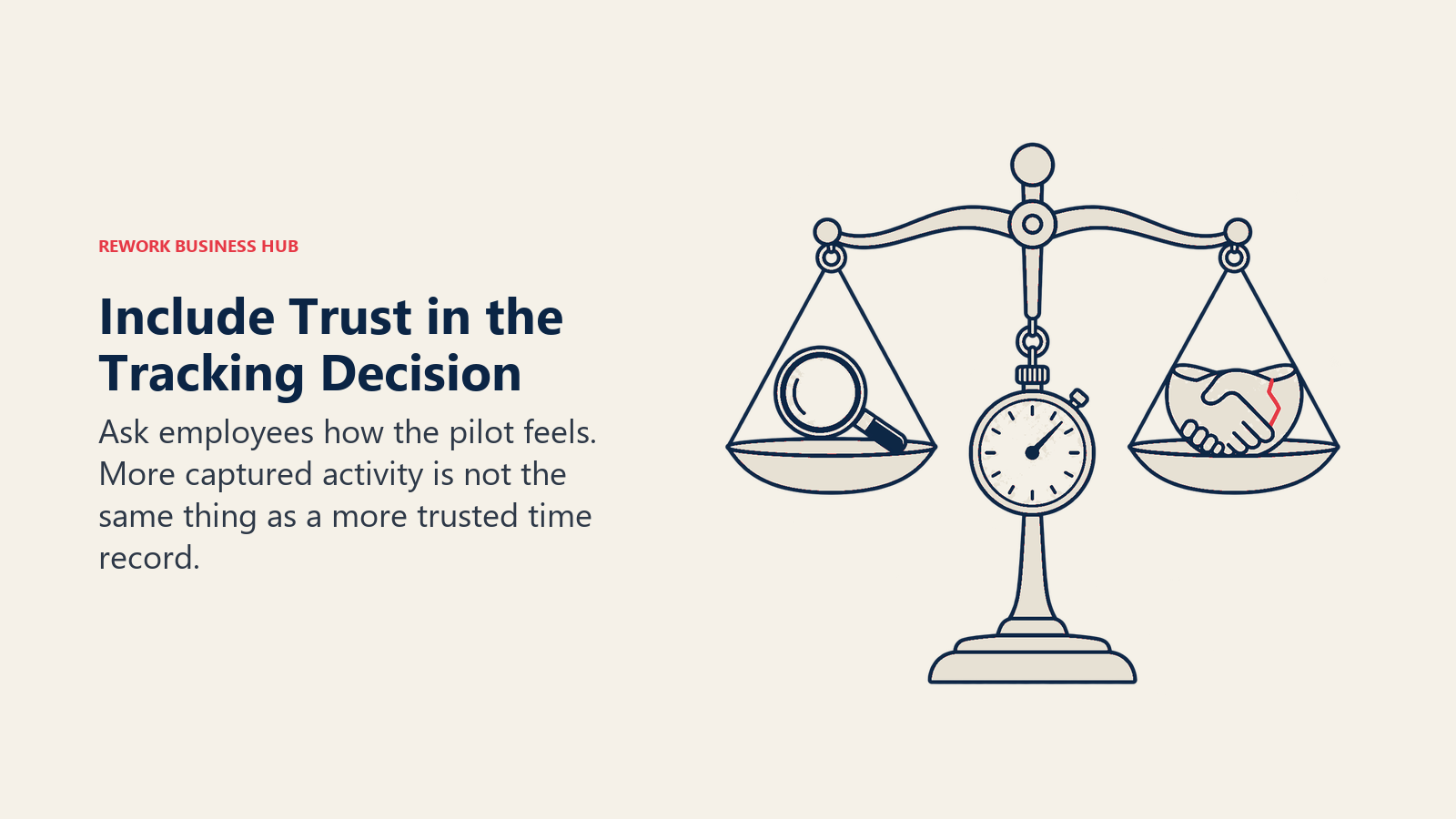
The mental-health data points the same direction. The APA's 2023 Work in America survey of 2,515 employed adults found monitored employees were nearly twice as likely to rate their mental health as poor or fair (32%) compared with employees who weren't monitored (24%). And in a Harvard Business Review-published study, 200 US employees told they were under electronic surveillance while completing a task were more likely to cheat than employees who weren't told that, the opposite of the trust-building effect monitoring is usually sold on.
None of this means Time Doctor is the wrong tool. A BPO paying an offshore team by verified hour has a legitimate, defensible reason for screenshots that has nothing to do with distrust; it's how the invoice gets paid. But for a salaried knowledge-work team with no contractor-payment reason to verify hours, the honest read of the evidence above is that picking Time Doctor over Clockify's default-off posture or Toggl Track's built-in refusal to monitor usually costs more in trust than it returns in data. The data capture itself isn't the risky part; screenshots and productivity ratings tell a manager what was true anyway. What the research above says is that the act of monitoring changes behavior and morale on its own, a cost worth pricing in before the plan is picked, not after the first all-hands where someone asks why the screenshots started.
The Legal Landscape: Notice, Consent, and GDPR
Employee-monitoring law isn't one rule. It depends on where your people actually sit, and it's worth checking before screenshots or activity tracking go live, not after.
| Jurisdiction | Requirement | Penalty or mechanism |
|---|---|---|
| Connecticut (Gen. Stat. § 31-48d) | Prior written notice describing the types of electronic monitoring in use, plus a posted workplace notice; an exception applies if the employer has reasonable grounds to suspect misconduct | Civil penalty up to $500 for a first offense, $1,000 for a second, $3,000 for a third and later, per Justia's text of the statute |
| Delaware (19 Del. Code § 705) | Either a daily electronic notice each time an employee accesses employer email or internet, or a one-time signed acknowledgment, employer's choice; content-neutral system-maintenance monitoring is exempt | Enforced under Delaware labor law, per Justia's text of the statute |
| New York (Civil Rights Law § 52-c) | Prior written notice at hiring plus a posted notice, before monitoring email, internet, or telephone use; in effect since May 7, 2022 | Civil penalty of $500 first offense, $1,000 second, $3,000 third and later, enforced by the state Attorney General, per Justia's text of the statute |
| European Union (GDPR) | Monitoring needs a lawful basis under Article 6. The EDPB's Guidelines 05/2020 on consent state that consent is unlikely to be valid in an employment relationship because of the power imbalance between employer and employee, so employers typically rely on a documented legitimate-interest assessment under Article 6(1)(f), with a Data Protection Impact Assessment for systematic monitoring | Enforced by national data protection authorities under GDPR's standard fine tiers |
| Germany specifically | A works council generally holds co-determination rights over introducing any technically monitoring-capable system, under Works Constitution Act (BetrVG) Section 87(1) No. 6. Objective suitability for monitoring is what triggers the right; intent to monitor is not required | A formal works agreement is required, or the dispute goes to a conciliation committee, per Luther Lawfirm's analysis of the provision |
This is not a complete list of every state or country's rules, and they change. Whether screenshot frequency, retention length, or blur settings satisfy a specific jurisdiction's requirements once monitoring is live is not confirmed here; that determination needs your own counsel, not a comparison article. What holds across every row is the underlying pattern: the more a tool is capable of capturing, whether or not every feature is switched on, the more disclosure and process it tends to require. That's one more reason "how much oversight do we actually need" is a better first question than "which tool has more features."
When Clockify Is the Right Call
- You want the lowest cost per seat in the category, and monitoring, if you ever need it, should be a deliberate upgrade rather than something built in from day one
- Attendance, kiosk clock-in, or PTO tracking for hourly staff matters as much as project time itself
- You're comfortable that the "unlimited free users" era ended in April 2026; 5 free users is still enough to pilot the tool honestly
- Your team is watching cost per seat closely at every tier, not just comparing entry-plan sticker prices
When Time Doctor Is the Right Call
- You're paying offshore or contractor hours and need verifiable, screenshot-backed proof of work, not a self-reported timesheet
- Your team already expects monitoring as part of the role (BPO, outsourcing, some remote-first agencies), so introducing it isn't a new conversation
- You want AI-flagged anomalies, like mouse jigglers or irregular keyboard activity, instead of a manager manually scrolling through screenshots
- Payroll and leave tracking living in the same product as the monitoring is worth more to you than keeping them in separate tools
When Toggl Track Is the Right Call
- Your team is salaried knowledge workers, and the honest goal is accurate reporting, not proof that someone was at their desk
- A past rollout failed because people felt watched and either quietly stopped tracking time or never started
- You want to be able to tell your team, truthfully, that the tool has no screenshot or activity-scoring feature to turn on later
- You'd rather pay more per seat for a tool nobody resents than save money on one people find ways around
If None of the Three Fits
Some teams read all of this and realize the real requirement sits just outside these three tools. If what you need is heavier, investigation-grade keystroke logging, continuous screen recording, or data-loss prevention, none of these three go that far by design. Our Best Employee Monitoring Software roundup covers the fuller depth spectrum, our dedicated Time Doctor alternatives guide is the closer starting point if Time Doctor's general approach is right but the specific plan isn't, and our ActivTrak alternatives guide covers tools built trust-first instead of monitoring-on-by-default.
If the actual complaint is that shifts, not hours, are hard to plan, who's working when rather than what they did once clocked in, that's a scheduling problem, not a monitoring one, and our employee scheduling software roundup covers it directly. And if cost per seat and attendance features matter more than any stance on monitoring, our other time-tracking head-to-heads in this collection, Clockify vs Toggl Track, Toggl Track vs Harvest, and Hubstaff vs TimeCamp, cover that side of the category if proof-of-work depth was never really the point for your team.
Decision Framework
| If you are... | Pick |
|---|---|
| Paying offshore contractors and need screenshot-backed proof of hours | Time Doctor |
| Running hourly staff who need kiosk clock-in and PTO tracking on a budget | Clockify |
| Trying to get a salaried team to actually open a timer every day | Toggl Track |
| Rolling out to a team where trust is already fragile | Toggl Track |
| Wanting monitoring available later without paying for it now | Clockify |
| Needing AI-flagged unusual activity across a distributed team | Time Doctor |
| Still comparing the wider category before narrowing down | See our full time tracking software roundup |
The verdict: if the job is verified proof of work for contractors or an outsourced team, Time Doctor earns its position, and its full-featured tier costs less than you'd expect relative to Toggl Track. If the job is attendance and kiosk clock-in on a tight budget, Clockify wins on price at every tier and keeps monitoring optional rather than default. And if the job is getting a salaried team to actually trust and use the tool, Toggl Track's zero-monitoring stance costs more on paper and, for that specific team, is usually cheaper in practice once you count what a failed rollout or an eroded-trust team costs.
What to Do Next
- Decide what you're actually trying to prove, before comparing price. If it's "hours worked," any of the three can answer that. If it's "where someone was and what they were doing on screen," only Time Doctor does, and mostly past its cheapest tier.
- Price your real seat count at the tier where the tool's real story lives, using the tables above, not the entry-tier sticker price that gets top billing on the pricing page.
- If Time Doctor is the pick, check your state's or country's notice requirements before flipping on screenshots, not after. The legal table above is a starting point, not a substitute for counsel.
- If Clockify or Toggl Track is the pick, run the free plan with your actual team for two weeks, not a demo account, since adoption is the variable that actually decides whether the data is trustworthy.
- Not sure any of the three is the right depth? Best Time Doctor Alternatives and Best Employee Monitoring Software cover lighter and heavier options in both directions.
Frequently Asked Questions about Clockify vs Time Doctor vs Toggl Track
Is Clockify, Time Doctor, or Toggl Track the cheapest?
At the entry paid tier, Clockify is cheapest at $3.99 per user a month billed annually, against Time Doctor's $6.67 and Toggl Track's $9. At the tier where each tool's real story lives (screenshots for Clockify, productivity ratings for Time Doctor, approvals for Toggl Track), the order holds: Clockify Pro, Time Doctor Standard, then Toggl Track Premium, which costs the most despite having zero monitoring features.
Does Time Doctor have a free plan?
No. Time Doctor offers a 14-day free trial of its full Premium tier with no credit card required, but there's no permanent free plan. Both Clockify and Toggl Track offer a free plan for up to 5 users.
Is it true Clockify's free plan used to support unlimited users?
Yes. For most of its history Clockify's free plan had no user cap. CAKE.com, the company behind Clockify, capped the free plan at 5 users and moved billable hours, kiosk clock-in, and exports to paid plans in an announcement dated April 21, 2026.
Can Clockify do screenshot monitoring like Time Doctor?
Yes, but only from its Pro tier ($7.99 per user a month billed annually), two tiers above the free plan. Time Doctor includes screenshots on its cheapest paid tier, Basic, so the two tools reach the same feature from very different starting points and very different defaults.
Does Toggl Track have any employee monitoring features at all?
No, at any tier or price, including Enterprise. Toggl Track tracks time, project data, and idle periods, but has no screenshots, no activity or productivity score, and no GPS tracking. That's a deliberate product decision, not a gap the company plans to fill.
Is it legal to monitor employees with screenshots or activity tracking?
It depends on where your employees work. Connecticut, Delaware, and New York all require employers to give notice before electronic monitoring, with real civil penalties for skipping it. Under GDPR, consent is generally not a valid legal basis for monitoring in an employment relationship according to EDPB guidance, so EU employers typically rely on a documented legitimate-interest assessment, and in Germany a works council generally has co-determination rights before monitoring-capable software goes live. Confirm your specific state and country requirements with counsel before enabling any of these features; this isn't legal advice.
Which of the three is easiest to get a team to actually adopt?
Toggl Track consistently earns the strongest reviews for daily-use adoption, in part because it has nothing to disclose or defend: there's no monitoring feature for employees to discover later. Clockify is functional with minimal pushback as long as monitoring stays off. Time Doctor requires real upfront communication, since screenshots and productivity ratings run from the cheapest paid plan.
What does Time Doctor's Unusual Activity AI Report actually do?
It's a Premium-tier feature that flags anomalous behavior, like mouse jiggler devices, unusually irregular keyboard input, or unstable internet connectivity, so a manager doesn't have to manually review screenshots to catch patterns like faked activity. It's not offered on Basic or Standard.
Related Resources:
- Best Time Tracking Software in 2026
- Best Time Doctor Alternatives in 2026
- Best Employee Monitoring Software in 2026
- Best Clockify Alternatives in 2026
- Best Toggl Track Alternatives in 2026
- Best ActivTrak Alternatives in 2026
- Clockify vs Toggl Track
- Toggl Track vs Harvest
- Hubstaff vs TimeCamp
- Best Employee Scheduling Software in 2026
- Best HR Software in 2026

Senior Customer Retention Strategist
On this page
- TL;DR
- What Each Tool Is Actually Built For
- Key Facts
- What Each Tool Actually Captures
- The Free-Tier Story, and Where It Ends
- Decision by Business Goal
- Team and Role Fit
- Pricing at 10, 25, and 100 Seats
- True annual cost at the entry tier
- True annual cost at the tier where each tool's real story lives
- Implementation and Change Management
- The Trust and Morale Cost
- The Legal Landscape: Notice, Consent, and GDPR
- When Clockify Is the Right Call
- When Time Doctor Is the Right Call
- When Toggl Track Is the Right Call
- If None of the Three Fits
- Decision Framework
- What to Do Next