Best Time Doctor Alternatives in 2026: 13 Tools for Tracking Remote and Outsourced Teams
Turn this article into takeaways for your work.


Each assistant summarizes the article only for you and suggests best practices for your work.
Hubstaff is the best fit if you need GPS and geofencing for a field or hybrid crew that Time Doctor doesn't track at all, Clockify and Toggl Track are the best fits if the real complaint is trust and morale rather than a missing feature, and Teramind is the best fit if you need security and insider-threat monitoring deeper than any productivity tracker offers. This guide covers 13 alternatives, evaluated on what each tool actually tracks, how pricing breaks down by tier, and fit for outsourced, remote, and BPO teams.
Time Doctor earns its position honestly: a decade-plus in the remote and outsourced-team monitoring category, payroll and leave tracking baked into the Standard tier, and an AI-driven Unusual Activity report that flags patterns like mouse jigglers instead of leaving a manager to scroll through screenshots by hand. Most people don't leave because a feature is missing. They leave because the useful analytics sit on Standard at $14 a month per user, screen recording and AI benchmarking only unlock on Premium at $20 a month, and the marketing pricing page shows no numbers at all, so a buyer has to dig into the support site just to learn what a plan costs. If you want the full category view first, see our roundup of the best employee monitoring software for 2026.
Key Facts
- The global business process outsourcing market is projected to reach $434.99 billion in 2026, up 4.63% year over year, the segment where Time Doctor and its heaviest monitoring competitors concentrate their sales effort. (Statista)
- Only 19% of US knowledge workers are confident their employer is NOT using employee tracking software, per Owl Labs' 2025 State of Hybrid Work Report (2,000 respondents surveyed). (Owl Labs)
- Monitored employees are nearly twice as likely to rate their mental health as poor or fair (32%) compared with employees who aren't monitored (24%), per the American Psychological Association's 2023 Work in America survey. (APA)
- In a Harvard Business Review-published study of 200 US employees, workers told they were under electronic surveillance while completing a task were more likely to cheat than workers who weren't monitored. (Harvard Business Review)
- 17% of US employees say they'd be very likely to quit, and another 32% say they'd seriously consider it, if workplace surveillance increased, per ExpressVPN's 2025 survey of 1,500 US employers and 1,500 US employees. (ExpressVPN)
Quick Comparison Table
| Tool | Best For | Starting Price | Key Strength | Key Limitation |
|---|---|---|---|---|
| Hubstaff | GPS and geofencing for field or hybrid teams | $7/seat/mo monthly, $4.99 annual (2-seat minimum) | GPS tracking through the Locations add-on, plus payroll integrations | GPS needs the Team tier plus that add-on; no free team plan, only a 14-day trial |
| ActivTrak | Enterprise analytics without default screenshots | Free (3 users); $10/worker/mo billed annually | Passive activity data instead of a screenshot reel | Paid tiers are annual-only, no monthly option |
| Insightful | Modular monitoring you price by add-on | $8/seat/mo billed annually | Buy screen recording only where you need it | Base plan has no screenshots included |
| DeskTime | Fully automatic tracking, no manual timer | $6.42/user/mo billed annually ($7 monthly) | Runs in the background, auto-categorizes apps | Screenshots are locked to the Premium tier |
| Monitask | Budget monitoring with adjustable screenshot frequency | $6.49/user/mo monthly, $5.32 annual | Cheapest tier here that still ships screenshots | Higher screenshot frequency costs extra |
| Apploye | Free monitoring for very small teams | Free (10 users, 1 screenshot/hour); $7/user/mo monthly, $4.50 annual | Free tier actually includes screenshots | Screenshot frequency is gated by tier |
| Teramind | Security and DLP-grade monitoring | $14/seat/mo (5-seat minimum) | Insider-threat detection, not just screenshots | Marketing page hides pricing like Time Doctor's |
| Controlio | Budget monitoring with deployment flexibility | $6.67/user/mo billed annually | Cloud, on-premise, or private-cloud deployment | Screen recording needs the Advanced tier |
| Clockify | Free time tracking with no monitoring by default | Free (5 users); $4.99/user/mo monthly, $3.99 annual | Cheapest paid ladder among the trust-first options | Free plan caps at 5 users, not unlimited |
| TimeCamp | Monitoring that stays optional | Free (unlimited users); $5.49/user/mo monthly, $3.99 annual | Screenshots off by default, on only if you choose | Steeper learning curve than a pure timer |
| Toggl Track | A trusted timer with zero monitoring | Free (limited users); $9/user/mo annual ($10 monthly) | Clean UI, strong reporting, no surveillance features | No monitoring features of any kind |
| RescueTime | Personal focus data, not manager-facing surveillance | Free Lite; Solo Focus $7/mo annual ($9 monthly) | Built for self-awareness, not oversight | Team plans still track activity, just not screenshots |
| Timely | AI-drafted timesheets, zero screenshots | $11/user/mo monthly, $9 annual (5-user cap on Starter) | Memory AI builds a timesheet automatically | No free plan; Starter caps out at 5 users |
Monitoring and Privacy Matrix
What each tool actually watches, the table that matters most for a Time Doctor switch.
| Tool | Screenshots | Screen Recording | App and URL Tracking | Activity/Productivity % | AI Anomaly Detection |
|---|---|---|---|---|---|
| Time Doctor (incumbent, for reference) | Yes, from Basic | Premium only | Yes | Yes | Premium only |
| Hubstaff | Yes | No | Yes | Yes | No |
| ActivTrak | No (activity data, not images) | No | Yes | Yes | Optional (Productivity Optimization tier) |
| Insightful | Optional add-on | Optional add-on | Yes | Yes | No |
| DeskTime | Premium tier only | No | Yes | Yes | No |
| Monitask | Yes | No | Yes | Yes | No |
| Apploye | Yes | No | Yes | Yes | No |
| Teramind | Yes | Yes | Yes | Yes | Yes (behavior and insider-threat analytics) |
| Controlio | Yes | Advanced tier | Yes | Yes | No |
| Clockify | Optional, Pro tier and up | No | No | No | No |
| TimeCamp | Optional, off by default | No | Optional | Optional | No |
| Toggl Track | No | No | No | No | No |
| RescueTime | No | No | Yes (auto-categorized) | Yes | No |
| Timely | No | No | Private AI capture only, not manager-visible | No (AI drafts a timesheet, doesn't score activity) | No |
Team Size and Structure Fit
| Tool | Best Team Size | Team Structure | Trust Posture |
|---|---|---|---|
| Hubstaff | 5-500 | Remote, hybrid, and field teams | Monitoring-first |
| ActivTrak | 50-5,000+ | Enterprise, security-conscious orgs | Analytics-led, not screenshot-first |
| Insightful | 10-1,000+ | Distributed teams, BPOs, agencies | Monitoring-first, modular |
| DeskTime | 1-200 | Small remote or hybrid teams | Monitoring-first, lightweight |
| Monitask | 5-500 | Remote and outsourced teams on a budget | Monitoring-first, budget |
| Apploye | 1-50 | Small teams and freelance agencies | Monitoring-first, budget |
| Teramind | 5-5,000+ (5-seat minimum) | Security-conscious enterprises, BPOs | Monitoring-first, security and DLP-grade |
| Controlio | 10-500 | Distributed and outsourced teams | Monitoring-first, deployment-flexible |
| Clockify | 1-unlimited | Any size, budget-conscious teams | Trust-first by default |
| TimeCamp | 1-500 | Teams wanting monitoring optional | Trust-first by default |
| Toggl Track | 1-100 | Freelancers, agencies, product teams | Trust-first |
| RescueTime | 1-500 | Knowledge workers wanting self-insight | Trust-first, individual-focused |
| Timely | 1-unlimited (tiered) | Consultancies billing by the hour | Trust-first, automatic |
1. Hubstaff: GPS and Geofencing Time Doctor Doesn't Have
Hubstaff is the closest like-for-like Time Doctor competitor for a team that wants monitoring plus something Time Doctor doesn't offer at all: GPS and geofencing. Screenshots, activity percentages, and app and URL tracking sit at the center of the product, the same core pitch as Time Doctor, but Hubstaff adds location verification for a field or delivery crew and payroll-ready timesheets that flow straight into common payroll tools. For an outsourced team split between desk-based agents and a few field staff, that combination covers more ground than Time Doctor alone. GPS is not part of that entry price: it arrives through Hubstaff's Locations add-on, priced at $3.33/seat/month on the Team tier and marked Included on Enterprise, and it is not offered on Starter or Grow at any price. Budgeting Hubstaff for a field crew means Team plus that add-on, roughly $13.33/seat/month on annual billing, not the $4.99 headline.
Hubstaff bills per seat with a 2-seat minimum, so even a single contractor relationship starts at two licenses: Starter $7/seat/month monthly ($4.99 annually), Grow $9 monthly ($7.50 annually), Team $12 monthly ($10 annually), Enterprise $25/seat/month, annual quoted. Locations, the add-on that carries GPS, geofenced job sites, and work orders, runs $3.33/seat/month on Team and is marked Included on Enterprise; it is not available on Starter or Grow. A 14-day free trial is available, and there's no free plan for teams. If Hubstaff itself is the tool you're evaluating against, see our dedicated Hubstaff alternatives guide.
| What you get | What you don't |
|---|---|
| GPS and geofencing Time Doctor doesn't offer | A free plan; only a 14-day trial |
| Payroll-ready timesheets and workforce analytics | Video screen recording or AI anomaly detection |
| Screenshots, activity tracking, and app/URL usage | A monthly-only entry price under the 2-seat minimum |
| Deep integrations across payroll and project tools | The cheapest tier among monitoring-first tools here |
Pricing: Starter $7/seat/month monthly ($4.99 annually); Grow $9 monthly ($7.50 annually); Team $12 monthly ($10 annually); Enterprise $25/seat/month monthly, annual custom. 2-seat minimum, 14-day trial, no free plan. Best for: Outsourced or remote teams that need Time Doctor-style monitoring plus GPS and geofencing for field staff. Not ideal for: Teams wanting a free tier or trying to move away from screenshot monitoring altogether.
2. ActivTrak: Enterprise Analytics Without the Screenshot Reel
ActivTrak reframes the pitch away from watching someone's screen and toward workforce analytics: activity summaries, schedule adherence, and utilization metrics built from passive data rather than a folder of screenshots. For a larger, security-conscious organization that wants productivity and compliance signals without the optics of screen captures, that's a meaningfully different posture than Time Doctor's default screenshot-and-activity model.
The free plan covers up to 3 workers with 30 days of history. Paid tiers, billed annually only, step from basic activity tracking up through workforce management to full productivity coaching, each adding analytics depth and data retention. Enterprise pricing is custom, with multi-year and volume discounts. (ActivTrak)
| What you get | What you don't |
|---|---|
| Passive activity analytics instead of default screenshot capture | A monthly billing option; paid tiers are annual only |
| Compliance alarms and false-activity detection | Video screen recording like Time Doctor's Premium tier |
| AI-driven productivity coaching (Productivity Optimization tier) | A low-friction, no-sales-call signup for paid tiers |
| A free tier for teams of 3 or fewer | GPS or geofencing for field teams |
Pricing: Free (up to 3 workers, 30-day retention); Work Activity Tracking $10/worker/month billed annually (6-month retention); Workforce Management $15/worker/month annual; Productivity Optimization $17/worker/month annual (1-year retention); Enterprise custom. If ActivTrak itself is the tool you're evaluating against, see our dedicated ActivTrak alternatives guide. Best for: Larger, security-conscious organizations wanting workforce analytics and compliance signals without screenshot-first monitoring. Not ideal for: Small teams wanting monthly billing, or teams that specifically need Time Doctor's screen-recording depth.
3. Insightful: Monitoring You Buy By the Module
Insightful (formerly Workpuls) unbundles monitoring into separate purchase decisions instead of one fixed package, closer in spirit to Time Doctor's tiered model but priced by feature rather than by bundle. The base Workforce Analytics plan covers time tracking, app and website usage, and reporting; screenshots, continuous screen recording, and on-demand or increased-frequency captures all price as separate add-ons, which suits a buyer who wants to add surveillance depth only where a specific team or client needs it.
Billed annually, the three main plans step from Workforce Analytics through Workflow Optimization (currently in beta) to a Combo bundle. Enterprise and Hyperscaler plans are custom-quoted for large, variable workforces, and add-ons price separately: Screen Recording $4/seat/month, On-Demand Screenshots $4, Increased-Frequency Screenshots $3, Workspace Security $4, Data Warehouse Integrations $0.50. (Insightful)
| What you get | What you don't |
|---|---|
| Modular pricing, pay only for the monitoring depth you use | A flat, all-inclusive price like Time Doctor's tiers |
| Workflow Optimization for process bottlenecks, not just logs | Screenshots or screen recording included by default |
| Enterprise-grade insider threat detection and audit logs | A generous free tier |
| A Hyperscaler plan for large, variable-shift workforces | One price to quote; the add-on menu takes reading |
Pricing: Workforce Analytics $8/seat/month; Workflow Optimization $12/seat/month (beta); Combo $16/seat/month; add-ons from $0.50 to $4/seat/month; Enterprise and Hyperscaler custom. All billed annually. If Insightful itself is the tool you're evaluating against, see our dedicated Insightful alternatives guide. Best for: Distributed teams or BPOs that want to buy monitoring depth (screenshots, screen recording, insider threat detection) as separate, priced modules instead of a fixed Time Doctor-style tier. Not ideal for: Teams wanting one simple price instead of a base plan plus a menu of add-ons.
4. DeskTime: Automatic Tracking, No Manual Timer
DeskTime's pitch is that time tracking should run in the background without anyone remembering to press start, automatically detecting productive versus unproductive time by categorizing the apps and URLs someone has open. That's a decent fit for a Time Doctor switcher whose real complaint isn't monitoring depth, it's that agents forget to clock in and out, or that Time Doctor's manual and idle-detection workflow feels clunky for a large outsourced roster.
Pro covers automatic tracking, document titles, and calendar integrations; Premium adds screenshots, shift scheduling, and an absence calendar, the rough equivalent of Time Doctor's jump from Basic to Standard. Enterprise is custom-priced for organizations above roughly 200 users, and a 14-day free trial is available. (DeskTime)
| What you get | What you don't |
|---|---|
| Fully automatic tracking, no manual timer required | Screenshot monitoring on the entry-level Pro tier |
| Shift scheduling and absence calendar (Premium) | AI anomaly detection like Time Doctor's Premium tier |
| Simple, published per-user pricing | GPS geofencing for field or delivery crews |
| Google and Outlook calendar integrations | A permanent free plan |
Pricing: Pro $7/user/month monthly ($6.42 annually); Premium $10/user/month monthly ($9.17 annually); prices exclude VAT; no permanent free plan, 14-day trial only; Enterprise custom (200+ users). Best for: Small to mid-size remote teams whose core problem was agents forgetting to start a timer, not a need for AI-driven anomaly detection. Not ideal for: Field teams needing GPS, or teams needing screenshots without upgrading past the entry tier.
5. Monitask: Budget Monitoring With Adjustable Screenshot Frequency
Monitask covers the same ground as Time Doctor's Basic and Standard tiers, screenshots, activity levels, app and URL tracking, at a lower published price, and lets a buyer dial screenshot frequency up or down per employee rather than accepting one fixed cadence for the whole roster. For a BPO or agency managing several client accounts with different monitoring requirements, that per-employee flexibility is the practical draw.
Pro is the entry monitoring tier; Business and Business Premium add stealth mode, work-proof reports, and deeper integrations. Enterprise is custom for organizations above 100 employees, and a screenshot-frequency add-on prices separately from $0 to $7.20 per license per month depending on how often you want captures. (Monitask)
| What you get | What you don't |
|---|---|
| Screenshots and activity tracking below Time Doctor's price | AI anomaly detection or Unusual Activity reporting |
| Per-employee adjustable screenshot frequency | Payroll processing built into the platform |
| Stealth mode and work-proof reporting (Business tiers) | GPS geofencing for field crews |
| Simple monthly or annual billing, no seat minimum | Time Doctor's depth of historical data retention |
Pricing: Pro $6.49/user/month monthly ($5.32 annually); Business $8.99 monthly ($7.37 annually); Business Premium $12.99 monthly ($10.65 annually); Enterprise custom (100+ employees); screenshot-frequency add-on $0 to $7.20/license/month. Best for: BPOs and agencies wanting Time Doctor-style monitoring at a lower published price, with per-employee screenshot frequency control. Not ideal for: Teams wanting Time Doctor's AI-driven anomaly detection or built-in payroll processing.
6. Apploye: A Free Plan That Still Takes Screenshots
Apploye undercuts Time Doctor's Basic tier entirely for a small team: its free-forever plan covers up to 10 users with hourly screenshots and basic project tracking included, not gated behind a trial the way Time Doctor's free access is. That makes it a realistic option for a small outsourced team or a startup piloting monitoring before committing budget.
Elite steps up screenshot frequency to 18 per hour and adds deeper reporting; Power goes further to 60 screenshots per hour for teams needing near-continuous visibility. Enterprise is custom for larger rosters. (Apploye)
| What you get | What you don't |
|---|---|
| A genuinely free plan that includes screenshots | AI anomaly detection like Time Doctor's Premium tier |
| Screenshot frequency up to 60 per hour on Power | Video screen recording |
| Quarterly and annual discounts on top of monthly pricing | Payroll processing built into the platform |
| A low-friction entry point for a small outsourced team | GPS geofencing for field crews |
Pricing: Starter free forever (10 users, 1 screenshot/hour, 3 projects); Elite $7/user/month monthly, $6 quarterly, $4.50 annually (18 screenshots/hour); Power $12 monthly, $8 annually (60 screenshots/hour); Enterprise custom. Best for: Small outsourced teams or startups wanting to pilot screenshot monitoring at zero cost before paying for it. Not ideal for: Teams needing AI-driven anomaly detection or Time Doctor's payroll and leave-tracking features.
7. Teramind: Security and DLP-Grade Monitoring
Teramind moves past productivity monitoring into insider-threat detection and data loss prevention, watching for behaviors like mass file downloads, unauthorized data transfers, or policy violations rather than just logging how long someone spent in a spreadsheet. For a BPO handling client data under strict compliance requirements, that security layer goes further than anything Time Doctor's Unusual Activity AI report attempts.
Teramind's own published rates step from a Starter monitoring tier through User Activity Monitoring (UAM) to full DLP, each tier adding deeper behavioral and data-protection coverage. Every plan carries a 5-seat minimum, available on cloud, on-premise, or private-cloud deployment, and annual billing includes roughly a month free. Like Time Doctor, Teramind's own pricing table on its marketing site renders no figures, so these rates come from the vendor's published blog post rather than the interactive calculator. (Teramind)
| What you get | What you don't |
|---|---|
| Insider-threat detection and data loss prevention | A published, self-serve pricing calculator |
| Cloud, on-premise, or private-cloud deployment | A plan for teams under 5 seats |
| Behavioral analytics beyond simple activity percentages | The lowest entry price among monitoring tools here |
| Volume discounts above 250 licenses | Time Doctor's payroll or leave-tracking features |
Pricing: Starter $14/seat/month; UAM $28/seat/month; DLP $32/seat/month; Enterprise custom. 5-seat minimum on every plan; annual billing includes about one month free. If Teramind itself is the tool you're evaluating against, see our dedicated Teramind alternatives guide. Best for: Security-conscious BPOs and enterprises needing insider-threat and DLP monitoring beyond standard productivity tracking. Not ideal for: Small teams under 5 seats, or buyers who want Time Doctor's payroll and leave-tracking features bundled in.
8. Controlio: Budget Monitoring With Deployment Flexibility
Controlio covers the same core ground as Time Doctor, screenshots, activity levels, app and URL tracking, at a lower published price, and adds a deployment choice Time Doctor doesn't advertise outside its Enterprise tier: on-premise starting at 10 users, or a private cloud from 100 users, alongside the standard cloud option. For an outsourced operation with a client contract that specifies where monitoring data physically lives, that flexibility matters more than any single feature.
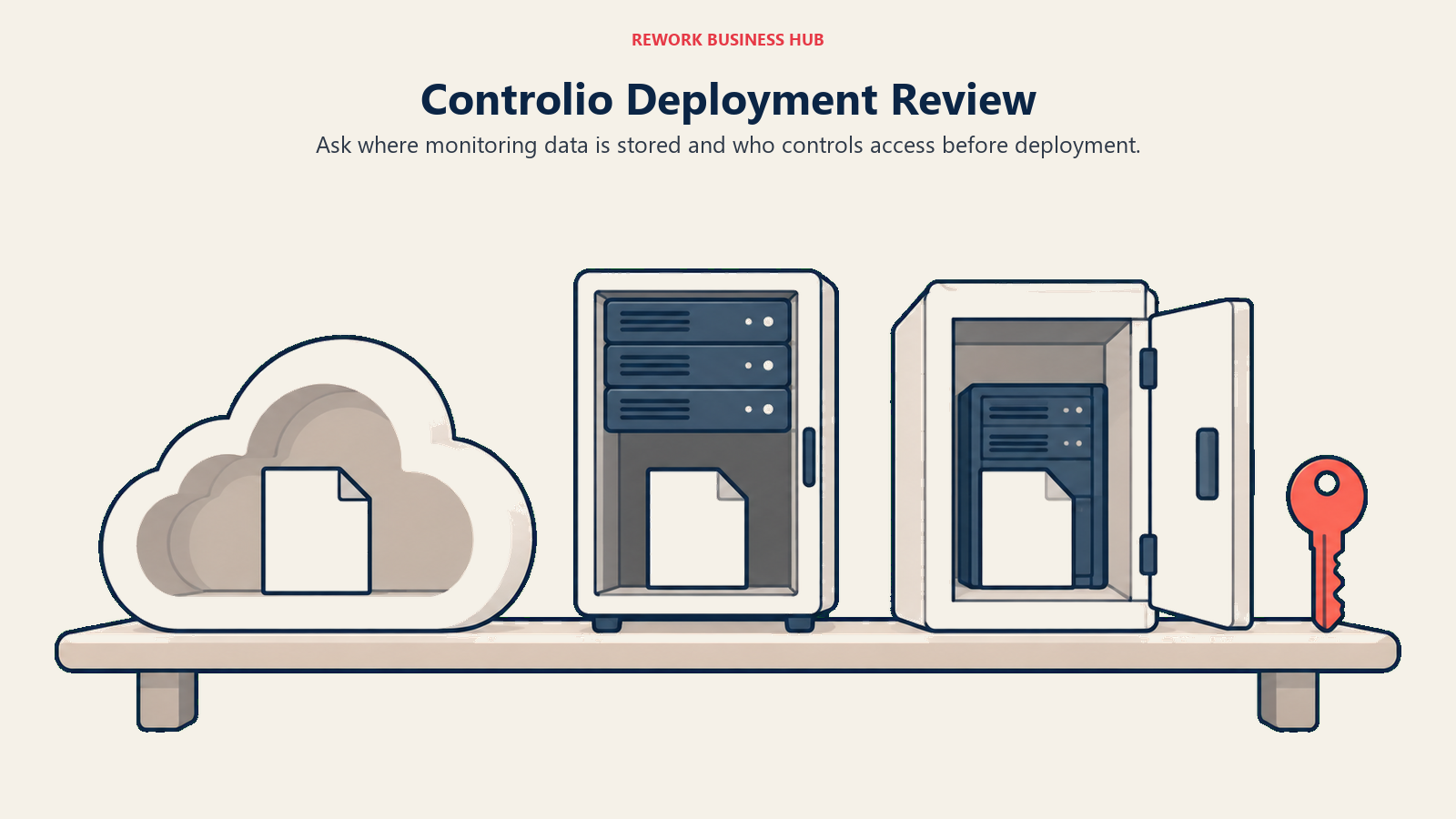
Basic covers the core monitoring stack; Advanced adds screen recording and deeper reporting. Enterprise pricing, covering on-premise and private-cloud deployment, is available on request. Annual billing saves 17% over the monthly-equivalent rate. (Controlio)
| What you get | What you don't |
|---|---|
| Screenshots and activity tracking below Time Doctor's price | AI-driven anomaly detection |
| A choice of cloud, on-premise, or private-cloud deployment | Payroll or leave-tracking features |
| Screen recording on the Advanced tier | GPS geofencing for field crews |
| 17% savings for annual billing over monthly | A free plan or trial beyond the vendor's stated terms |
Pricing: Basic $6.67/user/month billed annually; Advanced $9.99/user/month annually; Enterprise on request. Annual saves 17%; on-premise from 10 users, private cloud from 100. Best for: Outsourced operations needing on-premise or private-cloud deployment for compliance reasons, at a lower price than Time Doctor. Not ideal for: Teams wanting AI anomaly detection or built-in payroll processing.
9. Clockify: Free Tracking With No Monitoring by Default
Clockify's free plan covers up to 5 users, and CAKE.com capped its free plan at 5 users in April 2026 while moving billable hours, kiosk clock-in, and CSV export to paid tiers. What makes it realistic for a Time Doctor switcher on a tight budget isn't the free plan, it's what sits above it: Basic at $3.99 per user per month on annual billing is a fraction of Time Doctor's $11.67 Standard tier, and Clockify never requires monitoring to unlock reporting. Screenshots and GPS do exist, but only from the Pro tier up, and off by default.
Four paid tiers, Basic through Enterprise, step up reporting, time-off management, and approvals. A CAKE.com bundle adds project management (Plaky) and chat (Pumble) on top of Clockify Enterprise. (Clockify)
| What you get | What you don't |
|---|---|
| No screenshots or activity monitoring at the entry tiers | AI anomaly detection or benchmarking |
| A price roughly a fifth of Time Doctor's Standard tier | Payroll or leave-tracking features |
| Time-off, invoicing, and approvals on paid tiers | Deep productivity coaching or AI insights |
| Optional screenshots and GPS from Pro tier up | An unlimited free plan; it's capped at 5 users |
Pricing: Free (up to 5 users, admin features); Basic $4.99/user/month monthly ($3.99 annually); Standard $6.99 ($5.49); Pro $9.99 ($7.99); Enterprise $14.99 ($11.99); CAKE.com bundle $15.99 ($12.99). If Clockify itself is the tool you're leaving, see our Clockify alternatives guide, or the broader best time tracking software roundup for tools with no monitoring layer at all. Best for: Budget-conscious teams wanting Time Doctor-level reporting without paying for monitoring they don't use. Not ideal for: Teams needing screenshots or activity percentages by default, or a free plan beyond 5 users.
10. TimeCamp: Monitoring That Stays Optional
TimeCamp sits in an unusual middle ground for a Time Doctor switcher: computer activity tracking and screenshots exist, but off by default, an opt-in feature rather than the core product the way it is with Time Doctor. That's workable for a team wanting monitoring available for a specific project or contractor without running it company-wide the way Time Doctor's tiers assume.
The free plan covers unlimited users and projects with core time tracking. Starter, Premium, and Ultimate step up reporting, billing, and integration depth from there, with screenshots and remote-work detection live on Ultimate. Enterprise is available on request. (TimeCamp)
| What you get | What you don't |
|---|---|
| Screenshots and activity tracking, off by default | Time Doctor's always-on monitoring depth |
| A genuinely free plan with unlimited users | AI anomaly detection |
| Flexible, per-project monitoring settings | GPS geofencing for field crews |
| Budgeting, invoicing, and attendance in one tool | The interface polish of a pure trust-first timer |
Pricing: Free (unlimited users); Starter $5.49/user/month monthly ($3.99 annually); Premium $9.99 monthly ($6.99 annually); Ultimate $13.99 monthly ($9.99 annually, screenshots and remote-work detection); Enterprise on request. Best for: Teams that want the option to turn on monitoring for a specific project or contractor without making it the default for everyone. Not ideal for: Teams wanting Time Doctor's always-on monitoring depth by default.
11. Toggl Track: A Trusted Timer With Zero Monitoring
Toggl Track stays out of the monitoring business entirely: no screenshots, no activity percentages, no keystroke logging, just a one-click timer, solid reporting, and integrations with most project tools a team already uses. For a Time Doctor switcher whose main complaint is morale rather than a missing feature, Toggl is usually the first stop.
The free plan covers a limited number of users with core time tracking. Starter runs $10/user/month monthly ($9 annually); Premium runs $20/user/month monthly ($18 annually), though Toggl currently promotes $14/user/month for the first year of annual Premium before it renews at $18. Enterprise is custom. If Toggl itself is the tool you're leaving, see our dedicated Toggl Track alternatives guide.
| What you get | What you don't |
|---|---|
| No screenshots, activity percentages, or keystroke logging | Payroll or leave-tracking features |
| A free plan for small teams | AI anomaly detection or benchmarking |
| Clean reporting and broad integrations | GPS geofencing for field crews |
| Simple, published per-user pricing | Any monitoring layer, even optional |
Pricing: Free (limited users); Starter $10/user/month monthly ($9 annually); Premium $20/user/month monthly ($18 annually, first-year promo $14 renewing at $18); Enterprise custom. Best for: Remote and outsourced teams that want a simple, trusted timer with zero surveillance features. Not ideal for: Teams that specifically need proof-of-work screenshots for a client contract.
12. RescueTime: Personal Focus Data, Not Manager Surveillance
RescueTime flips the premise Time Doctor is built on. Instead of a manager dashboard built to review someone else's screenshots, RescueTime automatically categorizes the apps and sites someone uses and reports the data back to that person first, as a self-awareness tool for cutting distraction rather than a compliance record. Team plans exist and roll individual data up into team reporting, but there's no screenshot capture and no activity-percentage score to challenge. See our best productivity tracking software roundup for more tools built around this personal-insight model instead of manager surveillance.
Solo Focus and Solo+ target individuals; Team Focus and Team+ add manager-level reporting and integrations for organizations wanting the same auto-categorized data at a team level. A free Lite plan covers basic tracking. (RescueTime)
| What you get | What you don't |
|---|---|
| Automatic app and site categorization, no screenshots | Manager-facing screenshots or activity percentages |
| A framing built for self-improvement, not oversight | GPS geofencing or field-team features |
| A free Lite plan | Payroll or leave-tracking integrations |
| Team reporting on Team Focus and Team+ | AI anomaly detection like Time Doctor's Premium tier |
Pricing: Free Lite plan; Solo Focus $9/month monthly ($7/month annually, $84/year); Solo+ $15 monthly ($12 annually); Team Focus $12/user/month monthly ($10 annually); Team+ $18 monthly ($16 annually). Best for: Remote knowledge workers and managers who want auto-tracked focus data framed as self-improvement, not a surveillance record. Not ideal for: BPOs or client-facing teams needing screenshots as proof of work.
13. Timely: AI-Built Timesheets, No Screenshots Ever
Timely's Memory AI runs in the background and builds a private, draft timesheet from someone's actual activity, then lets that person review and confirm it before it becomes a record anyone else can see. Nothing is captured as an image or visible to a manager in real time, the direct opposite of Time Doctor's screenshot-and-review model. Timely markets this explicitly as the anti-surveillance alternative to screenshot-based tools like Time Doctor.
Starter, Premium, and Unlimited step the user cap up from 5 to 50 to unlimited, adding capacity planning and logging time for others along the way. A Tasks add-on costs extra on any tier, and there's no free plan, only a 14-day trial. (Timely)
| What you get | What you don't |
|---|---|
| AI-built timesheets from real activity, zero screenshots | A free plan |
| A private draft-then-confirm workflow, nothing visible live | GPS geofencing for field crews |
| Capacity planning and multi-currency billing (higher tiers) | A budget entry point under $9/user/month |
| An explicit, marketed anti-surveillance positioning | Tasks included by default; it's a paid add-on |
Pricing: Starter $11/user/month monthly ($9 annually, max 5 users); Premium $20/month monthly ($16 annually, max 50 users); Unlimited $28/month monthly ($22 annually); Tasks add-on from $5/person. Best for: Consultancies and knowledge-work teams wanting automatic timesheets with an explicitly private, no-screenshot design. Not ideal for: Teams on a tight budget, or BPOs needing screenshots as proof of work for a client.
Why Teams Leave Time Doctor
Time Doctor's strengths are real, worth stating before the complaints. It's a mature product built specifically for remote and outsourced-team monitoring, with a large installed base among BPOs and staffing agencies that need proof-of-work at scale. Payroll and leave tracking sit inside the Standard tier rather than a bolt-on module, and the Unusual Activity AI report on Premium does something most screenshot tools don't: it flags a pattern, a mouse jiggler, an idle stretch disguised as active time, instead of leaving a manager to scroll through a folder of images by hand. For an operation that genuinely needs monitoring plus payroll in one product, Time Doctor remains a reasonable default. See Best Payroll Software and Best HR Software for how that payroll and leave-tracking layer compares to dedicated platforms.
Pricing structure is the first reason teams look elsewhere. The features that actually justify the switch, payroll, leave tracking, attendance, sit on Standard at $14 a month per user ($11.67 annually), and the two features most associated with serious monitoring, video screen recording and the AI anomaly and benchmarking reports, only unlock on Premium at $20 a month ($16.70 annually). A buyer evaluating Time Doctor for its AI-driven monitoring capability, the reason many BPOs consider it in the first place, has to budget for the top tier, not the entry one.
Pricing opacity compounds the problem. Time Doctor's own marketing pricing page renders no figures at all, so a buyer has to leave the sales-facing site and search the support knowledge base just to find what Basic, Standard, and Premium actually cost. That's a friction point competitors like Hubstaff, Clockify, and Toggl Track don't create, since all three publish tier pricing directly on their pricing page.
The desktop agent and screenshot cadence are the third reason, and the one that shows up in employee sentiment rather than a spec sheet. Per Owl Labs' 2025 State of Hybrid Work Report, only 19% of US knowledge workers are confident their employer is not using tracking software, and per the American Psychological Association's 2023 Work in America survey, monitored employees are nearly twice as likely to report poor or fair mental health as employees who aren't monitored (32% versus 24%). (APA) Whether or not Time Doctor's specific screenshot cadence is heavier than a competitor's, the presence of an always-running desktop agent taking periodic captures is what draws the pushback, and it's a cost that shows up in attrition and morale long before it shows up on an invoice.
How to Choose: Decision Framework
| If you need... | Best pick |
|---|---|
| GPS and geofencing for a field or hybrid crew Time Doctor can't track | Hubstaff |
| Enterprise workforce analytics without default screenshot capture | ActivTrak |
| Monitoring depth you buy only where a specific team needs it | Insightful |
| Security and insider-threat monitoring beyond productivity tracking | Teramind |
| The cheapest tier that still ships real screenshot monitoring | Monitask or Apploye |
| On-premise or private-cloud deployment for a compliance requirement | Controlio |
| Zero monitoring and a genuinely free plan | Clockify |
| Monitoring that stays off unless you switch it on for one project | TimeCamp |
| AI-built timesheets with an explicit, marketed no-screenshot policy | Timely |
Frequently Asked Questions about Time Doctor Alternatives
Why do teams leave Time Doctor?
Three reasons come up most: the useful analytics, payroll, and leave tracking sit on the Standard tier at $14/user/month while screen recording and AI anomaly detection are locked to Premium at $20/user/month, the marketing pricing page shows no figures at all so buyers dig through the support site to price it, and the always-running desktop agent and screenshot cadence draw pushback from staff regardless of the tier.
Is there a Time Doctor alternative that doesn't take screenshots?
Yes. Toggl Track, Clockify's entry tiers, RescueTime, and Timely all track time or focus data without screenshots or activity-percentage monitoring. TimeCamp offers screenshots as an opt-in feature, off by default, so you can enable it only where it's actually needed.
What's the best Time Doctor alternative for an outsourced or BPO team?
Hubstaff, Insightful, and Teramind all target the same distributed and outsourced-team market Time Doctor does. Hubstaff adds GPS for hybrid field staff, Insightful lets you buy monitoring depth as separate modules, and Teramind adds insider-threat and DLP monitoring for BPOs handling sensitive client data.
What's the cheapest Time Doctor alternative that still takes screenshots?
Apploye's free plan covers up to 10 users with hourly screenshots included, and Monitask's Pro tier starts at $6.49/user/month monthly, both below Time Doctor's $8/user/month Basic tier.
Which Time Doctor alternative has the strongest security features?
Teramind, by a wide margin. Its User Activity Monitoring and DLP tiers watch for insider-threat behaviors like mass file downloads or unauthorized data transfers, well beyond the screenshot-and-activity model Time Doctor and most other tools on this list use.
Does employee monitoring actually make teams more productive?
The evidence on trust costs is stronger than the evidence on productivity gains. A Harvard Business Review-published study found monitored workers were more likely to cheat on an assigned task than unmonitored ones, and per Owl Labs' 2025 State of Hybrid Work Report, only 19% of employees are confident their employer isn't using tracking software in the first place.
How much does Time Doctor itself cost?
Time Doctor's own support knowledge base lists Basic at $8/user/month monthly ($6.67 annually), Standard at $14 monthly ($11.67 annually), and Premium at $20 monthly ($16.70 annually), with a custom Enterprise tier for private-cloud deployment. Annual billing includes two free months. The figures aren't shown on the main marketing pricing page.
Can I turn off monitoring features in a tool that offers them?
It depends. TimeCamp and Clockify's paid tiers ship with screenshots off by default, so you opt in only where needed. Time Doctor, Hubstaff, Insightful, Monitask, Apploye, Teramind, and Controlio build monitoring into the core product, so disabling it usually means downgrading a tier or switching to a trust-first tool like Toggl Track or RescueTime instead.
What's the best Time Doctor alternative for a field or hybrid team?
Hubstaff is the closest match here. It's the only tool on this list offering GPS and geofencing alongside the same screenshot and activity monitoring Time Doctor provides, useful for a team split between remote desk workers and staff who move between sites. Price it correctly though: GPS comes from Hubstaff's Locations add-on at $3.33/seat/month, sold on the Team tier and included on Enterprise, so it is not part of the $4.99 Starter rate.
Is Time Doctor's AI monitoring actually better than a simple screenshot tool?
It's more analytical, not necessarily more accurate. The Unusual Activity AI report and Benchmarks AI, both Premium-only, flag patterns across a team instead of leaving a manager to review raw screenshots one by one. Teramind's behavioral analytics go further still, watching for security-relevant patterns rather than just productivity patterns.
What to Do Next
Use the Monitoring and Privacy Matrix above to decide which camp you're actually shopping in, monitoring-capable or trust-first, before comparing individual tools. Then run a 2-week pilot with your real team, not a demo account. If the switch is really about cost and pricing transparency, put Hubstaff, Monitask, or Clockify's paid tier in front of your finance lead and compare the total per-seat math against Time Doctor's Standard or Premium tier. If it's about trust and morale, put Toggl Track, RescueTime, or Timely in front of the team that pushed back on screenshots and ask whether it changes anything. For the full category view, see Best Employee Monitoring Software for 2026.

Principal Product Marketing Strategist
On this page
- Key Facts
- Quick Comparison Table
- Monitoring and Privacy Matrix
- Team Size and Structure Fit
- 1. Hubstaff: GPS and Geofencing Time Doctor Doesn't Have
- 2. ActivTrak: Enterprise Analytics Without the Screenshot Reel
- 3. Insightful: Monitoring You Buy By the Module
- 4. DeskTime: Automatic Tracking, No Manual Timer
- 5. Monitask: Budget Monitoring With Adjustable Screenshot Frequency
- 6. Apploye: A Free Plan That Still Takes Screenshots
- 7. Teramind: Security and DLP-Grade Monitoring
- 8. Controlio: Budget Monitoring With Deployment Flexibility
- 9. Clockify: Free Tracking With No Monitoring by Default
- 10. TimeCamp: Monitoring That Stays Optional
- 11. Toggl Track: A Trusted Timer With Zero Monitoring
- 12. RescueTime: Personal Focus Data, Not Manager Surveillance
- 13. Timely: AI-Built Timesheets, No Screenshots Ever
- Why Teams Leave Time Doctor
- How to Choose: Decision Framework
- What to Do Next