Bill.com vs Tipalti in 2026: Which AP Automation Platform Fits Your Payables?
Turn this article into takeaways for your work.


Each assistant summarizes the article only for you and suggests best practices for your work.
Most people typing "bill.com vs tipalti" into a search box are finance leaders staring at a headcount problem: their AP team is growing, invoice volume is climbing, and somebody just asked why approvals still live in email. Both platforms promise to fix that. Both scan invoices, route approvals, and pay vendors, and on a feature checklist they look close enough that the decision feels arbitrary.
One thing to settle before anything else: BILL (formerly branded Bill.com) is two separate products. BILL Spend & Expense, formerly Divvy, is a corporate-card and employee-spend tool priced at $0 per user. This article is not about that product. It's about BILL's AP/AR platform, the one priced at $49 to $89 per user per month, because that's the one that actually competes with Tipalti on invoice automation and vendor payments. Keep those two straight and the rest of this comparison stays clean.
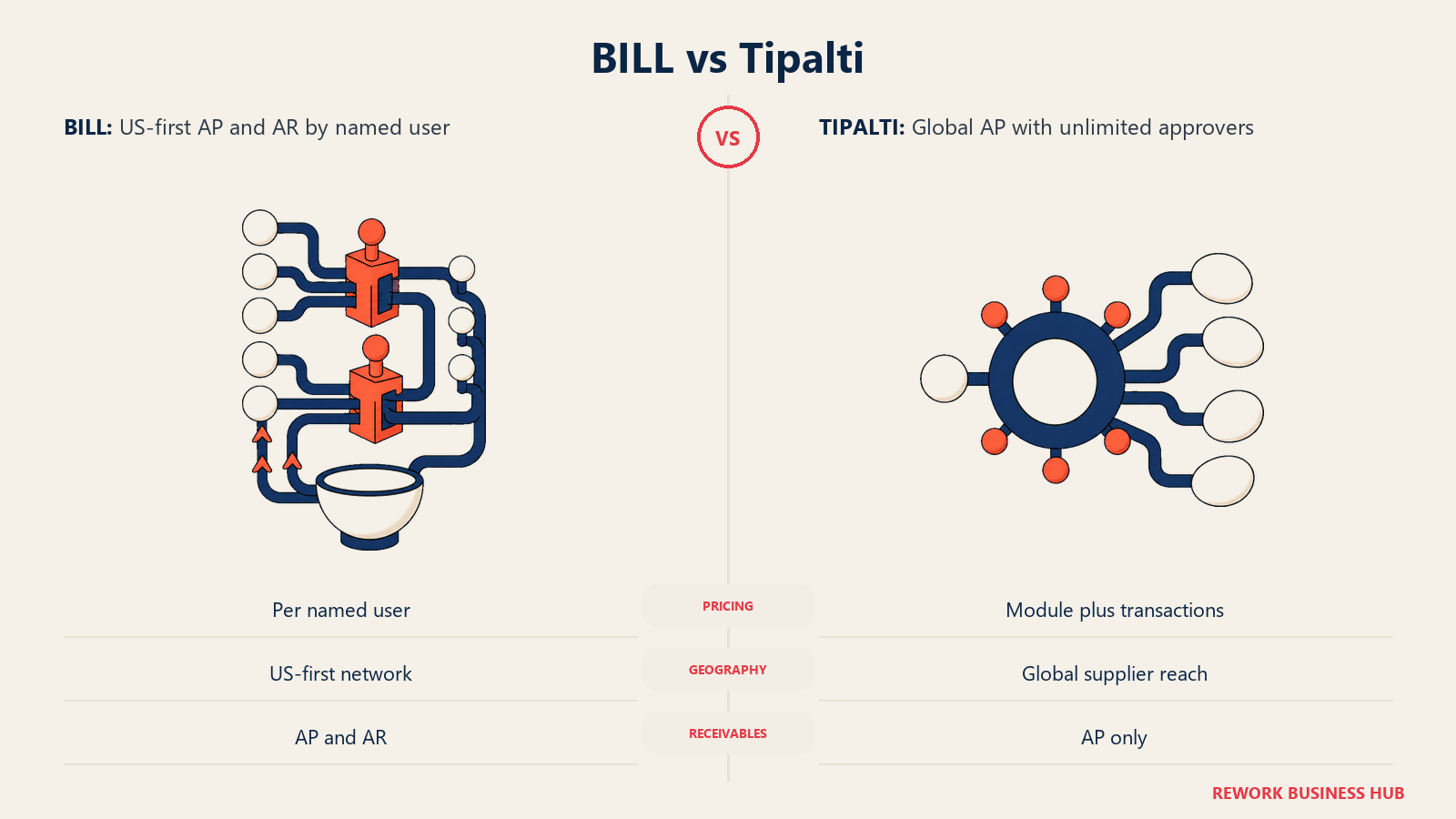
Two axes decide this comparison before a single feature gets compared. The first is pricing: BILL AP/AR charges a fee per user, per month, so every approver, every AP clerk, every controller who needs a login raises the bill, and mid-size teams start rationing seats, which pushes approvals back into email and breaks the audit trail the software was supposed to create. Tipalti charges a flat floor for its Accounts Payable module, unlimited users included, and earns instead on transaction fees and add-on modules. The second axis is geography: BILL is built for US domestic AP and AR, while Tipalti is built for cross-border payouts, supplier onboarding, and tax and compliance collection across dozens of countries. Get the axes right and the rest of this comparison sorts itself into "which one fits your company" rather than "which one has more features." For the wider field of AP tools this cluster covers, start with our best AP automation software roundup.
TL;DR
- Pick BILL if you're a US-based small or mid-size company that wants AP and AR bundled into one subscription. Essentials starts at $49 per user per month, and BILL syncs natively with QuickBooks, Xero, NetSuite, Sage Intacct, and Dynamics 365.
- Pick Tipalti if you pay suppliers, contractors, or creators across many countries and need tax compliance built in. The Accounts Payable module starts at $99 a month with unlimited users, and Tipalti collects W-9 and W-8 forms, runs IRS TIN matching, and generates 1099/1042-S forms automatically.
- BILL's price scales with headcount; Tipalti's does not. Every approver, clerk, or manager who needs a login on BILL adds $49 to $89 a month. Tipalti's unlimited-user floor stays flat no matter how many people touch an invoice.
- The Tipalti floor is not the total bill. Transaction fees apply per invoice and per payment on top of the $99 module price, and Tipalti does not publish that per-transaction rate.
- BILL sells Accounts Receivable; Tipalti does not sell AR at all. If you're trying to replace two tools with one, that gap decides the comparison on its own.
- Neither one is the cheap card-and-expense option. If your actual problem is employee spend and corporate cards rather than vendor bill pay, our Expensify vs Ramp comparison and the best expense management software roundup cover that adjacent category.
Key Facts
Key Facts: The numbers behind this decision
- The average fully loaded cost to process one invoice is $9.84, taking 8.2 days with an 18.4% exception rate, per Ardent Partners' State of ePayables 2025 research (Ardent Partners).
- Best-in-Class AP teams run 79% lower cost per invoice, 79% faster processing, and 47% lower exception rates than their peers (Ardent Partners, State of ePayables 2025).
- 76% of US organizations faced attempted or actual payments fraud in 2025, and checks remain the most targeted method at 58% (2026 AFP Payments Fraud and Control Survey).
- BILL served 479,300 businesses and processed roughly $344.2 billion in total payment volume during fiscal year 2026 (BILL Holdings investor relations).
- Tipalti pays suppliers and payees in more than 200 countries and territories, across 120 currencies, using more than 50 payment methods (Tipalti).
Bill.com vs Tipalti at a Glance
| BILL (AP/AR) | Tipalti | |
|---|---|---|
| What it sells you | Per-user AP and AR software | A flat-fee AP platform with unlimited users |
| Entry price | Essentials, $49 per user per month | Accounts Payable, from $99 per month |
| Top published price | Corporate, $89 per user per month (Enterprise custom) | Mass Payments, from $249 per month |
| Users included | Billed per user; discounted approver-only seats on Corporate/Enterprise, rate not published | Unlimited users on every published tier |
| Where it's strongest | US domestic AP and AR, QuickBooks/Xero-native accounting teams | Cross-border payouts, supplier tax compliance, multi-entity finance |
| Countries paid | 130+ | 200+ countries and territories, 120 currencies |
| Sells AR | Yes, bundled into the AP/AR subscription | No. AP, Mass Payments, Procurement, Expenses, and Treasury only |
| Tax form automation | W-9 collection on every tier | W-9, W-8 series, 1099/1042-S, VAT tax ID collection in 60+ countries |
| Best fit | US small and mid-size businesses wanting AP and AR in one login | Companies paying suppliers, freelancers, or creators across many countries |
| Worst fit | Global payouts to freelancers and suppliers across many currencies | Domestic-only US businesses that also need to invoice customers |
Sources: BILL's pricing page and Tipalti's pricing page.
The Pricing Model Difference That Decides This
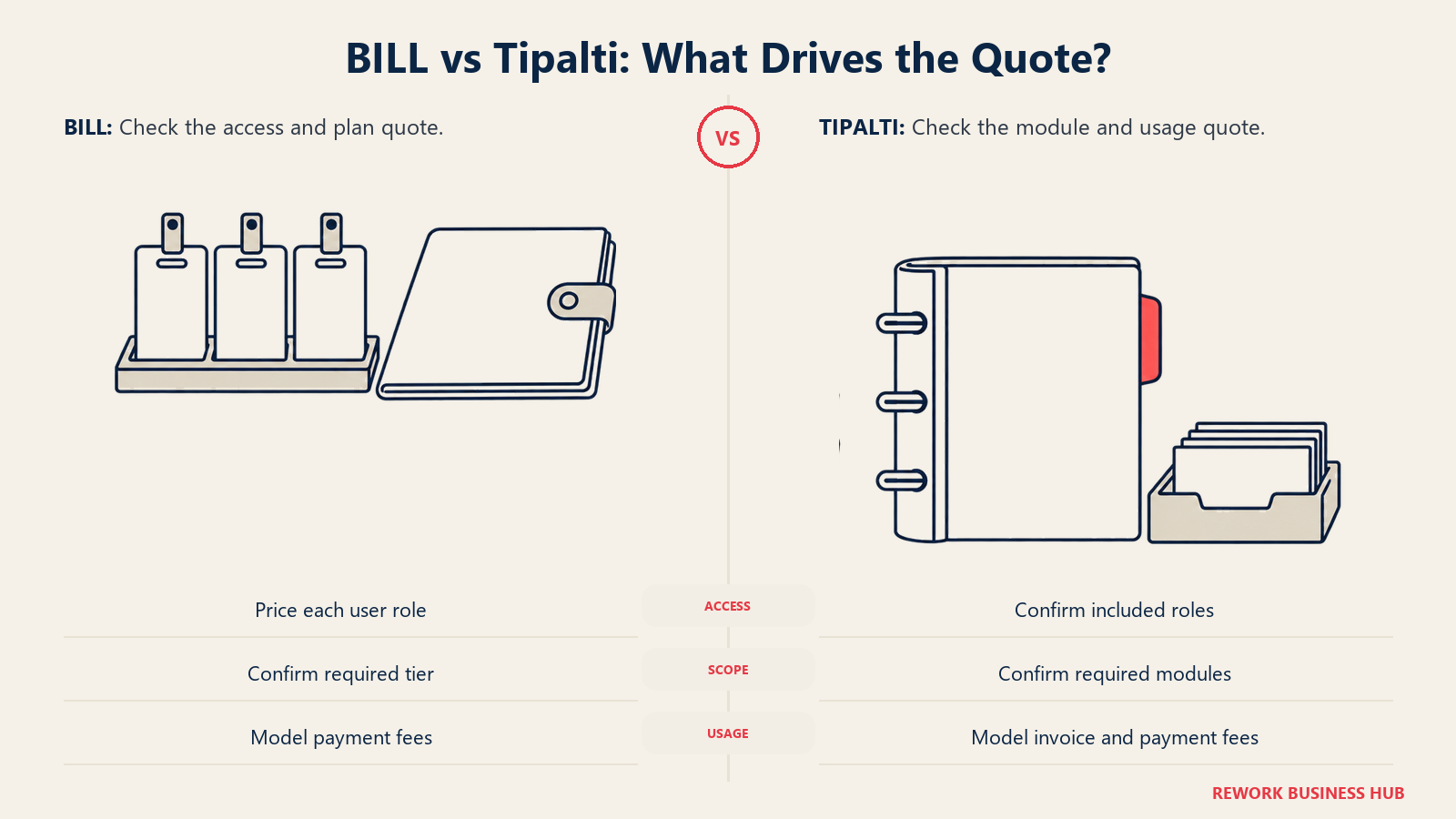
BILL sells access. Every named user who logs in, whether to approve a bill, key in a vendor, or just check on a payment status, sits on a subscription that renews monthly and moves the company to a higher tier as roles get more sophisticated.
| BILL tier | Price | What it adds |
|---|---|---|
| Essentials | $49 per user per month | Manual (CSV) accounting sync, standard approval workflows, six user roles, ACH/virtual card/credit card payments, W-9 collection, invoice coding automation |
| Team | $65 per user per month | Automatic two-way sync with QuickBooks Online, QuickBooks Pro/Premier, and Xero; custom user roles |
| Corporate (Most Popular) | $89 per user per month | Automatic sync adds QuickBooks Enterprise; custom approval policies; purchase orders with two-way matching; AR invoicing automation; discounted approver-only users, rate not published |
| Enterprise | Custom | Adds Oracle NetSuite, Sage Intacct, and Microsoft Dynamics 365 Business Central sync; multi-entity and multi-location accounting; API access; single sign-on; dual control; priority support |
Source: BILL's pricing page.
Notice the "discounted approver-only users" line on Corporate and Enterprise. BILL does recognize that not every login needs full AP/AR access, and it offers a cheaper seat for someone who only approves, but the discount amount isn't published anywhere on the pricing page. Budget for the full per-user rate until your rep gives you a number in writing.
On top of the subscription, BILL charges a fee for every payment method:
| Payment method | Fee |
|---|---|
| Standard ACH | $0.59 per transaction |
| Mailed check | $1.99 |
| Virtual card | Free |
| FX wire or local transfer | Free |
| USD international wire | $19.99 |
| Pay by card | 2.9% |
| Instant payment | 1.0% (minimum $9.99, maximum $100) |
Source: BILL's pricing page.
Tipalti sells a floor, not a seat. The Accounts Payable module starts at $99 a month and includes unlimited users, a self-service supplier portal, and core automation, full stop, whether two people touch invoices or two hundred do (Tipalti's pricing page). Mass Payments, aimed at paying out contractors, creators, and affiliates rather than running a standard AP workflow, starts at $249 a month, also with unlimited users and a payee portal. Procurement, Expenses, and Treasury are separate modules priced on request, and mid-market or enterprise deployments move to custom pricing entirely.
| Tipalti module | Starting price | Users | Extra cost |
|---|---|---|---|
| Accounts Payable | $99/month | Unlimited | Transaction pricing per invoice and per payment |
| Mass Payments | $249/month | Unlimited | Transaction pricing per payment |
| Procurement | Quoted | Unlimited | Quoted |
| Expenses | Quoted | Unlimited | Quoted |
| Treasury | Quoted | Unlimited | Quoted |
Source: Tipalti's pricing page.
That $99 is a floor, not a total, and it is worth repeating every time the number comes up: it buys the Accounts Payable module with unlimited seats, and the transaction fees on top of it are quoted individually rather than published as a flat rate. A company processing a handful of invoices a month and one processing thousands will both see "$99" on the pricing page, and only one of them will actually pay close to that.
The practical result is a mirror image of how Expensify and Ramp split the expense management category: one vendor here monetizes logins, the other monetizes transaction volume. On BILL, what drives your bill is the number of named users, so every added approver costs $49 to $89 a month, forever, and the "seat tax" shows up the moment a department head, project manager, or auditor needs their own login. On Tipalti, what drives your bill is invoice and payment transaction volume plus modules, so adding an approver costs nothing extra, but the real cost hides in a per-invoice and per-payment fee schedule that isn't public. BILL's model favors small teams with few approvers and steady headcount; Tipalti's favors larger or more distributed teams where lots of people need occasional access.
That distinction is the one that actually decides most deals. A 12-person company with two approvers and a controller barely notices BILL's per-seat pricing. A 150-person company where every department head needs to approve their own line items starts multiplying seats fast, which is exactly the scenario the next table works through.
Cost Crossover at 5, 10, 25, 50, and 100 People Who Touch an Invoice
Assumptions: every named user is billed at list price with no negotiated discount, annual totals are 12 times the monthly rate, and BILL's approver-only discount is left out because the rate isn't published. Tipalti's column is the Accounts Payable module list price only, and unlimited users are included at every size, so the number does not move with headcount. Transaction fees per invoice and per payment sit on top of every Tipalti figure below and are excluded, because Tipalti quotes them individually rather than publishing a flat rate.
| People who touch an invoice | BILL Essentials ($49/user/mo) | BILL Team ($65/user/mo) | BILL Corporate ($89/user/mo) | Tipalti AP module (software floor only) |
|---|---|---|---|---|
| 5 | $2,940/year | $3,900/year | $5,340/year | $1,188/year + transaction fees |
| 10 | $5,880/year | $7,800/year | $10,680/year | $1,188/year + transaction fees |
| 25 | $14,700/year | $19,500/year | $26,700/year | $1,188/year + transaction fees |
| 50 | $29,400/year | $39,000/year | $53,400/year | $1,188/year + transaction fees |
| 100 | $58,800/year | $78,000/year | $106,800/year | $1,188/year + transaction fees |
Sources: BILL's pricing page and Tipalti's pricing page. BILL figures are list price with no negotiated discount and no approver-only reduction applied. The Tipalti column is a software floor, not a total: it does not include the per-invoice and per-payment transaction fees Tipalti charges on top, which are quoted per company and not published as a rate card.
Read the shape of the table rather than the exact totals. Tipalti's software line is flat because unlimited users is the entire point of the module. Whether five people or five hundred touch an invoice, the $99-a-month floor doesn't move, only the transaction volume behind it does. BILL's software line is a straight multiplication table: add a person, add $49 to $89 a month, forever. At five people the two vendors are close enough on published software cost that transaction fees and integration depth should decide the purchase. By 25 people, BILL's cheapest tier already costs more than 12 times Tipalti's software floor, and by 100 people the gap on Essentials alone is nearly $58,000 a year, before anyone has paid a single Tipalti transaction fee. The honest reading is that Tipalti's real cost lives in a number this table cannot show you (the transaction fee schedule), while BILL's real cost is sitting right there in the row you just read.
Invoice Capture and Approvals
BILL's approval workflow depth is tied directly to which tier you're on. Essentials ships standard approval policies across six fixed user roles, enough for a small team with one or two levels of sign-off. Team adds custom user roles. Corporate adds custom approval policies, meaning you can build multi-step routing that actually matches your org chart, plus purchase orders with two-way matching for teams buying against a budget. Enterprise adds dual control, a second layer of review that most audit-focused finance teams eventually want (BILL's pricing page).
Tipalti's Accounts Payable module includes core invoice automation and a self-service supplier portal at every published tier, so approval routing and coding automation aren't gated behind a separate subscription the way BILL's custom policies are (Tipalti's pricing page). The tradeoff is that Tipalti's public pricing page doesn't break out approval-workflow depth feature by feature the way BILL's tier table does, so if multi-step, org-chart-matched routing is the deciding factor, get a demo of Tipalti's actual workflow builder before you commit rather than assuming parity from the module description.
| BILL | Tipalti | |
|---|---|---|
| Approval routing on the entry tier | Standard policies, six roles | Included, core automation |
| Multi-step custom routing | Corporate tier and above | Included on the AP module |
| Purchase orders and matching | Corporate tier and above | Part of the separate Procurement module |
| Supplier self-service | Not named as a feature at this depth | Self-service supplier portal on every AP tier |
| Dual control | Enterprise only | Not published as a named feature |
If AI-assisted line-item coding and an invoice-level copilot matter more to your team than global payout reach, it's worth putting Stampli's alternatives on the shortlist too. Stampli built its reputation specifically on invoice-level AI, and its newly launched Deep Finance layer pushes that further into spend intelligence.
Global Payments and Currency Coverage
This is the second axis, and for a lot of buyers it matters more than the pricing model. BILL pays vendors in more than 130 countries, offering Local Transfer (arrives up to four days faster than a wire, often the same business day, with no wire transfer fee) alongside traditional wire and card payments. This capability is scoped to Accounts Payable specifically, not to receiving money from customers (BILL's international payments page). For a US company paying a European contractor or an overseas manufacturing vendor now and then, that's plenty.
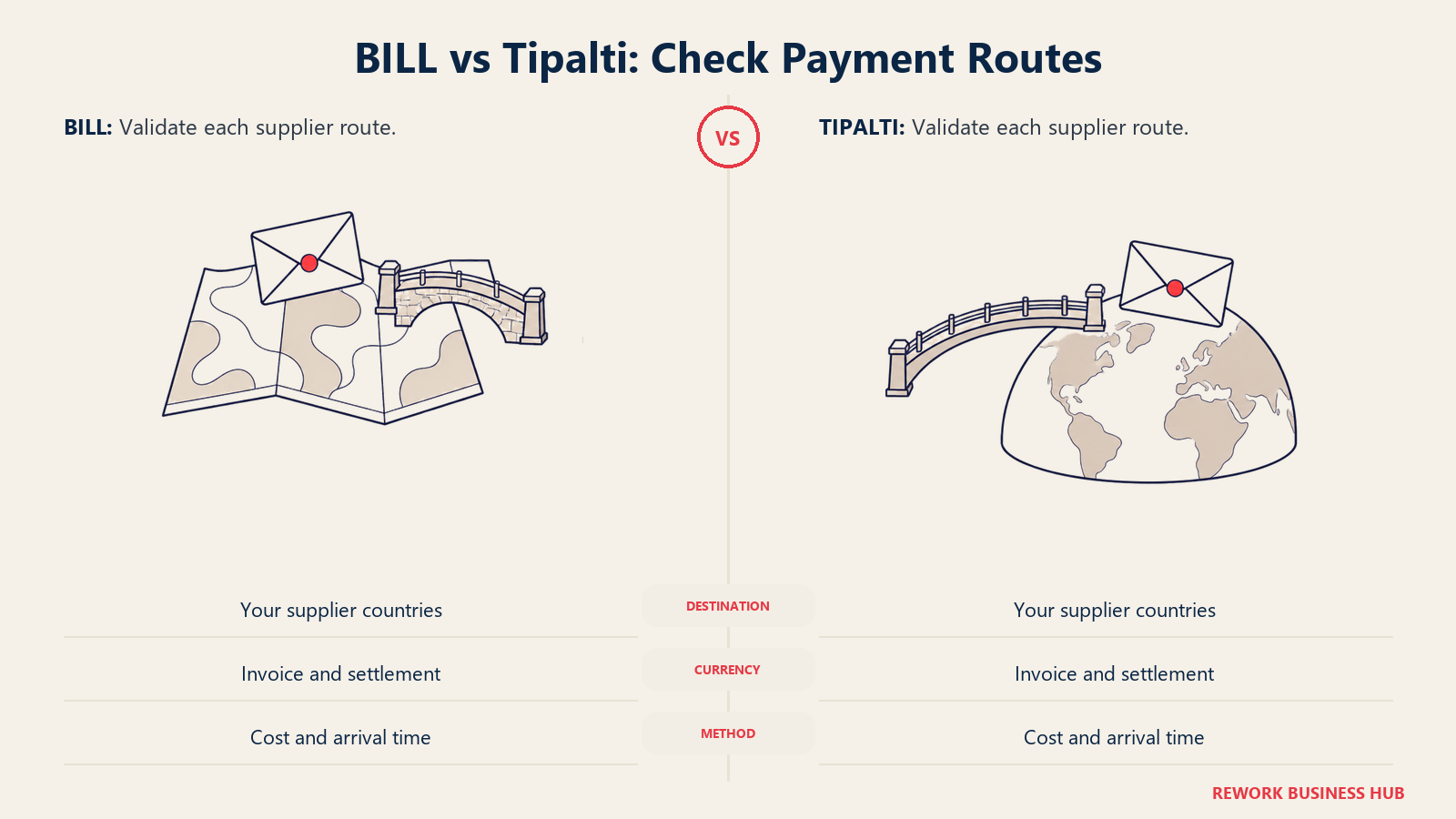
Tipalti was built around the harder version of that problem: paying tens or hundreds of payees around the world on a recurring basis. It schedules payments in 200+ countries and territories, across 120 currencies, using more than 50 payment methods, and applies more than 26,000 rules to catch payment errors before they happen (Tipalti's global payments page). The Accounts Payable module includes Tipalti Card at no extra cost on top of the $99 floor, and the self-service supplier portal that lets payees manage their own banking details and payment preferences cuts down the back-and-forth that normally eats an AP team's week during supplier onboarding.
| BILL | Tipalti | |
|---|---|---|
| Countries paid | 130+ | 200+ countries and territories |
| Currencies | Not published as a specific count | 120 |
| Payment methods | Local Transfer, wire, card | 50+ methods |
| Payment error rules | Not published | 26,000+ rules |
| Scope | Accounts Payable (outbound vendor payments) only | AP and Mass Payments (suppliers, contractors, creators, affiliates) |
| Included card program | Via BILL's own card and virtual card options | Tipalti Card included with the AP module |
Sources: BILL's international payments page and Tipalti's global payments page.
If your company's cross-border need is really about paying a large, dispersed base of freelancers or creators rather than standard trade vendors, look specifically at Tipalti's Mass Payments module (from $249 a month) instead of the AP module, since that's the tier built for payee volume at that scale.
Supplier Onboarding and Tax Forms
Supplier onboarding is where the pricing-model story and the geography story meet, and it's the section where Tipalti's category reputation actually holds up under a fact check.
Tipalti automatically collects the correct tax form from each payee during onboarding based on their country and tax classification, covering W-9 for US payees and the W-8 series (W-8BEN, W-8BEN-E, W-8EXP, W-8IMY, W-8ECI, and Form 8233) for foreign payees. It validates the taxpayer ID against the IRS's TIN-matching service, collects local and VAT tax IDs in more than 60 countries, and generates 1099 and 1042-S forms at year-end along with the associated withholding calculations (Tipalti's tax compliance page). For a finance team that currently chases these forms by email at year-end, that's the difference between a controlled process and a scramble.
BILL's published materials describe W-9 collection and invoice coding automation on every tier, which covers the domestic side of the same job (BILL's pricing page). BILL's own pages don't describe the equivalent W-8 series, 1042-S, or multi-country VAT ID collection that Tipalti runs, which lines up with BILL's broader US-domestic center of gravity. If your supplier base is entirely US-based, that gap doesn't matter. If you're onboarding contractors or vendors in a dozen countries, it does.
| BILL | Tipalti | |
|---|---|---|
| US tax form (W-9) | Yes, on every tier | Yes, collected automatically at onboarding |
| Foreign tax forms (W-8 series) | Not described in published materials | Yes: W-8BEN, W-8BEN-E, W-8EXP, W-8IMY, W-8ECI, Form 8233 |
| IRS TIN matching | Not described in published materials | Yes |
| VAT and local tax ID collection | Not described in published materials | Yes, in 60+ countries |
| Year-end forms | Not described in published materials | 1099 and 1042-S generated automatically |
| Supplier self-service onboarding | Not described at this depth | Self-service supplier portal, part of the AP module |
Sources: Tipalti's automated tax compliance page and BILL's pricing page.
The regulatory backdrop is only getting more demanding. Starting 1 September 2026, every VAT-registered business in France must be able to receive structured e-invoices, with the obligation to issue them starting the same day for large and medium enterprises and 1 September 2027 for small and micro ones (French government business portal). France is not the last country to move this direction. A company with any real supplier footprint in the EU should weight this section more heavily than the sticker price on either platform.
AR and Collections
This section is short because one side of the comparison doesn't exist. Tipalti's product line covers Accounts Payable, Mass Payments, Procurement, Expenses, and Treasury; there is no Accounts Receivable module anywhere in its published pricing (Tipalti's pricing page). Tipalti pays people out. It does not invoice or collect from your customers.
BILL sells AR alongside AP inside the same per-user subscription, with no separate AR price line. The AR side generates and sends invoices, offers a self-service customer portal so buyers can manage their own payment methods, and as of a 2026 product update added Payment Links, which sends a secure link by email or text so a customer can pay by ACH or credit card without logging into anything. BILL also expanded its AR API in 2026 to automate invoice updates, authorize and charge ACH payments programmatically, and push real-time payment and invoice events through webhooks, plus vendor-credit visibility so a team can see when a customer has applied a credit against an invoice (BILL's accounts receivable product page).
| BILL | Tipalti | |
|---|---|---|
| Sells AR | Yes, bundled into the AP/AR subscription | No |
| Invoice generation | Yes | Not applicable |
| Customer self-service portal | Yes | Not applicable |
| Payment Links (email/text pay) | Yes, added 2026 | Not applicable |
| AR API and webhooks | Yes, expanded 2026 | Not applicable |
| Accepts ACH and card from customers | Yes | Not applicable |
Source: BILL's accounts receivable product page.
If you're trying to replace two separate tools (a bill-pay platform and an invoicing platform) with one login, that gap is the whole ballgame: BILL can be that one tool, Tipalti cannot. If you're specifically shopping for AR software rather than AP software, whether standalone or to pair with Tipalti on the payables side, our best accounts receivable software roundup covers the dedicated AR field.
ERP and Accounting Integrations
Both platforms gate their deepest ERP connections behind a higher tier, which is worth knowing before you price out a plan based on the entry-level number.
BILL syncs with QuickBooks Online, QuickBooks Pro and Premier, and Xero automatically starting on the Team tier ($65/user/month); Essentials only offers a manual CSV import. QuickBooks Enterprise support arrives on Corporate ($89/user/month), and Oracle NetSuite, Sage Intacct, and Microsoft Dynamics 365 Business Central are reserved for Enterprise, custom pricing only (BILL's pricing page).
Tipalti's integration list is broader and isn't gated behind a separate tier the way BILL's is: NetSuite, QuickBooks Online and Desktop, Xero, Sage Intacct, Sage 50, Sage 100, Sage 200, Sage 300, Sage X3, Microsoft Dynamics 365 Business Central, Dynamics NAV, Dynamics GP, SAP Business One, SAP Business ByDesign, and Acumatica are all listed as supported ERP and accounting connections (Tipalti's integrations page).
| ERP or accounting system | BILL requires | Tipalti requires |
|---|---|---|
| QuickBooks Online / Xero | Team tier ($65/user/mo) | Included, AP module |
| QuickBooks Enterprise | Corporate tier ($89/user/mo) | Included, AP module |
| NetSuite | Enterprise (custom) | Included, AP module |
| Sage Intacct | Enterprise (custom) | Included, AP module |
| Microsoft Dynamics 365 Business Central | Enterprise (custom) | Included, AP module |
| Sage 50 / 100 / 200 / 300 / X3 | Not listed | Included, AP module |
| SAP Business One / ByDesign, Acumatica | Not listed | Included, AP module |
Sources: BILL's pricing page and Tipalti's integrations page.
For a company already committed to NetSuite or Sage Intacct, that difference alone can decide the purchase: reaching those connections on BILL means jumping straight to a custom Enterprise quote, while Tipalti includes them at the $99 AP-module floor. If your ERP decision is still open, our guides to NetSuite alternatives, QuickBooks alternatives, and Xero alternatives cover the layer underneath this decision.
Implementation and Time to Value
Neither vendor publishes a formal implementation timeline on its pricing page, so treat any specific week count you see elsewhere as an estimate, not a vendor commitment. What's structurally true, and verifiable, is different.
BILL is a self-serve SaaS signup. A company can create an account, connect a bank account, and start entering bills the same day, and BILL's own scale, more than 479,300 businesses served as of the end of fiscal year 2026, is evidence that most customers get through setup without a dedicated implementation team (BILL Holdings investor relations). Moving to a higher tier for deeper ERP sync (NetSuite, Sage Intacct, Dynamics 365) adds real integration work, but that work scopes to the connector, not to the whole platform.
Tipalti's setup carries more moving parts by design, because the product is solving a harder problem: payee tax classification, multi-country banking rails, and, for larger deployments, multi-entity configuration all need to be right before the first payment run. Tipalti's own marketing describes standard implementations as included in the price, with professional services available for complex environments, which is the vendor's own signal that setup effort scales with how complicated your payables actually are (Tipalti's pricing page).
| BILL | Tipalti | |
|---|---|---|
| Self-serve signup | Yes | Yes, for standard setups |
| Same-day first transaction | Realistic for a simple domestic setup | Less likely once supplier tax onboarding and bank rails are involved |
| What adds implementation time | Moving to a higher tier for deeper ERP sync | Multi-entity setup, bank partner onboarding, complex supplier tax scenarios |
| Professional services offered | Not called out separately in published pricing | Explicitly offered for complex implementations |
Sources: BILL's pricing page and Tipalti's pricing page.
The practical rule: if your AP setup is one entity, one country, and a handful of domestic vendors, expect BILL to be faster to stand up. If it's multiple entities, multiple countries, and a supplier base that needs proper tax onboarding, budget real implementation time for Tipalti regardless of which vendor you choose, because that complexity doesn't disappear, it just moves to whichever platform has to absorb it.
When BILL Is the Right Call
BILL is the right call when the underlying business is US-based, domestically focused, and wants AP and AR handled by the same login rather than two separate tools.
- You're invoicing customers and paying vendors, and you want one subscription for both. Tipalti doesn't sell AR at all, so if that's a hard requirement, BILL wins by default.
- Your vendor base is almost entirely US-based, with the occasional international wire. BILL's 130+ country reach and Local Transfer option cover the occasional cross-border payment without requiring the compliance depth Tipalti was built for.
- You already run QuickBooks or Xero and want the lightest possible sync. BILL's Team tier gets you automatic two-way sync at $65 a user, well below what an ERP-grade platform typically costs to stand up.
- You have a small, stable approver group. If only two or three people ever need to log in and approve, BILL's per-user pricing barely registers, and you get a mature, widely deployed product (BILL served over 479,300 businesses in fiscal year 2026) with a straightforward learning curve.
If none of those describe you, particularly if your vendor or payee base is spread across a dozen countries, BILL's per-seat pricing and narrower tax-compliance tooling will start to feel like the wrong shape. For a wider set of AP-focused options built US-first, our best BILL alternatives roundup is the place to keep looking.
When Tipalti Is the Right Call
Tipalti is the right call when the payables problem is global, high-headcount, or tax-form-heavy, and AR was never part of the requirement.
- You pay suppliers, contractors, or creators in a dozen or more countries. 200+ countries and territories, 120 currencies, and automated W-8 and VAT tax ID collection are built for exactly this, not bolted on.
- A lot of people need occasional access to the AP system. Because Tipalti's pricing doesn't scale with user count, a company with 60 people who each approve their own department's invoices a few times a month pays the same $99-a-month floor as a company with five.
- Your finance team is currently chasing W-8 and W-9 forms by email at year-end. Automated collection, IRS TIN matching, and 1099/1042-S generation turn a manual scramble into a controlled process.
- You're on NetSuite or Sage Intacct and don't want to pay for BILL's Enterprise tier to get there. Tipalti includes both at the $99 AP-module floor; BILL gates the same connections behind a custom quote.
If your company doesn't invoice customers through the same platform, or your vendor base is small and entirely domestic, Tipalti's global-payout depth is more platform than you need, and the module-plus-transaction-fee pricing can be harder to forecast than BILL's flat per-seat rate. For alternatives built around the same global-payout and mass-payments use case, see our best Tipalti alternatives roundup.
Decision Framework
Run the two axes from the top of this article back through your own numbers, and the decision usually resolves itself.
| If this describes you | Choose | Because |
|---|---|---|
| You need AP and AR in one login | BILL | Tipalti does not sell an AR product |
| You pay suppliers or payees across many countries | Tipalti | 200+ countries, 120 currencies, and automated tax-form collection built for it |
| You have a small, stable group of approvers | BILL | Per-user pricing barely matters at low headcount |
| Lots of people need occasional AP access | Tipalti | Unlimited users at every published tier; cost doesn't scale with headcount |
| You're US-domestic with occasional international wires | BILL | 130+ country reach covers occasional cross-border payments |
| Your supplier base needs W-8, VAT ID, or 1099/1042-S handling at volume | Tipalti | Purpose-built tax compliance automation |
| You're already on QuickBooks or Xero and want the cheapest sync | BILL | Automatic sync at $65/user/month on Team, well below an ERP-grade platform |
| You're on NetSuite or Sage Intacct and don't want an Enterprise quote to get there | Tipalti | Both included at the $99/month AP floor |
| Your budget process needs a predictable per-seat number | BILL | List price is public and scales linearly |
| Your budget process can absorb a variable, transaction-based cost | Tipalti | Software floor is flat; transaction fees are quoted, not published |
Neither column is a trick question. If you check more boxes in the BILL column, the seat-based pricing model is a fair trade for a bundled AP/AR workflow your US-based team already knows how to use. If you check more boxes in the Tipalti column, the flat module floor and unlimited seats are worth the extra step of getting a real transaction-fee quote before you sign.
Frequently Asked Questions about Bill.com vs Tipalti
What is the difference between BILL and Tipalti pricing?
BILL charges per user, per month: $49 for Essentials, $65 for Team, $89 for Corporate, with Enterprise on a custom quote. Tipalti charges a flat module fee instead of a per-user fee: the Accounts Payable module starts at $99 a month with unlimited users, and Tipalti earns on transaction fees and additional modules rather than seats.
Does BILL Spend & Expense belong in this comparison?
No. BILL Spend & Expense, formerly Divvy, is a separate product priced at $0 per user, focused on corporate cards and employee spend. This comparison covers BILL's AP/AR product, priced at $49 to $89 per user per month, which is the one that actually competes with Tipalti's Accounts Payable module.
Does Tipalti have an accounts receivable product?
No. Tipalti's published product line covers Accounts Payable, Mass Payments, Procurement, Expenses, and Treasury. There is no AR module. BILL sells AP and AR together in the same subscription, which matters if you're trying to replace two separate tools with one.
How many countries can each platform pay vendors in?
BILL supports payments to more than 130 countries through Local Transfer, wire, and card options. Tipalti supports payments in more than 200 countries and territories, across 120 currencies, using more than 50 payment methods, which is why it's the more common choice for companies with a large international supplier or payee base.
Is Tipalti's $99 a month the full cost?
No. The $99 figure is the starting price for the Accounts Payable module and includes unlimited users, but Tipalti also charges transaction fees per invoice and per payment on top, and that rate isn't published. Treat $99 a month as a software floor, not a total monthly cost.
Which platform handles supplier tax forms better?
Tipalti. It automatically collects W-9 forms from US payees and the appropriate W-8 series form from foreign payees based on their country and classification, validates tax IDs against the IRS TIN-matching service, collects VAT and local tax IDs in more than 60 countries, and generates 1099 and 1042-S forms at year-end. BILL's published materials describe W-9 collection but not the same W-8 or multi-country VAT tooling.
Does BILL's per-user pricing include approvers who only approve, not enter bills?
BILL's Corporate and Enterprise tiers do offer a discounted rate for approver-only users, but the discount amount is not published on BILL's pricing page. Ask for that number in writing before you budget headcount growth against the Corporate tier.
Which one is cheaper at 50 people who touch an invoice?
On published software list price alone, Tipalti's Accounts Payable module stays at roughly $1,188 a year regardless of headcount, plus unpublished transaction fees. BILL at 50 users ranges from about $29,400 a year on Essentials to about $53,400 a year on Corporate. The comparison isn't fully settled by those numbers, since Tipalti's transaction fees aren't public, but the software-only gap is large enough that most 50-person deployments should get a real Tipalti quote before assuming BILL is the default choice.
What to Do Next
Before you book a call with either vendor, pull one number from your own books: how many distinct countries did you pay a vendor, contractor, or supplier in over the last twelve months, and how many people currently have, or would need, a login to approve an invoice.
If that country count is one or two and your approver list is short and stable, price out BILL at your actual headcount using the tier table above and treat the number as close to final; BILL's cost is genuinely predictable. If the country count is in the double digits, or you're already spending hours a month chasing W-8 forms and tax IDs by email, get Tipalti's transaction-fee schedule in writing before you compare it to anything, because the $99 floor is not the number that will actually show up on your invoice. And if what actually spurred this search was employee card spend rather than vendor bill pay, our Ramp alternatives and Brex alternatives roundups are the better starting point. If you find yourself needing both a bundled AP/AR workflow and serious global payout depth, that's a legitimate reason to shortlist a third vendor rather than force either of these two into a shape it wasn't built for. Our best AP automation software roundup is the place to keep that search going.

Principal Product Marketing Strategist
On this page
- TL;DR
- Key Facts
- Bill.com vs Tipalti at a Glance
- The Pricing Model Difference That Decides This
- Cost Crossover at 5, 10, 25, 50, and 100 People Who Touch an Invoice
- Invoice Capture and Approvals
- Global Payments and Currency Coverage
- Supplier Onboarding and Tax Forms
- AR and Collections
- ERP and Accounting Integrations
- Implementation and Time to Value
- When BILL Is the Right Call
- When Tipalti Is the Right Call
- Decision Framework
- What to Do Next