Best Smartlead Alternatives in 2026: 14 Sales Engagement Tools for Cold Email and Outbound Teams
Turn this article into takeaways for your work.


Each assistant summarizes the article only for you and suggests best practices for your work.
Smartlead earned its reputation the straightforward way: agencies running cold email for a dozen client brands needed inbox rotation and white-label dashboards that don't fall over at volume, and Smartlead built exactly that. Unlimited mailboxes on every tier, a warmup engine tuned for deliverability at scale, and pricing that tracks sending volume rather than seat count make it a strong default for that specific job. This guide compares 14 alternatives on pricing model, channel depth, and real fit.
But Smartlead is an email-only tool, and that scope is exactly where teams start looking elsewhere. There's no LinkedIn step, no calling, and no real CRM pipeline beyond basic reply tracking, so a team running true multichannel outbound or wanting deal stages next to send activity ends up bolting on a second tool anyway. The advertised entry price also understates production cost once dedicated domains, the Warmup Pool add-on, and verified-prospect credits get added at real volume. If one of those gaps is why you're reading this, the 14 tools below cover the field: agency-grade sending infrastructure, multichannel personalization, prospecting-plus-sequencing platforms, and the enterprise tier, each with real pricing and an honest read on fit.
Key Facts
- Sales reps spend 60% of their time on non-selling tasks like data entry and internal approvals, per Salesforce's State of Sales research, which is a big part of why outbound platforms now compete on how much manual work they remove, not just on send volume (Salesforce).
- The average B2B cold email reply rate was 0.45% across 7.5 million emails analyzed in 2025, measured strictly as replies divided by emails sent rather than emails opened, per Belkins' cold email benchmark study (Belkins).
- Multichannel sequences combining LinkedIn, email, and calling generated roughly 21 meetings per 1,000 prospects contacted, compared with about 4 for LinkedIn outreach alone, across more than 1,800 campaigns reviewed in SmartReach.io's State of LinkedIn Outreach 2026 report (SmartReach.io).
- 67% of B2B buyers now prefer a sales-rep-free buying experience, according to a Gartner sales survey published in March 2026, one reason precision-targeted sequences beat raw sending volume once a list is small and warm (Gartner).
- Sellers use an average of 8 different tools to close a single deal, and the 42% who feel overwhelmed by tool sprawl are 45% less likely to hit quota, per Salesforce's State of Sales statistics, the same tool-fatigue problem pushing teams to consolidate sequencing and CRM into fewer platforms (Salesforce).
Quick Comparison Table
| Tool | Best For | Starting Price | Key Strength | Key Limitation |
|---|---|---|---|---|
| Instantly | High-volume agencies rotating across many domains | $37.60/month (annual) | Unlimited mailboxes, bundled CRM and leads option | No native multichannel; bundle plans needed for CRM |
| Saleshandy | Unlimited email accounts at the lowest entry price | $34/month (annual) | 852M+ contact database bundled in | Email infrastructure add-ons compound at scale |
| Lemlist | Multichannel personalization without enterprise pricing | $55/month (annual, Email plan) | Image and video personalization; 650M+ lead database included | Multichannel plan priced per seat, 5 senders/user |
| Reply.io | Multichannel plus a dedicated AI SDR product line | $49/month (annual, Email Volume) | Email, LinkedIn, calling, and a full AI SDR service | AI SDR is now a $500+/month tier, not a cheap add-on |
| La Growth Machine | LinkedIn-first multichannel for small teams and agencies | €60/month per identity | LinkedIn, email, and calls under one per-identity price | Per-identity pricing multiplies fast past a few users |
| Apollo.io | Teams that also need a prospecting database | $49/seat/month (annual) | 275M+ contact database plus sequencing in one login | Credit system limits scale for phone-heavy teams |
| Amplemarket | AI-native prospecting, sequencing, and dialing together | $600/month (annual, 2 seats) | Intent signals plus multichannel sequencing and a dialer | Entry tier priced as a team package, not a per-seat trial |
| Clay | Enrichment-first workflow automation feeding any sender | $167/month (Launch) | Waterfall enrichment across dozens of data providers | Not a sending tool; pairs with a separate sequencer |
| Klenty | CRM-native cadences with a dialer included | $50/user/month (annual) | Bidirectional CRM sync; dialer bundled from Growth up | Smaller ecosystem than Outreach or Salesloft |
| Woodpecker | Paying only for prospects you actually contact | $7 per 100 contacted prospects/month | Unlimited team members and mailboxes included free | No flat tier; real cost depends on the volume slider |
| QuickMail | Per-campaign pricing with zero per-seat charges | $49/month | Unlimited senders and users on every plan | No longer the budget option it once was |
| Mailshake | Month-to-month flexibility with no annual contract required | $25/month (annual) | Simple setup; dialer on the Sales Engagement tier | Lighter automation than Lemlist or Apollo |
| Outreach | Enterprise SDR orgs needing workflow governance | Custom (contact sales) | Deepest workflow automation, AI-credit-based tiers | No published pricing; consumption-based AI credits add complexity |
| Salesloft | Mid-market teams with complex, forecasted deal cycles | Custom (contact sales) | Mature cadence analytics and conversation intelligence | No published pricing; Clari-driven packaging still settling |
1. Instantly: The Direct Volume Competitor With a Bundled CRM Option
Instantly runs the same volume-first playbook as Smartlead, and the two genuinely compete for the same buyer: unlimited connected mailboxes on every paid tier, native warmup, and pricing that scales with contacts and emails sent rather than seats. A 1-person team and a 20-person team pay the same price on the same tier if they're sending similar volume, so the "what's your billing meter" question that matters most in this category resolves the same way for both tools.

Where Instantly differs is what it bundles beyond sending. Newer combined Starter, Scale, and Agency plans fold a 450M+ lead database and a light CRM into a single monthly price, so a team outgrowing Smartlead's email-only scope can add prospecting and a basic pipeline without leaving the platform. Smartlead, by comparison, caps its own CRM access to basic reply tracking even on its top tier.
The honest caveat: Instantly's bundled CRM still isn't a real deal-tracking system, and teams needing pipeline stages, forecasting, or account records will end up syncing to a dedicated CRM regardless. And like Smartlead, there's no LinkedIn or calling step natively.
| What you get | What you don't |
|---|---|
| Unlimited mailboxes on every paid tier, same as Smartlead | No native LinkedIn or calling steps |
| Bundled lead database and light CRM on Starter/Scale/Agency plans | Bundled CRM still isn't a real pipeline-tracking system |
| Pricing scales with volume, not headcount | Enterprise tier is custom-quoted only |
| AI Sales Agent and AI Reply Agent on bundle plans | Outreach-only and bundle plans are priced and structured separately |
Pricing: Growth $47/month billed monthly, $37.60/month billed annually (5,000 emails/month, 1,000 contacts). Hypergrowth $97/month monthly, $77.60/month annually (125,000 emails/month, 25,000 contacts). Lightspeed $358/month monthly, $286.30/month annually (500,000 emails/month, 100,000 contacts). Unlimited mailboxes on every tier. See instantly.ai/pricing.
Best for: Agencies and high-volume senders who want Smartlead's rotation-and-warmup model but with the option to add a lead database and a basic CRM under one subscription.
2. Saleshandy: Unlimited Email Accounts at the Lowest Entry Price
Saleshandy competes on the same "unlimited email accounts" pitch as Smartlead, but undercuts it on entry price. The Starter plan covers 2,000 active prospects and 6,000 emails a month with unlimited connected mailboxes, and every tier bundles an 852M+ contact and 42M+ company database that Smartlead doesn't offer without a separate tool.
The billing meter is active prospects plus emails sent, the same shape as Smartlead's active-leads model, so scaling from Starter to Pro to Scale is a volume decision, not a seat decision. The Pro tier's 10 included users at $76/month annual is a real difference from Smartlead, which doesn't publish a seat count at all because its plans aren't seat-gated.
The honest caveat, and the one that trips up teams shopping on the advertised entry price: mailbox infrastructure bills separately, at roughly $3 to $3.50 per mailbox per month on annual billing. A 10-mailbox rotation setup adds $30 to $35 a month on top of the plan price before a single email goes out, and lead-finder credits beyond the included allotment cost extra too.
| What you get | What you don't |
|---|---|
| Unlimited email accounts on every plan, matching Smartlead | Mailbox infrastructure billed separately ($3 to $3.50/mailbox/month) |
| 852M+ contact database bundled at every tier | Lead-finder credits beyond the monthly allotment cost extra |
| 10 users included on Pro; unlimited on Scale | No agency whitelabeling comparable to Smartlead's Pro tier |
| Waterfall enrichment across multiple data providers | Real cost at production volume adds up past the headline price |
Pricing: Starter $41/month billed monthly, $34/month billed annually (2,000 prospects, 6,000 emails/month, 1 user). Pro $99/month monthly, $76/month annually (30,000 prospects, 100,000 emails/month, 10 users). Scale $189/month monthly, $149/month annually (unlimited prospects, 200,000 emails/month, unlimited users). See saleshandy.com/pricing.
Best for: Teams that want Smartlead's unlimited-mailbox model plus a built-in contact database, and are willing to price mailbox infrastructure separately before comparing headline numbers.
3. Lemlist: Multichannel Personalization Smartlead Doesn't Attempt
Lemlist is the most direct answer to Smartlead's biggest limitation: it runs email, LinkedIn, and calling in one sequence builder, with conditional logic (if no reply on email step 2, switch to LinkedIn touch 1) that a non-technical rep can set up without a workflow diagram. Image and video personalization, dynamic per-recipient variables that render as an actual custom graphic, is a feature Smartlead has never built and isn't likely to, since it competes on infrastructure rather than personalization.
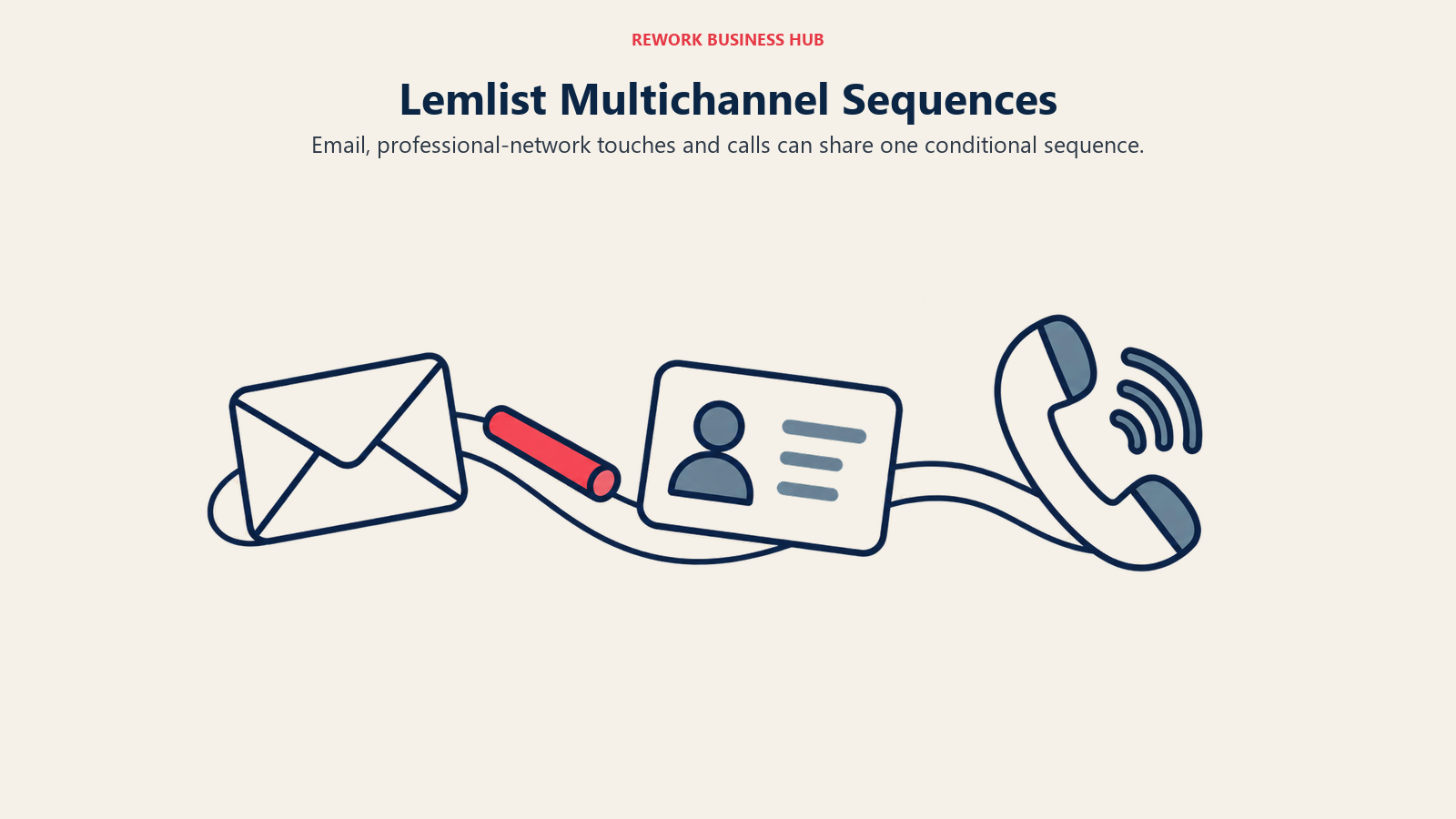
The billing meter differs by plan. The Email plan is a flat rate covering unlimited users, so team size doesn't move the price, similar to how it doesn't for Smartlead. But the Multichannel plan switches to per-user pricing with a 5-sending-address-per-user cap, which is where a team scaling past a handful of reps needs to run the math before assuming Lemlist stays cheaper.
The honest caveat: Lemlist's 650 million-plus lead database is bundled into the Email plan, but it's a research and list-building tool, not the deliverability-tuned sending infrastructure Smartlead built its name on. Teams sending at real agency volume across many domains will still find Smartlead's warmup and rotation more mature.
| What you get | What you don't |
|---|---|
| Email, LinkedIn, and calling in one sequence builder | Multichannel plan is priced per seat, unlike Smartlead |
| Conditional sequencing accessible to non-technical reps | 5 sending addresses per user cap on Multichannel |
| 650M+ lead database included on the Email plan | Sending infrastructure less mature than Smartlead at agency scale |
| Image and video personalization Smartlead doesn't offer | Not built for 10,000+ contact-per-week volumes |
Pricing: Email plan $69/month billed monthly, $55/month billed annually (unlimited users, 50,000 emails/month). Multichannel plan $109/user/month monthly, $87/user/month annually (5 sending addresses per user). Enterprise custom, 5+ user minimum. See lemlist.com/pricing.
Best for: Teams of 3 to 30 that want personalized, multichannel sequences and are willing to trade some of Smartlead's raw sending scale for reply rate.
Check the best Lemlist alternatives guide for the wider field around Lemlist itself.
4. Reply.io: Multichannel Plus a Dedicated AI SDR Product Line
Reply.io's pitch is breadth: email, LinkedIn, calling, and a full "hire an AI SDR" product line, all under one vendor. Where Smartlead stays deliberately narrow (send email well, rotate inboxes, look clean to agencies' clients), Reply.io tries to cover the entire top-of-funnel motion, including autonomous outreach handled by its AI agent, Jason.
The pricing structure changed meaningfully in 2026. The Email Volume plan is contact-based and covers unlimited users, a shape similar to Smartlead's active-leads meter. The Multichannel plan moves to per-user pricing and bundles LinkedIn, calling, SMS, and WhatsApp into a single per-seat rate rather than charging separate fees per channel. Jason AI SDR is no longer a cheap per-seat toggle: it's now sold as its own tiered service (Starter, Growth, Enterprise), positioned as a managed outbound function rather than a feature bolted onto a seat license.
The honest caveat: that AI SDR repositioning means teams evaluating Reply.io mainly for "AI-assisted sending near Smartlead's price point" will find the AI layer costs meaningfully more than it used to, and the core Multichannel plan is still a per-seat cost that scales with headcount in a way Smartlead's active-lead pricing doesn't.
| What you get | What you don't |
|---|---|
| Email, LinkedIn, calling, and SMS bundled on Multichannel | Multichannel bills per seat, unlike Smartlead's active-lead model |
| A dedicated AI SDR service (Jason) for full outreach delegation | AI SDR now starts near $500/month, not a cheap per-seat add-on |
| Contact-based Email Volume plan covers unlimited users | Real per-seat cost still climbs with headcount on Multichannel |
| Agency plan for multi-client management | No inbox-rotation infrastructure as mature as Smartlead's |
Pricing: Email Volume from $59/month billed monthly, from $49/month billed annually, scaling with contact volume. Multichannel from $99/user/month monthly, $89/user/month annually. AI SDR Starter from $800/month billed monthly, from $500/month billed annually, scaling to Growth and Enterprise tiers. Agency plans from $166/month. See reply.io/pricing.
Best for: Teams that want true multichannel sequencing without per-channel add-on fees, and that are evaluating a managed AI SDR service as its own line item rather than a cheap extra.
Check the best Reply.io alternatives guide for the rest of that field.
5. La Growth Machine: LinkedIn-First Multichannel for Small Teams and Agencies
La Growth Machine flips the channel priority Smartlead and most email-first tools default to: LinkedIn is the primary channel, with email, calling, and (on the top tier) X included around it. For a founder-led or small agency team selling into a market where buyers live on LinkedIn more than in their inbox, that's a genuinely different starting point than Smartlead's email-only design.
The billing meter is per identity, meaning per connected sending profile, priced in euros. That sits between Smartlead's mailbox-based thinking and Lemlist's per-seat model: each identity gets its own lead-enrichment allotment and sending capacity, and a team adds identities as it adds reps or campaigns rather than paying for total email volume the way Smartlead's active-lead tiers do.
The honest caveat: per-identity pricing means a 10-person team running 10 identities pays meaningfully more than a Smartlead or Saleshandy setup at similar headcount, since neither of those charges per seat at all. And La Growth Machine's core strength, LinkedIn automation depth, isn't something Smartlead users are usually looking to add; the two tools serve different primary channels.
| What you get | What you don't |
|---|---|
| LinkedIn, email, and calls built around LinkedIn as the lead channel | Per-identity pricing multiplies fast for larger teams |
| Lead enrichment included per identity every month | No agency-scale inbox rotation like Smartlead's |
| Annual billing includes 2 months free on every tier | Pricing in euros; the highest tier price matches the mid tier |
| Agency plan available for lead-gen agencies | 6-identity minimum on the Agency plan |
Pricing: Basic €60/month per identity (up to 3 identities, LinkedIn plus email, 250 leads enriched/month). Pro €120/month per identity (adds calls, unlimited identities, 400 leads enriched/month). Ultimate €120/month per identity (adds X, 1,000 leads enriched/month). See lagrowthmachine.com/pricing.
Best for: Small teams and agencies whose buyers respond better on LinkedIn than in a cold inbox, wanting calling and email layered around that without Reply.io's or Lemlist's per-seat structure.
6. Apollo.io: A Prospecting Database Smartlead Doesn't Have
Apollo's core advantage over Smartlead isn't sending infrastructure, it's the 275 million-plus contact database wired directly into its sequencing tool. Where Smartlead requires bringing your own list or pairing with a separate data vendor, Apollo lets you build a list, verify it, and push it into a sequence from one screen. For a Smartlead user already paying ZoomInfo or a lead-database tool separately, that consolidation often nets out cheaper.

The billing meter is per seat plus a credit system layered on top for data access (email, mobile, and export credits). That's a different shape from Smartlead's active-leads-and-sends model: a 10-person team on Apollo pays for 10 seats regardless of sending volume, while the same team on Smartlead pays based on how many leads and emails it's actually pushing.
The honest caveat: Apollo's engagement features, inbox rotation, warmup depth, and deliverability tooling are less mature than Smartlead's for sending at real agency volume across many domains. Teams whose primary need is raw sending scale rather than prospecting will still find Smartlead the more purpose-built tool for that job.
| What you get | What you don't |
|---|---|
| 275M+ contact database wired directly into sequencing | Credit system can get expensive for phone-heavy teams |
| Free plan available for initial testing | Inbox rotation and warmup less mature than Smartlead |
| CRM sync on the Professional tier | Per-seat pricing regardless of actual sending volume |
| Prospecting, enrichment, and sequencing in one subscription | Monthly billing rates not published; annual is the default |
Pricing: Free plan with 900 credits per seat per year. Starter $49/seat/month billed annually. Professional $79/seat/month billed annually. Enterprise $119/seat/month billed annually, 3-seat minimum. See apollo.io/pricing.
Best for: Teams that want to prospect, verify, and sequence from one subscription, especially if they're currently paying a separate data vendor alongside Smartlead or another sender.
Check the best Apollo alternatives guide for the wider field around Apollo itself.
7. Amplemarket: AI-Native Prospecting, Sequencing, and Dialing in One Platform
Amplemarket sits further up the stack than Smartlead: instead of competing on sending infrastructure alone, it bundles AI-driven intent signals, multichannel sequencing, and a dialer (branded Duo Voice and Duo Copilot) into one platform aimed at teams that want AI doing more of the qualification work before a rep ever sends a message.
The billing meter is a team package rather than a per-seat or per-lead price: the Startup plan includes 2 users and 27,000 contacts for one flat monthly price, with email and phone credits allocated per user per year rather than metered per send the way Smartlead counts active leads. That package structure means a 2-person team pays the full package price even if actual sending volume is closer to what Smartlead's Base tier covers for a fraction of the cost.
The honest caveat: Amplemarket's entry price is a real step up from Smartlead's, and it's built for teams that want the AI-signal and dialer layer, not for a team whose only need is high-volume cold-email rotation. Growth and Elite tiers are custom-quoted, which makes upfront budgeting harder than Smartlead's fully published tiers.
| What you get | What you don't |
|---|---|
| AI intent signals plus multichannel sequencing and a dialer in one platform | Entry price is a real step up from Smartlead's tiers |
| 2 seats included on Startup with allocated email and phone credits | Growth and Elite tiers are custom-quoted, not published |
| Duo Copilot AI assistance built into the sequencing workflow | Priced as a team package, not a flexible per-seat trial |
| Designed for teams past the pure cold-email-infrastructure stage | Overkill if raw sending scale is the only requirement |
Pricing: Startup $600/month billed annually (2 users included, 27,000 contacts, 13,500 email credits and 600 phone credits per user per year). Growth and Elite custom-quoted, scaling to 4 and 10 included users respectively. See amplemarket.com/pricing.
Best for: Funded sales teams that want AI intent signals and a dialer bundled with sequencing, and have outgrown pure cold-email infrastructure as their main constraint.
8. Clay: Enrichment-First Workflow Automation That Feeds Any Sender
Clay isn't a sending tool at all, and that's the point for teams whose real Smartlead frustration is the list, not the sending. It's a workflow-automation platform for enriching and qualifying leads across dozens of data providers, using waterfall enrichment that tries providers in sequence until one returns a match, before those leads ever reach a sequencer like Smartlead, Instantly, or Lemlist.
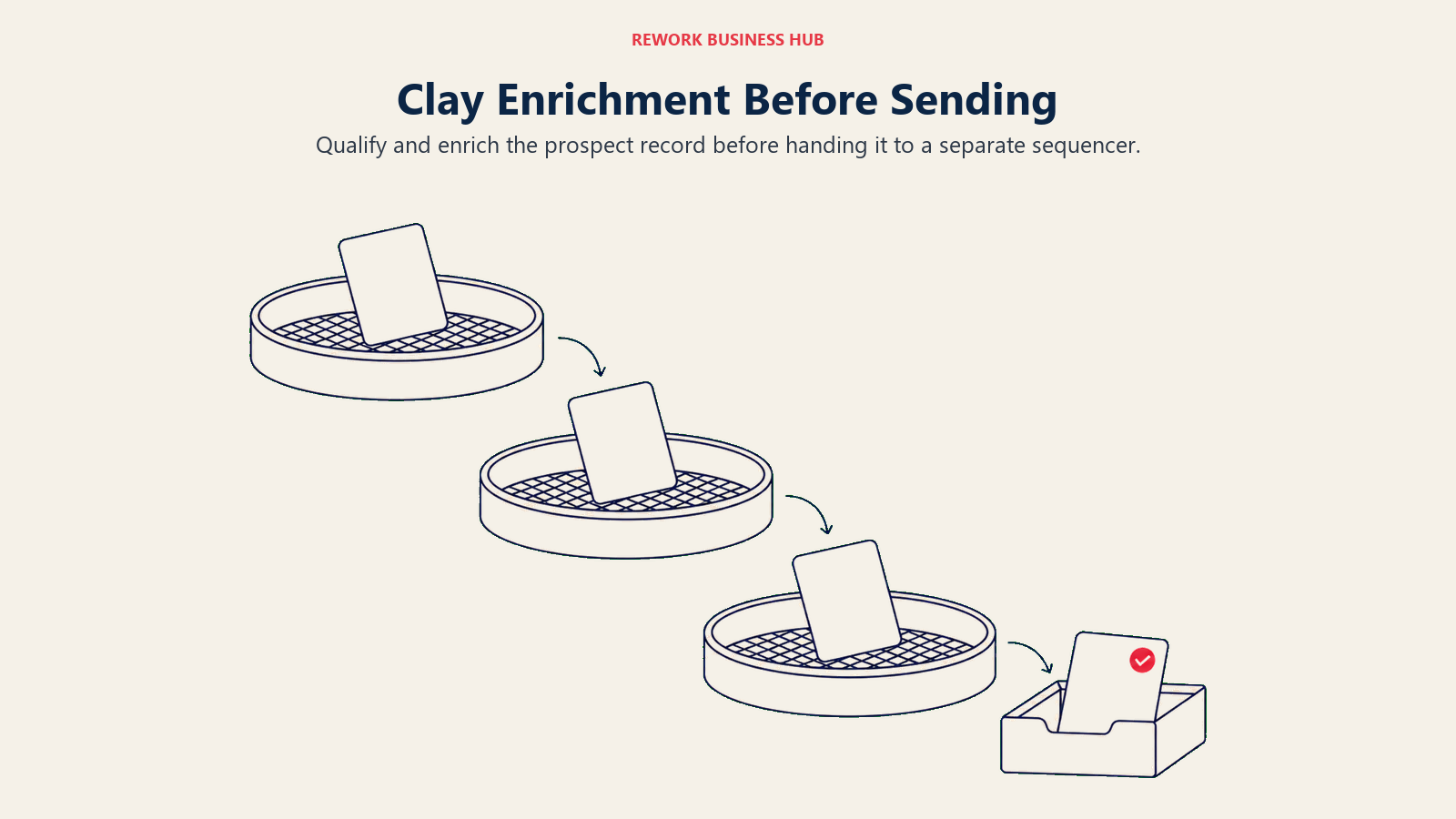
The billing meter is actions and data credits, not seats, mailboxes, or sends. Every plan includes unlimited seats and workspaces, so a 10-person team pays the same as a 2-person team at a given actions tier, a genuinely different model from every other tool on this list. Teams typically pair Clay with a separate sending tool rather than replacing one with the other.
The honest caveat: Clay solves a real problem, thin or stale prospect data, but it adds a second subscription and a learning curve on top of whatever actually sends the email. A team with clean lists whose real gap is sending infrastructure won't get much from adding Clay; it's the right fix specifically when personalization and data quality, not volume, are the bottleneck.
| What you get | What you don't |
|---|---|
| Unlimited seats and workspaces at every tier | Not a sending tool; pairs with Smartlead or another sequencer |
| Waterfall enrichment across dozens of data providers | Learning curve for building enrichment workflows |
| CRM auto-sync and web intent tracking on Growth | Credit top-ups at premium rates once limits are exceeded |
| Billing scales with actions, not headcount | Enterprise requires an annual commitment |
Pricing: Free plan with 500 actions and 100 data credits per month, unlimited seats. Launch from $167/month, billed monthly or annually (10% savings), 15,000 actions and 3,000 data credits per month. Growth from $446/month, 40,000 actions and 6,000 data credits per month. Enterprise custom, annual commitment required. See clay.com/pricing.
Best for: Teams whose Smartlead results are limited by list quality rather than sending volume, wanting enrichment logic they can rebuild without an engineer.
9. Klenty: CRM-Native Cadences With a Dialer Included
Klenty's design premise is that outbound sequences should live inside CRM workflows, not next to them. Bidirectional sync with Salesforce, HubSpot, Pipedrive, and Zoho updates contact records, deal stages, and activity logs as prospects move through cadences, closing the exact gap Smartlead leaves open, since Smartlead has no CRM pipeline beyond basic reply tracking.
The billing meter is per seat, priced by plan tier rather than by sends or active leads. The Growth plan bundles a dialer at no additional add-on fee, a material difference from Reply.io, which charges separately for calling, and from Smartlead, which doesn't offer calling at all.
The honest caveat: Klenty's ecosystem and third-party integration library are smaller than Outreach's or Salesloft's, and it doesn't attempt Smartlead's inbox-rotation-at-scale model. A cold-email agency rotating across 50-plus sending domains for multiple clients will find Klenty under-built for that job; it's aimed at a single team's outbound-to-pipeline visibility, not multi-client volume.
| What you get | What you don't |
|---|---|
| Bidirectional CRM sync with Salesforce, HubSpot, Pipedrive, Zoho | Smaller integration ecosystem than Outreach or Salesloft |
| Dialer included at the Growth tier, no add-on fee | No high-volume inbox rotation like Smartlead or Instantly |
| AI cadence features (objection detection, call scorecards) on Plus | Not built for multi-client agency cold-email volume |
| Per-seat pricing scales predictably with headcount | Monthly billing rates not separately published |
Pricing: Starter $50/user/month billed annually (email only). Growth $70/user/month billed annually (multichannel with dialer, 200 minutes included). Plus $99/user/month billed annually (AI coaching, 1,000 minutes included). Parallel and power dialer add-on $45/user/month. See klenty.com/sales-engagement-platform/pricing.
Best for: Teams of 10 to 100 with a defined CRM that need outbound cadences to sync cleanly with pipeline records and want a dialer without a separate add-on fee.
10. Woodpecker: Pay Only for the Prospects You Actually Contact
Woodpecker rebuilt its pricing around a genuinely different meter: contacted prospects, not seats, sends, or mailboxes. A team sets a monthly volume of people it plans to contact, and the platform charges per 100 contacted prospects at that tier, with the per-unit rate dropping as volume increases. Contacting the same person twice inside one campaign counts once toward the limit; a second campaign to the same person counts again.
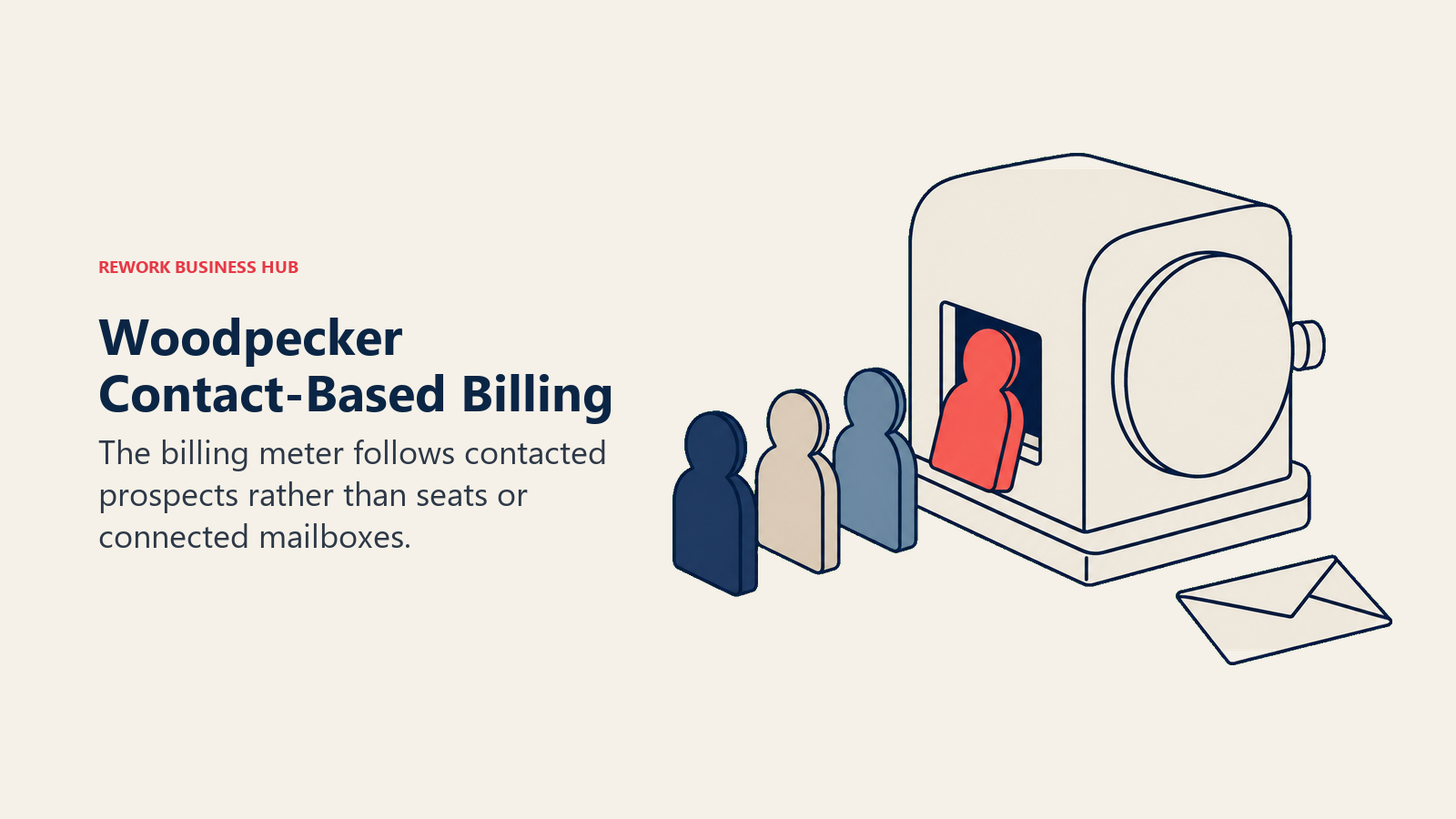
That's a meaningfully different bet than Smartlead's active-leads-and-sends model. A team running lower-volume, highly targeted outreach can end up paying less on Woodpecker's per-contact meter than on Smartlead's tiered active-lead brackets, because Woodpecker doesn't require jumping to the next full tier just to cover a marginal increase in volume. Unlimited team members and unlimited connected email accounts are included free at every volume level, matching Smartlead's unlimited-mailbox positioning without a separate seat cost.
The honest caveat: because pricing is a slider rather than named tiers, Woodpecker is harder to quote at a glance than Smartlead's four flat plans, and the entry cost for a small monthly volume, roughly $35/month for 500 contacted prospects on monthly billing, climbs quickly once a team scales toward Smartlead's mid-tier volume.
| What you get | What you don't |
|---|---|
| Unlimited team members and unlimited email accounts, free | No flat named tiers; pricing is a volume slider |
| Per-contacted-prospect billing instead of a fixed volume bracket | Harder to quote at a glance than Smartlead's four plans |
| Volume discounts as contacted-prospect count scales up | Cost climbs quickly once volume approaches Smartlead's mid tiers |
| Catch-all email verification included at no extra cost | Multichannel features lighter than Lemlist or Reply.io |
Pricing: $7.00 per 100 contacted prospects per month on monthly billing, with the per-unit rate discounted at higher volume tiers; annual billing cuts the rate by 33%. LinkedIn outreach add-on $29/month per connected account. Dedicated servers $59/month each. See woodpecker.co/pricing.
Best for: Smaller teams running targeted, lower-volume outreach who want to pay for actual contact volume rather than committing to a fixed tier that assumes more sending than they do.
11. QuickMail: No Per-Seat Charges on Any Plan
QuickMail's core pitch hasn't changed even as its pricing has: no per-seat charges on any tier, so a 5-person team shares one subscription rather than paying five times a per-seat fee. Unlimited email senders, unlimited LinkedIn-connected accounts, and unlimited users are included starting on the entry plan, a genuinely different structure from Smartlead's active-leads meter, and closer in spirit to Woodpecker's "the team doesn't drive the price" philosophy, just built around a flat monthly tier instead of a volume slider.

The tiers scale by sending volume and contact count instead: the Starter plan covers 5,000 emails and 1,000 uploaded contacts a month, and the Agency plan raises that to 500,000 emails and 100,000 contacts with 2 workspaces for running separate client campaigns, extra workspaces available at $49 each.
The honest caveat: QuickMail's entry price has moved up from the budget position it used to hold in this category, so teams shopping specifically for the lowest possible starting number will find Smartlead's Base tier and Saleshandy's Starter tier both currently priced below QuickMail's Starter plan. The deliverability tooling (native warmup, spam-check previews, bounce handling) is solid but doesn't match Smartlead's dedicated inbox-rotation infrastructure at real agency volume.
| What you get | What you don't |
|---|---|
| No per-seat pricing; whole team shares one subscription | No longer the lowest entry price in the category |
| Unlimited email senders and LinkedIn accounts included | No monthly/annual toggle; pricing is flat either way |
| Native warmup and spam-check previews included | Deliverability infrastructure lighter than Smartlead at scale |
| Agency plan with multiple workspaces for client work | Additional workspaces cost $49 each beyond the included count |
Pricing: Starter $49/month (5,000 emails, 1,000 contacts, 1 workspace). Growth $99/month (100,000 emails, 25,000 contacts, API access). Agency $299/month (500,000 emails, 100,000 contacts, 2 workspaces). See quickmail.com/pricing.
Best for: Small teams of 2 to 10 that want predictable flat pricing with zero per-seat math, and don't need Smartlead's white-label client portals.
12. Mailshake: Month-to-Month Flexibility Without Smartlead's Annual Push
Mailshake is the approachable, no-commitment option in this field. Monthly billing is the default, with an annual discount available but never required, which suits a founder or early sales team piloting outbound before committing to the kind of annual plan most tools in this category, Smartlead included, price their best rate around.
The billing meter is per email address connected, effectively per mailbox, a structure closer to Smartlead's per-mailbox thinking than to a per-seat model, though Mailshake's tiers name a specific mailbox count (1, 2, or 10 depending on plan) rather than offering unlimited mailboxes the way Smartlead does on every tier.
The honest caveat: Mailshake doesn't have Smartlead's inbox rotation, warmup depth, or white-label agency tooling, and email send caps apply below the Sales Engagement plan. For a small team whose need is structured, reliable follow-up sequences with occasional calling rather than agency-scale volume, the simplicity and no-lock-in pricing removes real friction that Smartlead's annual-first pricing page doesn't.
| What you get | What you don't |
|---|---|
| No annual contract required; month-to-month by default | Named mailbox counts per tier, not unlimited like Smartlead |
| Phone dialer included at the Sales Engagement tier | Lighter automation and no inbox rotation at Smartlead's level |
| Quick onboarding with minimal configuration | Email send caps apply below the top tier |
| CRM integrations (Salesforce, Pipedrive, HubSpot) | No white-label agency tooling |
Pricing: Starter $29/month billed monthly, $25/month billed annually (1 email address, 1,500 sends/month). Email Outreach $49/month billed monthly, $45/month billed annually (2 email addresses, unlimited sends). Sales Engagement $99/month billed monthly, $85/month billed annually (10 email addresses, phone dialer included). Agency plan custom-quoted. See mailshake.com/pricing.
Best for: SMB teams of 1 to 20 testing structured outbound for the first time who want to avoid Smartlead's annual-centric pricing and keep the option to cancel monthly.
13. Outreach: Enterprise Workflow Governance Smartlead Was Never Built For
Outreach operates in a different weight class than Smartlead. It's the platform large SDR organizations buy for governance, forecasting, and workflow depth: sequence rules, A/B tested cadences, rep performance analytics, and revenue forecasting layered on top of email, phone, and LinkedIn sequencing. This isn't really a Smartlead comparison so much as a different category of tool wearing a similar label.
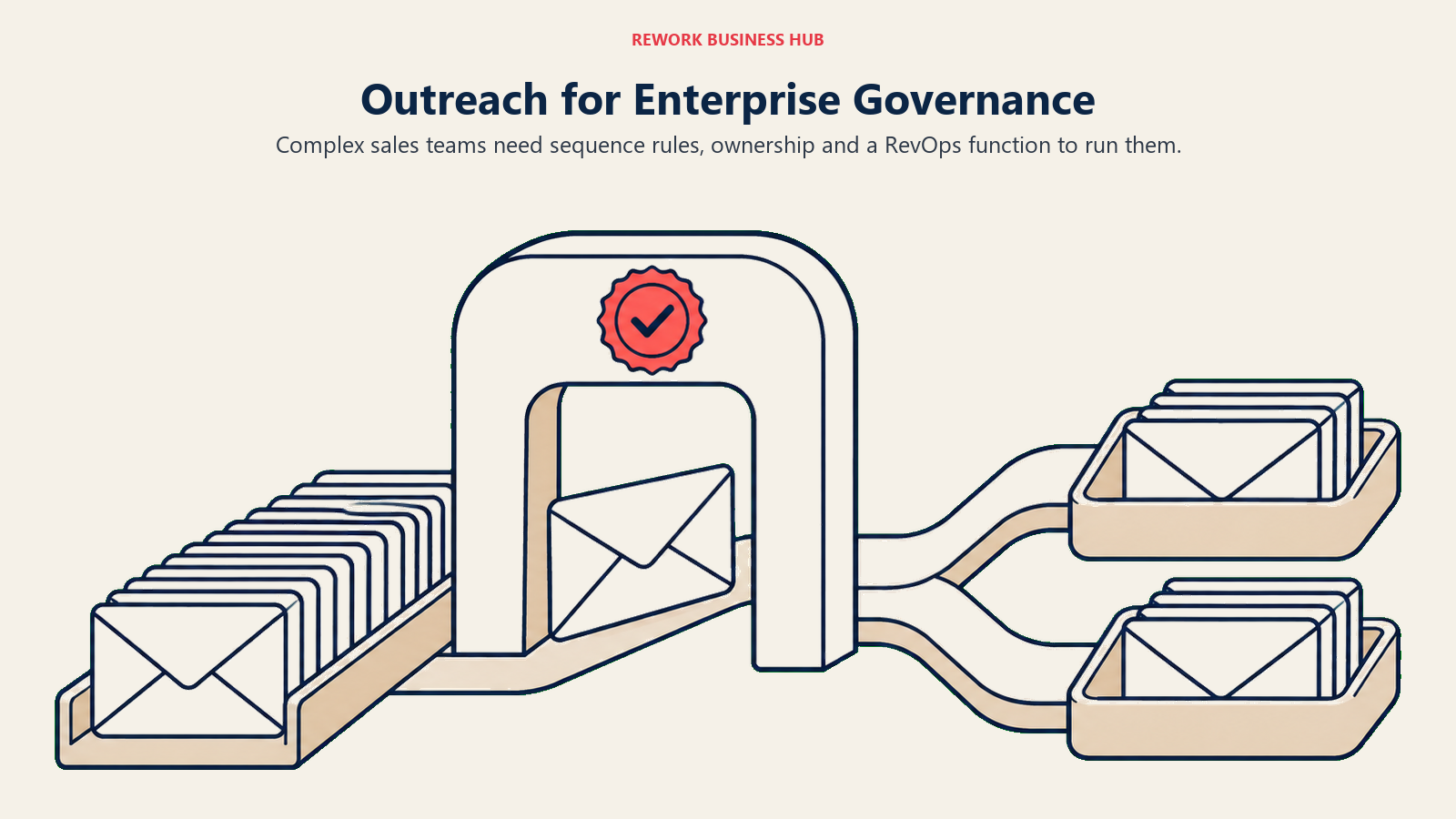
The billing meter, per Outreach's own pricing page, is now a hybrid: seat-based platform access plus consumption-based usage for its AI-powered workflows, tiered as Amplify Essentials, Core, Plus, and Pro, each allocating a stated pool of AI credits (10,000 up to 100,000) rather than a flat feature list. Pricing itself is not published; every tier routes to a sales conversation.
The honest caveat: implementation takes weeks, not days, and rewards organizations with a dedicated RevOps function to configure and run it. A team coming off Smartlead to add LinkedIn and calling is almost always over-buying if Outreach is the answer; it makes sense only once you're above roughly 50 seats with a structured SDR motion.
| What you get | What you don't |
|---|---|
| Best-in-class workflow automation for large SDR orgs | No published pricing; every tier routes to sales |
| AI-credit-based tiers (Essentials, Core, Plus, Pro) | High implementation complexity; weeks to configure |
| Revenue forecasting and deal inspection built in | Overkill for teams under roughly 50 seats |
| Conversation intelligence at call level | Needs a dedicated RevOps function to run effectively |
Pricing: Custom, contact sales; not published. Market estimates commonly cited for the mid tiers run $100 to $160/user/month (reported, not vendor-confirmed), typically with a five-figure minimum annual commitment. See outreach.ai/pricing.
Best for: Mid-market and enterprise organizations (50+ seats) with dedicated RevOps that need workflow governance and revenue intelligence, not agency-style cold-email volume.
Check the best Outreach alternatives guide if you're specifically evaluating whether Outreach itself is the right fit for your size.
14. Salesloft: Cadence Analytics for Mid-Market Teams Past Smartlead's Ceiling
Salesloft is the other half of the enterprise duopoly alongside Outreach, and like Outreach, it isn't really competing with Smartlead so much as serving a team that has already outgrown what any cold-email-first tool can offer. Its cadence builder, email personalization, and conversation intelligence are mature and built for mid-market teams running complex, multi-touch deal cycles where per-touch analytics matter more than raw send volume.
The billing meter is per seat, custom-quoted, with the 2025 Clari merger reshaping the combined product into what Salesloft now calls a Predictive Revenue System bundling forecasting with engagement. Pricing is not published on Salesloft's own site; every plan routes directly to a sales conversation.
The honest caveat: if a team's actual gap is Smartlead's email-only scope and lack of CRM sync, Salesloft is a substantial overcorrection, both in price and in the forecasting and coaching features a smaller team won't use. It's the right upgrade only when cadence-to-pipeline analytics and conversation intelligence at the call level are the specific things missing.
| What you get | What you don't |
|---|---|
| Deep cadence analytics and conversation intelligence | No published pricing; custom quote only |
| Strong brand recognition in enterprise procurement | Clari merger has reshaped packaging in 2026 |
| Account-based outbound features for complex deals | Overkill for teams under roughly 25 seats without RevOps |
| Mature integration ecosystem | Dialer and Conversations historically priced as add-ons |
Pricing: Custom, contact sales; not published on Salesloft's site. Market estimates commonly cited run $125 to $165/user/month (reported, not vendor-confirmed), with dialer and conversation intelligence historically priced as separate add-ons. See salesloft.com/pricing.
Best for: Mid-market teams of 25 to 500 seats running account-based outbound with a focus on cadence performance analytics and pipeline forecasting.
Check the best Salesloft alternatives guide for the wider field there.
Stage Fit Matrix
Choose for the outbound work your team does today, while accounting for the operational complexity it expects next.
| Stage | Best Options | Why |
|---|---|---|
| Early-stage, testing outbound (1 to 5 people) | Mailshake, QuickMail, Woodpecker | Flat or per-contact pricing, no annual lock-in, fast setup |
| Agency running multi-client cold email at volume | Instantly, Saleshandy | Unlimited mailboxes and active-lead pricing built for this exact job, same as Smartlead |
| Growth stage wanting multichannel (5 to 30 people) | Lemlist, Reply.io, La Growth Machine | Email plus LinkedIn plus calling in one sequence builder |
| Data or list-quality bottleneck | Clay, Apollo.io, Amplemarket | Enrichment or prospecting database wired into sequencing |
| CRM-native outbound for a single team (10 to 100 people) | Klenty | Bidirectional CRM sync plus a bundled dialer |
| Mid-market with dedicated RevOps (25 to 500 people) | Salesloft | Cadence analytics and forecasting for complex deal cycles |
| Enterprise SDR org (100+ people) | Outreach | Workflow governance and AI-credit-based automation at scale |
Sizing and Persona Table
| Team Size | Founder | Agency Owner | RevOps or SDR Lead | VP Sales |
|---|---|---|---|---|
| 1 to 5 | Mailshake, QuickMail | Woodpecker, Saleshandy | (too early for dedicated RevOps tooling) | Mailshake |
| 5 to 20 | Lemlist, Reply.io | Instantly, Saleshandy | Klenty, Apollo.io | Lemlist, Klenty |
| 20 to 50 | Apollo.io, Amplemarket | Instantly, La Growth Machine | Klenty, Clay | Klenty, Reply.io |
| 50 to 200 | Outreach, Salesloft | (agencies rarely run one workspace this large) | Outreach, Salesloft | Outreach, Salesloft |
| Cold-email agency, any size | Instantly, Saleshandy | Instantly, Saleshandy | Instantly, Saleshandy | Instantly, Saleshandy |
How to Choose: Decision Framework
Start with the gap in your current setup, then compare the billing model and test the shortlist with real prospects.
| If you need... | Pick... | Why |
|---|---|---|
| The closest like-for-like Smartlead replacement on price and mailbox model | Instantly or Saleshandy | Same active-leads and sends meter, unlimited mailboxes, agency-friendly |
| Email plus LinkedIn plus calling in one sequence builder | Lemlist or Reply.io | Both handle true multichannel; check per-seat math past 15 to 20 reps |
| LinkedIn as the primary channel, not an add-on | La Growth Machine | Built LinkedIn-first, with email and calling layered around it |
| A prospecting database bundled with sequencing | Apollo.io | 275M+ contacts; removes a separate data-vendor line item |
| AI-driven intent signals plus a dialer | Amplemarket | Bundles signals, multichannel sequencing, and calling in one platform |
| Better lead data feeding whatever sender you already use | Clay | Waterfall enrichment across dozens of providers; pairs with Instantly or Smartlead |
| Outbound cadences synced to a real CRM pipeline | Klenty | Bidirectional sync with Salesforce, HubSpot, Pipedrive, Zoho |
| To pay only for prospects you actually contact | Woodpecker | Per-contacted-prospect meter instead of a fixed volume tier |
| Zero per-seat charges regardless of team size | QuickMail | Unlimited users and senders on every plan |
| Month-to-month billing with no annual commitment | Mailshake | Monthly is the default; annual is optional, not required |
| Enterprise workflow governance and forecasting | Outreach or Salesloft | Deepest automation and analytics; budget for the commitment and the RevOps function to run it |
Frequently Asked Questions about Smartlead Alternatives
What is the best Smartlead alternative?
It depends on which gap you're filling. Instantly and Saleshandy are the closest replacements on pricing model and mailbox scale. Lemlist and Reply.io add LinkedIn and calling that Smartlead doesn't offer. Apollo.io and Amplemarket add a prospecting database. Klenty adds native CRM sync. There's no single best pick across all of those needs.
Why do teams leave Smartlead?
The most common reasons are the email-only scope (no LinkedIn or calling), the lack of a real CRM pipeline beyond basic reply tracking, and add-on costs (Warmup Pool, whitelabeling, SmartServers, verification credits) that raise the real operating cost well above the advertised entry price at production volume.
Is there a cheaper Smartlead alternative?
Woodpecker's pay-per-contacted-prospect model can cost less for a small, targeted list, since you're not paying for a full volume tier you don't use. Mailshake's monthly-billed Starter plan and QuickMail's flat per-campaign pricing are also priced near Smartlead's Base tier depending on your actual sending volume.
Which Smartlead alternative is best for agencies running multiple clients?
Instantly and Saleshandy are built around the same unlimited-mailbox, volume-based pricing Smartlead uses, and both work well for agency use. QuickMail's Agency plan with multiple workspaces and Reply.io's Agency plan for per-client management are also purpose-built for multi-client work.
Do these Smartlead alternatives all bill the same way?
No, and this is the most important thing to check before comparing sticker prices. Instantly, Smartlead, and Saleshandy bill on active leads plus emails sent. Apollo.io, Klenty, and Salesloft bill per seat. Woodpecker bills per contacted prospect. Clay bills on actions and data credits. La Growth Machine and Amplemarket bill per identity or per team package. Compare the meter, not just the headline number.
Does any Smartlead alternative include a real CRM?
Klenty syncs bidirectionally with Salesforce, HubSpot, Pipedrive, and Zoho rather than replacing them. Instantly's bundled Starter, Scale, and Agency plans add a basic CRM layer. Apollo.io includes CRM sync on its Professional tier. None of the tools reviewed here ship a full deal-tracking CRM as their core product; most expect replies to sync into a separate system.
What to Do Next
Before booking demos, settle two questions. First: is Smartlead's email-only scope the actual gap, or is it the pricing model? If you need LinkedIn and calling in the same sequence builder, Lemlist and Reply.io are the direct answers. If the pricing model itself is the friction, paying for a full tier you don't use, or wanting zero per-seat charges, Woodpecker, QuickMail, and Mailshake solve that specific problem without adding channels you don't need.
Second: is the real bottleneck sending infrastructure at all, or is it list quality and CRM visibility? A team with a clean, well-targeted list and a real deal pipeline to sync into gets more from Klenty, Apollo.io, or Clay than from another cold-email-first tool. A team still scaling raw sending volume across many domains will find Instantly or Saleshandy the more direct Smartlead replacement.
From there, run a two-week pilot with your actual list and your actual sending volume, not a vendor demo's sample data. Compare reply rate and mailbox health after real send volume, not day one. The tool that earns a permanent seat is the one your reps keep using without being reminded.
For the wider field around specific tools mentioned here, see the best Instantly alternatives, best Apollo alternatives, and best Lemlist alternatives guides, or the full best sales engagement platforms roundup for every tool in the category. For a closer look at how Smartlead itself stacks up against two of its closest competitors, see Instantly vs Lemlist vs Smartlead.

Principal CRM Strategist
On this page
- Key Facts
- Quick Comparison Table
- 1. Instantly: The Direct Volume Competitor With a Bundled CRM Option
- 2. Saleshandy: Unlimited Email Accounts at the Lowest Entry Price
- 3. Lemlist: Multichannel Personalization Smartlead Doesn't Attempt
- 4. Reply.io: Multichannel Plus a Dedicated AI SDR Product Line
- 5. La Growth Machine: LinkedIn-First Multichannel for Small Teams and Agencies
- 6. Apollo.io: A Prospecting Database Smartlead Doesn't Have
- 7. Amplemarket: AI-Native Prospecting, Sequencing, and Dialing in One Platform
- 8. Clay: Enrichment-First Workflow Automation That Feeds Any Sender
- 9. Klenty: CRM-Native Cadences With a Dialer Included
- 10. Woodpecker: Pay Only for the Prospects You Actually Contact
- 11. QuickMail: No Per-Seat Charges on Any Plan
- 12. Mailshake: Month-to-Month Flexibility Without Smartlead's Annual Push
- 13. Outreach: Enterprise Workflow Governance Smartlead Was Never Built For
- 14. Salesloft: Cadence Analytics for Mid-Market Teams Past Smartlead's Ceiling
- Stage Fit Matrix
- Sizing and Persona Table
- How to Choose: Decision Framework
- What to Do Next