Best Instantly Alternatives in 2026: 13 Tools for Cold Email and Outbound Teams

Turn this article into takeaways for your work.


Each assistant summarizes the article only for you and suggests best practices for your work.
Instantly built a genuine reputation as the go-to cold email platform for agencies and high-volume outbound teams. Unlimited email accounts on every plan, built-in warmup, volume-based pricing that doesn't punish you for scaling, and a deliverability network tuned for cold outreach at scale. For a team sending tens of thousands of emails per month across multiple client domains, that combination is hard to beat.
But the reasons to look elsewhere are specific and real. The modular pricing model stacks up fast: Outreach plus the lead database plus CRM lands at $124/month at the low end and north of $220/month once you move to mid-tier. Deliverability can be inconsistent despite healthy warmup scores, and support response times lag when something breaks on a live campaign. There's no native LinkedIn or multichannel sequencing. The CRM is basic enough that any team tracking real deal pipelines will need a separate system and a sync to manage. And for founders or RevOps owners who want outbound tied to a live pipeline rather than exported nightly to another tool, Instantly's architecture creates friction.
If one of those gaps is driving your search, this guide covers 13 alternatives. Each section includes real pricing, a straight read on who it fits, and honest caveats, so you can match the tool to your situation.
Quick Comparison Table
| Tool | Best For | Starting Price | Key Strength | Key Limitation |
|---|---|---|---|---|
| Rework | Teams wanting outbound inside their CRM | $999/year (up to 5 users) | CRM + sequences + ops in one system | Not for solo users or high-volume cold-email agencies |
| Smartlead | Cold-email agencies running multi-client inboxes | $39/month | Inbox rotation, whitelabeling, unlimited accounts | Email only; no LinkedIn or calling |
| Lemlist | Multichannel personalization without enterprise pricing | Email $55/month flat (annual), unlimited users | Email + LinkedIn in one UI; conditional sequencing | Sending address caps at lower tiers |
| Apollo | Teams that also need prospecting data | $49/user/month (annual) | 275M contact database plus sequencing | Credit system limits scale |
| Reply.io | Teams wanting multichannel with AI SDR features | $89/user/month | Email, LinkedIn, calling, AI SDR in one subscription | LinkedIn add-on drives real per-seat cost above $150 |
| Woodpecker | Smaller teams wanting per-slot billing | $29/month (1 slot/500 prospects) | Per-slot pricing, spam-filter testing, clean UX | Multichannel features lighter than competitors |
| Mailshake | SMB teams new to outbound without annual lock-in | $29/user/month | Flat monthly pricing, no annual commitment | Email send caps per tier |
| Saleshandy | High-volume email with unlimited accounts at low cost | $25/month (annual) | Unlimited email accounts; large lead database | Infrastructure add-ons raise actual cost significantly |
| QuickMail | Agencies and small teams wanting per-campaign pricing | $49/month (Starter) | No per-seat charges; generous free trial | Agency plan ($299/month) required for full multi-client features |
| Klenty | Outbound teams with CRM-first workflows | $50/user/month (annual) | CRM-native cadences; dialer included on Growth | Smaller ecosystem than Outreach or Salesloft |
| Outreach | Large enterprise SDR organizations | ~$100/user/month (custom) | Deep workflow automation and revenue forecasting | $20K+ minimum annual commitment |
| Salesloft | Mid-market teams with complex deal cycles | ~$125/user/month (custom) | Cadence analytics and conversation intelligence | Clari merger has complicated packaging |
| HubSpot Sales Hub | Teams already on the HubSpot platform | $20/seat/month (Starter) | Native CRM plus sequences in one login | Sequences gated at Professional ($100/seat/month) |
1. Rework: Outbound That Lives Inside Your CRM
Most outbound tools are point solutions that sit outside your CRM. You sequence in Instantly, prospects reply, and then you export the interested ones into HubSpot or Salesforce, manually update deal stages, and reconcile which touches moved which contacts through the pipeline. That sync problem compounds at scale. Rework takes the opposite approach: it combines a full sales CRM, lead management, multichannel outreach sequences, and cross-team workflow management in a single data model.
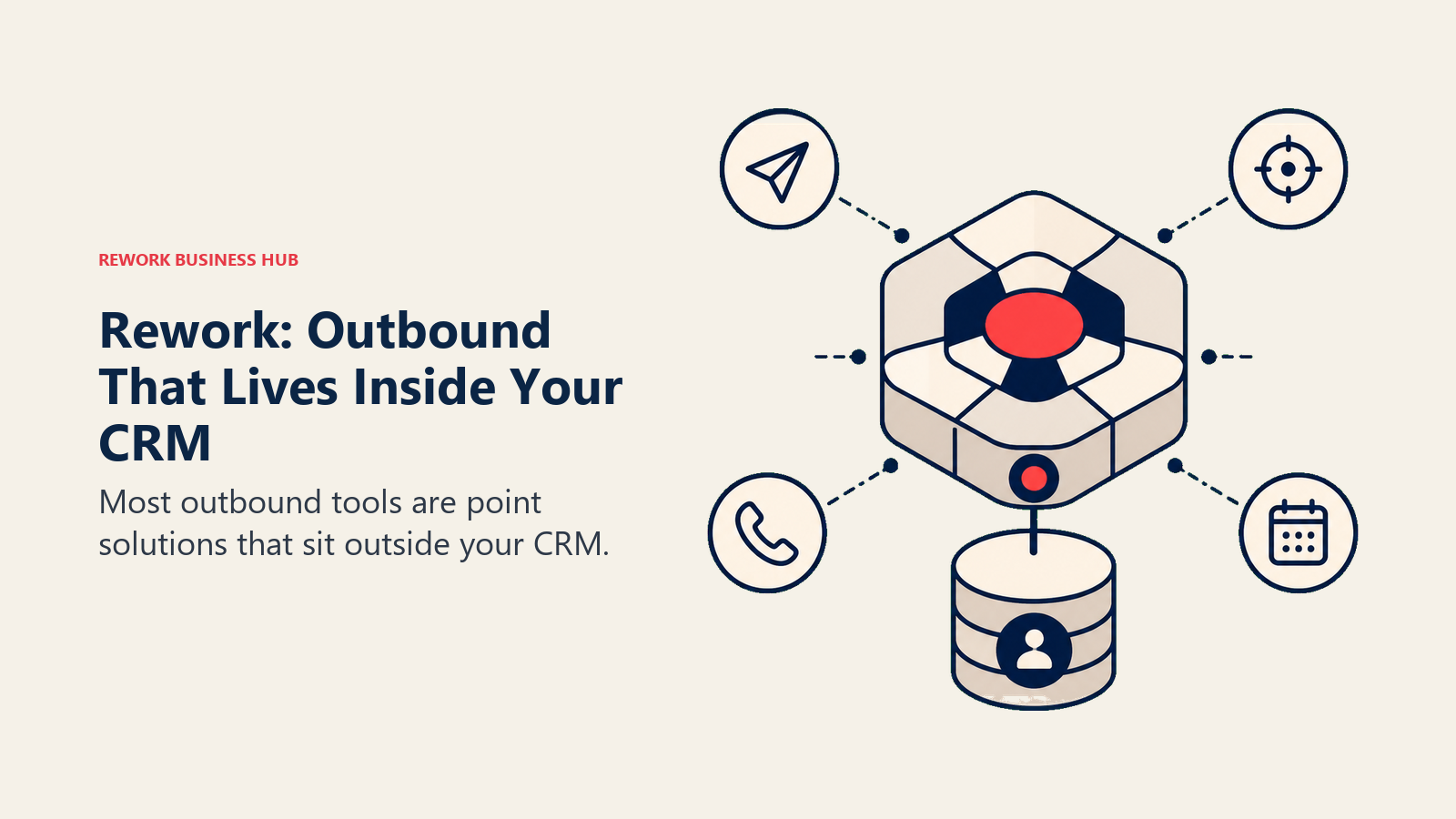
The pitch for an Instantly refugee is practical: instead of running email campaigns in one tool and deal tracking in another, every touch point, reply, and pipeline stage change lives in the same place. Your sequences know which contacts are already in active deals. Your pipeline knows which outbound touches drove which response. No nightly Zapier run, no reconciliation.
Rework's target buyer is a team of 5 to 200 seats that has outgrown "one rep with a spreadsheet" but doesn't need the full complexity of Outreach or Salesloft. It fits funded startup sales teams, regional distributors, professional services firms, and any organization where RevOps and CRM need to share data with outbound.
Not ideal for: solo users (the minimum package covers up to 5 users), cold-email agencies whose core workflow is rotating across 50+ sending domains for multiple clients, or high-volume shops where raw sending scale is the primary metric. If inbox rotation at volume is the top priority, Instantly or Smartlead is the more direct fit.
| What you get | What you don't |
|---|---|
| Full CRM and pipeline built in; no separate sync required | Not sold per seat, so 1 to 2 person teams will overpay |
| Multichannel sequences tied to live deal context | Limited inbox-rotation features compared to Instantly |
| Work Ops covers cross-team coordination, not just sales | Minimum package designed for teams of 5+, not solo use |
| Lead management and pipeline in the same data model | No high-volume cold-email sending network |
Pricing (Sales Ops):
- Starter: $999/year for up to 5 users
- Standard: $1,999/year for 10 users included, plus $12/user/month for each additional user
Best for: Teams of 5 to 50 that want outbound sequencing wired directly into CRM and pipeline from day one. See rework.com/pricing for current details.
2. Smartlead: Agency-First Cold Email with the Best Inbox Rotation
Smartlead targets the same deliverability-first buyer as Instantly, but leans harder into multi-client agency workflows. The platform's inbox rotation engine lets you spread volume across unlimited connected email accounts, keeping per-domain send volumes low and deliverability scores high. And the Pro plan at $94/month includes white-label client portals, so agencies can manage separate campaign dashboards per client without giving clients access to a shared account.
The infrastructure story is Smartlead's primary differentiator. Its warmup engine, custom tracking domains, and sending network are built for the volume that breaks standard sales engagement tools. The Unlimited Smart tier at $174/month removes the active-lead cap and scales to 150,000 emails per month. The Unlimited Prime at $379/month pushes to 510,000 sends per month.
Like Instantly, Smartlead is email only. No LinkedIn automation, no calling, no meaningful CRM pipeline. Teams with those needs will still build a separate stack around it. And the actual operating cost often doubles once you account for dedicated domains, verified prospect credits, and additional mailbox infrastructure at production volume.
| What you get | What you don't |
|---|---|
| Best-in-class inbox rotation for agencies | Email only; no LinkedIn or calling |
| Whitelabeling on Pro plan ($94/month) | Add-on costs compound at production scale |
| Strong warmup engine included on all plans | No native CRM pipeline for tracking deals |
| Unlimited email accounts on every tier | Multi-client setup takes configuration time |
Pricing: Base $39/month (2,000 active leads), Pro $94/month (30,000 active leads, API, whitelabeling), Unlimited Smart $174/month, Unlimited Prime $379/month. Annual billing saves 17%. See smartlead.ai/pricing.
Best for: Cold-email agencies running campaigns across multiple client domains where whitelabeling and per-client deliverability management are the top priorities.
3. Lemlist: Multichannel Personalization Without the Enterprise Price Tag
Lemlist built its name on personalized images and dynamic variables in cold email, then expanded into a full multichannel sequencer covering email, LinkedIn, and calling. The Multichannel Expert plan at $87/user/month (annual, or $109 monthly) is a direct competitor for teams that want email and LinkedIn in one UI without Reply.io's complex add-on pricing.
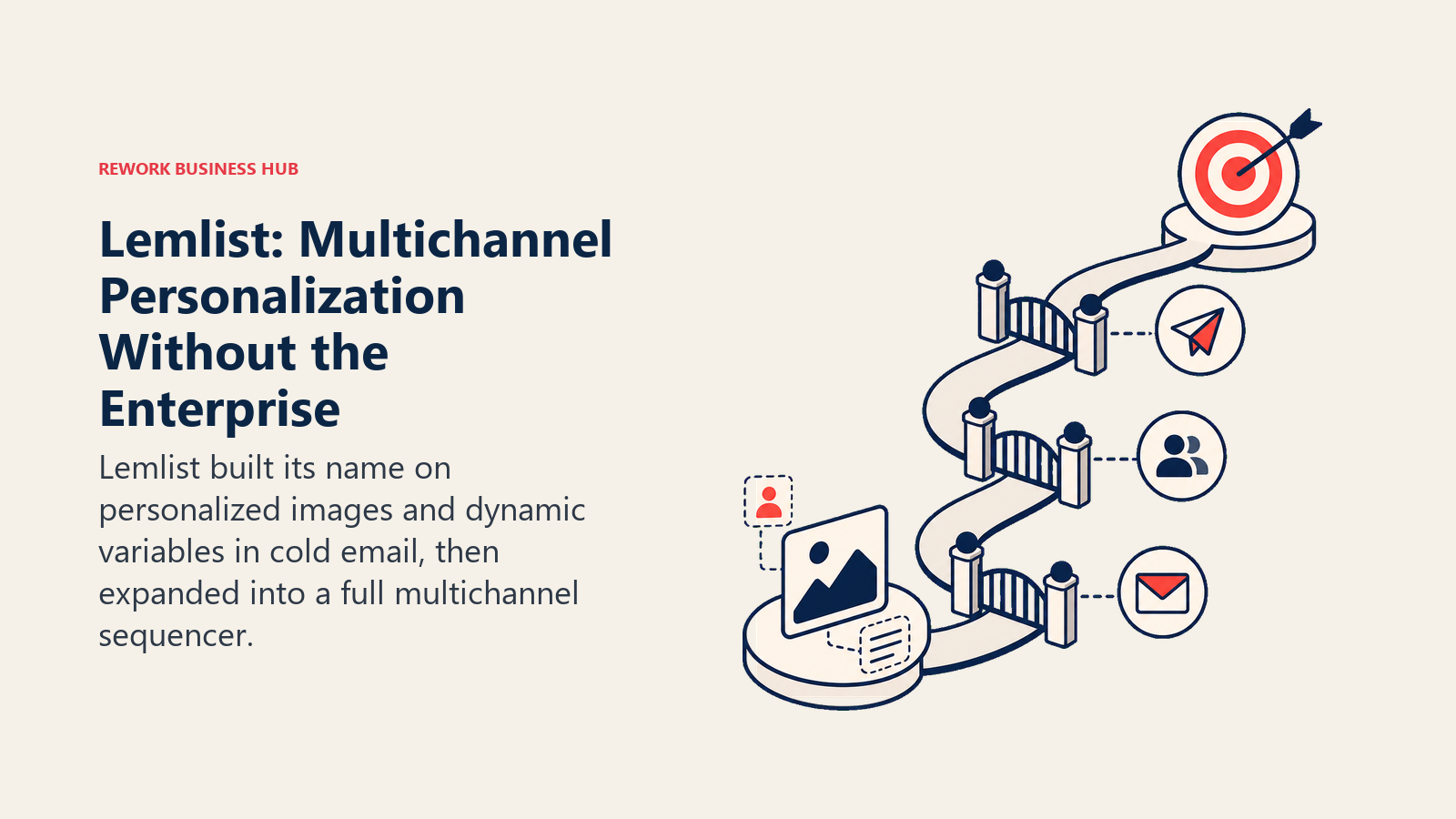
The conditional sequencing is Lemlist's practical differentiator. You can set rules like "if no reply on email step 2, switch to LinkedIn touch 1," and that logic is accessible to non-technical reps without building a workflow diagram. The platform handles warmup through its native Lemwarm tool (included), and provides 1,500 enrichment credits per user per month on the Multichannel Expert plan.
The honest limit: at the Multichannel Expert tier, you get 5 sending addresses per user. High-volume agencies sending to large lists across many domains will outgrow that fast. But for teams of 3 to 30 running personalized, targeted outreach to segmented lists, the feature-to-price ratio is clean.
Check the best Lemlist alternatives guide if you want to compare it against the broader field.
| What you get | What you don't |
|---|---|
| Email + LinkedIn in one UI; no separate add-on billing | 5 sending addresses per user cap on Multichannel Expert |
| Conditional sequencing accessible to non-technical reps | LinkedIn automation reliability can vary at scale |
| Lemwarm included on all plans | Not built for 10,000+ contact-per-week volumes |
| 1,500 enrichment credits per user per month (Multichannel) | Calling quality not at the same level as dedicated dialers |
Pricing: Email $69/month monthly, $55/month annual (flat fee, unlimited users, 50,000 emails/month). Multichannel $109/user/month monthly, $87/user/month annual. Enterprise custom-quoted. See lemlist.com/pricing.
Best for: Teams of 3 to 30 running personalized multichannel outbound without dedicated cold-email infrastructure.
4. Apollo: Prospecting Database Plus Sequencing in One Platform
Apollo's core advantage over Instantly is the built-in contact database: 275 million contacts with email and phone data, connected directly to its sequencing tool. Where Instantly requires you to bring your own list, Apollo lets you build a list, qualify it, and push it into a sequence from a single screen. That's a meaningful workflow compression for teams currently paying a separate data vendor.
The Basic plan at $49/user/month (annual) removes the two-active-sequence cap of the free tier. Professional at $79/user/month adds a US dialer and parallel dialing. The credit system is the main friction point. Phone number lookups cost significantly more than email credits. Credits expire each billing cycle. And overages run $0.20 each. A 10-person SDR team running heavy phone outbound can hit meaningful credit costs on top of the seat fee.
For Instantly users who are also paying ZoomInfo or Lusha separately, Apollo's combined pricing often comes out cheaper. The tradeoff is that Apollo's engagement features are slightly less mature than Instantly's when it comes to inbox rotation and warmup at volume.
Check the best Apollo alternatives for a side-by-side on data quality and engagement depth.
| What you get | What you don't |
|---|---|
| 275M contact database included; prospect and sequence from one screen | Credit system can become expensive for phone-heavy teams |
| Free plan available for initial testing | Phone credits cost significantly more than email credits |
| CRM sync on Professional tier | Warmup and inbox rotation less mature than Instantly |
| Prospecting plus enrichment plus sequencing in one subscription | Credits expire monthly; unused volume doesn't roll over |
Pricing: Free (limited credits), Basic $49/user/month (annual), Professional $79/user/month, Organization $119/user/month (3-seat minimum). See apollo.io/pricing.
Best for: Teams that want to prospect, enrich, and sequence from one subscription, especially if they're currently paying a separate data vendor.
5. Reply.io: Multichannel Sequencing with AI SDR Features
Reply.io covers email, LinkedIn, calling, and an AI SDR agent in one platform. That breadth is the main pitch. Where Instantly is purpose-built for cold email volume, Reply.io tries to handle the full top-of-funnel outbound motion in a single subscription, including an AI SDR ("Jason") that can handle initial outreach autonomously on the AI SDR plan.

But the real cost climbs fast. The Multichannel plan runs $89/user/month (annual) for email, LinkedIn, calling, and SMS bundled together. Reply.io restructured its AI SDR offering in 2026: Jason is no longer a per-seat add-on, it's now a separate managed tier (Starter, Growth, Enterprise) starting around $500/month on annual billing. A rep doing true multichannel on the per-seat plan still clears $99/user/month or more on monthly billing before any AI SDR or data add-ons. And deliverability at scale is still uneven compared to dedicated cold-email tools.
For Instantly teams that want to add LinkedIn and calling without building a separate stack, Reply.io is a practical upgrade in capability. For teams primarily focused on high-volume cold email, it's more expensive and less optimized for that use case. The best Reply.io alternatives guide covers the full competitive picture there.
| What you get | What you don't |
|---|---|
| Email, LinkedIn, calling, and AI SDR in one subscription | Real per-seat cost climbs past $180/month with add-ons |
| Conditional multichannel sequencing | Deliverability at volume less consistent than Instantly |
| AI SDR agent for autonomous initial outreach | No native CRM; requires integration to track deals |
| One platform for the full top-of-funnel motion | LinkedIn and calling priced as separate add-ons |
Pricing: Email Volume from $49/month (annual, contact-based, unlimited users). Multichannel $89/user/month (annual), $99/user/month (monthly), includes LinkedIn, calling, and SMS. AI SDR (Jason) now a separate tiered service from $500/month (annual, Starter) up to $1,000/month (Enterprise). See reply.io/pricing.
Best for: SDR teams of 5 to 50 that want to consolidate email, LinkedIn, and calling in one tool and can absorb the per-seat cost of true multichannel.
6. Woodpecker: Per-Slot Billing for Smaller Outbound Teams
Woodpecker charges per connected email account (slot) rather than per user. The Starter plan at $29/month covers one slot (email account) and up to 500 prospects. Every tier includes unlimited team members, so a 4-person team sharing one Woodpecker slot pays $29/month rather than $29 x 4. For small teams that coordinate on a shared outbound effort rather than running independent rep sequences, that pricing model is meaningfully cheaper.
The platform covers cold email sequencing well: clean sequence builder, spam-filter testing before each send, native follow-ups, A/B testing, and deliverability alerts. CRM integrations with Salesforce, HubSpot, and Pipedrive are available. Multichannel features are lighter than Lemlist or Reply.io, making Woodpecker the right call for email-dominant outbound rather than true multichannel campaigns.
Teams running periodic outbound bursts rather than continuous high-volume campaigns will find Woodpecker more predictable to budget. You pay for the accounts you actually use.
| What you get | What you don't |
|---|---|
| Per-slot pricing; unlimited users on every plan | Multichannel features lighter than Lemlist or Reply.io |
| Spam-filter testing before sends | LinkedIn and calling not native |
| Clean deliverability tooling; automated follow-up logic | Growth plan ($84/month) required for A/B testing and advanced automation |
| 7-day free trial, no credit card required | Not built for agencies managing multiple client workspaces |
Pricing: Starter $29/month (1 slot, 500 prospects), Growth $84/month (1 slot, 3,000 prospects), Scale $188/month (1 slot, 10,000 prospects). Per-slot pricing; add additional slots for each sending mailbox. See woodpecker.co/pricing.
Best for: Teams of 2 to 10 running targeted, lower-volume email outbound who want predictable costs without per-seat math.
7. Saleshandy: High-Volume Email with Unlimited Accounts at a Low Entry Price
Saleshandy competes directly with Instantly on the unlimited-email-accounts angle, but at a lower advertised entry price. The Starter plan at $25/month (annual) includes unlimited email account connections and covers up to 2,000 prospects. The Scale plan at $149/month raises that to 60,000 prospects and 250,000 emails per month, plus agency-style multi-workspace management.
The platform's B2B lead database (700 million+ contacts) is a separate subscription called Lead Finder, starting at $24/month for a Lead Starter plan. Combined with the outreach subscription, you're looking at $49+/month for the most basic complete setup before you factor in email infrastructure costs ($4/month per mailbox connected).
For Instantly refugees shopping on price, Saleshandy is worth a direct comparison. The warmup and deliverability tools are solid, the A/B testing covers up to 26 variants on Pro, and the agency workspace management on Scale handles multi-client scenarios. The honest caveat is that the advertised $25 starting price reflects a much lower-capability tier than the mid-range plans most active outbound teams actually need.
| What you get | What you don't |
|---|---|
| Unlimited email accounts on every plan | Infrastructure add-ons ($4/mailbox/month) compound quickly |
| 700M+ contact database available as add-on | Lead Finder is a separate subscription, not bundled |
| Agency multi-workspace on Scale plan | Real cost at production scale can hit $130 to $200/month+ |
| A/B testing up to 26 variants on Pro | No LinkedIn or native calling |
Pricing: Starter $25/month (annual, 2,000 prospects), Pro $74/month (30,000 prospects), Scale $149/month (60,000 prospects), Scale Plus $219/month. Lead Finder from $24/month additional. See saleshandy.com/pricing.
Best for: Teams scaling email volume who want unlimited account connections at a lower base price, with an eye toward the full cost once infrastructure and lead database are added in.
8. QuickMail: Per-Campaign Pricing with No Per-Seat Charges
QuickMail restructured its pricing model and now starts at $49/month for the Starter plan, covering basic cold email sequencing without charging per seat. The Growth plan at $99/month includes unlimited email senders and higher sending limits. The Agency plan at $299/month adds full multi-client management for outbound agencies running campaigns across separate client workspaces.
The no-per-seat model is the core pitch. A 5-person team shares one QuickMail subscription rather than paying 5x a per-seat fee. That pricing makes QuickMail meaningfully cheaper for small teams coordinating on shared outbound than Instantly, Lemlist, or Apollo at comparable feature levels.
The deliverability tooling includes native warmup, spam-check previews, and bounce handling. Multichannel features are lighter than Lemlist but the core email sequencing is clean and reliable. The platform's free trial is 14 days with no credit card required, and they won't auto-charge when the trial ends.
| What you get | What you don't |
|---|---|
| No per-seat pricing; whole team shares one subscription | Agency plan ($299/month) required for full multi-client features |
| 14-day free trial, no credit card required | Multichannel features less mature than Lemlist or Reply.io |
| Native warmup and spam testing included | Sending limits per plan; heavy volume teams will need to upgrade |
| Clean sequence builder; bounce and reply handling | Smaller ecosystem and integration library than Instantly or Smartlead |
Pricing: Starter $49/month, Growth $99/month (unlimited email senders), Agency $299/month (multi-client management). No monthly/annual toggle; no per-seat fees. 14-day free trial. See quickmail.com/pricing.
Best for: Small teams of 2 to 8 that want predictable flat pricing without per-seat overhead, especially if they're testing cold outbound without a large upfront commitment.
9. Mailshake: Month-to-Month Flexibility for Teams Testing Outbound
Mailshake is the approachable entry point for outbound: flat monthly billing, no annual contract required, and a feature set a new SDR can learn in an afternoon. The base Starter plan at $29/user/month covers email outbound with basic sequencing. The Sales Engagement plan at $99/user/month adds a Power Phone Dialer and social selling automation (LinkedIn and Twitter).
The billing model is a genuine differentiator for founders and early sales teams not ready to commit to a 12-month contract. Most outbound tools require annual billing by default. Mailshake's month-to-month option means you can start a pilot, evaluate results, and scale or cancel without sunk cost.
The tradeoff against Instantly is scope. Mailshake doesn't have Instantly's inbox rotation, warmup infrastructure, or volume-based pricing. Email send caps per plan tier apply. And the automation configurability is lighter than Lemlist or Apollo. But for a small team whose primary need is structured follow-up sequences with occasional calling, the simplicity and no-commitment pricing removes real friction.
| What you get | What you don't |
|---|---|
| No annual contract required; month-to-month by default | Email send caps per tier limit high-volume use |
| Power Dialer included at $99/user/month tier | Lighter automation than Lemlist or Reply.io |
| Quick onboarding; minimal configuration required | No inbox rotation or warmup at Instantly's level |
| Clean sequence builder with A/B testing | LinkedIn automation basic compared to dedicated multichannel tools |
Pricing: Starter $29/month billed monthly, $25/month annual. Email Outreach $49/month billed monthly, $45/month annual. Sales Engagement $99/month billed monthly, $85/month annual. Monthly billing standard; no annual lock-in required. See mailshake.com/pricing.
Best for: SMB teams of 1 to 20 testing structured outbound for the first time who want to avoid annual commitment risk.
10. Klenty: CRM-Native Cadences with Dialer Included
Klenty's design philosophy is that outbound sequences should live inside CRM workflows, not alongside them. The platform integrates tightly with Salesforce, HubSpot, Pipedrive, and Zoho, with bidirectional sync that updates contact records, deal stages, and activity logs as prospects move through cadences. For RevOps owners frustrated by Instantly's lack of native CRM integration, that sync depth is the key appeal.
The Growth plan at $70/user/month (annual) includes multichannel sequencing covering email, LinkedIn, and calling, plus a built-in dialer at no additional add-on fee. That's a material cost difference versus Reply.io, which charges a separate $29/user/month for calling. The Plus plan at $99/user/month adds AI coaching features and additional calling minutes.
The limitation is ecosystem maturity. Klenty doesn't have Outreach's breadth of third-party integrations or the same reporting depth for large RevOps analytics stacks. But for a 10 to 50 person team with a defined CRM and a need for outbound-to-pipeline visibility, Klenty's integration story is more practical than Instantly's.
| What you get | What you don't |
|---|---|
| Bidirectional CRM sync with Salesforce, HubSpot, Pipedrive | Smaller integration ecosystem than Outreach or Salesloft |
| Dialer included at Growth tier ($70/user/month) | Reporting less mature for complex RevOps analytics |
| Multichannel: email, LinkedIn, calling in one plan | No high-volume inbox rotation like Instantly or Smartlead |
| AI cadence features on Plus ($99/user/month) | Not the right fit for pure cold-email agencies |
Pricing: Startup $50/user/month (annual, email only), Growth $70/user/month (multichannel, dialer included), Plus $99/user/month (AI coaching), Enterprise $120 to $150/user/month. 14-day free trial. See klenty.com/pricing.
Best for: Teams of 10 to 100 with a defined CRM that need outbound cadences to sync cleanly with pipeline records, and want a dialer without paying a separate add-on fee.
11. Outreach: Enterprise Workflow Automation at Scale
Outreach is the platform large SDR organizations buy when they need governance, forecasting, and workflow depth that smaller tools can't match. It covers email, phone, and LinkedIn sequencing alongside deal inspection, revenue forecasting, and conversation intelligence within a purpose-built workflow engine. Large teams can configure sequence rules, A/B test cadences, and manage rep performance analytics at a detail level that Instantly and most alternatives simply don't offer.
The tradeoff is price and implementation complexity. Outreach doesn't publish pricing, but market data puts the Engage tier around $100 to $120/user/month, with annual commitments starting around $20,000. A 50-seat team is in the $72,000+/year range before add-ons. Implementation takes weeks and rewards orgs with a dedicated RevOps owner managing configuration.
For a team coming off Instantly to add LinkedIn and calling, Outreach is over-engineered unless you're above 50 seats with a structured SDR motion and a RevOps function to run it. If you're evaluating whether Outreach itself is right for your size, the best Outreach alternatives guide covers that decision in depth.
| What you get | What you don't |
|---|---|
| Best-in-class workflow automation for large SDR orgs | No published pricing; $20K+ minimum annual commitment |
| Revenue forecasting and deal inspection built in | High implementation complexity; weeks to configure |
| Enterprise governance: roles, permissions, audit logs | Overkill for teams under 50 seats |
| Conversation intelligence at call level | Needs dedicated RevOps function to run effectively |
Pricing: Custom. Estimated $100 to $160/user/month. Minimum annual contract around $20,000. Contact outreach.io for a quote.
Best for: Mid-market and enterprise organizations (50+ seats) with dedicated RevOps and a structured outbound motion that needs workflow governance and revenue intelligence.
12. Salesloft: Cadence Analytics and Conversation Intelligence for Mid-Market
Salesloft pioneered the cadence model of sales engagement and remains one of the two dominant enterprise platforms alongside Outreach. Its cadence builder, email personalization, and conversation intelligence are mature and trusted by mid-market teams running complex deal cycles where per-touch analytics matter.
The 2025 merger with Clari (revenue forecasting) closed in late 2025 and is reshaping the combined product in 2026. The company now markets a "Predictive Revenue System" that bundles forecasting with engagement. For buyers evaluating in 2026, that means more negotiation complexity and potentially different packaging than historical quotes. Pricing is custom, typically in the $125 to $165/user/month range before add-ons, with dialer access running $300 to $400/user/year on top.
For Instantly users who need richer cadence-to-pipeline analytics and conversation intelligence at the call level, Salesloft is a legitimate capability upgrade. But if your team doesn't need forecasting integration, you're likely paying for Clari features you won't use. The best Salesloft alternatives guide covers the full competitive picture.
| What you get | What you don't |
|---|---|
| Deep cadence analytics and conversation intelligence | Custom pricing with annual escalators (5 to 8%) |
| Strong brand recognition in enterprise procurement | Clari merger has muddied packaging in 2026 |
| Account-based outbound features for complex deals | Dialer and Conversations priced as separate add-ons |
| Mature integration ecosystem | Overkill for teams under 25 seats without RevOps |
Pricing: Custom. Typically $125 to $165/user/month. Dialer and Conversations Intelligence add-ons quoted separately. Contact salesloft.com for a quote.
Best for: Mid-market teams of 25 to 500 seats running account-based outbound with a focus on cadence performance analytics and pipeline forecasting.
13. HubSpot Sales Hub: When You're Already in the HubSpot Ecosystem
HubSpot Sales Hub is the least compelling Instantly replacement on cold-email feature depth, but the most compelling if your team already runs HubSpot CRM. Sequences, email tracking, task queues, and calling live inside the same platform as your contact database, deal pipeline, and marketing attribution. The context-switching problem between outbound tool and CRM disappears.
The pricing caveat matters. The Starter plan at $20/seat/month doesn't include sequences. Sequences are gated at Professional, which starts at $100/seat/month plus a $1,500 onboarding fee. A team of 10 pays $12,000/year before add-ons, which is in Klenty or Lemlist territory but with the built-in CRM value factored in.
If you're not already on HubSpot, building your entire stack around Sales Hub just to get outbound sequences is a heavy starting point. If you are, adding Sales Hub Professional is a more natural path than bolting on a separate cold-email tool.
| What you get | What you don't |
|---|---|
| Native CRM plus sequences; no separate sync required | Sequences gated at Professional ($100/seat/month + $1,500 onboarding) |
| Unified contact, deal, and campaign reporting | Starter plan ($20/seat/month) doesn't include sequences |
| Marketing and sales attribution in one system | Overkill if you don't need the full HubSpot platform |
| Large app marketplace and integration ecosystem | Cold-email sending volume and warmup not Instantly's equal |
Pricing: Starter $20/seat/month (no sequences). Professional $100/seat/month plus $1,500 onboarding fee (sequences included). See hubspot.com/pricing.
Best for: Teams already on HubSpot CRM that want to add sequencing without adding another vendor to the stack.
Stage Fit Matrix
| Stage | Best Options | Why |
|---|---|---|
| Early startup (1 to 5 reps, testing outbound) | Mailshake, QuickMail, Apollo Basic | Low commitment, flat pricing, fast setup without annual lock-in |
| Growth stage (5 to 25 reps, structured outbound) | Rework, Lemlist, Klenty, Apollo Professional | Balance of features and cost; CRM integration starts mattering here |
| Mid-market (25 to 100 reps, dedicated RevOps) | Rework, Outreach, Salesloft, Klenty | Governance, pipeline visibility, and sequence analytics become critical |
| Enterprise (100+ reps, multi-region) | Outreach, Salesloft | Platform depth and enterprise governance justify the contract size |
| Cold-email agencies (volume and multi-client focus) | Smartlead, Instantly, Saleshandy | Inbox rotation, whitelabeling, volume-based pricing built for this |
| Small teams with email-only outbound | Woodpecker, QuickMail | Per-slot or flat pricing; unlimited users at low monthly cost |
| Teams already on HubSpot | HubSpot Sales Hub Professional | One login; no sync required; sequences inside CRM |
Sizing and Persona Table
| Team Size | Founder | SDR Lead | RevOps Owner | VP Sales |
|---|---|---|---|---|
| 1 to 4 reps | Mailshake, QuickMail | Saleshandy, Woodpecker | (too early for dedicated RevOps tooling) | Mailshake |
| 5 to 15 reps | Rework, Lemlist | Lemlist, Apollo, Klenty | Rework, Klenty | Rework, Lemlist |
| 15 to 50 reps | Rework, Outreach | Apollo Pro, Klenty, Lemlist | Rework, Klenty, Outreach | Outreach, Rework |
| 50 to 200 reps | Outreach, Rework | Outreach, Salesloft | Outreach, Salesloft | Outreach, Salesloft |
| Cold-email agency | Smartlead, Instantly | Smartlead, Saleshandy | Smartlead, QuickMail | Smartlead, Instantly |
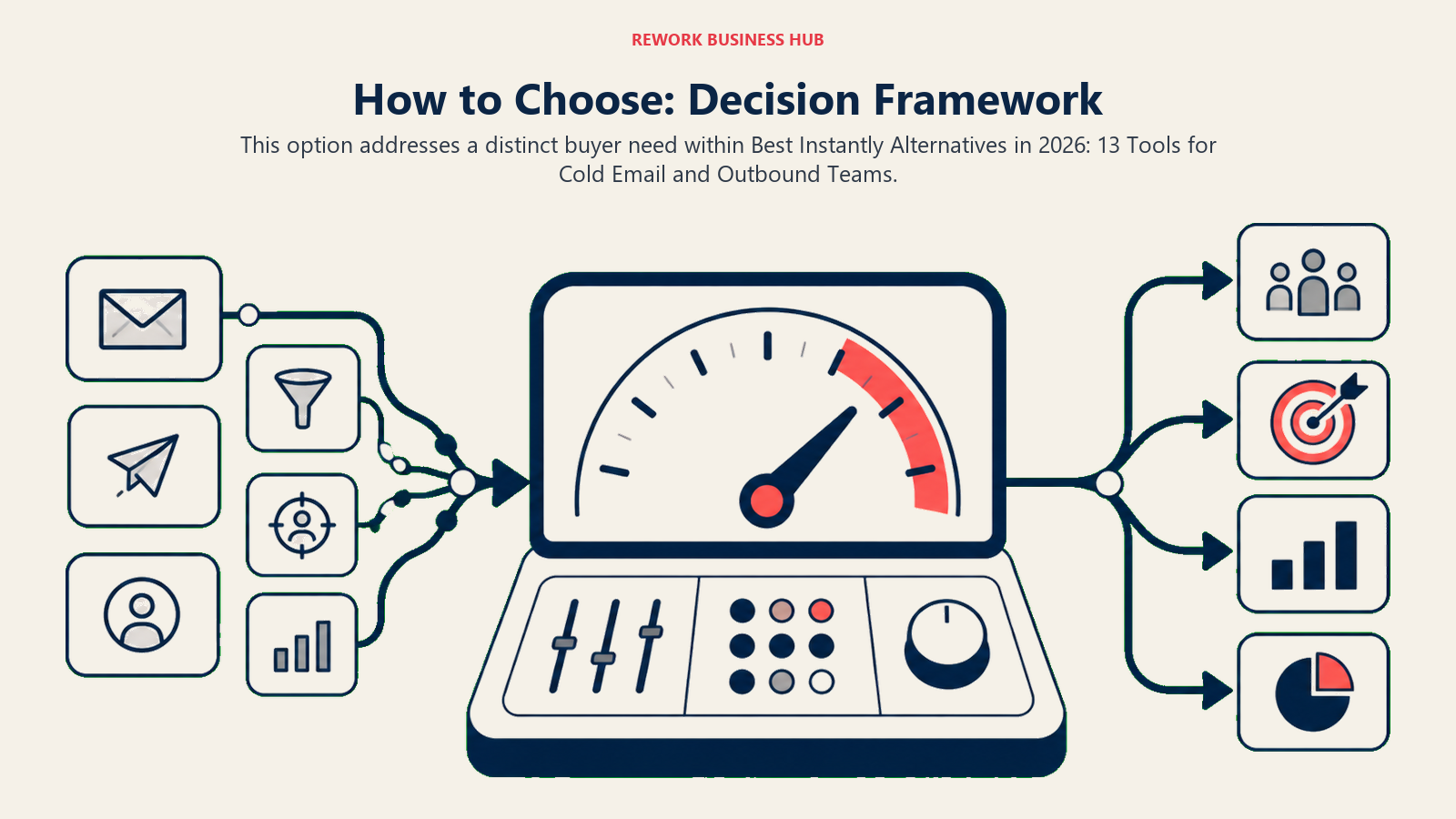
How to Choose: Decision Framework
| If you need... | Pick... | Why |
|---|---|---|
| Outbound tied directly to CRM and deal pipeline with no sync | Rework | Single system: sequences, CRM, pipeline, and ops in one data model |
| Inbox rotation across 50+ sending domains for cold-email agencies | Smartlead or Instantly | Both built specifically for this; warmup and rotation are the core product |
| Email plus LinkedIn plus calling without enterprise pricing | Lemlist or Klenty | Both handle true multichannel at practical per-seat pricing |
| A prospecting database plus sequencing in one subscription | Apollo | 275M contacts; eliminates the separate data vendor line item |
| Month-to-month flexibility while testing outbound | Mailshake or QuickMail | No annual commitment; fast ramp; cancel without penalty |
| High-volume email at a lower advertised base price | Saleshandy | Unlimited email accounts from $25/month; compare total cost with add-ons |
| The richest workflow automation for a large SDR organization | Outreach | Depth and governance at enterprise scale; budget for the commitment |
| Cadence analytics and deal forecasting for mid-market teams | Salesloft | Mature cadence-to-pipeline reporting; factor in Clari bundling |
| Sequences already inside your HubSpot CRM | HubSpot Sales Hub Professional | One login; no sync required; native attribution |
| Personalized multichannel with conditional branching | Lemlist | Cleaner conditional sequencing than most alternatives at the price point |
| Per-team-member billing versus per-seat | QuickMail or Woodpecker | Flat per-campaign or per-slot pricing; whole team uses one plan |
| All outbound and CRM in a single data model for a 5 to 50 team | Rework | No nightly Zapier sync; pipeline context lives where the sequences do |
What to Do Next
Before you book any demos, answer two questions.
First: does your team need outbound to live inside your CRM, or are you comfortable with a standalone sequencer that syncs back? If you want a single system where pipeline context and outbound activity share a data model, Rework is the only mid-market option that delivers that without enterprise pricing. If a clean sync from a standalone tool is fine, Klenty and Lemlist both handle it well at practical per-seat costs.
Second: what's your sending model? If you're running targeted, relationship-led outbound to segmented lists, most tools on this list work. But if you're sending at volume across many domains (agencies, outbound-as-a-service, or high-send-rate acquisition programs), Instantly and Smartlead are engineered for that use case in a way the others aren't. Saleshandy competes there too at a lower headline price, but compare the full cost with infrastructure add-ons before committing.
From there, run a two-week pilot with your actual campaigns. The tool that fits is the one your reps use without being reminded. Not the one with the most impressive live demo.
For more context on where sales engagement sits inside a broader evaluation, the best Reply.io alternatives and best Lemlist alternatives guides cover adjacent buying decisions. And if you're evaluating enterprise options specifically, the best Outreach alternatives and best Salesloft alternatives guides go deeper on that segment.

Principal Product Marketing Strategist
On this page
- Quick Comparison Table
- 1. Rework: Outbound That Lives Inside Your CRM
- 2. Smartlead: Agency-First Cold Email with the Best Inbox Rotation
- 3. Lemlist: Multichannel Personalization Without the Enterprise Price Tag
- 4. Apollo: Prospecting Database Plus Sequencing in One Platform
- 5. Reply.io: Multichannel Sequencing with AI SDR Features
- 6. Woodpecker: Per-Slot Billing for Smaller Outbound Teams
- 7. Saleshandy: High-Volume Email with Unlimited Accounts at a Low Entry Price
- 8. QuickMail: Per-Campaign Pricing with No Per-Seat Charges
- 9. Mailshake: Month-to-Month Flexibility for Teams Testing Outbound
- 10. Klenty: CRM-Native Cadences with Dialer Included
- 11. Outreach: Enterprise Workflow Automation at Scale
- 12. Salesloft: Cadence Analytics and Conversation Intelligence for Mid-Market
- 13. HubSpot Sales Hub: When You're Already in the HubSpot Ecosystem
- Stage Fit Matrix
- Sizing and Persona Table
- How to Choose: Decision Framework
- What to Do Next