Pendo vs Amplitude: Which Product Analytics Platform Fits in 2026?
Turn this article into takeaways for your work.


Each assistant summarizes the article only for you and suggests best practices for your work.
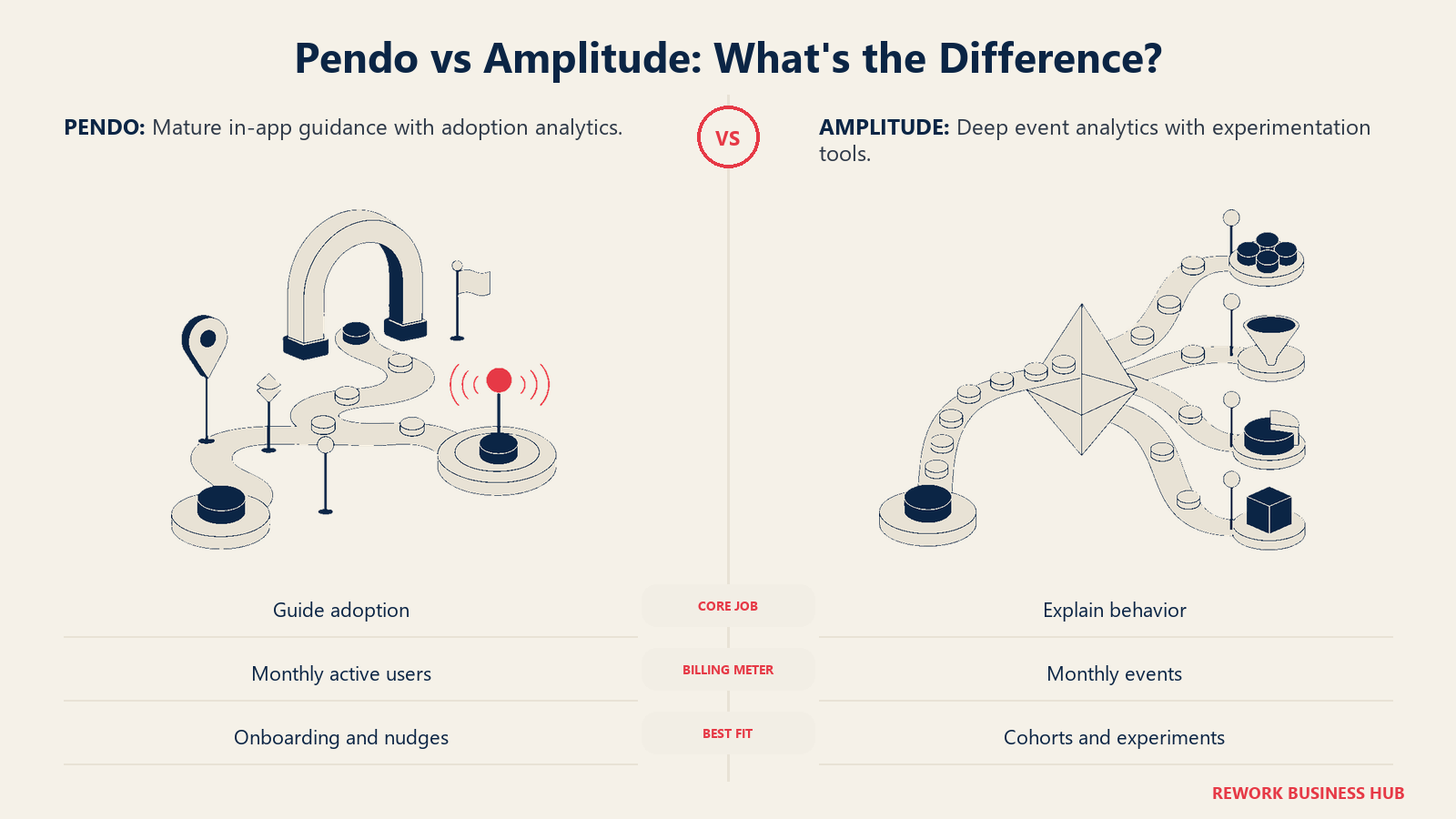
Search "Pendo vs Amplitude" and you mostly get a feature grid that scores both on "analytics depth," as if the two products grew up doing the same job. They did not. Pendo spent its first several years teaching product teams to put a tooltip in front of the right user at the right moment. Amplitude spent its first several years teaching product teams to answer "why did this cohort stop converting." Both are now product analytics platforms in the literal sense, and both now sell in-app guides, session replay, and surveys. That overlap is real, but it is not the same as parity.
Here is the split that actually decides this comparison: Pendo is an in-app engagement platform that added analytics. Amplitude is an analytics engine that added engagement. Each company's added half is genuinely useful, and each company's original half is where ten-plus years of product investment actually lives. The lazy version of this article scores both on the same six categories and calls it a draw. This one tells you honestly which half of each product is competitive and which half is a checkbox, because that is the difference that determines whether you are happy with your choice in month nine.
If you are comparing this pair as one piece of a wider product stack rather than choosing only between these two, the best product management software roundup covers roadmapping, delivery, and analytics tools side by side. And if you landed here because you actually need software to run projects and ship work, not to measure what users do inside a shipped product, that is a different category entirely: see best project management software instead.
TL;DR
| Pendo | Amplitude | |
|---|---|---|
| What it actually is | An in-app engagement platform that grew analytics | An event-analytics engine that grew engagement |
| Its home turf | Guides, walkthroughs, NPS, roadmapping | Event tracking, behavioral cohorts, funnels, retention |
| Free plan | $0, capped at 500 MAU, unlimited web and mobile app keys | $0, capped at 2M events per month, forever, no card |
| Paid pricing | Not published on any tier, "request a demo" only | Plus starts at $0 and scales with usage, up to 70M events |
| Billing axis | Monthly Active Users (MAU) | Events per month |
| Session Replay | Included from Core tier up (most popular tier) | Included on every tier, including a limited Free allotment |
| Guides and Surveys | Original core product, mature, over a decade of investment | Bundled into every tier since a February 2025 launch |
| Experimentation / feature flags | No dedicated product | Feature Experimentation, Web Experimentation, Feature Management |
| AI / agent monitoring | Novus, free beta, no MAU limit | Amplitude AI, AI Agents, Agent Analytics, Amplitude MCP |
| Best for | Teams whose product needs active in-product guidance and habit-building | Teams whose product decisions run on event-level behavioral data |
The Real Split: Whose Added Half Is Actually Competitive
Here is a faster test than any feature grid. Ask your team which report gets opened every Monday. If the answer is a funnel, a retention curve, or a behavioral cohort someone built by chaining three conditions together, you are an Amplitude team by instinct, whether or not you have bought it yet. If the answer is "how many people saw the new-feature tooltip, and did they click through," you are a Pendo team by instinct, and the rest of this article is mostly confirmation.
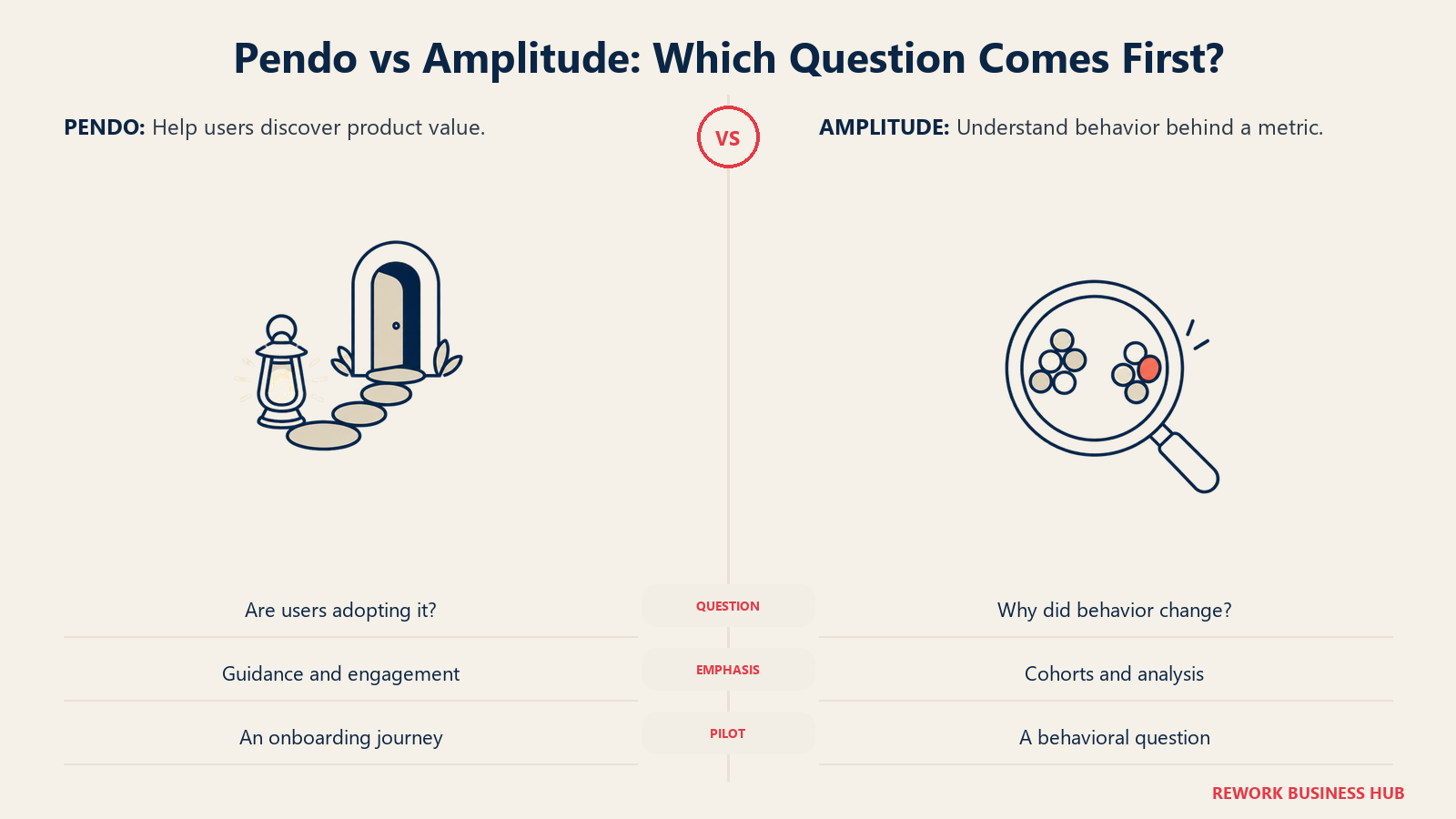
Pendo's own product page still describes its twelve modules the way a company describes its history: Guides and Session Replay and Listen and Orchestrate and Data Sync and Roadmaps sit alongside a single module simply called Analytics. That is one line item among twelve, and it reads that way because Pendo's Analytics was built to answer questions like "is this guide working" and "which features are actually adopted," not to be the general-purpose behavioral data platform a data team would hand custom event schemas to. It is genuinely good at the job it was built for. It is not trying to be Amplitude.
Amplitude runs the opposite way. Its own product navigation groups everything under Analytics and Insights, Experimentation and Testing, AI and Intelligence, and only then, as one category among several, Customer Engagement, which is where Guides and Surveys lives. That product launched in February 2025. It is legitimately useful (behavioral triggering, guardrails against notification fatigue, and surveys are all real, current capabilities) but it is eighteen months old against a Pendo Guides product that has an AI guide builder, deep account-level segmentation, and years of case studies behind it. Neither company hides which half is the original.
That asymmetry is not a knock on either product. It is the actual buying decision. The question worth asking isn't "which one scores higher," it's "which of these two histories matches the problem you actually have." Carry that lens into every section below, because it explains almost every gap you'll find.
Who Each Tool Is Actually Built For
| Pendo | Amplitude | |
|---|---|---|
| Primary buyer | Head of Product, Product Ops, VP Product | Data-driven PM, Growth lead, Analytics engineer |
| Team size sweet spot | Product teams at companies with an active user base to guide | Product and growth teams with an event pipeline already flowing |
| Core job | Drive feature adoption, onboarding, and NPS inside the product | Understand user journeys and prove what moves retention |
| Buying trigger | New users churn before finding value, or nobody can measure feature adoption | Nobody can answer "why" behind a metric without exporting to a spreadsheet |
| What they say six months in | "Adoption went up, our analytics questions still need a second tool" | "Our cohorts are great, in-app guides feel bolted on" |
| Typical failure mode | Treating Pendo Analytics as a replacement for a real data warehouse | Treating Amplitude Guides as a replacement for a mature engagement platform |
Neither buyer is wrong. A Head of Product who wants to ship a tooltip campaign this afternoon and a growth lead who wants to chain three behavioral cohorts together are solving different first problems, even when both eventually want the other half too.
Key Facts
- The average product sees just 6.4% of its features generating 80% of clicks; best-in-class products push that to 15.6%, nearly two and a half times higher, based on Pendo's own analysis across its customer base. (Pendo, 2024 software benchmarks)
- The global product analytics market is valued at $12.37 billion in 2026 and is projected to reach $30.80 billion by 2034, a 12.10% compound annual growth rate. (Fortune Business Insights, Product Analytics Market Report)
- Weekly retention for B2B products ranges from 44.6% to 77.9% globally, based on Amplitude's own 2026 State of Digital Analytics survey of more than 12,000 companies. (Mixpanel, on product-led growth benchmarks)
- Average Net Promoter Score for business software sits around 29, several points below consumer software, with scores of 50 or higher considered exceptional across the software industry. (Pendo, Making Sense of NPS)
In-App Guidance and Onboarding: Pendo's Home Turf
This is the section where the age of each product shows. Pendo Guides supports embedded walkthroughs, tooltips, banners, and modals across both web and mobile, targeted through segmentation that Pendo describes as working "at the user or account level" and powered by the same analytics data the platform already collects. Building one takes no code, and Pendo now offers an AI guide builder, in open beta, that generates a guide from a plain-language prompt through a conversational interface the company calls Leo.
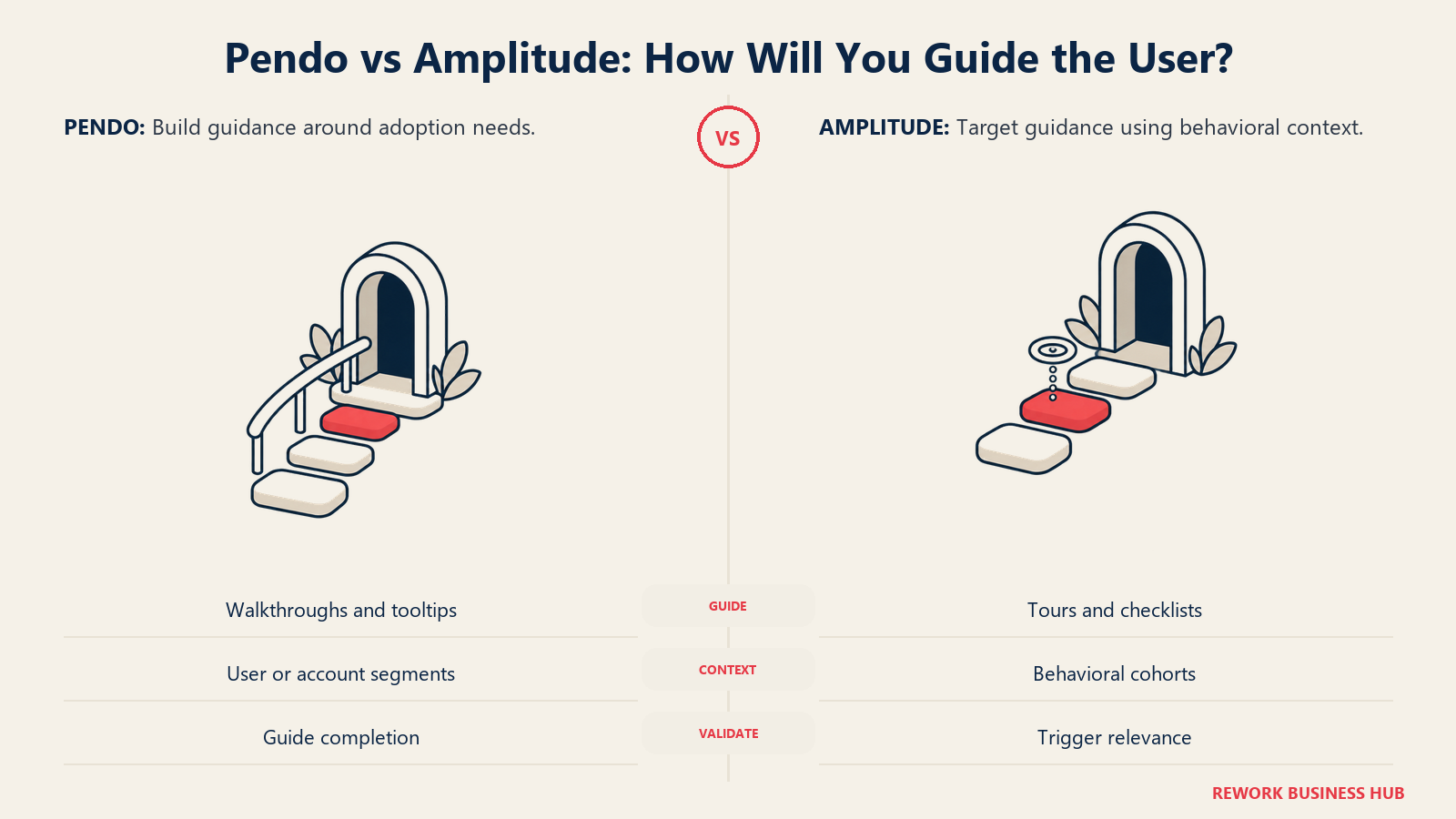
Pendo's own product page backs the pitch with real numbers from customer deployments: guide goal completion up 41% after adding a walkthrough, feature traffic tripling after an announcement guide, and free-to-paid conversion up 28% from a targeted upgrade prompt segment. Those are vendor-reported figures from Pendo's own customers, not independent research, but they are specific and they match what a mature in-app guidance product should be able to show after a decade in market.
Amplitude Guides and Surveys covers similar ground: tours, checklists, announcements, tooltips, banners, and modals, plus NPS, feedback forms, and microsurveys. What makes it distinctive is that targeting runs off the same behavioral cohorts that power Amplitude's analytics, so a guide can trigger off "did X, then didn't do Y within three days" rather than a static rule. Amplitude also ships built-in guardrails that measure user annoyance with nudges so a team doesn't stack five popups on the same session. That is a genuinely smart design, and it is the clearest evidence that Amplitude studied where Pendo already won before entering the category.
| Capability | Pendo | Amplitude |
|---|---|---|
| Guide formats | Tooltips, walkthroughs, embedded guides, banners, modals | Tours, checklists, announcements, tooltips, banners, modals |
| Platform coverage | Web and mobile | Web (mobile coverage more limited) |
| Targeting basis | Analytics and metadata, user or account level | Behavioral cohorts built from tracked events |
| No-code editor | Yes, plus an AI guide builder (beta) | Yes |
| Notification-fatigue controls | Segmentation-based | Built-in guardrails that measure nudge annoyance |
| Time in market | Original core product, over a decade | Launched February 2025 |
| Included on Free plan | Pendo-branded NPS only, no general guides | Guides and Surveys included, limited allotment |
If your product's biggest open question is "are people finding value," Pendo's depth here is the more mature answer. If your product's biggest open question is "trigger a guide the instant this specific behavior happens," Amplitude's behavioral triggering is a real advantage even at eighteen months old.
Product Analytics and Event Data: Amplitude's Home Turf
Flip the origin story and the same honesty applies in reverse. Amplitude's product navigation groups Product Analytics, Marketing Analytics, Session Replay, Heatmaps, and Zoning Insights under one banner, with a separate Experimentation and Testing category sitting next to it. That is the structure of a company that has sold nothing but behavioral data tooling for its entire history, and it shows in the depth: behavioral cohorts (20 included on Plus), advanced behavioral exploration on Growth, formulas, alerts, and heatmaps layered directly onto the event stream.
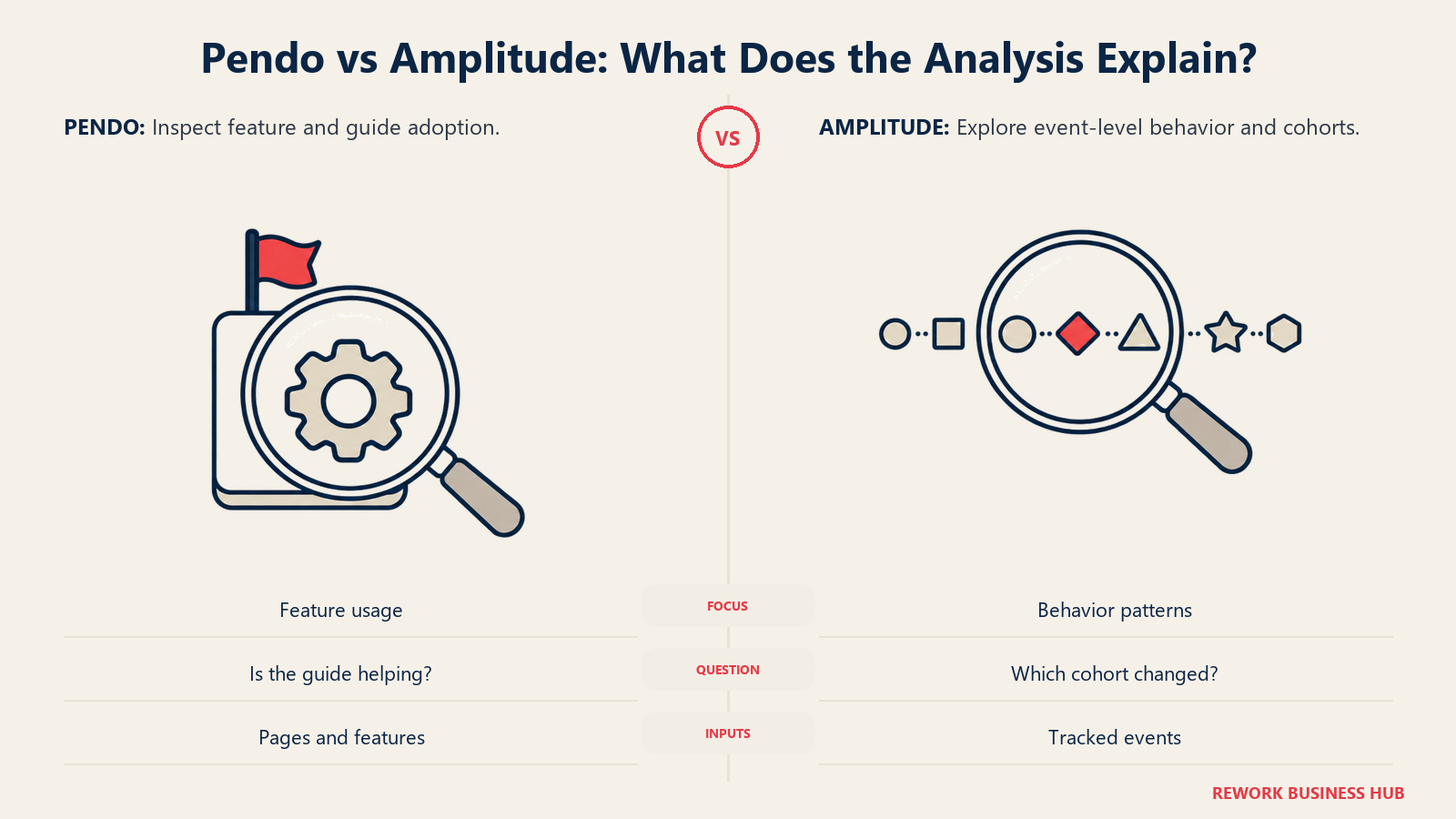
Pendo Analytics answers a narrower, more product-adoption-shaped question well: which features get used, which pages get skipped, and whether a specific guide moved the needle. It is genuinely useful for exactly that job and for teams that don't want to run a second tool just to check feature adoption. It is not built to be the record of truth a data team pipes into a warehouse and builds custom behavioral models on top of, and Pendo does not really market it that way, which is the honest tell.
| Capability | Pendo | Amplitude |
|---|---|---|
| Core data model | Feature, page, and guide-centric usage tracking | Raw event stream, purpose-built for behavioral analysis |
| Behavioral cohorts | Basic segmentation | 20 included on Plus, advanced exploration on Growth |
| Funnels and paths | Yes | Yes, core original capability |
| Retention curves | Yes | Yes, with formulas and custom time windows |
| Marketing-side analytics | Not a distinct product line | Dedicated Marketing Analytics module |
| Where it sits in the product line | One module among twelve | The category the company was named for |
| Best fit | "Is this feature/guide working" | "Why did this metric move, and for whom" |
Both vendors now claim the other's territory on paper. The module count and the marketing structure tell you which one is a decade of investment and which one is a recent, well-executed addition, and that distinction should weigh more than a feature checklist that treats both as equally deep.
Session Replay: Both Have It Now, Neither Invented It
Session Replay is the newest module for both companies, and neither is trying to out-build the dedicated specialists in this category (that would be a different comparison entirely). What matters here is how each replay product sits on top of the platform it was bolted onto. Amplitude describes its Session Replay as visualizing "user sessions based on tracked product events," which means replay quality inherits directly from how well your event instrumentation already works. Pendo's replay runs off the same page and feature tagging its Analytics module already uses, so the two products replay what each one already tracks best: events for Amplitude, tagged pages and features for Pendo.
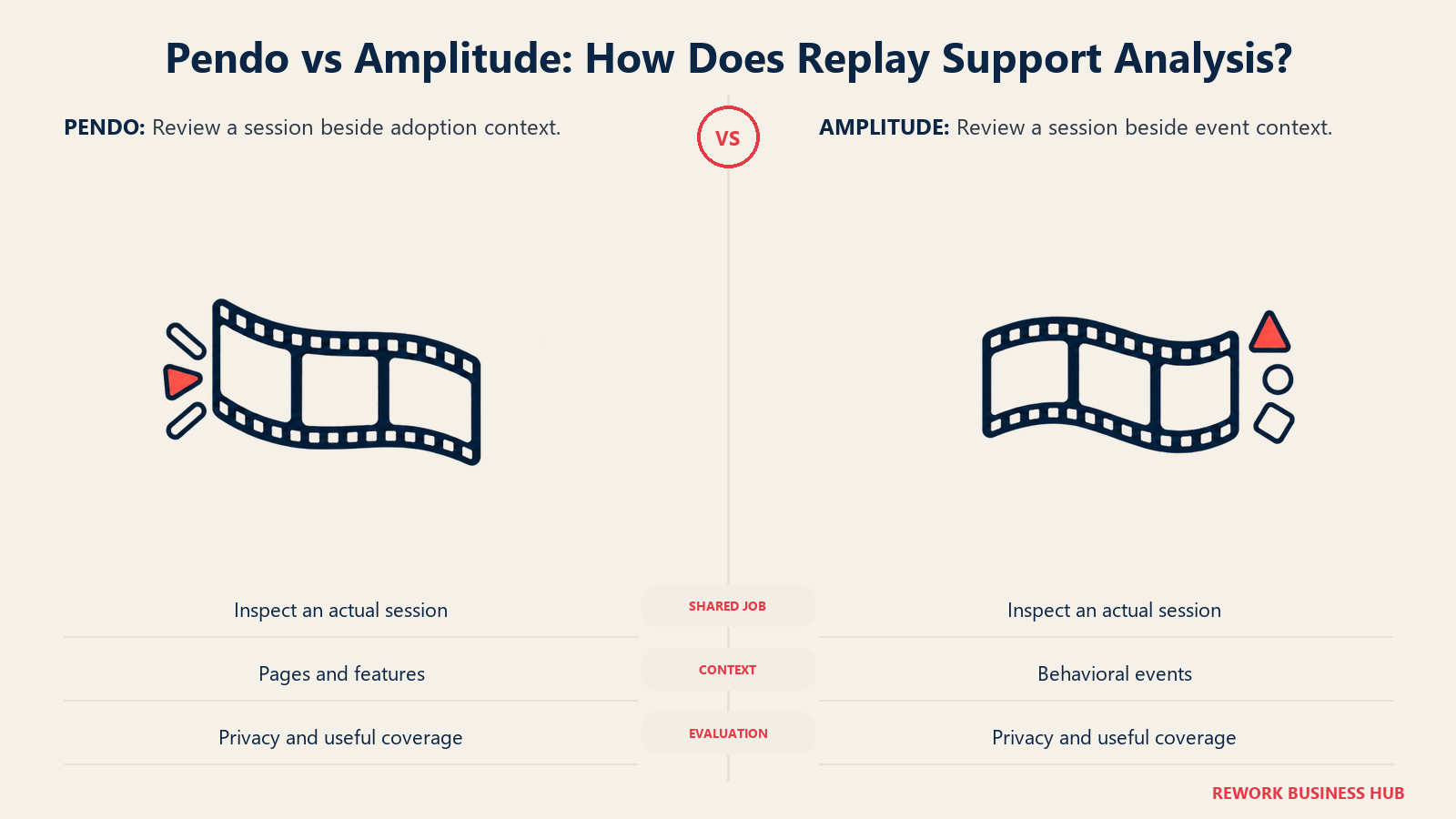
| Session Replay | Pendo | Amplitude |
|---|---|---|
| Tier availability | Core and above (Core is Pendo's "most popular" tier) | Every tier, including Free |
| Free tier allotment | Not included on Free | Included, limited monthly allotment |
| Growth-equivalent tier | Not published | 20,000 monthly session replays |
| Top-tier allotment | Not published | 50,000 monthly session replays on Enterprise |
| Replay basis | Tagged pages and features | Tracked product events |
Neither company built Session Replay to be a headline reason to switch. Treat it as a genuine convenience that removes a third tool from your stack in either direction, not as a deciding factor on its own.
Feedback, Surveys, and Voice of Customer
Pendo's NPS is Pendo-branded and included even on the free plan, which is a real advantage for a team that just wants a basic pulse without a separate budget line. Sentiment surveys, deeper qualitative analysis, and Listen, Pendo's AI-powered feedback aggregation product, are reserved for the Ultimate tier. Amplitude folds NPS, feedback forms, and microsurveys into the same Guides and Surveys product covered above, plus a separate AI Feedback module built specifically to distill open-ended customer input into themes.
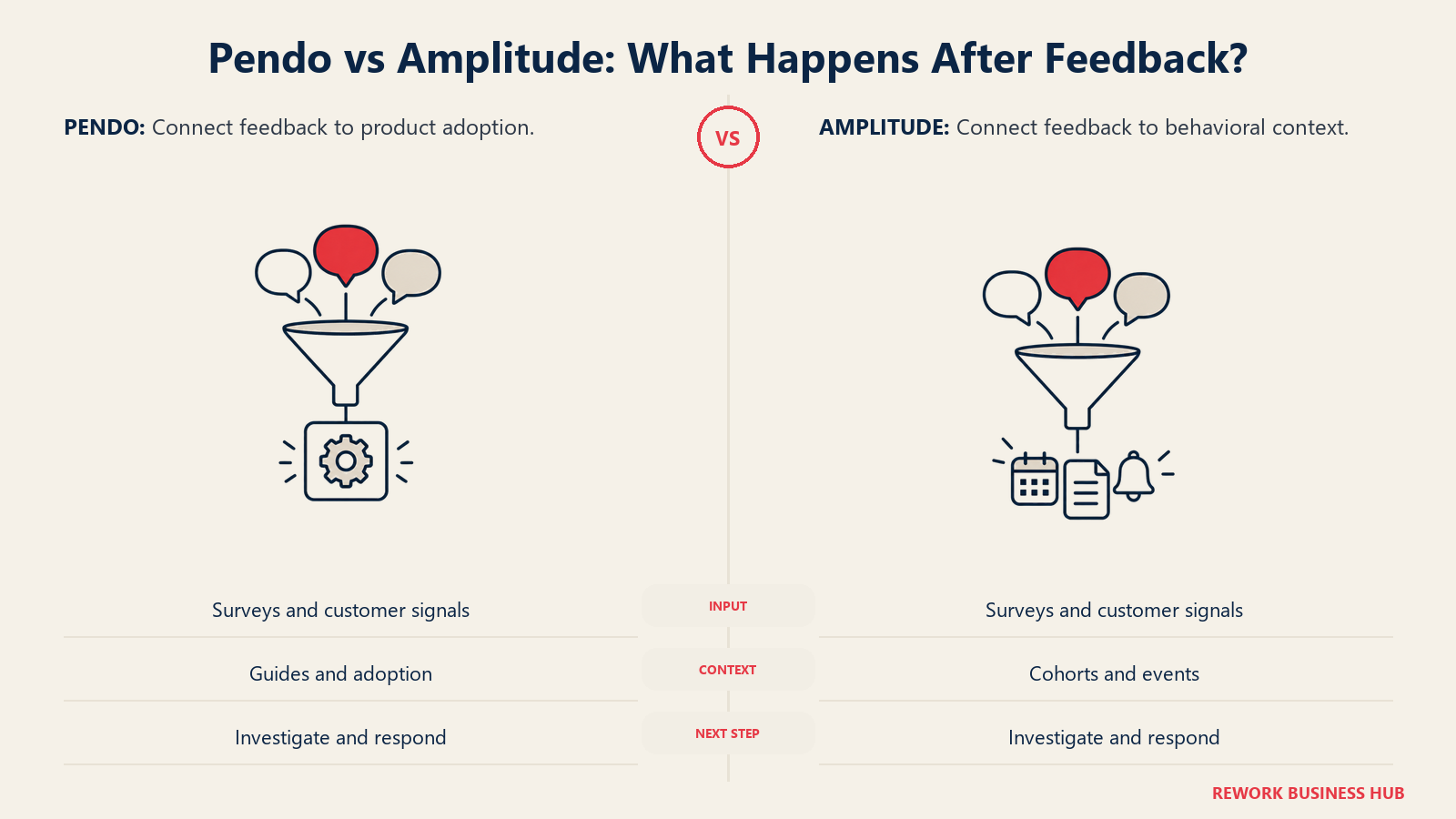
With an industry average business-software NPS sitting around 29, and 50 or higher considered exceptional, the number itself matters less than what you do after collecting it: both platforms can trigger a follow-up guide off a low score, which is the actual point of putting NPS inside a product analytics tool instead of a standalone survey product.
Neither platform is built to be a public-facing feedback board that customers browse and vote on. If that specific job (a roadmap customers can see and upvote) is the real requirement, that is a different tool category entirely; see best Canny alternatives for that shortlist rather than trying to bend either platform into it.
| Capability | Pendo | Amplitude |
|---|---|---|
| NPS on Free plan | Yes, Pendo-branded | Included as part of Guides and Surveys, limited |
| Sentiment analysis | Ultimate tier | Part of AI Feedback module |
| AI-powered feedback aggregation | Listen (Ultimate) | AI Feedback module |
| Public voting board | Not a native feature | Not a native feature |
Experimentation and Feature Management: Amplitude's Extra Half
This is the category where the origin-story asymmetry is starkest. Amplitude sells Feature Experimentation, Web Experimentation, and Feature Management as three distinct, mature products: A/B testing, targeted feature rollouts, and flag-based release control, all wired directly into the same event data the rest of the platform already collects. That is a serious second product line with years of independent investment behind it, not a checkbox added to compete on a feature grid.
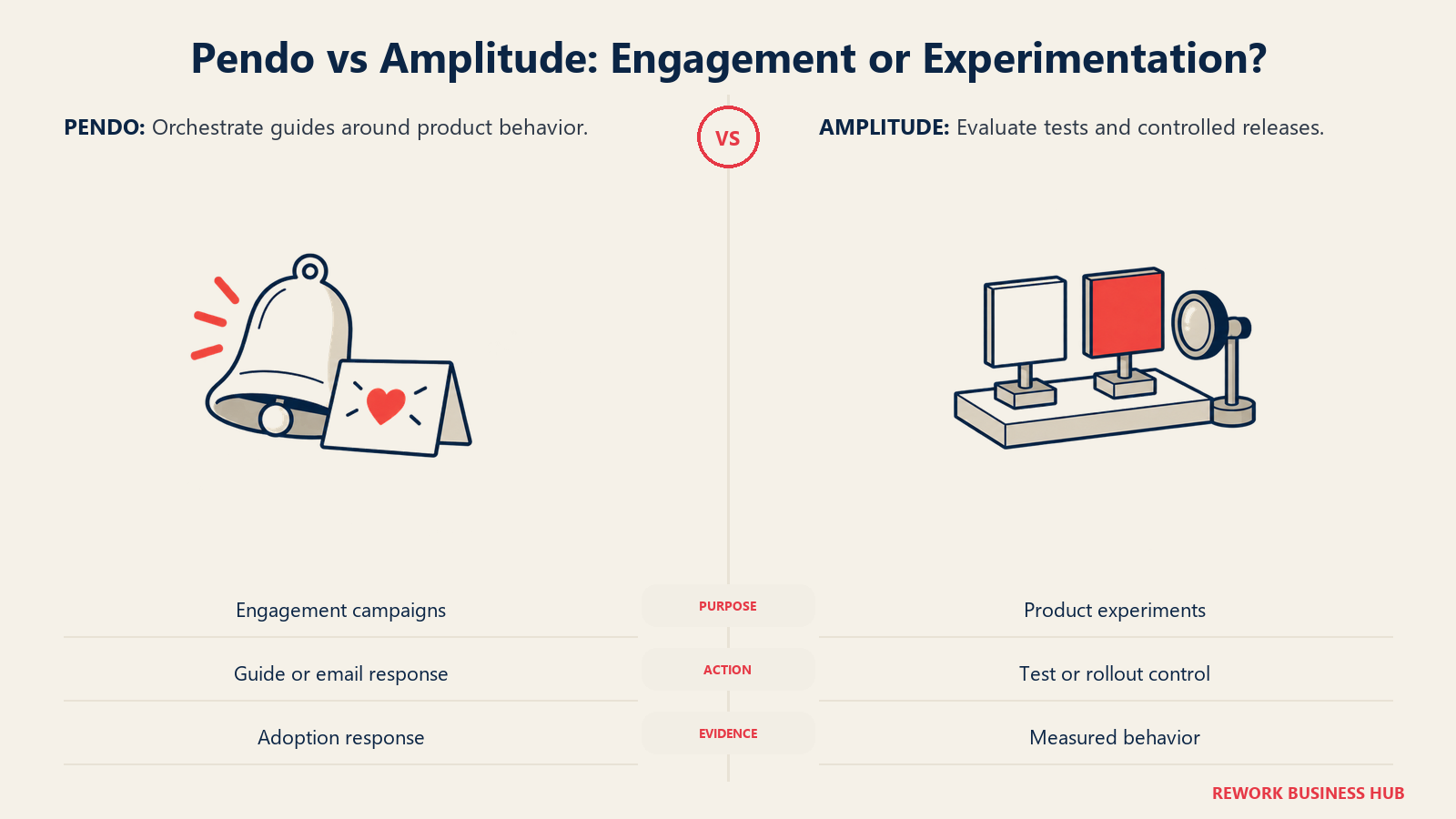
Pendo has no equivalent. Its closest adjacent product, Orchestrate, triggers in-app guides and emails off product data and user behavior, which is genuinely useful for engagement campaigns but is not an A/B testing or feature-flagging product in any real sense. If experimentation and progressive feature rollout are part of your actual workflow, that gap is not a rounding error; it is a second tool you will need regardless of which platform you pick for guidance and analytics.
| Capability | Pendo | Amplitude |
|---|---|---|
| A/B testing | No dedicated product | Feature Experimentation, Web Experimentation |
| Feature flags and rollouts | No | Feature Management |
| Data-triggered guide/email orchestration | Orchestrate | Overlaps with behavioral guide triggering |
| Maturity of experimentation line | Not applicable | Established, multi-year product line |
AI and Agent Monitoring: The Newest Shared Battleground
Both companies are racing into the same new category at almost the same time, and it is early enough that neither has a durable edge yet. Pendo's answer is Novus, a continuous product-monitoring product that watches AI agent adoption and impact, proactively surfaces recommendations in Slack, and can generate pull requests automatically, with auto-instrumentation via GitHub. It's free during its beta, with no MAU limit, which is a meaningful signal about how much Pendo wants adoption data on this category before it prices it.
Amplitude's parallel effort spans several products at once: Amplitude AI for automated insight generation, AI Agents built to "sense, decide, and act," a dedicated Agent Analytics module that measures the real-world impact of deployed agents, and Amplitude MCP, which surfaces Amplitude data inside whatever AI tools your team already uses.
| AI capability | Pendo | Amplitude |
|---|---|---|
| Monitor AI agent adoption/impact | Novus (free beta, no MAU limit) | Agent Analytics |
| In-product AI assistant | Leo (guide creation) | Amplitude AI |
| Autonomous action-taking | AI-generated PRs via Novus | AI Agents |
| Access data through external AI tools | Not published | Amplitude MCP |
| Category maturity | New, beta pricing | New, actively expanding |
Neither vendor has years of proof here the way they do in their original category. Judge this section as a roadmap signal, not a deciding factor, and revisit it in a year.
Pricing: A Transparent Ladder Against a Wall of "Request a Demo"
This is the part of the comparison most articles rush past, and it is the part that should actually change your evaluation timeline. Amplitude publishes real numbers on its pricing page for every tier except the top two: Free is $0 with a published 2M-events-per-month cap, forever, no card required. Plus "starts at $0" and scales with usage up to 70M events, so you can estimate your bill before you talk to anyone. Growth and Enterprise are custom and event-based, but the axis they price on is the same one you've already been billed on since Free.
Pendo publishes nothing for any paid tier. Base (Analytics plus Guides), Core (adds Session Replay, and is marked "most popular" on Pendo's own pricing page), and Ultimate (adds sentiment surveys, Orchestrate, Listen, and Data Sync) are all listed as "custom pricing, request a demo." Only Pendo's Free plan, capped at 500 MAU with unlimited web and mobile app keys, has a real number attached to it. Pendo also lists Novus, its new AI monitoring product, as free during beta with no MAU limit.
That asymmetry is a real buying factor on its own, not a footnote. A transparent usage-based ladder lets a team self-serve a budget estimate, compare it against a competitor's published number, and walk into a renewal conversation already knowing roughly where the next tier lands. A "request a demo" wall means every quote is negotiated individually, procurement takes longer by default, and you cannot sanity-check what you're being offered against a public number the way you can with Amplitude. If dollar figures you've seen quoted for Pendo don't match anything on this page, that's because they came from a third party rather than Pendo itself; treat any number you see attributed to Pendo's paid tiers as unverified unless it's followed by a link to pendo.io.
| Plan | Pendo | Amplitude |
|---|---|---|
| Free | $0, 500 MAU, unlimited web/mobile app keys | $0, 2M events/month, forever, no card |
| Entry paid tier | Base, custom pricing, request a demo | Plus, starts at $0, scales with usage to 70M events |
| Mid tier | Core (most popular), custom pricing, request a demo | Growth, custom, event-based |
| Top tier | Ultimate, custom pricing, request a demo | Enterprise, custom, event-based |
| Billed monthly or annually | Not disclosed on any paid tier | Not broken out separately; usage-based |
| New AI product | Novus, free beta, no MAU limit | Bundled into every existing tier |
The Two Billing Axes Aren't Comparable, and That Changes Who's "Cheap"
Pendo bills on Monthly Active Users. Amplitude bills on events per month. Those sound like two ways of measuring the same thing, and they are not, which means a product that looks cheap on one platform can look expensive on the other, purely based on how your users behave.
Take a "power tool" with few users but heavy, dense usage: 300 monthly active users, each firing roughly 400 tracked events a day across 22 working days. That's 300 × 400 × 22, or 2.64 million events a month. On Pendo's MAU axis, 300 users sits comfortably under the 500 MAU free cap, so this product stays free indefinitely. On Amplitude's event axis, 2.64 million events blows past the 2M free ceiling almost immediately, pushing the same product onto a paid Plus bill.
Now flip it: a "reach tool" with many users but light, occasional usage: 5,000 monthly active users who each fire around 10 events a month, a consumer-style app people check briefly and rarely. That's 50,000 events a month. On Amplitude's axis, 50,000 events is nowhere near the 2M cap, so it stays free. On Pendo's axis, 5,000 MAU is ten times the 500 MAU free ceiling, which forces this same product straight into "request a demo" territory.
| Illustration | Monthly active users | Monthly events | Stays free on Pendo (500 MAU cap)? | Stays free on Amplitude (2M events cap)? |
|---|---|---|---|---|
| Power tool: few users, dense usage | 300 | ~2,640,000 | Yes | No |
| Reach tool: many users, light usage | 5,000 | ~50,000 | No | Yes |
Model your own product against both axes before you compare a single headline number. A team that assumes "we're small, we'll be free on either" can be wrong in either direction depending on whether their product is used a little by a lot of people, or a lot by a few.
When Pendo Is the Right Call
- Your biggest open question is adoption, not causation. You need to know whether people find and use what you shipped, not run a five-condition cohort query to explain why.
- In-app guidance is core to your product-led motion. A decade of guide-editor depth, account-level targeting, and an AI guide builder is hard to match with an eighteen-month-old add-on.
- You want NPS on the free plan. No other module here ships a usable, branded survey at $0.
- You'd rather trade analytics depth for a single vendor across guides, roadmapping, and feedback. Twelve modules under one login is a real simplification if you don't need deep behavioral analytics.
- Your product has relatively few, highly engaged users. The MAU-based free tier rewards exactly that usage shape, as the worked illustration above shows.
When Amplitude Is the Right Call
- Your team already lives in cohorts, funnels, and retention curves. This is the platform's original, decade-plus discipline, not a bolted-on module.
- You need real experimentation and feature flagging. Feature Experimentation, Web Experimentation, and Feature Management are mature products with no Pendo equivalent at all.
- You want a transparent, self-serve pricing ladder. You can estimate your bill from the public pricing page instead of waiting on a custom quote for every tier above Free.
- Your product has many users with light, occasional usage. The event-based free tier rewards that shape, and the worked illustration above shows exactly why.
- You want guides and surveys triggered by real behavior, not just a static rule. Amplitude's behavioral-cohort targeting for Guides and Surveys is a genuine advantage even this early.
Decision Framework
| If this is you | Pick |
|---|---|
| Your core question is "are people finding value in what we shipped" | Pendo |
| Your core question is "why did this metric move, and for whom" | Amplitude |
| You need A/B testing or feature flags in the same platform | Amplitude |
| You want NPS included on a free plan | Pendo |
| Your product has few users with dense, heavy usage | Pendo (MAU-based free tier favors this) |
| Your product has many users with light, occasional usage | Amplitude (event-based free tier favors this) |
| You need a transparent, self-serve pricing estimate before talking to sales | Amplitude |
| You've ruled Pendo out and want the wider shortlist | See best Pendo alternatives |
| You actually need dedicated roadmapping, not engagement analytics | See best Productboard alternatives or best Aha! alternatives |
What to Do Next
- Model both billing axes against your actual usage, not your headcount. Pull your last 30 days of MAU and estimated event volume and run both through the free-tier caps above before assuming either platform is "the cheap one."
- Name which half of the product you actually need this year. If it's guidance and adoption, weight Pendo's decade of depth there heavily. If it's cohort-level causation and experimentation, weight Amplitude's original discipline the same way.
- Get a real quote from Pendo before you compare numbers. Because nothing paid is published, any dollar figure you've seen elsewhere is not vendor-confirmed; request a demo and get the actual number in writing.
- Decide whether you need a second tool anyway. Neither platform is a dedicated experimentation suite, a dedicated session-replay specialist, or a public feedback board, and pretending otherwise is how teams end up disappointed in month nine.
Frequently Asked Questions about Pendo vs Amplitude
Is Pendo or Amplitude better for product analytics?
Amplitude, if "analytics" means behavioral cohorts, funnels, and retention curves built on a raw event stream, which is the discipline the company has sold for its entire history. Pendo's Analytics module is genuinely useful for adoption-focused questions like feature usage and guide performance, but it sits as one module among twelve rather than the company's core product, and it isn't marketed as a general-purpose data platform.
What does Amplitude's free plan actually include?
2 million events per month, forever, with no card required, and it now bundles the full platform: Analytics, a limited Session Replay allotment, limited Experimentation, Guides and Surveys (limited), Activation, and Amplitude AI. This is a change from older versions of Amplitude's pricing, which billed on Monthly Tracked Users rather than events.
Does Pendo publish pricing for its paid plans?
No. Pendo's Free plan is the only tier with a published number, capped at 500 monthly active users. Base, Core, and Ultimate are all listed as custom pricing with "request a demo" as the only call to action. Any specific dollar figure you've seen for a Pendo paid tier came from a third party, not Pendo's own pricing page.
Can Pendo and Amplitude be used together?
Some teams do run both, typically Amplitude as the analytics system of record and Pendo for in-app guidance, though that means paying two vendors for the overlap that now exists in session replay and surveys. Most teams are better served picking the one whose original discipline matches their bigger open question, then adding a narrow point solution only for the specific gap that remains.
Which tool is better for in-app onboarding and guides?
Pendo, on maturity. Its Guides product has over a decade of investment, an AI guide builder, and account-level targeting, backed by its own reported results like a 41% lift in guide goal completion. Amplitude's Guides and Surveys, launched in February 2025, is a real and growing product with a genuine advantage in behavior-triggered targeting, but it's eighteen months old against a much deeper incumbent.
Why does one product bill by users and the other by events?
Because they were built to measure different things first. Pendo's Monthly Active User model grew out of tracking who is being guided and adopting features. Amplitude's event model grew out of tracking what people do, which only makes sense measured as a stream of actions. Neither axis is objectively cheaper; a product with few, heavily engaged users and a product with many, lightly engaged users land on opposite sides depending on which platform is doing the counting.
Related Resources:

Customer Success Operations Manager
On this page
- TL;DR
- The Real Split: Whose Added Half Is Actually Competitive
- Who Each Tool Is Actually Built For
- Key Facts
- In-App Guidance and Onboarding: Pendo's Home Turf
- Product Analytics and Event Data: Amplitude's Home Turf
- Session Replay: Both Have It Now, Neither Invented It
- Feedback, Surveys, and Voice of Customer
- Experimentation and Feature Management: Amplitude's Extra Half
- AI and Agent Monitoring: The Newest Shared Battleground
- Pricing: A Transparent Ladder Against a Wall of "Request a Demo"
- The Two Billing Axes Aren't Comparable, and That Changes Who's "Cheap"
- When Pendo Is the Right Call
- When Amplitude Is the Right Call
- Decision Framework
- What to Do Next