Best Mattermost Alternatives in 2026: 13 Self-Hosted and Cloud Chat Tools
Turn this article into takeaways for your work.


Each assistant summarizes the article only for you and suggests best practices for your work.
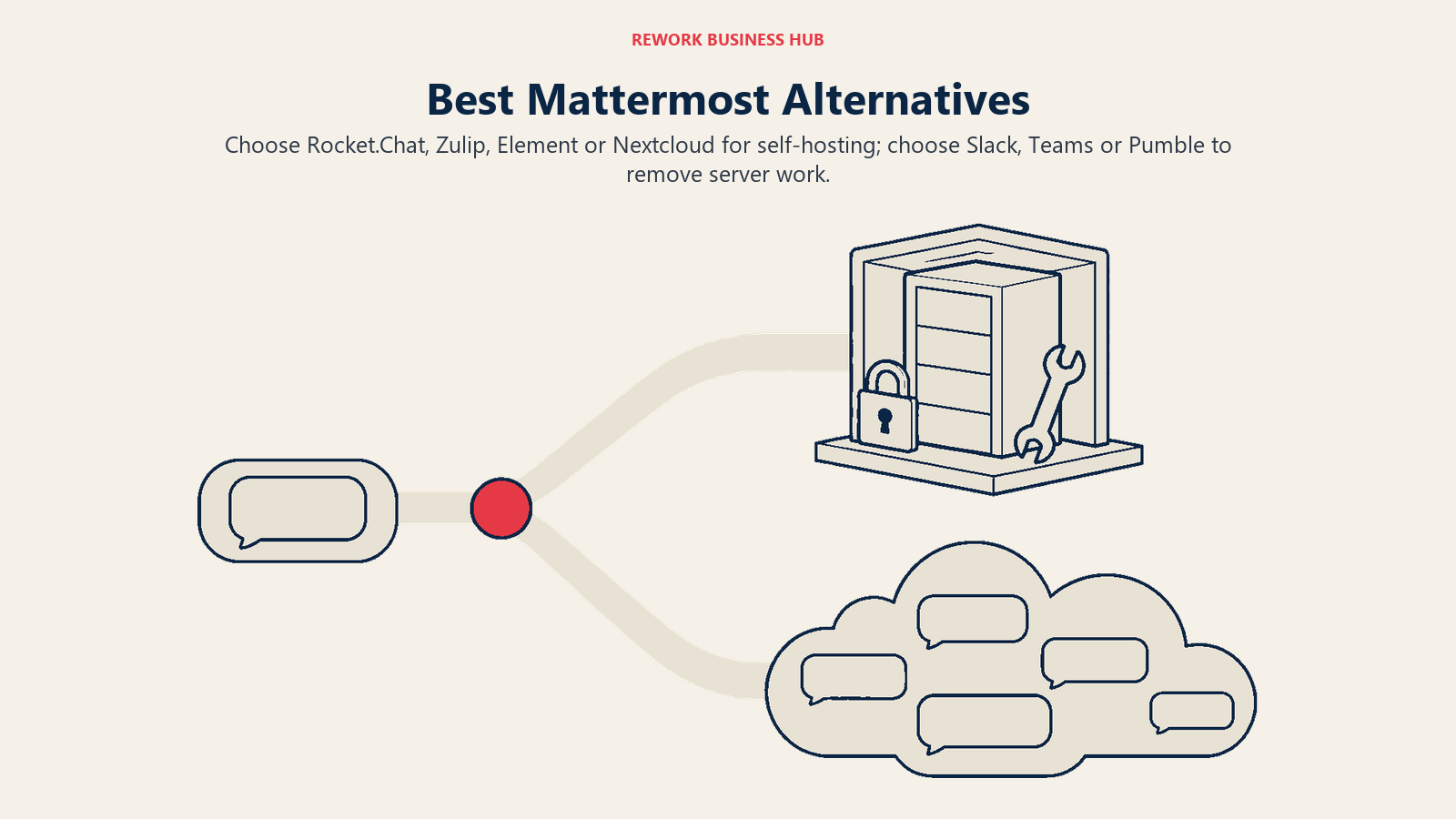
The best Mattermost alternatives in 2026 split into two real categories: self-hosted tools for teams that need air-gapped or on-premise control (Rocket.Chat, Zulip, Element, Nextcloud Talk, Wire), and cloud tools for teams that just want the IT lift gone (Slack, Microsoft Teams, Google Chat, Zoho Cliq, Pumble, Discord, Twist), plus Rework for teams consolidating chat with a broader ops platform. All 13 are evaluated on deployment model, licensing, and pricing.
If you're searching for Mattermost alternatives, you're probably not a generic chat shopper. You're the person who got told to evaluate self-hosting, air-gapped deployment, or a specific compliance requirement, or you hit one of Mattermost's real friction points: the free Entry edition's server-wide caps, Team Edition's missing SSO, the IT lift of running your own instance, or the fact that Mattermost no longer publishes a price for any paid tier, which means budgeting starts with a sales call. This guide treats those two readers differently instead of pretending a self-hostable open-source tool and a managed cloud SaaS are interchangeable just because they both have channels and threads. For the buyer-research process behind a decision like this, how to choose team chat software walks through the evaluation criteria in more depth than a single roundup can.
Key Facts
- 61% of Western European CIOs and IT leaders say geopolitics will push them toward local or regional cloud providers, and 55% plan to expand their use of open-source software, per a Gartner survey reported by Computerworld.
- Gartner forecasts that by 2030, more than 75% of enterprises outside the US will have a digital sovereignty strategy built on local or regional cloud usage, per the same Computerworld coverage of the Gartner survey.
- The average healthcare data breach cost $7.42 million in 2025, the most expensive of any industry for the 14th year running, per IBM's Cost of a Data Breach Report as summarized by HIPAA Journal.
Quick Comparison Table
| Tool | Best For | Starting Price | Key Strength | Key Limitation |
|---|---|---|---|---|
| Rocket.Chat | Self-hosted teams needing full control | Community: free, self-hosted (Starter free tier caps at 50 users) | Open-source, omnichannel, full data control | No published price above the Starter cap; needs DevOps to run |
| Zulip | Technical teams that want topic-threaded chat | Cloud Free; self-hosted Basic $3.50/user/mo; Cloud Standard $6.67/user/mo annual | SSO included on every self-hosted tier, unique topic threading | Learning curve for teams used to flat channels |
| Element (Matrix) | Federated, sovereignty-first messaging | Community: free, self-hosted | Matrix protocol federation, E2E encryption by default | No published Enterprise price; complex setup |
| Slack | Teams that want the biggest integration library | Free (90-day history); Pro $7.25/user/mo annual | Huge app ecosystem, polished UX | Per-seat cost climbs fast; no self-hosting option |
| Microsoft Teams | Microsoft 365 shops needing compliance depth | Teams Essentials $4/user/mo, paid yearly | Deep Office 365 integration, enterprise compliance | Heavy client; no self-hosted or air-gapped deployment |
| Rework | Mid-size teams consolidating chat with CRM and ops | Quote on request (rework.com/pricing) | Chat sits next to CRM, tasks, and workflow records | No self-hosted or air-gapped deployment; not sovereignty-focused |
| Nextcloud Talk | Self-hosted teams wanting chat inside a full open-source workspace | Free, open source, self-hosted | Bundled with file sync, calendar, and docs | Talk alone is a smaller feature set than the full file suite |
| Wire | Enterprises needing E2E encryption at every deployment tier | Free (up to 5 people); SMB EUR7.45/person/mo annual | E2E encrypted everywhere, on-prem and air-gapped Enterprise option | SMB tier caps at 100 people; Enterprise is custom-quoted |
| Zoho Cliq | Zoho-ecosystem teams on a budget | Free (100 participants/chat); Professional $1.80/user/mo (10-user min) | SAML SSO included even on the free plan | Standard tier is a flat 25-user bundle, awkward past that |
| Pumble | Budget teams needing unlimited free history | Free (unlimited users and history); Pro $2.49/seat/mo annual | Unlimited message history and users on the free plan | No self-hosting; thin automation and integrations |
| Discord | Startups and dev teams wanting free voice channels | Free; Nitro from $2.99/month (personal, not a business seat) | Generous free tier, best-in-class voice channels | No SSO, DLP, or admin compliance controls |
| Google Chat | Google Workspace teams | Business Starter $7/user/mo (promo $3.50 first 12 months) | Native Docs, Drive, and Meet integration | No self-hosting; thin value outside the Google ecosystem |
| Twist | Async-first distributed teams | Free (1-month history); Unlimited $6/user/mo | Thread-only format kills notification noise | Not built for real-time or incident-response workflows |
Self-Hosting and Deployment Matrix
This is the table most Mattermost searchers actually need. "Self-hosted" and "open source" are not the same claim, and neither guarantees SSO on the free tier.
| Tool | Self-Hosted | Air-Gapped Capable | Open-Source License | SSO on Free Tier |
|---|---|---|---|---|
| Rocket.Chat | Yes (Community) | Yes | Yes (MIT, Community edition) | Yes, via the free Starter plan (capped at 50 users) |
| Zulip | Yes (self-hosted Free) | Yes | Yes (Apache 2.0) | Yes, SAML ships on every self-hosted tier, including Free |
| Element (Matrix) | Yes (Community) | Yes | Yes (AGPLv3) | Basic SSO yes; advanced identity and RBAC needs paid ESS Pro |
| Slack | No | No | No | No (SSO requires Business+ or Enterprise+) |
| Microsoft Teams | No | No | No | Identity tied to Microsoft Entra ID from Business Basic; no separate free-tier SSO |
| Rework | No | No | No | No free tier; not built for sovereignty-driven deployment |
| Nextcloud Talk | Yes (open source, AGPL) | Yes | Yes | Yes, via self-managed SSO/SAML apps |
| Wire | Enterprise tier only (custom deployment) | Yes, at Enterprise tier | No (proprietary, E2EE by default) | SSO and SCIM ship on Enterprise, not the SMB tier |
| Zoho Cliq | No | No | No | Yes, SAML SSO is included from the Free plan |
| Pumble | No | No | No | No |
| Discord | No | No | No | No |
| Google Chat | No | No | No | No free tier; SSO via the Workspace admin console from Business Standard |
| Twist | No | No | No | No |
Stage Fit Matrix
| Tool | Startup (1-20) | Growth Stage (20-100) | Mid-Market (100-500) | Enterprise (500+) |
|---|---|---|---|---|
| Rocket.Chat | Possible | Good fit | Strong fit | Good fit |
| Zulip | Good fit | Strong fit | Good fit | Possible |
| Element | Possible | Good fit | Strong fit | Primary target (government/defense) |
| Slack | Good fit | Strong fit | Good fit | Possible (cost) |
| Microsoft Teams | Overkill | Possible | Good fit | Primary target |
| Rework | Not ideal | Strong fit | Primary target | Selective fit |
| Nextcloud Talk | Possible | Good fit | Strong fit | Good fit |
| Wire | Possible | Good fit | Good fit | Strong fit (Enterprise tier) |
| Zoho Cliq | Strong fit | Good fit | Possible | Not ideal |
| Pumble | Primary target | Good fit | Possible | Not ideal |
| Discord | Primary target | Good fit | Possible (culture fit) | Not recommended |
| Google Chat | Good fit | Good fit | Good fit | Limited (compliance depth) |
| Twist | Primary target | Good fit | Good fit | Possible |
Sizing and Persona Table
| Tool | Team Size Sweet Spot | Primary Buyer Persona | Secondary Buyer |
|---|---|---|---|
| Rocket.Chat | 20-500 | IT Manager, Security Lead, DevOps | COO, Compliance Officer |
| Zulip | 10-500 | Engineering Lead, DevOps | IT Manager |
| Element | 20-1,000 | CISO, IT Director, Government/Defense Buyer | Compliance Officer |
| Slack | 5-2,000 | Head of Ops, IT Manager | Any department lead |
| Microsoft Teams | 100-10,000+ | IT Director, CIO, IT Procurement | Department Heads |
| Rework | 10-200 | COO, Head of Ops, RevOps Director | IT Manager |
| Nextcloud Talk | 20-500 | IT Manager, Sysadmin | Compliance Officer |
| Wire | 20-1,000 | CISO, Legal/Compliance, Government Buyer | IT Director |
| Zoho Cliq | 5-250 | Founder, Ops Manager (Zoho-stack teams) | IT Admin |
| Pumble | 2-200 | Founder, Budget Owner | Team Lead |
| Discord | 2-100 | Founder, Dev Lead, Community Manager | Engineering Manager |
| Google Chat | 10-1,000 | IT Admin, Office Manager | Any Google Workspace team |
| Twist | 5-150 | Founder, Remote Team Lead, Head of Async | COO, HR Director |
1. Rocket.Chat: Open Source With Full Control, If You Have the DevOps to Run It
Rocket.Chat is the most direct open-source competitor to Mattermost, and it carries the same famous-free-tier trap. Community edition is free, open source (MIT), and self-hosted, with no user cap. The Starter plan is also free and includes premium features (AD/LDAP, SSO, MFA, RBAC, E2E encryption, retention, DLP, moderation), but it's capped at 50 users. Exceed 50 and, per Rocket.Chat's own plan documentation, the workspace is restricted from adding new users while existing users and data remain accessible. Beyond that, Commercial, Government, and Defense plans are all "Get pricing," with no published number.
For teams that already run Mattermost self-hosted, Rocket.Chat is the closest lateral move: omnichannel routing (so customer-facing chat and internal messaging live in the same system), a marketplace of extensions, and REST APIs for custom integrations. See Mattermost vs Rocket.Chat for a direct feature-by-feature breakdown if these two are your actual shortlist.
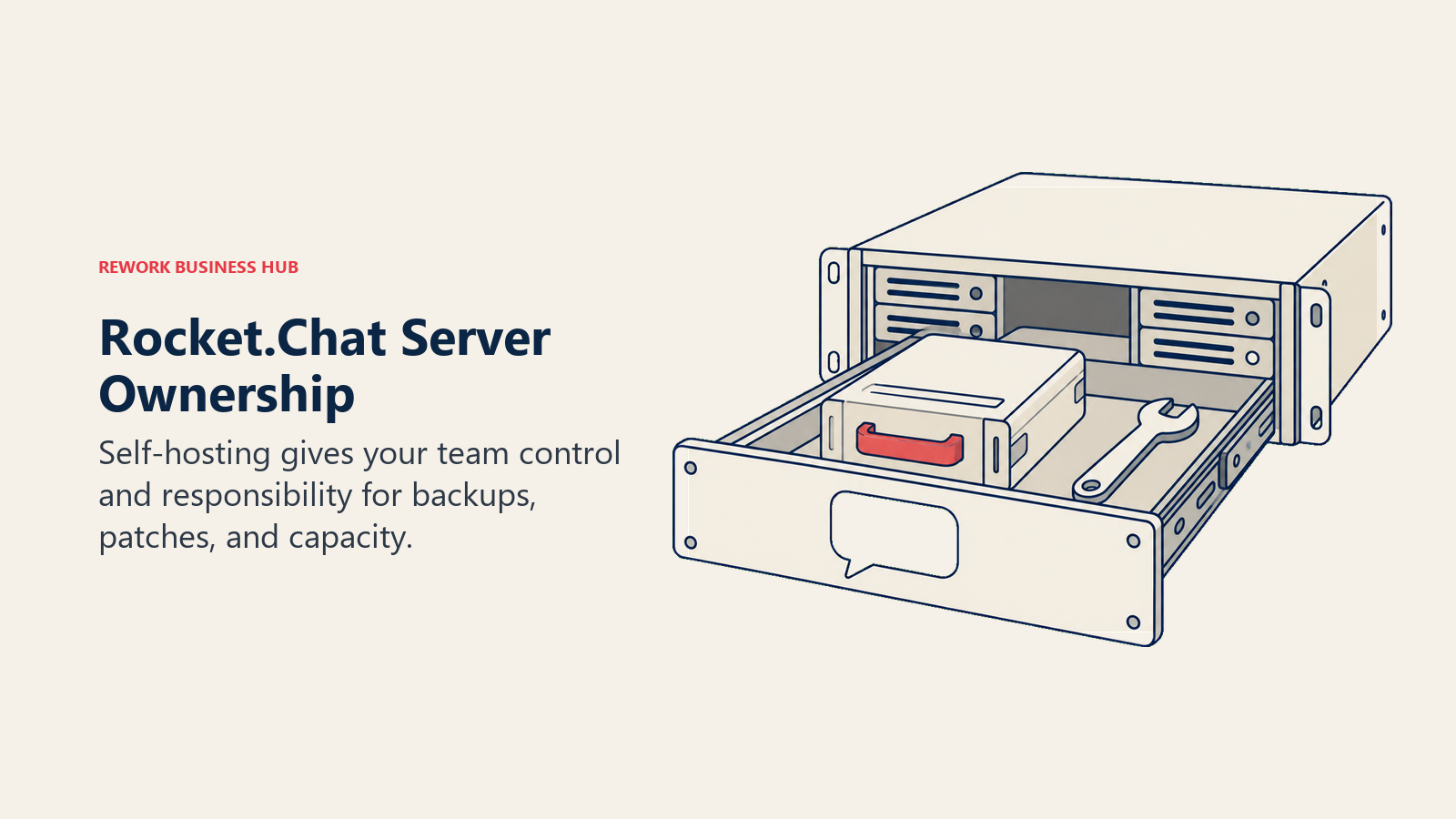
The tradeoff is the same one every self-hosted tool on this list shares: someone has to patch, back up, and scale the server. If you don't have that capacity, the free tiers stop being free the moment you count engineering hours.
| What you get | What you don't |
|---|---|
| Full source code access and self-hosting | Zero infrastructure overhead |
| Omnichannel: internal plus customer-facing messaging | A published price above 50 users |
| SSO, MFA, RBAC, and E2E encryption on the free Starter plan | Plug-and-play onboarding |
| Data sovereignty and on-premises deployment | A large commercial app marketplace |
Pricing: Community and Starter are free (Starter capped at 50 users); Commercial, Government, and Defense plans have no published price.
Best for: Security-conscious mid-size teams (20-500) with in-house DevOps that need self-hosted messaging with full data control.
2. Zulip: Topic-Threaded Chat Built for Technical Teams
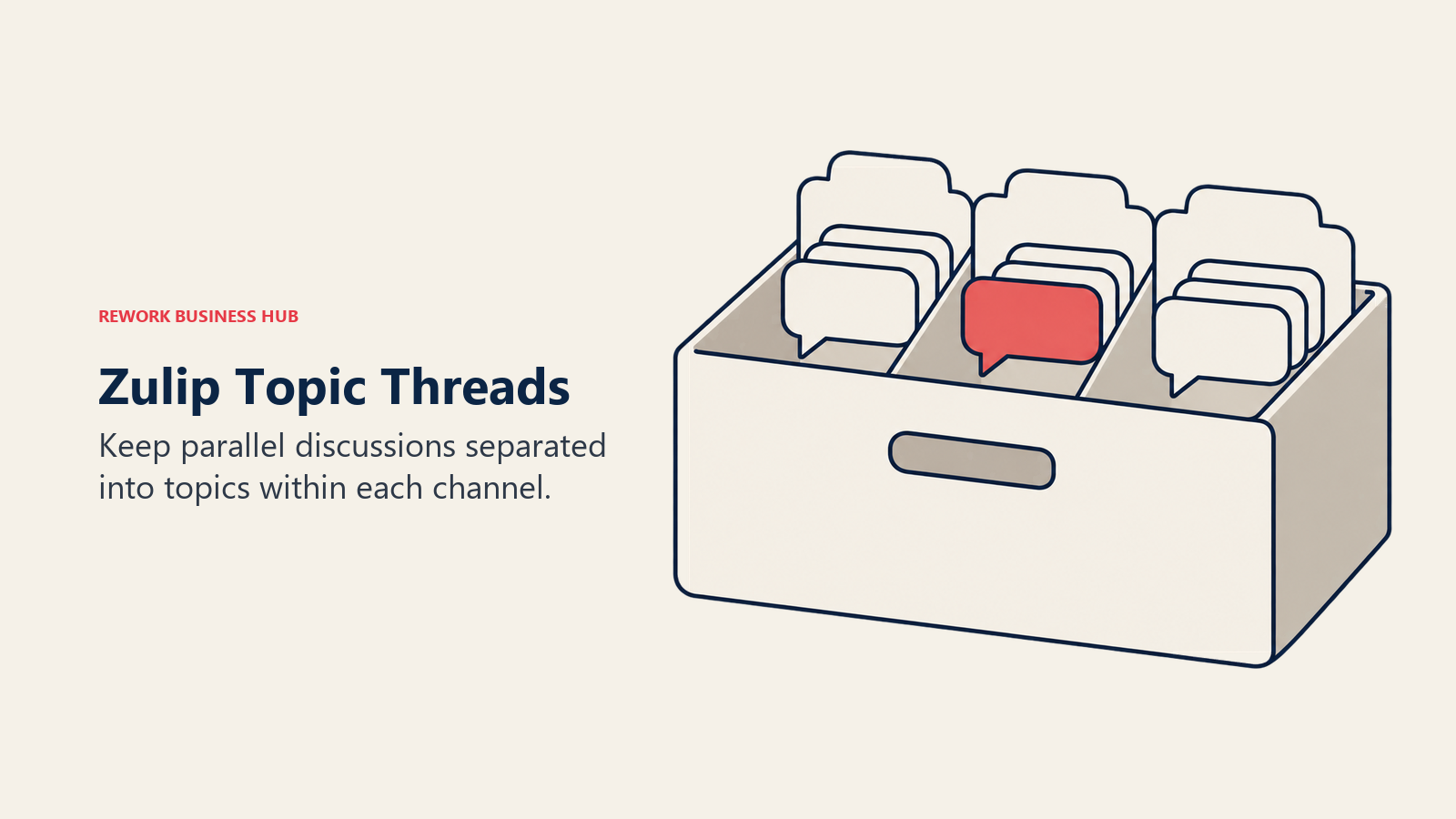
Zulip's core difference from Mattermost isn't deployment, it's the messaging model. Every message belongs to a topic within a channel, not a flat stream of messages you have to scroll to find context in. For engineering teams juggling a dozen parallel conversations, that structure keeps discussions searchable months later in a way flat channels don't.
Zulip is also the cleanest answer to the SSO gap that trips people up in Mattermost's Team Edition. SAML authentication ships on every self-hosted Zulip installation, including the free self-hosted tier, with no plan upgrade required. That's a real distinction: Mattermost's free Entry edition includes SSO, but Team Edition (the uncapped-history free tier) does not. Zulip doesn't force that tradeoff. Cloud Zulip is a separate product line; Cloud Free caps at 10,000 messages of searchable history, and Cloud SAML requires the Cloud Plus plan.
| What you get | What you don't |
|---|---|
| SSO on every self-hosted tier, including free | Familiar flat-channel UX for non-technical teams |
| Topic-threaded conversations that stay organized long-term | Large third-party integration marketplace |
| Unlimited self-hosted history at no cost | A polished consumer-grade interface |
| Open-source core (Apache 2.0) | Deep enterprise compliance certifications |
Pricing: Self-hosted Free (unlimited, open source); self-hosted Basic $3.50/user/month; self-hosted Business $6.67/user/month annual or $8 monthly (25-user minimum). Cloud Free (10,000-message history); Cloud Standard $6.67/user/month annual or $8 monthly; Cloud Plus $10/user/month annual or $12 monthly (10-user minimum).
Best for: Engineering and technical teams (10-500) that want topic-based threading and need SSO without paying for a higher tier.
3. Element (Matrix): Federated, Sovereignty-First Messaging
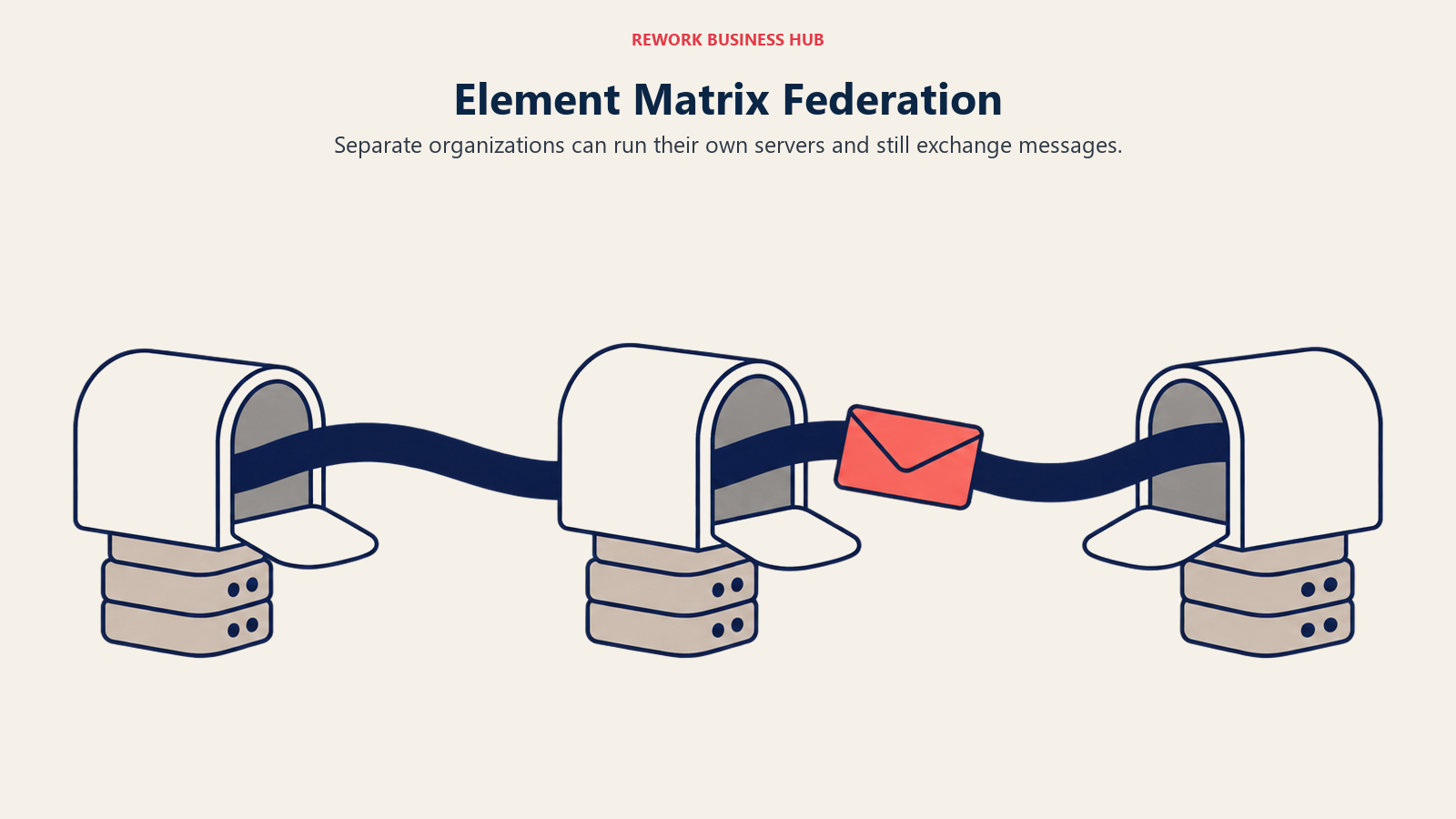
Element is the one tool on this list built on an open, federated protocol rather than a single vendor's server. Matrix lets different organizations run their own homeservers and still message each other directly, the way email works across providers, instead of requiring everyone to be on the same platform. For agencies, consultancies, or government bodies that regularly need to talk across organizational boundaries without funneling everything through one company's cloud, that architecture is the actual point.
Like Mattermost and Rocket.Chat, Element has stopped publishing per-seat prices. Element Server Suite Community is free, open source (AGPLv3), and self-hosted, with basic SSO available through the bundled Matrix Authentication Service. Element Enterprise is "priced per seat/month" starting from 100 users, and Element Sovereign is "priced per deployment," both confirmed as contact-sales only on element.io/pricing. Advanced identity management, autoscaling, and audit tooling sit behind the paid Enterprise tier (ESS Pro), not Community.
| What you get | What you don't |
|---|---|
| Matrix protocol federation across organizations | A published Enterprise or Sovereign price |
| End-to-end encryption by default, not opt-in | Simple, consumer-grade onboarding |
| Full data sovereignty via self-hosting (Community) | Polished UX comparable to Slack |
| No vendor lock-in (open protocol) | Advanced RBAC without the paid tier |
Pricing: Community is free, self-hosted, open source. Enterprise and Sovereign have no published price; Enterprise starts from 100 seats.
Best for: Government, defense, and healthcare organizations (20-1,000) that need decentralized, self-hosted, end-to-end encrypted messaging with cross-organization federation.
4. Slack: The Market Leader, If You Don't Actually Need Self-Hosting
Not every Mattermost search ends in self-hosting. Some readers hit Mattermost's IT lift, decided it wasn't worth it, and want to know what a fully-managed cloud tool costs instead. Slack is the honest answer to that version of the question: the biggest integration library in the category (2,600+ apps), a workflow builder, and a UX that most people already know how to use.
The free tier caps message history at 90 days and limits you to 10 app integrations, which is the opposite problem from Mattermost's unlimited-but-unmanaged self-hosted history. Pro runs $7.25 per user per month billed annually, or $8.75 monthly (with a promotional $4.38 rate for the first three months). Business+ is $15 per user per month annually, or $18 monthly. There's no self-hosted option at any tier. See best Slack alternatives if Slack's own pricing and channel sprawl are the actual complaint driving your search.
| What you get | What you don't |
|---|---|
| The largest third-party integration ecosystem in team chat | Self-hosting, air-gapping, or on-premise deployment at any tier |
| Polished UX with a short learning curve | Unlimited message history on the free plan |
| Workflow Builder for lightweight automation | Data sovereignty guarantees beyond region selection |
| Strong enterprise compliance on Business+ and above | A price that stays flat as you scale seats |
Pricing: Free (90-day history, 10 apps); Pro $7.25/user/month annual or $8.75 monthly; Business+ $15/user/month annual or $18 monthly; Enterprise+ contact sales.
Best for: Teams that want the biggest integration library and don't have a self-hosting or air-gapping requirement.
5. Microsoft Teams: Enterprise Compliance for the Microsoft 365 Stack
Teams isn't competing with Mattermost on deployment model at all, it's a cloud-only product that wins on a different axis: if your organization already pays for Microsoft 365, Teams is effectively bundled in. For regulated industries that need eDiscovery, DLP policies, and Entra ID-based identity without standing up their own infrastructure, that's a credible alternative to running Mattermost yourself.
The free consumer Teams app (60-minute group calls, up to 100 participants, 5 GB storage) isn't the business product. Teams Essentials starts at $4 per user per month, paid yearly. Microsoft 365 Business Basic, which bundles Teams, runs $7 per user per month yearly. Business Standard with Copilot is $23.50 per user per month yearly, and Business Premium with Copilot is $32. None of these are self-hosted, and Microsoft doesn't offer an air-gapped on-premise version the way Skype for Business once did. For a side-by-side against Google's equivalent, best Microsoft Teams alternatives and Slack vs Microsoft Teams cover the comparison from the other direction.
| What you get | What you don't |
|---|---|
| Deep Office 365 integration (Word, Excel, SharePoint, Outlook) | Self-hosted or air-gapped deployment |
| Enterprise compliance, eDiscovery, DLP policies | A lightweight, fast client |
| Identity tied to Microsoft Entra ID | Independence from Microsoft ecosystem lock-in |
| Copilot AI assistance on higher tiers | A published free-tier SSO option |
Pricing: Teams Essentials $4/user/month, paid yearly; M365 Business Basic $7/user/month yearly; Business Standard with Copilot $23.50/user/month yearly; Business Premium with Copilot $32/user/month yearly.
Best for: Mid-market and enterprise orgs already inside the Microsoft 365 stack that need compliance tooling without running their own servers.
6. Rework: Chat Built Into CRM and Ops Workflows, Not a Standalone Messenger
Most tools on this list are answering the same question Mattermost answers: how do we run our own chat server, or find a managed replacement for one. Rework is answering a different question entirely, which is why it sits at the middle of this list rather than the top. If chat is the whole problem, Rework isn't the fix. If the actual complaint was cost or IT overhead rather than sovereignty, and the team also juggles a CRM, task boards, and approval workflows in separate tools, Rework's argument is consolidation: chat sits next to the CRM record, the task, and the workflow it's actually about, instead of in a separate app someone has to tab over to.
Rework's live chat-adjacent modules are Chat (internal work chat), Exchange (chat across companies), Townhall (company-wide announcements and comms), Square (internal Q&A), plus Meeting, Booking, and Schedule. Video Call and Mail are not live products, so don't expect Rework to replace a video conferencing tool or business email today.
Be clear about who this isn't for. Most people reading a Mattermost-alternatives article want self-hosting, and Rework has no self-hosted, air-gapped, or on-premise deployment option, and no federation. If data sovereignty or a compliance-driven private deployment is the actual requirement, Rework is the wrong tool; look at Rocket.Chat, Element, or Nextcloud Talk instead. Rework also isn't built for solo operators or 2-3 person teams; the realistic fit starts around 10 people and tops out around 200.
| What you get | What you don't |
|---|---|
| Chat inside CRM, task, and workflow records | Self-hosted, air-gapped, or on-premise deployment |
| Exchange for cross-company chat, Townhall for company-wide comms | Matrix-style federation or open-protocol interoperability |
| Square for internal Q&A, plus Meeting, Booking, and Schedule | A free tier or a published per-seat rate |
| Consolidation of chat with CRM and ops, not a bolt-on integration | Depth as a standalone messaging app (bot ecosystem, huge app marketplace) |
Pricing: Quote on request (rework.com/pricing). Pricing for the Rework Chat module is quoted per organization, so budgeting starts with a sales conversation, similar to where Mattermost's own paid tiers land you.
Best for: Mid-size teams (10-200 people) whose real complaint about Mattermost was cost or IT lift, not sovereignty, and who want chat living next to CRM and workflow records instead of in a separate app.
7. Nextcloud Talk: Self-Hosted Chat Inside a Full Open-Source Workspace
Nextcloud Talk is the chat layer of a much bigger self-hosted product: file sync and sharing, calendar, contacts, and collaborative docs, all under one AGPL-licensed, open-source umbrella. If your team's actual goal is replacing several SaaS subscriptions with one self-hosted stack, not just replacing Mattermost specifically, Talk is worth evaluating as part of the whole Nextcloud server rather than in isolation. For a look at what else gets replaced in that kind of consolidation, best Dropbox alternatives covers the file-sync side of the same decision.
The core server, Talk included, is free and open source when self-hosted; you provide the infrastructure. Nextcloud's Enterprise pricing is published in euros: Talk standalone runs EUR 42 per user per year starting at 100 users, while Files Standard (which includes Talk) runs EUR 71.29, Files Premium EUR 104.99, and Files Ultimate EUR 204.75 per user per year at the 100-user tier, with lower per-user rates at 200 users and above.
| What you get | What you don't |
|---|---|
| Full open-source stack: chat, files, calendar, docs | A chat-only product if you don't want the rest of Nextcloud |
| Self-hosting with no per-user cost on the core server | Enterprise support without a paid contract |
| Self-managed SSO/SAML apps at no license cost | A polished, consumer-grade video experience |
| Euro-denominated Enterprise pricing that scales down at volume | A published price under 100 users for Enterprise support |
Pricing: Free, open source, self-hosted (core server). Enterprise Talk standalone from EUR 42/user/year at 100 users; bundled into Files Standard (EUR 71.29), Premium (EUR 104.99), or Ultimate (EUR 204.75) per user per year at 100 users, lower at 200+.
Best for: IT teams (20-500) consolidating file storage, docs, and chat into one self-hosted, open-source workspace rather than running point solutions.
8. Wire: End-to-End Encrypted at Every Deployment Tier
Wire's pitch is that end-to-end encryption isn't a paid add-on, it's the default across text, voice, and video on every plan, including the free one. That's a meaningfully different security posture than tools where E2EE is an Enterprise-only checkbox. Wire for Free covers up to 5 people and 8 devices. Wire for SMB runs EUR 7.45 per person per month billed annually, or EUR 8.94 monthly, for up to 100 people; Wire publishes these figures in euros, so quote them that way rather than converting informally.
Where Wire earns a spot on a Mattermost-alternatives list specifically is deployment flexibility at the Enterprise tier: on-premise, private cloud, and fully air-gapped backend deployment are all supported options for Enterprise customers, alongside SSO and SCIM provisioning, which the SMB tier doesn't include. That makes Wire one of the few tools here that scales from "5 people, free, cloud" all the way to "custom air-gapped deployment for a defense contractor" without switching products.
| What you get | What you don't |
|---|---|
| E2E encryption by default on every tier, including free | SSO or SCIM on the SMB tier |
| On-premise and air-gapped deployment (Enterprise) | A published Enterprise price (custom quote) |
| Euro-denominated, transparent SMB pricing | Self-service setup for air-gapped deployments |
| 40% NGO discount available on request | A large third-party integration marketplace |
Pricing: Free (up to 5 people, 8 devices); Wire for SMB EUR 7.45/person/month annual or EUR 8.94 monthly (up to 100 people); Wire for Enterprise custom-quoted (100+ people, on-prem and air-gapped options).
Best for: Enterprises and NGOs (20-1,000) that need end-to-end encryption guaranteed at every tier and the option to move to on-premise or air-gapped deployment without a platform change.
9. Zoho Cliq: Budget Chat for Teams Already Inside Zoho
Zoho Cliq's most useful trait for this list is one most budget chat tools skip: SAML-based SSO is included starting on the Free plan, not gated behind Professional or Enterprise. That puts Cliq in an unusual spot; it undercuts Slack and Teams on price while matching Mattermost's own Entry-edition SSO story, minus the self-hosting.
The free tier supports up to 100 participants per group chat, 10,000 searchable messages, and 100 GB of file storage per organization, though it excludes call recording and external channels. Pricing gets a little unusual past that: Standard is a flat $16.20 per month for up to 25 users rather than a per-seat rate, which is a fine deal at 25 people and an awkward one right past it. Professional runs $1.80 per user per month with a 10-user minimum, and Enterprise is $3.60 per user per month, also with a 10-user minimum; yearly billing saves 10% on either.
| What you get | What you don't |
|---|---|
| SAML SSO included from the Free plan | A per-seat Standard tier (it's a flat 25-user bundle) |
| Generous free tier: 100 participants, 10,000 messages, 100 GB storage | Self-hosting or air-gapped deployment |
| Low Professional rate at $1.80/user/month | Deep enterprise compliance certifications |
| Native integration with the rest of Zoho One | A large non-Zoho integration marketplace |
Pricing: Free (100 participants/chat, 10,000 messages, 100 GB storage); Standard $16.20/month flat (up to 25 users); Professional $1.80/user/month (10-user minimum); Enterprise $3.60/user/month (10-user minimum); yearly billing saves 10%.
Best for: Small-to-mid teams (5-250) already using Zoho apps that want SSO without paying Enterprise-tier prices.
10. Pumble: Unlimited Free History, No Self-Hosting
Pumble solves the one thing that frustrates free-tier chat users across this whole category: unlimited message history and unlimited users, at no cost, with 10 GB of file storage per workspace. There's no 90-day cliff like Slack's, and no server-wide message cap like Mattermost Entry's. The tradeoff is that Pumble has no self-hosted option at all; everything runs on Pumble's cloud.

Paid plans stay cheap: Pro is $2.49 per seat per month billed annually, or $2.99 monthly. Business runs $3.99 annual or $4.99 monthly, and Enterprise is $6.99 annual or $7.99 monthly. Pumble is also sold as part of a CAKE.com bundle with Clockify and Plaky at $12.99 annual or $15.99 monthly, if project tracking is also on your list.
| What you get | What you don't |
|---|---|
| Unlimited message history and users on the free plan | Any self-hosting or on-premise option |
| Very low Pro pricing ($2.49/seat/month annual) | Deep native integrations (Zapier covers most automation) |
| Audio and video calls on all plans | Enterprise security certifications on lower tiers |
| A CAKE.com bundle option with task tracking included | Advanced workflow automation |
Pricing: Free (unlimited users and message history); Pro $2.49/seat/month annual or $2.99 monthly; Business $3.99 annual or $4.99 monthly; Enterprise $6.99 annual or $7.99 monthly.
Best for: Budget-conscious teams (2-200) that want unlimited free history without any self-hosting responsibility.
11. Discord: Free Voice Channels for Dev Teams, Not an Enterprise Tool
Discord earns a place here for a narrow reason: developer and startup teams sometimes land on a Mattermost-vs-Discord decision when the real requirement was never compliance at all, just free persistent voice channels and unlimited message history. Discord's free tier delivers both, plus a mature bot and community ecosystem that outclasses anything in the self-hosted chat category.
What Discord doesn't have is any of the reasons most people search "Mattermost alternatives" in the first place: no SSO, no SCIM provisioning, no DLP, and no self-hosting. If your organization has a security review, a legal hold policy, or any regulated data handling requirement, Discord fails that review by design, not by oversight.
| What you get | What you don't |
|---|---|
| Unlimited message history on the free plan | SSO, SCIM, or DLP on any tier |
| Persistent voice channels with no scheduling needed | Self-hosting or air-gapped deployment |
| Mature bot and community ecosystem | Compliance certifications for regulated industries |
| No per-seat cost for most business use | Professional inbox and DM management |
Pricing: Free for most teams; Nitro Basic $2.99/month and Nitro $9.99/month are personal subscriptions, not business seat licenses.
Best for: Early-stage startups and developer teams (2-100) where free voice channels and culture fit matter more than compliance.
12. Google Chat: Native Chat for Google Workspace Teams
Google Chat's case is simple: if your company already runs on Google Workspace, Chat is already there, with Spaces for topic-based channels, one-click Meet integration, and native Docs and Drive previews. It's not trying to be a Mattermost replacement so much as removing the need to evaluate one if you're Google-native already. For teams weighing the wider Workspace stack rather than just chat, best Google Workspace alternatives covers what's worth replacing versus keeping.
There's no standalone free tier; Chat comes bundled starting with Business Starter at $7 per user per month, discounted to $3.50 for the first 12 months, with 30 GB of pooled storage per person. Business Standard runs $14 (discounted to $8.40 for year one) with 2 TB, and Business Plus is $22 with 5 TB. Starter, Standard, and Plus all cap at 300 users; Enterprise is quote-only. None of it is self-hosted.
| What you get | What you don't |
|---|---|
| Native Google Docs, Drive, Meet, and Calendar integration | Self-hosting or air-gapped deployment |
| A first-year discount on every paid tier | A standalone free tier |
| Spaces for topic channels plus DMs | Advanced workflow automation |
| Google-grade search across conversations | A user count above 300 on Starter through Plus |
Pricing: Business Starter $7/user/month (promo $3.50 for 12 months); Business Standard $14/user/month (promo $8.40); Business Plus $22/user/month; Enterprise contact sales. Starter/Standard/Plus cap at 300 users.
Best for: Google Workspace organizations (10-1,000) that want chat included in their existing subscription rather than adding another vendor.
13. Twist: Async-Only Threads for Distributed Teams
Twist's thesis is the opposite of Mattermost's default assumption: real-time chat is the wrong shape for most work. Every conversation in Twist is a thread, not a live stream, and nothing carries an expectation of an immediate reply. For fully distributed, timezone-spread teams that have deliberately adopted async-first culture, that design choice removes a category of notification noise that persists in any real-time tool, self-hosted or not. Distributed teams and time zones and the async communication guide cover when that tradeoff actually pays off versus when it just adds friction.
The free plan keeps 1 month of comment and message history, up to 5 integrations, and 5 GB of file storage. Unlimited is $6 per user per month; Twist's own pricing page doesn't publish a separate annual rate, so there isn't a discount to quote here.
| What you get | What you don't |
|---|---|
| Thread-only format that reduces notification noise | Real-time chat for fast-moving or incident-response work |
| Purposeful, organized conversations by design | A published annual discount |
| Strong search across all historical threads | Self-hosting or on-premise deployment |
| A clear fit for distributed, timezone-spread teams | Voice or video calls built in |
Pricing: Free (1-month history, 5 integrations, 5 GB storage); Unlimited $6/user/month (no separate annual rate published).
Best for: Fully distributed, async-first teams (5-150) that have already decided real-time chat isn't their operating model.
Why Teams Leave Mattermost: The Specific Pain Points
| Pain Point | Who Feels It Most | What to Look For Instead |
|---|---|---|
| Entry edition's server-wide caps (10,000 messages, 5 playbook runs/month, 40-minute calls) | Self-hosted teams that outgrew the free ceiling | Rocket.Chat Community, Zulip self-hosted, Element Community |
| Team Edition has no SSO and tops out under 250 activated users | IT teams needing enterprise identity on a free tier | Zulip (SSO on every self-hosted tier), Zoho Cliq (SSO on Free) |
| No published price for any paid tier | Budget owners, procurement | Slack, Microsoft Teams, Google Chat, Zoho Cliq, Pumble |
| IT lift of running, patching, and scaling a self-hosted instance | Small IT teams without dedicated DevOps | Slack, Microsoft Teams, Google Chat, Pumble, Twist |
| Federation or cross-organization messaging needs | Agencies and consultancies messaging client orgs | Element (Matrix federation) |
| Wanting chat consolidated with CRM and ops instead of a standalone app | Ops-heavy mid-size teams | Rework |
One factor that's easy to underweight: switching cost. The sticker price is simple to compare; the real cost is migration, exporting message history, rebuilding webhooks and bot integrations, and retraining the team. Self-hosted-to-self-hosted moves (Mattermost to Rocket.Chat or Zulip) generally carry supported import tooling. Self-hosted-to-cloud moves (Mattermost to Slack or Teams) usually mean a clean cutover date instead of a full history migration.
Pricing Comparison Table
| Tool | Free Tier | Entry Paid (Monthly) | Entry Paid (Annual) | Notes |
|---|---|---|---|---|
| Rocket.Chat | Community (self-hosted); Starter free up to 50 users | Not published | Not published | Commercial/Government/Defense are all quote-only |
| Zulip | Cloud Free (10k msgs); self-hosted Free (unlimited) | Cloud Standard $8/user | Cloud Standard $6.67/user | Self-hosted Basic $3.50/user/mo (monthly rate only) |
| Element | Community, free self-hosted | Not published | Not published | Enterprise "from 100 users"; Sovereign priced per deployment |
| Slack | Free (90-day history) | Pro $8.75/user | Pro $7.25/user | Business+ $18 monthly / $15 annual |
| Microsoft Teams | Teams (free, personal use) | Essentials $4/user (yearly only) | Essentials $4/user | M365 Business Basic $7/user, paid yearly |
| Rework | No free tier | Quote on request | Quote on request | rework.com/pricing |
| Nextcloud Talk | Free, self-hosted, open source | Not published under 100 users | Talk standalone EUR 42/user/year (100+ users) | Euro pricing; bundled into Files Standard/Premium/Ultimate |
| Wire | Free (up to 5 people) | SMB EUR 8.94/person | SMB EUR 7.45/person | Euro pricing; Enterprise custom-quoted |
| Zoho Cliq | Free (100 participants/chat) | Professional $1.80/user (10-user min) | Same, yearly billing saves 10% | Standard is a flat $16.20/month bundle for 25 users |
| Pumble | Free (unlimited users/history) | Pro $2.99/seat | Pro $2.49/seat | Business $4.99 monthly / $3.99 annual |
| Discord | Free | Nitro Basic $2.99/mo | Not published (monthly only) | Personal subscription, not a business seat |
| Google Chat | No standalone free tier | Business Starter $7/user | Promo: $3.50/user for first 12 months | Caps at 300 users through Business Plus |
| Twist | Free (1-month history) | Unlimited $6/user | Not published (monthly rate only) | No separate annual rate published by the vendor |
How to Choose: Decision Framework
| If you need... | Pick this |
|---|---|
| Self-hosted, open-source chat with full control and no seat caps | Rocket.Chat (versatile) or Zulip (SSO everywhere, free) |
| Federated messaging across organizations with E2E encryption by default | Element (Matrix) |
| A fully-managed cloud tool so nobody has to patch a server | Slack, Microsoft Teams, or Google Chat |
| Chat bundled with CRM, tasks, and ops workflows | Rework |
| Self-hosted chat as part of a bigger open-source workspace (files, docs, calendar) | Nextcloud Talk |
| E2E encryption at every tier, including an on-prem Enterprise option | Wire |
| SSO and a real feature set on a genuinely free plan | Zoho Cliq |
| Unlimited free message history with the lowest paid seat price | Pumble |
| Free voice channels for a dev team, no compliance requirement | Discord |
| Async-only threads that kill notification noise for a distributed team | Twist |
What to Do Next
Pick your top two candidates and run a two-week pilot with one real team, not a demo environment. If self-hosting or air-gapping is the actual requirement, stand up Rocket.Chat or Zulip on real infrastructure with real IT ownership assigned before you commit; the free tier's true cost only shows up once someone has to patch it at 2 a.m. If the requirement was cost or IT overhead rather than sovereignty, run the same pilot against a managed option, Slack, Teams, or Rework if your team also wants chat living next to its CRM and workflow records, and compare total effort, not just the sticker price.
Frequently Asked Questions about Mattermost Alternatives
Is Mattermost still free for self-hosting in 2026?
Yes, but not without limits. Mattermost Entry is free and self-hosted with all Enterprise Advanced features, but it's capped server-wide at 10,000 channel messages of history, 1,000 board cards, 5 active playbook runs a month, and 40-minute calls, and Mattermost's own docs say it's "best suited for teams less than 50 users." Team Edition removes the history cap and is documented for under 250 activated users, but it doesn't include SSO. Neither is "free and unlimited" without qualification.
What's the best self-hosted Mattermost alternative?
Rocket.Chat for the closest feature match and omnichannel routing, Zulip if you want SSO included on the free self-hosted tier, and Element if federation across organizations or government-grade sovereignty is the actual requirement.
Why doesn't Mattermost publish its pricing anymore?
Mattermost, along with Rocket.Chat and Element, has moved every paid tier above its free plan to "Get pricing" or "Request a quote," per each vendor's own pricing page. If a published per-seat rate matters to your budgeting process, Slack, Microsoft Teams, Google Chat, Zoho Cliq, and Pumble all still list real numbers.
What's the best free Slack-style tool with SSO included?
Zoho Cliq includes SAML SSO from its Free plan, and Zulip includes SSO on every self-hosted tier, including free. Rocket.Chat's free Starter plan also includes SSO, but it's capped at 50 users.
Can Rework replace Mattermost for a security-focused team?
Not if security means self-hosting, air-gapping, or data sovereignty. Rework has no self-hosted or on-premise deployment option. It's a fit only for teams whose Mattermost complaint was cost or IT overhead, and who want chat living next to a CRM and ops workflows instead of in a standalone app.
What's the best Mattermost alternative for messaging across different organizations?
Element, built on the Matrix protocol. Federation lets separate organizations run their own servers and still message each other directly, which none of the other self-hosted tools on this list offer.

Principal Product Marketing Strategist
On this page
- Key Facts
- Quick Comparison Table
- Self-Hosting and Deployment Matrix
- Stage Fit Matrix
- Sizing and Persona Table
- 1. Rocket.Chat: Open Source With Full Control, If You Have the DevOps to Run It
- 2. Zulip: Topic-Threaded Chat Built for Technical Teams
- 3. Element (Matrix): Federated, Sovereignty-First Messaging
- 4. Slack: The Market Leader, If You Don't Actually Need Self-Hosting
- 5. Microsoft Teams: Enterprise Compliance for the Microsoft 365 Stack
- 6. Rework: Chat Built Into CRM and Ops Workflows, Not a Standalone Messenger
- 7. Nextcloud Talk: Self-Hosted Chat Inside a Full Open-Source Workspace
- 8. Wire: End-to-End Encrypted at Every Deployment Tier
- 9. Zoho Cliq: Budget Chat for Teams Already Inside Zoho
- 10. Pumble: Unlimited Free History, No Self-Hosting
- 11. Discord: Free Voice Channels for Dev Teams, Not an Enterprise Tool
- 12. Google Chat: Native Chat for Google Workspace Teams
- 13. Twist: Async-Only Threads for Distributed Teams
- Why Teams Leave Mattermost: The Specific Pain Points
- Pricing Comparison Table
- How to Choose: Decision Framework
- What to Do Next