Best Google Forms Alternatives in 2026: 13 Tools for Teams That Outgrew Free Forms
Turn this article into takeaways for your work.


Each assistant summarizes the article only for you and suggests best practices for your work.
Google Forms is free, already in every Google Workspace account, and fine for a quick internal survey or RSVP. That's why teams start there without a second thought. The trouble shows up once the form has to do more: route a request, take a deposit, qualify a lead, or feed a process other people depend on.
Nobody switches off a free tool out of general dissatisfaction. They switch for specific reasons: shallow conditional logic, no way to take a payment, zero brand control, analytics that stop at a bar chart, and no path from "submitted" to "assigned." This guide covers 13 alternatives, evaluated on logic depth, payments, design control, analytics, and workflow routing, with pricing.
Key Facts
- Desktop forms complete at a 47% view-to-completion rate versus 42% on mobile, an 8-9 point gap that shows up in nearly every industry except gambling, per Zuko's form conversion research.
- Two-thirds of people who start a form finish it, but only 45% of everyone who lands on the page converts, and contact forms alone convert at just 38%, per Zuko.
- Removing a single unnecessary field can lift conversion by as much as 26%, according to research cited by Formstack.
- One documented experiment saw conversions jump 59.2% after a single-step form was rebuilt as a multi-step form, per HubSpot.
- 90% of no-code automation users say their company has grown faster because of it, and over a third report saving 10-20 hours per person, per Zapier's no-code adoption report.
Quick Comparison Table
| Tool | Best For | Starting Price | Key Strength | Key Limitation |
|---|---|---|---|---|
| Jotform | Payments, files, templates | Free; from $34/mo | Widest feature range | Busy UI at scale |
| Typeform | Brand-forward lead magnets | Free (100 resp/mo); $39/mo monthly, $28/mo annual | Conversational UI | Caps bite fast |
| Microsoft Forms | Microsoft 365 shops | Free (capped); from $7/user/mo | Native Excel/Teams sync | Lifetime cap on free |
| Tally | Budget, unlimited responses | Free (unlimited); Pro $24/mo | No response caps | Thinner CRM sync |
| Fillout | Notion/Airtable/Supabase users | Free (1,000 resp/mo); from $15/mo | Writes into your database | Smaller templates |
| Paperform | Landing-page-style forms | From $24/mo (annual) | Rich media, native Stripe | No free plan |
| Cognito Forms | Approvals and calculations | Free (100 entries); $24/mo monthly, $19.20/mo annual | Built-in workflow, math fields | Entry-based at volume |
| Formstack | Regulated-industry compliance | $99/mo monthly, $83/mo annual | HIPAA, docs, e-signature | Expensive for small teams |
| Zoho Forms | Teams already inside Zoho | Free; Basic US$10/mo billed annually | Deep Zoho CRM integration | Annual billing only on the pricing page |
| Wufoo | Proven, simple builder | Free (100/mo); from $16.25/mo | Long track record | Tight entry caps; no shipped update since 2020 |
| SurveyMonkey | Formal research, benchmarking | Free (limited); from $25/user/mo | Statistical analysis | Overkill for lead capture |
| Gravity Forms | WordPress, data ownership | From $59/year (intro) | Self-hosted, deep add-ons | Needs a WordPress site |
| WPForms | WordPress beginners | $49.50/yr first year, $99/yr renewal (Basic, 1 site) | Easiest WP builder | Depth behind higher tiers |
Stage Fit Matrix
Team size changes the right Google Forms replacement: lighter tools suit startups, while governance-heavy options become stronger as teams and process complexity grow.
| Tool | Startup (1-10) | Growth (10-50) | Mid-Market (50-200) | Enterprise (200+) |
|---|---|---|---|---|
| Jotform | Good | Strong fit | Strong fit | Limited |
| Typeform | Strong fit | Strong fit | Good | Limited |
| Microsoft Forms | Good | Good | Strong fit | Strong fit |
| Tally | Strong fit | Good | Limited | Not recommended |
| Fillout | Strong fit | Strong fit | Good | Limited |
| Paperform | Good | Strong fit | Good | Limited |
| Cognito Forms | Good | Strong fit | Good | Limited |
| Formstack | Not recommended | Limited | Good | Strong fit |
| Zoho Forms | Good | Good | Strong fit | Good |
| Wufoo | Strong fit | Good | Limited | Not recommended |
| SurveyMonkey | Limited | Good | Strong fit | Strong fit |
| Gravity Forms | Good | Good | Good | Limited |
| WPForms | Strong fit | Good | Limited | Not recommended |
Sizing and Persona Table
| Tool | Team Size Sweet Spot | Primary Buyer | Secondary Buyer |
|---|---|---|---|
| Jotform | 5-200 | Operations Manager | Marketing Manager |
| Typeform | 1-100 | Marketing Manager | Founder |
| Microsoft Forms | 10-1000+ | IT Admin | HR / Internal Ops |
| Tally | 1-30 | Founder / Solo Marketer | Content Marketer |
| Fillout | 1-100 | Product Manager / Ops | Marketing Ops |
| Paperform | 5-100 | Marketing Manager | Creative Director |
| Cognito Forms | 5-100 | Operations Manager | Finance / Approvals Lead |
| Formstack | 50-1000+ | IT / Compliance Officer | Marketing Director |
| Zoho Forms | 10-500 | Ops Manager (Zoho shops) | Sales Ops |
| Wufoo | 1-50 | Small Business Owner | Solo Marketer |
| SurveyMonkey | 20-1000+ | Research Lead | Marketing Director |
| Gravity Forms | 5-100 | WordPress Developer | Marketing Ops |
| WPForms | 1-50 | Small Business Owner | Content Marketer |
1. Jotform: The Broadest Feature Set Without a Developer
Jotform's philosophy: any information-collection process should be buildable without code. 10,000+ templates, 200-plus integrations, and widgets for payments, e-signatures, scheduling, and calculations back that up. For a team leaving Google Forms to actually act on a submission (charge a card, generate a PDF, route a file), Jotform usually has a built-in answer instead of a workaround. Templates cover HIPAA-compliant intake, event registration, and order forms, suiting operations-heavy teams running several form types at once. CRM integrations with Salesforce, HubSpot, and Pipedrive run through connectors rather than native sync, but they're solid.
The tradeoff is polish: the interface is busier than newer competitors, and a growing form library takes real effort to organize.
| What you get | What you don't |
|---|---|
| Massive template library (10,000+) | The cleanest UI in the category |
| Payment, signature, scheduling widgets | Native CRM data model |
| Deep conditional logic, multi-step forms | Simple, single-tier pricing |
| HIPAA-compliant option on higher tiers | Fast setup for one quick form |
| Strong form analytics | Lightweight mobile performance |
Pricing: Free (5 forms, 100 submissions/mo); Bronze $39/mo monthly ($34/mo annual); Silver $49/mo monthly ($39/mo annual); Gold $129/mo monthly ($99/mo annual, HIPAA); Enterprise custom. Figures here come from Jotform's own support documentation and are worth reconfirming at checkout, since first-term discounts are common.
Best for: Operations-heavy teams running several form types who want one tool that handles all of them without developer help.
2. Typeform: The Design Upgrade for Brand-Conscious Teams
Typeform's pitch is that a form shouldn't feel like a form. One question at a time, smooth transitions, and a conversational tone make data collection feel closer to a conversation, the most direct fix for teams leaving Google Forms because the plain gray layout undersells their brand. Conditional logic, branching, and hidden fields are all supported, and the completion-rate story genuinely holds up for shorter, well-designed forms.
The free plan caps at 100 responses a month, and CRM sync beyond the basics usually means wiring up Zapier or Make. Typeform earns its cost when the form is part of the brand experience; it's overkill for a plain internal intake form.
| What you get | What you don't |
|---|---|
| Best-in-class conversational design | Generous response limits on low tiers |
| Strong conditional logic, branching | Native CRM sync without middleware |
| AI-assisted form creation | Fast loads on animation-heavy forms |
| Drop-off and conversion analytics | Budget-friendly pricing at scale |
| Multi-language support | A simple, single flat rate |
Pricing: Free (100 responses/mo, 1 user, no conditional logic); Basic $28/month billed annually ($39/month month-to-month, 100 responses, 1 user); Plus $56/month billed annually ($79/month month-to-month, 1,000 responses, 3 users); Business $91/month billed annually ($129/month month-to-month, 10,000 responses, 5 users); Enterprise custom. Source: typeform.com/pricing.
Best for: Marketing and growth teams where the form's design directly affects brand perception and completion rate.
3. Microsoft Forms: The Google Forms Equivalent for Microsoft Shops
If your organization already pays for Microsoft 365 instead of Google Workspace, Microsoft Forms is the closest parallel here, down to the free tier being tied to an account you probably already have. It builds surveys, quizzes, and polls, syncs to Excel automatically, and plugs into Teams. The catch: a personal account caps a form at 200 responses for its entire lifetime, not per month, and file uploads aren't included.
Real business use means a Microsoft 365 Business plan, where Forms comes bundled alongside Outlook and Teams rather than sold on its own, and it earns its place inside organizations already standardized on Microsoft.
| What you get | What you don't |
|---|---|
| Native Excel, Teams, SharePoint sync | A response cap that resets monthly (free) |
| Included in any M365 Business plan | A standalone low-cost paid tier |
| Familiar UI for Microsoft-standardized teams | Deep conditional logic or multi-step design |
| Branching and quiz scoring | CRM-native integrations outside Dynamics |
| Enterprise compliance on higher M365 tiers | File uploads on free personal accounts |
Pricing: Free with a personal Microsoft account (200 responses/form lifetime cap, 400 forms max); full access via Microsoft 365 Business Basic from $7/user/mo (annual), Business Standard $23.50/user/mo, Business Premium $32/user/mo. Source: Microsoft's published M365 business plan comparison.
Best for: Teams already standardized on Microsoft 365 who want forms syncing natively to Excel and Teams.
4. Tally: The Closest Thing to Unlimited, Free Google Forms
Tally exists to solve one frustration: response caps. Where Typeform and most competitors meter free usage by response count, Tally's free plan includes unlimited forms and responses, no per-submission fees. The design philosophy is "Notion for forms," a block-based editor that's fast to build in without Typeform's price tag. Conditional logic, payments, signatures, and file uploads are all included even on the free tier, unusually generous for the category.
The gap shows up in CRM depth: Tally connects to HubSpot natively and to most other CRMs through Zapier or Make, more setup than a native-sync tool requires. For "stop worrying about response limits," Tally delivers better than anything else here.
| What you get | What you don't |
|---|---|
| Unlimited forms and responses, even free | Deep native CRM integrations |
| Clean, Notion-style block editor | Advanced workflow automation |
| Payments, signatures, uploads on free tier | A large template marketplace |
| Fast form creation | Enterprise compliance certifications |
| Good embedding and sharing options | Robust built-in analytics |
Pricing: Free (unlimited forms and responses); Pro $24/mo (custom branding, custom domains); Business $74/mo (data retention controls, email verification). Source: tally.so/pricing.
Best for: Early-stage teams and solo marketers who want to stop worrying about response caps without Typeform's price tag.
5. Fillout: Forms That Write Straight Into Your Database
Fillout's bet is that forms shouldn't export to a spreadsheet and sync elsewhere, they should write directly into the database a team already runs on. Native integrations with Notion, Airtable, Supabase, Salesforce, and HubSpot mean a submission lands in the right table with relationships intact, no middleware step. If the CRM is Airtable and the wiki is Notion, Fillout removes the export-then-import dance entirely.
Being newer than Jotform or Typeform shows in a smaller template library and compliance features still catching up. The integration story, though, is ahead of most of the category.
| What you get | What you don't |
|---|---|
| Native Notion, Airtable, Supabase, Salesforce sync | Category-leader brand recognition |
| Generous free tier (1,000 submissions/mo) | A large template library |
| Conditional logic, multi-step forms | Deep enterprise compliance features (yet) |
| Modern, clean interface | Extensive built-in analytics |
| Competitive, transparent pricing | A long integration track record |
Pricing: Free (1,000 submissions/mo, unlimited forms/seats); Starter $15/mo ($180/year annual); Pro $40/mo ($480/year annual); Business $75/mo ($900/year annual, unlimited submissions); Enterprise custom. Source: fillout.com/pricing.
Best for: Tech-forward teams on Notion, Airtable, or Supabase who want submissions to land directly in their existing data structure.
6. Paperform: Forms That Double as Landing Pages
Paperform's premise is that a form should carry images, video, and rich formatting well enough to function as a standalone landing page, not just a stack of fields, a strong pick for content upgrades, quizzes, and event pages where the form itself has to sell the offer. Conditional logic supports showing or hiding sections based on prior answers, and native Stripe payment collection needs no add-on. Calculation and scoring fields suit pricing quizzes and lead qualification.
The catch coming from free Google Forms: no free tier at all, and CRM integrations run through Zapier rather than native sync. It's a stronger design tool than an operations tool.
| What you get | What you don't |
|---|---|
| Rich media form pages (video, images) | A free tier |
| Native Stripe payment processing | Native CRM data model |
| Strong conditional logic, branching | Deep enterprise compliance features |
| Calculation and quiz scoring fields | Budget-friendly entry pricing |
| Good template library for quizzes | Built-in advanced analytics |
Pricing: Essential $24/mo ($288/year annual, 1,200 submissions/year); Pro $49/mo ($588/year annual, 12,000/year); Business $99/mo ($1,188/year annual, 120,000/year); Enterprise custom. Source: paperform.co/pricing.
Best for: Marketing teams building quizzes, content upgrades, or event pages where the form needs to convert like a landing page.
7. Cognito Forms: Built-In Workflow for Ops-Heavy Teams
Cognito Forms targets the gap Google Forms can't fill: approval routing and calculation logic without a separate automation tool. Every plan, including the free one, supports unlimited forms and payment collection, and workflow steps unlock on the Team tier. The calculation engine is a real differentiator: forms can run math on submitted values (quotes, totals, conditional pricing), a natural fit for order forms and internal requests needing more than a yes/no branch.
Pricing runs on monthly entry limits rather than a flat seat price, rewarding low-volume, high-complexity forms over high-traffic public campaigns.
| What you get | What you don't |
|---|---|
| Built-in workflow and approval routing | Flat, volume-independent pricing |
| Real calculation and quoting logic | A large public template marketplace |
| Electronic signatures included | Native deep CRM sync |
| Unlimited forms on every tier | Generous entry limits on lower tiers |
| Client portal for external submitters | Strong built-in analytics |
Pricing: Free (100 entries/mo, 1 user); Pro $24/mo ($19.20 annual, 2,000 entries/mo); Team $49/mo ($39.20 annual, 10,000 entries/mo, workflow/approvals); Enterprise $174/mo ($129.60 annual, unlimited entries, HIPAA, SSO). Source: cognitoforms.com/pricing.
Best for: Operations teams that need forms to trigger approvals or run calculations, not just collect answers.
8. Formstack: Compliance and Document Generation for Regulated Teams
Formstack treats forms as enterprise infrastructure. A submission can trigger automatic PDF generation, route for e-signature, and archive into Salesforce, all in one workflow, exactly what healthcare, finance, and government teams need. The buyer is typically an IT director or compliance officer at an organization with real regulatory requirements: HIPAA, GDPR, and SOC 2 compliance are core to the product.
The pricing reflects that: $99/month for the base Forms plan ($83/month billed annually) and $299/month for the bundled Suite ($250 annually) make Formstack significant overkill for a small team that just needs better logic than Google Forms.
| What you get | What you don't |
|---|---|
| HIPAA, GDPR, SOC 2 compliance | Budget-friendly pricing for small teams |
| Native document generation, e-signatures | A free tier |
| Strong Salesforce integration | A modern, lightweight interface |
| Advanced workflow and approval routing | Fast setup for one simple form |
| Enterprise audit trails | Low-complexity pricing |
Pricing: Forms $99/mo ($83 annual, 25 forms, 1,000 submissions/form); Suite (Forms + Documents + Sign) $299/mo ($250 annual, 100 forms, unlimited e-signatures); Salesforce Solutions and Enterprise custom. Source: formstack.com/pricing.
Best for: Regulated industries (healthcare, finance, government) needing forms tied to document generation and e-signature compliance.
9. Zoho Forms: The Natural Pick Inside a Zoho Stack
Zoho Forms wins by being the intake layer for a Zoho stack a team already runs: native integration with Zoho CRM and Zoho Creator means a submission moves straight into a pipeline, database record, or approval flow with no separate connector. Workflow and approval steps unlock on the Basic paid tier; the free plan (three forms, 500 submissions/month) covers light internal use.
Zoho's pricing page defaults to the annual toggle. The ladder runs US$10 a month for Basic through US$90 for Premium, every figure billed annually, and month-to-month rates are not shown at all.
| What you get | What you don't |
|---|---|
| Native Zoho CRM and Creator integration | Published, fixed public pricing |
| Workflow and approval routing on paid tiers | Standout design differentiation |
| HIPAA compliance on the Premium tier | A large public template gallery |
| Reasonable entry-level pricing (US$10/mo billed annually) | Simplicity for a non-Zoho team |
| Solid free tier for internal use | Fast, self-serve checkout clarity |
Pricing: Free (3 forms, 500 submissions/mo); Basic US$10/month billed annually; Standard US$25/month billed annually; Professional US$50/month billed annually; Premium US$90/month billed annually (100 users, HIPAA), the top self-serve tier. See Zoho's pricing page.
Best for: Teams already running Zoho CRM or Zoho Creator who want forms that plug directly into that stack.
10. Wufoo: The Long-Standing, No-Surprises Option
Wufoo has built simple, reliable web forms since before most of this list existed, and still reflects that "get it done, don't overthink it" philosophy. Form building is drag-and-drop, reporting is straightforward, and setup takes minutes. Conditional logic ("rules"), file uploads, and payment acceptance are available on paid tiers, and every plan includes unlimited reports.
The limitation isn't only volume. Even the Professional tier caps at 5,000 entries a month, a real ceiling for high-traffic campaigns, and Wufoo's own release notes page hasn't listed a shipped product update since August 2020, six years of the product simply staying put while the price didn't move either.
| What you get | What you don't |
|---|---|
| Simple, fast form building | Generous entry limits on paid tiers |
| Unlimited built-in reports | Deep conditional logic depth |
| Reliable, long-standing product | Native CRM sync |
| Field encryption, password protection (Pro) | Modern, brand-forward design options |
| Straightforward, transparent pricing | Advanced workflow or approval routing |
| A frozen, dependable feature set since 2020 | Any publicly shipped update in six years |
Pricing: Free (5 forms, 100 entries/mo); Starter $16.25/mo ($195/year annual, 1,000 entries/mo); Professional $33.25/mo ($399/year annual, 5,000 entries/mo, payments); Advanced $83.25/mo (25,000 entries/mo); Ultimate $210.25/mo (200,000 entries/mo). Every tier's annual price is exactly 12 times the monthly rate, no discount for prepaying, unusual among the tools in this guide. Source: wufoo.com/pricing.
Best for: Small businesses wanting a proven, no-drama form builder without a learning curve, and comfortable with a vendor whose public roadmap has been frozen since 2020.
11. SurveyMonkey: The Research-Grade Option
SurveyMonkey solves a different problem than everything else here: not lead capture, but formal research: satisfaction benchmarking, engagement surveys, market sizing. Statistical significance testing, proprietary benchmark data, and a respondent panel service are things nothing else on this list offers. For a team leaving Google Forms purely because analytics were too thin, SurveyMonkey is the deepest possible upgrade on that dimension.
But pricing is per seat and climbs fast, forms aren't optimized for conversion, and CRM integration is limited outside the top tier. The buyer is typically a research lead, not an operations manager.
| What you get | What you don't |
|---|---|
| Best-in-class statistical analysis | Affordable per-seat pricing |
| Proprietary benchmark data | Forms optimized for lead conversion |
| Respondent panel recruitment | Deep native CRM integration |
| Enterprise SSO and security | A budget-friendly entry tier |
| Multi-survey and thematic AI analysis | Fast load times on long surveys |
Pricing: Basic/Standard individual plans at lower price points; Team Advantage $25/user/mo (annual, 3-user minimum, 50,000 responses/year); Team Premier $75/user/mo (100,000 responses/year); Enterprise custom. Source: surveymonkey.com/pricing.
Best for: Research and insights teams running formal surveys, not the right pick for a Google Forms replacement focused on lead capture.
12. Gravity Forms: Full Data Ownership on WordPress
Gravity Forms is a WordPress plugin, not a hosted SaaS product, so forms and their data live entirely on infrastructure the team already controls, which matters for organizations that want to avoid a vendor holding submission data. The add-on ecosystem covers Stripe, HubSpot, Mailchimp, Salesforce, and dozens more, and licensing scales by site count rather than seats or volume, undercutting SaaS competitors at scale.
The obvious limitation: a WordPress site is a prerequisite, and setup takes more comfort with plugins and hosting than any hosted alternative here.
| What you get | What you don't |
|---|---|
| Full data ownership, self-hosted | A hosted, no-setup experience |
| Site-based licensing (not per-submission) | Availability outside WordPress |
| Deep WordPress plugin ecosystem | Built-in support beyond tickets |
| Conditional logic, multi-page forms | Native CRM sync without an add-on |
| One-time-feeling annual license cost | Mobile app or no-code hosting |
Pricing: Basic $44 first year, then $59/year (1 site); Pro $119 first year, then $159/year (3 sites); Elite $194 first year, then $259/year (unlimited sites, all add-ons). First-year prices include a limited-time promotional discount, per gravityforms.com/pricing.
Best for: WordPress-based teams wanting to own their form data outright and avoid ongoing per-submission SaaS costs.
13. WPForms: The Easiest On-Ramp for WordPress Beginners
WPForms sits in similar territory to Gravity Forms, a WordPress plugin rather than a hosted product, but targets a different buyer: someone with little technical background who wants a working lead form in minutes, not a developer wiring up logic from scratch. The drag-and-drop builder is genuinely beginner-friendly, and unlimited forms, submissions, and users come even on the entry-level Basic license.
Payments (Stripe, Square, PayPal), surveys, and digital signatures unlock on the Pro tier, and premium CRM integrations require the top Elite tier. Like Gravity Forms, a WordPress site is required and pricing is licensed annually by site count.
| What you get | What you don't |
|---|---|
| Easiest WordPress form builder to learn | Availability outside WordPress |
| Unlimited forms and submissions, every tier | Payment collection on the entry tier |
| No transaction fees on payments | Native CRM sync below the top tier |
| Conditional logic, multi-page forms | Monthly billing option |
| Broad marketing tool integrations (Plus+) | Deep customization without add-ons |
Pricing: Basic $49.50/year (1 site, promotional rate; standard $99/year); Plus $99.50/year (3 sites); Pro $199.50/year (5 sites, payments, surveys, signatures); Elite $299.50/year (unlimited sites, premium CRM). Source: wpforms.com/pricing.
Best for: WordPress site owners with limited technical resources who want a simple, no-code form builder.
Feature Depth Comparison
| Feature | Jotform | Typeform | MS Forms | Tally | Fillout | Paperform | Cognito | Formstack | Zoho | Wufoo | SurveyMonkey | Gravity | WPForms |
|---|---|---|---|---|---|---|---|---|---|---|---|---|---|
| Conditional logic | Yes | Yes | Limited | Yes | Yes | Yes | Yes | Yes | Yes | Yes | Yes | Yes | Yes |
| Multi-step forms | Yes | Yes | No | Yes | Yes | Yes | Yes | Yes | Yes | Yes | Yes | Yes | Yes |
| Payment collection | Yes | No | No | Yes | Yes | Yes | Yes | Yes | Yes | Yes | No | Yes | Pro+ |
| Workflow / approvals | Limited | No | Limited | No | Yes | No | Yes | Yes | Yes | No | No | Limited | No |
| Calculations | Yes | Limited | No | Yes | Yes | Yes | Yes | Limited | Yes | No | No | Limited | Limited |
| E-signatures | Yes | No | No | Yes | No | No | Yes | Yes | Limited | No | No | No | Pro+ |
| HIPAA compliance | Add-on | No | Ent. | No | No | No | Ent. | Yes | Premium | No | Ent. | No | No |
Why Teams Outgrow Google Forms
Before picking a replacement, it helps to name what's driving the switch. Google Forms is good at a narrow job, and the frustration clusters around a few specific gaps once a form has to do more:

| Pain Point | Detail | Who Feels It Most |
|---|---|---|
| Conditional logic is shallow | Branching exists but lacks multi-condition rules, calculations, or personalization | Ops teams building intake or qualification forms |
| No payment collection | No native way to charge a card or take a deposit | Anyone selling through a form |
| Weak branding and design control | Layout limited to a handful of themes and a header image | Marketing teams, agencies, brand-conscious founders |
| Thin analytics | Basic charts; no drop-off tracking, no A/B testing | Anyone optimizing conversion rate |
| No workflow or approval routing | A submission lands in a spreadsheet; nothing routes or assigns it | Approval-heavy processes (expense, leave, procurement) |
| CRM sync requires manual work | Sheets syncs automatically; a CRM doesn't, without Zapier or Apps Script | Sales and marketing teams tracking leads |
None of this makes Google Forms bad. For a zero-budget internal poll or quick feedback form, it's hard to beat: free, familiar, no-setup Sheets sync. The switch only makes sense once a form starts carrying real operational weight.
How to Choose: Decision Framework
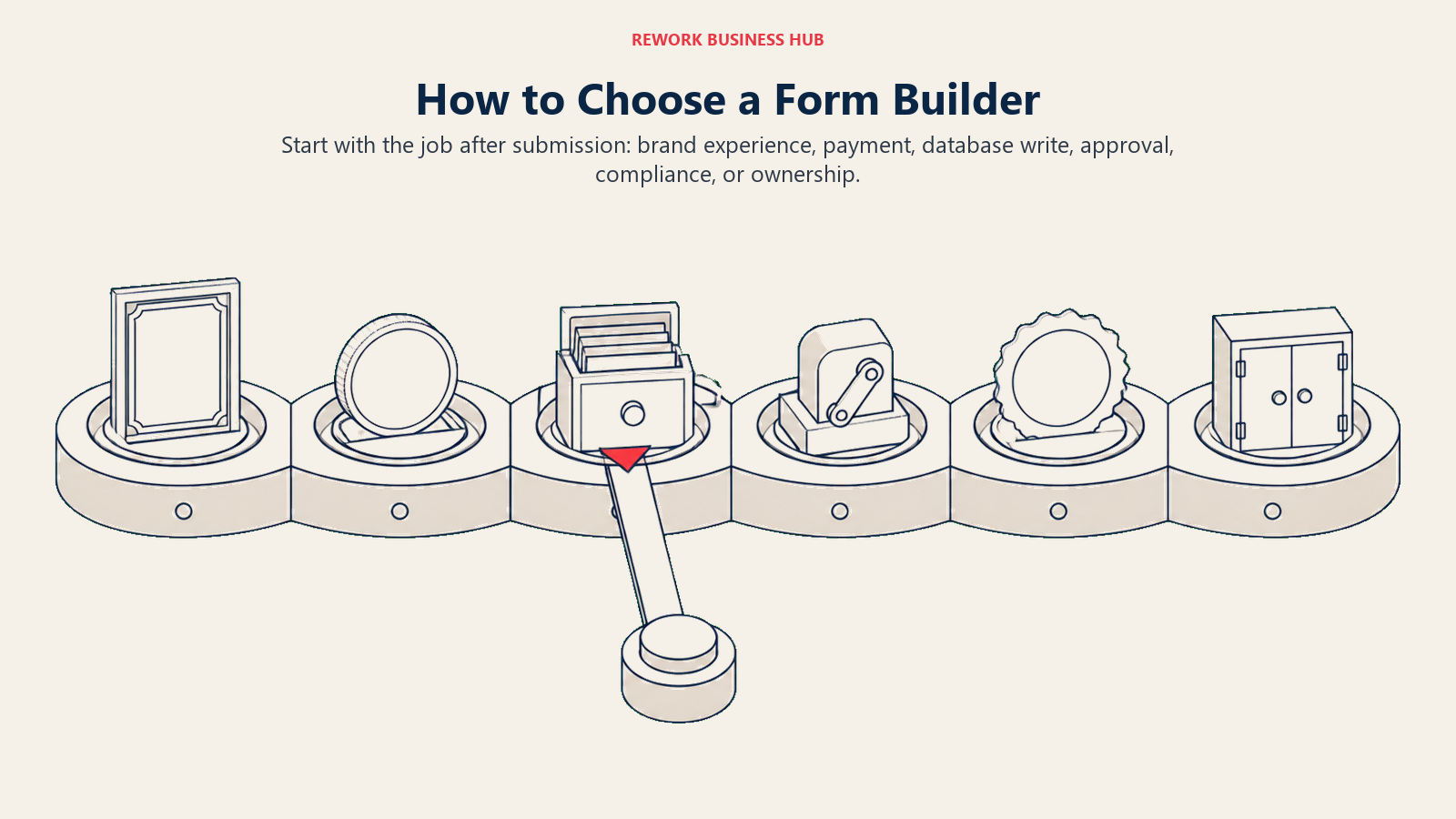
The right replacement depends on the job the form must do next, from brand-forward lead capture to payments, database sync, approvals, research, or WordPress data ownership.
| If you need... | Best pick | Why |
|---|---|---|
| The widest feature set without a developer | Jotform | Templates and widgets cover most use cases |
| Forms that feel like part of your brand | Typeform | Conversational design, strong completion |
| You're already paying for Microsoft 365 | Microsoft Forms | Native Excel/Teams sync, no new vendor |
| Unlimited responses without a big budget | Tally | Free plan has no response caps |
| Forms that write into Notion, Airtable, Supabase | Fillout | Native database integrations |
| Forms that double as a landing page | Paperform | Rich media, native Stripe payments |
| Approval routing and calculation logic | Cognito Forms | Built-in workflow, real math |
| Regulated industry compliance | Formstack | HIPAA, document generation, e-signature |
| You're already running Zoho | Zoho Forms | Native CRM and Creator integration |
| A proven, no-drama simple builder | Wufoo | Long track record, easy reporting, though nothing publicly shipped since 2020 |
| Formal research or benchmarking | SurveyMonkey | Statistical analysis, panel recruitment |
| Full data ownership on WordPress | Gravity Forms | Self-hosted, site-based licensing |
| The easiest WordPress on-ramp | WPForms | Beginner-friendly, unlimited on entry tier |
Frequently Asked Questions about Google Forms Alternatives
What's the biggest reason teams leave Google Forms?
One specific missing capability, not general dissatisfaction: no payment collection, logic too shallow for a real qualification flow, or no way to route a submission into an approval or CRM process.
Is there a truly free alternative with no response limits?
Tally is closest. Its free plan includes unlimited forms and responses, which most competitors here still meter.
Which alternative is best for collecting payments?
Jotform, Paperform, Fillout, Wufoo, Cognito Forms, and WPForms (Pro+) support native payment collection. Typeform, Microsoft Forms, and SurveyMonkey don't.
Do any of these sync natively to a CRM the way Google Forms syncs to Sheets?
Microsoft Forms syncs to Excel, not a CRM. Zoho Forms syncs natively to Zoho CRM. Most others connect through built-in connectors or Zapier instead.
What's the difference between Gravity Forms and WPForms?
Both are WordPress plugins, not hosted SaaS. Gravity Forms suits technical users wanting full data ownership. WPForms suits beginners wanting a working form in minutes.
Is Microsoft Forms actually free like Google Forms?
Only partially. A personal account caps each form at 200 responses for life, not per month, with no file uploads. Full use needs Microsoft 365 Business from around $7/user/month.
What to Do Next
Pick two candidates based on the specific limitation costing you time: one for the payment/logic gap (Jotform or Fillout) and one for the design gap (Typeform or Paperform). Run both against one real form, not a test form, for two weeks, and watch whether the logic holds up when someone answers out of order and whether the pricing tier that covers your actual volume matches what you assumed.
For the surrounding stack: Form-to-CRM Automation and Zapier vs n8n vs Make cover connecting a form to a real pipeline. For adjacent tool decisions, see best SurveyMonkey alternatives, best Typeform alternatives, how to choose survey software, best Google Workspace alternatives, how to choose form builder software, how to choose e-signature software, best DocuSign alternatives, and best PandaDoc alternatives. And for the category view rather than the Google-Forms-replacement view, see the full form builder comparison.
External Resources:
- Typeform pricing: Free through Enterprise plan comparison
- Jotform pricing plans: Free through Enterprise tiers
- Tally pricing: Free and Pro plan comparison
- Fillout pricing: Free through Enterprise tiers
- Formstack pricing: Forms and Suite plan comparison
- Cognito Forms pricing: Free through Enterprise tiers
- Wufoo pricing: Free through Ultimate plan comparison
- SurveyMonkey pricing: Team and Enterprise plan comparison
- Gravity Forms pricing: Basic, Pro, and Elite license comparison
- WPForms pricing: Basic through Elite license comparison
- Zoho Forms pricing: Free tier and paid tier feature comparison
- Zuko form conversion statistics: Desktop vs. mobile completion research
- Zapier no-code adoption report: No-code usage and growth data

Principal Product Marketing Strategist
On this page
- Key Facts
- Quick Comparison Table
- Stage Fit Matrix
- Sizing and Persona Table
- 1. Jotform: The Broadest Feature Set Without a Developer
- 2. Typeform: The Design Upgrade for Brand-Conscious Teams
- 3. Microsoft Forms: The Google Forms Equivalent for Microsoft Shops
- 4. Tally: The Closest Thing to Unlimited, Free Google Forms
- 5. Fillout: Forms That Write Straight Into Your Database
- 6. Paperform: Forms That Double as Landing Pages
- 7. Cognito Forms: Built-In Workflow for Ops-Heavy Teams
- 8. Formstack: Compliance and Document Generation for Regulated Teams
- 9. Zoho Forms: The Natural Pick Inside a Zoho Stack
- 10. Wufoo: The Long-Standing, No-Surprises Option
- 11. SurveyMonkey: The Research-Grade Option
- 12. Gravity Forms: Full Data Ownership on WordPress
- 13. WPForms: The Easiest On-Ramp for WordPress Beginners
- Feature Depth Comparison
- Why Teams Outgrow Google Forms
- How to Choose: Decision Framework
- What to Do Next