Best Bird (MessageBird) Alternatives in 2026: 12 Messaging APIs and Platforms Compared
Turn this article into takeaways for your work.


Each assistant summarizes the article only for you and suggests best practices for your work.
Updated August 2026.
If you came here to buy SMS from MessageBird, the short answer is that Twilio and Sinch are the two closest replacements with published per-message rates, Infobip is the closest match to MessageBird's old omnichannel enterprise pitch, and Telnyx is the cheapest published US rate if you just need messages to move. Sinch Engage is where you land if you wanted a packaged product rather than a raw API.
Here's the part that surprises most people who arrive here. MessageBird rebranded to Bird, and Bird's own pricing page today prices email and nothing else. SMS, WhatsApp, Voice, RCS and Push are all labelled "Coming soon," each described as shipping as a new API. So a buyer shopping MessageBird for SMS in August 2026 cannot actually buy SMS from Bird. That's not a knock on the roadmap, it's just the state of what's purchasable, and it reframes this whole comparison: you're not looking for something better than Bird's SMS product, you're looking for a vendor that currently sells one. Every price below was checked against each vendor's own pricing page in August 2026.
Key Facts
- Operator revenue from business messaging was $51.7 billion in 2025 and is forecast to reach $54.6 billion by 2030, about 5% growth over the period, on a base heading toward nearly 3 trillion business messages a year (Juniper Research, A2P and Business Messaging report).
- 75% of brands said they planned to adopt RCS during 2025, which is why nearly every vendor here now advertises an RCS roadmap (Twilio State of Customer Engagement Report 2025, vendor research surveying 7,640 consumers and 637 business leaders across 18 countries).
- US A2P traffic on 10-digit long codes requires brand and campaign registration. The Campaign Registry verifies brands and Campaign Service Providers before they're allowed to send (The Campaign Registry).
- Consent, opt-out handling and content rules for A2P messaging across short code, 10DLC and toll-free come from the wireless industry's shared framework, not from any single vendor (CTIA Messaging Principles and Best Practices).
- Carrier surcharges are billed on top of every per-message rate in this article. Amazon's own SMS pricing page says its published figures "are provided for guidance only, and change frequently" because rates vary by country, region and destination carrier (AWS SNS SMS pricing).
What Bird Actually Sells Today
Before comparing replacements, it's worth being precise about what you can and cannot buy from Bird right now. This comes straight from bird.com/pricing in August 2026.
| Bird channel | Status on Bird's own pricing page | What that means for a buyer |
|---|---|---|
| Priced and purchasable | Free 1,000 emails/mo, Startup from $15/mo, Growth from $80/mo, Enterprise custom | |
| SMS | "Coming soon" | No published rate, no self-serve purchase |
| "Coming soon" | No published rate, no self-serve purchase | |
| Voice | "Coming soon" | No published rate, no self-serve purchase |
| RCS | "Coming soon" | No published rate, no self-serve purchase |
| Push | "Coming soon" | No published rate, no self-serve purchase |
The email product is real and reasonably priced. Free covers 1,000 emails a month on a shared IP with no card required. Startup runs from $15/mo at 50,000 emails up to $30/mo at 100,000, with overage at $0.90 per 1,000. Growth runs from $80/mo at 100,000 up to $1,039/mo at 2.5 million, with the effective per-thousand rate declining as volume climbs. Enterprise is custom above that. If email is genuinely what you need, Bird is a fine option, and the best SendGrid alternatives roundup covers it alongside its direct competitors.
But if you arrived because you wanted the omnichannel SMS and WhatsApp provider MessageBird was known for, the honest read is that the reputation is running well ahead of the current catalogue. That's exactly the kind of claim worth checking on the vendor's own page rather than inheriting from a two-year-old comparison post.
Quick Comparison Table
| Tool | Best For | Starting Price | Key Strength | Key Limitation |
|---|---|---|---|---|
| Twilio | The default full-channel CPaaS replacement | $0.0083 per US SMS, send or receive | Widest channel and number coverage, all rates published | Highest per-message rate of the published CPaaS group |
| Sinch (SMS API) | European-rooted omnichannel CPaaS at a lower rate | $0.0078 per US 10DLC SMS, out or in | Undercuts Twilio on the most common number type | Short code rental and support tiers need a sales call |
| Infobip | The closest match to MessageBird's omnichannel pitch | Not published, pay as you go, routes to sales | Broadest channel catalogue and global carrier reach | You cannot price it without talking to sales |
| Vonage | Teams that want messaging and voice from one vendor | $0.0086 per US SMS send, $0.00691 receive | Publishes number rental, strong voice heritage | MMS routes to sales, pricing page geo-defaults |
| Plivo | Cost-conscious teams that need cheap numbers | $0.0077 per US long code SMS, each direction | Cheapest published number rental at $0.50/mo | Smaller channel catalogue than Twilio or Infobip |
| Telnyx | The lowest published US per-message rate | $0.004 per US local SMS, out or in | Roughly half Twilio's rate on local numbers | Number pricing not stated on the messaging page |
| Bandwidth | Enterprises that want fewer intermediaries | $0.006 per outbound US 10DLC SMS | Owns its carrier network rather than reselling | Inbound and number pricing only on request |
| Amazon SNS | AWS-native alerting and notifications | Per-message rates not published, guidance only | Deep AWS integration, fully published number and 10DLC fees | Not a conversational or omnichannel platform |
| Sinch Engage (was MessageMedia) | Non-developers who want a packaged product | Basics $49/mo, 1,000 SMS, 1 user | No code required, unlimited contacts on every tier | Volume-capped tiers, not an API-first product |
| Brevo | Marketers wanting email, SMS and WhatsApp on one bill | Starter $9/mo monthly, $8.08/mo on annual | One account across email and messaging channels | SMS credits sold separately from the email plan |
| Klaviyo | Ecommerce teams running email and SMS together | Email $30/mo at 1,000 profiles; SMS from $15/mo | Deep ecommerce data model behind both channels | Email and SMS are separate plans that stack |
| Mailgun | Replacing Bird's email product specifically | Basic $15/mo for 10,000 emails | Still has a permanent free tier at 100 emails/day | Email only, no SMS or WhatsApp channel |
US Per-Message SMS Rates Compared
This is the table most people actually need, and it's the one most roundups get wrong by quoting a single number per vendor. Rates differ by number type and by direction, so a headline "cheapest SMS API" claim is meaningless without saying which number you're sending from.
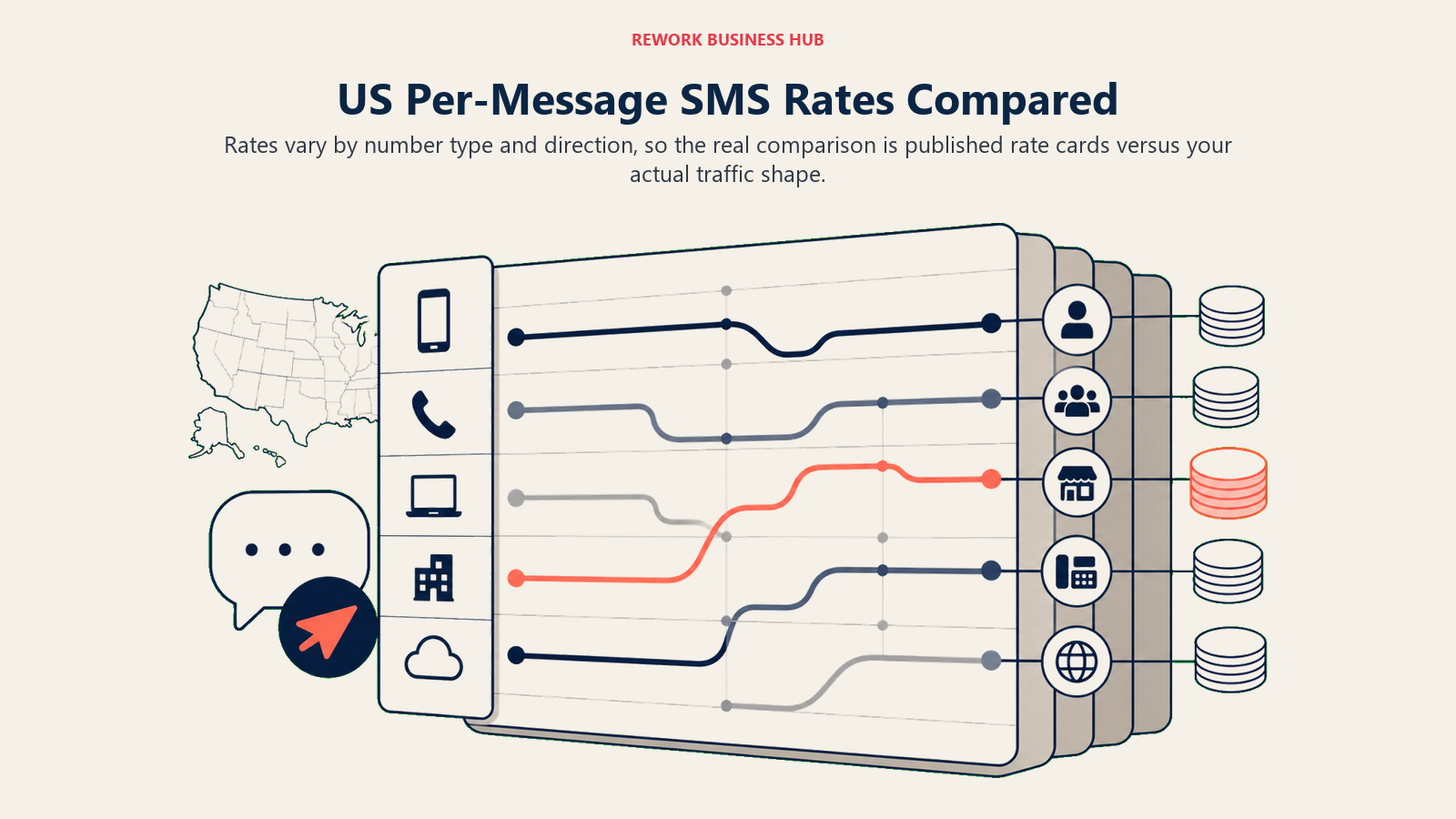
Read every cell as a US rate, per message part, with carrier surcharges billed separately on top. A 160-character message is one part; longer messages are split and billed per part.
| Vendor | 10DLC / long code, send | 10DLC / long code, receive | Toll-free, send | Short code, send |
|---|---|---|---|---|
| Twilio | $0.0083 | $0.0083 | $0.0083 | $0.0083 |
| Sinch (SMS API) | $0.0078 | $0.0078 | $0.0078 | $0.009 (receive $0.0075) |
| Telnyx | $0.004 | $0.004 | $0.0055 (direction not broken out) | $0.007 (direction not broken out) |
| Plivo | $0.0077 | $0.0077 | $0.0079 (each direction) | $0.0077 |
| Bandwidth | $0.006 | Not published | $0.0075 | $0.006 |
| Vonage | $0.0086 | $0.00691 | Not published | Not published |
| Amazon SNS | Not published, guidance only | Not published | Not published (toll-free carrier fee $0.0025) | Not published |
| Infobip | Not published | Not published | Not published | Not published |
Three things worth pulling out of that grid. First, Twilio charges the same $0.0083 across long code, toll-free and short code in both directions, which is unusually simple and makes budgeting easy even though it isn't the cheapest. Second, Telnyx at $0.004 on local numbers is roughly half Twilio's rate, which is a real difference at volume: a million messages a month is about $4,000 versus $8,300 before carrier fees. Third, two of the eight vendors publish nothing at all, and that's a procurement fact, not an oversight you can work around.
Vonage's rates above are US figures. Its pricing page geo-defaults to the visitor's market, so if you pull it up yourself and see different numbers, check the country selector before assuming anything changed.
US Per-Message MMS Rates Compared
MMS pricing diverges much more sharply than SMS between these vendors, and it's where a picture-heavy use case can quietly double a bill. Same rules: US rates, per message, carrier fees separate.
| Vendor | 10DLC / long code MMS | Toll-free MMS | Short code MMS |
|---|---|---|---|
| Twilio | Send $0.022, receive $0.0165 | Send $0.022, receive $0.02 | Send $0.022, receive $0.0165 |
| Sinch (SMS API) | $0.02 | $0.018 | $0.02 |
| Telnyx | Send $0.015, receive $0.005 | $0.016 | Send $0.018, receive $0.009 |
| Plivo | $0.0180 | $0.0200 | $0.0200 |
| Bandwidth | Outbound $0.015 | Outbound $0.020 | Outbound $0.020 |
| Vonage | Not published, routes to sales | Not published | Not published |
| Amazon SNS | Not published | Not published | Not published |
| Infobip | Not published | Not published | Not published |
Telnyx holds its cost advantage on MMS receive in particular, at $0.005 inbound on local numbers against Twilio's $0.0165. If you run two-way picture messaging, that gap compounds fast.
Number Rental and Registration Fees
Per-message rates are only half the bill. Numbers carry monthly rental, and US 10DLC traffic carries registration fees that several vendors pass through at cost. Amazon publishes the most complete fee schedule of anyone here, which is genuinely useful for modelling even if you don't end up buying from AWS.
| Vendor | Local / 10DLC number | Toll-free number | Short code |
|---|---|---|---|
| Twilio | $1.15/mo (bring your own $0.50/mo) | $2.15/mo | $1,000/quarter random, $1,500/quarter vanity, plus one-time setup |
| Sinch (SMS API) | $1.00/mo, plus a $1.00 one-time setup fee | $2.00/mo, plus a $2.00 one-time setup fee | Not published |
| Telnyx | Not stated on the messaging pricing page | Not stated | Not stated |
| Plivo | $0.50/mo | $1.00/mo | $500/mo regular or $1,000/mo vanity, billed quarterly, plus $1,500 one-time |
| Bandwidth | Not published, available on request | Not published | Not published |
| Vonage | Virtual number $1.05/mo, $0.00 setup | Not published | Not published |
| Amazon SNS | $1/mo per number | $2/mo lease plus $0.0025 per message carrier fee | $650 one-time setup plus $995/mo |
| Infobip | Not published | Not published | Not published |
On top of those, Amazon publishes the 10DLC registration costs every US sender pays in some form: $4 one-time for company registration, $50 one-time for campaign registration (its page notes this is currently waived), then $10/mo per campaign, or $2/mo for a low-volume campaign. Budget for registration whichever vendor you choose, because unregistered 10DLC traffic doesn't reach US handsets.
Stage Fit Matrix
This matrix shows which replacements fit startup, growth, mid-market, and enterprise teams.
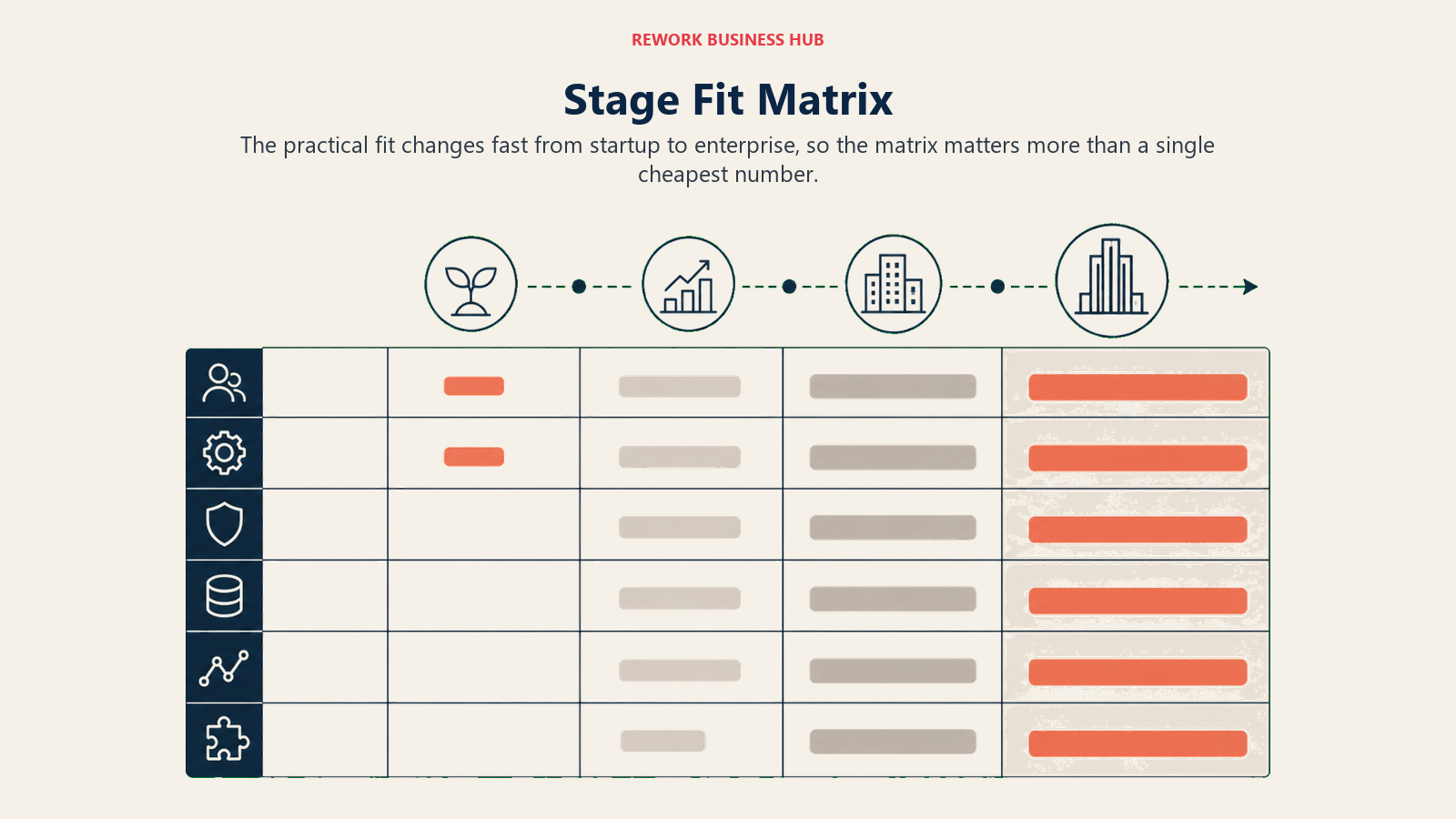
| Tool | Startup (1-10) | Growth (10-50) | Mid-Market (50-200) | Enterprise (200+) |
|---|---|---|---|---|
| Twilio | Strong fit | Strong fit | Strong fit | Strong fit |
| Sinch (SMS API) | Good fit | Strong fit | Strong fit | Strong fit |
| Infobip | Possible | Good fit | Strong fit | Strong fit |
| Vonage | Good fit | Strong fit | Good fit | Good fit |
| Plivo | Strong fit | Strong fit | Good fit | Possible |
| Telnyx | Strong fit | Strong fit | Good fit | Good fit |
| Bandwidth | Weak fit | Possible | Good fit | Strong fit |
| Amazon SNS | Good fit | Good fit | Strong fit | Strong fit |
| Sinch Engage | Strong fit | Strong fit | Good fit | Possible |
| Brevo | Strong fit | Good fit | Weak fit | Not ideal |
| Klaviyo | Good fit | Strong fit | Strong fit | Good fit |
| Mailgun | Good fit | Strong fit | Strong fit | Good fit |
Sizing and Persona Table
| Tool | Team Size Sweet Spot | Primary Buyer | Team vs Company-Wide |
|---|---|---|---|
| Twilio | 5-1,000+ | Backend engineer, platform lead | Engineering, company-wide platform |
| Sinch (SMS API) | 10-500 | Backend engineer, messaging ops | Engineering |
| Infobip | 100-5,000 | CX or digital channels director | Company-wide |
| Vonage | 10-300 | Engineer needing voice plus messaging | Engineering |
| Plivo | 1-150 | Developer, technical founder | Engineering team |
| Telnyx | 5-300 | Cost-focused platform engineer | Engineering team |
| Bandwidth | 200+ | Telecom or procurement lead | Company-wide |
| Amazon SNS | 10-1,000+ | Cloud or DevOps engineer | Infrastructure |
| Sinch Engage | 1-50 | Ops manager, marketer, no developer | Single team |
| Brevo | 1-75 | Marketing manager, founder | Marketing team |
| Klaviyo | 5-200 | Ecommerce or lifecycle marketer | Marketing team |
| Mailgun | 5-300 | Backend engineer, DevOps lead | Engineering team |
1. Twilio - the default replacement, and the only one that publishes everything
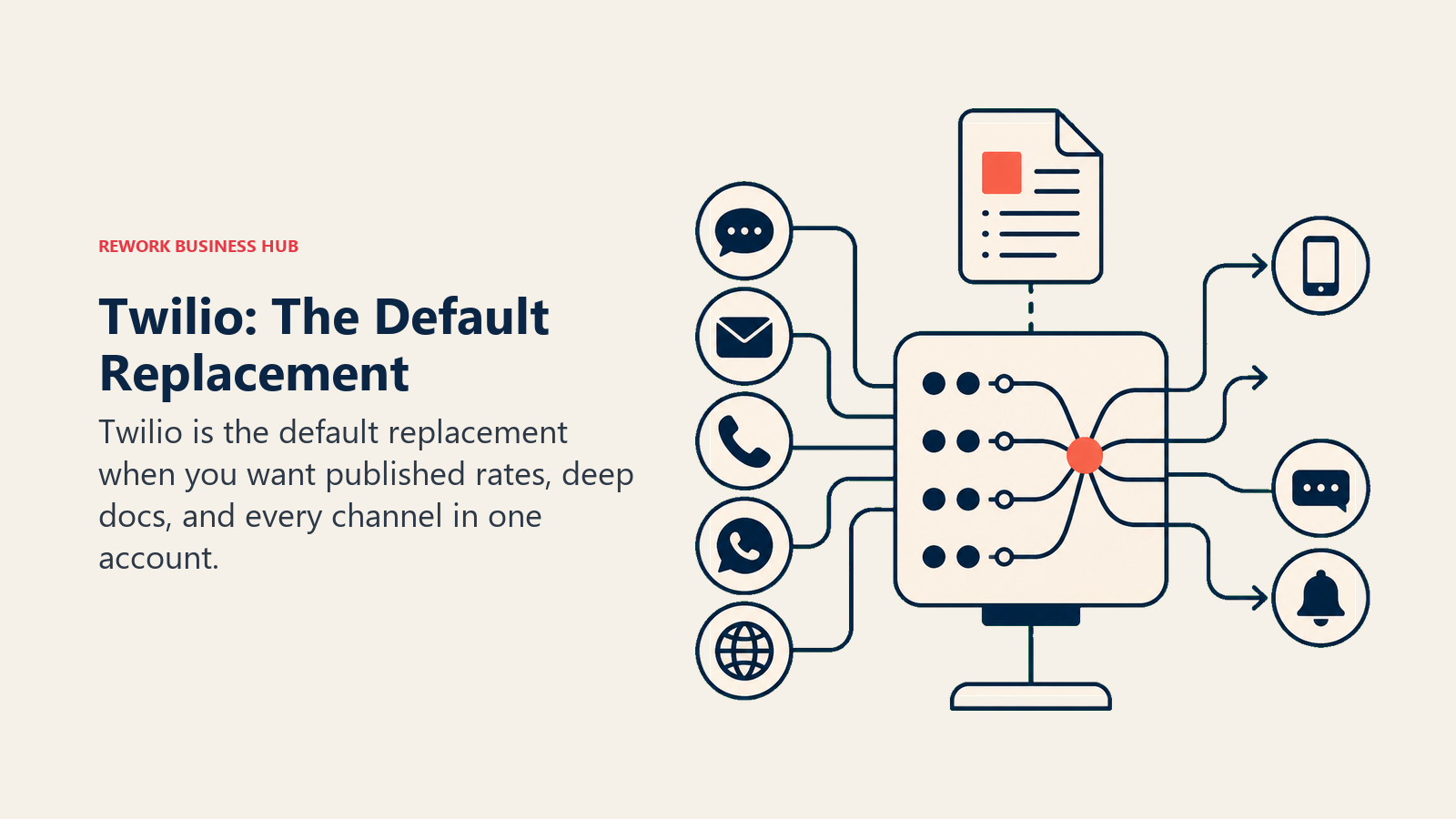
Twilio is where most teams leaving a stalled CPaaS end up, for an unglamorous reason: it publishes every rate, for every number type, in both directions, and it actually sells all the channels it advertises. SMS, MMS, WhatsApp, voice, email through SendGrid, and a verification product all sit behind one account and one billing relationship.
The ICP is a backend or platform engineer at anything from a seed-stage startup to a global enterprise. Twilio's documentation and SDK coverage are the deepest in the category, and the ecosystem effect is real: when you hit a strange carrier behaviour at 2am, someone has already written about it. The trade-off is price. At $0.0083 per US SMS in either direction, Twilio is the most expensive of the vendors here that publish a rate, and there's no volume discount visible on the public page.
Two costs to model before committing. Short codes run $1,000 per quarter for a random code or $1,500 per quarter for a vanity code, plus a one-time setup fee, so they're a real commitment rather than a casual upgrade. And Twilio charges a $0.001 processing fee on failed messages, which is small per message but noticeable if your list quality is poor. If you want the head-to-head against the other obvious pick, see Twilio vs Sinch, and the best Twilio alternatives roundup covers the flip side of this decision.
| What you get | What you don't |
|---|---|
| Every rate published, for every number type and direction | The cheapest per-message pricing in this comparison |
| The deepest docs, SDK and community coverage in CPaaS | Visible volume discounting on the public pricing page |
| Genuinely live SMS, MMS, WhatsApp, voice and verification | A packaged no-code product for non-developers |
Pricing: $0.0083 per US SMS, send or receive, across long code, toll-free and short code. MMS send $0.022; MMS receive $0.0165 on long and short code, $0.02 toll-free. Numbers: local $1.15/mo, toll-free $2.15/mo, bring-your-own $0.50/mo. Short code $1,000/quarter random or $1,500/quarter vanity, plus one-time setup. Failed-message processing fee $0.001. US A2P 10DLC registration fees apply on top. Carrier fees separate.
Best for: teams that want every channel MessageBird promised, actually purchasable today, and will pay a premium for published rates and mature documentation.
2. Sinch (SMS API) - the closest European analog, at a lower rate than Twilio
Sinch is the most direct like-for-like swap for what MessageBird used to be: a European-headquartered CPaaS with global carrier relationships, an omnichannel catalogue spanning SMS, MMS, WhatsApp, RCS and voice, and an API-first delivery model. If you chose MessageBird partly because you wanted a non-US vendor with EU data handling as a first-class concern, Sinch is the natural first call.
The important thing to get right, and the thing most comparisons botch, is that Sinch sells two completely different products under one brand. The Sinch SMS API discussed in this section is the pay-as-you-go CPaaS priced per message. Sinch Engage, covered separately at number 9 below, is a packaged SaaS starting at $49/mo. Quoting "Sinch starts at $49" for the API, or "$0.0078" for Engage, mixes up two products at wildly different price points.
On the API side, Sinch undercuts Twilio on the most common US number type: $0.0078 per 10DLC message in either direction against Twilio's $0.0083. That's about a 6% saving, which matters at scale but isn't the reason to switch on its own. The stronger arguments are carrier reach outside North America and a genuine omnichannel roadmap that's shipping rather than pending.
| What you get | What you don't |
|---|---|
| Lower US 10DLC rates than Twilio, out and in | Number rental pricing published on the SMS page |
| European base with global carrier relationships | Twilio's depth of third-party integrations |
| A live omnichannel catalogue, not a roadmap | One simple rate card (two products, two models) |
Pricing (Sinch SMS API): US 10DLC $0.0078 out and in; toll-free $0.0078 out and in; short code $0.009 out and $0.0075 in. MMS: 10DLC $0.02, toll-free $0.018, short code $0.02. Numbers: 10DLC $1.00/mo with a $1.00 one-time setup fee, toll-free $2.00/mo with a $2.00 setup fee; short code rental is not published there. Carrier fees separate. A trial is available.
Best for: teams replacing MessageBird who want the same European omnichannel CPaaS shape, with published per-message rates and a modest saving against Twilio.
3. Infobip - the closest thing to what MessageBird promised, if you'll talk to sales
Of everyone on this list, Infobip is the vendor whose positioning most resembles the MessageBird pitch that probably brought you here: one platform, every channel, global carrier reach, enterprise-grade. SMS, MMS, WhatsApp, RCS, Viber, voice, email and chat apps all sit in one catalogue, backed by direct operator connections in a very large number of markets.
The catch is procurement. Infobip's pricing page describes a pay-as-you-go model and says you only pay for what you use, but it publishes no per-message rate and no subscription price. It routes you to a calculator or to a sales conversation for a custom package. That's a legitimate enterprise motion, but it means you cannot compare Infobip against Twilio or Telnyx on a spreadsheet without booking a call first, and you should assume a longer buying cycle than a self-serve signup.
The ICP is a mid-market or enterprise buyer, often a CX or digital channels director rather than an individual engineer, who's consolidating messaging across many countries and wants one contract instead of a per-region patchwork. If that's you, the lack of a published rate is an annoyance rather than a blocker. If you're a five-person team wanting to send 10,000 texts next Tuesday, it's a genuine mismatch.
| What you get | What you don't |
|---|---|
| The broadest channel catalogue in this comparison | Any published per-message rate or subscription price |
| Direct carrier connections across a very wide market list | A self-serve signup you can price in an afternoon |
| Enterprise consolidation onto one contract | A fast buying cycle for a small team |
Pricing: Infobip does not publish pricing. The company describes a pay-as-you-go model where you pay only for what you use, offers a calculator on its site, and routes buyers wanting a custom package to its sales team. Treat any specific figure you see elsewhere as unconfirmed until you have a quote.
Best for: mid-market and enterprise buyers consolidating many channels and many countries onto one messaging contract, who are comfortable buying through sales.
4. Vonage - messaging and voice from one vendor, with number pricing on the page
Vonage sells a Messages API alongside a long-established voice and video business, which makes it a reasonable pick when SMS is one part of a communications stack rather than the whole thing. If your product needs a phone call and a text from the same vendor and the same number, Vonage covers that pairing more naturally than a messaging-only API.
Its US SMS rates sit slightly above Twilio's on send at $0.0086, but below on receive at $0.00691, so the effective cost depends on how two-way your traffic is. An alerting use case that mostly sends will pay a little more than Twilio; a conversational use case with heavy inbound may come out ahead. Vonage also publishes its virtual number rental at $1.05/mo with no setup fee, which several competitors here don't publish at all.
One practical warning that costs people real money: Vonage's pricing page geo-defaults to the visitor's market. If you open it from outside the US you'll see another country's rates, and the figures above will look wrong. Set the country selector to United States before quoting anything internally. MMS pricing isn't published on that page either; the Messages API routes MMS enquiries to sales.
| What you get | What you don't |
|---|---|
| Messaging and mature voice from one vendor and number | Published US MMS pricing (it routes to sales) |
| Published virtual number rental at $1.05/mo, no setup fee | The lowest send rate in this comparison |
| Lower inbound than outbound, good for two-way traffic | A pricing page that stays on your market by default |
Pricing: US long code (virtual number) SMS send $0.0086, receive $0.00691, plus carrier fees of roughly $0.0025 to $0.005. Virtual number $1.05/mo for SMS and voice, $0.00 initial setup. MMS is not published on the SMS pricing page. Free credit on signup. These are US figures pulled with the country selector set to United States.
Best for: teams that need SMS and voice from one vendor, especially with heavy two-way inbound traffic where the lower receive rate pays off.
5. Plivo - the cheapest numbers, and a simple rate card
Plivo competes on straightforward economics. Its US long code and short code SMS both run $0.0077 in each direction, toll-free is $0.0079, and, unusually for this group, it publishes its number rental clearly: $0.50/mo for a long code and $1.00/mo for a toll-free number. Those are the cheapest published number costs in this comparison, less than half Twilio's $1.15 and $2.15.
That matters more than it sounds. Teams running many numbers, for example one per location, per agent, or per campaign, find number rental becomes a bigger line item than the messages themselves. A hundred local numbers costs $50/mo on Plivo against $115/mo on Twilio, before a single message is sent.
The ICP is a developer or technical founder at a small to mid-sized company who wants clean SMS and voice APIs without paying the incumbent premium. The trade-off is breadth: Plivo's channel catalogue is narrower than Twilio's or Infobip's, so if WhatsApp, RCS and Viber are all on your roadmap, check coverage before you commit. Short codes are also a substantial commitment at $500/mo regular or $1,000/mo vanity, billed quarterly, plus a $1,500 one-time fee.
| What you get | What you don't |
|---|---|
| The cheapest published number rental at $0.50/mo long code | The channel breadth of Twilio or Infobip |
| A simple, symmetric rate card in both directions | The largest integration ecosystem |
| Clean SMS and voice APIs with solid documentation | A cheap route into short codes |
Pricing: US long code and short code SMS $0.0077 each direction; toll-free $0.0079 each direction. MMS: long code $0.0180, toll-free and short code $0.0200. Numbers: long code $0.50/mo, toll-free $1.00/mo. Short code $500/mo regular or $1,000/mo vanity, billed quarterly, plus a $1,500 one-time fee. Free credits on signup, amount not published. Carrier fees separate.
Best for: cost-conscious developer teams running many phone numbers, where rental cost matters as much as the per-message rate.
6. Telnyx - the lowest published US rate, by a wide margin
Telnyx publishes $0.004 per US local SMS in either direction. That's roughly half Twilio's $0.0083 and about 48% below the Sinch SMS API's $0.0078, which makes it the clear cost leader among vendors that publish anything at all. Toll-free runs $0.0055 and short code $0.007, both quoted per message part with carrier fees on top.
The reason it can price that way is architectural: Telnyx runs its own private IP network and holds carrier interconnects directly rather than layering on top of another provider's infrastructure. That also tends to show up as tighter latency control and more granular routing options, which appeals to teams that care about delivery paths rather than just delivery.
The ICP is a platform engineer at a company with enough volume for the rate difference to be worth a migration. At a million US messages a month, moving from Twilio to Telnyx local numbers is roughly $4,000 against $8,300 in pure message cost before carrier fees, and that gap is what funds the switching effort. Below maybe 100,000 messages a month the absolute saving is small enough that Twilio's documentation and ecosystem may be worth more than the delta. Note that Telnyx doesn't state number rental on its messaging pricing page, so get that quoted before you model the full bill.
| What you get | What you don't |
|---|---|
| The lowest published US per-message rate in this group | Number rental stated on the messaging pricing page |
| Its own private IP network and direct carrier interconnects | Twilio's ecosystem and third-party integration depth |
| Strong inbound MMS economics at $0.005 on local numbers | A no-code product for non-technical teams |
Pricing: US local SMS $0.004 out and in; toll-free $0.0055; short code $0.007. MMS: local out $0.015 and in $0.005; toll-free $0.016; short code out $0.018 and in $0.009. All quoted per message part, with carrier fees separate. Number rental is not stated on the messaging pricing page.
Best for: high-volume senders where a roughly 50% cut in per-message cost against Twilio justifies a migration and a slightly thinner ecosystem.
7. Bandwidth - the one that owns the network underneath
Bandwidth's differentiator is structural rather than featural: it operates its own carrier network in the US instead of reselling capacity from someone else's. For most buyers that's an abstraction, but for enterprises with regulatory exposure, unusual routing needs, or a very large number footprint, removing an intermediary from the delivery path changes both the economics and the accountability when something breaks.
Its published outbound rates are competitive: $0.006 per US 10DLC or short code message, $0.0075 toll-free. Outbound MMS runs $0.015 on 10DLC and $0.020 on short code and toll-free. What's missing from the public page is inbound pricing and number rental. Bandwidth states that full product pricing is available on request, which puts it partway between the fully published vendors and the fully gated ones like Infobip.
The ICP skews clearly enterprise: a telecom or procurement lead at a company with 200 or more employees, often buying messaging alongside voice and emergency services. A ten-person startup will find the buying process heavier than the product warrants. If you're at that scale though, being one hop closer to the carriers is a genuine argument, and the outbound rates hold up well against everyone except Telnyx.
| What you get | What you don't |
|---|---|
| Its own US carrier network rather than resold capacity | Published inbound message rates |
| Competitive published outbound rates at $0.006 on 10DLC | Published number rental (available on request) |
| Messaging, voice and emergency services from one vendor | A light-touch, self-serve buying experience |
Pricing: Outbound US SMS: 10DLC $0.006, short code $0.006, toll-free $0.0075. Outbound MMS: 10DLC $0.015, short code $0.020, toll-free $0.020. Inbound rates and number rental are not published; the page states full product pricing is available on request. Carrier fees separate.
Best for: enterprises that want fewer intermediaries between their application and the carriers, and can run a procurement process to get the rest of the numbers.
8. Amazon SNS - great for alerts, wrong shape for conversations
Amazon SNS deserves a place here with a clear caveat: it's a notification service, not a conversational messaging platform. It publishes to topics and endpoints, and SMS is one of several delivery targets alongside push, email and queues. If what you actually need from a MessageBird replacement is two-way conversation, WhatsApp threads, or campaign management, SNS is the wrong tool and no amount of pricing advantage fixes that.
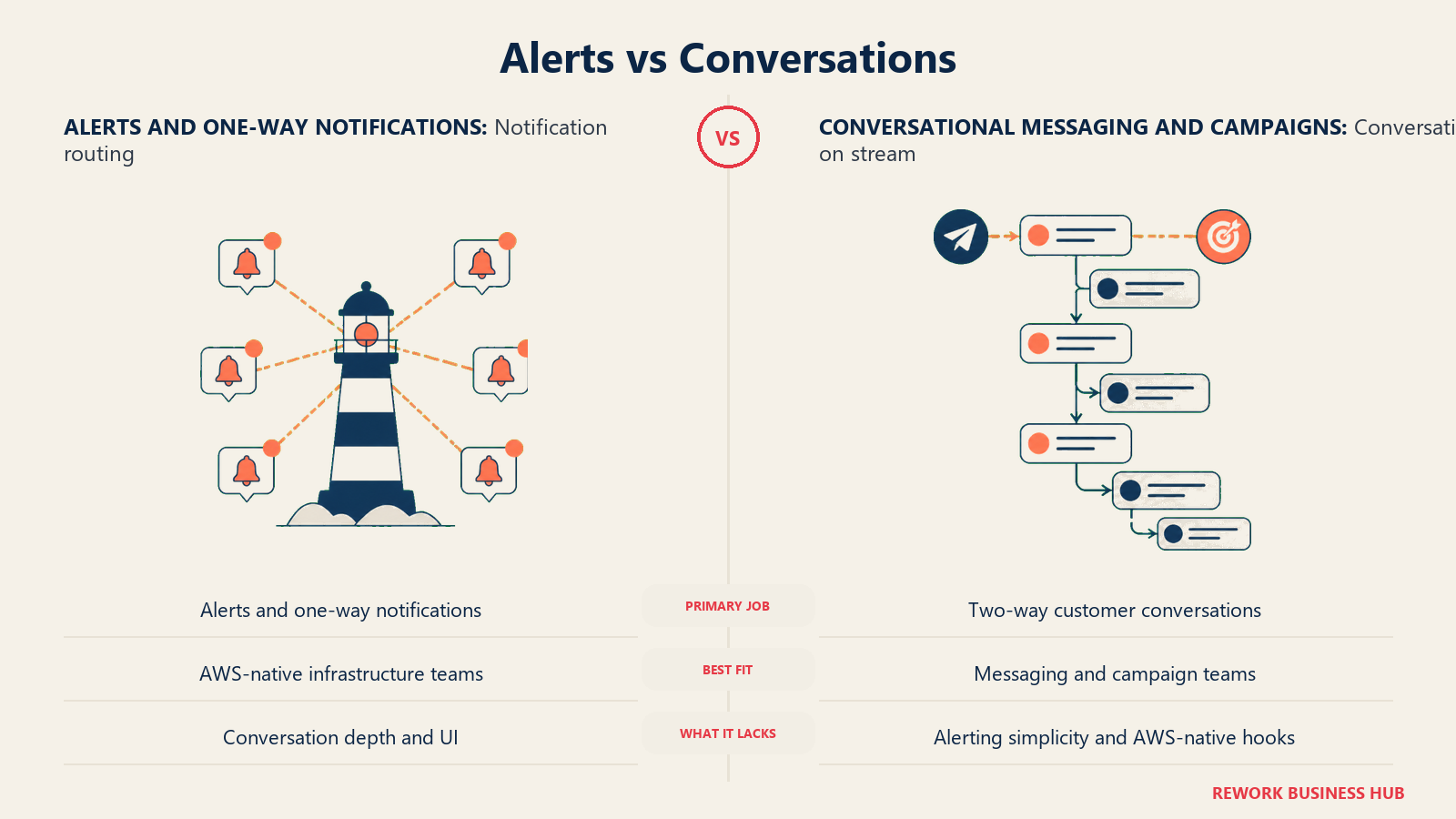
For the alerting use case though, it's excellent, particularly if your infrastructure already lives in AWS. Alarms, deployment notifications, on-call escalation and one-time passcodes route naturally through it with IAM permissions and CloudWatch metrics you already understand.
The pricing situation needs stating plainly, because it's easy to misread as an oversight. Amazon does not publish per-message SMS rates in a way you can rely on. Its page says prices vary between countries, regions and even between carriers in the same country, and that the figures shown are provided for guidance only and change frequently. It points you to daily usage reports for exact per-message pricing after the fact. What Amazon does publish, and publishes better than anyone else here, is the fixed fee schedule around numbers and registration.
| What you get | What you don't |
|---|---|
| Native AWS integration with IAM, CloudWatch and infra-as-code | Reliable published per-message SMS rates |
| The clearest published 10DLC and number fee schedule here | Two-way conversation, WhatsApp or campaign tooling |
| Sensible economics for alerting and notification traffic | A product shaped like an omnichannel CPaaS |
Pricing: Per-message SMS rates are not published as firm figures; Amazon states its prices are for guidance only and vary by country, region and carrier. Published fixed fees: toll-free number lease $2/mo plus a $0.0025 per message carrier fee; 10DLC company registration $4 one-time; 10DLC campaign registration $50 one-time (the page notes it is currently waived); $10/mo per campaign or $2/mo for a low-volume campaign; $1/mo per number; US short code $650 one-time setup plus $995/mo. AWS free tier includes 1 million mobile push notifications.
Best for: AWS-native teams sending alerts, passcodes and system notifications, who want messaging governed by the same IAM and tooling as the rest of their stack.
9. Sinch Engage (formerly MessageMedia) - the packaged option, and a name change to know about
If you were shopping MessageBird alongside MessageMedia, there's a rebrand you need to know about: MessageMedia no longer exists as a brand. Its pricing URL now permanently redirects to Sinch Engage, and the destination page says so directly, noting that visitors redirected there arrived because MessageMedia is rebranding to Sinch Engage. The product continues, the name doesn't.
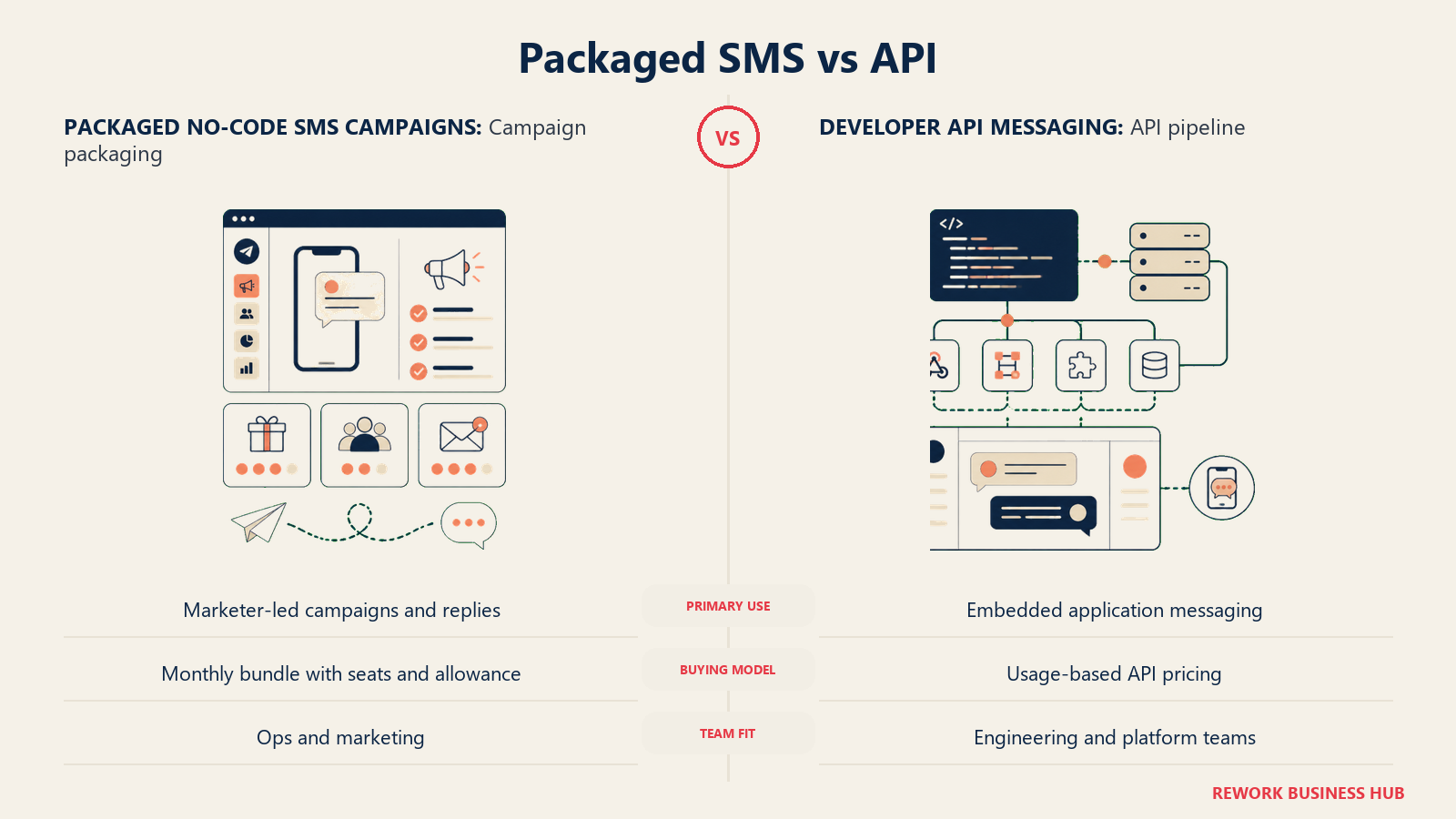
Sinch Engage is the packaged, no-code counterpart to the Sinch SMS API covered at number 2. Instead of per-message billing, you buy a monthly tier with a bundled message allowance, a set number of users, and a limit on automations. That's a much better fit for an ops manager or marketer who wants to run SMS campaigns and two-way conversations without an engineer, and a much worse fit for a product team embedding messaging in an application.
Every tier includes unlimited contacts, which is a meaningful differentiator against contact-priced platforms where your bill grows just from having a bigger list. The constraint is message volume instead. Watch the user limits too: Basics includes a single user, and even the $799/mo Advanced tier includes only three, so a large team will hit seat limits before message limits.
| What you get | What you don't |
|---|---|
| Unlimited contacts on every tier, volume-capped instead | An API-first model for embedding in a product |
| No-code campaigns and two-way inbox, no engineer needed | Generous user seats (3 users even at $799/mo) |
| Predictable monthly cost rather than variable per-message | Per-message economics that scale down at high volume |
Pricing (Sinch Engage): Basics $49/mo (1,000 SMS, 1 user, 3 automations). Conversations $99/mo (3,000 SMS, 2 users, 30 automations). Pro $249/mo (10,000 SMS, 3 users, 1 sub-account). Pro Plus $450/mo (20,000 SMS, 3 users, 2 sub-accounts, SSO). Advanced $799/mo (40,000 SMS, 3 users, 3 sub-accounts, SSO). Unlimited contacts on all tiers. 14-day trial, no card required. Annual commitment is shown as saving 16% against monthly.
Best for: non-technical teams that wanted a packaged messaging product rather than an API, and readers who came searching for MessageMedia and need to know where it went.
10. Brevo - email, SMS and WhatsApp on one bill for marketers
Brevo is the pick when the thing you liked about MessageBird's pitch was channel consolidation rather than API depth. One account covers transactional and marketing email, SMS, WhatsApp, push and a campaign builder, at a price point aimed squarely at small and mid-sized businesses rather than enterprises.
The entry price is genuinely low: Starter is $9/mo billed monthly, or $8.08/mo on an annual plan (a 10% saving), covering from 5,000 emails a month and 500 contacts. Standard is $18/mo monthly or $16.17/mo annually. The step to Professional is steep, at $499/mo monthly or $449.08/mo annually, which brings 150,000 emails a month, 10 seats, and the WhatsApp, popup and push features. There's also a free forever tier at 300 emails a day with no card required.
One structural detail to plan around: SMS credits are sold separately from the email plan. The monthly figures above buy email volume and platform features, not text messages, so model SMS as a distinct line item rather than assuming it's included. If Brevo looks close but not quite right, the best Brevo alternatives guide compares it against its direct peers.
| What you get | What you don't |
|---|---|
| Email, SMS, WhatsApp and push on one account and one bill | SMS credits bundled into the plan price |
| A genuinely low entry price and a free forever tier | A gentle step up (Standard $18 to Professional $499) |
| A campaign builder alongside the transactional API | The API depth of a dedicated CPaaS |
Pricing: Starter $9/mo billed monthly, $8.08/mo on annual (10% off), from 5,000 emails/mo and 500 contacts. Standard $18/mo monthly, $16.17/mo annual. Professional $499/mo monthly, $449.08/mo annual, from 150,000 emails/mo, 10 seats, plus WhatsApp, popups and push. Enterprise custom. SMS credits sold separately. Add-ons: remove Brevo branding $10.80/mo, Sales Essentials $27.92/mo, Sales Advanced $58.50/mo per user. Free forever: 300 emails/day, no card.
Best for: small and mid-sized marketing teams that want email and messaging channels consolidated on one affordable bill, with no engineering required.
11. Klaviyo - the ecommerce answer, with email and SMS billed separately
For an ecommerce brand, Klaviyo is usually the strongest replacement on this list, because the value isn't the messaging pipe at all. It's the data model underneath: order history, browse behaviour, product catalogue and lifetime value all sit in one profile store that both email and SMS segment against. A generic CPaaS gives you a better rate per message and no idea who's about to churn.
The pricing structure trips people up constantly, so state it precisely: email and SMS are separate plans that stack. Email starts at $30/mo for 1,000 active profiles with 10,000 sends a month. SMS starts from $15/mo for 1,250 credits. Writing "Klaviyo starts at $30" without saying that's email only, at 1,000 profiles, with SMS costing a further $15/mo minimum on top, understates the real entry cost by half. Every account does get 150 SMS credits free per billing cycle, and there's a free tier at 250 active profiles, 500 email sends a month, and $5 of mobile messages.
Cost scales with profile count rather than message volume, which is the opposite of the CPaaS model and can favour or punish you depending on list shape. A small, highly engaged list that receives a lot of messages is cheap on Klaviyo and expensive on a per-message API. A huge, rarely-messaged list is the reverse. The best Klaviyo alternatives guide works through that trade-off in more detail.
| What you get | What you don't |
|---|---|
| An ecommerce data model shared by email and SMS | One combined price (email and SMS plans stack) |
| Segmentation on orders, browsing and lifetime value | Good economics for huge, rarely-messaged lists |
| Strong native integrations with major ecommerce platforms | A general-purpose developer messaging API |
Pricing: Email from $30/mo at 1,000 active profiles (10,000 sends/mo). SMS from $15/mo for 1,250 credits, billed as a separate plan that stacks on top of email. 150 SMS credits included free per billing cycle on any account. Free tier: 250 active profiles, 500 email sends/mo, $5 of mobile messages/mo.
Best for: ecommerce brands where segmentation quality drives revenue more than per-message cost, and who accept paying for two stacked plans.
12. Mailgun - the replacement for the one product Bird actually sells
This entry exists for a specific reader: someone who was using, or was about to buy, Bird's email product and wants a direct comparison rather than a channel switch. Since email is the only thing Bird currently prices, that's a more common position than it sounds.
Mailgun is the strongest like-for-like option. It's a REST API and SMTP relay with validation, inbound routing and suppression management built in, aimed at the same backend engineer who'd otherwise reach for Bird's email API. Basic is $15/mo for 10,000 emails with overage from $1.80 per 1,000, Foundation is $35/mo for 50,000 with 5-day log retention, and Scale is $90/mo for 100,000 with 30-day retention.
The detail that matters most in 2026: Mailgun still has a permanent free tier at 100 emails a day. That's genuinely notable, because the comparable free plan at SendGrid was retired on 27 May 2025, and a lot of writing still assumes both vendors offer one. Bird's own free tier of 1,000 emails a month is competitive at low volume, so the real decision is what happens as you scale and whether you want a vendor whose other channels are shipping today. See SendGrid vs Mailgun for the head-to-head, or best Mailgun alternatives if Mailgun itself is the thing you're replacing.
| What you get | What you don't |
|---|---|
| A permanent free tier at 100 emails/day | Any SMS, WhatsApp or voice channel |
| Built-in validation, inbound routing and suppression lists | Long log retention on the entry paid plan (1 day) |
| A direct like-for-like swap for Bird's email API | A campaign builder for marketing sends |
Pricing: Basic $15/mo for 10,000 emails (overage from $1.80 per 1,000, 1-day log retention). Foundation $35/mo for 50,000 emails (overage from $1.30 per 1,000, 5-day retention). Scale $90/mo for 100,000 emails (overage from $1.10 per 1,000, 30-day retention). Dedicated IP add-on $59 per IP/mo. Monthly billing is what the page shows. Free tier: 100 emails/day, permanent, 1-day log retention.
Best for: teams replacing Bird's email product specifically, who want a permanent free tier and a straightforward paid ladder.
What You Actually Lose Leaving Bird
It's worth being fair here, because "the SMS product isn't purchasable" isn't the same as "the company is a bad choice."
Bird's email pricing is competitive and its free tier needs no credit card, which is rarer than it should be. The usage-based structure, where Startup and Growth both scale continuously with volume rather than jumping between fixed tiers, is friendlier than the step-function pricing most email vendors use. And a platform that's rebuilding its channels as new APIs may well end up with a cleaner product than one carrying a decade of legacy endpoints.
The question is timing, not quality. If you need SMS or WhatsApp this quarter, none of that helps, and you should pick from the eleven vendors above that sell those channels today. If you need email now and might want messaging later, Bird is a defensible bet, as long as you're making it with clear eyes about what "Coming soon" means for a project plan. What you shouldn't do is assume the MessageBird SMS product you remember is still sitting there behind a login.
How to Choose: Decision Framework
This decision table maps the right replacement to the job you need done.
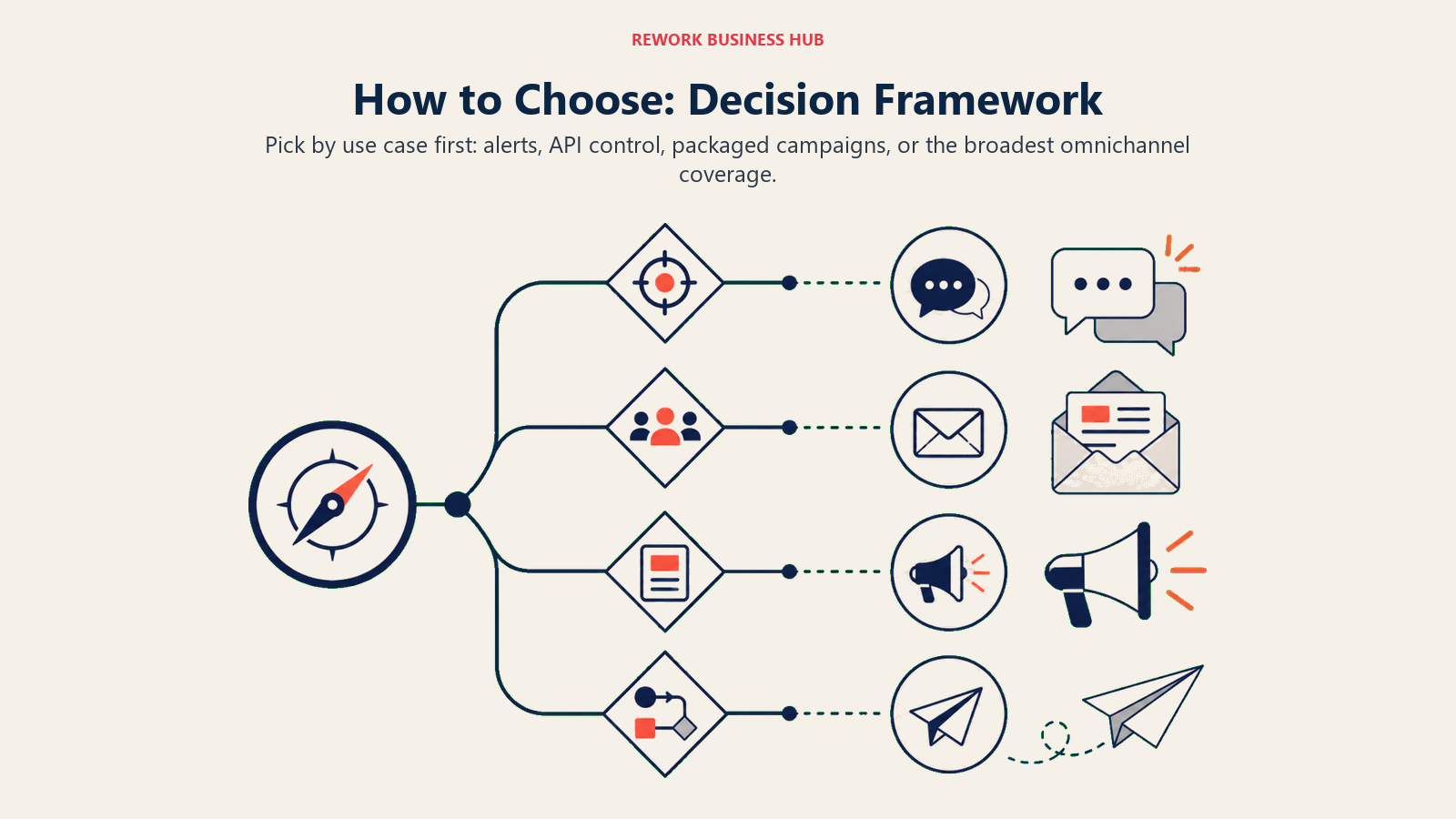
| If you need... | Pick this |
|---|---|
| Every channel MessageBird promised, purchasable today | Twilio |
| The same European omnichannel CPaaS shape, cheaper than Twilio | Sinch (SMS API) |
| MessageBird's enterprise omnichannel pitch, and can buy through sales | Infobip |
| SMS and mature voice from one vendor, with heavy inbound traffic | Vonage |
| Many phone numbers, where rental cost beats per-message cost | Plivo |
| The lowest published US per-message rate at real volume | Telnyx |
| Fewer intermediaries between your app and the US carriers | Bandwidth |
| Alerts and passcodes inside an existing AWS stack | Amazon SNS |
| A packaged no-code product, or you were shopping MessageMedia | Sinch Engage |
| Email, SMS and WhatsApp on one affordable bill, no engineer | Brevo |
| Ecommerce segmentation driving both email and SMS | Klaviyo |
| A direct replacement for Bird's email product, with a free tier | Mailgun |
What to Do Next
Start by separating the two questions Bird's current catalogue forces on you: what do you need to send this quarter, and what would you like to send next year. If SMS or WhatsApp is in the first bucket, your shortlist is short. Pick two from Twilio, Sinch, Telnyx and Plivo, run the same 5,000 messages through each on a trial, and compare delivery receipts and latency rather than just whether the API returned a 200.
Build the cost model before the pilot, not after. Take your real monthly volume, split it by number type and direction, then add number rental and the 10DLC registration fees from the tables above. That total is what you're comparing, and it routinely reorders a shortlist built on headline per-message rates alone. If you're buying the packaged rather than the API version of this, weigh Sinch Engage against the SMS marketing platforms instead, since the tier structures are more comparable there.
Two adjacent decisions worth making at the same time. If voice is anywhere on your roadmap, checking business phone systems before you commit to a messaging vendor can save a second migration later. And if the ecommerce angle is what actually drew you to omnichannel, read the best Attentive alternatives and best Postscript alternatives roundups, since those platforms solve a different problem than a raw CPaaS and may be the better fit.

Principal Product Marketing Strategist
On this page
- Key Facts
- What Bird Actually Sells Today
- Quick Comparison Table
- US Per-Message SMS Rates Compared
- US Per-Message MMS Rates Compared
- Number Rental and Registration Fees
- Stage Fit Matrix
- Sizing and Persona Table
- 1. Twilio - the default replacement, and the only one that publishes everything
- 2. Sinch (SMS API) - the closest European analog, at a lower rate than Twilio
- 3. Infobip - the closest thing to what MessageBird promised, if you'll talk to sales
- 4. Vonage - messaging and voice from one vendor, with number pricing on the page
- 5. Plivo - the cheapest numbers, and a simple rate card
- 6. Telnyx - the lowest published US rate, by a wide margin
- 7. Bandwidth - the one that owns the network underneath
- 8. Amazon SNS - great for alerts, wrong shape for conversations
- 9. Sinch Engage (formerly MessageMedia) - the packaged option, and a name change to know about
- 10. Brevo - email, SMS and WhatsApp on one bill for marketers
- 11. Klaviyo - the ecommerce answer, with email and SMS billed separately
- 12. Mailgun - the replacement for the one product Bird actually sells
- What You Actually Lose Leaving Bird
- How to Choose: Decision Framework
- What to Do Next