Best Kahoot Alternatives in 2026: 13 Tools for Classrooms, Training, and Team Meetings
Turn this article into takeaways for your work.


Each assistant summarizes the article only for you and suggests best practices for your work.
"Kahoot alternatives" is really two different searches sharing one keyword. A teacher typing it wants a free or near-free quiz tool with a big ready-made content library. A training manager or event organizer typing the exact same phrase wants live engagement for a workshop, an all-hands, or a conference, and has usually hit a wall on Kahoot's per-participant pricing. This guide covers both, split clearly so you can skip straight to your half, and it evaluates every tool on pricing model, player caps, and how far each one reaches beyond a simple multiple-choice quiz.
Two things about Kahoot itself have changed and most of the web hasn't caught up. First, Kahoot's workplace pricing has moved off the kahoot.com domain entirely: kahoot.com/pricing and kahoot.com/business/pricing now both 301-redirect to kahoot360.com/pricing, a separate brand called Kahoot! 360 with its own five-tier structure. Schools pricing stays put at kahoot.com/schools/pricing. Second, Kahoot's closest education rival renamed itself: Quizizz became Wayground in June 2025, and a lot of "vs Kahoot" content out there is still comparing against a brand name that no longer exists.
Key Facts
Gamified Learning and Engagement, By the Numbers
- Global employee engagement fell to 20% in 2025, the lowest level since 2020, according to Gallup's State of the Global Workplace report, a big part of why L&D teams keep reaching for gamified formats (see the Best Employee Engagement Software in 2026 roundup for the wider engagement stack). (Gallup)
- 83% of employees who receive gamified training report feeling motivated, compared to 61% of those who receive non-gamified training. (TalentLMS 2019 Gamification at Work survey)
- Students who were tested on a passage recalled 61% of it after one week, versus 40% for students who simply reread the same material four times, a landmark demonstration of the testing effect. (Roediger & Karpicke, 2006, Psychological Science, via PubMed)
- Wayground (formerly Quizizz) reaches educators in more than 150 countries and 90% of U.S. schools, as of its June 2025 rebrand announcement. (PR Newswire)
- 69% of educators say they, or teachers in their school or district, use online quizzes almost daily, with quiz-style apps like Blooket and Quizizz among the most-mentioned tools. (EdWeek Research Center, 2022)
Classroom or Workplace: Which Half of This List Is Yours
Classroom buyers prioritize teaching and practice; workplace buyers choose for training and meeting scale.
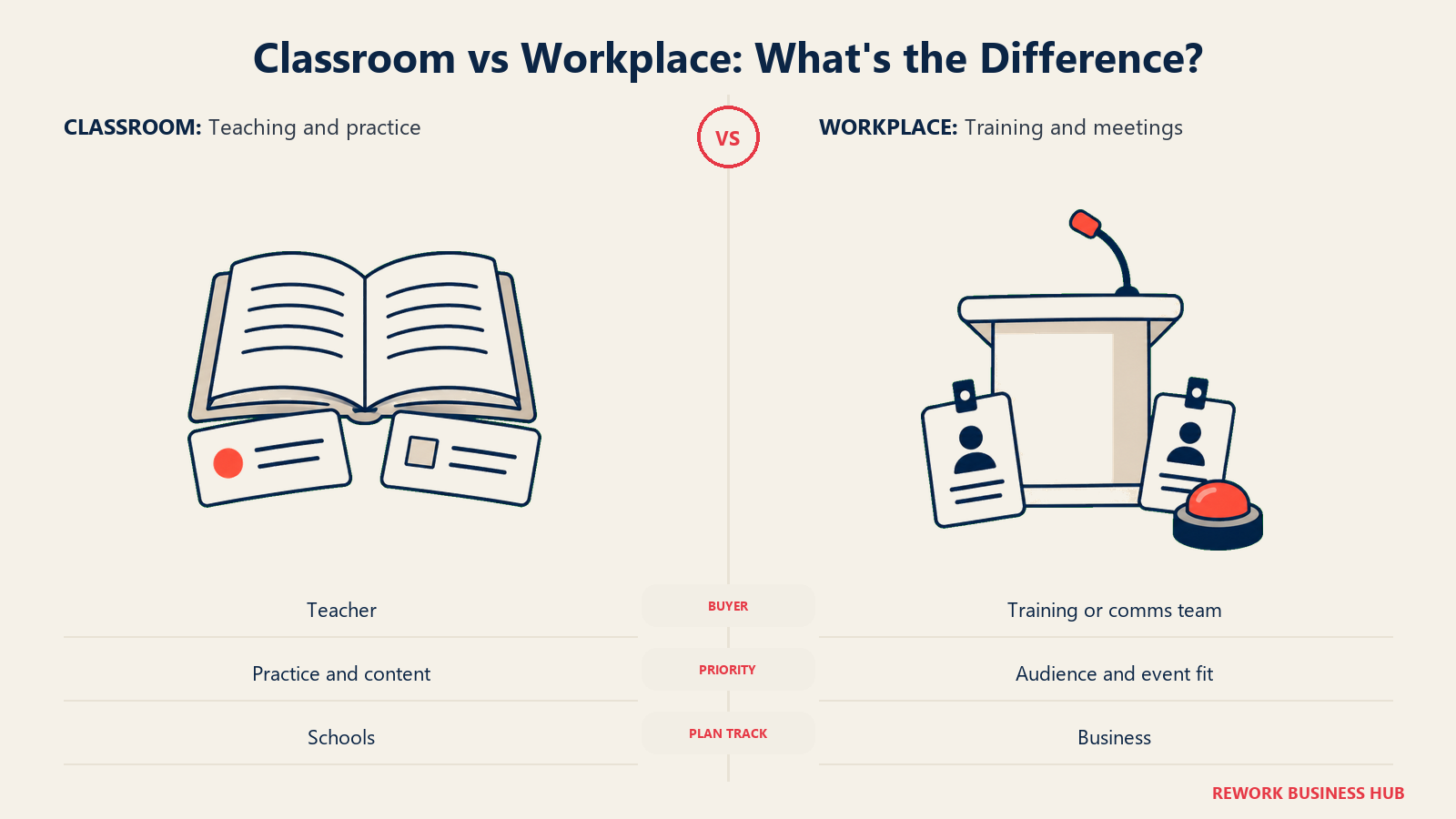
| If you are a... | You want... | Start with |
|---|---|---|
| K-12 or higher-ed teacher | A free or cheap tool with a huge ready-made question-set library | Wayground, Gimkit, Blooket, Kahoot! for schools |
| Corporate trainer or L&D lead | Quizzes plus polls inside a training session, LMS-integrated | Wooclap, Vevox, AhaSlides |
| Conference or event organizer | Live audience Q&A and polling at real attendee scale | Slido, Poll Everywhere, Crowdpurr |
| Meeting facilitator or all-hands host | A quick poll or quiz embedded in a video call, no second screen | StreamAlive, Mentimeter, Sendsteps |
| Student revising for an exam | Flashcards and self-paced study, not live gameplay | Quizlet |
Quick Comparison Table
| Tool | Best For | Starting Price | Key Strength | Key Limitation |
|---|---|---|---|---|
| Kahoot! (for reference) | Best-known brand, deepest ready-made content library | Free (Kahoot! Go, 40 players); Kahoot! 360 Pro Start from $19/mo | Recognition and audience familiarity | Two separate price lists on two domains |
| Wayground (formerly Quizizz) | Direct education rival, self-paced or live | Not published; contact for education/district pricing | Self-paced homework mode alongside live games | Pricing isn't shown on a crawlable page |
| Mentimeter | Workplace polling that occasionally becomes a quiz | Free (50 participants/month); Basic $11.99/presenter/mo | Strong slide-and-poll hybrid format | Free tier caps at 50 participants per month, account-wide |
| AhaSlides | Quizzes plus polls at the lowest published paid price | Free (50 participants); Essential $7.95/mo equivalent ($95.40/yr) | Cheapest confirmed paid entry point here | Pro pricing isn't on a crawlable page |
| Slido | Q&A and polling for meetings and conferences | Free (100 participants/event); Engage $210/year | Cisco-backed reliability at conference scale | Annual billing only, with no month-to-month option |
| Gimkit | Game-mode variety with a strong classroom retention loop | Free; Pro $14.99/mo month-to-month, or $59.98/yr | Assignment mode plus in-game economy that keeps kids engaged | Classroom-first: no Q&A, no enterprise admin, no event features |
| Blooket | Game-mode variety for younger classrooms | Free; Plus (annual) and Plus Flex (monthly), prices shown only at checkout | Large variety of arcade-style game modes on one question set | No published price, and the game art skews young for adult audiences |
| Quizlet | Study sets and self-paced revision, not live events | Free; Quizlet Plus priced only at quizlet.com/upgrade | Enormous shared library of student-made study sets | Built for solo study, not a live shared-screen event |
| Poll Everywhere | North American enterprise and higher-ed standard | Free (40 audience, 700 for first 30 days); Present $10/mo | Deep, transparent published pricing ladder | Free tier drops from 700 to 40 after the first month |
| Vevox | Cheapest serious paid tier, quizzing plus Q&A | Free (100/session); Starter $11.95/mo ($143.40/yr) | Strong Microsoft Teams and PowerPoint integration | Free tier caps at one user |
| Wooclap | Education and training first, LMS integration | Free (5 questions/month); Basic $13/mo billed annually | Deep LMS integration story for training teams | Every paid tier is annual-billing only |
| Crowdpurr | Live trivia and mobile-first crowd experiences | Free (20 participants); Classroom $49.99/mo or $24.99/mo annual | Built for real event scale, up to 5,000 participants | Jump from free to paid tiers is steep |
| Sendsteps | AI-generated presentations plus interaction | Not published; "save up to 31%" annually is the only public detail | AI builds the deck and the interactive questions together | No pricing transparency at all |
| StreamAlive | Engagement inside the video call chat itself | Free (5 participants/session); Starter $50/mo or $20/mo annual | No second screen, works inside Zoom/Meet/Teams chat | Free tier is genuinely tiny at 5 participants |
Why Kahoot Still Sets the Bar (and Where It Doesn't)
Kahoot earns its reputation honestly. It's the most recognized name in the category by a wide margin, its question-set marketplace is the deepest of any tool on this list, and for a classroom teacher who just wants to run a quick review game with zero setup friction, Kahoot! Go still does the job for free. None of the 13 tools below are here because Kahoot is bad. They're here because "Kahoot" as a search term covers two very different jobs, and Kahoot itself now prices those two jobs on two different websites with two different tier structures. If your real need is a full event platform rather than a single engagement layer, the Best Event Management Software in 2026 roundup covers that broader category.
The split matters because the friction each group hits is different. Teachers rarely complain about price, since Kahoot! Go costs nothing; they complain about the 40-player cap on free games and the content-library gaps in niche subjects. Workplace buyers complain about something else entirely: Kahoot! 360's tiers scale by participant count, and a training team running sessions for 250 people needs at least the $49/month Plus tier, more once attendance climbs past 1,000.
Kahoot's Two Price Lists, Explained
Kahoot runs two separate pricing pages under two brand names, and conflating them is the single most common mistake in Kahoot coverage. kahoot.com/pricing and kahoot.com/business/pricing both 301-redirect to kahoot360.com/pricing. Kahoot! 360 is the workplace product; Kahoot! for schools stays on kahoot.com/schools/pricing and never redirects.
Kahoot! 360 (workplace), from kahoot360.com/pricing:
| Plan | Promotional price | Regular price | Annual | Participants |
|---|---|---|---|---|
| 360 Pro Start | $19/month | $19/month | $228/year | 50 |
| 360 Pro Standard | $25/month | $29/month | $300/year | 200 |
| 360 Pro Plus | $49/month | $49/month | $588/year | 1,000 |
| 360 Pro Max | $69/month | $79/month | $828/year | 2,000 |
| 360 Pro Ultra | $79/month | $99/month | $948/year | up to 5,000 with onboarding |
A free plan is available with account creation, no card required. Note that most tiers show a promotional price that differs from the regular renewal price; budget for the regular number, not the introductory one.
Kahoot! for schools, from kahoot.com/schools/pricing:
| Plan | Monthly | Annual | Players per game |
|---|---|---|---|
| Kahoot! Go | Free | Free | 40 |
| Kahoot!+ Bronze | $3/month | $36/year | 50 |
| Kahoot!+ Silver | $7/month | $84/year | 100 |
| Kahoot!+ Gold | $12/month | $144/year | 200 |
| Kahoot! One | $19/month | $228/year | 800 |
The number nearly every article gets wrong: Kahoot! Go, the free teacher tier, caps at 40 players per game, not the 50 that keeps circulating. If your classes run larger than 40 and you don't want to pay, that gap alone is reason enough to look at the alternatives below, several of which publish a more generous free tier.
Free Tier Comparison
| Tool | Free Tier Limit | Basis |
|---|---|---|
| Kahoot! Go | 40 players | Per game |
| Wayground (formerly Quizizz) | Free tier exists; limits not published on a crawlable page | Contact vendor |
| Mentimeter | 50 participants | Per month, account-wide (not per presentation) |
| AhaSlides | 50 live participants | Per presentation |
| Slido | 100 participants | Per event |
| Vevox | 100 participants | Per session, 1 user |
| Poll Everywhere | 40 (700 for the first 30 days) | Per poll audience |
| Wooclap | 5 active questions | Per 30-day period, up to 1,000 participants |
| Crowdpurr | 20 participants | Per experience |
| StreamAlive | 5 participants | Per session |
| Gimkit | Free with player caps on exclusive modes | Per game |
| Blooket | Free with core game modes | Per game |
| Quizlet | Free study sets, capped premium features | Account-wide |
Mentimeter's cap is the one that trips people up most: it's not per presentation, it's 50 participants total across your account per month, resetting on your signup date. Run one big session and you may not be able to present again free until the counter resets.
Sizing and Persona Table
| Tool | Team/Class Size Sweet Spot | Primary Buyer | Use Case Fit |
|---|---|---|---|
| Wayground | Any class size | Teacher, Curriculum Lead | Self-paced homework and live review games |
| Mentimeter | 10-500 | Trainer, Meeting Facilitator | Polls that occasionally include a quiz round |
| AhaSlides | 10-500 | Trainer, Teacher | Budget-friendly quizzes and polls together |
| Slido | 50-5,000+ | Event Organizer, Exec Assistant | Conference Q&A and live polling |
| Gimkit | 1 classroom (up to ~60) | Teacher | Game-based review with a self-paced assignment mode |
| Blooket | 1 classroom (up to ~60) | Teacher | Arcade-style game variety on one question bank |
| Quizlet | 1 student to 1 class | Student, Teacher | Flashcards and self-paced study, not live events |
| Poll Everywhere | 10-700+ | Higher-Ed Faculty, Trainer | Lecture polling and enterprise Q&A |
| Vevox | 10-1,500 | L&D Lead, Meeting Facilitator | Quizzing, polling, and Q&A with Teams built in |
| Wooclap | 10-1,000 | Trainer, Instructional Designer | Training sessions with LMS integration |
| Crowdpurr | 20-5,000 | Event Producer, Emcee | Live trivia and mobile-first crowd games |
| Sendsteps | 10-500 | Presenter, Trainer | AI-generated decks with built-in interaction |
| StreamAlive | 5-5,000 | Webinar Host, Remote Meeting Lead | Engagement inside the video call itself |
1. Wayground (formerly Quizizz): The Direct Education Rival
Wayground is the tool most K-12 and higher-ed teachers already think of as "the other Kahoot," and as of June 2025 it isn't Quizizz anymore. The rebrand didn't change the legal entity, ownership, user accounts, or privacy practices, but it did signal a real product shift: Wayground positions itself less as a quiz app and more as a supplemental learning platform, adding curriculum alignment, lesson bundles, and an AI generation hub for building assignments from any resource. It still does everything Quizizz did, live games with music and a leaderboard, self-paced homework mode, and a shared library of teacher-made question sets, but the self-paced mode is the real differentiator from Kahoot: students can work through a Wayground assignment on their own timeline, not just live in a shared session.
| What you get | What you don't |
|---|---|
| Self-paced assignment mode alongside live games | Kahoot's brand recognition with parents and students |
| A large existing library carried over from Quizizz | A crawlable, self-serve pricing page |
| Reach into 90% of U.S. schools already | Transparency on what a paid plan actually costs |
Pricing: Wayground does not publish pricing on a crawlable page (wayground.com/pricing and /plans both fail to load for automated checks). Treat any dollar figure you see elsewhere as unconfirmed; the honest answer is that education and district pricing is quoted after contact, and a free tier exists for individual teachers.
Best for: Teachers who want Kahoot's live-game format plus a self-paced homework mode Kahoot doesn't offer. Not ideal for: Buyers who want to compare a number before signing up; there's nothing published to compare against.
2. Mentimeter: The Workplace Default When the Quiz Was Really a Poll
Mentimeter is the tool most corporate presenters reach for first, not because it's the best quiz engine, but because most workplace "quizzes" are actually opinion polls wearing a game-show costume. Word clouds, live polls, Q&A, and a competitive quiz format all live in the same slide-based editor, which makes it easy to mix a single quiz question into an otherwise normal meeting deck instead of switching tools entirely.
| What you get | What you don't |
|---|---|
| Polls, word clouds, and quizzes in one slide editor | Unlimited participants on the free tier |
| Menti AI to help draft questions and slides | A cap that resets per presentation rather than per month |
| A genuinely large paid-tier participant allowance | Kahoot's music-and-leaderboard game energy |
Pricing: Free plan covers 50 participants per month, account-wide, with 23 slide types and Menti AI. Basic is $11.99 per presenter per month billed yearly ($143.88/yr), with unlimited participants, slide import, and result export; monthly billing is also available. Pro is $24.99 per presenter per month billed yearly ($299.88/yr), requiring an annual commitment, and adds workspace collaboration and more design control. Enterprise is custom, adding SSO, SCIM, and participant verification.
Best for: Meeting facilitators and trainers who need polling most of the time and an occasional quiz, not a dedicated game-based learning tool. See Kahoot vs Mentimeter for the direct head-to-head between these two, the companion Best Mentimeter Alternatives guide if Mentimeter's own limits are what sent you here, Slido vs Mentimeter for the other big head-to-head, or the Best Employee Communication Software in 2026 roundup if the real job is broader internal comms, not a single meeting poll. Not ideal for: Teams that will blow past 50 monthly participants fast; that free-tier cap is stricter than most people expect going in.
3. AhaSlides: Quizzes Plus Polls at the Lowest Published Paid Price
AhaSlides pitches itself squarely as a Mentimeter-and-Kahoot hybrid: the same slide-based poll and quiz format as Mentimeter, with a live leaderboard game mode closer to Kahoot's energy, at what is currently the cheapest confirmed paid entry point in this whole list.
| What you get | What you don't |
|---|---|
| Both poll-style slides and Kahoot-style live quiz games | A confirmed Pro-tier price on a crawlable page |
| The lowest published paid annual price here | Kahoot's brand recognition or content-library depth |
| A reasonably generous 50-participant free tier | AI features gated behind the top tier only |
Pricing: Free tier includes 50 live participants, unlimited presentations, and AI features. Essential is $95.40/year for non-educators (about $7.95/month equivalent); an "Edu Small" educator tier runs $35.40/year. Pro is $15.95/month billed yearly ($191.40/year) and its plan spec caps a presentation at 2,500 participants, not the 10,000 that AhaSlides' own comparison pages still claim; budget against 2,500. Enterprise covers up to 100,000 participants at a custom rate. Legacy "Plus" plans closed to new customers after September 2024.
Best for: Budget-conscious teams that want both poll and quiz formats in one tool without Mentimeter's per-presenter pricing. If AhaSlides is itself the tool you are replacing, the best AhaSlides alternatives guide covers that lane. Not ideal for: Buyers who need to see a confirmed Pro price before committing; that tier isn't published anywhere crawlable.
4. Slido: Q&A and Polling for Meetings and Conferences
Slido, owned by Cisco, is built for a different room than Kahoot: not a classroom running a review game, but a conference hall or all-hands where the real job is surfacing and moderating audience questions live, with polling as the second feature rather than the first.
| What you get | What you don't |
|---|---|
| Purpose-built live Q&A with upvoting and moderation | Any dollar figure published on a crawlable page |
| Cisco-backed reliability at real conference scale | Monthly billing; plans are annual only |
| Quizzes and surveys included alongside Q&A and polls | Kahoot's game-show energy as the primary format |
Pricing: The free Basic plan covers 100 participants per Slido event, per the vendor's own community answer. Paid plans are named Engage (up to 200 participants per meeting), Professional (adds Q&A moderation, custom branding, email verification), Enterprise (adds SSO, SCIM, and Slido Spaces, with bulk discounts from 20+ members), Unlimited Enterprise, and one-time event plans. Slido publishes real figures as of September 2026: Engage $210/year, Professional $900/year, Enterprise $2,400/year, including 1, 2 and 3 members with extra members at $17.50, $37.50 and $50 a month. It still offers no monthly billing at any tier, so every paid plan is an annual commitment.
Best for: Conference organizers and meeting facilitators whose priority is structured, moderated audience Q&A, not gamified quizzing. The Best Slido Alternatives and Best Poll Everywhere Alternatives guides cover this same job from other angles. Not ideal for: Anyone who wants to compare a monthly dollar figure before talking to sales; Slido gives you nothing to compare.
5. Gimkit: Game-Mode Variety Built by a Student
Gimkit's origin story is part of its pitch: it was built by a high schooler who thought Kahoot needed more strategy, and the result is a set of game modes (an in-game currency you spend on upgrades, team modes, boss-battle formats) that reward repeated play in a way a single leaderboard round doesn't. Teachers who use it report students asking to play again voluntarily, which is a meaningfully different signal than compliance with an assigned review game.
| What you get | What you don't |
|---|---|
| A self-paced Assignments mode built on any kit, with due dates | Kahoot's content-library size or brand recognition |
| An in-game economy that keeps engagement high across rounds | A vendor pricing page that loads for automated verification |
| A no-card-required 14-day Pro trial for new educator accounts | Image or audio question support without Pro |
Pricing: Gimkit publishes its rates on its own group pricing page and in its Gimkit Pro FAQ: Pro is $14.99 a month month-to-month, or $59.98 for a year. Group licensing runs $650 a year for a Department (Pro for up to 20 teachers) and $1,000 a year for a School (Pro for every teacher in one building). Confirm the current figure at checkout. Free accounts get most core game modes with player caps on exclusive modes; Pro removes those caps and unlocks the Assignments mode plus image and audio uploads.
Best for: Teachers who've noticed students disengage from a single leaderboard round and want game-mode variety to sustain repeat play. Not ideal for: Buyers who need a vendor-confirmed price before purchasing; verify the current figure directly at checkout.
6. Blooket: Game-Mode Variety for Younger Classrooms
Blooket runs the same basic idea as Gimkit, one question bank playable through many different arcade-style game modes, but leans younger: its visual style and game formats (matching games, tower-defense-style modes, racing games) tend to land best with elementary and middle-school classrooms rather than high school.
| What you get | What you don't |
|---|---|
| A wide variety of game modes on a single imported question set | Gimkit's strategy-driven in-game economy |
| A flexible monthly Plus Flex option alongside the annual plan | A vendor pricing page that loads for automated verification |
| Group bundle pricing scaling from 10 to 80 seats | Self-paced homework assignment mode |
Pricing: Blooket sells Plus, billed annually, and Plus Flex, billed monthly with no annual commitment, plus group bundles for teacher teams and whole schools. The rates are shown only on the signed-in upgrade page at dashboard.blooket.com/upgrade, and Blooket does not publish them anywhere a reader can check without an account, so we are not quoting a figure here. Check the upgrade page before you budget. Free accounts get core game modes; Plus unlocks the full game library and additional customization.
Best for: Elementary and middle-school teachers who want game variety aimed at a younger audience than Gimkit's typical user. Not ideal for: High school or corporate use cases; the visual style and game formats skew younger.
7. Quizlet: Study Sets and Self-Paced Revision, Not Live Events
Quizlet solves a different problem than everything else on this list, and it's worth naming that clearly: it's a flashcard and self-paced study tool first, with a live game mode (Quizlet Live) bolted on, rather than a live-event platform with study features added later. Students use it to cram before a test, not to play a shared-screen game with a class.
| What you get | What you don't |
|---|---|
| An enormous existing library of student- and teacher-made study sets | A live, shared-screen event experience as the primary use case |
| Flashcards, practice tests, and spaced-repetition study modes | A vendor pricing page that loads for automated verification |
| A genuinely useful free tier for individual studying | Kahoot's leaderboard-and-music live-game energy |
Pricing: Quizlet sells a free tier, Quizlet Plus, and a family plan, with separate Quizlet for Schools licensing for districts. Prices appear only at quizlet.com/upgrade at checkout and are not published on a page a reader can check beforehand, so we are not quoting a figure here. Free accounts get flashcards, basic study modes, and Quizlet Live in class.
Best for: Students revising independently, or teachers who want a shared study-set library more than a live shared-screen event. Not ideal for: Anyone whose actual need is a live, competitive classroom game as the main activity; Quizlet Live exists but isn't the product's focus.
8. Poll Everywhere: The North American Enterprise and Higher-Ed Standard
Poll Everywhere has spent over a decade becoming the default polling tool inside North American higher education and enterprise training, largely because it does one thing, live audience response embedded directly into PowerPoint, Google Slides, or Keynote, and does it with genuinely transparent published pricing that most of this category avoids.
| What you get | What you don't |
|---|---|
| Native embedding inside PowerPoint, Google Slides, and Keynote | Kahoot's game-show format as the default experience |
| Fully transparent published pricing across every paid tier | A free tier that stays generous past the first 30 days |
| Unlimited questions even on the free Intro plan | The lowest starting price in this list |
Pricing: Intro (free) allows a 40-person audience (700 for the first 30 days) with 10 AI prompts per month and unlimited questions. Present is $10/month or $120/year, raising the audience limit to 700 with 100 AI prompts and reporting. Engage is $49/month or $588/year, unlimited AI prompts, attendance management, and 2 included users. Teams is $84/month or $999/year, adding custom branding, logo removal, phone support, and 2 included users. Enterprise is custom, with SSO and a dedicated CSM. Extra seats cost $120 to $499 annually depending on tier.
Best for: University lecturers and enterprise trainers who want live response embedded directly in the slide deck they're already building. If what you actually need is a standalone survey rather than a live-session poll, the Best Typeform Alternatives guide covers that adjacent category. Not ideal for: Teams that need more than 40 free participants after the first month; the drop from the 700-person trial period is steep.
9. Vevox: Cheapest Serious Paid Tier, Quizzing Plus Q&A
Vevox packages quizzing, polling, and Q&A into one tool aimed squarely at organizations already living inside Microsoft 365, and its Starter tier is the cheapest confirmed serious paid plan in this entire roundup, undercutting Mentimeter's Basic and AhaSlides' Essential on a monthly basis.
| What you get | What you don't |
|---|---|
| Native Microsoft Teams and PowerPoint integration | Kahoot's brand recognition or content-library depth |
| AI-assisted question creation on every tier, including free | Multi-user access on the entry paid tier |
| The lowest confirmed monthly paid price in this list | A large existing public question-set library |
Pricing: Free includes 100 participants per session, 1 user, unlimited basic multi-choice polling, quizzing, Q&A, AI question creation, and Teams plus PowerPoint integrations. Starter is $11.95/month or $143.40/year billed annually, raising the cap to 250 participants. Pro is $24.95/month regular, $19.96/month with promo code ENGAGE, or $239.52/year billed annually, covering 1,500 participants and letting you add more users. Enterprise is custom, covering 5,000 participants with 3-plus users.
Best for: Microsoft-shop training teams that want quizzing, polling, and Q&A in one tool at the lowest confirmed paid price here. Not ideal for: Teams outside the Microsoft ecosystem who won't benefit from the Teams and PowerPoint integration that's Vevox's main differentiator.
10. Wooclap: Education and Training First, Strong LMS Integration
Wooclap positions itself as a training and education specialist rather than a general meeting tool, with 20-plus question types and, notably, deep LMS integration that Kahoot and most of this list don't attempt at the same depth, a real advantage for corporate L&D teams tracking completion in a learning platform.
| What you get | What you don't |
|---|---|
| 20-plus question types and self-paced session support | Any dollar figure published on a crawlable page |
| Strong LMS integration built for training teams | Kahoot's game-show energy as the primary format |
| A generous 1,000-participant cap even on the free tier | Result downloads on the free Starter tier |
Pricing: Starter (free) covers up to 1,000 participants per event with 5 active questions per 30-day period and 20-plus question types, but no result downloads. Basic is $13/month billed annually, excluding VAT. Pro is $25/month per presenter, billed annually, excluding VAT, and adds AI-powered sessions, team collaboration, custom branding, and moderator mode. Corporate requires a custom quote with a minimum of 6 presenters, adding LMS integrations and SSO/SAML/CAS.
Best for: Corporate training teams who need LMS integration and self-paced session options more than a Kahoot-style live game. If Wooclap's own limits are the sticking point, the wider Best LMS Software in 2026 roundup covers the platforms it plugs into. Not ideal for: Buyers who want to see a price before talking to sales; nothing here is published.
11. Crowdpurr: Live Trivia and Mobile-First Crowd Experiences
Crowdpurr is built for a room Kahoot doesn't really serve well: a live trivia night, a corporate happy hour, or a conference general session where hundreds to thousands of attendees play from their own phones on a mobile-first interface, not a classroom of 30 on shared devices.
| What you get | What you don't |
|---|---|
| Real event scale, up to 5,000 participants per experience | A generous free tier; it caps at 20 participants |
| A mobile-first interface built for phones, not shared screens | Kahoot's classroom-specific content library |
| Live streaming built into paid tiers | A gentle jump from free to the first paid tier |
Pricing: Basic (free) covers 20 participants, 15 questions per experience, 3 simultaneous experiences, and 15 minutes of live streaming per month. Classroom is $49.99/month or $24.99/month billed yearly ($299.94/year), covering 100 participants and 2 team members. Seminar is $149.99/month or $74.99/month billed yearly ($899.94/year), covering 500 participants and 5 team members. Conference is $249.99/month or $124.99/month billed yearly ($1,499.94/year), covering 1,000 participants and 10 team members. Convention is $499.99/month or $249.99/month billed yearly ($2,999.94/year), covering 5,000 participants and 25 team members. The yearly rate is a 50% discount off month-to-month across every tier.
Best for: Event producers running live trivia or crowd games at real scale, hundreds to thousands of participants on their own phones. Not ideal for: A single classroom or small team; Crowdpurr's pricing and design both assume a much bigger room than Kahoot typically serves.
12. Sendsteps: AI Presentation Generation Plus Interaction
Sendsteps takes a different angle than everything else here: instead of adding quizzes and polls to a presentation you already built, it uses AI to generate the presentation itself, then layers in the same live interaction (polls, quizzes, word clouds, Q&A) on top of the AI-built deck.
| What you get | What you don't |
|---|---|
| AI-generated slide decks with interaction built in from the start | Any published pricing figure, even a starting price |
| The same core poll, quiz, and Q&A formats as its competitors | Kahoot's brand recognition or content library |
| A stated (if unquantified) annual savings message | A crawlable pricing page at all |
Pricing: Sendsteps' pricing page is JS-rendered and exposes no crawlable figures beyond a claim of "pay annually and save up to 31%." Treat pricing as entirely unpublished until you get a quote directly.
Best for: Presenters who want AI to build the deck and the interactive questions together in one pass, rather than adding interaction to an existing deck. Not ideal for: Buyers who need a price to compare before starting a trial; there's nothing published to work from.
13. StreamAlive: Engagement Inside the Video Call Chat, No Second Screen
StreamAlive skips the second-screen model entirely. Instead of sending participants to a separate app or browser tab the way Kahoot, Mentimeter, and nearly everything else on this list do, it reads reactions and responses directly out of the chat window in Zoom, Google Meet, or Microsoft Teams, turning a webinar's existing chat into the interaction layer.
| What you get | What you don't |
|---|---|
| Interaction built entirely inside the call's native chat, no second app | A workable free tier past 5 participants |
| Works across Zoom, Google Meet, and Microsoft Teams | Kahoot's dedicated game-show format and leaderboard |
| Unlimited sessions on Free and Pro tiers | A published participant cap on Starter; it's session-count limited instead |
Pricing: Free covers unlimited sessions but only 5 participants per session and 2,000 AI tokens; sessions under 5 people count as test sessions and don't count against limits. Starter is $50/month or $20/month billed annually ($240/year), covering any audience size but capped at 10 sessions per month with 36,000 AI tokens per year. Pro is $150/month or $60/month billed annually ($720/year), unlimited sessions, 72,000 AI tokens per year. Scale is $375/month or $150/month billed annually ($1,800/year), provisioned to 5,000 participants per session with unlimited AI tokens.
Best for: Webinar hosts and remote meeting leads who want engagement without asking attendees to open a second app or scan a QR code, especially teams already standardized on Zoom or Google Meet for the call itself. Not ideal for: Anyone who wants a genuinely usable free tier; 5 participants per session is too small to test properly before paying.
Built-In Options Worth Naming Honestly
Not every reader needs a dedicated tool. Microsoft Teams Polls and Microsoft Forms, and Zoom's built-in polls and Q&A, are included at no extra cost with licenses many organizations already own. If your real need is an occasional poll inside a recurring team meeting rather than a gamified classroom experience or a conference-scale Q&A, check what your existing video and productivity stack already includes before buying anything on this list. Verify current capabilities on Microsoft's or Zoom's own documentation, since built-in features change faster than dedicated tools do.
How to Choose: Decision Framework
| If you need... | Best pick |
|---|---|
| A free classroom quiz tool with the deepest content library | Wayground (formerly Quizizz) |
| To fix Kahoot's 40-player free-tier cap without paying | Poll Everywhere (700 for the first 30 days) or AhaSlides (50) |
| Polling that occasionally includes a quiz, workplace-first | Mentimeter |
| The cheapest confirmed serious paid tier for training | Vevox Starter |
| Structured, moderated Q&A at conference scale | Slido |
| Game-mode variety with a strategy layer for repeat play | Gimkit |
| Younger-classroom-friendly game variety | Blooket |
| Self-paced flashcard revision, not a live event | Quizlet |
| LMS-integrated training sessions | Wooclap |
| Live trivia at real event scale, hundreds to thousands of people | Crowdpurr |
Frequently Asked Questions about Kahoot Alternatives
What's the biggest reason people search for Kahoot alternatives?
It splits into two different reasons depending on who's searching. Teachers usually run into the 40-player cap on the free Kahoot! Go tier or want a bigger existing content library. Workplace buyers usually hit Kahoot! 360's participant-based tiering once their training sessions or town halls exceed the 50 or 200 participants included in the entry tiers.
Is Kahoot's pricing really split across two different websites?
Yes. kahoot.com/pricing and kahoot.com/business/pricing both 301-redirect to kahoot360.com/pricing, the workplace product's own domain. Kahoot! for schools stays on kahoot.com/schools/pricing and doesn't redirect anywhere. They're separate tier structures with separate participant caps.
Is Quizizz still called Quizizz?
No. Quizizz became Wayground on 24 June 2025. quizizz.com now redirects to wayground.com. The legal entity, ownership, user accounts, and privacy practices didn't change, only the brand name and some added AI and curriculum features.
Does the free Kahoot plan really only allow 40 players?
Yes, for Kahoot! Go, the free teacher tier. Most articles still repeat a 50-player figure that no longer matches Kahoot's own schools pricing page. If your class or group regularly exceeds 40 people, either upgrade to Kahoot!+ Bronze ($3/month, 50 players) or look at a free alternative with a higher cap, like Poll Everywhere's 700-person first-30-days allowance.
Which alternative is cheapest for a small training team?
Vevox Starter, at $11.95/month or $143.40/year billed annually for 250 participants, is the lowest confirmed paid price for a genuinely training-oriented tool in this list. AhaSlides Essential at $95.40/year is close behind but caps participants lower on the free tier.
Which alternative should a conference organizer look at instead of Kahoot?
Slido or Poll Everywhere. Both are built around structured audience Q&A and polling at real conference scale rather than a classroom-style single-leaderboard game, and Slido in particular is the category standard for moderated Q&A at large events.
Are Gimkit, Blooket, and Quizlet's prices confirmed?
Gimkit's are, on its own group pricing page and Pro FAQ: $14.99 a month or $59.98 a year for Pro, $650 a year for a Department and $1,000 a year for a School. Blooket and Quizlet publish nothing a reader can check without signing in, so this guide quotes no figure for either. Check Blooket's upgrade page and quizlet.com/upgrade at checkout.
What happened to Glisser?
Glisser is not a product you can buy today. It went into administration in February 2023 and was acquired by Array in March 2023. It shouldn't appear as a live option in any 2026 comparison.
Do I need a dedicated tool if I already use Zoom or Microsoft Teams for meetings?
Not necessarily. Zoom's built-in polls and Q&A, and Microsoft Teams Polls plus Microsoft Forms, cover basic in-meeting interaction at no extra cost if you already hold those licenses. A dedicated tool earns its price when you need gamified quizzing, large-scale conference Q&A, or LMS-integrated training tracking that the built-in options don't offer.
When does it make sense to just stay on Kahoot?
For a classroom teacher running occasional review games under 40 players, Kahoot! Go's free tier already does the job, and the brand recognition means students already know the format. For a workplace team already paying for Kahoot! 360 at a participant count that fits comfortably in one tier, switching mainly makes sense if a specific gap, like LMS integration or conference-scale Q&A, is actually costing you time.
What to Do Next
If you're a teacher, the fastest path is simple: try Wayground or Gimkit against your actual class size and see whether the self-paced assignment mode or the game-mode variety earns a permanent spot next to Kahoot, rather than replacing it outright. Most classrooms end up using two tools, not one.
If you're a workplace buyer, do the participant math against Kahoot! 360's tiers first. If your training sessions or town halls sit comfortably under 200 people, the switching cost probably isn't worth it. If you're paying for the $49 or $69 tier just to cover headcount rather than features, Vevox or AhaSlides likely does the same job for less. For the wider audience-engagement category beyond Kahoot specifically, the Best Audience Engagement Software in 2026 roundup covers the full landscape this list only samples.

Principal Product Marketing Strategist
On this page
- Key Facts
- Classroom or Workplace: Which Half of This List Is Yours
- Quick Comparison Table
- Why Kahoot Still Sets the Bar (and Where It Doesn't)
- Kahoot's Two Price Lists, Explained
- Free Tier Comparison
- Sizing and Persona Table
- 1. Wayground (formerly Quizizz): The Direct Education Rival
- 2. Mentimeter: The Workplace Default When the Quiz Was Really a Poll
- 3. AhaSlides: Quizzes Plus Polls at the Lowest Published Paid Price
- 4. Slido: Q&A and Polling for Meetings and Conferences
- 5. Gimkit: Game-Mode Variety Built by a Student
- 6. Blooket: Game-Mode Variety for Younger Classrooms
- 7. Quizlet: Study Sets and Self-Paced Revision, Not Live Events
- 8. Poll Everywhere: The North American Enterprise and Higher-Ed Standard
- 9. Vevox: Cheapest Serious Paid Tier, Quizzing Plus Q&A
- 10. Wooclap: Education and Training First, Strong LMS Integration
- 11. Crowdpurr: Live Trivia and Mobile-First Crowd Experiences
- 12. Sendsteps: AI Presentation Generation Plus Interaction
- 13. StreamAlive: Engagement Inside the Video Call Chat, No Second Screen
- Built-In Options Worth Naming Honestly
- How to Choose: Decision Framework
- What to Do Next