Slido vs Mentimeter: Which Audience Engagement Tool Fits Your Meetings in 2026?
Turn this article into takeaways for your work.


Each assistant summarizes the article only for you and suggests best practices for your work.
If you've searched for a way to make a meeting, town hall, or classroom less of a one-way broadcast, these two names keep showing up together. Slido and Mentimeter both do live polls. Both do quizzes. Both do word clouds and Q&A. Line up their feature pages side by side and they look close enough that picking between them feels like a coin flip. For the broader field they sit in, our best audience engagement software guide for 2026 is the place to start if you haven't narrowed the category down yet.
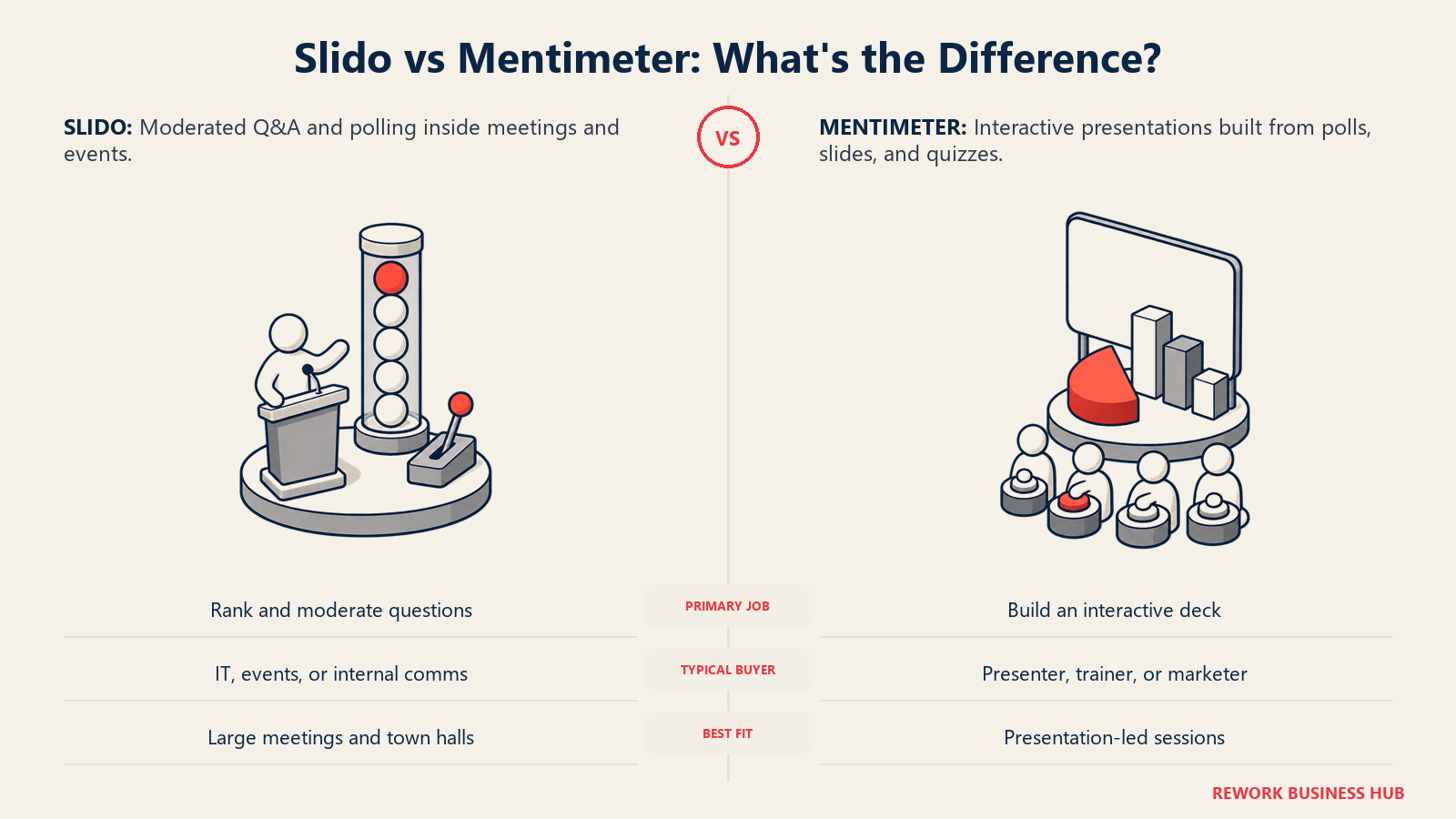
They aren't actually close, because the two tools were built to answer different questions. Slido is a Q&A product that also does polls: it's owned by Cisco, sold on annual-only contracts at prices it now publishes, and it wins where an audience needs to ask and rank questions inside a Webex or Teams meeting that's already running. Mentimeter is a presentation product that also does Q&A: it's sold per presenter, per seat, and it wins where the interactive slide deck itself is the deliverable. Both publish their numbers now, so the split is no longer transparency, it's the unit you buy. Slido sells a plan with members attached and tends to be a procurement decision, routed through IT or events. Mentimeter sells a presenter seat and tends to be a corporate-card decision, made by whoever is standing in front of the room.
TL;DR
| Slido | Mentimeter | |
|---|---|---|
| Started as | A live Q&A and polling tool for conferences, now part of Cisco Webex | A presentation tool built around interactive slides, quizzes, and word clouds |
| Organizing principle | Q&A and polling layered onto a meeting or deck you already have | The presentation itself, with polls and quizzes as slide types inside it |
| Owned by | Cisco Systems, as part of Webex | Independent, Mentimeter AB (Sweden) |
| Commercial model | Engage, Professional, Enterprise, and Unlimited Enterprise plans, quote-only, annual billing only | Free, Basic, Pro, and Enterprise plans, published per-presenter pricing, monthly or annual |
| Free plan cap | 100 participants per Slido event | 50 participants per month, account-wide |
| Signature strength | Q&A with upvoting and moderation, native inside Webex and Teams meetings | Slide design, word clouds, and gamified quizzes with a leaderboard |
| Typical buyer | IT, AV, or an events/internal comms team standing up a town hall or conference | A presenter, trainer, or marketer paying for their own seat |
| Best fit | Large meetings where the audience needs a moderated, ranked question queue | Presentations where the interactive slide is the point of the session |
Key Facts
- Global employee engagement fell to 20% in 2025, its lowest level since 2020, according to Gallup's State of the Global Workplace.
- Employees using Microsoft 365 are interrupted roughly every 2 minutes by a meeting, email, or notification during the workday, per Microsoft's Work Trend Index.
- Executives now spend nearly 23 hours a week in meetings, up from less than 10 hours in the 1960s, according to Harvard Business Review's "Stop the Meeting Madness".
- Mentimeter's free plan caps out at 50 participants per month, account-wide, not per presentation, according to Mentimeter's own help centre. One 60-person all-hands uses up the whole month's allowance in a single session.
- Slido's free Basic plan covers up to 100 participants per Slido event, confirmed in Slido's community help centre.
Who Each Tool Is Really For
Slido's natural buyer sits inside IT, AV, or an internal comms/events team standing up a company town hall, all-hands, or conference where the audience's questions need a public queue people can upvote and a moderator can screen before anything lands on the screen. Because Slido plugs natively into Webex and Teams meetings, it usually gets bought where one of those platforms is already the meeting backbone. A company already on Cisco Webex is extending a relationship it has, not adding a brand-new vendor with its own separate security review. If the underlying need is really about running the town hall itself well, our best employee communication software guide for 2026 covers that broader category.
Mentimeter's buyer is usually the person standing in front of the room: a trainer, a marketer building an on-brand keynote, a manager running a workshop, or an HR team building an onboarding deck. They reach for Mentimeter because the interactive slide is the whole point of the session, and they're paying for a named number of presenter seats with a corporate card, not filing a purchase order and waiting on a security review.
| Slido | Mentimeter | |
|---|---|---|
| Primary buyer | IT, AV, or an events/internal comms team | An individual presenter, trainer, or marketing/HR team |
| Buying motion | Procurement conversation, quote request, annual contract | Self-serve signup, monthly or annual card payment |
| Where it gets deployed | Inside an existing Webex or Teams meeting, or standalone for an event | A standalone presentation, often the entire deck |
| Company profile | Enterprises already on Cisco Webex, large town-hall/all-hands programs, conference organizers | Trainers, teachers, consultants, marketers, and HR/L&D teams at companies of any size |
| The question they're hired to answer | "How do we let a large audience ask and rank questions without chaos?" | "How do I make my own presentation interactive without learning a new platform?" |
| Where it disappoints | A presenter who just wants one interactive slide deck, no meeting-platform tie-in | A team that needs a moderated, ranked public Q&A queue for a 500-person town hall |
Here's the feature landscape at a glance before we go section by section:
| Capability | Slido | Mentimeter |
|---|---|---|
| Live polling | Yes, 5 core poll types (multiple choice, word cloud, rating, open text, ranking) | Yes, up to 23 slide types on the free plan, unlimited on paid plans |
| Live Q&A with upvoting | Yes, on every plan including free | Yes, on every plan including free |
| Q&A moderation (pre-screen before it's shown) | Professional plan and above | Pro, Conference, or Enterprise plans only, not Free or Basic |
| Quizzes with a leaderboard | Yes, with a timer | Yes, with configurable time-based or fixed-point scoring |
| Slide design and presentation editor | No, overlays your existing deck or meeting | Yes, a full presentation editor with branded templates |
| Surveys | Yes | Yes |
| Open brainstorming/idea collection | Yes, a named "Ideas" feature | Not a named equivalent feature |
| Analytics and sentiment reporting | Yes, engagement and Q&A sentiment analytics | Yes, AI-assisted grouping of response trends |
| Data export formats | Google Sheets, Excel, PDF | Image, PDF, and Excel, paid plans only |
| SSO and SCIM | Yes, Enterprise plan | Yes, Enterprise plan only |
| Owned by | Cisco Systems | Independent, Mentimeter AB |
| Billing basis | Annual only, no monthly option at any tier | Monthly or annual |
Live Polling and Question Types
Slido ships five core poll types: multiple choice, word cloud, rating, open text, and ranking, according to Slido's features page. Custom images inside polls are available starting on the Engage plan. That's the whole menu, because Slido was never meant to be a slide editor. It's an overlay: you already have a PowerPoint deck, a Webex meeting, or a Zoom webinar, and Slido drops interactive elements into it.
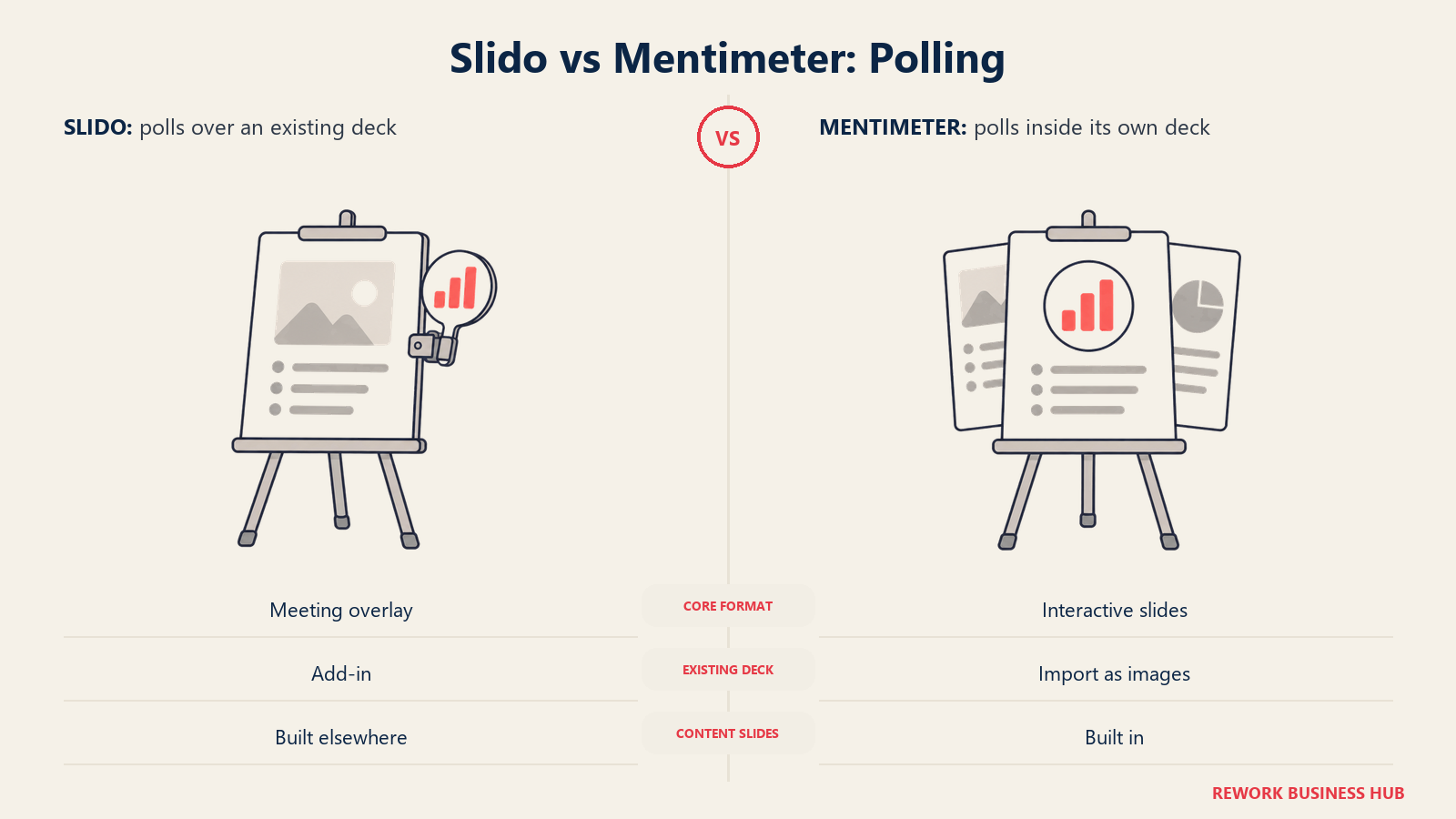
Mentimeter takes the opposite approach. Its free plan alone includes almost all of its question types, listed by the vendor as Multiple Choice, Ranking, Scales, Word Cloud, Open Ended, 2x2 Grid, 100 Points, Pin on Image, and Quiz Competition, per Mentimeter's plans page. Paid plans unlock the rest, including Quick Form slides. Because Mentimeter is a presentation editor first, you can also drop plain content-only slides between the interactive ones, so the whole deck, questions and narration alike, lives in one tool.
| Capability | Slido | Mentimeter |
|---|---|---|
| Number of poll/question types | 5 core types | Up to 23 types on Free, unlimited types on paid plans |
| Where the poll lives | Overlaid on your existing meeting or deck | A slide inside a presentation built in Mentimeter |
| Word cloud | Yes | Yes |
| Image-based polls | Custom images, Engage plan and above | Pin on Image slide type, available on Free |
| Non-interactive content slides in the same deck | Not applicable; Slido isn't a slide editor | Yes, content-only slides sit alongside interactive ones |
| Importing an existing deck | Add Slido on top via the PowerPoint or Google Slides add-in | Import as static images, then insert interactive slides between them |
If polling specifically, rather than the whole engagement suite, is the actual gap you're filling, our best Poll Everywhere alternatives roundup covers other tools built around that one use case.
Q&A, Moderation and Upvoting
Both tools let participants submit questions and upvote each other's, but the depth around that core loop differs. Slido's Q&A supports anonymous or named participation, and Professional-plan customers get "advanced Q&A settings," including longer questions up to 300 characters, replies, and labels, according to Slido's Professional plan page. Moderation, meaning a host reviews questions before the audience sees them, is confirmed as a Professional-plan feature. The Engage plan is described by Slido itself as offering "basic audience Q&A functionality," which reads as a lighter version of the same feature rather than the full moderation suite.
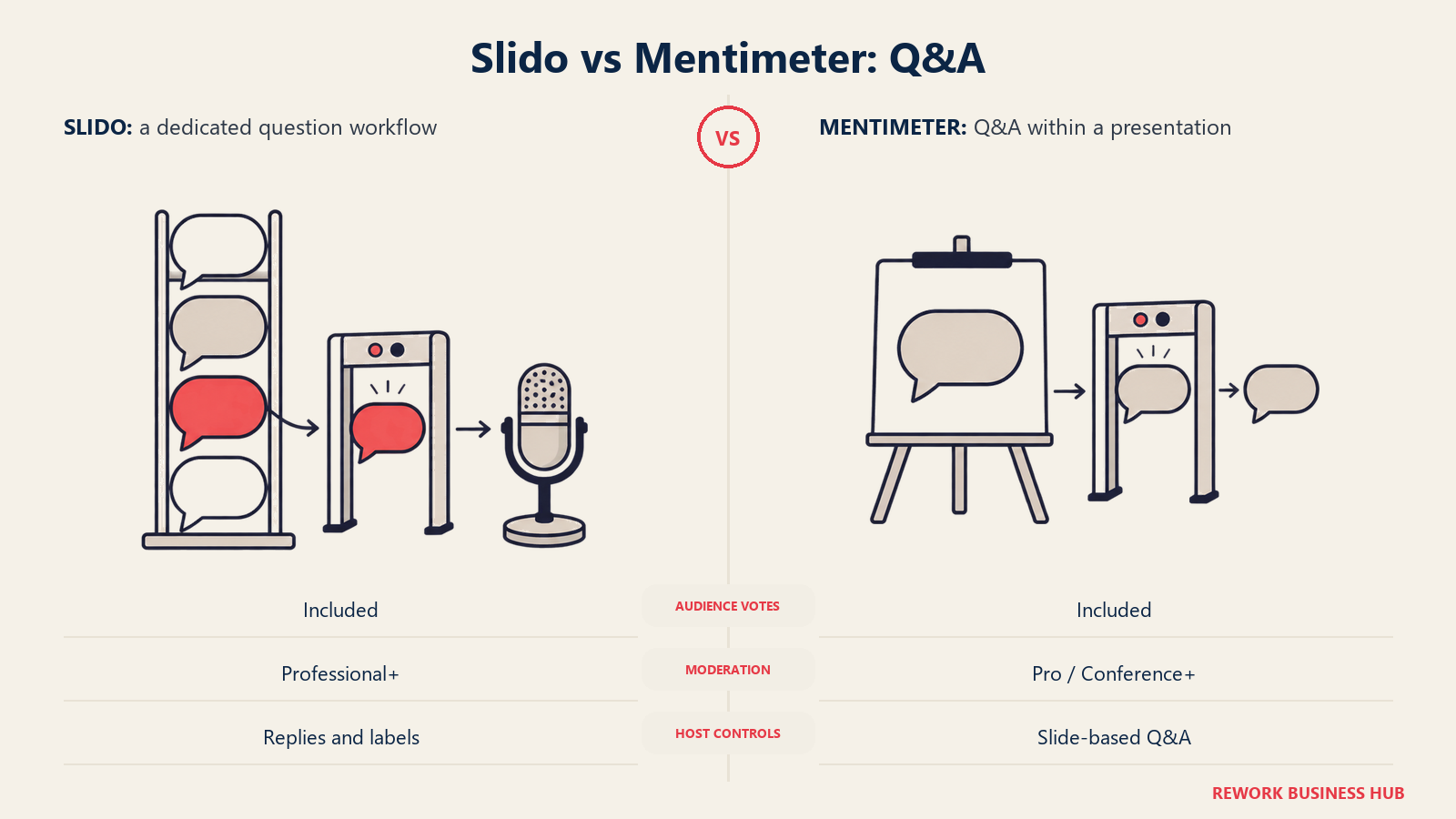
Mentimeter's Q&A also supports upvoting, described on its own Q&A feature page as letting the most pressing questions rise to the top. But pre-screening, approving or rejecting a question before it appears on screen, is gated further up the plan ladder than Slido's: it's available "if you're on a Pro, Conference, or Enterprise plan," according to Mentimeter's own moderation help article, and not on Free or Basic at all.
| Q&A capability | Slido | Mentimeter |
|---|---|---|
| Live Q&A included | Yes, all plans including free Basic | Yes, all plans including Free |
| Upvoting | Yes | Yes |
| Anonymous or named participation | Yes | Not a named toggle on the vendor's feature page |
| Pre-screening before the audience sees a question | Professional plan and above | Pro, Conference, or Enterprise plans only |
| Longer questions, replies, and labels | Professional plan and above | Not a named equivalent feature |
| Multiple simultaneous Q&A rooms | Professional plan and above | Not a named equivalent feature |
This is the clearest evidence for the thesis: Slido treats Q&A as the product and gives it the deepest settings, while Mentimeter treats Q&A as one slide type among many and gates its moderation later.
Quizzes and Gamification
Slido's quiz mode adds a timer and a leaderboard on top of the same question-and-answer mechanics, per Slido's features page. It's built to slot a competitive round into a meeting or event that's already happening, not to carry an entire session.
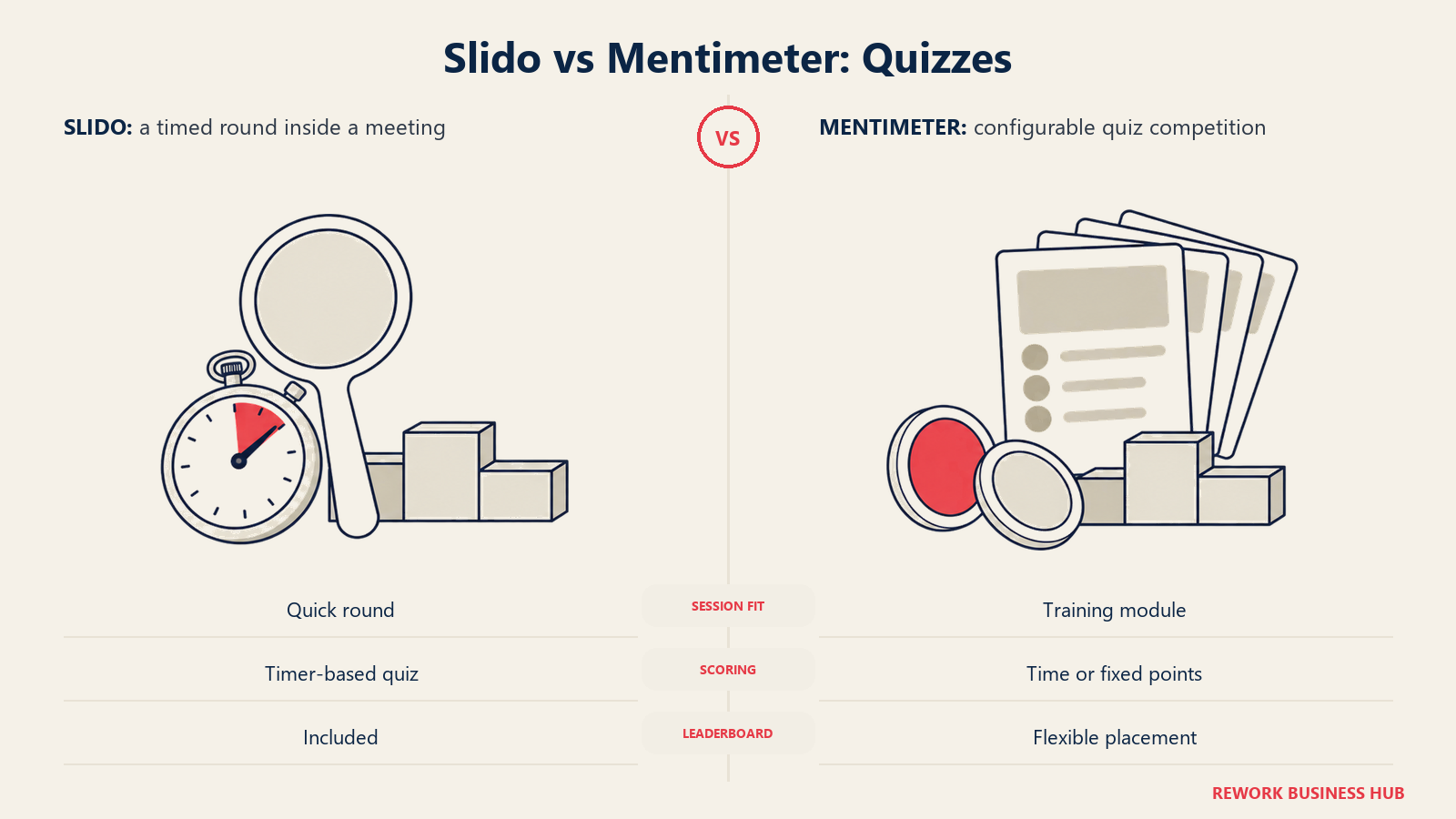
Mentimeter goes deeper here because gamification is a bigger part of its pitch to trainers and teachers. Quiz Competition slides support two scoring models: time-based scoring, where a correct answer earns between 500 and 1,000 points depending on speed, or fixed scoring, where every correct answer earns a flat 1,000 points, according to Mentimeter's help centre. A leaderboard can show the top 10 participants after every question, once at the end, or both, per Mentimeter's hosting guide.
| Quiz/gamification capability | Slido | Mentimeter |
|---|---|---|
| Quiz mode | Yes, with a timer | Yes, Quiz Competition slide type |
| Leaderboard | Yes | Yes, top 10 participants |
| Scoring model | Timer and leaderboard, not detailed further on the vendor site | Time-based (500 to 1,000 points) or fixed 1,000 points, toggleable |
| Leaderboard placement | Not specified | After every question, once at the end, or both |
| Best fit | A quick competitive round inside a meeting or event | A full gamified training module or classroom session |
If gamified quizzes are the primary reason you're comparing these two, our best Kahoot alternatives roundup covers the tools built specifically around that use case, including some that go further on scoring and game modes than either Slido or Mentimeter does.
Slide Design and the Presentation Experience
This is the section that makes the thesis concrete. Mentimeter is a presentation tool: it ships branded templates, custom themes and colors on Pro and above, company logo placement, shared team workspaces, and an AI Menti Creator that can draft an entire interactive deck from a prompt, per Mentimeter's features page. The slides you build in Mentimeter can be the only deck you ever open for that session.
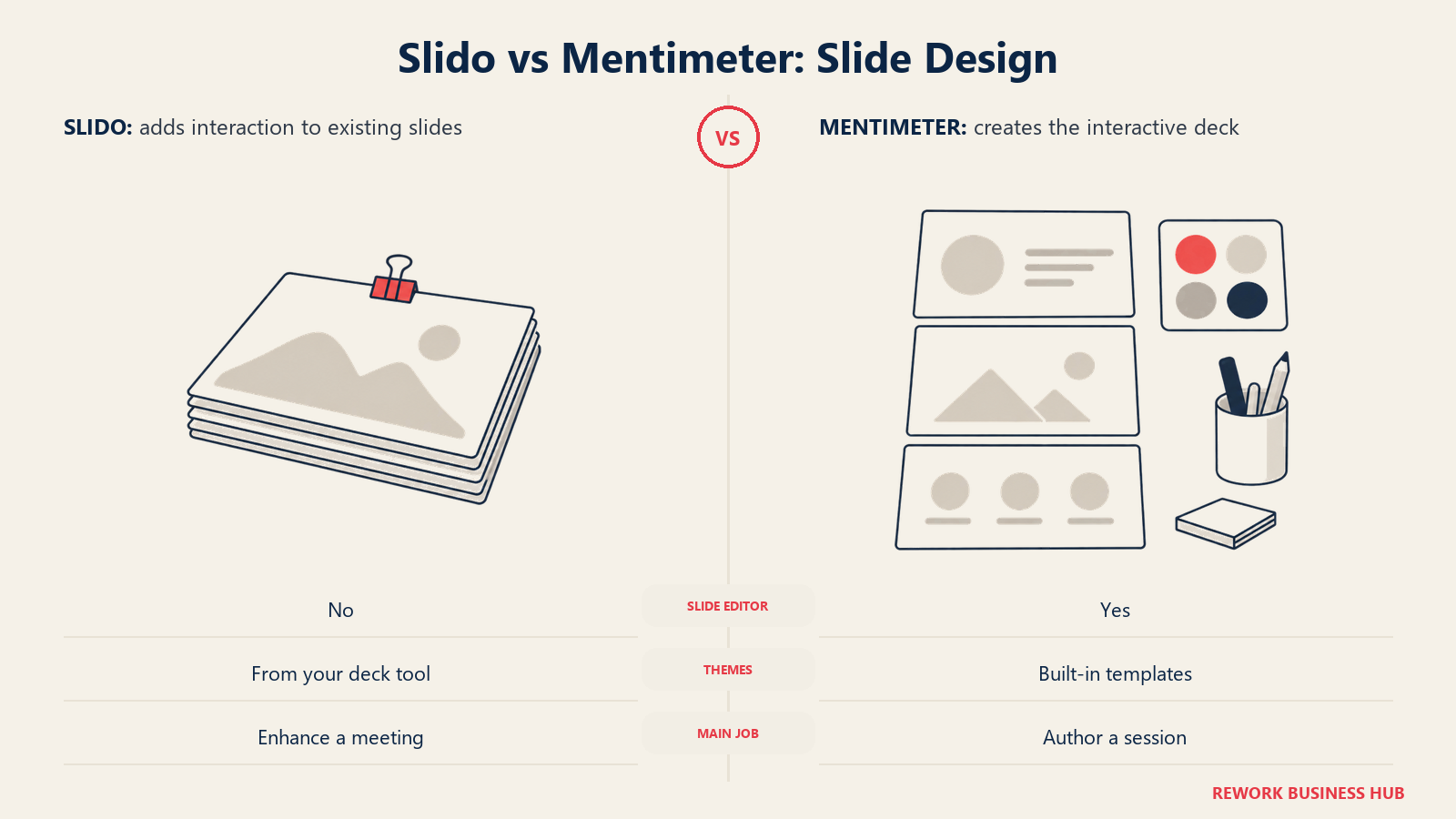
Slido has no slide design layer at all, by design. It doesn't build slides; it overlays interactive elements onto whatever you built elsewhere, PowerPoint, Google Slides, or the shared screen inside a Webex, Teams, or Zoom meeting. Whatever the audience sees behind the poll or the Q&A panel still looks like the deck you made in another tool. That's not a gap in Slido so much as a different job: it was built to sit inside meetings people already run, not to replace the software they build slides in.
Put plainly: Slido is a Q&A product that also does polls. Mentimeter is a presentation product that also does Q&A. Neither description is a knock; they're just different products wearing similar feature lists.
How the Audience Joins
Both tools keep the participant side deliberately frictionless, and on this point they're close to identical. Slido participants join at slido.com with an event code, scan a QR code, or, when the host is running the Webex or Teams integration, interact without ever leaving the meeting window. Mentimeter participants join at menti.com with a code or scan a QR code, and can also respond directly inside a Teams meeting through Mentimeter's Teams integration. Neither requires an app download on either side.
The one real difference is verified or authenticated participation. Slido offers participant authentication and email verification on paid tiers, useful for internal meetings where you want to know who's asking. Mentimeter lists "Verified Participants" explicitly as excluded from the Free plan, available starting on paid tiers, according to Mentimeter's free-plan documentation.
Integrations: PowerPoint, Teams, Webex, Zoom, Google Slides
This is where Slido's Cisco ownership shows up directly, and where the two tools' integration lists diverge the most.
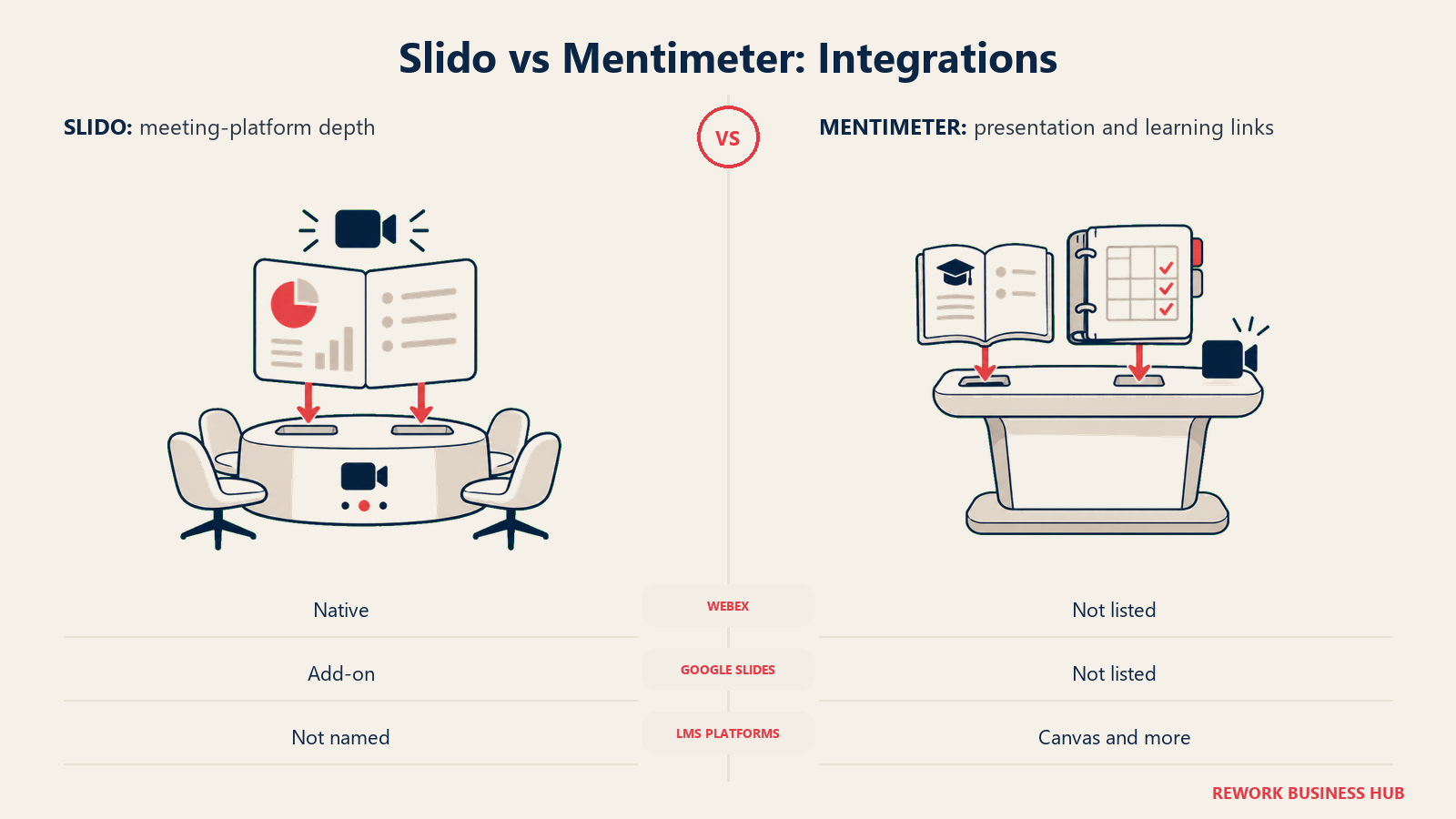
| Integration | Slido | Mentimeter |
|---|---|---|
| Microsoft PowerPoint | Yes, an add-in for polls, quizzes, and Q&A, Windows and macOS, per Slido's integrations page | Yes, an add-in, or import a PowerPoint deck as static images and add interactive slides |
| Microsoft Teams | Yes, native inside Teams meetings | Yes, described as engaging "attendees with Polls, Quizzes, Q&A and more in your Teams meetings" |
| Cisco Webex | Yes, called Slido's "most powerful integration to date" | Not offered |
| Zoom | Yes, in Meetings and Webinars | Yes, in meetings |
| Google Slides | Yes, an add-on | Not offered |
| Learning management systems (Canvas, Blackboard, Moodle, Brightspace) | Not a named integration | Yes, all four, per Mentimeter's integrations page |
| Embed into a website or event app | Yes | Not a named equivalent feature |
| Live video (YouTube, Vimeo) | Yes | Not a named equivalent feature |
Cisco owning Slido means Webex gets first-class treatment nobody outside that ecosystem can match, and Google Slides support gives Slido a reach into non-Microsoft shops that Mentimeter's integration list doesn't. Mentimeter's counter is the education stack: Canvas, Blackboard, Moodle, and Brightspace are all named integrations, aimed squarely at the trainers and instructors who make up a large share of its buyer base. If your team runs meetings mainly through Zoom or Webex and the integration itself is the deciding factor, it's worth checking both of those categories directly before you commit to either engagement tool.
Analytics, Exports and Post-Session Reporting
Slido exports results to Google Sheets, Excel, or PDF and offers analytics covering participant engagement and Q&A sentiment, according to Slido's features page. That reporting is available broadly across plans, since Slido treats the data from a session as core to what you're paying for.
Mentimeter's exports are gated harder by plan. The Free plan includes no export at all; Basic and above add image, PDF, and Excel export, according to Mentimeter's plans page. On the analytics side, Mentimeter leans on AI grouping to help presenters "spot trends and prioritize questions" across open-ended responses, per its features page, which is a genuinely different kind of analysis than Slido's sentiment scoring, better suited to summarizing free-text answers than to scoring engagement across a meeting series.
If your team is also trying to close the loop between a session's results and whatever survey or feedback tool runs elsewhere, our best SurveyMonkey alternatives roundup covers the standalone survey category both of these tools border but don't fully replace.
Participant Limits and What They Cost You
This is where the two most-repeated claims about these tools turn out to be wrong, and getting the arithmetic right matters more than any feature comparison in this article.
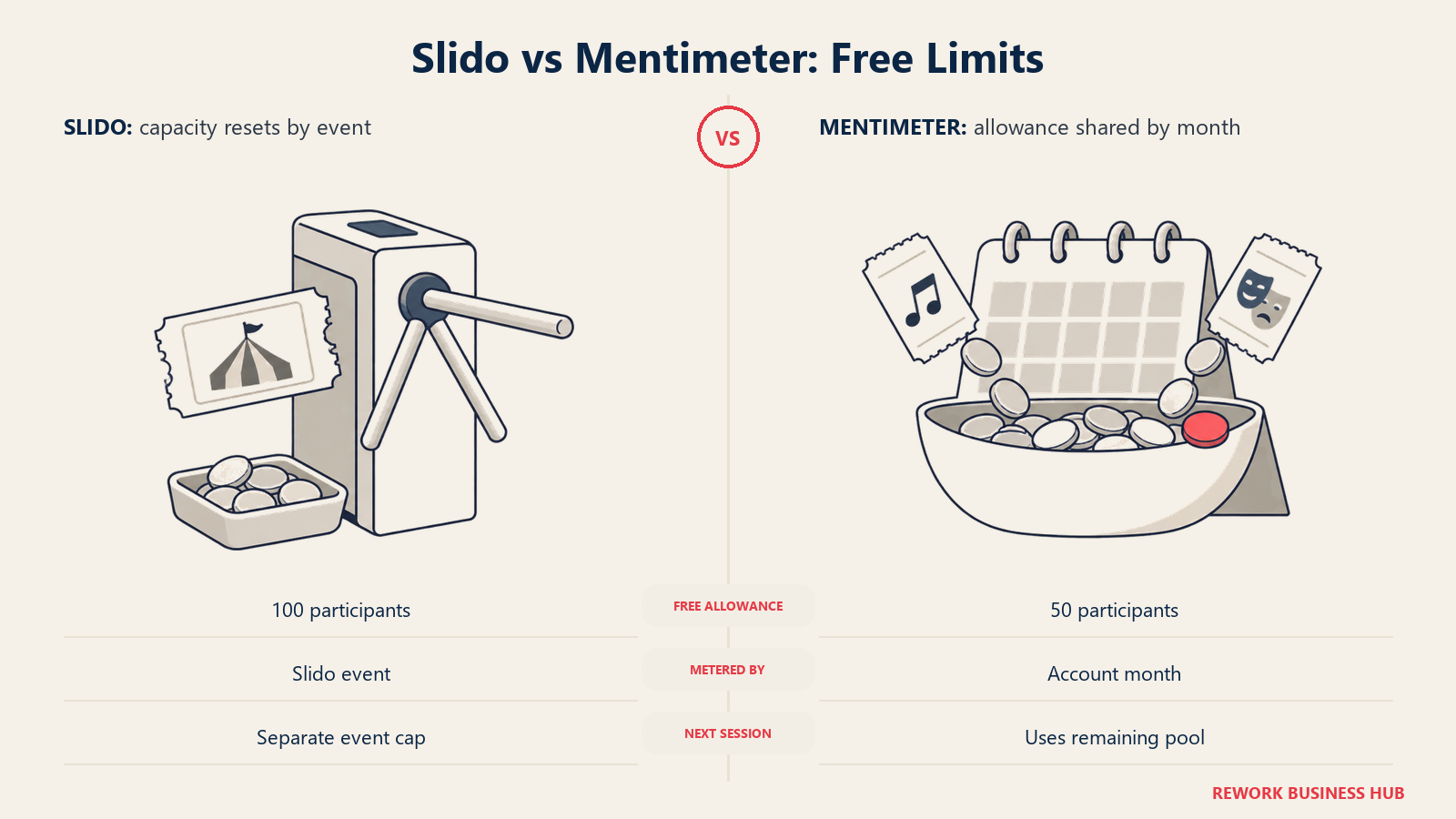
Mentimeter's free plan is not "unlimited participants," despite what nearly every other comparison on the web says. It's 50 participants per month, account-wide, on a counter that resets monthly on your signup date, not per presentation. One session can exceed 50 people, but you can't run another free presentation until the counter resets or you upgrade, per Mentimeter's own help centre. Run the arithmetic concretely: a single 60-person all-hands consumes the entire month's free allowance in one sitting, with nothing left over for a second session that month.
| Mentimeter plan | Participant limit | Basis |
|---|---|---|
| Free | 50 | Per month, account-wide, resets on your signup date |
| Basic | Unlimited | Per presenter, monthly or billed yearly |
| Pro | Unlimited | Per presenter, billed yearly |
| Enterprise | Unlimited | Custom |
Slido's free Basic plan covers up to 100 participants per Slido event, per Slido's community help centre. That's the one number nearly every other article gets right, but the paid tiers above it are worth laying out clearly too:
| Slido plan | Participant limit | Basis |
|---|---|---|
| Free Basic | 100 | Per Slido event |
| Engage | Up to 200 | Per meeting, per Slido's Engage plan page |
| Professional | Up to 1,000 | Per meeting, per Slido's Professional plan page |
| Enterprise | Up to 5,000 | Per meeting |
| Unlimited Enterprise | Unlimited | Flat annual fee, org-wide |
Pricing and What Each One Actually Costs
Here's the honest core of this comparison: one of these two tools will tell you what it costs, and the other will not.
Mentimeter publishes real numbers on mentimeter.com/plans. Basic runs $11.99 per presenter per month billed yearly, which works out to $143.88 a year, and monthly billing is also available at a higher rate. Pro runs $24.99 per presenter per month billed yearly, or $299.88 a year, and adds custom branding, company themes, and Q&A moderation. Enterprise is custom, and adds SSO and SCIM.
Slido publishes its prices as of September 2026, a change from earlier in the year when every tier was quote-only. Basic is free for up to 100 participants per event. Engage is $210 a year, which is $17.50 per member per month, and covers up to 200 participants with 1 member included. Professional is $900 a year ($75 a month), up to 1,000 participants, 2 members included. Enterprise is $2,400 a year ($200 a month), up to 5,000 participants, 3 members included. Extra members cost $17.50, $37.50 and $50 a month on those three tiers. Separate one-time event plans exist for a single conference. What has not changed is the billing term: there is no monthly option at any tier, so every paid plan is a full-year commitment.
| Pricing dimension | Slido | Mentimeter |
|---|---|---|
| Published dollar price | None, at any tier | Yes, on mentimeter.com/plans |
| Free plan | Basic, 100 participants per event | Free, 50 participants per month |
| Entry paid tier | Engage, quote-only, up to 200 participants per meeting | Basic, $11.99/presenter/month billed yearly ($143.88/yr); monthly billing also offered |
| Mid tier | Professional, quote-only, up to 1,000 participants per meeting | Pro, $24.99/presenter/month billed yearly ($299.88/yr) |
| Top tier | Enterprise or Unlimited Enterprise, quote-only, up to 5,000 or unlimited | Enterprise, custom pricing |
| Billing basis | Annual only, no monthly option at any tier | Monthly available on Basic; the published rate assumes annual billing |
| What you're licensing | A plan tier, scoped to participants per meeting or event | A named number of presenter seats |
That asymmetry is worth taking at face value rather than filling in with a guessed number. Slido's silence on price is itself the differentiator that matters most to a buyer comparing the two: it signals a sales-led, annual-contract product, while Mentimeter's published rate signals a self-serve one.
What a real team actually pays: Mentimeter licenses by presenter, meaning the people who build and run sessions, not the audience that attends them, so the cost scales with your team's number of active presenters rather than your meeting size.
| Team size | Mentimeter Basic (published) | Mentimeter Pro (published) | Slido (any paid tier) |
|---|---|---|---|
| 1 presenter | $143.88/year | $299.88/year | Unknown, quote required |
| 5 presenters | $719.40/year | $1,499.40/year | Unknown, quote required |
| Department of 25 presenters | $3,597/year | $7,497/year | Unknown, quote required |
Slido's plans aren't licensed per presenter in the same visible way, and because none of the paid tiers publish a number, there's no honest way to model a Slido column beyond "unknown, quote required" at every row. That's not a knock on the arithmetic; it's the accurate answer.
Security, SSO and Enterprise Admin
Slido inherits Cisco's compliance posture. Its trust documentation lists SOC 2, ISO 27001, 27017, 27018, 27701, 22301, and 9001, HIPAA, and BSI C5, and the product supports SSO through Google OAuth or SAML-based providers like Okta and OneLogin, per Slido's security page. That page confirms directly: "Slido is now part of Webex," Cisco's video and meetings brand. SSO, SCIM, domain claim, and organization-wide analytics are Enterprise-tier features, alongside a dedicated success manager.
Mentimeter's public security documentation is thinner. Its privacy policy states that customer data at rest defaults to EU hosting, with multi-regional options available, and payment processing runs through PCI-compliant vendors, but the policy doesn't spell out SOC 2 status, and SSO and SCIM appear only on the plans page as Enterprise-only features, not backed by the same depth of published certification detail Cisco provides for Slido.
Neither company's public page is the whole story for a serious enterprise deal; if security documentation depth is a hard requirement, request each vendor's full trust package before assuming either one clears your bar based on marketing copy alone.
Accessibility and Language Support
Slido supports 40 interface languages for participants, though the host's control view defaults to English unless changed separately in profile settings, according to Slido's community help centre. A beta feature translates incoming Q&A submissions for some free accounts, but text typed by hosts or participants elsewhere in the product isn't machine-translated.
Mentimeter splits language support differently: the mentimeter.com editor interface itself is available in English, German, Spanish, or Brazilian Portuguese, while the participant-facing voting page supports 32 languages, according to Mentimeter's help centre.
On accessibility, both vendors publish a VPAT (Voluntary Product Accessibility Template) rather than claiming full compliance. Slido's VPAT documents where the product meets and doesn't meet WCAG 2.1, and the vendor notes screen-reader support on Apple devices and Google Chrome, per Slido's community accessibility page. Mentimeter's VPAT covers WCAG 2.0 Level AA for the participant-facing menti.com pages specifically, tested with VoiceOver on macOS and iOS, while the mentimeter.com presenter interface is not stated as meeting the same bar. Neither tool should be assumed fully accessible out of the box; if that's a hard requirement for your organization, request the current VPAT from each vendor directly rather than relying on marketing pages.
When Slido Is the Right Call
- Your meetings already run inside Cisco Webex or Microsoft Teams. The native integration means participants never leave the meeting window, and you're extending a vendor relationship you already have instead of adding a new one.
- You need a moderated, ranked Q&A queue for a large audience. Upvoting plus pre-screening on the Professional plan and above is built for a town hall or conference where hundreds of questions need triage before anything reaches the stage.
- You need Google Slides support alongside PowerPoint. Slido's add-on covers both; Mentimeter's published integration list doesn't include Google Slides at all.
- Your organization needs Cisco-grade compliance documentation. SOC 2, the full ISO stack, HIPAA, and BSI C5 sit behind Slido's Enterprise tier, backed by Cisco's broader trust program.
If Slido's lack of published pricing is the sticking point, our best Slido alternatives roundup lists other Q&A-first tools, some of which publish a number up front.
When Mentimeter Is the Right Call
- The interactive slide deck is the actual deliverable. Mentimeter's presentation editor, branded templates, and AI Menti Creator mean the whole session, narration and polls alike, lives in one tool.
- You want to see a real price before talking to anyone. Mentimeter's published per-presenter rate lets an individual or small team budget without a sales call.
- You're teaching and need LMS gradebook sync. Canvas, Blackboard, Moodle, and Brightspace integrations are named and built for exactly that workflow; Slido has no equivalent.
- Gamified quizzes with configurable scoring matter to your sessions. Mentimeter's time-based or fixed-point scoring and flexible leaderboard placement go further than Slido's timer-and-leaderboard quiz mode.
If Mentimeter's per-presenter model doesn't fit how your team is structured, or the free plan's monthly participant cap is too tight for what you run, our best Mentimeter alternatives roundup covers other presentation-first engagement tools worth comparing.
Decision Framework
| If this is true for you | Pick |
|---|---|
| Your meetings already run inside Cisco Webex or Microsoft Teams | Slido |
| You need a moderated, upvoted Q&A queue for a large town hall or conference | Slido |
| You want to see a dollar price before you talk to a salesperson | Mentimeter |
| The slide deck itself is the deliverable, not just an add-on to a meeting | Mentimeter |
| You're teaching and need Canvas, Blackboard, or Moodle grade sync | Mentimeter |
| You need SSO and Cisco-grade compliance documentation as part of an existing contract | Slido |
| You're a solo presenter or small team paying with a corporate card | Mentimeter |
| You're comparing the whole category, not just these two | See the best audience engagement software guide for 2026 |
What to Do Next
- Name the actual problem in one sentence. "We need a moderated Q&A queue for a 400-person town hall inside Webex" and "I need my own presentation to be interactive" are different problems, and these two tools solve different halves of them.
- If you're leaning Slido, ask for a written quote naming your tier and participant count. Confirm whether you need the Webex or Teams integration specifically, since that's the feature Cisco ownership actually buys you.
- If you're leaning Mentimeter, test the free plan with a real session under 50 participants first. Then price out Basic against Pro using your actual number of presenters, not attendees, since that's what the published rate scales on.
- Run one real session before signing an annual contract with either vendor. A single town hall or a single training class will surface friction a feature page won't show you.
- Check the wider category if neither fits cleanly. Our best audience engagement software guide for 2026 and, for a full event platform rather than a meeting add-on, Cvent vs Bizzabo and the best event management software guide for 2026 cover the adjacent decisions this comparison doesn't.
Related Resources:
- Best Audience Engagement Software in 2026
- Best Slido Alternatives
- Best Mentimeter Alternatives
- Best Kahoot Alternatives
- Best Poll Everywhere Alternatives
- Cvent vs Bizzabo
- Best Event Management Software in 2026
- Best Webex Alternatives
- Best Zoom Alternatives
- Best Employee Engagement Software in 2026
- Best Employee Communication Software in 2026

Principal Product Marketing Strategist
On this page
- TL;DR
- Key Facts
- Who Each Tool Is Really For
- Live Polling and Question Types
- Q&A, Moderation and Upvoting
- Quizzes and Gamification
- Slide Design and the Presentation Experience
- How the Audience Joins
- Integrations: PowerPoint, Teams, Webex, Zoom, Google Slides
- Analytics, Exports and Post-Session Reporting
- Participant Limits and What They Cost You
- Pricing and What Each One Actually Costs
- Security, SSO and Enterprise Admin
- Accessibility and Language Support
- When Slido Is the Right Call
- When Mentimeter Is the Right Call
- Decision Framework
- What to Do Next