Kahoot vs Mentimeter: Which One Fits Your Classroom or Your Company in 2026?
Turn this article into takeaways for your work.


Each assistant summarizes the article only for you and suggests best practices for your work.
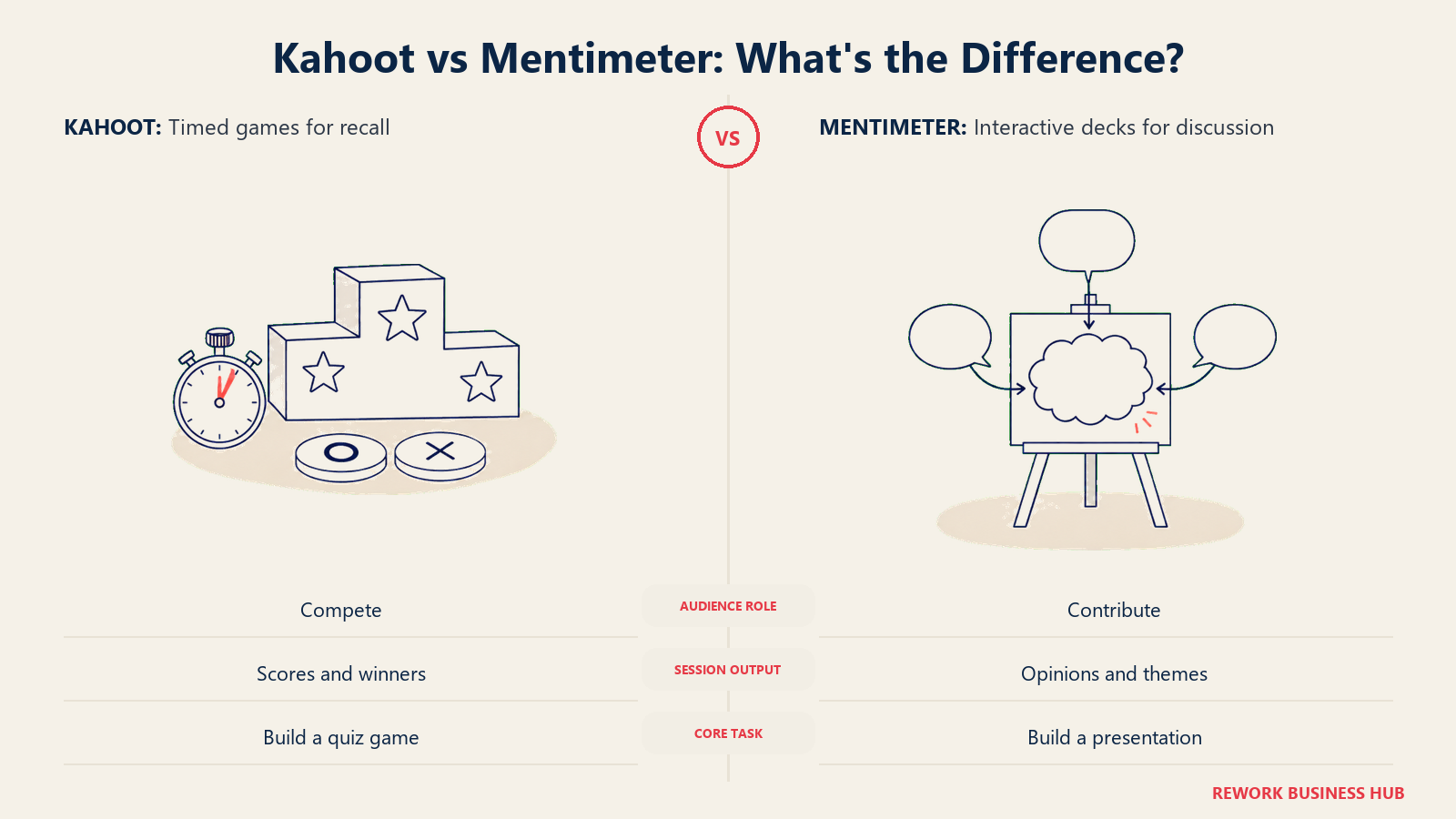
Kahoot and Mentimeter turn up in the same searches, land on the same shortlists, and then get compared as though they were two versions of one product. They aren't. Kahoot is a game: a timer runs, points scale with how fast you answer, a leaderboard names a winner. Mentimeter is a presentation, where polls, word clouds, scales, and open-ended questions are slide types inside a deck you build and narrate. Both put a join code on a screen, and that's roughly where the similarity stops. If you haven't narrowed the category down yet, our best audience engagement software guide for 2026 is the wider view. This page is about choosing between these two, and the choice comes down to which job you have.
Two facts decide most of it, and almost every competing article gets both wrong. First, Kahoot doesn't have a price list. It has two, on two different domains, with different plan names, different player caps, and a cheapest paid tier that differs by more than six times for what looks like the same software. Quote the wrong one into a budget and you'll be off by thousands. Second, Mentimeter's free plan is not unlimited and never has been. It's 50 participants per month, counted across your whole account, not per presentation. One 60-person all-hands spends the month's entire allowance in a single sitting.
Key Facts
- Global employee engagement fell to 20% in 2025, its lowest level since 2020, and dropped for two consecutive years for the first time, according to Gallup's State of the Global Workplace.
- Executives now spend nearly 23 hours a week in meetings, up from less than 10 hours in the 1960s, according to Harvard Business Review's "Stop the Meeting Madness".
- Across 225 studies of undergraduate STEM courses, failure rates ran 33.8% under traditional lecturing against 21.8% under active learning, and exam scores rose about 6%, per the Freeman et al. meta-analysis published in PNAS.
- A review of 93 studies found Kahoot can have a positive effect on learning performance, classroom dynamics, attitudes, and student anxiety, while also noting studies where it had little or no effect, per Wang and Tahir in Computers & Education.
- When classroom response scores counted for 15% or more of a course grade, attendance rose to 80 to 90%, according to a review of classroom response system research in CBE Life Sciences Education.
TL;DR
| Kahoot! | Mentimeter | |
|---|---|---|
| What it is at heart | A quiz game built on a timer, points, and a leaderboard | An interactive presentation with polls and open questions as slide types |
| Price lists | Two separate ones: Kahoot! 360 for workplaces, a schools list for teachers | One list, at mentimeter.com/plans |
| What you license | A license, meaning one individual host | A presenter seat |
| Billing options | Monthly or annual on both price lists | Billed yearly only on Basic and Pro |
| Free plan cap | 40 players per session on the schools free tier; the workplace free tier is feature-limited | 50 participants per month, account-wide |
| Cheapest paid entry | $3/month or $36/year on the schools list; $19/month or $228/year on the workplace list | $11.99 per presenter per month, $143.88/year, billed yearly |
| Participant ceiling | Steps up tier by tier: 40 to 800 on schools, 50 to 5,000 on workplace | Up to 10,000 on any paid plan, 2,000 on quiz slides |
| Discussion question types | Word cloud, poll, and brainstorm start at Pro Plus, $588/year | Word cloud, scales, and open-ended are on the free plan |
| Typical buyer | A teacher paying personally, or an L&D team buying hosts | A presenter, trainer, or marketer buying their own seat |
| Best fit | Recall and energy, when the room should compete | Discussion and comprehension, when the room should contribute |
Who Each Tool Is Actually Built For
Kahoot started in a classroom and every design decision still shows it. The timer creates urgency, points reward speed as well as accuracy, and the leaderboard between rounds is the emotional engine of the whole thing. Kahoot's how-it-works page lists quiz, poll, puzzle, type answer, word cloud, and open-ended as its formats, plus plain slides for context, and hosts can run a session live or set it as a self-paced assignment. Behind all of it sits a library Kahoot advertises as more than 100 million ready-to-play games. For many buyers the real value isn't the editor, it's never having to write the questions.
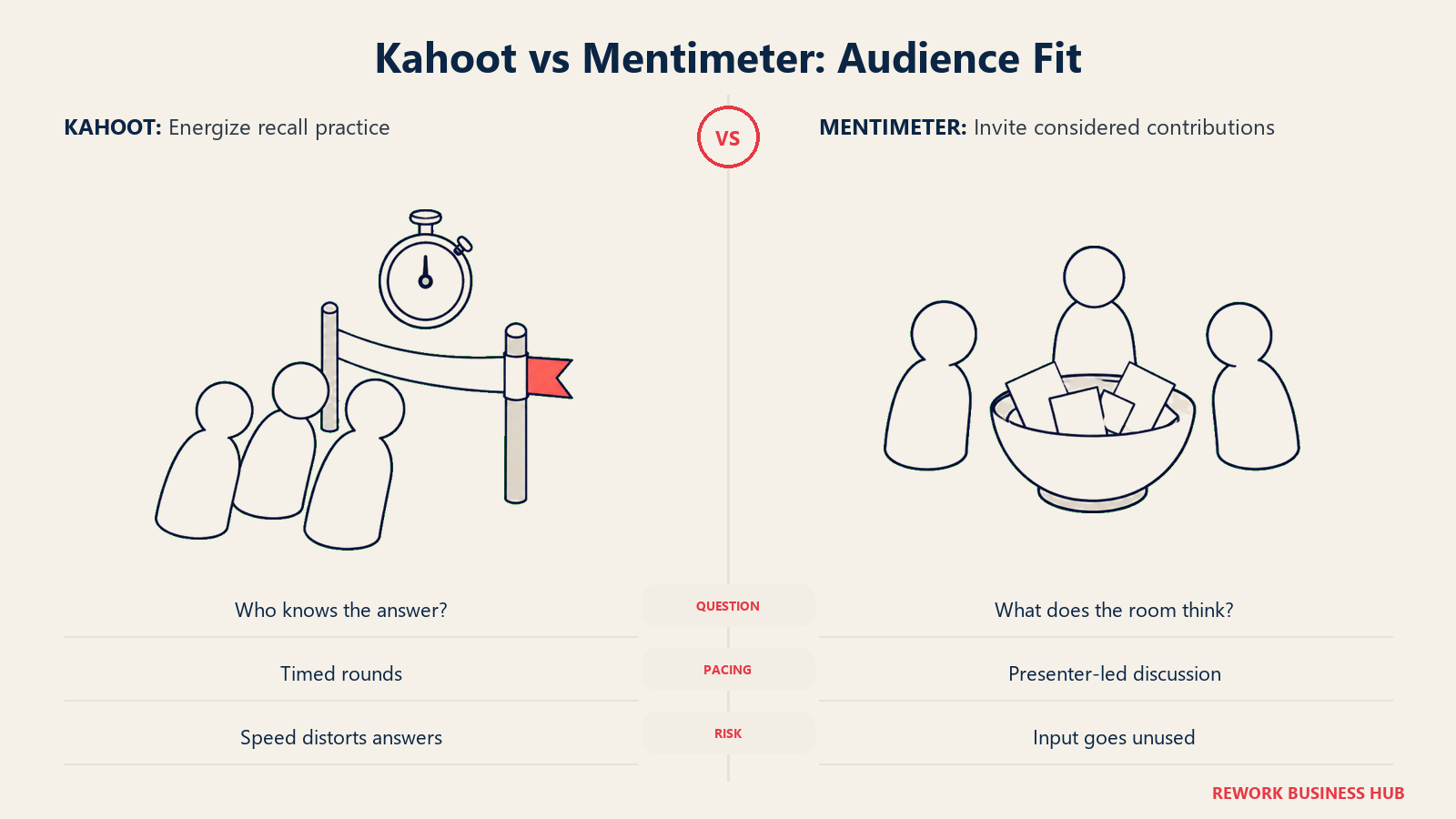
Mentimeter starts from the other end. A Menti is a deck: content slides and response slides in one editor, with answers appearing on the slide as it runs. Nobody wins, and there's no timer unless you add a quiz slide on purpose. The output is a record of what a room thought, which is a different artifact from a scoreboard.
| Kahoot | Mentimeter | |
|---|---|---|
| Primary buyer | A teacher, or a corporate L&D, enablement, or internal comms team | A presenter, trainer, marketer, consultant, or HR team |
| Buying motion | Self-serve, on whichever of the two price lists you qualify for | Self-serve, annual card payment, no monthly option on Basic or Pro |
| The question it answers | "How do I get this room to remember the material and enjoy it?" | "How do I get this room to tell me what it thinks, live?" |
| What the audience remembers | Who won | What the room said |
| Where it disappoints | A workshop where competing is wrong and speed distorts the answers | A refresher session where you wanted energy and a scoreboard |
Kahoot's split personality is worth spelling out before the pricing sections. The two buyer sides don't just pay different amounts. They buy from different sites, get different plan names, and get very different capacity for the same money.
| The classroom buyer | The workplace buyer | |
|---|---|---|
| Which Kahoot price list | kahoot.com/schools/pricing, with plans named Kahoot! Go, Kahoot!+ Bronze, Silver, Gold, and Kahoot! One | kahoot360.com/pricing, with Kahoot! 360 Express and Pro Start through Pro Ultra |
| Cheapest paid plan | $3/month or $36/year | $19/month or $228/year |
| Free player cap | 40 players on Kahoot! Go | No participant figure published for Express, which is described as limited feature access |
| Highest published cap | 800 players on Kahoot! One | 5,000 participants on Pro Ultra, with onboarding required |
| What they're really solving | Recall, review, attendance, and holding a class on a Friday afternoon | Onboarding, compliance refreshers, sales enablement, all-hands energy |
| Where Mentimeter presses | The 50-per-month free cap makes a weekly class impossible without paying | Basic at $143.88 per presenter per year undercuts every workplace Kahoot tier |
| Where the budget breaks | Every teacher in a department needing a separate paid plan | One license per host, so a team of hosts multiplies the annual figure directly |
The Free Tiers, Read Literally
"Free" means something different on each side here, and the gap is bigger than the headline numbers suggest.
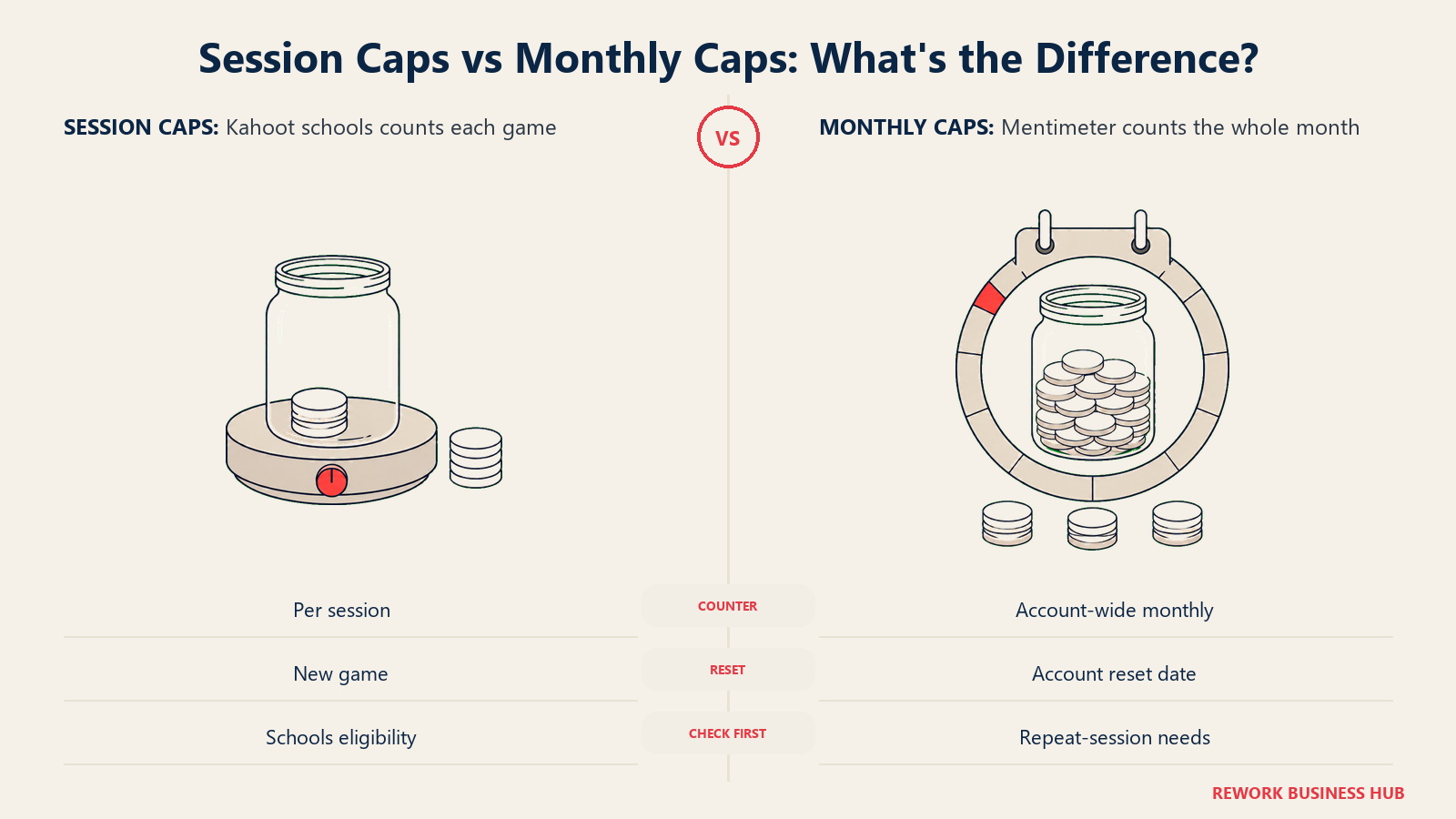
Mentimeter's free plan allows 50 participants per month. Not per presentation, not per session. Per month, across the whole account, on a counter that resets on the day you signed up. The vendor pairs that with the idea of unlimited participants once a month, which is the same constraint from the other direction: blow past 50 in one session and you're done until the reset. Mentimeter won't cut off a live presentation mid-flight and gives an 8-hour grace period, but once that lapses you can't set another presentation live. Run a monthly all-hands for 60 people and the free plan works fine. Run a weekly workshop for 20 and it stops working in week three.
Kahoot has two free tiers because it has two price lists. Kahoot! Go, on the schools side, allows 40 players per session with no monthly budget, so a teacher can run it daily. Kahoot! 360 Express, on the workplace side, is described as limited feature access with no participant figure beside it, so the wall you hit first is what the plan can do rather than who can join.
| Free plan | Cap | Basis | What happens when you hit it |
|---|---|---|---|
| Kahoot! Go, schools | 40 players | Per session, no monthly budget | The 41st player can't join that game |
| Kahoot! 360 Express, workplace | Not published | Limited feature access | The wall is features, not a published headcount |
| Mentimeter Free | 50 participants | Per month, account-wide, resets on your signup date | The live session isn't cut off and an 8-hour grace period follows, then you can't set another presentation live until reset |
Neither product has an unlimited free tier, and if you've read that either one does, the source wasn't the vendor. AhaSlides is the usual escape hatch for people who get stuck here, since its free tier caps per presentation rather than per month, and our best AhaSlides alternatives roundup covers what sits around it.
Kahoot Has Two Price Lists, Not One
This is the single most useful thing to know before you budget for Kahoot. The workplace product sells at kahoot360.com/pricing, and both kahoot.com/pricing and kahoot.com/business/pricing redirect there. The schools product sells at kahoot.com/schools/pricing. The plan names don't overlap, the caps don't line up, and there's no shared tier to anchor on.
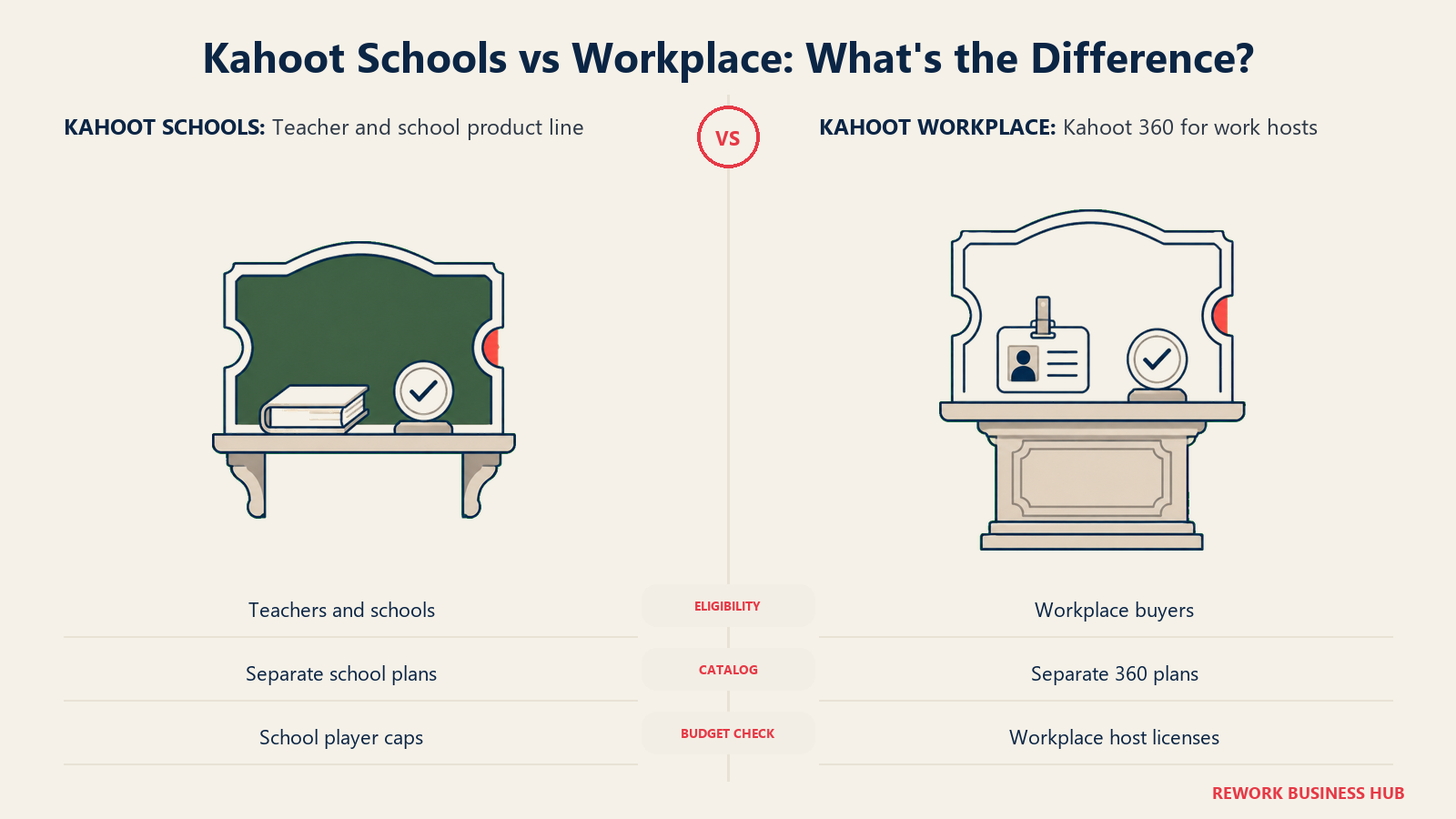
Both lists price per license rather than per participant. Kahoot's checkout describes a license as supporting one individual host, and every Kahoot! 360 Pro tier ships with exactly one. Participants never need an account. Here's the workplace list.
| Kahoot! 360 plan | Month-to-month | Billed annually | Participants per session |
|---|---|---|---|
| Kahoot! 360 Express | Free | Free | Limited feature access |
| Pro Start | $19/month | $228/year, 1 license | 50 |
| Pro Standard | $29/month regular, $25 promotional | $348/year regular, $300 promotional | 200 |
| Pro Plus | $49/month | $588/year | 1,000 |
| Pro Max | $79/month regular, $69 promotional | $948/year regular, $828 promotional | 2,000 |
| Pro Ultra | $99/month regular, $79 promotional per host | $1,188/year regular, $948 promotional | Up to 5,000, onboarding required |
Prices exclude VAT. Compare the two middle columns and something unusual shows up: the annual figure is exactly twelve times the monthly one at every tier, so committing to a year buys nothing but the commitment. Kahoot! 360's only discount is the promotional strikethrough on Pro Standard, Pro Max, and Pro Ultra, which applies to monthly and annual alike. Mentimeter sits at the opposite extreme and sells no month-to-month option at all. Most tools here split the difference with an annual discount. These two both refuse, in opposite directions.
Read the feature ladder alongside the prices, because the entry tier is thinner than the headline $19 suggests. Pro Start caps report snapshots at 3 participants and 3 questions, with quiz, true or false, multi-select, and puzzle. Pro Standard adds type answer, slider, and pin answer, plus downloadable reports and a player identifier. Pro Plus is where the discussion-shaped types arrive: word clouds, polls, and brainstorms, with combined reporting and certificates. Pro Max adds an NPS scale and heavier branding.
Now the schools list, a genuinely different product line at genuinely different prices.
| Schools plan | Month-to-month | Billed annually | Player limit |
|---|---|---|---|
| Kahoot! Go | Free | Free | 40 |
| Kahoot!+ Bronze | $3/month | $36/year | 50 |
| Kahoot!+ Silver | $9/month regular, $7 promotional | $84/year | 100 |
| Kahoot!+ Gold | $15/month regular, $12 promotional | $144/year | 200 |
| Kahoot! One | $25/month regular, $19 promotional | $228/year | 800 |
| Kahoot! One Ultra | $49/month regular, $39 promotional | Not shown | A communities plan, not sold to individual teachers |
Here the annual price works out to twelve times the promotional monthly rate rather than the regular one, so paying yearly is the cheaper commitment in a way it isn't on the workplace list.
And then the comparison that makes the whole two-list situation concrete. Kahoot! 360 Pro Start costs $228 a year and caps a session at 50 participants. Kahoot! One, on the schools list, costs $228 a year and caps a session at 800 players. Same vendor, same annual price, sixteen times the capacity. Eligibility is the catch, since the schools list is sold to teachers and schools. But if you're a teacher who has been quoted from the workplace list, you've been quoted from the wrong page.
What Mentimeter Costs
Mentimeter's pricing is the simpler half of this comparison by a wide margin: one list at mentimeter.com/plans, priced per presenter, with no second product line on another domain.
| Mentimeter plan | Price | Billing | Participants |
|---|---|---|---|
| Free | $0 | Not applicable | 50 per month, account-wide |
| Basic | $11.99 per presenter/month, $143.88/year | Billed yearly only | Unlimited, up to the platform ceiling |
| Pro | $24.99 per presenter/month, $299.88/year | Billed yearly only | Unlimited, up to the platform ceiling |
| Enterprise | Custom | Custom | Unlimited, plus SSO, SCIM, and participant verification |
The billing restriction is real. Mentimeter's own FAQ states plainly that it sells yearly subscriptions only on Basic and Pro, with no one-month option. A separate one-off Conference deal covers teams that need the tool for one week in October and not the rest of the year. Otherwise, budgeting for Mentimeter means budgeting twelve months up front.
The platform ceiling is the other number worth knowing, and it's the quiet advantage in this model. Paid plans support up to 10,000 participants, with quiz-type slides capped at 2,000, according to Mentimeter's help centre, which recommends other slide types above 2,000. The ceiling is identical on Basic at $143.88 a year and Pro at $299.88, so capacity isn't what you buy by moving up a tier. On Kahoot it's precisely what you buy, and it's most of what separates $228 from $1,188.
Participant Capacity Per Dollar
The two products meter capacity in completely different ways, so it's worth putting annual price against participant cap to see what a seat in the room costs.
| Plan | Annual price | Participants per session | Annual cost per participant slot |
|---|---|---|---|
| Kahoot! 360 Pro Start | $228 | 50 | $4.56 |
| Kahoot! 360 Pro Standard | $348 | 200 | $1.74 |
| Kahoot! 360 Pro Plus | $588 | 1,000 | $0.59 |
| Kahoot! 360 Pro Max | $948 | 2,000 | $0.47 |
| Kahoot! 360 Pro Ultra | $1,188 | 5,000 | $0.24 |
| Kahoot!+ Bronze, schools | $36 | 50 | $0.72 |
| Kahoot!+ Gold, schools | $144 | 200 | $0.72 |
| Kahoot! One, schools | $228 | 800 | $0.29 |
| Mentimeter Basic | $143.88 | 10,000 | $0.01 |
| Mentimeter Pro | $299.88 | 10,000 | $0.03 |
Read that table with some suspicion, because it flatters Mentimeter in a way that only holds if you fill the room. Cost per slot is a useful lens for a conference organizer sizing a keynote and a useless one for a manager running a 25-person meeting, where every plan here is oversized and the annual fee is all that matters. Mentimeter's quiz slides also cap at 2,000, moving Basic to roughly $0.07 per slot for gamified rounds.
What it shows cleanly is the structural difference. Kahoot sells capacity in steps and charges you to climb them. Mentimeter sells presenter seats and hands you the ceiling on its cheapest paid tier. A session that unexpectedly draws 250 people hits a wall at 200 on Pro Standard. On Mentimeter Basic, the same session just runs.
Feature Parity, Side by Side
On paper the feature lists overlap heavily. Both do quizzes, word clouds, open-ended questions, live hosting, self-paced modes, AI generation, and branding. What differs is which capability is central and what tier each one sits behind.
| Capability | Kahoot | Mentimeter |
|---|---|---|
| Self-paced asynchronous mode | Yes, as an assignment players work through alone | Yes, a named self-paced option |
| Timer on questions | Yes, and it's central to the format | On quiz slides, by choice |
| Points and leaderboard | Yes, the core of the product | Yes, on Quiz Competition slides |
| Full presentation editor | Partial, since slides sit between questions in a game | Yes, the deck is the base unit |
| Q&A with audience upvoting | Not a named feature on the pages cited here | Yes, a named feature |
| Ready-made content library | Yes, advertised as 100+ million ready-to-play games | Not a named equivalent |
| AI generation | Yes, from documents, slides, and URLs, on every Pro tier | Yes, AI Menti Creator and an AI quiz generator |
| Branding | Logo and themes from Pro Start, custom colours and 120 fonts higher up | Branded templates, theming on paid tiers |
| Anonymous or identified responses | Players pick a nickname, and a player identifier arrives at Pro Standard | Anonymous responses are named; verified participants are paid-tier |
| SSO | Kahoot! 360 for Enterprises | Enterprise plan |
The rows that decide most purchases, though, are about where each product puts the question types you'll use most.
Question Types and Slide Types
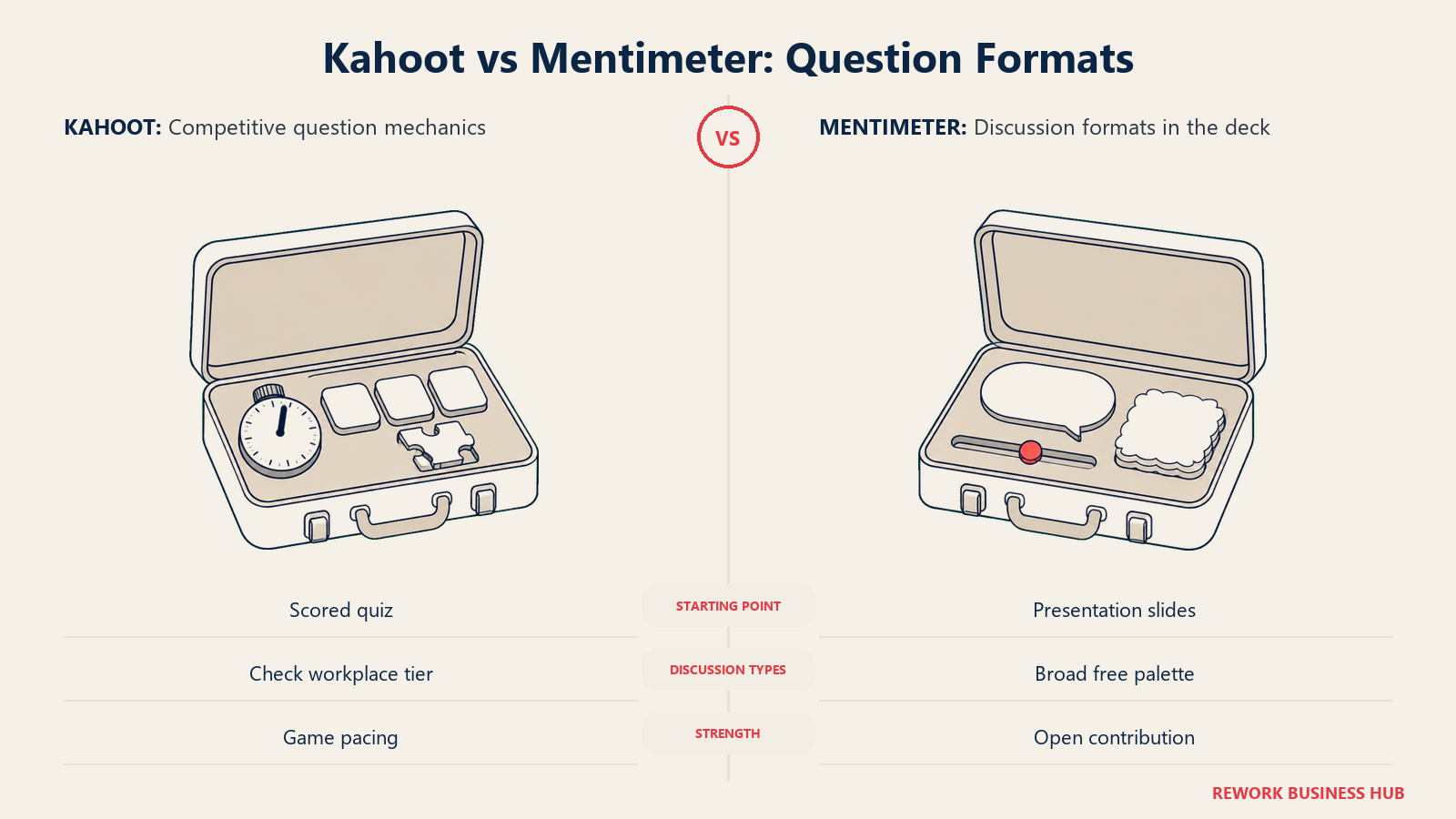
Mentimeter puts nearly its whole question palette on the free plan: Multiple Choice, Ranking, Scales, Word Cloud, Open Ended, 2x2 Grid, 100 Points, Pin on Image, and Quiz Competition, all before you pay anything. Kahoot! 360 does the opposite and rations types up the ladder, which is the detail most likely to catch a workplace buyer out.
| Question or slide type | Kahoot! 360 | Mentimeter |
|---|---|---|
| Multiple choice quiz | Pro Start, up to 6 answers | Quiz Competition slide, on Free |
| True or false, multi-select | Pro Start | Covered by multiple choice |
| Puzzle or ordering | Pro Start | Ranking slide, on Free |
| Type answer | Pro Standard | Open Ended slide, on Free |
| Slider or scale | Pro Standard | Scales slide, on Free |
| Pin on an image | Pin answer, Pro Standard | Pin on Image slide, on Free |
| Word cloud | Pro Plus | On Free |
| Poll | Pro Plus | On Free |
| Brainstorm | Pro Plus | Not a named equivalent |
| NPS scale | Pro Max | Not a named equivalent |
| 2x2 grid | Not a named equivalent | On Free |
| 100 points allocation | Not a named equivalent | On Free |
| Content-only slides | Yes, between questions | Yes, the base slide type |
Follow the left column down and the pattern is hard to miss. Every question type built for discussion rather than scoring, meaning word cloud, poll, and brainstorm, starts at Pro Plus at $588 a year. All three sit on Mentimeter's free plan. If what you're buying is a way to ask a room what it thinks, Kahoot's entry tiers can't do it, and the honest price comparison isn't $19 against $11.99. It's $49 against $11.99.
The reverse holds for scoring, where Kahoot's quiz mechanics, game modes, library, and pacing controls all serve a competitive format Mentimeter treats as one slide type. If polling rather than gamified quizzing is your gap, our best Poll Everywhere alternatives roundup covers the tools built around that single job.
Integrations and Where Each Tool Lives
Both tools go where your meetings already are, and their integration lists are closer than their feature lists. The interesting divergence is at the edges.
| Integration | Kahoot! 360 | Mentimeter |
|---|---|---|
| Microsoft Teams | Yes, named on every Pro tier | Yes |
| Zoom | Yes, named on every Pro tier | Yes |
| Microsoft PowerPoint | Yes, named on every Pro tier | Yes |
| Hopin | Yes, named on every Pro tier | Not named |
| Canvas | Not named on the Kahoot! 360 pricing page | Yes |
| Blackboard | Not named on the Kahoot! 360 pricing page | Yes |
| Moodle | Not named on the Kahoot! 360 pricing page | Yes |
| Cisco Webex | Not named | Not named |
Two things fall out of that. Mentimeter carries the learning-management story, with Canvas, Blackboard, and Moodle named on its own features page, which matters when a session needs to reach a course record instead of ending with the meeting. And neither product names Cisco Webex, a real constraint if Webex is your meeting backbone. That's the gap Slido fills by being owned by Cisco, covered separately in Slido vs Mentimeter. One caveat on the Kahoot rows: they come from the workplace pricing page, and the schools line is documented separately.
Reporting and Analytics
If anyone is going to ask what a session produced, read this before picking a tier, because both vendors gate reporting harder than they gate the questions.
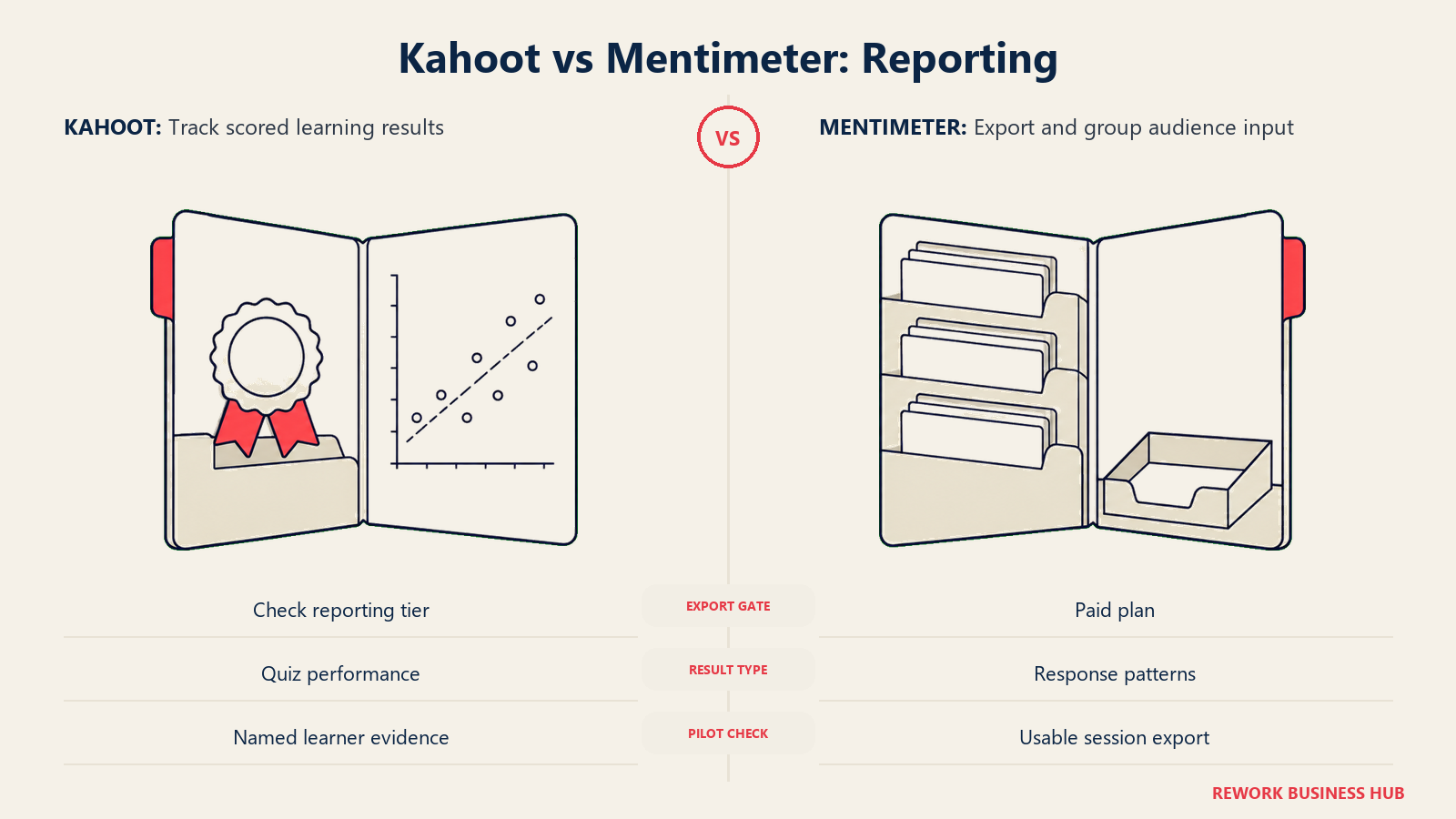
Kahoot! 360's entry tier is the one to watch. Pro Start caps report snapshots at 3 participants and 3 questions, so at $228 a year you can run a session for 50 people and then not meaningfully report on it. Pro Standard is where reporting becomes real: downloadable standard reports, with a player identifier so results attach to a person rather than a nickname. Pro Plus adds combined reports across sessions plus course and story reporting, which is what a program needs.
Mentimeter's gate lands elsewhere. The free plan includes no export at all, and paid plans add image, PDF, and Excel. Mentimeter also uses AI grouping to cluster open-ended responses so a presenter sees trends without reading 400 free-text answers, a different kind of analysis from scoring a quiz.
| Reporting capability | Kahoot! 360 | Mentimeter |
|---|---|---|
| Export or download | Pro Standard and above | Paid plans, as image, PDF, or Excel |
| What you get on the cheapest paid tier | Snapshots capped at 3 participants and 3 questions | Full export on Basic, nothing on Free |
| Results tied to a named individual | Player identifier, Pro Standard and above | Participant names can be gathered; verified participants are paid-tier |
| Results combined across sessions | Combine reports, Pro Plus and above | Session-to-session progress, enterprise |
| Analysis of open-text answers | Not a named feature | AI grouping to surface trends |
| Course completion and certificates | Pro Plus and above | Not a named equivalent |
The translation: if reporting is a requirement, Kahoot's real entry price is Pro Standard at $348 a year rather than Pro Start at $228, and Mentimeter's is Basic at $143.88 rather than free.
What It Costs at 1, 5, and 20 Presenters
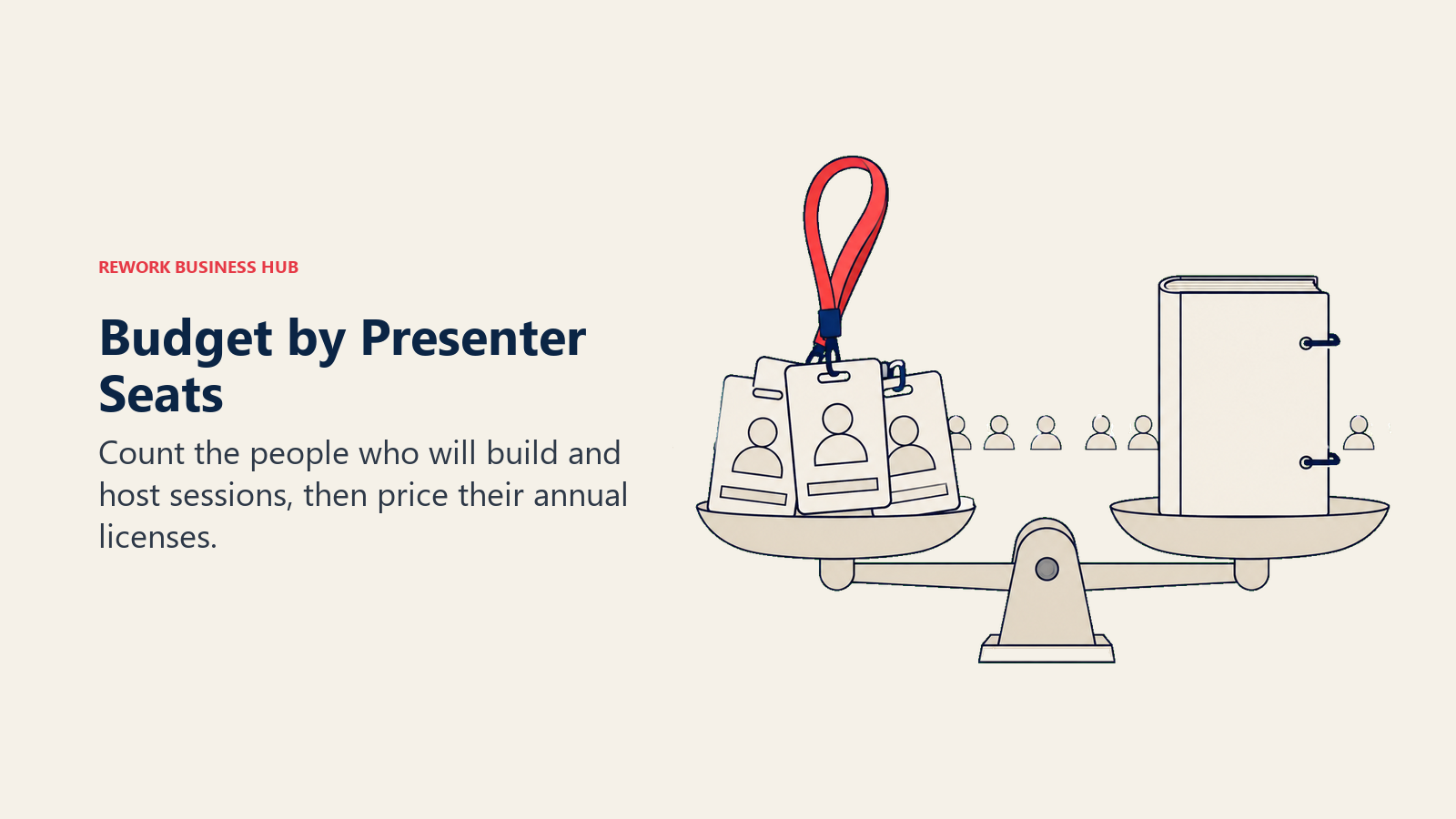
Both products bill by the person running the session rather than the people attending, so the seat math lines up cleanly. Kahoot's checkout treats a license as one individual host and every Pro tier includes exactly one, so five hosts means five licenses. Mentimeter charges per presenter seat the same way.
| Annual cost | 1 presenter | 5 presenters | 20 presenters |
|---|---|---|---|
| Mentimeter Basic | $143.88 | $719.40 | $2,877.60 |
| Mentimeter Pro | $299.88 | $1,499.40 | $5,997.60 |
| Kahoot! 360 Pro Start, 50 participants | $228 | $1,140 | $4,560 |
| Kahoot! 360 Pro Standard regular, 200 | $348 | $1,740 | $6,960 |
| Kahoot! 360 Pro Standard promotional, 200 | $300 | $1,500 | $6,000 |
| Kahoot! 360 Pro Plus, 1,000 | $588 | $2,940 | $11,760 |
| Kahoot!+ Gold schools, 200 players | $144 | $720 | $2,880 |
| Kahoot! One schools, 800 players | $228 | $1,140 | $4,560 |
Two caveats before anyone pastes those into a budget. Volume pricing exists, so a 20-host order is worth a conversation with either vendor. And the schools rows only apply if you qualify to buy from that list.
The comparison that matters sits in the middle column. At five presenters, Mentimeter Basic costs $719.40 a year with a 10,000-participant ceiling. The cheapest workplace Kahoot at the same headcount costs $1,140 and caps each session at 50 people. That's 58% more money for 0.5% of the capacity. The extra spend isn't buying headroom. It's buying the game: the timer, the leaderboard, the ready-made library. Whether that's worth $420 a year is the real decision, and it's a far clearer question than which tool has more features.
If your shortlist is really Mentimeter against another polling-first tool rather than a quiz-first one, Mentimeter vs Poll Everywhere is the closer head-to-head.
Implementation and Time to Value
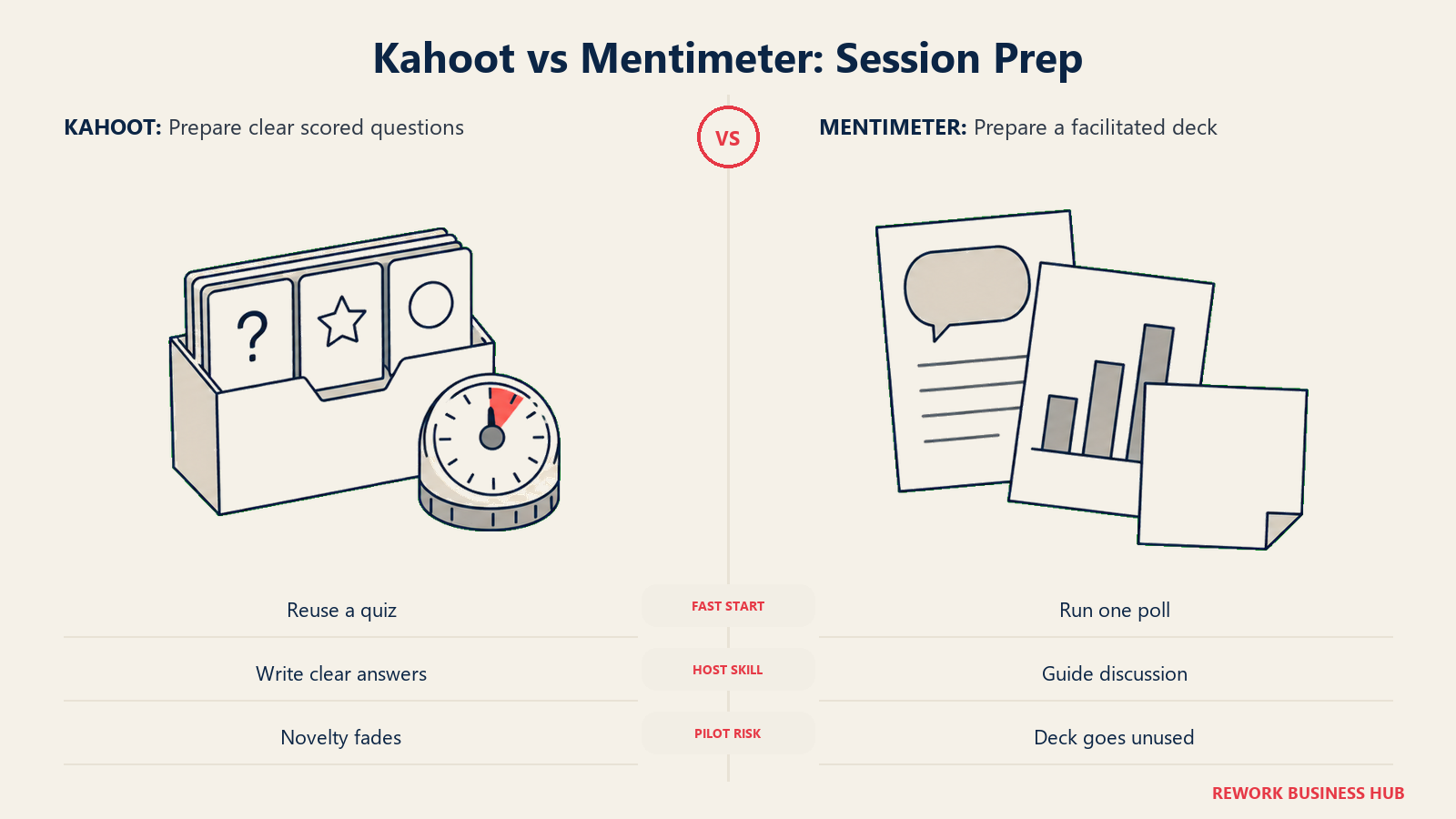
Neither tool has a real implementation project attached, which is part of why both spread through organizations without anyone signing off. The difference is effort per session, not setup.
| Kahoot | Mentimeter | |
|---|---|---|
| Time to a first usable session | Minutes, and close to zero if you start from the ready-made library | Minutes for a single poll, longer when the deck is the deliverable |
| What you're actually building | A game: questions, answer options, correct answers, timings | A presentation: content slides with response slides between them |
| Prep load per session | Low when you reuse library content, higher when writing questions that need one defensible right answer | Moderate, because the deck usually is the session |
| Skill it demands of the host | Writing unambiguous questions and reading a room that's competing | Presentation design and live facilitation |
| Host training | Light | Light for polling, real if you want the deck to be good |
| The rollout risk nobody plans for | Competition landing badly in a room where it's inappropriate | Collecting opinions in a session and then acting on none of them |
| First thing to test in a pilot | Whether a timer sharpens your material or distorts it | Whether your team will genuinely build decks in a second tool |
That last row deserves a moment. Mentimeter's failure mode in companies isn't the software, it's that presenters keep building in PowerPoint and never migrate, so the seat gets used for one poll a quarter. Kahoot's is enthusiastic adoption, three great months, then fading novelty and nobody writing new questions. Neither shows up on a feature page.
When Kahoot Is the Right Call
- Recall is the goal. Timed, scored, repeated questioning is retrieval practice with a scoreboard attached, and the research base is real. The 93-study review found positive effects on learning performance, classroom dynamics, and attitudes, while noting studies that found little or none. It works when the material suits it, and it isn't a guarantee.
- You want the room's energy to change. A leaderboard does something to a group after lunch that a word cloud does not. If attendance is the underlying problem in your compliance refreshers, that's the case for Kahoot.
- You'd rather not write the questions. More than 100 million ready-to-play games is a different starting point from a blank slide, and for many teams that library is the product.
- You need course structure with certificates. Courses with completion certificates start at Pro Plus, and Mentimeter has no named equivalent.
- You're a teacher and can buy from the schools list. Kahoot!+ Bronze at $36 a year is the cheapest serious plan discussed anywhere here, and Kahoot! One at $228 covers 800 players. Nothing on Mentimeter's list competes on price for a classroom.
If the game format is right but Kahoot's tiering isn't, our best Kahoot alternatives roundup covers quiz-first tools that price capacity differently.
When Mentimeter Is the Right Call
- The room's opinion is the output. Offsites, retrospectives, town halls, and workshops don't have right answers, and a timer damages the quality of what people say. Mentimeter is built for sessions where thinking time is the point.
- You need discussion-shaped questions without climbing a price ladder. Word cloud, scales, open-ended, ranking, 2x2 grid, and 100 points are all on the free plan. The equivalent set on Kahoot starts at $588 a year.
- Audience size is unpredictable. A 10,000-participant ceiling on the $143.88 tier means never guessing your headcount at purchase time.
- The deck is the deliverable. If the session's artifact is a presentation you'll reuse, Mentimeter keeps narration and interaction in one file rather than two tools.
- You're teaching and need the LMS to know. Canvas, Blackboard, and Moodle are named integrations, and Kahoot's workplace pricing page names none of them.
Be honest about the two costs here. Basic and Pro are billed yearly only, so a team that needs the tool for one conference should look at the one-off Conference deal instead. And the 50-per-month free cap makes piloting awkward exactly where you most want to pilot. If either is a dealbreaker, our best Mentimeter alternatives roundup covers presentation-first tools with different billing, and the tier below these two splits cleanly by buyer in Vevox vs AhaSlides vs Wooclap.
Decision Framework
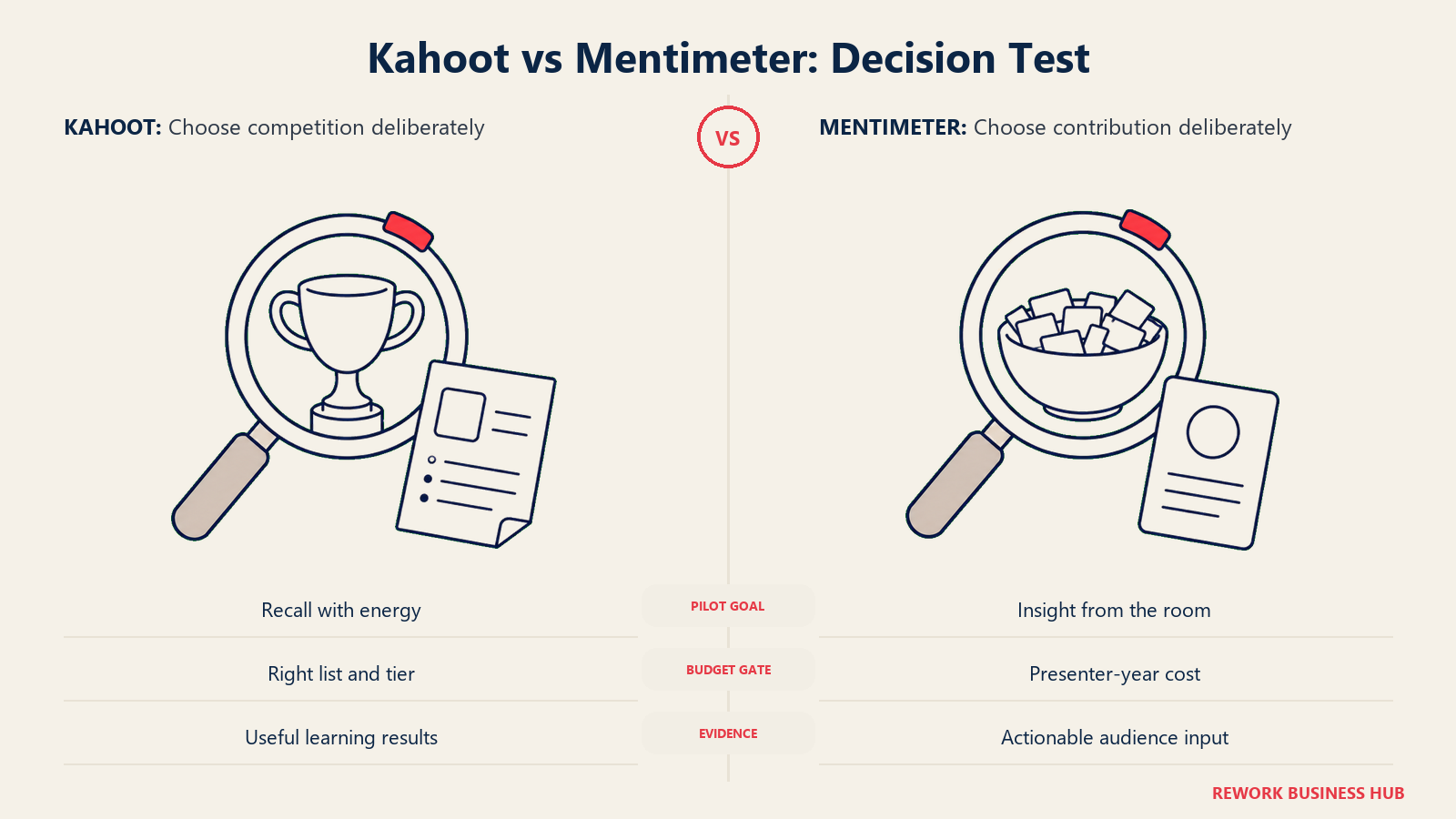
Start with the result the session should produce, then check buying eligibility, reporting needs, and the presenter's annual budget.
| If this is true for you | Pick |
|---|---|
| You want a timed, scored game with a winner at the end | Kahoot |
| You want the room's opinion, not the room's score | Mentimeter |
| You're a teacher buying from the schools price list | Kahoot, at $36 to $228 a year |
| You need word clouds, scales, and open-ended questions on a small budget | Mentimeter, they're on the free plan |
| Your audience swings between 20 and 2,000 people | Mentimeter, the ceiling doesn't move with the tier |
| You'd rather start from ready-made content than write questions | Kahoot, with 100+ million ready-to-play games |
| You need to pay monthly instead of a year up front | Kahoot, since Mentimeter sells Basic and Pro yearly only |
| You need courses with completion certificates | Kahoot, Pro Plus and above |
| You need results to reach Canvas, Blackboard, or Moodle | Mentimeter |
| Reporting on every participant matters from day one | Kahoot at Pro Standard, or Mentimeter at Basic, not the tiers below them |
| Your meetings run on Cisco Webex | Neither one names Webex, so see Slido vs Mentimeter |
| You're still comparing the whole category | Start with the best audience engagement software guide for 2026 |
What to Do Next
- Say out loud whether you want the room to compete or contribute. That sentence resolves this faster than any table above. "People need to remember 12 policy facts" and "we need to know what the team thinks about the reorg" are different problems.
- Confirm which Kahoot price list you're eligible for before you request a quote. If you're a school and someone quoted you from kahoot360.com, you're looking at more than six times the entry price of the list you can actually buy from.
- Count hosts, not attendees. Both products charge per person running sessions, so write down how many people will genuinely build and run one in a year, then multiply. That's what the annual invoice is based on.
- Check the reporting tier before the feature list. Pro Start snapshots cap at 3 participants and 3 questions, and Mentimeter's free plan exports nothing. If someone will ask for results, budget for Pro Standard or Basic.
- Run one real session on each free tier. Mentimeter's 50-per-month allowance covers exactly one modest pilot, and Kahoot! Go covers 40 players per session. Use the same audience and material, then watch which format the room responds to. If neither lands, the wider field is in the best audience engagement software guide for 2026, and if you actually need a full event platform, start with the best event management software guide for 2026.
Frequently Asked Questions about Kahoot vs Mentimeter
What is the main difference between Kahoot and Mentimeter?
Kahoot is a quiz game built around a timer, points, and a leaderboard, so a session produces a winner. Mentimeter is an interactive presentation where polls, word clouds, scales, and open-ended questions are slide types in a deck, so a session produces a record of what the room thought. Pick Kahoot when you want the audience to compete, Mentimeter when you want it to contribute.
Why does Kahoot show two completely different prices for the same product?
Because it runs two separate price lists. The workplace product sells at kahoot360.com as Kahoot! 360 Express and Pro Start through Pro Ultra. The schools product sells at kahoot.com/schools as Kahoot! Go, Kahoot!+ Bronze through Gold, and Kahoot! One. Both kahoot.com/pricing and kahoot.com/business/pricing redirect to the workplace list, which is how buyers get quoted from the wrong page.
Is Mentimeter's free plan really limited to 50 participants?
Yes, and the limit is per month across your whole account, not per presentation, resetting on the day of the month you signed up. Mentimeter won't cut off a live presentation that goes over and allows an 8-hour grace period, but after that you can't set another presentation live until the reset. A single 60-person session uses the full allowance.
How many players can join a free Kahoot?
On the schools free plan, Kahoot! Go, the cap is 40 players per session rather than per month, so you can run it every day. The workplace free tier, Kahoot! 360 Express, is described as limited feature access with no participant figure published beside it.
Can I pay for Mentimeter monthly?
Not on Basic or Pro. Mentimeter's own FAQ states it sells yearly subscriptions only on those two plans. A separate one-off Conference deal covers teams that need the tool for a single event rather than a full year.
Which one is cheaper for a team of five presenters?
Mentimeter Basic, at $719.40 a year for five seats, against $1,140 for five Kahoot! 360 Pro Start licenses. The gap widens on capacity, since Basic carries a 10,000-participant ceiling while Pro Start caps a session at 50 people. Kahoot's extra cost buys the game format, not more room.
Does Kahoot have word clouds and open-ended questions?
Yes, but not on its cheaper workplace tiers. Type answer and slider arrive at Pro Standard, and word cloud, poll, and brainstorm start at Pro Plus at $588 a year. Mentimeter includes word cloud, scales, open-ended, ranking, 2x2 grid, and 100 points on its free plan, so if discussion formats are the point, the real comparison is Pro Plus against Mentimeter's free or Basic tier.
How many participants can a paid Mentimeter presentation hold?
Up to 10,000, with quiz-type slides capped at 2,000, according to Mentimeter's help centre, which suggests other slide types above 2,000. That ceiling is the same on Basic as on Pro, so moving up a tier buys features rather than capacity.
Can a company just buy Kahoot's cheaper school plans?
No. The schools list is sold to teachers and schools, so eligibility is the constraint rather than price. Knowing the gap is still useful: a corporate buyer quoted $228 a year for 50 participants on Pro Start can see that the same figure buys 800 players on the list they can't use, and negotiate accordingly.
Related Resources:
- Best Audience Engagement Software in 2026
- Best Kahoot Alternatives
- Best Mentimeter Alternatives
- Best AhaSlides Alternatives
- Best Poll Everywhere Alternatives
- Slido vs Mentimeter
- Mentimeter vs Poll Everywhere
- Vevox vs AhaSlides vs Wooclap
- Crowdpurr vs StreamAlive vs Sendsteps
- Best Event Management Software in 2026

Principal Product Marketing Strategist
On this page
- Key Facts
- TL;DR
- Who Each Tool Is Actually Built For
- The Free Tiers, Read Literally
- Kahoot Has Two Price Lists, Not One
- What Mentimeter Costs
- Participant Capacity Per Dollar
- Feature Parity, Side by Side
- Question Types and Slide Types
- Integrations and Where Each Tool Lives
- Reporting and Analytics
- What It Costs at 1, 5, and 20 Presenters
- Implementation and Time to Value
- When Kahoot Is the Right Call
- When Mentimeter Is the Right Call
- Decision Framework
- What to Do Next