Monday Sales CRM vs Folk vs Salesforce: Which CRM Fits Your Company's Stage in 2026?
Turn this article into takeaways for your work.


Each assistant summarizes the article only for you and suggests best practices for your work.
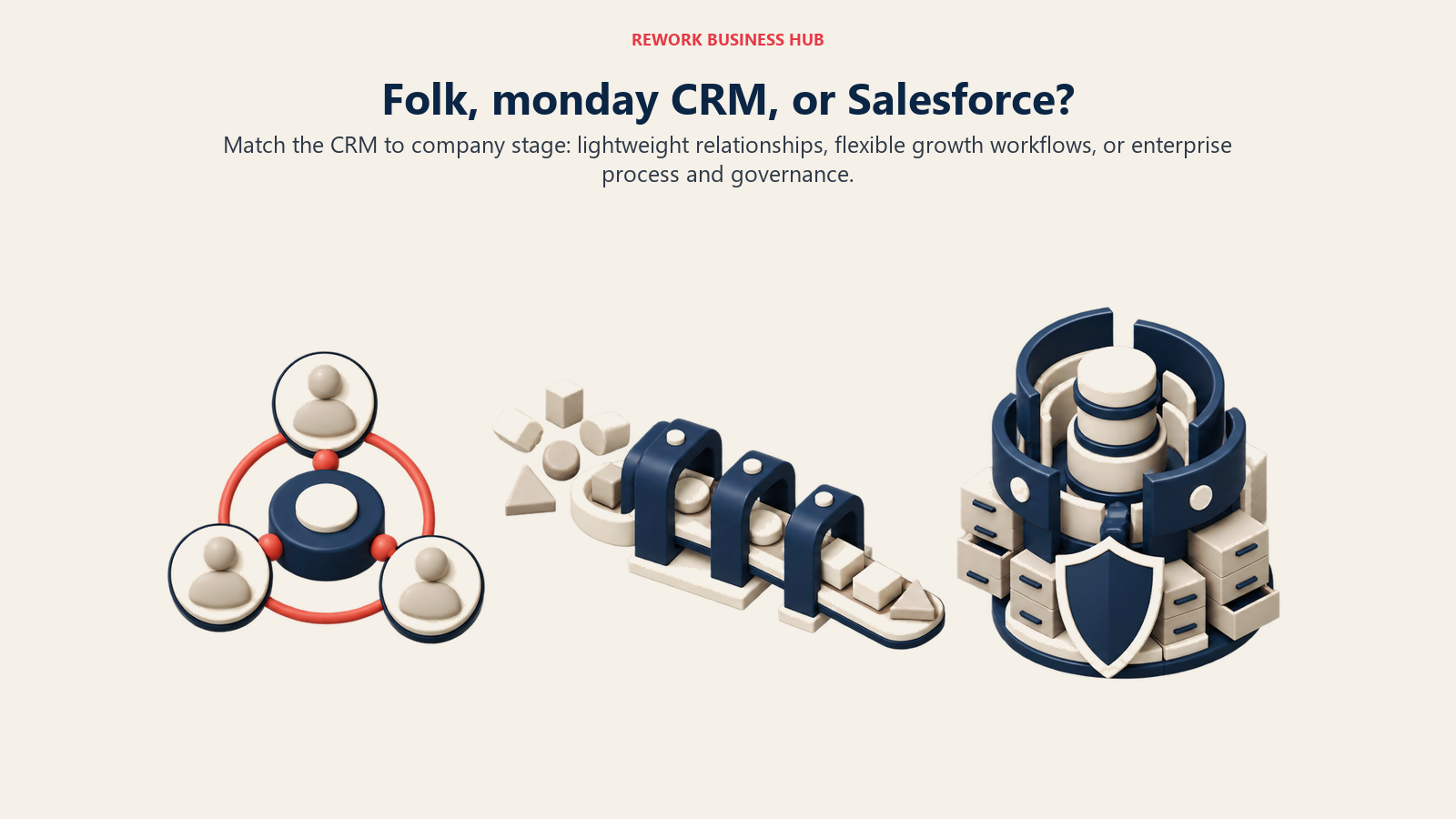
Most CRM comparisons put two similar tools side by side. This one doesn't, on purpose. Folk is a lightweight relationship tool built for a founder tracking 200 warm contacts. Salesforce is the platform that runs sales for some of the largest companies on earth. monday CRM sits in between: a CRM built on top of a flexible work platform rather than as a dedicated sales tool from day one. That spread isn't an accident of keyword research. It's the point: the honest answer to "which CRM should I buy" usually isn't a feature comparison, it's a question about what stage your company is actually at. If you haven't narrowed the field this far yet, our best CRM software of 2026 roundup covers all three plus 12 other platforms first.
That's the lens this article uses throughout. Folk is right for a specific kind of small team, and wrong the moment your sales motion needs structure. Salesforce is right once your revenue complexity justifies the admin overhead, and badly wrong before that point. monday CRM is the middle ground, useful if your company already lives on monday.com, less convincing if it doesn't. We priced all three at 5, 25, and 100 seats using each vendor's own numbers as of August 2026, and modeled what implementation and admin time add on top, because the seat price is never the real number for at least one of these three tools.
TL;DR
| Dimension | Folk | monday CRM | Salesforce |
|---|---|---|---|
| Best known for | Lightweight relationship management, not a formal pipeline | Visual, board-style CRM inside a work platform | Enterprise customization and governance |
| Core bet | Your network of people is the asset, not a sales stage | Your CRM should work like every other team's boards | Any sales process can be modeled, given enough configuration |
| Realistic starting price | $24/seat/mo annual (Standard), no seat minimum | $17/seat/mo annual (Standard), 3-seat minimum | $25/user/mo (Starter Suite), then a hard jump past $100/user/mo |
| Genuinely strongest at | Relationship depth, LinkedIn/email workflows, zero setup | Cost predictability at scale, one vendor for CRM and other work | Custom objects, territory management, compliance depth |
| Falls short on | No structured pipeline, lead routing, or forecasting | Lead routing and calling are thin, still catching up | License is never the total; admin and implementation are real costs |
| Ideal team size | 1 to 30 employees | 10 to 200 employees | 100 to 10,000+ employees |
| Buyer persona | Founder, agency lead, consultant, BD/partnerships lead | Operations Manager, PMO, Team Lead already on monday.com | CIO, VP Sales, RevOps, IT leaders |
Key Facts: Folk, monday CRM, and Salesforce in 2026
- Salesforce holds roughly 20% of the global CRM applications market, its 13th straight year at #1 (IDC Worldwide Semiannual Software Tracker, via Salesforce).
- In Gartner's 2026 Magic Quadrant for CRM Sales Platforms, published August 6, 2026, Salesforce stayed a Leader for the 20th consecutive year (CX Today).
- monday.com reported Q2 2026 revenue of $364.6 million, up 22% year over year, with 4,834 customers now paying more than $50,000 in annual recurring revenue, up 31% from a year earlier (monday.com Q2 2026 results).
- Folk's entry Standard plan is $24 a seat a month billed annually as of August 2026, confirmed on Folk's own pricing page, with no free tier currently listed (Folk pricing), up from the roughly $20 a seat several earlier 2026 roundups still cite.
- Salesforce's Agentforce actions run on Flex Credits priced at $500 per 100,000 credits, with a standard agent action consuming about 20 credits, roughly $0.10 per action (Constellation Research).
What Each Tool Is Actually Built For
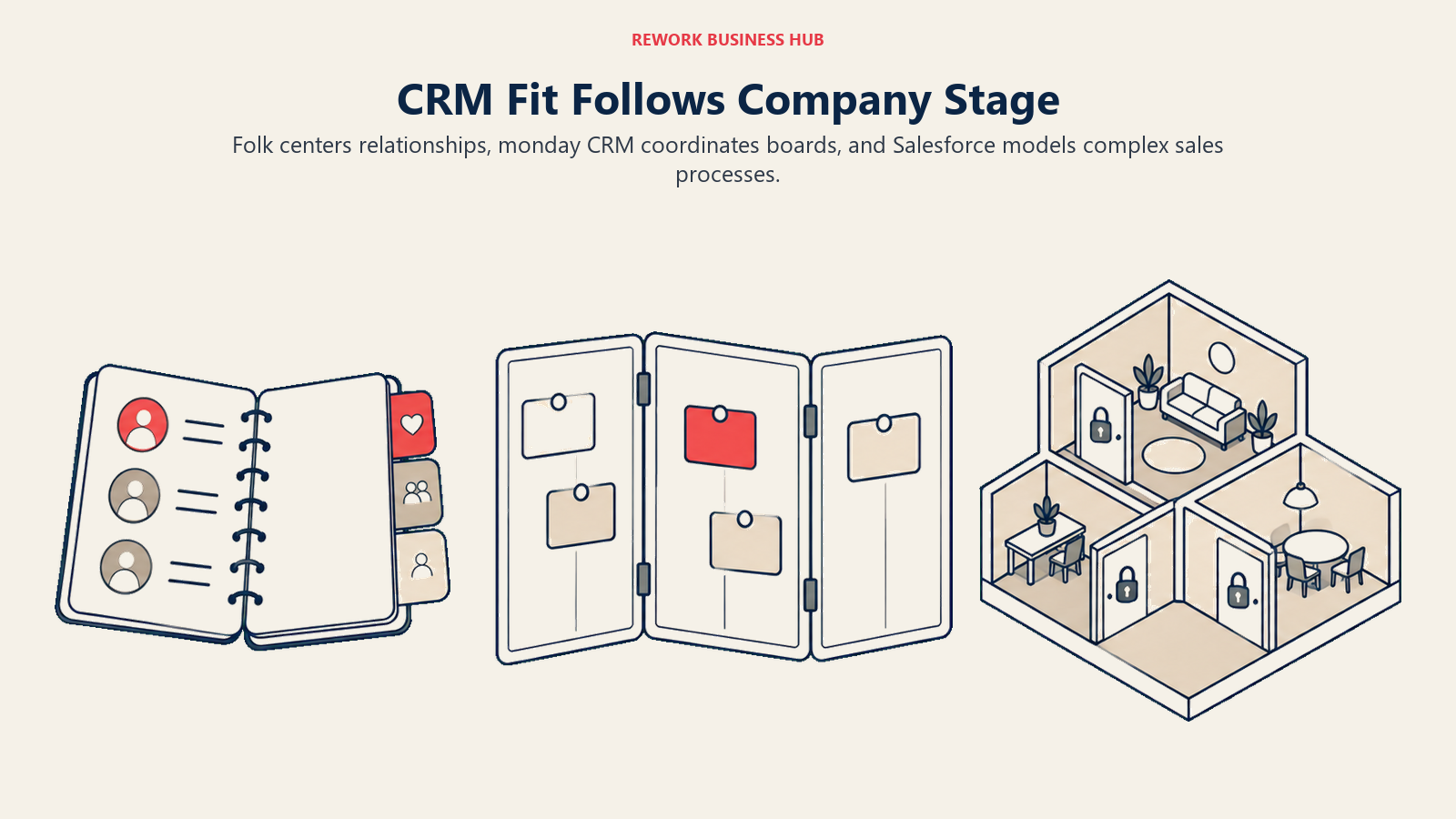
Folk centers relationships, monday CRM coordinates boards, and Salesforce models complex sales processes.
Folk: the network is the product
Folk starts from a different premise than a conventional CRM. Instead of contacts feeding a pipeline, contacts and the relationships between them are the whole point. Import from LinkedIn with the Chrome extension, sync email and calendar, and Folk enriches and organizes what you already have without asking you to define stages first. That's why its fans aren't sales teams in the traditional sense: founders doing their own business development, agencies managing client relationships, VCs and angels tracking deal flow, and partnerships leads who live in a network more than a funnel.
The Standard plan covers pipeline views, email campaigns, contact enrichment, AI assistants, and native WhatsApp sync alongside email and calendar, with no seat minimum. Premium adds custom objects and deals, email sequences, and API access for teams that want more structure without leaving Folk's simpler data model. What Folk still doesn't do, at any tier, is act like a sales-ops platform: no lead scoring, no native routing, no forecasting, no dialer. That's deliberate, not a gap the roadmap is racing to close. See the best Folk alternatives if your team has outgrown that shape already.
monday CRM: the board is the CRM
monday CRM extends monday.com's core idea, every piece of work as an item on a board you can view as a kanban, table, or timeline, to sales. Deals, contacts, and activities are board items, so a company already running monday.com for marketing, ops, or product work can add sales without learning a second tool or paying a second vendor.
2026 brought a real shift here: the Standard tier now ships AI agents built into the CRM, an outreach caller agent, a lead sourcer agent, and a meeting prep agent, with Pro adding a full AI workflow builder. That's new enough that it isn't yet a like-for-like replacement for a dedicated power dialer's call volume and coaching tools, but it softens the older complaint that monday CRM has no calling story at all. What hasn't changed: lead routing still runs through automation recipes and Zapier-style workarounds rather than first-class round-robin or territory logic, and reporting is real but not RevOps-grade. See the best monday CRM alternatives if those gaps are costing you deals.
Salesforce: the platform that can model anything
Salesforce's pitch hasn't changed in two decades: whatever your sales process looks like, however many custom objects, approval chains, or territory hierarchies it needs, Salesforce can be configured to match it. In 2026 that runs through Agentforce, the AI agent layer automating SDR outreach, deal summarization, and forecasting across the Einstein platform, and through an AppExchange marketplace independently tracked at 5,877 publicly listed apps as of mid-2026 (SF Apps Stats), short of Salesforce's own "7,000+" marketing figure but still the deepest third-party ecosystem in the category.
The cost of that depth is real and doesn't show up on the pricing page. Implementation, admin headcount, and the tier jump past Starter Suite are where the actual spend sits, and we model all three below rather than quoting a seat price and moving on. See the best Salesforce alternatives if the admin overhead is what you're trying to avoid.
| Capability | Folk | monday CRM | Salesforce |
|---|---|---|---|
| Core data model | Contacts and companies, spreadsheet-like | Boards, items, and columns | Fully custom objects and relationships |
| Structured pipeline / deal stages | Basic pipeline view | Yes, board-based | Yes, fully configurable |
| Native lead routing / distribution | No | Limited, via automation recipes | Yes, native and configurable |
| Forecasting | No | Basic | Advanced, native |
| Native calling / dialer | No | AI outreach caller agent (Standard+), no traditional dialer | No native dialer; AppExchange add-ons available |
| Email sequences | Premium tier and up | Pro tier and up (mass email + sequences) | Via Sales Engagement add-on |
| Custom objects / API access | Premium tier and up | Via automations and integrations | Every paid edition |
| AI features | AI Assistants, Magic fields (all tiers) | Outreach caller, lead sourcer, meeting prep agents (Standard+); AI workflow builder (Pro) | Agentforce, consumption-priced via Flex Credits |
| Reporting depth | Basic | Custom dashboards, tier-gated limits | Deepest of the three, native and via AppExchange |
| Seat minimum | None | 3 | None published |
Decision by Business Goal
| Your goal | Best fit | Why |
|---|---|---|
| Manage a personal or firm-wide network of relationships, not a formal pipeline | Folk | Built around contacts and warm relationships first, deal stages second |
| Get a visual, board-style CRM live today without hiring anyone to configure it | monday CRM | Drag-and-drop boards, familiar to any team already on monday.com |
| Give your team real forecasting, territory management, and approval chains | Salesforce | Flow, custom objects, and validation rules handle complexity no board or contact list can express |
| Keep per-seat cost flat and predictable as headcount doubles | monday CRM or Folk | Both hold one published rate with no forced tier jump, unlike Salesforce past Starter Suite |
| Run sales and every other department's work inside the same tool | monday CRM | Its CRM sits inside the same Work OS as marketing, ops, and product boards |
| Get board-ready governance, audit trails, and industry-specific compliance | Salesforce | The only one of the three built for regulated, enterprise-scale governance |
| Avoid a dedicated admin hire entirely, at any size | Folk | Genuinely zero-configuration; monday CRM and Salesforce both start to want one past a certain point |
Before you commit to a goal-driven pick, it helps to know which stage you're actually in rather than the stage you expect to be in next year. The how to choose a CRM for a startup guide covers that first-tool decision in more depth than a single comparison table can.
Team and Role Fit
| Role | Best fit | Why |
|---|---|---|
| Founder, agency lead, or investor managing a personal network or dealflow | Folk | Contacts and relationships are the unit of work, not pipeline stages |
| Sales manager at a company already running monday.com for other work | monday CRM | One vendor, one login, familiar board UX company-wide |
| RevOps or sales ops lead building structured process for the first time | monday CRM (Pro) or Salesforce Pro Suite | Depends entirely on how much custom logic the process needs |
| VP Sales or CRO at a 200+ person org with multiple business units | Salesforce | Territory hierarchies and multi-org support exist nowhere else here |
| CIO or Head of IT evaluating governance and compliance | Salesforce | Deepest audit trail, permissioning, and compliance ceiling of the three |
| Ops-minded generalist who wants to build the process without writing code | monday CRM | No-code automation recipes on a flexible board structure |
| Dedicated Salesforce admin, in-house or fractional | Salesforce | The role that makes the platform's depth actually usable day to day |
| Company stage | Folk | monday CRM | Salesforce |
|---|---|---|---|
| Pre-PMF, just off spreadsheets (1-15) | Strong | Possible | Not suited |
| Early traction (15-50) | Possible | Strong | Limited |
| Growth (50-200) | Limited | Strong | Possible |
| Mid-market (200-500) | Not suited | Possible | Strong |
| Enterprise (500+) | Not suited | Limited | Strong |
Pricing at Real Team Sizes: 5, 25, and 100 Seats
Sticker price tells you almost nothing about which of these three actually costs the least at your team size, and the seat price is only the whole story for one of them. Here's the full tier ladder for each, followed by what a real team pays once implementation and admin time are counted honestly.
| Folk plan | Monthly billing | Annual billing | Seat minimum | What you get |
|---|---|---|---|---|
| Standard | $30/member/mo | $24/member/mo | None | Pipeline view, email campaigns, contact enrichment, AI Assistants, Magic fields, LinkedIn extension, email/calendar/WhatsApp sync, 5,000+ integrations |
| Premium | $60/member/mo | $48/member/mo | None | Standard, plus custom objects and deals, email sequences, workspace roles, dashboards, API access, full interaction history |
| Enterprise | From $100/member/mo | From $80/member/mo | None | Standard and Premium, plus custom credit limits, security controls, group permissions, dedicated account manager, 1:1 onboarding |
Source: Folk pricing.
| monday CRM plan | Monthly billing | Annual billing | Seat minimum | What you get |
|---|---|---|---|---|
| Basic | $18/seat/mo | $12/seat/mo | 3 | 1 workspace, 1 custom dashboard, 1,000 active contacts and deals, 5 columns per board |
| Standard | $25/seat/mo | $17/seat/mo | 3 | Basic, plus AI agents (outreach caller, lead sourcer, meeting prep), 3 workspaces, 5 dashboards, 10,000 active contacts and deals, centralized comms hub, 250 automations/month |
| Pro | $41/seat/mo | $28/seat/mo | 3 | Standard, plus AI workflow builder, 15 workspaces, 50 dashboards, 100,000 active contacts and deals, mass email, email sequences, 25,000 automations/month |
| Enterprise | Custom | Custom | 3 | Unlimited workspaces, dashboards, and automations; HIPAA compliance; advanced permissions and governance |
Source: monday.com pricing.
| Salesforce Sales Cloud edition | Price per user/month | Billing | Notes |
|---|---|---|---|
| Starter Suite | $25 | Monthly or annual, buyer's choice | The only edition Salesforce publishes on its own pricing page; no seat minimum |
| Pro Suite | $100 (reported) | Annual only, quoted through sales | Not published on a page we could independently verify in August 2026 |
| Enterprise | $165 (reported) | Annual only, quoted through sales | Same caveat; figure corroborated by Capterra's tracked Salesforce pricing page |
| Unlimited | $330 (reported) | Annual only, quoted through sales | Same caveat |
Salesforce's Starter Suite is $25/user/month. The three higher tiers are reported figures, so confirm current pricing with Salesforce. For Salesforce against HubSpot, see our HubSpot vs Salesforce comparison.
That structural difference matters more than any single number. Folk and monday CRM both let a team stay on one tier indefinitely as headcount grows, upgrading only for features, not because a seat cap forces it. Salesforce doesn't work that way: Starter Suite caps out fast on automation and forecasting, routing almost any real 25-seat deployment into Pro Suite or Enterprise, tiers priced 4 to 13 times higher per seat and quoted through a sales conversation, not a checkout page.
The real cost at 5, 25, and 100 seats
None of these totals are hidden inside a "contact sales" button. Each one states its assumption plainly.
| Tool (tier modeled) | 5 seats | 25 seats | 100 seats |
|---|---|---|---|
| Folk (Standard, $24/seat/mo annual) | $1,440/yr | $7,200/yr | $28,800/yr |
| monday CRM (Standard, $17/seat/mo annual) | $1,020/yr | $5,100/yr | $20,400/yr |
| Salesforce (Starter Suite at 5; Pro Suite at 25; Enterprise at 100) | $1,500/yr | $30,000/yr | $198,000/yr |
License cost alone tells an honest story: at 25 seats, Salesforce's license runs 4 to 6 times what Folk or monday CRM charge, because complexity forces a tier jump the other two don't have. But license cost isn't the total for Salesforce, and pretending otherwise is exactly the mistake this comparison exists to correct. Here's the admin and implementation line each tool actually needs, stated as our own modeled assumption rather than hidden in a footnote:
| Tool | 5 seats | 25 seats | 100 seats |
|---|---|---|---|
| Folk | $0 (no configuration exists) | $0 | $0 |
| monday CRM | $0, self-serve | $0, self-serve | ~$18,000/yr, fractional ops owner (roughly a fifth of an operations salary) |
| Salesforce | $0 to minimal, self-serve on Starter Suite | ~$25,000 one-time implementation + ~$46,000/yr fractional admin | ~$95,000 one-time implementation + ~$92,000/yr full-time admin |
The Salesforce implementation figures are the midpoints of ranges industry trackers report for deployments this size, $15,000 to $40,000 at 25 seats and $40,000 to $150,000 at 100 (Folio3's 2026 implementation cost breakdown, reported). The admin salary is the Salesforce Ben 2025/26 survey's roughly $92,000 US mid-level figure, halved for a fractional role at 25 seats. None of this includes the add-ons most growing orgs eventually buy: CPQ for quote-to-cash, Sales Engagement for sequencing, extra API access, or additional sandboxes, each quoted separately, so treat every Salesforce total below as a floor. If a dedicated admin is the actual blocker in your decision, the when to hire a CRM consultant guide is worth reading first.
| Tool | 5 seats total | 25 seats, Year 1 / ongoing | 100 seats, Year 1 / ongoing |
|---|---|---|---|
| Folk | $1,440/yr | $7,200 / $7,200 | $28,800 / $28,800 |
| monday CRM | $1,020/yr | $5,100 / $5,100 | $38,400 / $38,400 |
| Salesforce | $1,500/yr | $101,000 / $76,000 | $385,000 / $290,000 |
That $290,000 ongoing figure at 100 seats lines up closely with the $150,000 to $300,000 annual total cost of ownership Forrester's Total Economic Impact research on Salesforce has reported at that size, a useful cross-check that it isn't a number invented to make a point.
The honest point buried in this section: on pure license price, monday CRM is cheapest at every seat count here, even undercutting Folk. That shouldn't read as "monday CRM wins," because its Standard tier still has no native lead routing and no real forecasting at 100 seats, the same gaps it has at 5. Folk stays close behind on price with even less sales-ops structure. Cheap and right for the job aren't the same claim, and a 100-person sales org picking either one for the lowest number on this table has usually made a stage mistake, not a pricing win.
Migration and Lock-In
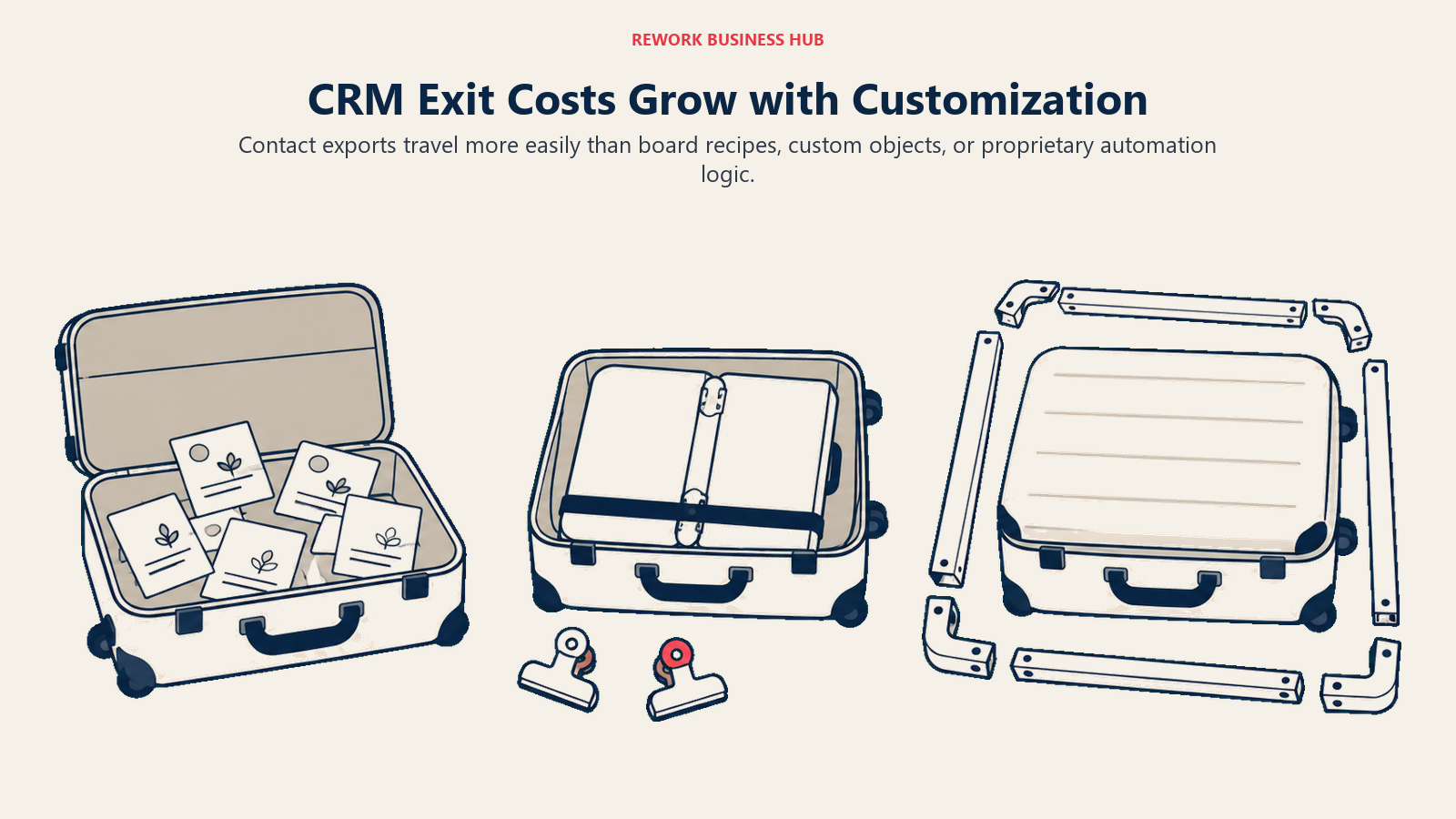
How hard each tool is to leave matters as much as how hard it is to adopt, and the three are genuinely different here.
| Dimension | Folk | monday CRM | Salesforce |
|---|---|---|---|
| Raw data export | CSV of contacts and companies; stays close to a spreadsheet shape even on Premium's custom objects | CSV/Excel export per board; contacts and deals are board items | Mature native tools (Data Export Service, Data Loader); cleanest raw export of the three |
| Custom fields | Premium's custom objects are simple key-value fields, low remapping effort | Custom columns and cross-board relationships are monday-specific; no standard export for the structure itself | Custom objects, page layouts, and record types are deeply specific, rarely mapping onto another CRM's schema |
| Automations / workflow logic | Minimal automation to begin with, so little to lose | Recipes don't export or transfer; rebuild from zero elsewhere | Flow and Apex logic is entirely proprietary; none of it transfers anywhere else |
| Vendor lock-in risk | Low: the pitch is that you could leave in an afternoon | Moderate: data is portable, the workflow logic isn't | High: deeper customization costs more to unwind, part of why deployments run for years |
The practical read: choosing Folk or monday CRM and it turns out wrong in a year, the exit cost is mostly your own time re-entering data, not a sunk technical investment. Salesforce is the opposite. Every custom object, Flow, and Apex trigger your admin builds adds switching cost, which is part of why Salesforce deployments tend to outlive the person who chose them. Before building deep customization into any of these three, the CRM data model design guide is worth reading: the structural decisions you make in month one are the ones that get expensive to undo in year three.
Implementation and Change Management
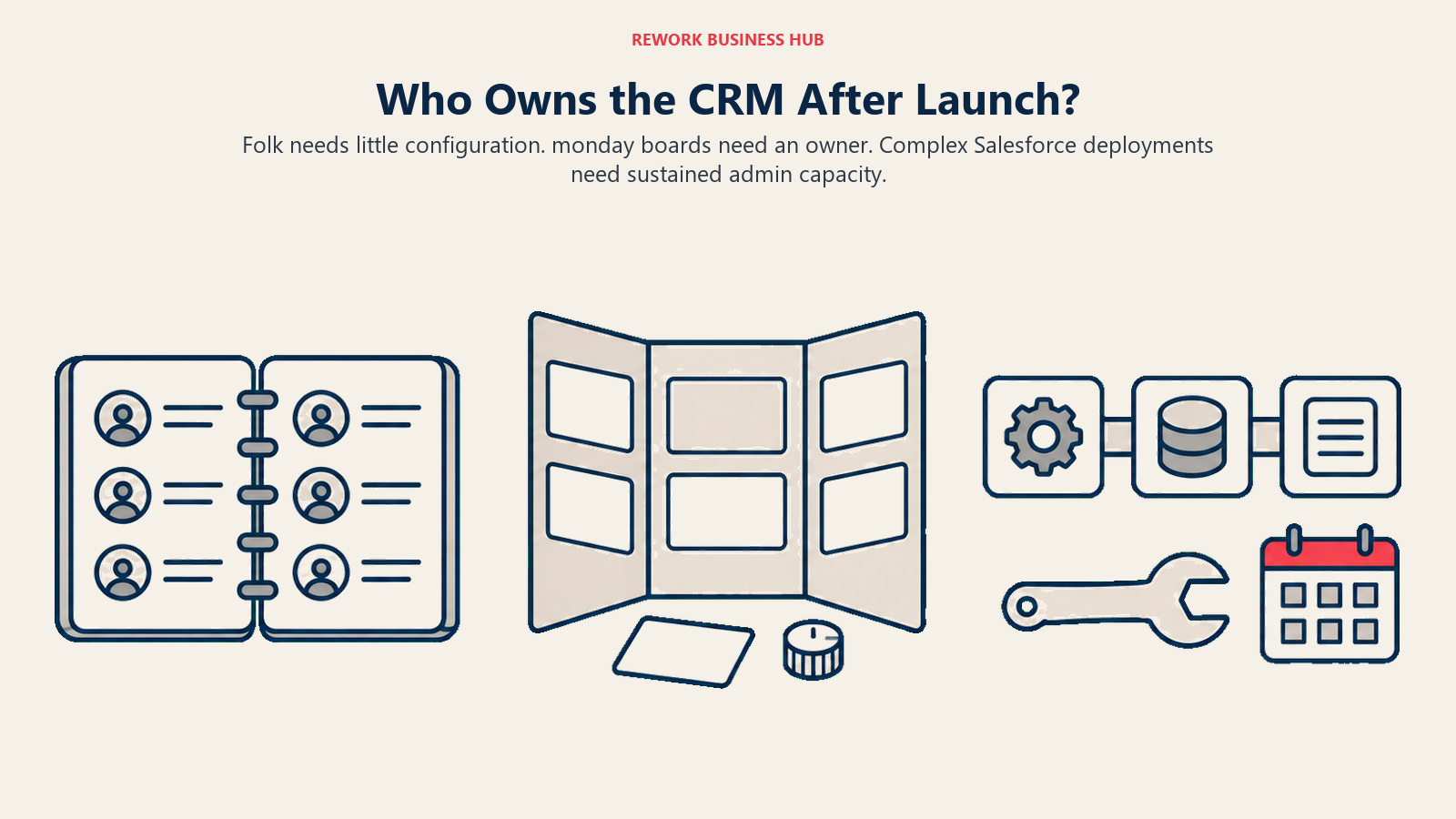
Folk needs little configuration. monday boards need an owner. Complex Salesforce deployments need sustained admin capacity.
| Dimension | Folk | monday CRM | Salesforce |
|---|---|---|---|
| Time to first deal tracked | Hours | Under a day for a basic board | Days on Starter Suite; weeks to months on Pro Suite or Enterprise with a partner |
| Setup style | Self-serve; install the Chrome extension and import contacts | Self-serve; drag-and-drop board building | Self-serve at Starter Suite; partner-led or admin-led from Pro Suite up |
| Who maintains it long-term | Nobody needs to; almost no configuration to maintain | A sales manager or ops-minded team member owns boards and automations | A dedicated admin, in-house or fractional, past Starter Suite complexity |
| Training load | Minimal; the UI mirrors a contact list | Low to moderate; a team already on monday.com needs almost none | Low at Starter Suite; a real ramp-up for Flow and permissions past that |
| Where onboarding risk hides | Importing contacts cleanly the first time and trusting the enrichment data | Automation recipes built by one person nobody else understands | Underscoping cost: budgeting license only, missing implementation and admin |
Risk and Governance
| Risk dimension | Folk | monday CRM | Salesforce |
|---|---|---|---|
| Company maturity / backing | Private, independent, smaller team | Public (NASDAQ: MNDY); Q2 2026 revenue $364.6M, up 22% YoY | Public (NYSE: CRM); largest CRM vendor by market share |
| Compliance depth | Standard SaaS terms; not built for regulated industries | Business/Enterprise tiers add admin controls; Enterprise adds HIPAA | Deepest of the three: HIPAA-eligible options, industry-specific clouds, long track record |
| Vendor lock-in risk | Low | Moderate | High |
| AI data handling to review | AI Assistants and Magic fields read contact data to act on it; check current terms before routing sensitive data through it | AI agents (caller, sourcer, meeting prep, workflow builder) take actions inside your account; review what they can touch | Agentforce acts autonomously across Sales, Service, and other clouds; the governance question is bigger given that reach |
On maturity: monday.com's public filings give real visibility into company health that Folk, as a private company, doesn't offer. That's not a knock on Folk, most buyers at Folk's target size aren't running vendor-risk assessments anyway, but it's a fair distinction if governance is genuinely part of your evaluation.
When Folk Is the Right Call
- You're under 30 people and your sales motion runs through warm relationships and referrals, not a formal multi-stage pipeline.
- LinkedIn and email are genuinely your primary channels, and the Chrome extension plus mail merge cover most of your day already.
- You don't have, and don't want, anyone whose job includes configuring or maintaining a CRM.
- Budget predictability matters more than depth, and $24 to $48 a seat a month with no seat minimum is a number you can commit to without a sales call.
When monday CRM Is the Right Call
- Your company already runs monday.com for other work, and adding a separate CRM vendor is a real cost, in dollars and login fatigue, you'd rather avoid.
- You want a visual, board-style pipeline your team can pick up without training, and you're comfortable building your own automations rather than getting routing logic out of the box.
- Cost predictability matters: Standard stays $17 a seat a month at 5 people or 500, with no forced tier jump the way Salesforce has past Starter Suite.
- Your sales process is real but not yet complex enough to need territory hierarchies, approval chains, or a dedicated admin.
When Salesforce Is the Right Call
- Your sales process genuinely needs custom objects, multi-step approval chains, or territory-based routing that a board or contact list can't express.
- You're at the size, typically 100 or more seats, where license cost is a rounding error next to a broken sales process, and $290,000 a year is defensible to a board.
- You have, or are ready to hire, a dedicated admin. Salesforce's depth is only real if someone owns it full-time, or close to it.
- You need compliance certifications or industry-specific clouds that neither Folk nor monday CRM offer at any price.
Decision Framework
| If you need... | Pick... |
|---|---|
| A CRM built around relationships, not pipeline stages, with zero setup time | Folk |
| The lowest real per-seat license cost at almost any team size | monday CRM |
| One tool for CRM and the rest of the company's project work | monday CRM |
| Structured forecasting, territory management, and approval chains | Salesforce |
| The deepest compliance and governance ceiling available in this category | Salesforce |
| To avoid a dedicated admin hire entirely, at any size | Folk |
| Room to keep customizing for a decade without hitting a ceiling | Salesforce |
| A tool your reps will actually open without being told to | Folk or monday CRM |
What to Do Next
Don't shortlist based on which of these three you've heard of most. Shortlist based on which stage description above actually matches your company today, not the one you expect in two years. Under 30 people with sales running through relationships, trial Folk for two weeks with your real contact list before looking at anything else. Already living in monday.com, get a sales manager to build one real pipeline in monday CRM and see whether the automation-recipe approach to routing bothers your team. Past 100 seats with the conversation circling back to approval chains, territories, or compliance, skip the smaller tools and get implementation quotes from at least two Salesforce partners before signing anything, because the license price is the number you already know and the implementation price is the one that surprises teams. The CRM buyer's checklist is worth working through before any of those three conversations.
If none of the three quite fits, your team has outgrown Folk's simplicity and monday CRM's shallow lead-management depth, but the Salesforce admin tax feels wrong for your size, that's a real, narrower gap between them. Rework packages CRM, lead management, and a multi-channel inbox as one product for teams roughly 20 to 500 people, starting from $159 a month billed yearly for its Revenue Engine (5 marketing and 5 sales seats) (rework.com/pricing). It won't out-relationship Folk for a 10-person agency, and it won't out-customize Salesforce for a 2,000-person enterprise, so it isn't a fit at either end of this article. For the stage in between, it's worth a look alongside the three compared here. See Rework vs Folk, Rework vs monday CRM, and Rework vs Salesforce for the direct breakdowns.
Frequently Asked Questions about monday CRM vs Folk vs Salesforce
Which of the three is cheapest for a small team?
monday CRM's Standard tier is the cheapest license at every seat count here, $17 a seat a month billed annually versus Folk's $24. Folk's real advantage was never the sticker price, it's zero implementation and no admin needed at any size, which narrows the gap once you count total cost, not just license.
Is Salesforce's $25 a month Starter Suite the real price?
For a small team on Starter Suite, yes: vendor-published, billable monthly or annually, no seat minimum. But Starter Suite caps out on automation and forecasting fast, and most 25-seat-plus deployments move to Pro Suite or Enterprise, priced 4 to 13 times higher per seat and quoted through sales rather than published.
Does Folk work for a team past 30 or 40 people?
It can technically run at any seat count since there's no seat minimum, but Folk has no native lead routing, forecasting, or structured pipeline at any tier. A team past 30 to 40 people usually needs at least one of those, a process gap Folk isn't built to close, not a price problem.
Can monday CRM replace a dedicated sales CRM for a growing sales team?
For teams that value visual, board-based work management and will build their own automation recipes, yes, especially through the growth stage. Where it still falls short is native lead routing and a traditional power dialer; the 2026 AI outreach agents help but aren't yet a full replacement.
Do I need a dedicated administrator for any of these three?
Not for Folk, at any size, that's the product's core design. Not for monday CRM under roughly 50 to 100 seats, though a fractional ops owner helps past that. For Salesforce, budget a fractional admin from around 25 seats and a full-time admin by 100, since its depth is only usable with someone actively maintaining it.
How hard is it to migrate off each platform later?
Folk is easiest: contacts and companies export cleanly with minimal automation logic to lose. monday CRM's raw data exports fine, but automation recipes don't transfer and have to be rebuilt elsewhere. Salesforce is hardest: custom objects, Flow, and Apex code are proprietary and rarely map onto another CRM's data model.
Are Folk, monday CRM, and Salesforce all still independently purchasable in 2026?
Yes, all three are active as of August 2026. Folk remains private and independent. monday.com trades publicly as NASDAQ: MNDY and reported 22% year-over-year revenue growth in Q2 2026. Salesforce trades publicly as NYSE: CRM and remains the largest CRM vendor by global market share.

Head of Enterprise Solutions
On this page
- TL;DR
- What Each Tool Is Actually Built For
- Folk: the network is the product
- monday CRM: the board is the CRM
- Salesforce: the platform that can model anything
- Decision by Business Goal
- Team and Role Fit
- Pricing at Real Team Sizes: 5, 25, and 100 Seats
- The real cost at 5, 25, and 100 seats
- Migration and Lock-In
- Implementation and Change Management
- Risk and Governance
- When Folk Is the Right Call
- When monday CRM Is the Right Call
- When Salesforce Is the Right Call
- Decision Framework
- What to Do Next