Best PIM (Product Information Management) Software in 2026: 15 Platforms for Teams Drowning in Product Data
Turn this article into takeaways for your work.


Each assistant summarizes the article only for you and suggests best practices for your work.
The best PIM software in 2026 depends on whether your actual problem is data governance, retailer syndication, or just getting product content out of a shared spreadsheet before the next channel launch. Akeneo leads for teams that want the category-defining PIM, with a genuinely free, self-hosted Community Edition sitting behind the commercial SaaS line. Salsify and Syndigo lead when the real job is pushing complete, retailer-ready content out to a wide network of retailers and marketplaces. Plytix and Struct PIM lead for small and mid-size teams that want a modern PIM without an enterprise sales cycle. Pimcore leads for technical teams who want an open platform they can extend rather than a locked-down SaaS tool. And Rework fits mid-size operators who want the product record sitting next to the deal, the order and the customer, instead of syncing a fifth tool into everything else.
This guide ranks 15 platforms for ecommerce managers, heads of merchandising, product data managers and COOs who need one accurate source of product truth across a website, a handful of marketplaces, and however many retail partners are asking for their own spreadsheet template this quarter. Each one is judged on data modeling and attribute governance, workflow and approval, channel and retailer syndication, digital asset handling, AI-assisted enrichment, and what the bill actually looks like once you get past the marketing page. That distinction matters more in this category than in most: only five of the fifteen platforms below publish an actual price.
Key Facts
- Retailers face an average of 15,000 issues with inaccurate product data every year, per GS1's own product data standards material, a scale problem no shared drive or spreadsheet template is built to catch.
- The average online shopping cart abandonment rate sits at 70.22%, per Baymard Institute's aggregate of 50 studies (page last updated 22 September 2025). Product content is not on Baymard's own list of stated abandonment reasons, which is led by extra costs at 40%, so treat a PIM as a merchandising and returns lever rather than a checkout fix.
- 83% of online shoppers say they are likely to abandon a site or product page that does not give them the information they want, per PIM vendor Syndigo's State of Product Experience 2026 study of 8,736 adults across six countries.
- In the same Syndigo study, 76% of shoppers say they are more likely to return to brands that get product content right, and 26% returned a product in the past six months because it did not match expectations, exactly the gap a PIM's structured attributes and approval workflow exist to close.
What PIM Software Actually Is (and What It Isn't)
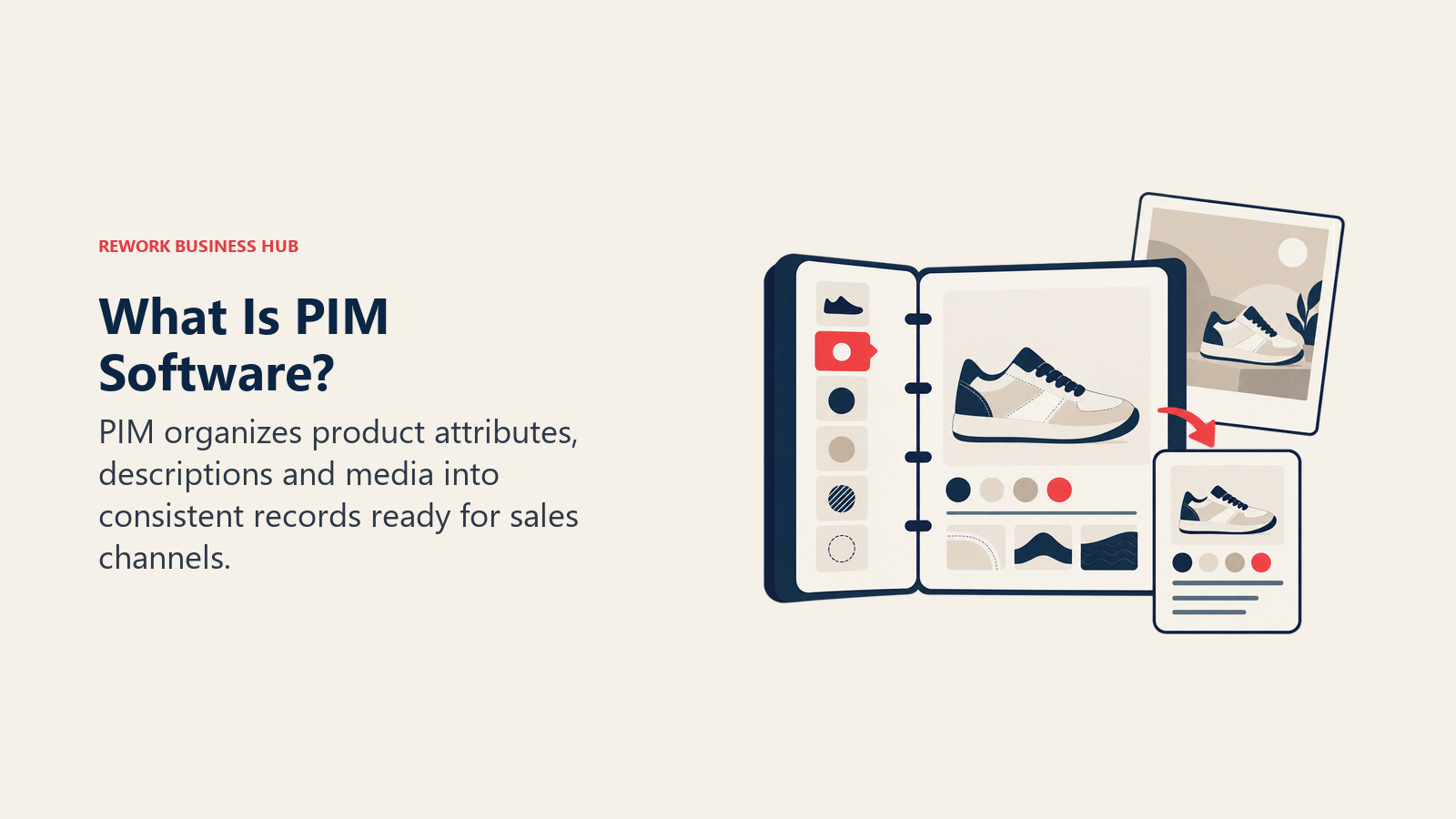
Most people shopping this category are actually shopping three or four categories at once, which is why the shortlists get confusing fast. A PIM (product information management) system is the single source of truth for product attributes, descriptions, images, and variants, structured once and pushed out consistently to every channel: the website, marketplaces, retailer portals, print catalogs, and increasingly an AI shopping agent reading a product feed on your behalf.
That is not the same job as a digital asset manager, and it is not the same job as an ecommerce platform, an order management system, or an enterprise master data management (MDM) tool, even though several vendors on this list blur two or three of those lines on purpose. If the real gap is rich media storage and brand asset distribution rather than structured product attributes, the best digital asset management software roundup is the closer fit. If the storefront itself is still the open decision, the best ecommerce platforms guide covers that. And if orders, not product content, are what is breaking, the best order management software roundup is the one to read instead.
| Job to be done | Storefront platform | DAM | PIM | Enterprise MDM |
|---|---|---|---|---|
| Public catalog, themes, checkout | Yes | No | No | No |
| Product attributes, one structured record per SKU | Basic, per channel | No | Yes, the core job | Sometimes, for product domain only |
| Rich media, images, video, brand assets | Via apps | Yes, the core job | Basic to strong, varies by vendor | Rarely |
| Variant, bundle and kit modeling | Sometimes | No | Yes | Sometimes |
| Approval workflow across teams and locales | Rarely | Sometimes | Yes, the core job | Sometimes |
| Syndication to retailers, marketplaces and GDSN pools | Via apps | No | Usually | Varies |
| Multidomain data (customer, supplier, location, product) | No | No | No, product only | Yes, the core job |
| Translation and localization at scale | Rarely | No | Usually | Sometimes |
The practical test is simple. If a customer cannot buy, that is a storefront problem. If the brand photography and video assets are scattered across five drives, that is a DAM problem. If an order landed but nobody knows where it should ship from, that is an order management problem. And if the same SKU shows a different weight on the website, a different description on Amazon, and a blank field on a retailer's portal because three people update three spreadsheets on three different schedules, that is a PIM problem, and it is the one this list solves.
Why Only Five of These Fifteen Publish a Price
This is the fact that changes how long a PIM evaluation actually takes, and it belongs up front rather than buried in a footnote. Of the fifteen platforms ranked below, only Plytix, Pimberly, Struct PIM, Pimcore, and Jasper PIM publish a real dollar or euro figure you can read without talking to anyone. Akeneo's cheapest listed figure is a trial-gated "$0 Annually" that is not a usable price, and everything above it is "Call for a quote." Salsify has no pricing page at all; it 301-redirects straight to the homepage. Sales Layer publishes plan limits (users, SKU caps) but not a number. inriver, Syndigo, Stibo Systems, Bluestone PIM, Productsup, and Centric PXM (formerly Contentserv) all sit behind a "talk to sales" wall with nothing published.
| Tool | Publishes a real price? | What you get instead |
|---|---|---|
| Plytix | Yes | Free Standard tier, $499/mo Pro, published limits on both |
| Pimberly | Yes | Three named annual tiers with published SKU, user and storage caps |
| Struct PIM | Yes | Three named monthly tiers in euros, unlimited SKUs on every one |
| Pimcore | Yes | Free open source edition, two named annual paid tiers |
| Jasper PIM | Yes | Two named monthly USD tiers, tied to channel count |
| Akeneo | No, trial-gated placeholder only | "Call for a quote" on Advanced and Premium |
| Salsify | No | No pricing page exists; a sales conversation from the first click |
| inriver | No | Four named plans, all "Get in touch" |
| Rework | No | Quoted per organization |
| Sales Layer | No, but publishes tier limits | User and SKU caps per tier, price on request |
| Syndigo | No | "Talk to Sales" only, no plan names published |
| Centric PXM (formerly Contentserv) | No | Contact-only |
| Stibo Systems (STEP) | No | Contact-only, positioned as MDM first |
| Bluestone PIM | No | Usage-based model described, no rate published |
| Productsup | No | Quote depends on products, feeds, modules and seats |
That split is not a minor inconvenience. A published price means a data manager or ecommerce lead can build a shortlist and a rough budget alone, in an afternoon. A quote wall means procurement, IT security (for the inevitable questionnaire), and often legal have to be looped in before anyone sees a number, which routinely adds two to six weeks to a timeline that a published-price vendor would have closed already. If your organization runs on a fixed quarterly budget cycle rather than an open enterprise procurement process, weight that timeline difference as heavily as any feature checkbox.
Quick Comparison Table
| Tool | Best For | Starting Price | Key Strength | Key Limitation |
|---|---|---|---|---|
| Akeneo | Teams that want the category-defining PIM with a real open source edition | No usable price; Growth is trial-gated at "$0 Annually," Advanced and Premium are quote-only | Deepest ecosystem, largest partner network, and a genuinely free Community Edition | No published SaaS price at any paid tier |
| Salsify | Brands prioritizing content quality and syndication over budget transparency | No pricing page exists at all (redirects to the homepage) | Strong content and syndication tooling built around a PXM philosophy | Cannot even start a budget conversation from the website |
| Plytix | Small and mid-size sellers wanting a modern PIM without an enterprise contract | Standard $0/mo (500 SKUs); Pro $499/mo (50,000 SKUs) | Unlimited seats on every plan, including the free tier | Add-ons (feeds, brand portals, data sheets) are priced separately at $200 to $300/mo each |
| Pimcore | Technical teams wanting an open, extensible platform rather than a locked SaaS tool | Community Edition free; Professional $9,900/year; Enterprise $29,900/year | No per-seat and no per-product fees on any tier | Requires real engineering investment to get value from the open platform |
| inriver | Mid-market to enterprise brands wanting a dedicated, customizable PIM | No published price; four plans, all "Get in touch" | Plans described as "fully customizable" to fit complex catalogs | Zero pricing transparency, even a starting range |
| Rework | Mid-size operators wanting the product record on the same platform as the CRM and the order | Quote on request | Product sits beside Sales CRM, Commerce, Inventory and Invoice, one record, no sync | Not a dedicated enterprise PIM, no GDSN or retailer-network syndication |
| Sales Layer | Teams wanting clear plan limits before a quote conversation | No published price; Scale caps at 5 users/10,000 SKUs | Publishes user and SKU ceilings per tier even without a dollar figure | Still requires a sales call to get an actual number |
| Pimberly | Enterprise brands wanting a fixed named-tier structure | Regular $36,000/year; Pro $60,000/year; Corporate $90,000/year | Three clearly named annual tiers with published SKU, user and storage caps | Entry point is a five-figure annual commitment |
| Syndigo | CPG brands and manufacturers needing broad retailer syndication reach | No published price; "Talk to Sales" only | Syndication network the vendor states reaches 3,500+ retailers and marketplaces | Zero pricing transparency; also the source of some Key Facts stats above, so read its own research as vendor-labeled |
| Struct PIM | Teams that want unlimited SKUs on every tier, metered only on languages and users | Basic from €2,200/month; Professional from €3,430/month | Products, catalogs, models and attributes are unlimited on every tier | Priced in euros; a US buyer needs to convert and confirm |
| Centric PXM (formerly Contentserv) | Enterprise retail and CPG brands wanting a PXM (product experience management) suite | No published price | Full PXM suite (PIM, DAM, syndication) under Centric Software since February 2025 | Zero pricing transparency, plus a recent rebrand to track |
| Stibo Systems (STEP) | Enterprises that need multidomain MDM with product data as one domain among several | No published price | Positioned as true multidomain MDM, not PIM with an MDM label bolted on | Overkill, and priced accordingly, for a team that only needs product data |
| Bluestone PIM | Mid-market brands wanting pricing that scales down as well as up | No published price; usage-based on users, SKUs and languages | "You never pay for more than you use," per the vendor's own FAQ | No published rate, so the usage-based promise cannot be budgeted without a quote |
| Productsup | Large catalogs feeding many syndication endpoints and ad channels | No published price; depends on products, feeds, modules and seats | Explicitly lists every pricing variable instead of hiding them | Cannot estimate cost without disclosing your own catalog and feed count first |
| Jasper PIM | Smaller teams wanting a flat monthly PIM price tied to channel count | Growth $999/mo (2 channels); Professional $1,999/mo (8 channels) | Simple, published, per-month USD pricing | Enterprise (unlimited channels) reverts to a custom quote |
1. Akeneo: The Category-Defining PIM, Still With a Real Open Source Edition
Akeneo is the name most PIM shortlists start with, and for good reason: it effectively defined the modern, catalog-first PIM category, and it still ships a genuinely free, open source, self-hosted Community Edition alongside its commercial SaaS line. GitHub shows the Community Edition actively maintained, with v2026.4 released 28 August 2026, and endoflife.date confirms 2026.4 as the current supported release. If you have seen claims that Community Edition is being discontinued, that is not accurate: it is still shipping monthly releases as of this month.
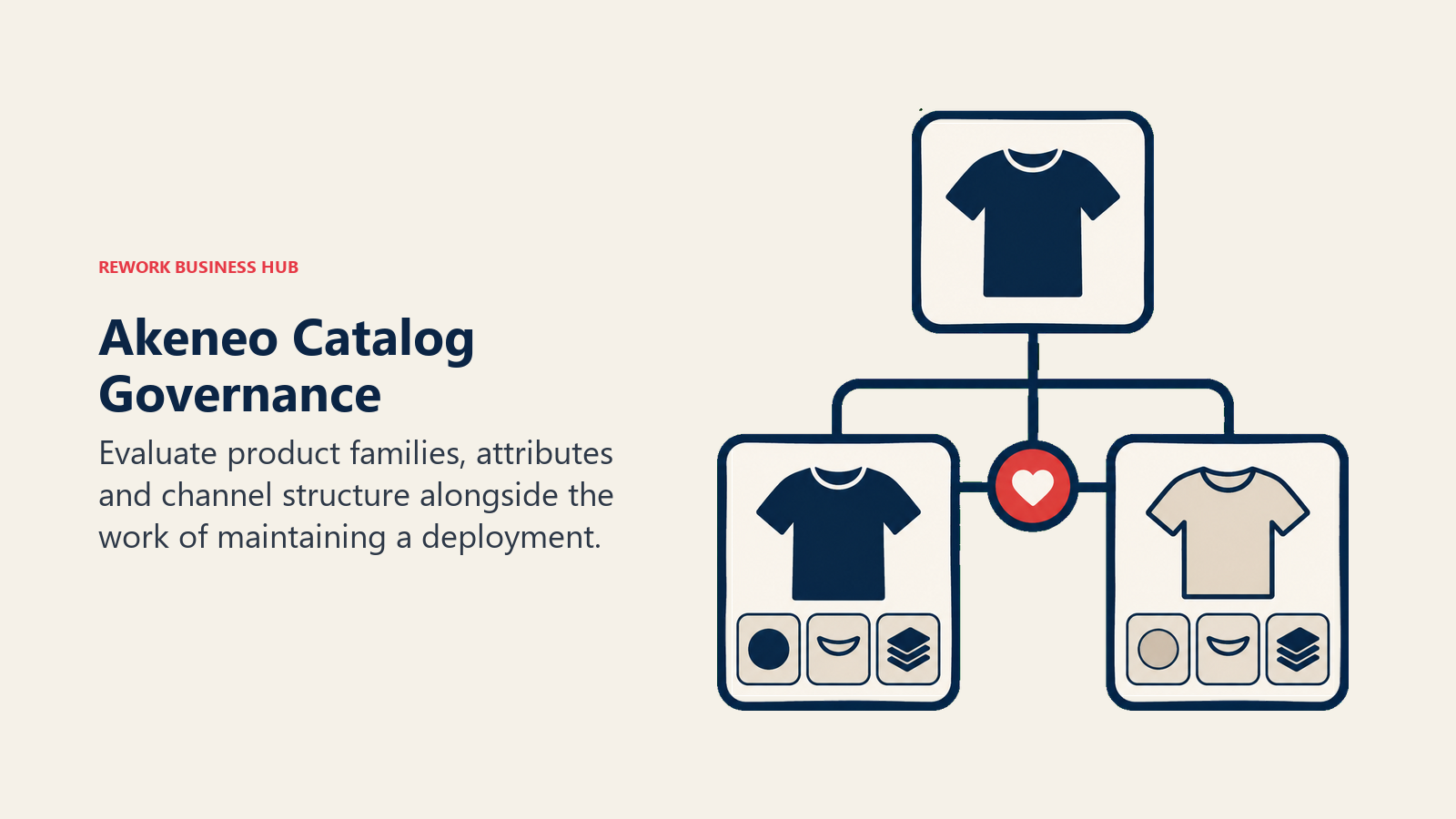
What is genuinely worth knowing if you run an older self-hosted install: Akeneo version 7.0 reaches end of support on 30 September 2026, a real deadline for anyone still on that release, and a legitimate reason a reader is shopping alternatives right now rather than upgrading in place. Since version 2026.1, Akeneo has also warned that breaking changes may land in any release, so self-hosters should pin exact versions rather than auto-updating.
On the SaaS side, Akeneo restructured its packages to Growth, Advanced, and Premium (the older "Enterprise Edition" name is gone). Growth is listed as "Starting at $0 Annually" behind a free trial, which is not a usable price for budgeting. Advanced (adding collaboration workflows, advanced rights management, and channel-ready data governance) and Premium (adding PX Insights, enterprise governance with SIEM, 24/7 support, and the Agentic Ziggy AI assistant) both say "Call for a quote." All three SaaS tiers include one activation channel, with no published user, SKU, or locale caps. Add-ons include Supplier Data Manager, DAM, Digital Showroom AI, and connector apps for Salesforce Commerce Cloud, Adobe Commerce, and Shopify. Akeneo Growth reportedly runs roughly $45,000/year. If Akeneo is the incumbent you are evaluating alternatives to, the dedicated Akeneo alternatives guide and the Akeneo vs Salsify head-to-head both go deeper on that specific comparison.
| Pros | Cons |
|---|---|
| Genuinely free, actively maintained open source Community Edition | No published SaaS price at any paid tier |
| Largest partner and integrator ecosystem in the category | Community Edition warns of breaking changes in any release since 2026.1 |
| Agentic Ziggy AI assistant on the Premium tier | v7.0 self-hosters face a real end-of-support deadline this month |
| Broad connector library for major commerce platforms | No published price for the paid SaaS tiers |
Best for: Teams that want the category-defining PIM and value having a genuinely free, self-hosted path available if the SaaS relationship ever ends. Not ideal for: Buyers who need to see a number before booking a call, since every paid SaaS tier is quote-only.
2. Salsify: Content and Syndication, With No Pricing Page At All
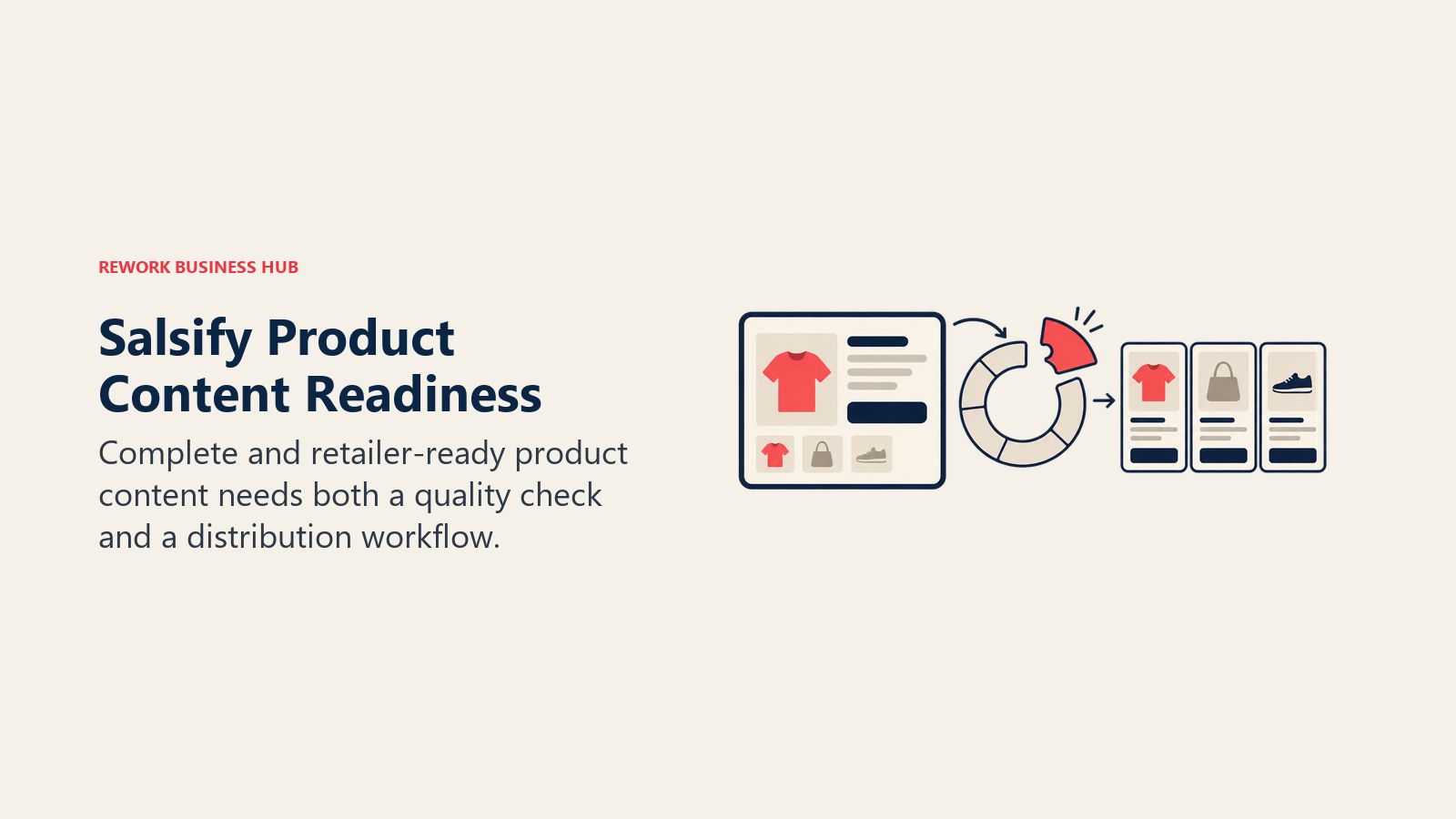
Salsify built its name on product experience management (PXM), the idea that winning the digital shelf takes more than accurate attributes: it takes complete, retailer-optimized content, distributed everywhere a shopper might see the product. That philosophy shows up in the product itself, with strong content scoring, syndication tooling, and workflow built around getting a listing to "complete" fast. One thing to factor into a 2026 evaluation: in July 2026 private equity firm Cinven agreed to acquire Salsify, on undisclosed terms and subject to regulatory approval, so you would be signing with a vendor mid-ownership-change.
The one fact worth stating plainly, because it is unusual even in a category full of quote walls: salsify.com/pricing does not exist. It 301-redirects straight to the homepage. There is no pricing page, no plan names, and no dollar figure anywhere on the site. Every other vendor in this roundup that withholds pricing at least keeps a page with plan names and a "contact us" button; Salsify does not even have that page. Budgeting starts entirely from a sales conversation, with nothing to anchor expectations beforehand. For the direct comparison buyers ask about most in this category, see Akeneo vs Salsify.
| Pros | Cons |
|---|---|
| Strong content-completeness scoring and workflow tooling | No pricing page exists anywhere on the site |
| Built around a PXM philosophy, not just attribute storage | Cannot start even a rough budget conversation without a sales call |
| Established syndication network for retailer and marketplace listings | Evaluation timeline depends entirely on how quickly sales responds |
| Well known brand recognition among enterprise ecommerce teams | No self-serve trial or transparent entry point |
Best for: Brands prioritizing content quality and syndication reach over having any budget visibility up front. Not ideal for: A data manager who wants to build a shortlist and a rough number before looping in procurement.
3. Plytix: The Modern PIM With a Genuinely Free Tier
Plytix earns its spot by doing something almost nobody else on this list does: publishing a real, usable, free plan. Standard is $0/mo for up to 500 SKUs, 500 AI credits a month, 5,000 API calls an hour, and 50 GB of storage, with unlimited seats included. Pro is $499/mo for 50,000 SKUs, the same 500 AI credits, 15,000 API calls an hour, and 750 GB of storage, also with unlimited seats. Enterprise is custom, for unlimited SKUs and multi-account setups. Plytix's pricing page states plainly that all plans are billed monthly and can be canceled at any time, which is a meaningfully lower-commitment model than the annual contracts most of this list runs on.
One detail worth getting right if you are quoting the Pro price to a non-US audience: Plytix renders its currency symbol from the visitor's country via JavaScript. The number itself does not change, but the symbol does, showing $ to buyers in the US, Canada, Australia, and most of Latin America, and € to everyone else, including the entire EU. So the accurate way to state it is that Pro is 499 a month, shown as $499 to a US buyer and €499 to a European one, not that it is a fixed $499 globally. Add-ons sit on top of either paid tier: product feeds and templates at $300/mo, brand portals at $300/mo, product data sheets at $200/mo, and free Shopify and BigCommerce connectors.
| Pros | Cons |
|---|---|
| Genuinely usable free tier, not a time-limited trial | Add-on modules (feeds, portals, data sheets) stack quickly at $200 to $300/mo each |
| Unlimited seats on every plan, including free | Pro's 50,000 SKU cap forces a custom Enterprise conversation for larger catalogs |
| Monthly billing with cancel-anytime terms | AI credit allowance (500/mo) is shared across all paid tiers below Enterprise |
| Clear, fully published price ladder | Currency display is JavaScript-rendered, not a true multi-currency price list |
Best for: Small and mid-size sellers who want to start on a real free plan and see the exact cost of scaling up before committing. Not ideal for: Catalogs already past 50,000 SKUs that would land in a custom Enterprise quote regardless.
4. Pimcore: The Open Platform for Teams Who Want to Build, Not Just Configure
Pimcore takes a different bet than most of this list: instead of a polished, configuration-only SaaS product, it ships as an open platform, PIM, DAM, and digital experience tooling built on open source, that a technical team can extend directly. Community Edition is free, open source, and self-hosted, with no per-seat and no per-product fees. Professional is $9,900 per year, and Enterprise is $29,900 per year, both flat annual figures with no user or SKU metering. A PaaS option exists as a custom, "tailored to you" quote, and running more than four production instances on the paid tiers also moves to a custom conversation.
That structure suits a company with in-house developers who want to shape the data model and integrations directly, rather than working inside a vendor's configuration UI. It is a worse fit for a team that wants to be productive on day one without an implementation project. Because Pimcore shows up on DAM shortlists as often as PIM shortlists, it also appears in the Bynder alternatives and Canto alternatives roundups, so if the real job at hand is asset management rather than product attributes, those guides are the closer read.
| Pros | Cons |
|---|---|
| Free, open source Community Edition with no seat or product fees | Requires real engineering investment to configure and extend |
| Flat annual pricing on Professional and Enterprise, no per-user math | More than 4 production instances forces a custom quote |
| Doubles as a capable DAM, useful if that is also a gap | Steeper learning curve than a configuration-first SaaS PIM |
| No vendor lock-in on the self-hosted Community path | Support quality on Community Edition depends on your own team or a partner |
Best for: Technical teams that want an open, extensible platform and are comfortable investing engineering time to get value from it. Not ideal for: Non-technical teams that want to be live in weeks without an implementation project.
5. inriver: Fully Customizable, and Fully Quote-Only
inriver positions itself as a dedicated, highly configurable PIM for mid-market and enterprise brands with complex catalogs, structured products, kits, variants, and multi-brand hierarchies that a lighter tool struggles to model cleanly. The company sells four named plans, Foundation, Core, Professional, and Enterprise, and every single one shows "Get in touch" rather than a figure. The page states plainly that every plan is "fully customizable," which is presumably true but offers a prospective buyer nothing to anchor a budget against.
That total absence of pricing signal (no starting range, no per-tier differentiator beyond the name) puts inriver at the harder end of this list to shortlist without a sales conversation. It suits organizations already running a formal RFP process where a published price would not have changed the evaluation path anyway, and is a frustrating first stop for a smaller team trying to build a quick comparison.
| Pros | Cons |
|---|---|
| Positioned specifically for complex, structured product catalogs | Zero pricing signal of any kind across all four plans |
| Four named tiers suggest a real range of buyer sizes | "Fully customizable" messaging gives no sense of a starting point |
| Established presence in mid-market and enterprise PIM RFPs | No public trial or self-serve path to try the product |
| Dedicated PIM focus rather than a bolt-on module | Harder to build an apples-to-apples shortlist comparison |
Best for: Mid-market to enterprise brands already running a formal procurement process where price transparency was never going to drive the shortlist. Not ideal for: A smaller team trying to compare five vendors' pricing in an afternoon.
6. Rework: Product Operations on the Same Platform as the CRM and the Order
Rework's Product module runs product operations inside the wider Rework platform, which also carries Sales CRM, Commerce, Lead, Inventory, Invoice, Work Ops, and People. The argument is not that Rework out-features a dedicated enterprise PIM on retailer syndication or GDSN compliance. It is that the product record, the deal it is attached to, the order it eventually becomes, and the invoice that gets raised all live on one platform, instead of a PIM synced to a CRM, an ecommerce platform, and an invoicing tool through three integrations that each drift out of step on their own schedule. For a mid-size team, that means one person can look at a product, see which deals reference it, which orders shipped it, and which invoices billed for it, without switching systems.
Two honest limits, stated clearly because they matter more here than almost anywhere else on this list. Rework is not a dedicated enterprise PIM: it does not ship GDSN syndication, it does not push content to a 3,500-retailer network the way Syndigo does, and it is not built for a global CPG brand publishing to hundreds of retail partners. And it is not a master data management platform: no multidomain MDM the way Stibo Systems positions itself. If your product data problem is really a retailer-syndication problem or a multidomain-MDM problem, a specialist further down this list is the better fit.
Pricing for the Rework Product module is quoted per organization; see rework.com/pricing. If the CRM side of the evaluation matters as much as the product data side, the best CRM software roundup covers that category in full.
| Pros | Cons |
|---|---|
| Product record sits on the same platform as the CRM, Commerce, and Invoice | No GDSN or retailer-network syndication of the kind Syndigo or Salsify provide |
| No integration syncing product data into the CRM or commerce module | Not a dedicated enterprise PIM for a global multi-brand CPG catalog |
| Removes a fourth or fifth tool from the stack for mid-size teams | Not a multidomain MDM platform |
| Fits teams already running Rework for sales or commerce | Pricing is quoted per organization, not published |
Pricing: Quote on request. Best for: Mid-size operators (roughly 10 to 200 people) who want the product record on the same platform as the deal, the order and the customer, rather than a PIM synced to three separate tools. Not ideal for: Rework is not a dedicated enterprise PIM and it is not a multidomain MDM platform. Global CPG brands syndicating to hundreds of retail partners, or enterprises needing true multidomain MDM, should look at Syndigo, Stibo Systems, or Akeneo Advanced/Premium instead.
7. Sales Layer: Quote-Only, But at Least the Limits Are Published
Sales Layer sells four named plans, Scale, Premium, Enterprise, and Enterprise Plus, and all four are "Get a quote." What separates it from a pure quote wall is that the page still publishes the plan limits: Scale caps at 5 users and 10,000 SKUs, Premium at 10 users and 50,000 SKUs, Enterprise at 35 users and 200,000 SKUs, with Enterprise Plus on request for anything larger. Connector coverage widens by tier too: Premium adds Shopify, BigCommerce, and Amazon, and Enterprise adds PrestaShop, Adobe Commerce, and WooCommerce. The FAQ states that clients can choose annual payment or monthly installments, which at least gives a buyer a sense of billing flexibility before a number is attached.
That combination, real limits without a real price, makes Sales Layer easier to shortlist than a total quote wall like inriver or Syndigo, even though it still requires a sales conversation to close the loop. A buyer can at least match their catalog size and user count to a named tier before booking that call.
| Pros | Cons |
|---|---|
| Publishes user and SKU caps per tier, unusual among quote-only vendors | Still no dollar figure anywhere on the page |
| Connector coverage clearly tied to tier, easy to self-qualify | Enterprise Plus limits are undefined until a sales conversation |
| Both annual and monthly billing offered, per the FAQ | 200,000 SKU ceiling on Enterprise forces a custom quote for larger catalogs |
| Four-tier structure signals a wide range of buyer sizes | No free trial or self-serve entry point |
Best for: Teams that want to self-qualify against published user and SKU limits before starting a sales conversation. Not ideal for: Buyers who need an actual number to compare against a budget line before any call happens.
8. Pimberly: Named Enterprise Tiers With Real Annual Figures
Pimberly is one of only five vendors on this list willing to put a dollar figure next to a named plan, and it does so with unusual specificity. Regular is $36,000/year for 50,000 SKUs, 20 users, and 3 TB of storage. Pro is $60,000/year for 100,000 SKUs, 50 users, and 10 TB. Corporate is $90,000/year for 250,000 SKUs, 100 users, and 20 TB. Enterprise is "Contact for quote" for unlimited scale. The page also publishes GBP and EUR list prices alongside the USD figures (£30,000/£48,000/£72,000 and €36,000/€60,000/€90,000 respectively), which is a level of multi-currency transparency almost nothing else here matches.
Add-ons are priced separately and are not small: Product Data Sheets from $15,000/yr, Customer Connect from $15,000/yr, Pimberly AI from $7,500/yr, and Pimberly Catalog from $30,000/yr. A realistic Pimberly budget is the named tier plus whichever of those the team actually needs, not the headline figure alone. Even with add-ons layered on, the fact that a buyer can build a full five-figure or six-figure budget estimate from the website alone, in three currencies, puts Pimberly well ahead of most competitors at this scale on transparency.
| Pros | Cons |
|---|---|
| Three clearly named tiers with published annual figures in three currencies | Entry point is a five-figure annual commitment regardless of tier |
| Published SKU, user, and storage caps make sizing straightforward | Add-ons (Data Sheets, Customer Connect, AI, Catalog) can add tens of thousands more |
| Rare level of pricing transparency at enterprise scale | Enterprise tier still reverts to a custom quote past Corporate |
| Clear upgrade path across Regular, Pro, and Corporate | Storage and SKU caps still require accurate forecasting to pick the right tier |
Best for: Enterprise brands that want a fixed, named-tier annual budget they can plan against without a sales call. Not ideal for: Smaller catalogs that would be paying a $36,000/year floor for scale they will not use.
9. Syndigo: Retailer Syndication Reach, No Price at All
Syndigo positions itself around getting product content in front of shoppers everywhere they might encounter it, PIM, syndication to a stated 3,500-plus retailer and marketplace network, MDM (since its 2021 acquisition of Riversand, which still operates as a named product line at syndigo.com/riversand), rich media, and analytics. For a CPG brand or manufacturer whose real bottleneck is getting complete, compliant content onto dozens of retailer portals at once, that syndication reach is the entire pitch.
There is no pricing page in the navigation or footer, and no figure anywhere on the site: it is "Talk to Sales" only. The Syndigo survey cited in Key Facts above is vendor research, not neutral third-party analysis.
| Pros | Cons |
|---|---|
| Syndication network the vendor states reaches 3,500+ retailers and marketplaces | No pricing page anywhere on the site |
| MDM capability added via the Riversand acquisition, not bolted on separately | Zero budget signal before a sales conversation starts |
| Rich media and analytics bundled alongside core PIM | Its own published research should be read as vendor-labeled, not neutral |
| Established relationships across major retail and grocery networks | Likely a longer, more enterprise-paced sales cycle than smaller vendors here |
Best for: CPG brands and manufacturers whose core need is broad, compliant retailer syndication at scale. Not ideal for: A smaller team wanting a self-serve trial or a published starting price.
10. Struct PIM: Unlimited SKUs on Every Tier, a Genuine Structural Difference
Struct PIM (at struct.com, not structpim.com) does something none of the other named-price vendors on this list do: it does not meter products at all. SKUs, catalogs, product models, and attributes are unlimited on every tier, including the entry plan. What scales with the price instead is languages and users. Basic starts from €2,200/month for 3 languages and 5 users. Professional starts from €3,430/month for 10 languages and 30 users. Premium starts from €4,650/month for unlimited languages and users. Enterprise is custom. Extra languages cost €200/month each, and extra users cost €70/month each. The currency selector on the page also offers USD, GBP, and DKK, so a non-EUR buyer can see a like-for-like figure without converting by hand.
That "we don't meter products" structure is the single clearest differentiator in this roundup's pricing landscape: a catalog growing from 10,000 to 200,000 SKUs does not trigger a tier jump on Struct the way it would on almost every other vendor here. The trade-off is that a small team with few users but a huge catalog gets that benefit for free, while a large team with many users but a modest catalog pays for headcount instead.
| Pros | Cons |
|---|---|
| Unlimited SKUs, catalogs, models, and attributes on every tier | Priced in euros as the base currency; confirm the conversion for budgeting |
| Named, published monthly tiers, easy to compare against competitors | Users and languages, not products, are what actually drive the bill up |
| Multi-currency display (EUR, USD, GBP, DKK) built into the pricing page | Premium's "unlimited languages and users" still sits at a real monthly floor |
| Clear per-unit add-on pricing for extra languages and users | Enterprise tier still reverts to a custom quote |
Best for: Teams with large or fast-growing catalogs who want pricing that scales with headcount and localization, not SKU count. Not ideal for: A very small team with a huge catalog but only one or two users, who would still pay the tier's user-based floor.
11. Centric PXM (Formerly Contentserv): A Renamed Suite, Not a Discontinued One
Get the name right here, because a lot of proposals and old bookmarks still say the old one. Centric Software announced its acquisition of Contentserv on 25 February 2025, at an enterprise value of €220 million, with Dassault Systèmes announcing the same deal the same day. The product now ships as Centric PXM, and contentserv.com redirects visitors into Centric Software's site. It is not discontinued: it changed owner and name, and the PXM (product experience management) suite, PIM, DAM, and syndication together, continues under the new brand.
Centric PXM publishes no price anywhere. If your organization has a Contentserv contract up for renewal, expect the renewal conversation to reference Centric PXM rather than Contentserv going forward, and confirm which parts of the older product map onto the current suite before assuming feature parity.
| Pros | Cons |
|---|---|
| Full PXM suite (PIM, DAM, syndication) in one product | No published price of any kind |
| Backed by Centric Software's broader retail and CPG product portfolio | Recent rebrand means old collateral and contracts may reference the wrong name |
| Established base of enterprise retail and CPG customers from the Contentserv era | Migration and continuity questions worth asking explicitly post-acquisition |
| Positioned for the full product experience, not attributes alone | Quote-only evaluation, same as most enterprise suites on this list |
Best for: Enterprise retail and CPG brands already evaluating a full PXM suite rather than a PIM alone. Not ideal for: Anyone assuming "Contentserv" is a discontinued or orphaned product; it is neither.
12. Stibo Systems (STEP): Multidomain MDM First, PIM Second
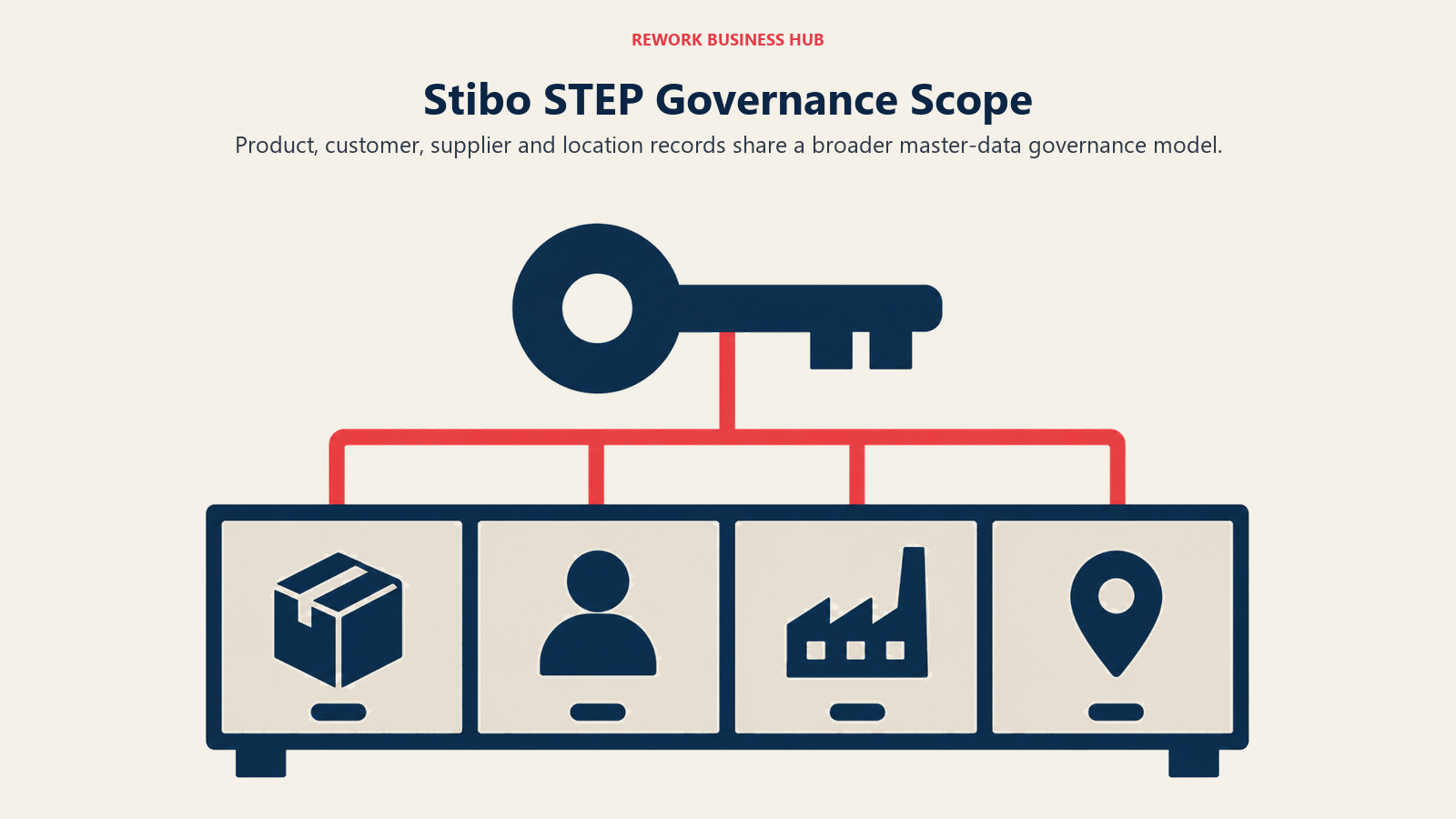
Stibo Systems positions its STEP platform as multidomain master data management, not a PIM with an MDM label attached. Product data is one domain the platform manages, alongside customer, supplier, location, and other master records, all governed under one data model rather than product attributes living in their own silo. For an enterprise that has already concluded its real problem is master data governance across several domains, not just product content, that framing is the whole reason to shortlist Stibo over a dedicated PIM.
There is no pricing page and no figures anywhere, contact-only, which is standard for enterprise MDM but still worth naming plainly. The scale and cost of a genuine multidomain MDM deployment (data stewardship processes, governance councils, integration work across every domain touched) is also usually much larger than a PIM-only project, closer in shape to the kind of enterprise commitment covered in the best NetSuite alternatives roundup than to a SaaS PIM signup.
| Pros | Cons |
|---|---|
| True multidomain MDM, product is one governed domain among several | No published price or starting range anywhere |
| Suits enterprises that have already ruled out a PIM-only fix | Overkill, and priced accordingly, for a team that only needs product data |
| Established enterprise MDM track record beyond retail and CPG | Implementation scope and timeline typically exceed a PIM-only project |
| Governance model spans data domains, not just products | Requires organizational buy-in across multiple domains, not one team |
Best for: Enterprises whose actual problem is multidomain master data governance, with product data as one piece of a larger puzzle. Not ideal for: A team that only needs product attributes and syndication, and would be buying far more platform than the problem requires.
13. Bluestone PIM: Pricing That Claims to Scale Down as Well as Up
Bluestone PIM's pitch on price is explicit: the FAQ states "Our price model is based on usage, so you never pay for more than you use," metered on users, SKUs, and languages, with typical contract lengths of 3 to 12 months. That is a genuinely different commercial model from the fixed annual tiers most of this list runs on, and in principle it should mean a smaller team pays less rather than absorbing an enterprise-sized floor.
The catch is that "usage-based" is not the same as "published." There is no rate card, no per-unit figure, and no worked example on the site, so the promise cannot actually be budgeted without a quote. A buyer evaluating Bluestone on price alone has to take the flexible-pricing pitch on faith until a sales conversation produces an actual number.
| Pros | Cons |
|---|---|
| Usage-based pricing model, in principle scales down for smaller teams | No published rate card or per-unit figure of any kind |
| Shorter typical contract lengths (3 to 12 months) than most enterprise PIMs | The "never pay for more than you use" promise cannot be verified without a quote |
| Metered on users, SKUs, and languages, a reasonably transparent formula | No worked pricing example published to sanity-check the model |
| Positioned for mid-market brands, not only enterprise | Still requires a full sales cycle to get to a number |
Best for: Mid-market brands attracted to a usage-based pricing philosophy and shorter contract terms, willing to get the actual rate via a quote. Not ideal for: A buyer who wants to verify a vendor's pricing claims against a published number before engaging sales.
14. Productsup: Every Pricing Variable Named, No Figure Attached
Productsup is built around getting product data out to a very large number of downstream endpoints at once, marketplaces, comparison shopping engines, social and retail media ad platforms, and syndication partners, at a scale that can run into the hundreds of feeds for a large retailer or brand. Rather than hiding what drives its price, the page explicitly lists every variable a quote depends on: number of products, number of feeds, number of platform modules, sync frequency, number of seats, number of countries, and any special requests.
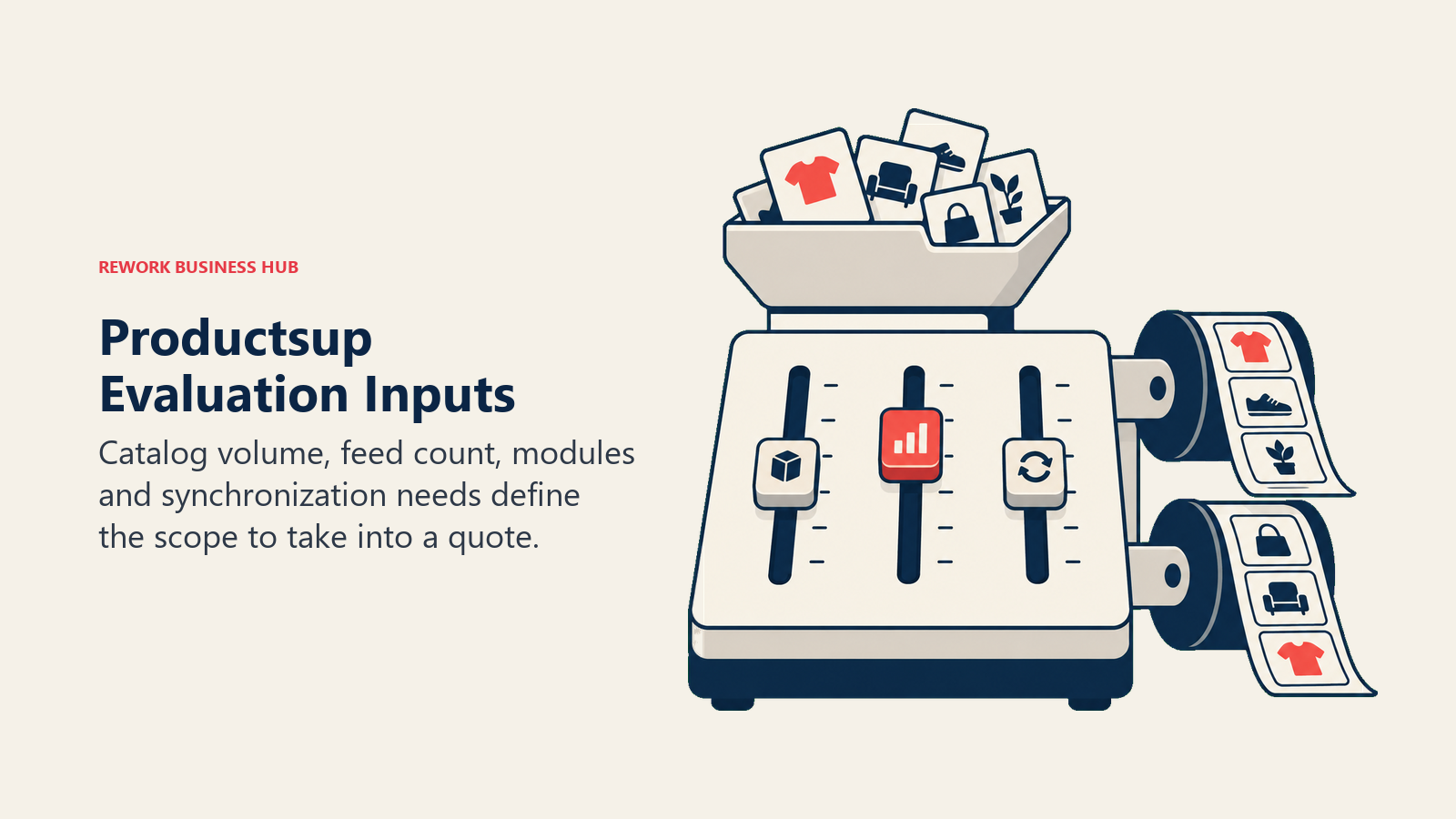
That transparency about the formula, without a figure attached to it, sits in an unusual middle ground: a buyer cannot get a number without disclosing their own catalog and feed count first, but at least knows exactly what information sales will ask for and why the quote will move up or down.
| Pros | Cons |
|---|---|
| Explicitly lists every pricing variable instead of hiding the formula | No published figure or starting range regardless |
| Built for very high feed and endpoint counts most PIMs do not handle well | Cannot estimate cost without disclosing your own catalog and feed count first |
| Strong fit for ad-channel and comparison-engine syndication specifically | Likely priced toward larger catalogs and feed counts than a small team needs |
| Sync frequency as a named pricing lever suits real-time-sensitive catalogs | Requires a sales conversation even for a rough range |
Best for: Large catalogs feeding many syndication endpoints, marketplaces, ad channels, and comparison engines, at once. Not ideal for: A smaller team with a handful of channels who does not need hundreds of feed endpoints.
15. Jasper PIM: A Flat Monthly Price Tied to Channel Count
Jasper PIM closes this list as the simplest published pricing model among the five vendors that publish one at all. Growth is $999/mo, covering 2 sales channels and 5 hours of onboarding. Professional is $1,999/mo, covering 8 sales channels, 10 hours of onboarding, API access, a staging environment, and workflow tooling. Enterprise is custom, for unlimited channels and 20 hours of onboarding. All figures are stated in USD, per month, directly on the page, with no published SKU or seat caps at either named tier.

That channel-count model is easy to reason about for a smaller team selling on a known, fixed number of channels: two channels fits Growth, eight fits Professional, and only a genuinely large multi-channel operation needs to have the Enterprise conversation at all.
| Pros | Cons |
|---|---|
| Simple, published, flat monthly USD pricing on two named tiers | No SKU or seat caps published, so growth in catalog size is untracked pricing-wise |
| Channel count as the pricing lever is easy to plan against | Enterprise (unlimited channels) still reverts to a custom quote |
| Onboarding hours bundled into the price, not billed separately | Smallest named tier (Growth) covers only 2 channels |
| API access and staging included starting at Professional | Less established brand recognition than the enterprise incumbents on this list |
Best for: Smaller teams selling across a known, fixed number of channels who want a flat monthly price with no sales call for the first two tiers. Not ideal for: Large catalogs or channel counts that would need the custom Enterprise tier anyway.
Also Worth Knowing
One more tool comes up often on PIM shortlists without quite belonging in the numbered list above.
| Tool | What it actually is | Published price |
|---|---|---|
| Catsy | A Shopify-oriented PIM lineup (Essential, Multi-Store, Enterprise packages, with Industrial, Distributor, and BigCommerce variants in other tabs) | No prices, no seat counts, no SKU caps published anywhere |
Catsy is worth a look if your catalog and storefront are already deeply Shopify-native and you want a PIM built around that ecosystem specifically, but with no published pricing or limits of any kind, it needs the same sales-conversation-first evaluation as most of the quote-only vendors above.
Stage Fit: What to Buy at Each Point of Growth
The right PIM changes as the catalog and the channel count change. This is the shape most teams actually move through.
| Stage | Typical scale | What breaks first | Best fits |
|---|---|---|---|
| Pre-PIM, spreadsheet stage | Under 2,000 SKUs, 1 to 2 channels | Nobody trusts the "master" spreadsheet anymore | Plytix, Rework |
| Growing catalog, a few channels | 2,000 to 20,000 SKUs, 2 to 4 channels | Attribute completeness varies by who last touched the channel | Plytix, Struct PIM, Akeneo Growth |
| Multi-channel plus retailer syndication | 20,000 to 100,000 SKUs, 5+ retail partners | Retailer-specific content requirements multiply faster than a spreadsheet can track | Salsify, Syndigo, Sales Layer, Pimberly |
| Enterprise, multi-brand or multi-region | 100,000+ SKUs, multiple brands or locales | Governance, translation, and approval workflow at scale | Akeneo Advanced/Premium, inriver, Centric PXM |
| Global CPG or manufacturer on GDSN | Any size, standards-driven | Compliance with retailer data pools and GDSN requirements | Syndigo, Stibo Systems |
| Mid-size ops wanting one platform | Roughly 10 to 200 people, product data is one of several ops needs | Syncing PIM data into the CRM, commerce, and invoicing tools | Rework |
Sizing and Persona Fit
Who signs the contract usually tells you which tool wins, because each of these is built around a different job title's daily pain.
| Team size | Primary buyer | Daily pain | Strongest matches |
|---|---|---|---|
| 1 to 10 | Founder or ecommerce generalist | Product data lives in a spreadsheet everyone edits differently | Plytix, Rework |
| 10 to 50 | Ecommerce or merchandising manager | Channels show a different description for the same SKU | Struct PIM, Plytix, Akeneo Growth, Rework |
| 50 to 200 | Head of merchandising or product data manager | Retailer-specific content requirements and approval bottlenecks | Salsify, Sales Layer, Pimberly, Jasper PIM |
| 200 to 1,000 | Director of digital or VP ecommerce | Governance across brands, regions, and locales | Akeneo Advanced/Premium, inriver, Centric PXM |
| 1,000+, multi-brand or CPG | CDO or VP of data / MDM | Multidomain master data and GDSN compliance | Stibo Systems, Syndigo, Productsup |
How to Choose: Decision Framework
Start from the constraint that will still be true in two years, not the feature that annoys you this week.
| If you need... | Pick... | Why |
|---|---|---|
| The category-defining PIM with a real open source edition | Akeneo | Community Edition is free and actively maintained; Growth, Advanced, and Premium scale the SaaS side |
| A modern PIM with a genuinely usable free tier | Plytix | Standard is $0/mo for up to 500 SKUs with unlimited seats |
| Product content plus retailer syndication at real scale | Salsify or Syndigo | Both are built around getting complete content out to a wide retailer and marketplace network |
| A published price with no product cap on any tier | Struct PIM | Every tier is unlimited on SKUs, catalogs, and attributes; only languages and users are metered |
| An open, extensible platform a dev team can shape | Pimcore | Community Edition is free and open source, with flat-priced tiers for support and scale |
| The product record on the same platform as the CRM and the order | Rework | Product sits beside Sales CRM, Commerce, Inventory, and Invoice, one record, no sync |
| Published plan limits before you even talk to sales | Sales Layer | Publishes user and SKU caps per tier without a dollar figure |
| A fixed, named-tier annual budget at enterprise scale | Pimberly | Three tiers with published annual prices in three currencies and clear SKU/user/storage caps |
| A flat monthly price tied to channel count | Jasper PIM | Growth and Professional both publish a monthly USD figure scaled by channel count |
| Multidomain MDM that happens to include product data | Stibo Systems (STEP) | Positioned as an MDM platform first, PIM second |
| One system feeding hundreds of downstream syndication endpoints | Productsup | Publishes every pricing variable (products, feeds, modules, seats) even without a figure |
| Pricing that scales down as well as up | Bluestone PIM | Usage-based on users, SKUs, and languages, per the vendor's own FAQ |
| A renamed incumbent you already evaluated as Contentserv | Centric PXM | Same suite, new owner and name since the February 2025 acquisition |
What to Do Next
Pick two tools of different shapes rather than two versions of the same thing: one that fits the catalog and channel count you have today, one built for the syndication or governance load you expect in two years. Then run the same test on both. Import a real slice of your actual catalog, not a demo dataset, including the messiest SKUs with missing attributes and inconsistent naming. Push one product record end to end: create it, enrich it with real attributes and images, route it through an approval step, and publish it to at least two channels. Then add up the true annual cost: the base tier, any add-on modules you would actually need, onboarding, and what happens to the price when the catalog doubles.
If the shortlist still feels wide, name your constraint out loud. A spreadsheet you can no longer trust points to Plytix or Rework. Retailer syndication at scale points to Salsify or Syndigo. A published price with no product cap points to Struct PIM. An open platform your engineers can shape points to Pimcore. And if the honest answer is that product data, the deal it is attached to, and the order it becomes all live in three disconnected systems, that is a consolidation problem rather than a PIM feature gap, and worth settling before you sign anything.

Principal Product Marketing Strategist
On this page
- Key Facts
- What PIM Software Actually Is (and What It Isn't)
- Why Only Five of These Fifteen Publish a Price
- Quick Comparison Table
- 1. Akeneo: The Category-Defining PIM, Still With a Real Open Source Edition
- 2. Salsify: Content and Syndication, With No Pricing Page At All
- 3. Plytix: The Modern PIM With a Genuinely Free Tier
- 4. Pimcore: The Open Platform for Teams Who Want to Build, Not Just Configure
- 5. inriver: Fully Customizable, and Fully Quote-Only
- 6. Rework: Product Operations on the Same Platform as the CRM and the Order
- 7. Sales Layer: Quote-Only, But at Least the Limits Are Published
- 8. Pimberly: Named Enterprise Tiers With Real Annual Figures
- 9. Syndigo: Retailer Syndication Reach, No Price at All
- 10. Struct PIM: Unlimited SKUs on Every Tier, a Genuine Structural Difference
- 11. Centric PXM (Formerly Contentserv): A Renamed Suite, Not a Discontinued One
- 12. Stibo Systems (STEP): Multidomain MDM First, PIM Second
- 13. Bluestone PIM: Pricing That Claims to Scale Down as Well as Up
- 14. Productsup: Every Pricing Variable Named, No Figure Attached
- 15. Jasper PIM: A Flat Monthly Price Tied to Channel Count
- Also Worth Knowing
- Stage Fit: What to Buy at Each Point of Growth
- Sizing and Persona Fit
- How to Choose: Decision Framework
- What to Do Next