Akeneo vs Salsify: Which One Actually Tells You What It Costs?
Turn this article into takeaways for your work.


Each assistant summarizes the article only for you and suggests best practices for your work.
Type "akeneo pricing" into a search bar and you land on a real page with three tiers, a feature grid, and a "Start Free Trial" button. Type "salsify pricing" and the URL you'd expect, salsify.com/pricing, redirects straight to the Salsify homepage. There's no pricing page to land on, not a hidden one, not a stale one. It doesn't exist. That single difference tells you more about how each vendor wants to sell you a PIM than any feature comparison will, and it's worth sitting with before you get to SKUs and syndication.
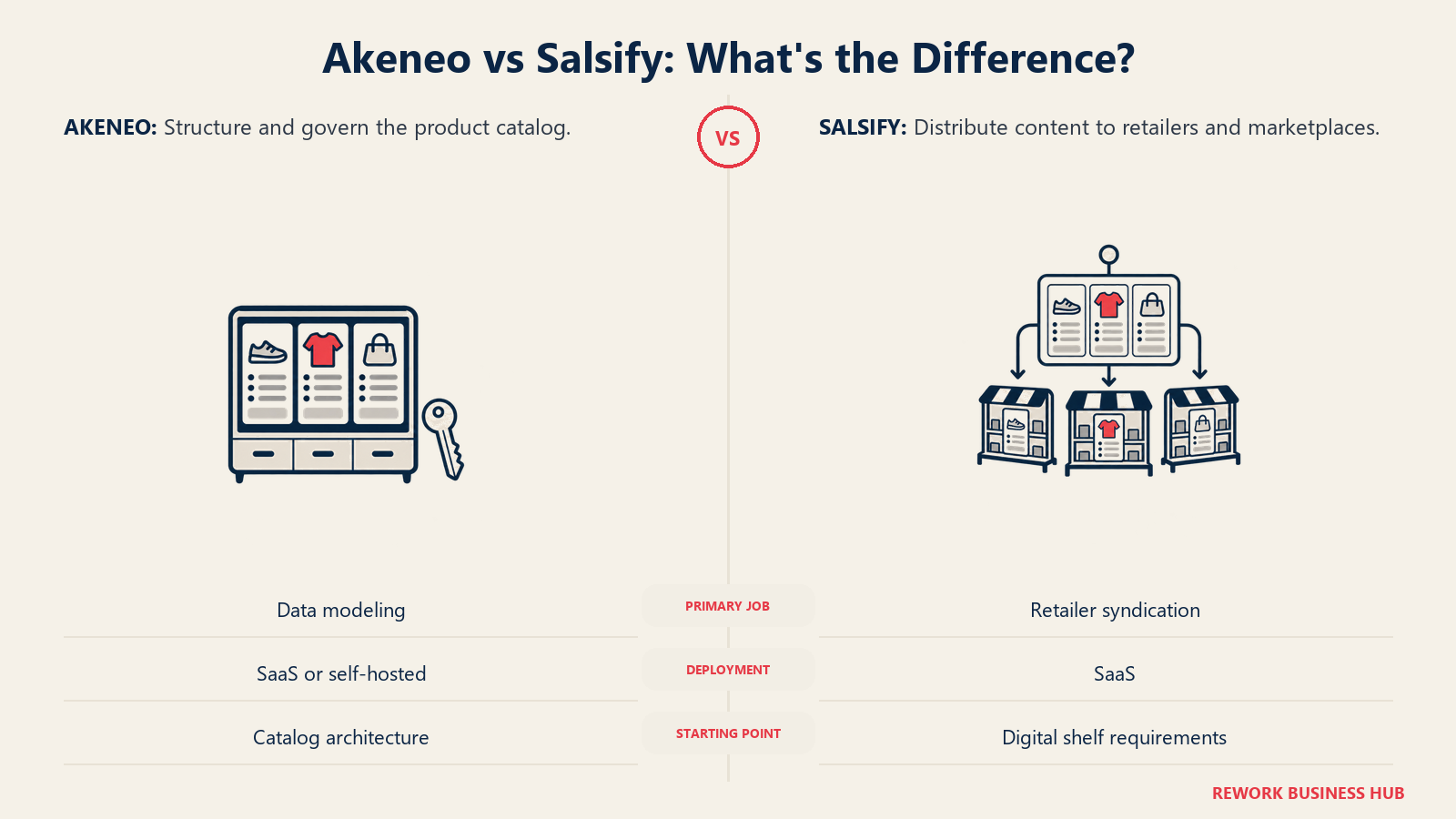
The two platforms also don't share a center of gravity. Akeneo grew up as an open-source PIM and still ships a free, self-hostable Community Edition alongside its SaaS packages, which pulls in teams that want to own their deployment and model their own product data. Salsify built its business around getting content out the door to retailers and marketplaces, so its whole product experience management framing points at the syndication and retailer relationship rather than at the data model underneath. Neither approach is wrong. They just answer different questions, and this guide works through both with the exact wording each vendor uses on its own site.
Key Facts
- Akeneo's own packages page lists Growth at "Starting at $0 Annually" with a free trial, while Advanced and Premium both read "Call for a quote." No price of any kind is published for the two higher tiers. (Akeneo)
- Salsify's pricing URL, salsify.com/pricing, redirects to the Salsify homepage. There is no pricing page, no tier list, and no dollar figure anywhere on the site.
- Akeneo PIM Community Edition remains a free, open-source, self-hosted download, with version 2026.4 released 28 August 2026, the most recent release on the project's public GitHub repository. (GitHub)
- Akeneo PIM 7.0 reaches end of support on 30 September 2026, and only the current release gets bug and security fixes going forward. (endoflife.date)
- 83% of online shoppers say they're likely to abandon a site or product page that doesn't give them the information they want, per PIM vendor Syndigo's State of Product Experience 2026 survey of 8,736 adults across six countries. (Syndigo)
TL;DR: Akeneo vs Salsify at a Glance
| Akeneo | Salsify | |
|---|---|---|
| Best for | Teams that want to own their PIM data model, including a free self-hosted option | Brands and manufacturers whose main job is getting accurate content onto retailer and marketplace pages |
| Origin | Open-source PIM, still ships a free Community Edition | SaaS product experience management (PXM), built around syndication |
| Price transparency | Growth tier shows "Starting at $0 Annually" behind a trial; Advanced and Premium are quote-only | No pricing page exists at all; salsify.com/pricing redirects to the homepage |
| Self-hosting option | Yes, free and open source (Community Edition) | No, SaaS only |
| Free tier or trial | Growth tier free trial | None published |
| Where the product is strongest | Data modeling, attribute governance, channel-ready structure | Retailer and marketplace syndication, digital shelf content |
| Current live migration deadline | Akeneo PIM 7.0 end of support 30 September 2026 | Not applicable |
| Deployment | SaaS (Growth/Advanced/Premium) or self-hosted (Community Edition) | SaaS only |
| Typical buyer conversation | Can start solo with a trial, then a sales call for the higher tiers | Sales call from the first click, no self-serve number to anchor to |
Getting product content right is not a cosmetic problem for either vendor's buyer. Cart abandonment across ecommerce averages 70.22%, aggregated by the Baymard Institute across 50 separate studies (Baymard Institute). Worth being precise about what that number does and does not cover: Baymard's own list of stated abandonment reasons is led by extra costs at 40%, and product content is not on it, so a PIM is a merchandising and returns lever rather than a checkout fix. Whichever platform you pick is being asked to reduce that number, not just organize a spreadsheet more neatly, and it's worth keeping that stake in view through the rest of this comparison.
Who Each Platform Is Built For
Akeneo and Salsify both get filed under "PIM" in most roundups, but the buyer who picks up the phone for each one is usually solving a different problem. An Akeneo evaluation is often led by someone who cares about the data model itself: how attributes are structured, how many locales and channels the catalog has to support, and whether the team can shape that structure without waiting on the vendor. That's the same instinct that keeps Community Edition alive as a real, current option rather than a marketing footnote, because it lets a team with in-house engineering own the whole stack from day one.
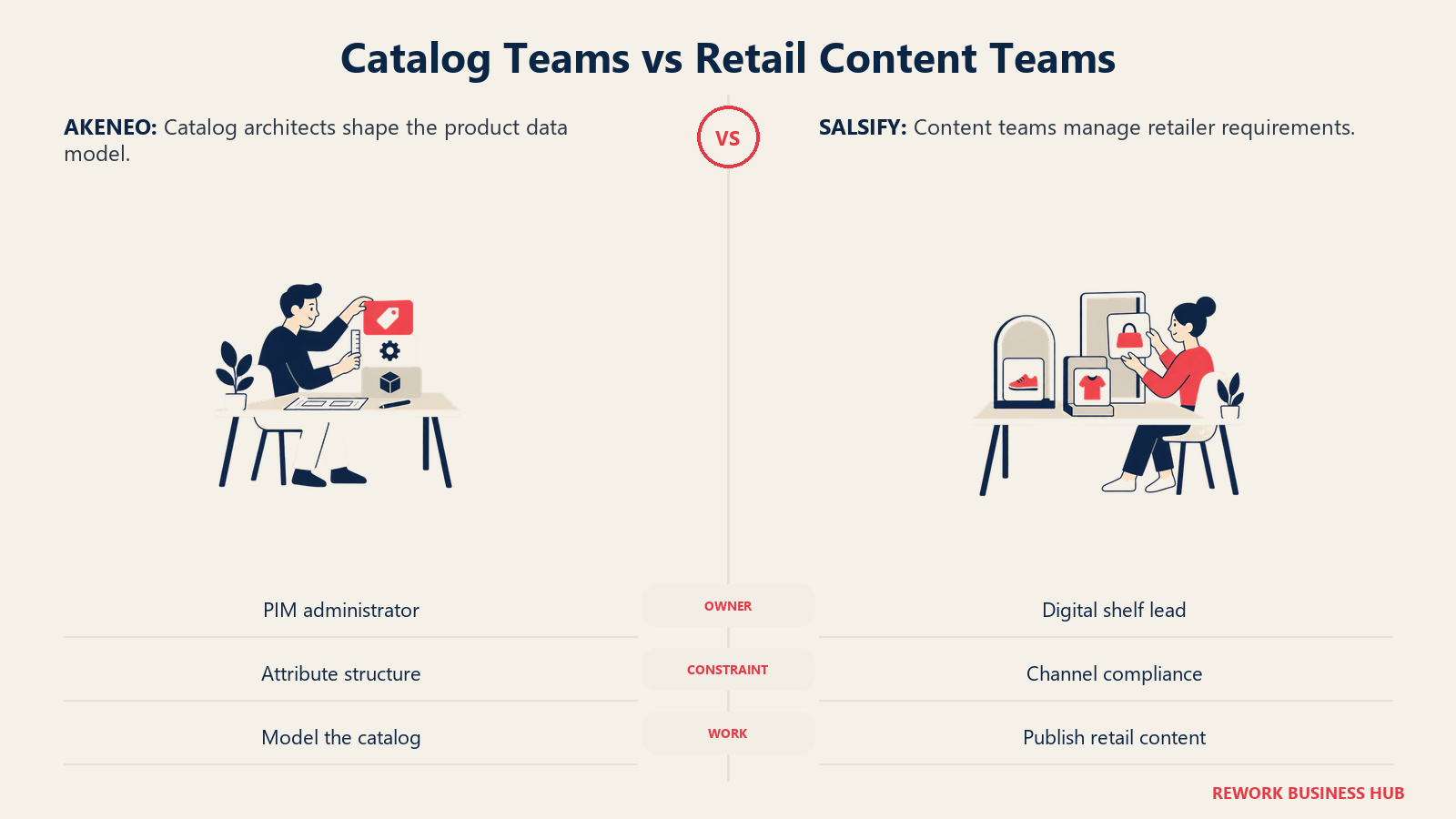
A Salsify evaluation usually starts from the other end: a brand or manufacturer that already has a reasonably organized catalog and needs it to show up correctly, and consistently, on Amazon, Walmart, Target.com, and a growing list of digital shelves. Salsify's own platform messaging centers on syndicating "product content to every consumer touch point" and treating the product record as a governance and distribution problem more than a modeling one. (Salsify) If your headache is retailer scorecards and content compliance rather than attribute architecture, that's the Salsify conversation, not the Akeneo one.
Company size follows the same split more than people expect. A mid-market brand with three or four retail partners and a lean ops team can genuinely run Akeneo's Growth tier or even Community Edition if someone can maintain it. A brand selling into dozens of large retail accounts, where every account has its own content requirements and compliance checks, tends to gravitate toward Salsify's syndication-first model regardless of headcount, because the retailer relationship is the constraint, not the org chart. If your problem is neither of these, a shortlist that includes more of the category is worth a look in our best PIM software in 2026 roundup before you commit to either name.
| Akeneo | Salsify | |
|---|---|---|
| Primary buyer | PIM admin, data architect, or a technical ecommerce lead | Ecommerce content manager, digital shelf lead, or retail ops team |
| What they're trying to fix | A catalog that's inconsistently structured, hard to expand, or locked into one vendor's terms | Product pages that fail retailer scorecards or lag competitors on the digital shelf |
| Team shape needed | Someone comfortable owning data structure, more so if self-hosting | A content operations team fluent in each retailer's requirements |
| Engineering involvement | Optional on SaaS tiers, required for Community Edition | Not required; the platform is fully hosted |
| Typical trigger for evaluation | Outgrowing spreadsheets or a legacy PIM, or an approaching version end-of-life | A failed retailer content audit, a new major retail account, or a digital shelf competitive gap |
| Where the budget conversation starts | A visible tier structure, even without full numbers | A blank pricing page and a discovery call |
Neither company hides who it's built for once you read past the homepage copy. Akeneo's own materials talk about "Data Architect Agent AI" and composable products, language aimed at someone who thinks in schemas. Salsify's talk about touch points and syndication, language aimed at someone who thinks in retailer relationships. If your day-to-day vocabulary matches one column more than the other, that's usually a faster signal than any feature checklist.
Pricing Transparency, Stated Plainly
This is the section most comparison content glosses over, and it shouldn't be, because the two vendors don't just charge differently. They disclose differently, and that changes how long your evaluation takes before either one.
Akeneo at least gives you something to read without a sales call. Its packages page names three tiers, Growth, Advanced, and Premium, and Growth shows "Starting at $0 Annually" tied to a free trial button. That's not a usable number for budgeting; a $0 headline behind a trial tells you nothing about what Growth costs once the trial ends. But Advanced and Premium are more honest about it: both say "Call for a quote," full stop, no anchor figure at all. What you do get, even without a price, is a feature grid: Advanced adds collaboration workflows, advanced rights management, and channel-ready data governance; Premium adds PX Insights, enterprise governance with SIEM integration, and a success package with 24/7 support. That grid at least tells you what you're paying more for, even if it won't tell you how much more.
Salsify skips the grid entirely. There's no packages page, no tier names, no feature-by-tier breakdown, and no figure at any point in the funnel that we could find on the vendor's own site. Every conversation starts with a demo request. For a buyer, this has three concrete effects worth planning around before you start the evaluation:
- You cannot pre-qualify yourself. With Akeneo, a small brand can at least see the Growth trial and self-serve into the platform before deciding it needs more. With Salsify, you don't know if you're too small, the wrong shape, or a perfect fit until a salesperson tells you, sometimes several calls in.
- There's no anchor for a three-year cost model. A published starting price, even a vague one, gives finance something to extrapolate from. A blank page gives them nothing, so the first real number in your model arrives after discovery calls, not before them.
- The sales cycle inherits the ambiguity. A fully quote-gated model structurally pushes the first real number to the far end of the process: there is nothing to react to, negotiate against, or walk away from until discovery is finished. Akeneo's free trial lets a smaller team find its own answer without booking anything. That is not a knock on Salsify's product, it is the honest cost of the disclosure model it has chosen.
Third-party sites circulate a figure of roughly $45,000 per year for Akeneo Growth (reported by implementation and consulting sites, not Akeneo itself). Treat that as someone else's market estimate, not a vendor-confirmed price, and don't build a budget on it without getting your own quote. The one number you can trust on Akeneo's own page is "$0 Annually" for the trial, and the one honest thing to say about Salsify's price is that there isn't one to read.
| Akeneo | Salsify | |
|---|---|---|
| Public pricing page | Yes, akeneo.com/compare-packages | No, salsify.com/pricing redirects to the homepage |
| Tier names published | Yes: Growth, Advanced, Premium | No tier names published anywhere |
| Any dollar figure published | Only "$0 Annually" for Growth's trial | None |
| Feature grid without price | Yes, by tier | Not published in tier form |
| Self-serve sign-up | Yes, Growth free trial | Not found |
| First number you'll see | Whatever the trial converts to, still unpriced past that | Whatever a salesperson quotes after discovery |
| What you can budget from today | A tier name and a feature list | Nothing published |
One more thing belongs in a 2026 evaluation of Salsify specifically, because it is the kind of detail that surfaces late otherwise: in July 2026 private equity firm Cinven agreed to acquire Salsify, on undisclosed terms and subject to regulatory approval. It does not change what the product does today, but signing a multi-year contract with a vendor mid-ownership-change is worth raising with your own procurement team rather than discovering afterwards.
That table is really the whole pricing story in one place. Akeneo's opacity is partial: two of three tiers are quote-only, but the structure and the entry point are public. Salsify's opacity is total: nothing about cost, structure, or tiering exists outside a sales conversation. If your procurement process needs a number to open a file with, only one of these vendors gives you one, even a small one, before you pick up the phone.
The Self-Hosting Question Only Akeneo Raises
Salsify doesn't offer a self-hosted option, so this entire section is an Akeneo-only conversation, and it's worth having in full because a lot of secondhand comparison content gets it wrong.
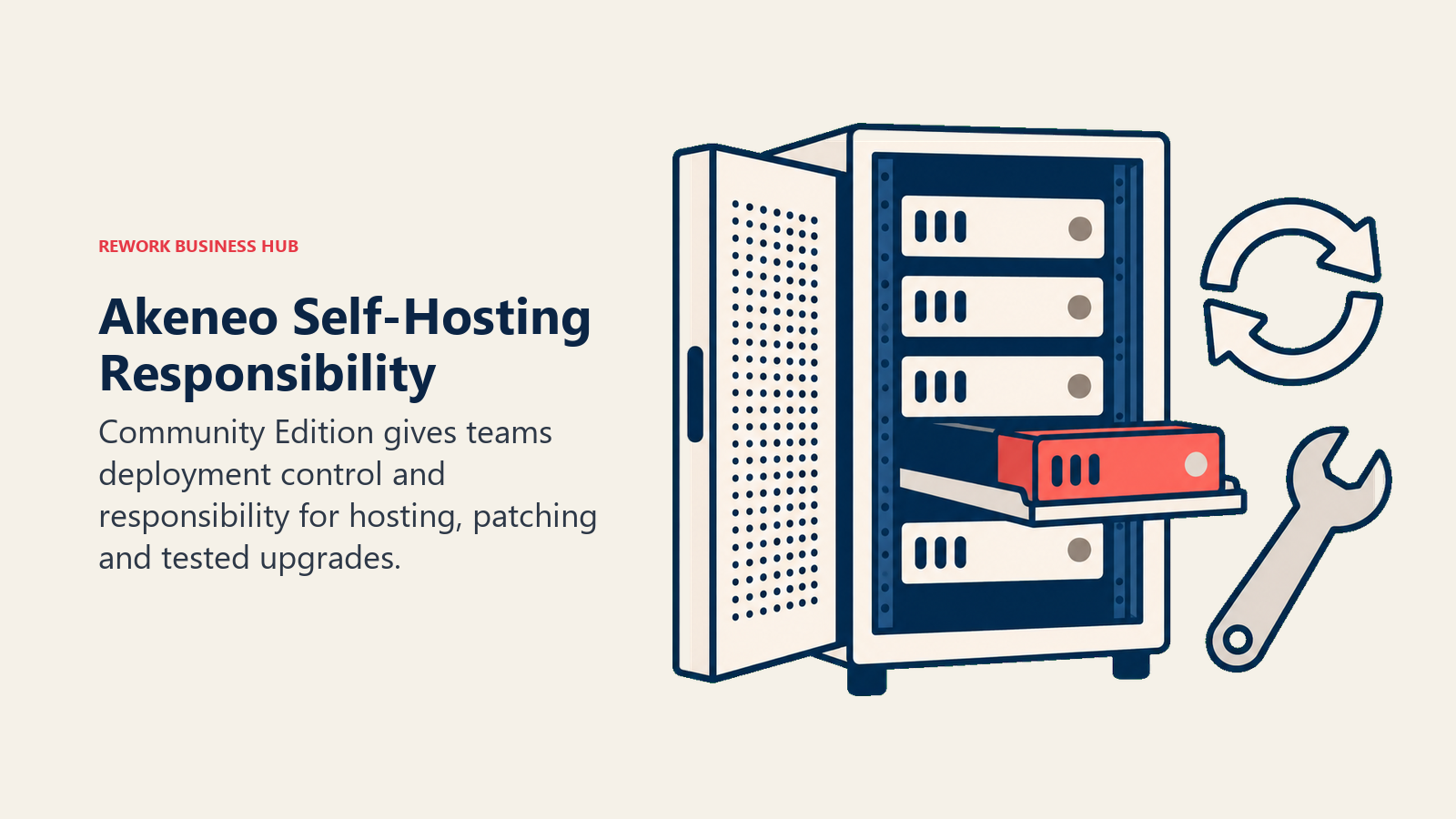
Akeneo PIM Community Edition is still a free, open-source, self-hosted product, full stop. Akeneo's own page for it states plainly that the company has "offered an open-source free PIM" since its first day, and that you can "download, install, host, and customize" it yourself. (Akeneo) It is not being discontinued, and if you've read otherwise on an integrator's blog, that claim is out of date. The project's public GitHub repository shipped version 2026.4 on 28 August 2026, which is the current release, so Community Edition is an actively maintained option today, not a legacy leftover.
What is true, and is a real, dated decision point rather than a scare headline, is this: Akeneo PIM 7.0 reaches end of support on 30 September 2026, three weeks from the date on this article. Once that date passes, version 7.0 stops receiving bug and security fixes, and Akeneo's support policy for Community Edition is explicit that only the current release is supported. (endoflife.date) If your team is still running 7.0, that's a live migration you need to schedule now, not a someday item, and it's a genuinely honest reason a reader might be shopping alternatives at this exact moment.
There's a second cost to self-hosting worth planning for even after you're current. Since version 2026.1, Akeneo has moved to calendar versioning and warns that "breaking changes may be introduced in any release," including a minor-looking jump like 2026.1 to 2026.2. (endoflife.date) Combined with the "only the latest release is supported" policy, that means a self-hosting team can't just leave a version running indefinitely and expect security patches, and can't blindly auto-upgrade either without reading release notes first. Pin exact versions, test upgrades in staging, and budget the engineering time to do both on an ongoing basis. That's the honest cost of the free option, not a knock against it.
The upshot for a buyer: Community Edition is a legitimate choice if you have engineering capacity to own hosting, patching, and version discipline, and it costs nothing in license fees to get there. If you don't have that capacity, the free option isn't actually free, it's a deferred hire, and Akeneo's own SaaS Growth tier or Salsify's fully-hosted model removes that burden entirely.
It's also worth being clear about what Community Edition doesn't include. Akeneo's own Community Edition page steers fast-growing companies toward the SaaS-based Growth package for "advanced PIM features," which is a signal that some of the newer AI-assisted capabilities named on the packages page, like Data Architect Agent AI, live on the SaaS side rather than in the open-source download. Free and open source gets you the core data model and the ability to shape it however you want. It doesn't get you every feature Akeneo ships this year, and that gap is worth checking against your own requirements before you commit engineering time to the self-hosted path.
Data Modeling and Catalog Depth
| Akeneo | Salsify | |
|---|---|---|
| Core positioning | Product Cloud / PIM, attribute-and-family data model | Product Experience Management (PXM) platform |
| Where the product record lives | Structured PIM data model you configure directly | Central "system of record" with channel/region-specific versions layered on top |
| Attribute governance | Advanced Rights Management and Channel-Ready Data Governance are named Advanced-tier features | Governance framed around content compliance for specific retail channels |
| AI-assisted data work | Data Architect Agent AI and AI-powered description generation and asset extraction on Growth | AI assistant ("Angie") for workflow automation within the Intelligence Suite |
| Multi-region / multi-language | Handled through the PIM's channel and locale model | Salsify describes itself as built for global, multi-region, multi-language deployment |
| Self-hosting the data model | Yes, via Community Edition, so you control schema changes directly | No, the data model lives in Salsify's SaaS environment |
| Who typically owns the model | An in-house PIM admin or data architect | A content or ecommerce ops team working inside Salsify's structure |
The practical difference: Akeneo hands you the modeling primitives (attributes, families, channels, locales) and expects you or a partner to build the structure that fits your catalog, which is exactly why an open-source edition makes sense for this vendor and doesn't for Salsify. Salsify's model is more opinionated by design, built around getting one product record to render correctly across many retailer-specific templates, so less of the modeling burden falls on you but you also have less latitude to reshape the underlying structure yourself.
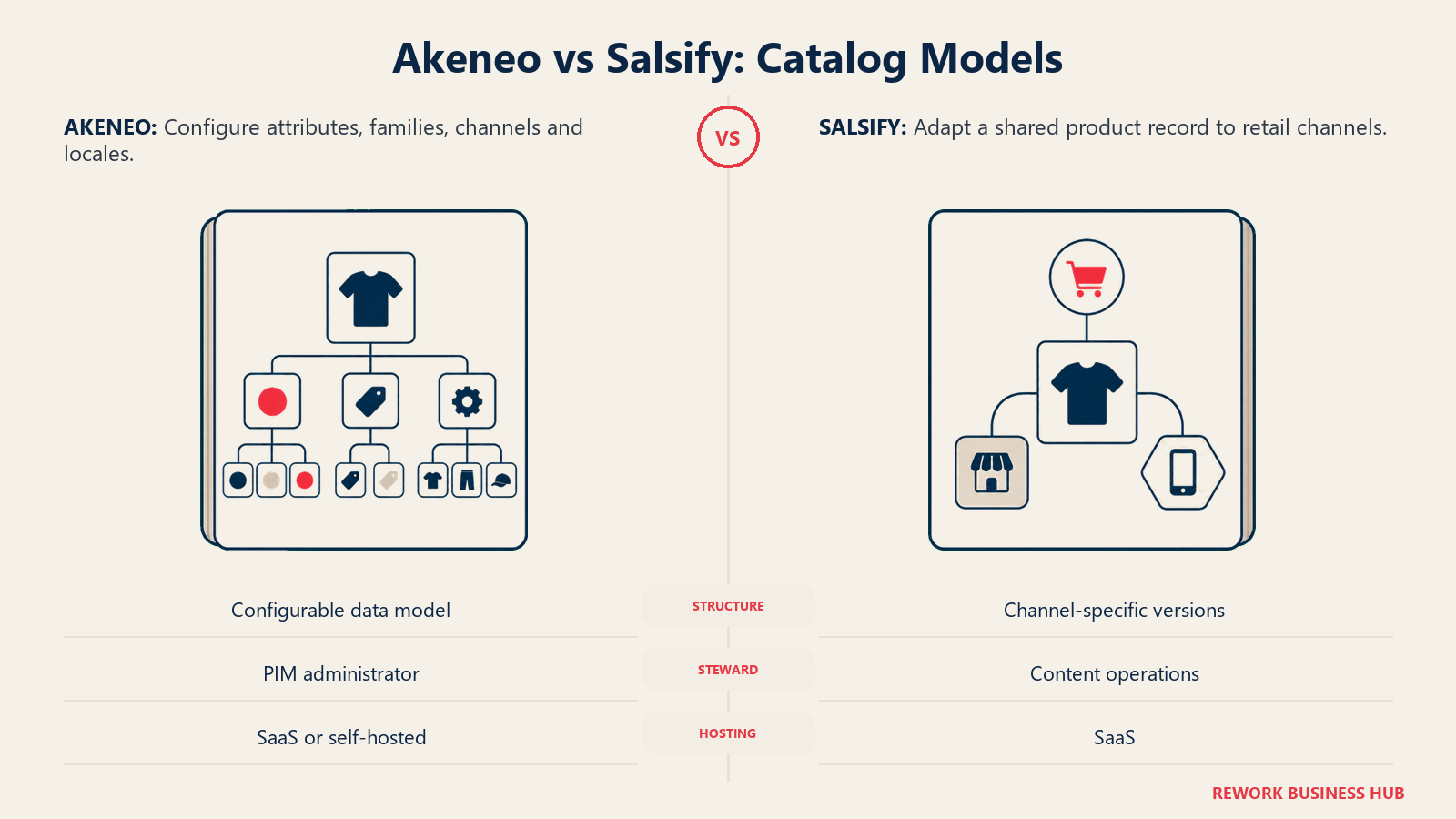
That trade-off shows up most clearly the moment a retailer or marketplace changes its content requirements. On Akeneo, that's a modeling change you make yourself, in your own attribute sets and channels, on your own timeline. On Salsify, it's closer to a template update within a system built to absorb exactly that kind of change quickly, because retailer requirement churn is the problem the platform exists to manage. Neither is objectively faster. It depends whether you'd rather own the change yourself or hand it to a platform built around anticipating it.
Syndication and Channel Reach
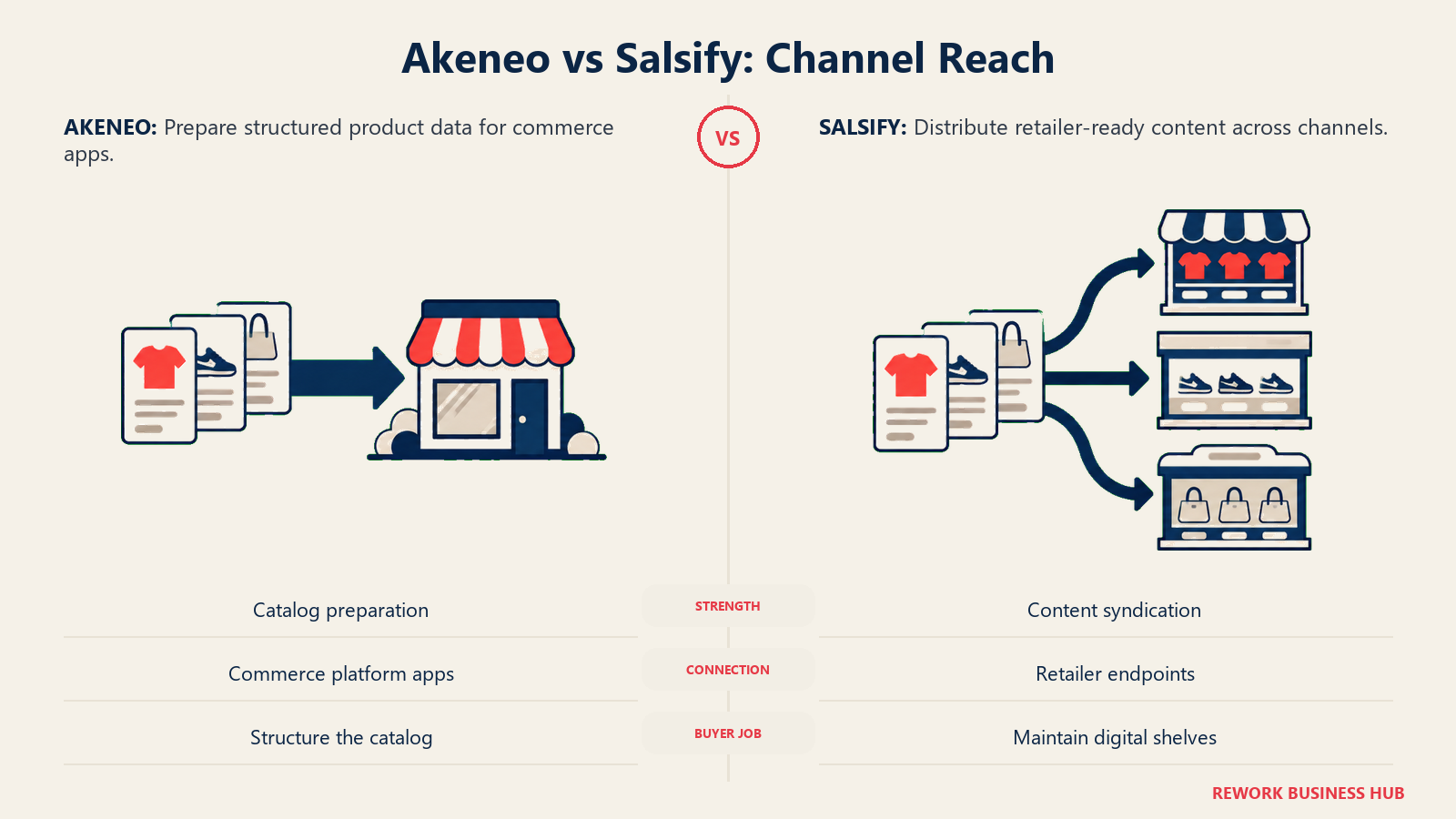
| Akeneo | Salsify | |
|---|---|---|
| Core strength | Structuring and governing the data before it goes anywhere | Getting the finished content out to retailer and marketplace touch points |
| Syndication framing | Add-on apps for Salesforce Commerce Cloud, Adobe Commerce, and Shopify | Syndication named as a core platform pillar: "syndicate product content to every consumer touch point" |
| Retailer network specifics | Not the platform's primary sell; integrations are commerce-platform-focused | Salsify markets itself around scale across "140 countries," though it does not publish a specific retailer count on its platform page |
| Digital shelf monitoring | Not a named Akeneo capability | Central to Salsify's PXM narrative |
| Best fit if syndication is the whole job | Only with add-on apps or custom integration work | Yes, this is the product's reason for existing |
If the honest description of your project is "get our content structured," lean Akeneo. If it's "get our content onto forty retailer pages correctly and keep it that way," lean Salsify. A lot of teams need both, which is exactly why some organizations run a structuring tool feeding a syndication layer rather than expecting either one to do the whole job alone.
DAM and Asset Handling
| Akeneo | Salsify | |
|---|---|---|
| Native DAM | Not core; Digital Asset Management is a named add-on on Akeneo's packages page | Enhanced content and asset capabilities built into the platform for retailer-ready pages |
| Asset-to-product linking | Through the PIM's structure, tying assets to attributes and channels | Through the PXM record, tied to how the product renders on each channel |
| AI on assets | AI-powered asset extraction named as a Growth-tier capability | Angie assistant covers workflow automation broadly, including content tasks |
| Dedicated asset-heavy alternative | If DAM is the primary need rather than a PIM add-on, see our best digital asset management software in 2026 roundup | Same recommendation applies |
Neither platform positions itself as a dedicated DAM first. If your evaluation keeps drifting toward "we mostly need somewhere to manage rich media assets," that's a signal to widen the search rather than force-fit either PIM.
Workflow and Governance
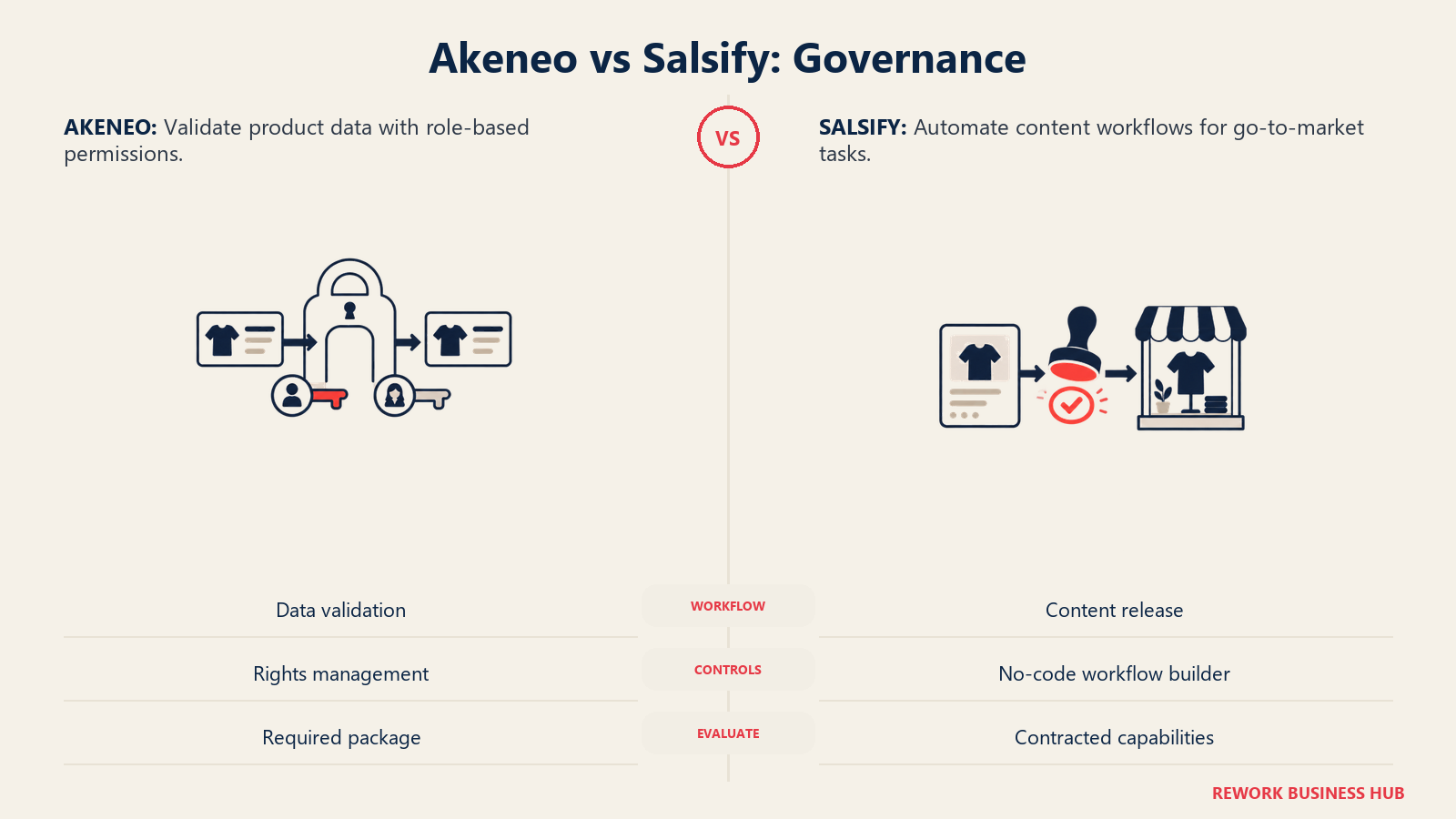
| Akeneo | Salsify | |
|---|---|---|
| Approval workflows | Collaboration Workflows named as an Advanced-tier feature: "streamline product data validation and approvals" | No-code workflow builder for automating go-to-market tasks |
| Permissions | Advanced Rights Management with fine-tuned permissions (Advanced tier) | Governance framed around retailer content compliance rather than internal role permissions |
| Enterprise governance | Enterprise Governance with SIEM integration (Premium tier) | Not named as a distinct governance tier on the platform page |
| Dedicated support tier | Premium includes a Strategic CSM and 24/7 support | Not published |
Both vendors gate their more serious governance and workflow tooling behind higher, quote-only tiers, so "workflow and governance" is one area where the pricing opacity actually matters in practice: you can't tell from either public page exactly what a mid-size governance need will cost you until you're in a sales conversation.
Reporting and Performance Insight
| Akeneo | Salsify | |
|---|---|---|
| Named analytics product | PX Insights (1 Data Source), Premium tier only | Intelligence Suite, described as scaling AI-powered tasks across the platform |
| What it measures | Product experience performance against a connected data source | Workflow and content performance, with AI assistance layered on top |
| Gated behind | The highest paid tier | Not clearly tiered on the public platform page |
| Who uses it | A PIM or data team tracking data quality and completeness | A content or ecommerce ops team tracking retailer and channel performance |
Reporting is another place where the two vendors' framing diverges along the same line as everything else. Akeneo names its analytics product PX Insights and puts it behind Premium, treating performance measurement as an advanced add-on to a data platform. Salsify folds analytics into its broader Intelligence Suite and AI assistant, treating measurement as part of the day-to-day workflow rather than a separate module you unlock later. Neither approach is inherently better, but it does mean an Akeneo buyer on Growth or Advanced won't get performance insight without an upgrade, while a Salsify buyer gets some version of it earlier in the relationship, sales conversation notwithstanding.
Integrations
| Akeneo | Salsify | |
|---|---|---|
| Named commerce integrations | Apps for Salesforce Commerce Cloud, Adobe Commerce, and Shopify | Retailer and marketplace connections are the platform's primary integration surface |
| Approach to integration | Point apps you add to a specific commerce platform | Broad syndication network as the default output layer |
| Best fit | Teams whose main integration need is one or two commerce platforms | Teams whose main integration need is many retailer and marketplace endpoints |
Neither vendor publishes a full connector directory on its pricing or platform page, which is worth flagging before you assume either one plugs into your stack out of the box. Akeneo's named apps point at the commerce platform layer specifically, which fits a team whose main integration headache is getting structured data into one storefront. Salsify's integration story is really its syndication network wearing a different hat: the "connections" that matter most are retailer and marketplace endpoints, not general-purpose middleware. If your integration need is broader than either of these, an ERP or middleware layer usually sits between the PIM and everything else regardless of which vendor you pick, and that's a separate build either way.
Implementation Effort and Time to Value
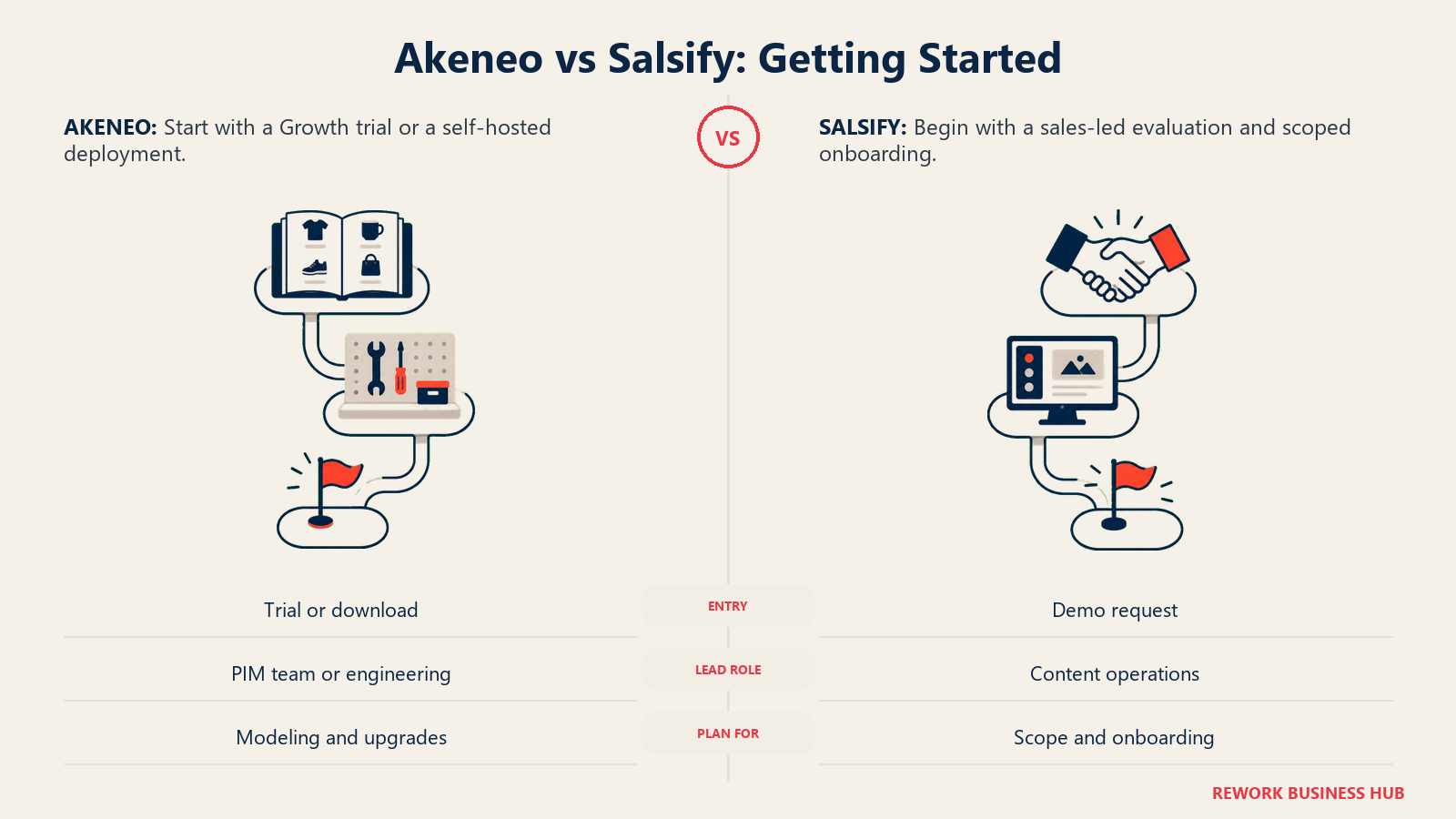
| Akeneo | Salsify | |
|---|---|---|
| Fastest path to start | Growth tier free trial, self-serve sign-up | Demo request, sales-led from the first touch |
| Self-hosted path | Community Edition, download and install yourself, real engineering lift | Not available |
| Who typically leads implementation | A PIM admin for Growth, an internal team or partner for Community Edition | A content/ecommerce ops team working with Salsify's onboarding |
| What slows it down | Data modeling decisions on Community Edition; version discipline over time | No public pricing to pre-qualify against, so the sales cycle itself is the first delay |
| Migration deadline pressure | Akeneo PIM 7.0 end of support 30 September 2026 makes this a live clock for some teams | Not applicable |
The honest read on time to value: Akeneo's Growth tier can get a small catalog started quickly because you can begin structuring data the day you sign up for the trial, before a contract even exists. Community Edition takes longer up front because someone has to stand up the environment first, but there's no procurement delay once engineering time is allocated. Salsify's timeline is harder to predict from the outside precisely because the sales cycle itself is unpriced and unstructured, so discovery calls have to establish scope before anyone can commit to a go-live date. None of that makes Salsify slower to implement once work actually starts. It just means the clock starts later.
When Akeneo Is the Right Call
- You want to try before you commit anything. Growth's free trial is a real, self-serve starting point, not a sales-gated demo.
- You need to own the deployment. Community Edition is free, open source, and actively maintained (2026.4 shipped 28 August 2026), which fits teams with in-house engineering who want the codebase.
- Your priority is the data model itself. Attribute governance, channel-ready structure, and rights management are named, purchasable capabilities, even if the price behind them isn't published.
- You're already on an older Akeneo version. If you're on 7.0, the 30 September 2026 end-of-support date makes this a forced decision point regardless of which platform you ultimately choose.
- You want at least a partial price anchor. Growth's "$0 Annually" trial and named tier structure give you something to react to that Salsify simply doesn't offer.
- You want the AI-assisted data work built into the core tiers. Data Architect Agent AI and AI-powered description generation and asset extraction both ship on Growth, not gated behind the top tier the way PX Insights is.
When Salsify Is the Right Call
- Your job is retailer and marketplace content, full stop. If your team spends its time chasing retailer content compliance and digital shelf accuracy, that's the product Salsify built.
- You're managing many retail relationships at once. Salsify's syndication framing and multi-region claims are built for a brand pushing content to a wide set of channels, not for a team modeling data for a single storefront.
- You don't want to own any infrastructure. There's no self-hosted option to weigh, which also means no patching, versioning, or hosting decisions land on your team.
- You're comfortable evaluating without a public number. If a longer, sales-led evaluation isn't a dealbreaker for your procurement process, the lack of a pricing page stops being a practical obstacle.
- Content governance across many channel templates matters more than owning the raw data schema. Salsify's workflow builder and enhanced content tools are built around that specific job.
- You'd rather have analytics folded into daily workflow than unlocked as a top-tier add-on. The Intelligence Suite sits inside the platform rather than behind a named, gated product the way Akeneo's PX Insights does.
If Neither One Fits
If the real gap in your evaluation isn't the PIM layer at all, it's worth naming that before you sign either contract. A lot of teams comparing Akeneo and Salsify are actually trying to solve a wider problem: the product record lives in one tool, the order lives in a commerce platform, the stock count lives in a separate inventory system, and the customer record lives in a fourth tool entirely, held together by syncs nobody fully trusts. Rework's Product module runs product operations inside a platform that also carries Sales CRM, Lead, Commerce, Inventory, Invoice, and Work Ops, so the product record sits next to the order, the stock count, and the customer instead of syncing between four systems.
Be clear-eyed about what that is not. Rework is not a dedicated enterprise PIM and doesn't try to be one: there's no retailer syndication network to rival Salsify's, no GDSN connection, no MDM layer, and it isn't built for a global CPG brand publishing structured content to hundreds of retail partners. For most people seriously evaluating Salsify specifically, Rework's Product module is a downshift in scale, not a like-for-like swap. Pricing is quoted per organization, not published as a fixed figure, at rework.com/pricing, and it's built for mid-size operators of roughly 10 to 200 people who'd rather run product data next to the rest of their operations than maintain a fourth synced tool. If your organization is bigger than that or your whole problem is retailer syndication at scale, this isn't the fix, and the Akeneo-versus-Salsify decision above still stands on its own.
If you've already ruled out Akeneo and want a wider field before landing on Salsify, our best Akeneo alternatives roundup is the natural next stop, and our best PIM software in 2026 piece covers the category more broadly, including vendors that publish real numbers where these two don't.
Decision Framework
| If this is true for you | Pick |
|---|---|
| You want a free trial and a self-serve starting point | Akeneo (Growth) |
| You need to self-host and own the deployment permanently | Akeneo (Community Edition) |
| You're still on Akeneo PIM 7.0 | Plan your migration now; support ends 30 September 2026 |
| Your whole job is getting content onto retailer and marketplace pages | Salsify |
| You manage content across many retail relationships at once | Salsify |
| You want at least a partial price anchor before a sales call | Akeneo |
| You're fine with a fully sales-led evaluation and want zero infrastructure | Salsify |
| The real gap is product data syncing badly with orders, stock, and customers | See "If Neither One Fits" above |
| You want a wider shortlist than these two names | See our best PIM software in 2026 |
| You've ruled out Akeneo specifically | See our best Akeneo alternatives |
What to Do Next
The right next step depends on which side of this comparison you're actually on.
- If you're evaluating Akeneo, start the Growth trial before anything else. It's the only self-serve number either vendor gives you, even if it doesn't tell you what Advanced or Premium will cost.
- If you're on Akeneo PIM 7.0, put the 30 September 2026 end-of-support date on a calendar today. Decide whether you're upgrading in place, moving to Community Edition, or moving to a SaaS tier, and start that conversation now rather than after support lapses.
- If you're evaluating Salsify, come to the first call with your own numbers ready. Since there's no public tier structure to react to, the more specific you are about catalog size, retailer count, and team size upfront, the faster you'll get a real quote instead of a second discovery call.
- If you're leaning toward Community Edition, budget the engineering time, not just the license fee. Since 2026.1, breaking changes can land in any release, so plan for staged upgrades and version pinning as an ongoing cost, not a one-time setup task.
- If the pain is really about syncing product data with orders, inventory, and customer records, read the "If Neither One Fits" section above before you sign a multi-year PIM contract for a problem a PIM alone won't solve.
- Widen the search if neither name fits cleanly. Our best PIM software in 2026 and best Akeneo alternatives roundups cover the vendors that do publish real numbers.
Whichever path you take, don't let the pricing asymmetry itself become the deciding factor. A published starting price makes Akeneo easier to research on your own time, and that's worth something, but it doesn't make Growth the right fit if your real job is retailer syndication at scale. A blank pricing page makes Salsify slower to evaluate, but that's a process cost, not a signal about whether the product fits your catalog. Match the platform to the job, then treat whichever sales cycle you're in as a known cost of doing business with that vendor.
Frequently Asked Questions about Akeneo vs Salsify
How much does Akeneo cost?
Akeneo's Growth package shows "Starting at $0 Annually" tied to a free trial, which isn't a usable ongoing price. Advanced and Premium both show "Call for a quote" with no published figure. Third-party sites report roughly $45,000 per year for Growth, but that's an outside estimate, not a number from Akeneo itself, so get your own quote before budgeting.
How much does Salsify cost?
Salsify doesn't publish a price anywhere on its site. The URL salsify.com/pricing redirects to the Salsify homepage rather than to a pricing page, and there's no tier list, no starting figure, and no self-serve sign-up. Every price comes from a sales conversation.
Is Akeneo PIM Community Edition really still free?
Yes. Akeneo's own Community Edition page states the company has offered a free, open-source PIM since its first day, and the project's public GitHub repository shipped version 2026.4 on 28 August 2026, its most recent release. It is not being discontinued, despite claims to that effect on some third-party integrator blogs.
What happens when Akeneo PIM 7.0 reaches end of support?
Version 7.0 reaches end of support on 30 September 2026. After that date it stops receiving bug and security fixes, because Akeneo's support policy only covers the current release. Teams still on 7.0 need to plan a migration to a supported version before that date.
Can I self-host Salsify the way I can with Akeneo?
No. Salsify is SaaS only, with no self-hosted or open-source option. Akeneo is the only one of the two that offers a free, self-hosted deployment through its Community Edition, alongside its paid SaaS packages.
Is Akeneo a PIM and Salsify a PXM, and does that difference matter?
Akeneo markets itself primarily as a PIM (product information management) and Product Cloud, focused on structuring and governing product data. Salsify markets itself as a PXM (product experience management) platform, focused on getting that data out to retailers and marketplaces correctly. In practice the categories overlap heavily, but the label reflects which end of the problem each vendor built for first.
Which one is easier to try before buying?
Akeneo. Its Growth tier includes a free trial you can start yourself, and Community Edition is a free download you can install without contacting sales. Salsify has no published pricing and no self-serve trial that we found, so a demo request with a salesperson is the starting point for any evaluation.
Does either platform publish how many retailers or marketplaces it connects to?
Neither publishes a specific retailer or marketplace count on its core platform pages. Salsify frames syndication as a central capability and cites reach across 140 countries, without a specific retailer network number. Akeneo's syndication options are narrower and commerce-platform-focused, through named apps for Salesforce Commerce Cloud, Adobe Commerce, and Shopify.
Should I pick the free option just because it's free?
Not automatically. Akeneo Community Edition has no license fee, but self-hosting means owning hosting, patching, and version upgrades yourself, and Akeneo warns that breaking changes can land in any release since version 2026.1. If your team doesn't have the engineering capacity to do that ongoing work, a paid SaaS tier from either vendor, or a lighter tool entirely, is often the more honest cost comparison.
What's the real difference between Akeneo's tiers?
Growth includes the core PIM, Data Architect Agent AI, and one activation channel, and it's the only tier with a self-serve trial. Advanced adds Collaboration Workflows, Advanced Rights Management, and Channel-Ready Data Governance. Premium adds PX Insights, Enterprise Governance with SIEM integration, and a Strategic CSM with 24/7 support. Only Growth's trial shows a number; Advanced and Premium are both quote-only.
We already have a CRM, order system, and inventory tool. Does either platform help with that?
No, and neither claims to. Both Akeneo and Salsify are focused specifically on product data and content, not on orders, stock, or customer records. If the actual friction in your business is those systems failing to stay in sync with each other and with product data, that's a different problem than either PIM solves, and it's worth reading the "If Neither One Fits" section above before signing a contract with either vendor.

Principal Product Marketing Strategist
On this page
- Key Facts
- TL;DR: Akeneo vs Salsify at a Glance
- Who Each Platform Is Built For
- Pricing Transparency, Stated Plainly
- The Self-Hosting Question Only Akeneo Raises
- Data Modeling and Catalog Depth
- Syndication and Channel Reach
- DAM and Asset Handling
- Workflow and Governance
- Reporting and Performance Insight
- Integrations
- Implementation Effort and Time to Value
- When Akeneo Is the Right Call
- When Salsify Is the Right Call
- If Neither One Fits
- Decision Framework
- What to Do Next