Best Canto Alternatives in 2026: 12 DAM Platforms for Brand and Marketing Teams
Turn this article into takeaways for your work.


Each assistant summarizes the article only for you and suggests best practices for your work.
The best Canto alternatives in 2026 split into three groups depending on what you actually need from a DAM: Bynder, Brandfolder, Acquia DAM (Widen), MediaValet, Frontify and Aprimo if you want an established enterprise platform and don't mind a sales call before you see a number, Dash, Air, Filecamp, Pics.io and Cloudinary if you want a starting price on the page before you pick up the phone, and Pimcore if your brand needs product data sitting next to its assets rather than bought as a separate package. Every price below comes from the vendor's own pricing page,, and any figure that isn't vendor-confirmed is labeled as such.
Canto's own pricing page is unusually candid about what it won't tell you. Four named packages, Core Essentials, Enhanced Collaboration, Omni Brand Solution and Advanced, sit right there on the page, and then the vendor adds this line, word for word: "All packages shown are illustrative. Canto purchases can be customized to fit your needs." You can see the exact shape of a Canto deal and still not know what it costs, and the number that eventually lands on your desk scales with both your team size and your storage needs, which only grow. None of that makes Canto a bad DAM, its search and filtering experience is genuinely well regarded and the rollout is lighter than the top-tier enterprise suites, but it does mean the real comparison shopping happens after a demo call, not before one. This guide covers twelve alternatives with real, checkable pricing and packaging, plus an honest look at where Canto still wins, so you walk into that call already knowing where you stand. For the wider category, the best digital asset management software roundup covers the buyer's-market side rather than the Canto-specific angle.
One more thing worth clearing up before the comparison: "digital asset management" gets confused with two other categories that show up in the same searches. If you're actually managing contracts, policies and records, that's document management software, not DAM. And if "asset management" means physical or IT equipment tracking rather than creative files, see best asset management software instead, a genuine naming collision that sends a lot of searches to the wrong category page.
Key Facts
- The global digital asset management market was worth USD 5.36 billion in 2025 and is projected to reach USD 6.29 billion in 2026, growing to USD 19.36 billion by 2034 at a 15.10% CAGR, per Fortune Business Insights.
- Gartner named Adobe, Aprimo, Bynder and Storyteq as Leaders in its 2025 Magic Quadrant for Digital Asset Management Platforms, published November 4, 2025, per Gartner.
- Forrester named Aprimo, Bynder, Orange Logic, Adobe Experience Manager Assets and OpenText as Leaders in The Forrester Wave: Digital Asset Management Systems, Q1 2026, with Bynder earning the added distinction of Customer Favorite, per Forrester.
- 77% of organizations surveyed reported improved brand consistency after adopting a DAM, rising to 88% when paired with a templating solution, per MediaValet's 2026 DAM Trends Report (vendor-published survey).
Quick Comparison Table
| Tool | Best For | Starting Price | Key Strength | Key Limitation |
|---|---|---|---|---|
| Bynder | Enterprise brand teams scaling globally | Quote only | Deep integration ecosystem, AI-driven workflow orchestration | No published price; a multi-module quote can take weeks |
| Brandfolder by Smartsheet | Marketing teams wanting the simplest UI at scale | Quote only (Premium / Enterprise) | Enterprise usability, tight Smartsheet reporting link | Only two published tiers, no self-serve entry point |
| Acquia DAM (Widen) | Brands wanting DAM inside a full DXP | Quote only | Works with non-Drupal stacks, strong PIM-adjacent features | Value depends on adopting the wider Acquia DXP |
| MediaValet | Regulated or security-first enterprises on Azure | Quote only | Azure-native security posture, SOC 2 / HIPAA / GDPR | No self-serve pricing at all, sales-only |
| Frontify | Brand teams wanting DAM plus guidelines in one system | Quote only (meters active users, not seats) | Guidelines, templates and DAM in a single platform | No published Starter plan since 2026 |
| Dash | Ecommerce and DTC brands managing retailer portals | GBP 79/mo (Start up, monthly) | Unlimited users on every plan, AI auto-tagging included | Priced in GBP by default; downloads are metered |
| Air | Creative teams needing real-time review and versioning | $900/mo (Business, billed annually) | Unlimited seats, deep creative-tool integrations | Starter sits between Free and Business but carries no published price |
| Filecamp | Small teams wanting flat, storage-based pricing | $29/mo (Basic, monthly) | Unlimited users on every plan, no annual markup | Storage caps bite fast for video-heavy libraries |
| Pics.io | Teams already living in Google Drive | $100/mo (Solo, monthly only) | Keeps assets in Google Drive, no migration | AI tagging and search cost extra |
| Cloudinary | Dev teams needing DAM plus an image/video API | Assets DAM: Quote only (Programmable Media Plus $99/mo, $89/mo billed annually) | Best-in-class transformation and delivery API | The actual DAM product has no published price |
| Aprimo | Enterprise content operations at scale | Quote only | Gartner and Forrester Leader, agentic AI workflows | Built for large teams; overkill for a small one |
| Pimcore | Product-driven brands needing DAM plus PIM | Free (Community, open source) | Only DAM-and-PIM combo on this list, self-hostable | Professional and Enterprise tiers need in-house setup |
Why Teams Leave Canto
Canto rarely loses a deal on the product itself. It loses deals on the shape of the purchase, four names on a page with no numbers attached, and on how the module ladder lines up against what a typical marketing team assumes is already included. Here's what pushes a team to look elsewhere, and which alternatives tend to solve it.
| Pain Point | Who Feels It Most | Better Fit |
|---|---|---|
| Illustrative packages, no published numbers | Procurement and finance teams that need a figure before a demo | Filecamp, Dash, Air, Pics.io, Cloudinary (Media API) |
| Pricing scales with team size and storage | Growing teams, especially ones adding video libraries | Filecamp, Dash (flat storage tiers), Pimcore (flat annual license) |
| Core marketing features gated behind Enhanced Collaboration | Mid-size marketing teams that assumed proofing and portals were baseline | Bynder, Brandfolder, Frontify (broader baseline feature set) |
| Product data is a separate Omni Brand Solution purchase | Product-driven, retail and CPG brands | Pimcore (DAM and PIM in one platform) |
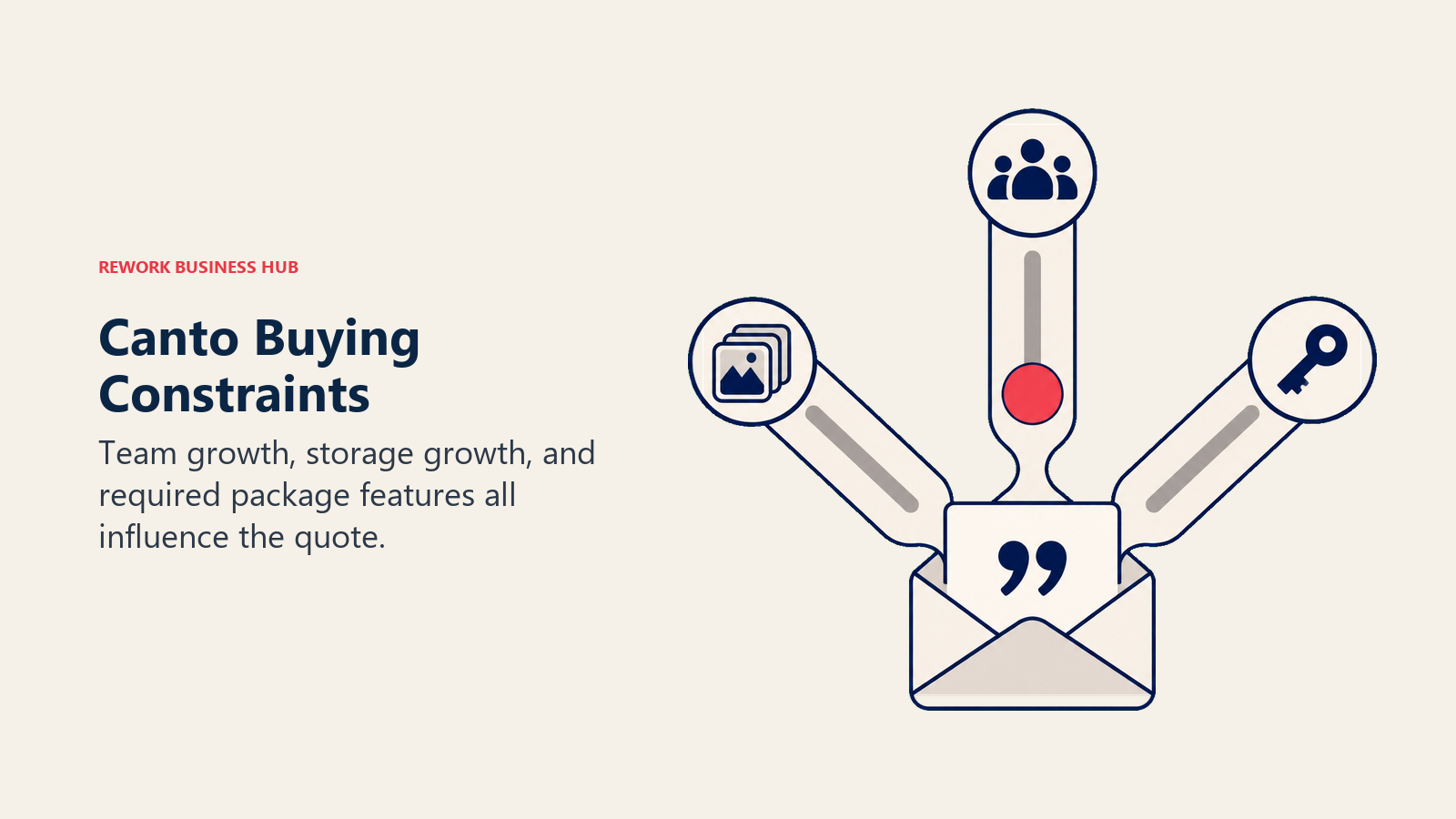
The illustrative-packages line catches the most people off guard. Canto's own pricing page states it plainly: "All packages shown are illustrative. Canto purchases can be customized to fit your needs." That's a candid way of saying there's no list price to anchor a renewal negotiation against, so year two and year three conversations start from scratch instead of from a published rate card. Pair that with pricing that "scales based on your team size and storage needs" and the bill moves in two directions at once: add headcount and it goes up, add a video library and it goes up again.
The module ladder compounds the problem. Review and approval with proofing, dynamic brand templates, AI search and organize, and branded portals, the features a mid-size marketing team usually assumes are table stakes for a DAM, all sit at Enhanced Collaboration (DAM PLUS), not Core Essentials. Advanced (DAM PRO) is where AI-powered tagging, multi-language support and deeper CRM and ERP integrations live. And if your brand needs product data sitting next to its assets, that's a fourth, separate purchase: Omni Brand Solution (DAM for Products). Pimcore is the closest direct comparison there, since it bundles DAM and PIM into one open-source platform instead of selling them as two packages.
What Canto Gets Right
None of this makes Canto a weak product, and a fair comparison has to say where it earns its renewal. Canto has been a mid-market DAM staple for years, and its search and filter experience, faceted metadata search, smart tags and quick previews across image, video and document types, still gets called out as one of the easier DAM interfaces to hand to a non-technical marketer without a training session. The rollout is genuinely lighter than the top-tier enterprise suites too: teams that have evaluated Bynder or Aprimo alongside Canto consistently describe Canto's onboarding as faster, with less professional-services overhead.
The four-package structure is also, in its own way, a strength once you get past the illustrative labeling. Unlike a vendor that hides everything behind one undifferentiated "contact sales" button, Canto's page tells you exactly what you'd be negotiating for: proofing and portals at Enhanced Collaboration, product data at Omni Brand Solution, AI tagging and multi-language at Advanced. That means you walk into the sales call with a real menu instead of a blank page. For a brand team that wants a capable, well-liked, mid-market DAM and is comfortable running a real negotiation rather than clicking "buy" on a published tier, Canto remains a reasonable default.
Canto's Four Packages and What Sits in Each
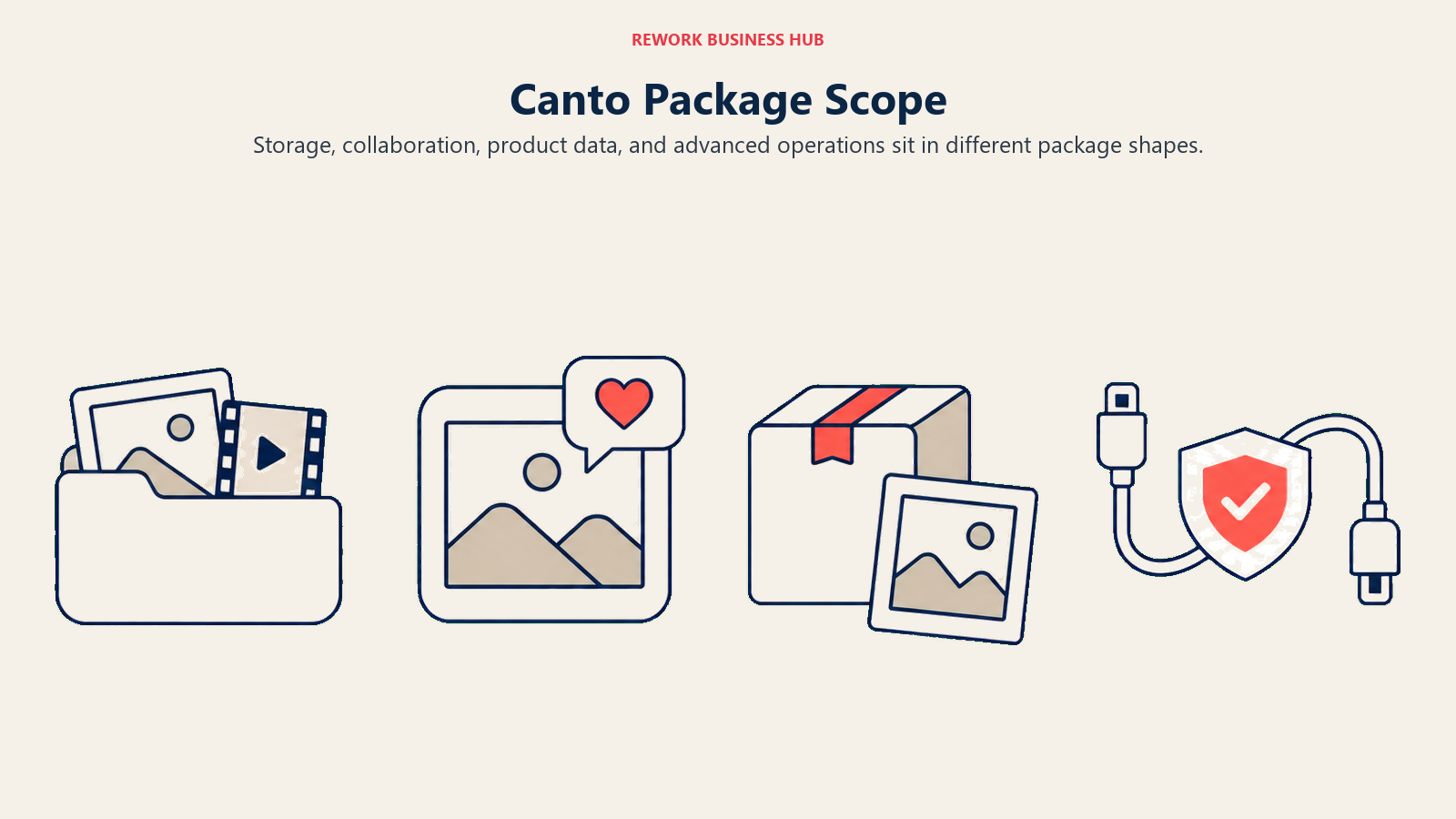
Canto's own pricing page names four packages and describes what sits in each one. Read this as a shape to negotiate from, not a price list: the vendor's own words are "All packages shown are illustrative. Canto purchases can be customized to fit your needs," and pricing scales based on team size and storage needs on top of whichever package you land on.
| Package | Positioning | What's Included | Price |
|---|---|---|---|
| Core Essentials (DAM) | Entry-level DAM | Secure asset storage, intuitive search, trusted security protocols | Illustrative only, custom quote |
| Enhanced Collaboration (DAM PLUS) | Where most marketing teams actually need to start | Centralized review and approval with proofing, dynamic brand templates, AI search and organize, customizable brand portals | Illustrative only, custom quote |
| Omni Brand Solution (DAM for Products) | Product-driven, retail and CPG brands | Consistent brand representation across channels, centralized content and product data, customizable retailer-specific product catalogs, data-driven insights | Illustrative only, custom quote |
| Advanced (DAM PRO) | Large, complex organizations | AI-powered search and tagging, dedicated onboarding and training, extensive storage, CRM/ERP/enterprise integrations, multi-language support, enhanced security and compliance | Illustrative only, custom quote |
Notice where the line falls: a marketing team's actual day-to-day list, proofing, templates, AI search, portals, doesn't start until the second package.
How Each Alternative Meters: Users, Storage, Credits or Active Users
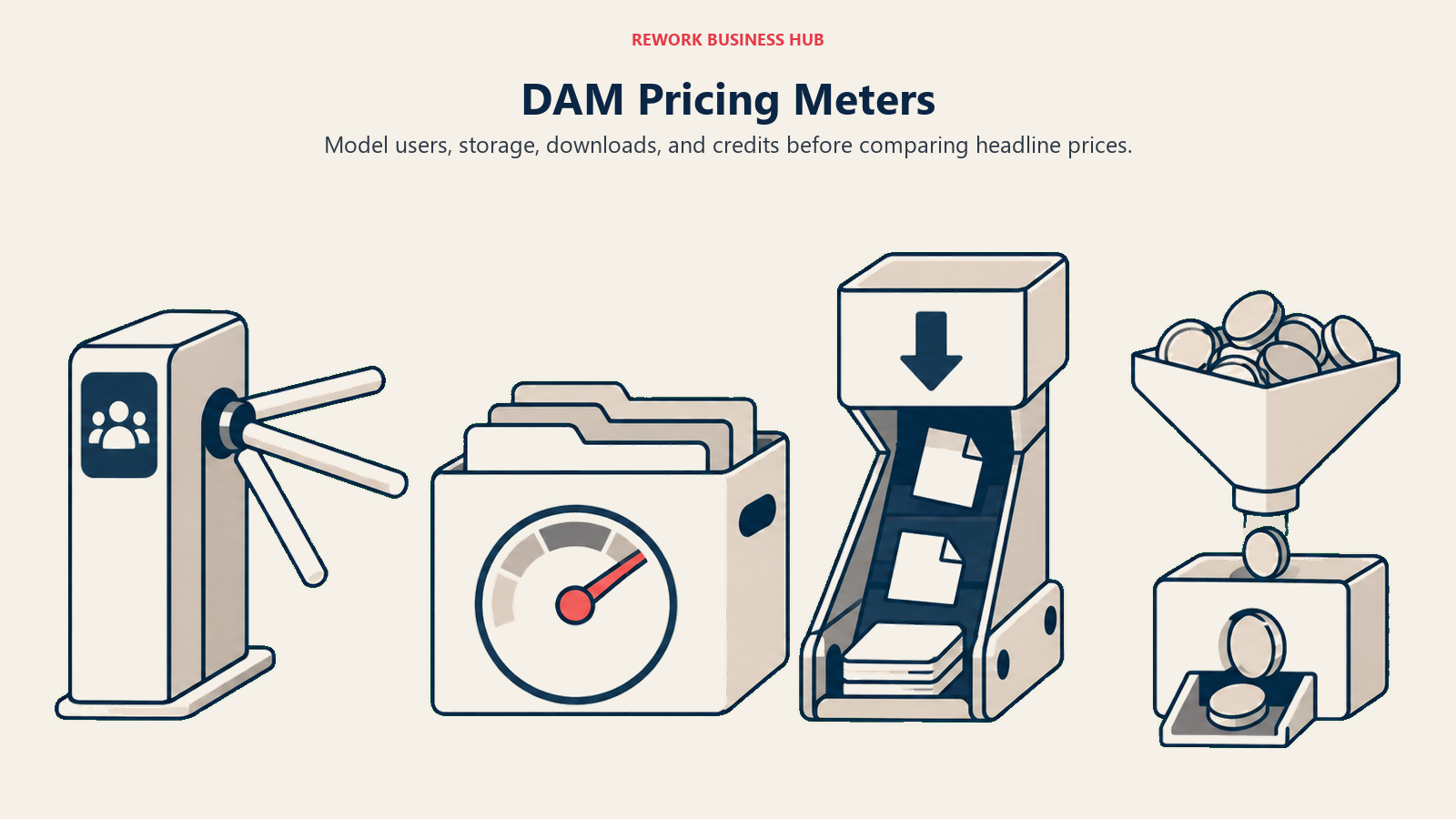
Canto meters on team size and storage, a combination that means growth in either direction moves the bill. None of the twelve alternatives below meter identically, and that difference is often more decisive than the sticker price.
| Platform | Meters By | Unlimited Users? | Notes |
|---|---|---|---|
| Canto (for reference) | Team size and storage | Not stated | Illustrative packages; scales with headcount and library size |
| Bynder | Users, storage, MarTech usage, product tier, support level | No | Fully custom package per customer, per Bynder's own pricing page |
| Brandfolder by Smartsheet | Feature tier (Premium vs Enterprise), not per-unit | Not published | Only two tiers exist; no self-serve unit basis |
| Acquia DAM (Widen) | Custom, sold standalone or within the Acquia DXP | Not published | Quote-based regardless of Drupal usage |
| MediaValet | Custom, based on organization needs | Not published | Azure-hosted; no self-serve pricing at all |
| Frontify | Monthly Active Users (MAU), not seats | Not applicable, pay per active user, not per license | Reevaluated yearly using six-month usage averages |
| Aprimo | Users and modules | No | Custom quote built around chosen products |
| Dash | Downloads per month and storage GB | Yes, unlimited users on every plan | Extra storage sold in GB bundles |
| Air | Credits per month (storage plus AI generation combined) | Yes, unlimited seats on every plan | Credits reset monthly and don't roll over |
| Filecamp | Storage GB (20 / 50 / 100GB tiers) | Yes, unlimited users on every plan | No annual discount, exactly 12x monthly |
| Pics.io | Plan tier (Solo / Micro / Small / Enterprise) | Not published | AI tagging and search billed separately by asset volume |
| Cloudinary | Assets DAM: custom, untiered. Media API: credits (1,000 transformations, or 1GB storage, or 1GB bandwidth) | Assets DAM not published; Media API includes 3-5 users by plan | Two different products live on one pricing page |
| Pimcore | Flat annual license (Professional / Enterprise); Community is free and self-hosted | Not seat-metered at all | No per-user or per-storage metering on any tier |
The two outliers worth remembering: Frontify charges by who actually logs in during a given month rather than by license count, and Filecamp and Dash both sell unlimited seats and meter storage or downloads instead, the closest thing on this list to Canto's storage-based logic, minus the team-size multiplier.
1. Bynder: The Enterprise Gold Standard, at an Enterprise Process
Bynder is the alternative teams reach for when they've outgrown "good enough" and need a DAM built for global brand teams: high asset volume, complex regional permissions, and a real integration footprint into the rest of the MarTech stack. Per Bynder's pricing page, there's no published number. Subscription plans are, in the vendor's own words, "structured based on what you use, influenced by the number of users, storage, usage within your MarTech ecosystem, the products included as part of your solution, and the desired level of support," and "every Bynder customer... has a custom-made package tailored to their business needs and, therefore, a unique price point." Bynder claims 4,000+ brands as customers.
Bynder was named a Leader in both Gartner's 2025 Magic Quadrant and Forrester's Q1 2026 Wave for digital asset management, and it picked up Forrester's Customer Favorite distinction on top of that, credentials that put it in the same conversation as Aprimo rather than the mid-market field. The tradeoff is process: expect a genuine sales cycle, a scoping call, and a package that only exists after that conversation.
| What You Get | What You Don't |
|---|---|
| A modular platform covering DAM, AI search, workflow and analytics | A published price to compare before a call |
| Analyst-verified Leader status (Gartner, Forrester) | A quick self-serve signup |
| Deep integration ecosystem across the MarTech stack | A lightweight rollout for small teams |
| Custom-fit packaging for complex global brand operations | A fast path for a two or three-person team |
Best for: Global brand teams with complex permissions and a real MarTech integration list who want an analyst-recognized platform and don't mind a scoping call before pricing. See best Bynder alternatives if Bynder itself is what you're replacing.
2. Brandfolder by Smartsheet: The Usability Play
Brandfolder competes on ease of use rather than feature breadth, and it shows in the packaging: just two published tiers, Premium and Enterprise, both gated behind "Book a demo" or "Get a quote" on Brandfolder's pricing page. Premium adds asset analytics, document intelligence (OCR), bulk admin, SSO/SAML, and Video AI (auto-tagging, scene detection, speech-to-text). Enterprise layers on custom automation, tighter permissions, multi-brand organizational controls, enterprise creative tooling, and a BI data connector. An older third tier, Essentials, no longer appears on the page. For a full head-to-head on how those two tiers compare with Canto's four packages, see Canto vs Brandfolder.
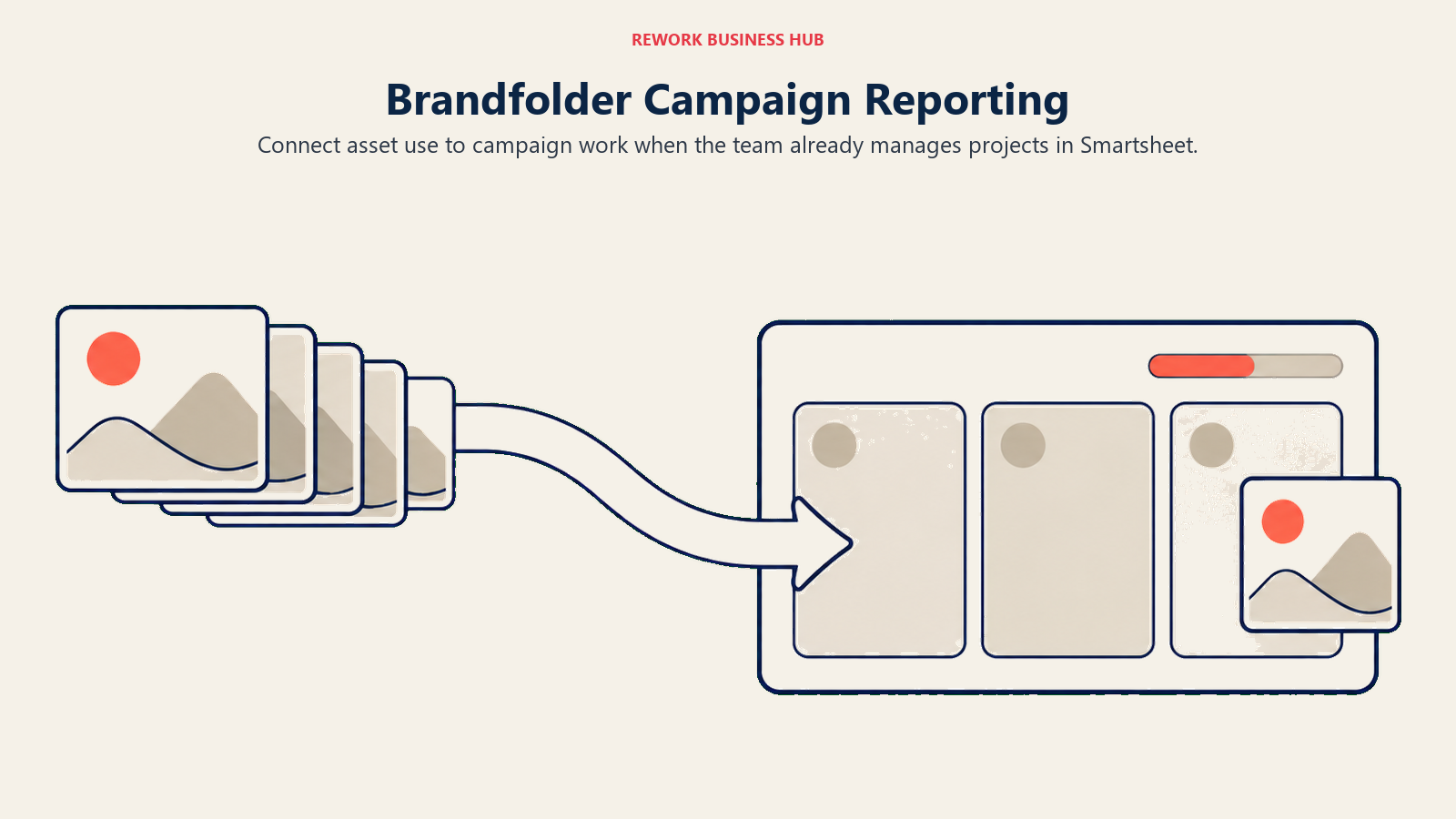
Smartsheet completed its acquisition of Brandfolder in September 2020, and the product is actively maintained, not sunset, with live sections in Smartsheet's own Learning Center and Community. That parentage is the real differentiator: teams already running Smartsheet for project and work management get a genuine reporting link between asset performance and campaign work, syncing Brandfolder insights straight into Smartsheet dashboards. Brandfolder's own pricing page also cites a customer claim worth flagging as vendor-published rather than neutral research: Conga cut software costs meaningfully and let a 1,200-person global team self-serve assets.
| What You Get | What You Don't |
|---|---|
| A genuinely simple, low-training interface | A published number before the demo call |
| Native Smartsheet reporting and dashboard sync | A self-serve entry tier |
| Video AI (auto-tagging, scene detection, speech-to-text) on Premium | A third, cheaper tier (the old Essentials plan is gone) |
| Active, ongoing product investment post-acquisition | Deep custom workflow depth like Aprimo's |
Best for: Marketing, legal and creative teams that want the easiest DAM to onboard non-technical users into, especially if Smartsheet is already the project-management system of record. See best Brandfolder alternatives if Brandfolder itself is what you're replacing.
3. Acquia DAM (Widen): The DXP-Native Option
Acquia DAM (Widen), Acquia's own current name for the product, is the pick for brands that want their DAM to sit inside a broader digital experience platform rather than stand alone. It works with non-Drupal stacks just as readily, integrating with Adobe Experience Manager, HubSpot and other CMS and MarTech tools, so choosing it doesn't lock you into Acquia's Drupal-based DXP if you don't want the rest of the suite.
Per Acquia's pricing page, there's no published price. It's quote-based and sold either standalone or bundled into the Acquia Digital Experience Platform. Acquia's own customer story on the University of Georgia, managing roughly 1 million assets on the platform, gives a sense of the scale the product is built to handle. Product information management capability carried over from the original Widen product, which is part of why it competes credibly against Pimcore for brands weighing DAM-plus-PIM against paying for two separate systems.
| What You Get | What You Don't |
|---|---|
| Works standalone or inside the full Acquia DXP | A published price on the site |
| PIM-adjacent capability inherited from Widen | Independence from an enterprise sales process |
| Proven at large scale (roughly 1M assets, per Acquia) | Fast self-serve signup |
| Broad CMS and MarTech integration beyond Drupal | The lightest possible rollout |
Best for: Brands already evaluating a broader digital experience platform who want DAM and product-content management under one roof without committing to Drupal specifically.
4. MediaValet: The Azure-Native, Security-First Option
MediaValet's entire pitch is infrastructure trust: it's built exclusively on Microsoft Azure, using Azure Service Fabric, Video Indexer and Computer Vision, and leans hard on compliance credentials, SOC 2, HIPAA, GDPR, and a security posture the vendor markets as best in class among DAM providers. That combination lands it with regulated industries and enterprises already standardized on the Microsoft stack.
Per MediaValet's pricing page, titled "Get Your Custom DAM Pricing," there's no published number at all, on the reasoning that most enterprise DAM platforms use custom pricing based on an organization's specific needs. MediaValet's own claim, worth flagging as vendor-published rather than neutral research, is that customers see ROI in an average of 10 months. Named customers on the vendor's site include Hard Rock Hotels, HelloFresh and A&W.
| What You Get | What You Don't |
|---|---|
| Azure-native security and compliance (SOC 2, HIPAA, GDPR) | Any self-serve pricing option |
| Handles 4K-8K video, CAD files and broad media types | A quick signup path |
| Enterprise-grade uptime and redundancy claims | A published starting price |
| Strong fit for regulated or Microsoft-standardized orgs | A lightweight, low-process rollout |
Best for: Regulated industries and Microsoft-standardized enterprises that want their DAM's infrastructure story to match their compliance requirements.
5. Frontify: The Guidelines-Plus-DAM Platform, Priced by Who Shows Up
Frontify folds DAM into the same platform as brand guidelines, templates and approval workflows, so assets don't live apart from the standards that govern how they're used. Named customers include Uber, Microsoft and Zoom. The company was founded in Switzerland in 2013 specifically to stop brand consistency from eroding as companies scale globally, and that guidelines-first DNA still shapes the product today.
Frontify's pricing is unpublished by design. The vendor's own pricing FAQ is headlined "Why doesn't Frontify display fixed pricing?" and the answer is that Frontify engages directly to propose a tailored package. The pricing model itself is the more interesting detail: Frontify meters Monthly Active Users (MAU), not seats, so you pay for people who actually used the platform that month rather than for dormant licenses, calculated from industry averages and reevaluated yearly using six-month usage averages so short spikes don't move the bill. Frontify used to publish a self-serve Starter plan; that plan is gone as of 2026, and no dollar figure appears on the current pricing page.
| What You Get | What You Don't |
|---|---|
| Brand guidelines, templates and DAM in one platform | Any published price, even an entry-level one |
| Usage-based (MAU) pricing instead of per-seat licenses | A self-serve Starter tier (retired) |
| Recognizable enterprise customer base (Uber, Microsoft, Zoom) | A quick way to estimate cost without a sales call |
| A single system of record for both assets and standards | Predictable month-to-month billing without a true-up |
Best for: Brand teams that want guidelines and asset management unified in one platform and are comfortable with usage-based pricing tied to active users rather than seats.
6. Dash: The Unlimited-Seat Option for Ecommerce Brands
Dash is built specifically for ecommerce and DTC brands managing images and video across retailers, distributors and marketplaces, with branded portals per partner so each one can self-serve the right assets without a support ticket. AI search, auto-tagging and custom metadata fields (SKU, campaign) are baseline features on every plan, not an add-on tier.
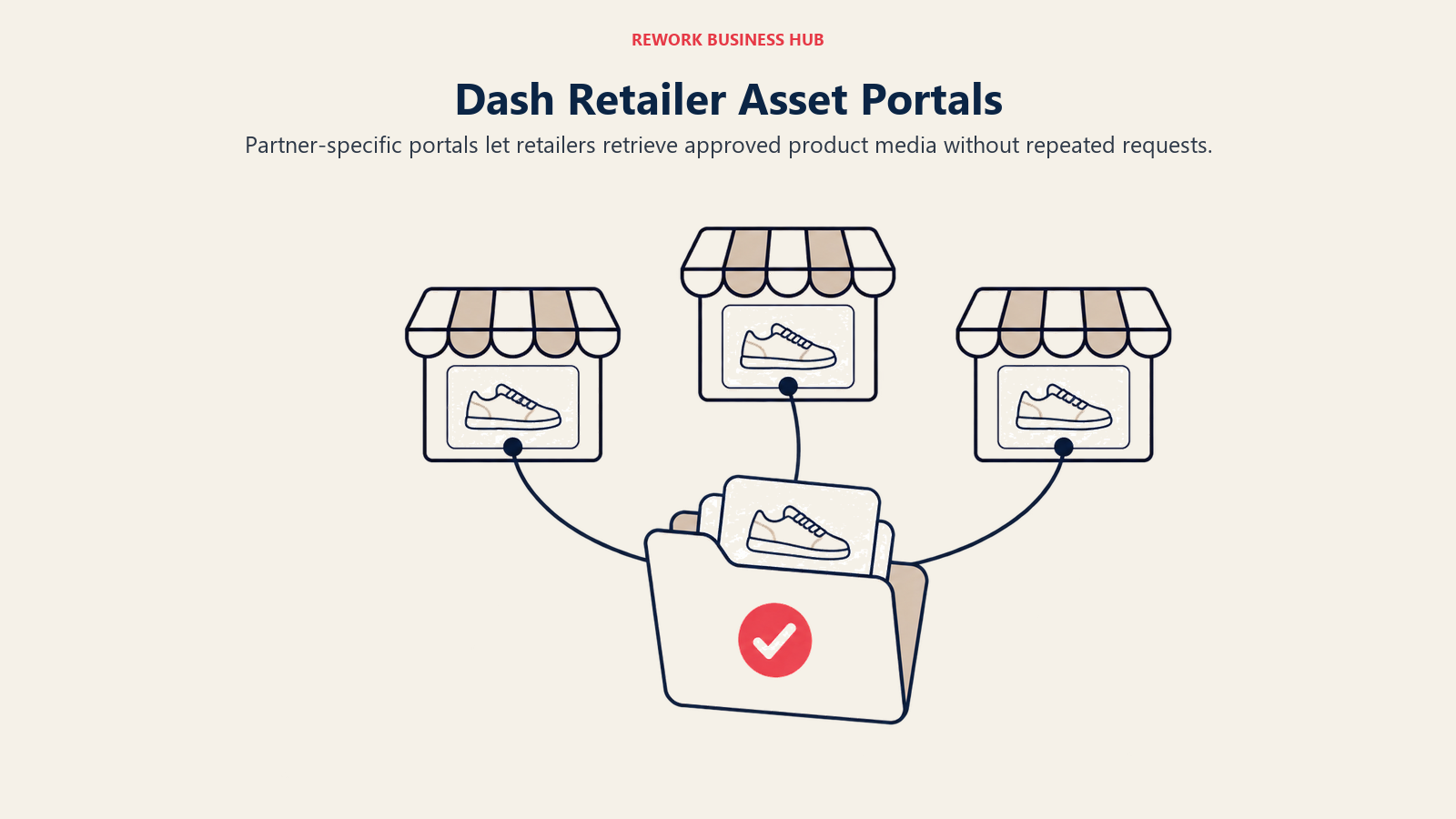
Per Dash's pricing page (prices published in GBP by default): Start up runs GBP 79/mo or GBP 853/yr, Small team GBP 179/mo or GBP 1,933/yr, Growing brand GBP 299/mo or GBP 3,229/yr, and Established brand GBP 449/mo or GBP 4,849/yr. Annual billing saves 10% across the board. Every plan carries unlimited users, and the meter instead falls on monthly downloads (250 up to unlimited by tier) and storage (10GB up to 200GB-50TB by tier), with extra storage sold in GB bundles that get cheaper on higher tiers.
| What You Get | What You Don't |
|---|---|
| Unlimited users on every published tier | USD pricing by default (GBP is the base currency) |
| AI search and auto-tagging included, not upsold | Unlimited downloads below the top tier |
| Per-retailer branded portals built for ecommerce | Facilitation or workflow tooling outside asset sharing |
| A clear, published price at every tier | Enterprise-scale storage without add-on bundles |
Best for: Ecommerce and DTC brands that need retailer-facing portals and unlimited seats, and don't mind budgeting in GBP.
7. Air: The Credit-Metered Creative Ops Platform
Air launched in Brooklyn in 2017 as a purpose-built DAM for creative teams, and it now markets itself as a "Creative Operations" platform: real-time commenting and annotation on images and video, Kanban-style project boards, version stacking to compare file revisions side by side, and Creative Intelligence, an AI layer that auto-tags and organizes the library, including conversational search by plain-English prompt.
Per Air's pricing page: Free includes 120 credits/month (roughly 20GB of enriched storage or 24 AI-generated images), Business runs $900/month billed annually with 30,000 credits/month, and Enterprise is custom with 60,000 credits/month. Every plan, including Free, carries unlimited seats, Air's own framing is "you're never charged based on how many people are in your workspace." Air used to be known for cheap per-seat pricing; that model is gone. It's credit-metered now, with a $900/month entry point for the Business tier, and credits reset each cycle without rolling over.
| What You Get | What You Don't |
|---|---|
| Unlimited seats on every plan, including Free | Cheap per-seat economics (the old model is gone) |
| Deep creative-tool integrations (Photoshop, Illustrator, Figma) | A mid-tier between Free and $900/month Business |
| AI-driven search by color, object, face and dialogue | Rolling-over credits between billing cycles |
| Real-time review, annotation and version comparison | A budget option for small teams |
Best for: Creative and marketing teams producing high volumes of visual content who want deep review and versioning tools and can absorb the $900/month Business entry point.
8. Filecamp: The Flat, Storage-Metered Budget Option
Filecamp keeps its pitch simple: unlimited users on every plan, free bandwidth on every tier, and a price that moves only with storage, not headcount. Per Filecamp's pricing page: Basic runs $29/mo or $348/yr with 20GB, Advanced $59/mo or $708/yr with 50GB, and Professional $89/mo or $1,068/yr with 100GB. Annual billing here is exactly 12 times the monthly rate, so there's no discount for paying yearly, an unusual choice worth knowing before you assume the annual price saves you money.
Extra storage sells in fixed add-ons: 10GB for $10, 50GB for $25, 100GB for $45, 250GB for $100, 500GB for $175. A 30-day free trial runs on Professional-tier features with 10GB included. For a small team that has outgrown a shared drive but doesn't need Dash's ecommerce-specific tooling or Air's creative-ops layer, Filecamp is a straightforward way to get a real DAM without a seat count working against it.
| What You Get | What You Don't |
|---|---|
| Unlimited users on every plan, including Basic | An annual billing discount (it's flat 12x monthly) |
| Free bandwidth regardless of tier | Ecommerce-specific portal tooling like Dash's |
| A published, predictable storage-based price | AI-driven tagging or search built in |
| Simple, fixed storage add-on pricing | Deep workflow or approval automation |
Best for: Small to mid-size teams that want unlimited seats and a flat, storage-based price without negotiating a custom quote.
9. Pics.io: The Google Drive-Native DAM
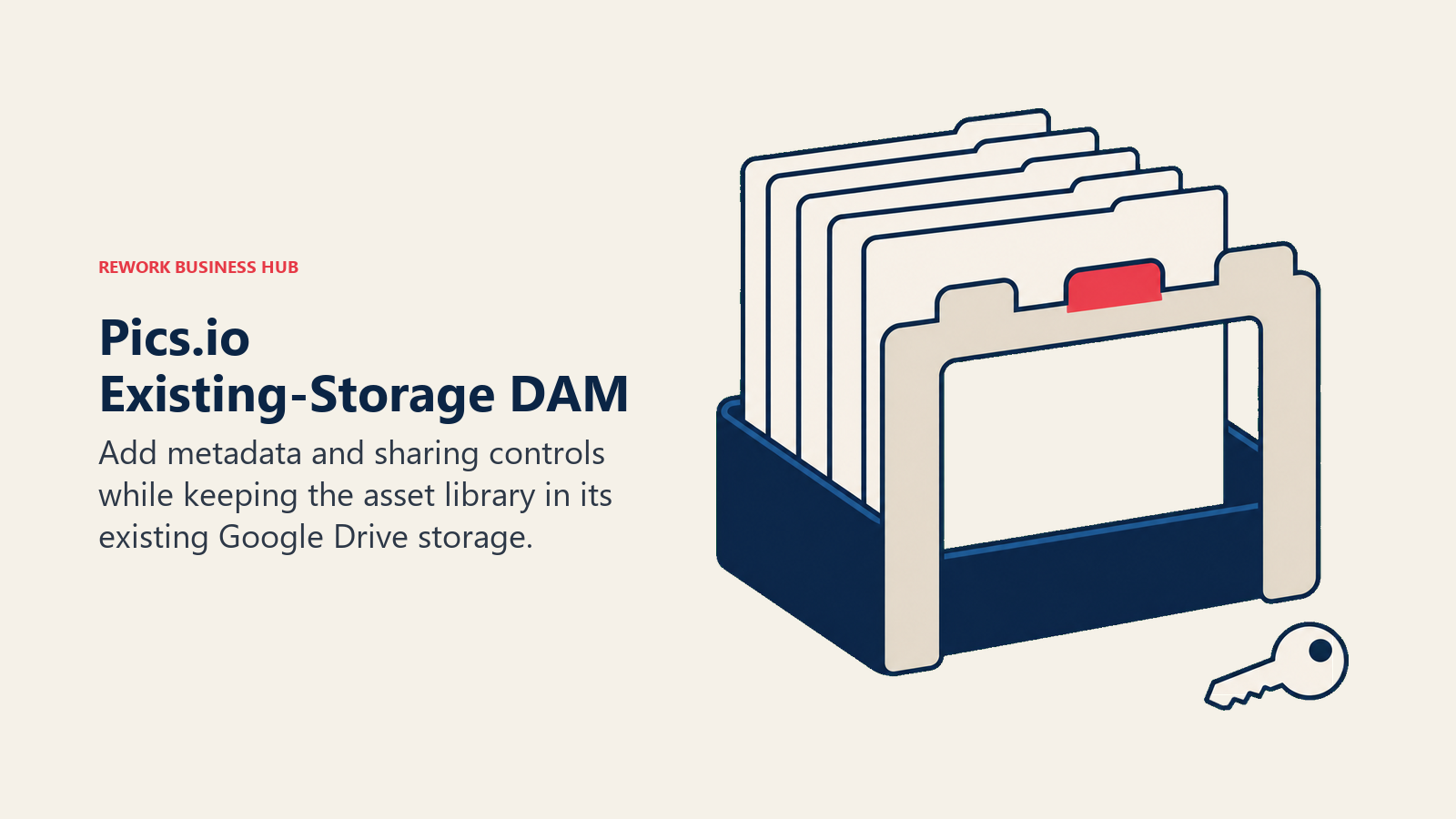
Pics.io takes a different architectural approach entirely: it layers a DAM interface, organization, metadata, versioning, sharing controls, directly on top of Google Drive, which stays the actual storage backend. Assets never move, there's no migration, and no extra fee for the Drive storage space already in use. Pics.io extensions also work inside Google Docs, Slides, Sheets and Forms, putting the media library a click away from wherever a team already works.
Per Pics.io's pricing page: Solo runs $100/mo (monthly billing only, no annual option), Micro $250/mo or $225/mo billed annually ($2,700/yr, 10% off), Small $800/mo or $680/mo billed annually ($8,160/yr, 15% off), and Enterprise is quote-based. AI features are a separate paid add-on priced by asset volume, for example $50/mo for 3,000 assets, $175/mo for 15,000 assets, or $300/mo for 30,000 assets, plus video-minute pricing.
| What You Get | What You Don't |
|---|---|
| Assets stay in Google Drive, no migration or duplicate storage cost | AI tagging and search bundled into the base price |
| Deep native integration with Docs, Slides, Sheets and Forms | A cheaper entry tier below $100/mo |
| Cryptographic access via Google's own API, no separate asset store | Independence from a Google Workspace deployment |
| Meaningful annual discounts on Micro and Small tiers | A published Enterprise number |
Best for: Teams already standardized on Google Workspace that want DAM organization without moving assets off Google Drive.
10. Cloudinary: The Developer-First Image and Video Platform
Cloudinary sells two different things on one pricing page, and mixing them up is the easiest mistake to make when comparing it to Canto. Cloudinary Assets, the actual DAM product, has no published price at all: the DAM tab offers only an Enterprise/Custom plan ("work directly with our expert team to craft a plan") plus a free 30-day trial with 3 users, 1 account and 25GB of storage. Programmable Media, Cloudinary's separate image and video transformation API, does publish prices: Free ($0, 25 monthly credits), Plus ($99/mo or $89/mo billed yearly, 225 monthly credits), Advanced ($249/mo or $224/mo billed yearly, 600 monthly credits), and Enterprise (custom). One credit covers 1,000 transformations, or 1GB of managed storage, or 1GB of image bandwidth, interchangeably, up to the plan's monthly limit.
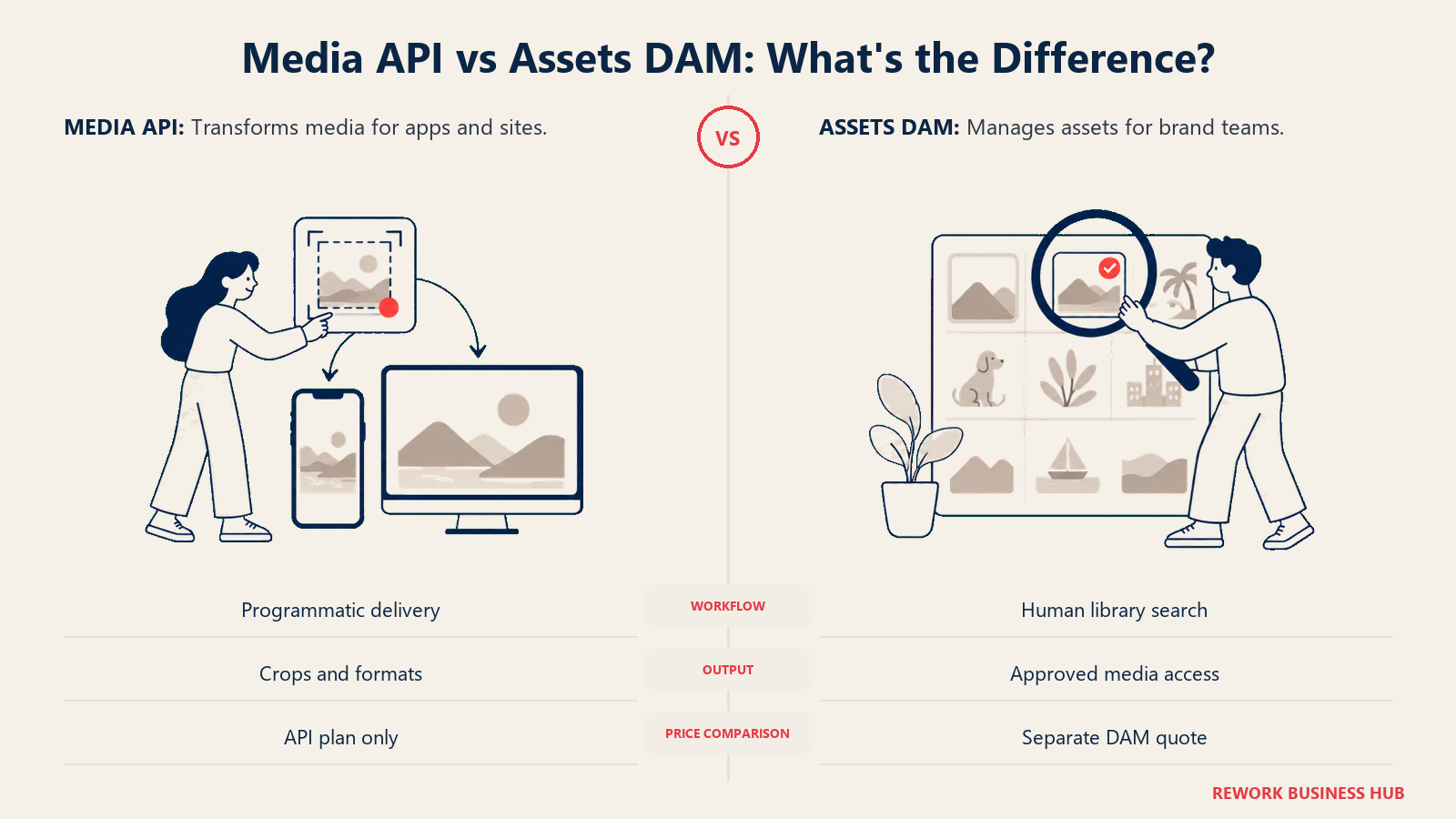
For a marketing or brand team evaluating Cloudinary as a Canto alternative, the relevant product is Assets, and it's quote-only like most of the enterprise tier here. Development-heavy teams that need programmatic image and video transformation alongside asset storage are the ones who get the most out of Cloudinary's dual product line.
| What You Get | What You Don't |
|---|---|
| Best-in-class image and video transformation API | A published price for the actual DAM (Assets) product |
| Flexible, interchangeable credit system on Programmable Media | Simplicity, two products live on one pricing page |
| A genuine free tier to start on Programmable Media | Assets DAM pricing that maps cleanly to Programmable Media's |
| Strong fit for dev-heavy, API-first content pipelines | A brand-team-friendly, no-code-first buying experience |
Best for: Engineering-led teams that need programmatic image and video transformation as much as they need asset storage. See best Cloudinary alternatives if the API side is your primary requirement rather than DAM.
11. Aprimo: The Analyst-Recognized Enterprise Content Operations Platform
Aprimo positions itself less as a file store and more as a full content operations platform, DAM plus marketing work management, with AI agents (its "Agentic DAM" framing) actively enriching and routing content rather than just storing it. It carries the deepest analyst recognition on this list: a Leader in both the 2025 Gartner Magic Quadrant for Digital Asset Management and Marketing Work Management Platforms, and in Forrester's Q1 2026 DAM Wave, where it scored highest of all vendors in the Current Offering category.
Per Aprimo's pricing page, there's no published price. The vendor's own FAQ states it plainly: "Aprimo pricing is based on chosen product(s) and the number of users. Once you get in touch with our team, we create a custom quote to match your exact needs," with packages described as based on users and modules. That depth comes with real process overhead, Aprimo is built for large organizations running complex content operations, not a five-person brand team wanting a simple asset library.
| What You Get | What You Don't |
|---|---|
| Gartner and Forrester Leader status, both current cycles | A published price anywhere on the site |
| AI-driven workflow and content-operations depth | A lightweight rollout |
| End-to-end approval and distribution workflow tooling | Fit for small teams that just need storage and search |
| Modular packaging built around exact product needs | A fast, self-serve path to a number |
Best for: Large enterprises running content operations at scale that want the deepest analyst-verified workflow and governance capability on this list.
12. Pimcore: The Open-Source DAM Plus PIM Platform
Pimcore is the direct answer to Canto's Omni Brand Solution problem: instead of buying DAM and product data management as two separate purchases, Pimcore ships both in one open-source platform, deployable on-premise or in a private cloud. That matters most for product-driven, retail and CPG brands that need product data (SKUs, specs, catalog attributes) sitting next to the images and video that represent each product, rather than syncing two systems by hand.
Per Pimcore's pricing page: Community Edition is free and open source, available on GitHub, with no license fee at all. Professional runs $9,900 per year, and Enterprise runs $29,900 per year, both flat annual licenses with no per-seat or per-storage metering. An Enterprise Edition PaaS or fully tailored deployment is available as a custom quote. Running Pimcore well takes real in-house technical capacity, this isn't a plug-and-play SaaS signup, but for a brand that has that capacity, it's the only platform on this list that avoids the DAM-plus-PIM purchase split entirely.
| What You Get | What You Don't |
|---|---|
| DAM and PIM in one open-source platform | A no-code, plug-and-play SaaS signup |
| A genuinely free Community Edition | Managed hosting on the free tier |
| Flat annual licensing, no per-seat or per-storage metering | A low-touch rollout without technical staff |
| Full control via on-premise or private-cloud deployment | Vendor-run infrastructure and support by default |
Best for: Product-driven, retail and CPG brands with in-house technical capacity that want DAM and PIM under one roof instead of buying Canto's Omni Brand Solution as a separate package.
Sizing and Persona Table
| Tool | Ideal Team Size | Primary Buyer | Secondary Users |
|---|---|---|---|
| Bynder | 200+ (global brand teams) | CMO, VP of Brand or Marketing Ops | Creative directors, regional marketing teams |
| Brandfolder by Smartsheet | 50-1,000+ | Marketing operations lead | Legal, creative, agency partners |
| Acquia DAM (Widen) | 100-1,000+ | Digital experience or marketing IT lead | Product marketing, brand teams |
| MediaValet | 200+ (regulated or Microsoft-standardized) | IT director, compliance lead | Marketing, communications |
| Frontify | 50-500+ | Brand or design systems lead | Marketing, product, agency partners |
| Dash | 5-100 (ecommerce/DTC) | Ecommerce or brand marketing lead | Retail partners, distributors |
| Air | 5-200 (creative-heavy) | Creative director, marketing ops | Designers, content marketers, agencies |
| Filecamp | 2-50 | Marketing or ops manager | Small creative or content teams |
| Pics.io | 2-100 (Google Workspace shops) | Marketing or ops lead | Anyone already living in Google Drive |
| Cloudinary | 10-500+ (dev-heavy) | Engineering lead, dev relations | Marketing (via Assets), content teams |
| Aprimo | 500+ | VP of Marketing Operations, CMO | Content operations, compliance, regional teams |
| Pimcore | 20-500+ (technical capacity required) | IT or digital platform lead | Product marketing, ecommerce merchandising |
Stage Fit Matrix
| Tool | Startup (1-20) | Growth (20-100) | Mid-Market (100-500) | Enterprise (500+) |
|---|---|---|---|---|
| Bynder | Weak | Moderate | Good | Best fit |
| Brandfolder by Smartsheet | Weak | Good | Best fit | Strong |
| Acquia DAM (Widen) | Weak | Moderate | Good | Best fit |
| MediaValet | Weak | Moderate | Good | Best fit |
| Frontify | Moderate | Good | Best fit | Strong |
| Dash | Best fit | Good | Moderate | Weak |
| Air | Best fit | Good | Moderate | Weak |
| Filecamp | Best fit | Good | Weak | Weak |
| Pics.io | Best fit | Good | Moderate | Weak |
| Cloudinary | Moderate | Good | Best fit | Strong |
| Aprimo | Weak | Weak | Moderate | Best fit |
| Pimcore | Weak | Moderate | Best fit (with tech capacity) | Strong |
How to Choose: Decision Framework
| If You Need... | Pick This |
|---|---|
| A published price and unlimited seats, no sales call required | Filecamp or Dash |
| Deep creative review and versioning for a high-output creative team | Air |
| DAM without moving assets off Google Drive | Pics.io |
| An image and video transformation API alongside asset storage | Cloudinary (Programmable Media) |
| DAM and product data (PIM) in one purchase, not two | Pimcore |
| The deepest analyst-verified enterprise content operations platform | Aprimo |
| Brand guidelines and DAM unified, priced by active users | Frontify |
| The simplest interface to hand a non-technical marketing team | Brandfolder by Smartsheet |
| A global brand team's integration ecosystem and analyst-recognized DAM | Bynder |
| Azure-native security and compliance credentials | MediaValet |
| DAM inside a broader digital experience platform | Acquia DAM (Widen) |
| A well-liked mid-market DAM and you're comfortable negotiating a custom quote | Stay on Canto |
What to Do Next
Start from the actual complaint, not a feature list. If it's the missing number, get Filecamp, Dash or Cloudinary's Programmable Media pricing in front of your team this week, all three publish a real figure you can budget against today. If it's the module ladder, Enhanced Collaboration features gated above Core Essentials, price out Brandfolder or Bynder against what your team actually uses day to day, not what a package name implies. And if product data belongs next to your assets, run Pimcore's Community Edition against a real product catalog before committing to a paid tier anywhere. The tool worth paying for is the one whose bill you can predict before it arrives, not just the one with the best demo. For the broader design and creative stack, see best Figma alternatives and best Canva alternatives if design tooling, not just asset storage, is also up for review.

Principal Product Marketing Strategist
On this page
- Key Facts
- Quick Comparison Table
- Why Teams Leave Canto
- What Canto Gets Right
- Canto's Four Packages and What Sits in Each
- How Each Alternative Meters: Users, Storage, Credits or Active Users
- 1. Bynder: The Enterprise Gold Standard, at an Enterprise Process
- 2. Brandfolder by Smartsheet: The Usability Play
- 3. Acquia DAM (Widen): The DXP-Native Option
- 4. MediaValet: The Azure-Native, Security-First Option
- 5. Frontify: The Guidelines-Plus-DAM Platform, Priced by Who Shows Up
- 6. Dash: The Unlimited-Seat Option for Ecommerce Brands
- 7. Air: The Credit-Metered Creative Ops Platform
- 8. Filecamp: The Flat, Storage-Metered Budget Option
- 9. Pics.io: The Google Drive-Native DAM
- 10. Cloudinary: The Developer-First Image and Video Platform
- 11. Aprimo: The Analyst-Recognized Enterprise Content Operations Platform
- 12. Pimcore: The Open-Source DAM Plus PIM Platform
- Sizing and Persona Table
- Stage Fit Matrix
- How to Choose: Decision Framework
- What to Do Next