Best Akeneo Alternatives in 2026: 14 PIM Platforms Compared
Turn this article into takeaways for your work.


Each assistant summarizes the article only for you and suggests best practices for your work.
If your product catalog needs to reach Amazon, your own storefront, a distributor network and a dozen retail partners without four teams re-typing the same attributes, a handful of these platforms actually do that job. Salsify, Syndigo, inriver and Centric PXM run PIM inside a bigger content-syndication or product-experience suite built for enterprise retail and CPG brands. Plytix, Pimberly, Struct PIM and Jasper PIM sell dedicated PIM with a real, published price you can size before you ever talk to sales. Pimcore gives you the same core job as free, open-source software if you have the engineering capacity to run it yourself. And Rework fits the mid-size operator who wants the product record living next to the order, the stock count and the customer instead of syncing between four separate systems. This guide checks all 14 against the wider category, see Best PIM Software in 2026.
The reason to shop around right now usually isn't a missing feature. It's the price wall and the calendar. Akeneo's own compare-packages page lists Growth at "Starting at $0 Annually" behind a free trial, then routes both Advanced and Premium straight to "Call for a quote" with no dollar figure published for either tier. If you're weighing it specifically against the other big enterprise name in the category, see Akeneo vs Salsify. And if you're still self-hosting Akeneo PIM version 7.0, the clock is real: support ends September 30, 2026, three weeks from today, which turns "we'll look at this eventually" into an actual migration deadline. Sort yourself into one of three honest bands before reading further: published-price tools you can budget before a sales call (Plytix, Pimberly, Struct PIM, Jasper PIM, Pimcore), quote-only enterprise peers that trade one quote wall for another (Salsify, inriver, Syndigo, Stibo Systems, Centric PXM, Sales Layer, Bluestone PIM, Productsup), and open source if you have the engineering capacity (Pimcore Community Edition).
Key Facts
- Akeneo PIM version 7.0 reaches end of support on September 30, 2026, after which Akeneo stops issuing technical support and bug or security patches for it. (Akeneo)
- The global product information management market is valued at $6.74 billion in 2026 and is projected to reach $20.66 billion by 2034, a 15.00% CAGR. (Fortune Business Insights)
- The average documented online shopping cart abandonment rate is 70.22%, per Baymard Institute's aggregate of 50 studies. (Baymard Institute)
- 83% of online shoppers say they're likely to abandon a site or product page that doesn't give them the information they want, per PIM vendor Syndigo's State of Product Experience 2026 survey of 8,736 adults. (Syndigo)
- 80% of shoppers in the same Syndigo study say inaccurate product information damages their perception of a brand, and 76% say they're more likely to return to brands that get product content right. (Syndigo)
Quick Comparison Table
| Tool | Best For | Starting Price | Key Strength | Key Limitation |
|---|---|---|---|---|
| Salsify | Enterprise brands syndicating to hundreds of retail partners | No published price (pricing page redirects to the homepage) | Deep retailer syndication plus AI content tools | No pricing page at all, not even a range |
| Plytix | Small and mid-size brands wanting a real free tier | Free (Standard); Pro $499/mo | Genuine free plan with unlimited seats | Pro caps out at 50,000 SKUs |
| Pimcore | Teams with engineering capacity wanting open source | Community Edition free; Professional $9,900/year | Free, open-source core with paid support tiers | Running the free tier means owning the infrastructure |
| inriver | Enterprise brands needing syndication and DAM together | No published price ("Get in touch" on every tier) | Purpose-built API syndication platform | All four named plans are quote-only |
| Sales Layer | Mid-market sellers who want published seat and SKU ceilings | No published price, but tier limits are public | User and SKU caps published per tier | Still requires a sales call for the actual figure |
| Rework | Mid-size operators unifying product data with CRM and commerce | Quote on request (rework.com/pricing) | Product record sits beside orders, stock and the customer | Not a dedicated enterprise PIM or syndication network |
| Pimberly | Mid-market retailers wanting enterprise structure with public numbers | Regular $36,000/year | Every tier's SKU, user and storage limit is published | Entry price is a real annual commitment |
| Syndigo | CPG brands needing syndication to thousands of retailers | No published price ("Talk to Sales" only) | Retailer and marketplace syndication network at scale | No pricing page anywhere on the site |
| Struct PIM | Multi-language, multi-locale catalogs | Basic from €2,200/month | Unlimited SKUs, catalogs and attributes on every tier | Cost scales with languages and users instead |
| Centric PXM | Fashion, CPG and luxury brands wanting PIM, DAM and syndication together | No published price | Broad product-experience suite inherited from Contentserv | Still settling in after a 2025 acquisition and rebrand |
| Stibo Systems | Enterprises needing product data inside multidomain MDM | No published price | True MDM depth across product, customer and supplier domains | Heavier and slower to implement than a pure PIM |
| Bluestone PIM | Teams wanting usage-based pricing over flat tiers | No published price (usage-based) | "Never pay for more than you use" pricing model | Still a quote to learn the actual number |
| Productsup | Sellers whose core problem is feed and marketplace management | No published price | Transparent about exactly what drives a quote | Feed-management heritage, thinner governance depth |
| Jasper PIM | Smaller teams wanting a clear monthly number | Growth $999/mo | Published per-month pricing with no SKU cap listed | Fewer sales channels included at the entry tier |
Understanding What You're Leaving: Akeneo's Price Wall and the September 2026 Deadline
Akeneo's tier names changed, and if you're researching pricing based on an older article, that's the first thing to fix. It's Growth, Advanced and Premium now, not the old Growth and Enterprise pair. All three SaaS tiers include one activation channel for syndicating product experiences, with additional channels sold as add-ons. Growth's page reads "Starting at $0 Annually" next to a "Start Free Trial" button, which is a free-trial framing rather than a usable price. Advanced and Premium both read "Call for a quote," with no dollar figure anywhere on the page. No user, SKU, locale or product-record limits are published for any paid tier either, so there's genuinely nothing to size yourself against before a sales call.
The quote wall does guard real capability, worth naming plainly. Advanced adds Collaboration Workflows, Advanced Rights Management and Channel-Ready Data Governance over Growth. Premium adds PX Insights (one data source), Enterprise Governance with SIEM, 24/7 support and the Agentic Ziggy AI assistant. Separately named add-ons include Supplier Data Manager, DAM, Digital Showroom AI, and connector apps for Salesforce Commerce Cloud, Adobe Commerce and Shopify, none of them priced on the page either.
| Cost component | What Akeneo publishes | What that means for budgeting |
|---|---|---|
| Growth subscription | "Starting at $0 Annually," a free-trial placeholder | Not a usable number for planning |
| Advanced subscription | "Call for a quote" | You cannot benchmark it without a sales call |
| Premium subscription | "Call for a quote" | Same, plus you don't know what SIEM-grade governance actually costs |
| Activation channels beyond the first | Not published | A real cost driver for any multi-channel seller |
| Add-ons (Supplier Data Manager, DAM, Digital Showroom AI, connectors) | Named, not priced | First-year cost is genuinely unknowable from the site alone |
| Implementation and onboarding | Not published | A services cost you'll only learn about mid-negotiation |
Here's what several integrator blogs get wrong, and what you shouldn't repeat: Akeneo Community Edition was not discontinued. The akeneo/pim-community-dev GitHub repository shipped version 2026.4 on 28 August 2026, and endoflife.date lists that release as current and supported. What's true, and worth knowing before you commit to self-hosting, is narrower: only the latest release receives bug and security fixes, and Akeneo has warned since version 2026.1 that breaking changes may land in any release, from one point release to the next. Self-hosters should pin an exact version in their dependency file rather than tracking a range, and budget real engineering time for testing each upgrade.
The genuinely dated reason to act now sits separately from that debate. Akeneo PIM version 7.0 reaches end of support on September 30, 2026, three weeks from today. After that date, Akeneo stops providing technical support and bug or security patches for it. If you're still self-hosting v7, that's not a someday problem anymore, it's a this-month one, whether the destination is an upgrade to a newer Akeneo release or a move to one of the platforms below.
Which Alternatives Actually Replace Akeneo's Governance and Workflow Depth
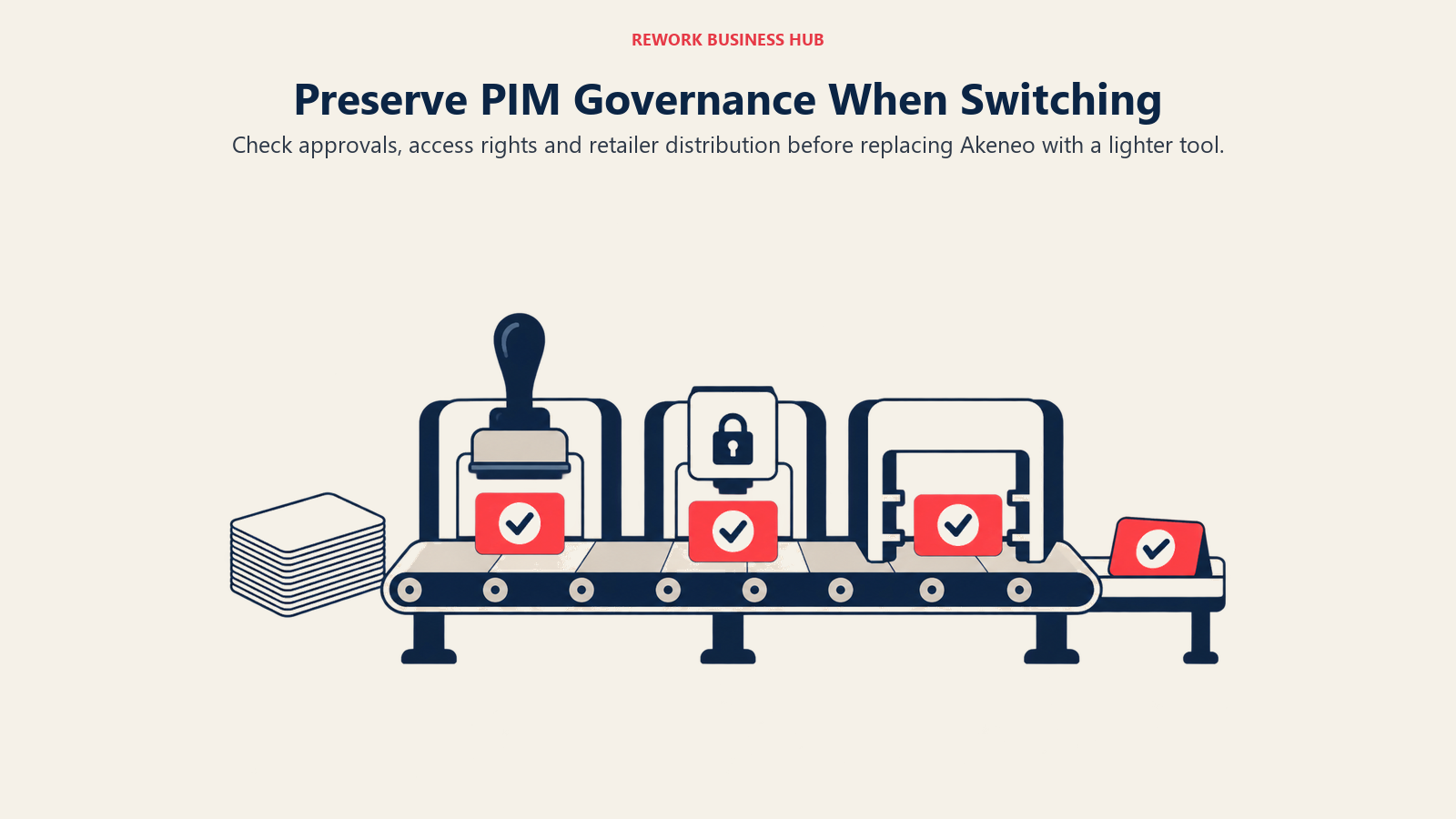
This is the migration risk most roundups skip. Akeneo's quote wall isn't guarding nothing, it's guarding collaboration workflows, rights management and data governance that a cheaper, published-price tool may not replicate. Swapping Akeneo for a tool with a clear invoice can still leave a real capability gap if governance depth is what your team actually uses today. Check the table below against your current setup before you sign anything.
| Tool | Collaborative workflows | Advanced rights and governance | Built-in AI enrichment | Retailer syndication network |
|---|---|---|---|---|
| Salsify | Yes | Yes | Yes (Angie assistant) | Yes, at enterprise scale |
| Plytix | Basic | Basic | Yes (credit-based) | No |
| Pimcore | Yes (workflow engine) | Yes | Limited | No |
| inriver | Yes | Yes | Limited | Yes |
| Sales Layer | Yes | Basic | Yes (AI Hub) | No |
| Rework | Not built for this | Basic | No | No |
| Pimberly | Basic | Basic | Yes (paid add-on) | No |
| Syndigo | Yes | Yes | Yes | Yes, 3,500+ retailers |
| Struct PIM | Yes | Yes | Limited | No |
| Centric PXM | Yes | Yes | Yes | Yes |
| Stibo Systems | Yes, MDM-grade | Yes, the deepest here | Limited | No |
| Bluestone PIM | Basic | Yes | Limited | No |
| Productsup | No, feed-focused | Basic | Limited | Yes, feed and marketplace |
| Jasper PIM | Basic | Basic | Limited | No |
1. Salsify: The Enterprise Peer With No Pricing Page At All
Salsify is the name most Akeneo evaluators put on the same shortlist, because it solves an adjacent version of the same problem: unify product content and push it accurately to every retailer, marketplace and channel a brand sells through. Founded in 2012 and headquartered in Boston, Salsify says it supports more than 2,000 customers and publishes roughly 750 million product records across thousands of commerce destinations. The company built its "Angie" conversational AI assistant and a broader Intelligence Suite on top of that data, positioning itself as a Product Experience Management (PXM) platform rather than a narrower PIM. In July 2026, private equity firm Cinven agreed to acquire Salsify, citing its cloud-native platform and high customer retention as the draw for backing its next growth phase. Terms were not disclosed and the deal remains subject to regulatory approval, so treat Salsify as a vendor mid-ownership-change rather than one that has already changed hands.
None of that comes with a number. Type salsify.com/pricing into a browser and it 301-redirects straight to the homepage. There isn't a pricing page, a range, or even a "starting at" placeholder anywhere on the site: every evaluation starts with a demo request.
| What you get | What you don't |
|---|---|
| Deep retailer and marketplace syndication at real scale | Any pricing page, range, or placeholder figure |
| An AI assistant (Angie) built into content workflows | A self-serve trial or fast, no-sales evaluation |
| A large customer base and a stated 750 million product records | Ownership change in progress: the Cinven deal was agreed in July 2026 and is still subject to closing |
| PXM-level positioning beyond a narrow PIM | A published answer to "how much does this cost" |
Pricing: No published price. salsify.com/pricing redirects to the homepage; every quote starts with a sales conversation. Best for: Enterprise brands syndicating complex catalogs to hundreds of retail partners who already expect a bespoke quote. Not ideal for: Buyers who want to compare a published number before booking a demo. See Akeneo vs Salsify for the direct head-to-head.
2. Plytix: The Real Free Tier in This Category
Plytix is where a lot of Akeneo evaluators land after realizing they were pricing an enterprise platform for a mid-market catalog. It covers the core PIM job, centralizing product data, enriching it, and syndicating to marketplaces, storefronts and print, with an interface built for teams without a dedicated PIM administrator, and its AI features run on a credits system rather than a flat "AI included" claim.

Plytix publishes its tiers directly on its pricing page. Standard is genuinely free: 500 SKUs, 500 AI credits a month, 5,000 API calls an hour, 50 GB of file storage, and unlimited seats. Pro runs $499/month for 50,000 SKUs, the same 500 monthly AI credits, 15,000 API calls an hour and 750 GB of storage, still with unlimited seats. Enterprise is custom, for unlimited SKUs and multi-account setups. All plans bill monthly with no long-term contract, and Shopify and BigCommerce connectors ship free; Product feeds and templates, Brand Portals, and Product Data Sheets are each $300, $300 and $200 a month as separate add-ons. One nuance worth stating plainly: the price is the same number worldwide, Plytix's page just swaps the currency symbol by visitor location, showing $499 to a US buyer and €499 to a European one.
| What you get | What you don't |
|---|---|
| A genuinely free Standard plan, not a trial | Unlimited SKUs below the custom Enterprise tier |
| Unlimited seats on every plan, including free | Deep workflow or rights-management depth |
| Published add-on prices for feeds, portals and data sheets | AI credits beyond 500/month without a top-up |
| Monthly billing with no contract lock-in | The enterprise governance features Akeneo's higher tiers add |
Pricing: Standard free (500 SKUs); Pro $499/month (50,000 SKUs); Enterprise custom. Billed monthly, cancel any time. Best for: Small and mid-size brands who want to run the numbers themselves before ever booking a call. Not ideal for: Catalogs past 50,000 SKUs, where you're already into custom Enterprise pricing anyway.
3. Pimcore: Free and Open Source, If You Can Run It
Pimcore is the honest open-source answer to an Akeneo Community Edition question, and Community Edition on Community Edition is a fair fight: both are free, self-hosted, and require you to own the operational overhead. Pimcore's platform actually reaches wider than PIM alone, bundling MDM, DAM and a headless digital experience layer on one open data model, which suits a team that wants product data, digital assets and content management to live in the same system rather than three. See Best Digital Asset Management Software in 2026 if DAM is the half of that pull that matters most to you.
Pimcore publishes three commercial tiers plainly: Community Edition is free and open source. Professional runs $9,900 per year. Enterprise runs $29,900 per year. A PaaS option is custom, described as "tailored to you." None of the three charges per seat or per product, and running more than four production instances moves you into a custom quote regardless of tier. That's a genuinely different economic model from every SKU-metered or user-metered competitor on this list, Akeneo included.
| What you get | What you don't |
|---|---|
| A free, open-source core with no per-seat or per-product fee | Vendor-run hosting or support on the free tier |
| PIM, MDM, DAM and DXP on one open data model | A quick, no-code setup out of the box |
| Published Professional and Enterprise prices | Included implementation, that's a separate cost |
| No SKU-count penalty for growing your catalog | The polish of a purpose-built, single-function SaaS PIM |
Pricing: Community Edition free; Professional $9,900/year; Enterprise $29,900/year; PaaS custom. Best for: Teams with in-house engineering capacity who want PIM, DAM and content management on one open platform without per-product fees. Not ideal for: Teams without engineering resources to self-host, patch and maintain the free tier.
4. inriver: Syndication-First PIM With No Number on Any Tier
inriver was founded in Malmo, Sweden in 2007, and it's built its identity around syndication speed: an API-based syndication platform it markets as the first in the PIM category to offer that architecture, consolidating channel connections into a hub instead of point-to-point integrations. The company says it now employs more than 300 people and powers over 1,600 global brands, with DAM plug-ins built into the same platform so product content and digital assets travel together to each channel.
Every published plan routes to a quote. inriver names four tiers, Foundation, Core, Professional and Enterprise, each showing "Get in touch" rather than a figure, and the page describes every plan as "fully customizable." That's four named tiers and zero dollar amounts, a more granular version of exactly the wall Akeneo's Advanced and Premium put up.
| What you get | What you don't |
|---|---|
| Purpose-built, API-first syndication architecture | A published figure on any of its four tiers |
| DAM plugged directly into the PIM platform | A self-serve or trial path |
| A track record with 1,600+ brands | Any way to size cost before a sales conversation |
| Four named tiers matching different syndication maturity | A published entry price even at Foundation |
Pricing: No published price. Foundation, Core, Professional and Enterprise all show "Get in touch." Best for: Enterprise brands whose core requirement is syndication speed and depth, paired with DAM. Not ideal for: Buyers who want to compare a number before a conversation, since even the entry tier is quote-only.
5. Sales Layer: The Quote-Only Vendor That Still Tells You the Ceiling
Sales Layer positions itself as an "agentic" PIM built around AI-assisted enrichment: an AI Hub that translates content, rewrites product text, fills empty fields and flags errors across a catalog, plus an MCP server that connects a Sales Layer catalog to Claude, ChatGPT or any other MCP-compatible AI tool. It targets B2B manufacturers and distributors with complex, attribute-heavy catalogs, and G2 users have voted it "The Easiest PIM to Use" in past category surveys.
Sales Layer doesn't publish a dollar figure on any of its four named plans, all shown as "Get a quote." What it does publish, unusually for a quote-only vendor, are the caps: Scale tops out at 5 users and 10,000 SKUs, Premium at 10 users and 50,000 SKUs, Enterprise at 35 users and 200,000 SKUs, with Enterprise Plus available on request above that. Connector coverage widens by tier too: Premium adds Shopify, BigCommerce and Amazon, and Enterprise adds PrestaShop, Adobe Commerce and WooCommerce. Its FAQ states clients can choose annual payment or monthly instalments.
| What you get | What you don't |
|---|---|
| Published user and SKU ceilings for every tier | A published dollar figure on any tier |
| AI Hub for enrichment plus a native MCP server | A self-serve signup |
| Connector coverage that widens predictably by tier | Certainty on price until you talk to sales |
| A choice of annual or monthly instalment payment | The scale of Salsify or Syndigo's retailer network |
Pricing: No published price. Scale (5 users, 10,000 SKUs), Premium (10 users, 50,000 SKUs) and Enterprise (35 users, 200,000 SKUs) are all "Get a quote." Best for: B2B manufacturers and distributors who want AI-assisted enrichment and can size themselves against published caps before calling. Not ideal for: Buyers who need an exact number without a sales conversation.
6. Rework: Product Data Next to the Order, the Stock Count and the Customer
Rework's Product module runs product operations inside the same platform as its Sales CRM, Lead, Commerce, Inventory, Invoice, Work Ops and People apps. In practice, that means the product record central to Akeneo's job (attributes, variants, channel-ready content) sits next to the order it eventually appears on, the stock count behind it and the customer buying it, rather than syncing between a standalone PIM, a separate commerce platform and a CRM through integrations that each drift out of sync in their own way. For sellers running Commerce alongside Product, see Best Order Management Software in 2026 for how the two connect, and Best CRM Software in 2026 if the deeper question is which system owns the customer record.
Here's the distinction worth stating plainly. Rework is not a dedicated enterprise PIM, and it doesn't try to be. It doesn't ship retailer syndication to a GDSN network or the 3,500-plus retailer reach a vendor like Syndigo sells, and it isn't built as a standalone MDM platform for a global CPG brand publishing into hundreds of retail partners. If that's the job Akeneo was doing for you, Salsify, Syndigo or Stibo Systems is the more honest comparison. If your Akeneo spend was really funding a product catalog that then had to be re-synced into your CRM, your commerce platform and your inventory system, that's the gap Rework is built to close.
| What you get | What you don't |
|---|---|
| Product data on the same platform as CRM, commerce, inventory and invoicing | Retailer syndication to a GDSN network or thousands of channels |
| One login instead of a PIM wired to a separate CRM and commerce stack | A dedicated MDM platform for multi-domain enterprise governance |
| Work Ops and People on the same platform for cross-team operations | A published price you can benchmark before a conversation |
| A fit built for mid-size operators, not a global CPG rollout | A free tier or a fit for a solo seller |
Pricing: Quote on request. Pricing for Rework Product is quoted per organization; see rework.com/pricing. Best for: Mid-size operators (roughly 10 to 200 people) who want product data unified with their CRM, commerce and inventory instead of synced across separate tools. Not ideal for: Global CPG brands needing retailer syndication at scale, or teams whose Akeneo spend is really buying multidomain MDM governance. Rework is not that platform, and solo or single-user sellers aren't the fit either.
7. Pimberly: Enterprise-Style Tiers With Every Number Published
Pimberly was founded in Manchester, UK in 2015 and has since raised over £14 million to fund its US expansion, with customers including Westcoast, JD Sports, Build-A-Bear and Chefs' Warehouse among its roughly 157-customer base. It pairs PIM with DAM in one platform, aimed at brands and retailers who want a single system for centralizing, enriching and syndicating product data at commerce scale.
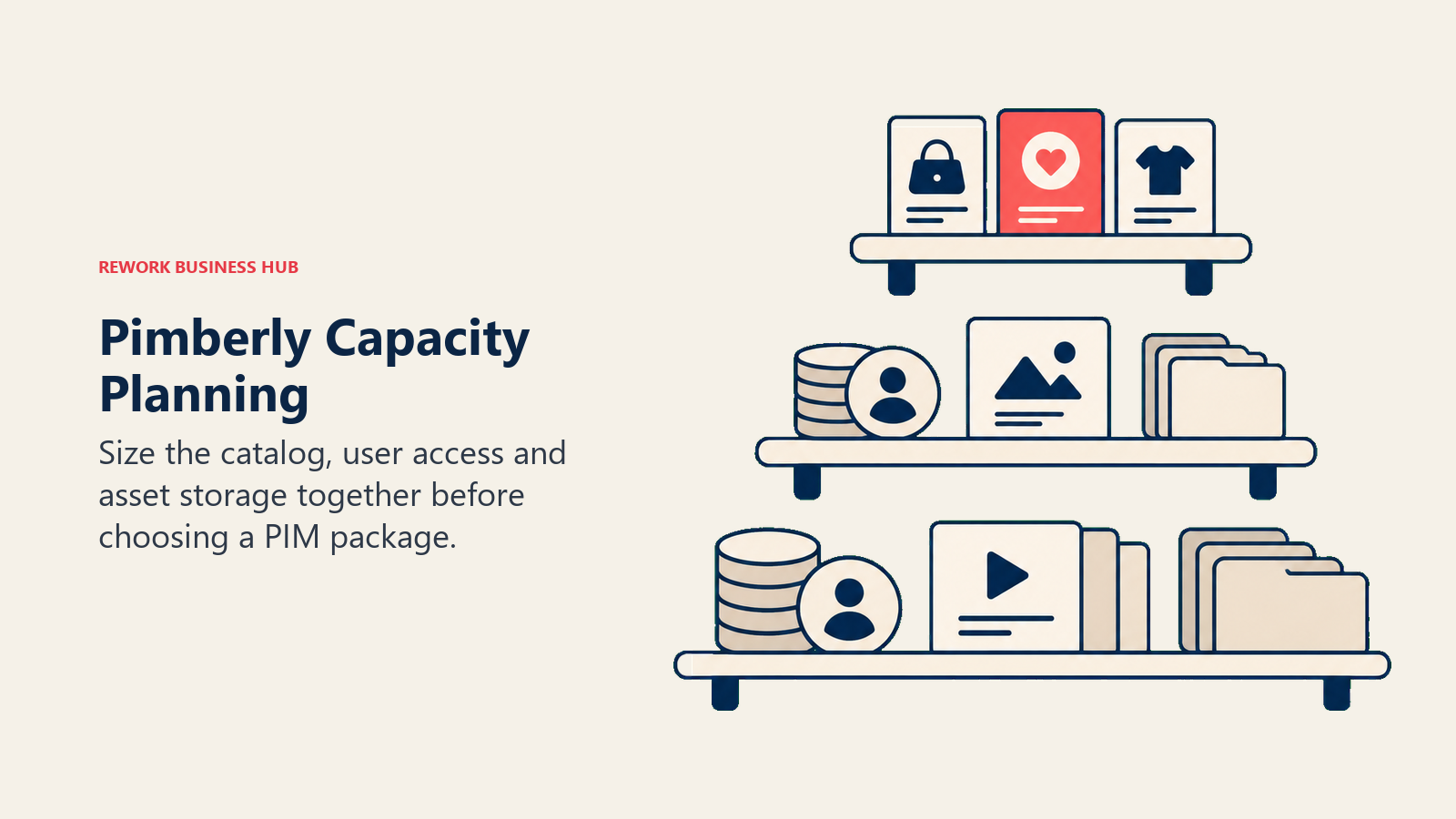
What sets Pimberly apart from most of this list is that its enterprise-style pricing is entirely public. Regular runs $36,000 a year for 50,000 SKUs, 20 users and 3 TB of storage. Pro runs $60,000 a year for 100,000 SKUs, 50 users and 10 TB. Corporate runs $90,000 a year for 250,000 SKUs, 100 users and 20 TB. Enterprise, for unlimited scale, is "Contact for quote." Add-ons are published too: Product Data Sheets and Customer Connect each start from $15,000 a year, Pimberly AI from $7,500 a year, and Pimberly Catalog from $30,000 a year.
| What you get | What you don't |
|---|---|
| Every SKU, user and storage limit published per tier | A tier under five figures a year |
| PIM and DAM together in one platform | A free trial you can self-serve into |
| Published add-on prices instead of a bundled black box | Flexibility below the Regular tier's 50,000-SKU floor |
| A real customer base across retail and consumer brands | The lowest entry price on this list |
Pricing: Regular $36,000/year, Pro $60,000/year, Corporate $90,000/year, Enterprise "Contact for quote." Add-ons from $7,500 to $30,000/year. Best for: Mid-market retailers who want an enterprise-shaped platform but need to see the number before committing budget. Not ideal for: Small catalogs or teams not ready for a five-figure annual commitment.
8. Syndigo: The Retailer Network at the Top of the Category
Syndigo traces back to Gladson, a Chicago-based company that consolidated a run of acquisitions (Edgenet, ItemMaster, Webcollage, and later 1WorldSync) under the Syndigo brand starting in 2019, building what it now positions as a content-and-syndication network reaching more than 3,500 retailers and marketplaces. Beyond PIM, the platform bundles MDM, rich media management and analytics, and it runs its own primary research arm, publishing the State of Product Experience report cited earlier in this guide.
Syndigo publishes no pricing page in its navigation or footer at all, only a "Talk to Sales" path. For an Akeneo buyer specifically frustrated by two quote-only tiers, moving to Syndigo trades that frustration for an even less transparent starting point, since Akeneo at least states Growth's structure even if the number is a placeholder.
| What you get | What you don't |
|---|---|
| Syndication reach to 3,500+ retailers and marketplaces | Any pricing page, anywhere on the site |
| MDM, rich media and analytics bundled with PIM | A published starting figure or range |
| A primary research arm producing category data | A fast, self-serve evaluation path |
| The scale to serve major CPG and retail brands | Transparency, notably, given its own research on trust |
Pricing: No published price. No pricing page in the navigation or footer; every path leads to "Talk to Sales." Best for: Large CPG and retail brands needing syndication at the top end of the category. Not ideal for: Buyers looking to escape Akeneo's quote wall, since Syndigo's is more opaque, not less.
9. Struct PIM: Unlimited SKUs, Metered by Language Instead
Struct is a Danish company headquartered in Odense, founded in 2013, and its platform lets teams model any product data structure without code, then distribute it to ecommerce platforms, ERPs, marketplaces and print through a large connector library and a REST API. Customers cited on its own site include STARK, KOMPAN, PanzerGlass, Salling Group and Nilfisk, positioning it toward mid-market and enterprise brands managing complex catalogs across multiple markets and languages.
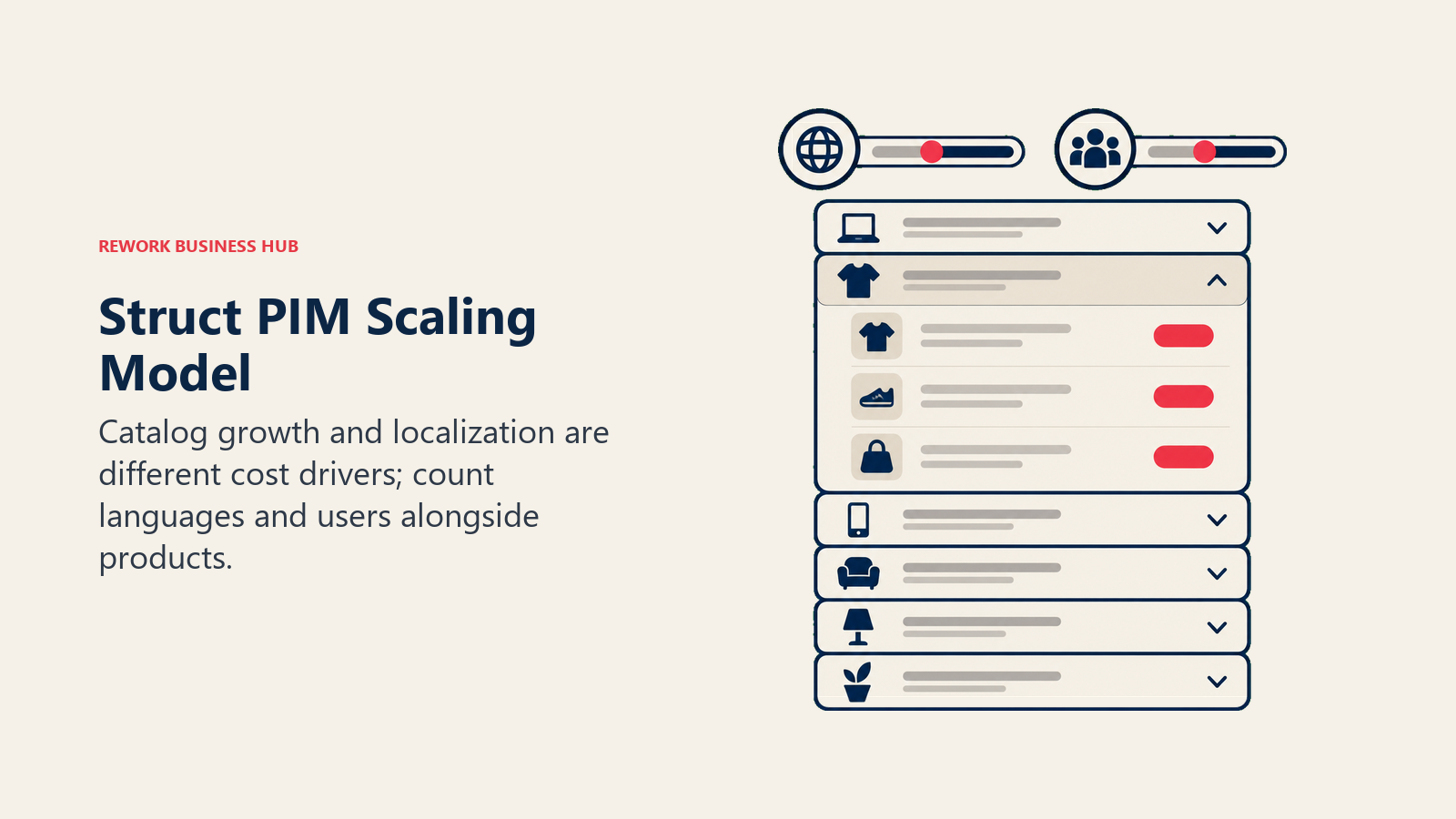
Its pricing is genuinely different from the rest of this list in one specific way: SKUs, catalogs, product models and attributes are unlimited on every tier. Struct meters languages and users instead. Basic starts from €2,200 a month for 3 languages and 5 users, Professional from €3,430 a month for 10 languages and 30 users, Premium from €4,650 a month for unlimited languages and users, and Enterprise is custom. Extra languages cost €200 a month and extra users €70 a month. The site's currency selector also offers USD, GBP and DKK.
| What you get | What you don't |
|---|---|
| Unlimited SKUs, catalogs and attributes on every tier | A published price under roughly €2,200/month |
| No-code data modeling for complex product structures | A cap-free bill; languages and users still meter cost |
| A large connector library into ecommerce, ERP and print | A free tier or a low entry point for small catalogs |
| Published per-extra-language and per-extra-user rates | US-dollar-first pricing, EUR is the base currency |
Pricing: Basic from €2,200/month (3 languages, 5 users); Professional from €3,430/month; Premium from €4,650/month (unlimited languages and users); Enterprise custom. Best for: Multi-language, multi-market catalogs that would otherwise pay per SKU as the product count grows. Not ideal for: Small teams or single-language catalogs, where the monthly floor is high relative to the job.
10. Centric PXM (formerly Contentserv): The Renamed Suite for Fashion, CPG and Luxury
Contentserv spent years building a name in fashion, luxury goods, footwear, home and CPG before Centric Software, a Dassault Systèmes company, announced its acquisition of the business on 25 February 2025, at an enterprise value of €220 million. The product now ships as Centric PXM, unifying PIM, DAM, syndication and digital shelf analytics in one AI-driven suite aimed at the same industries Centric already served through its retail planning software.
Get the naming right if you're evaluating it: it is not an independent vendor anymore, and it was not discontinued, it changed owner and name. Centric PXM publishes no price; every path from its site leads to a sales conversation. For a buyer coming from Akeneo, the pitch is a wider, more retail-specific suite in exchange for the same quote-only starting point you're trying to leave.
| What you get | What you don't |
|---|---|
| PIM, DAM, syndication and digital shelf analytics in one suite | A published price on any tier |
| Deep vertical expertise in fashion, luxury and CPG | Independence, it's now owned by Centric Software |
| AI-driven content enrichment and localization | A clean, single-product brand after the 2025 rename |
| Backing from Dassault Systèmes-owned Centric Software | A fast or self-serve evaluation |
Pricing: No published price. Every evaluation starts with a sales conversation. Best for: Fashion, luxury, footwear and CPG brands wanting PIM, DAM and syndication combined under one retail-focused vendor. Not ideal for: Buyers who want a stable, long-established brand name. It changed hands and identity in 2025.
11. Stibo Systems (STEP): When the Real Job Is Multidomain MDM, Not Just PIM
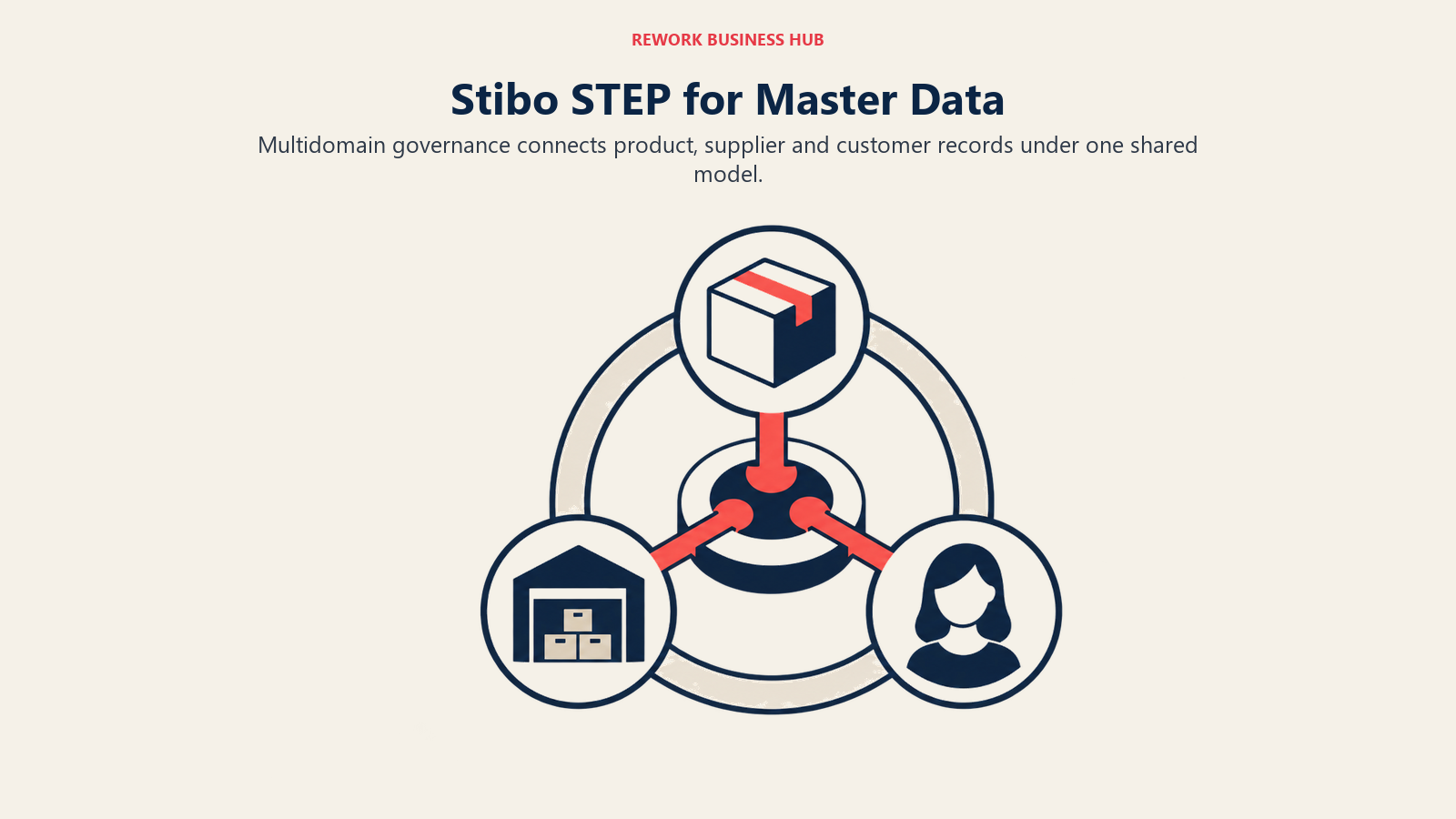
Stibo Systems sells STEP as multidomain master data management, meaning product data sits alongside customer, supplier, location and asset data under one governance model, connected to ERP and CRM systems through more than 100 prebuilt connectors. That's a meaningfully bigger job than a PIM does on its own, and it's the right comparison if what actually frustrates you about Akeneo isn't product content specifically, it's that product, supplier and customer data all live in different systems that don't agree with each other.
Stibo Systems publishes no pricing anywhere. There's no tier structure, no range, and no self-serve path; every engagement starts as a sales and implementation conversation, which tracks with the platform's positioning as a heavier, longer-implementation enterprise system rather than a quick PIM swap.
| What you get | What you don't |
|---|---|
| True multidomain MDM across product, customer and supplier data | Any published price or tier structure |
| Over 100 prebuilt ERP and CRM connectors | A quick or lightweight implementation |
| Governance depth beyond what a pure PIM attempts | A fast, self-serve evaluation |
| A fit for enterprises with data scattered across systems | A fit for a team that just needs product content managed |
Pricing: No published price. Every engagement starts with a sales and scoping conversation. Best for: Enterprises whose real problem spans product, customer and supplier data, not product content alone. Not ideal for: Teams that just need a straightforward PIM swap; this is a heavier, slower implementation by design.
12. Bluestone PIM: Usage-Based Pricing, With the Catch Still a Quote
Bluestone PIM was built in 2016 on MACH principles (microservices-based, API-first, cloud-native and headless), and it leans into that architecture harder than most peers: more than 700 documented APIs with full parity to its own user interface, meaning the admin screen your team uses is just another client of the same public API a partner portal or AI agent would call. That's a genuine answer to a specific Akeneo complaint, that the UI and the API don't always expose the same capability.
Its FAQ states the pricing model plainly even without a number: "Our price model is based on usage, so you never pay for more than you use," quoted against users, SKUs and languages, with typical contract lengths of 3 to 12 months. No figures are published anywhere on the site, so "usage-based" describes the shape of the bill, not its size.
| What you get | What you don't |
|---|---|
| A genuinely headless, API-first architecture (700+ APIs) | Any published price or usage rate |
| Usage-based pricing tied to actual users, SKUs and languages | A tier you can compare before a quote |
| Shorter typical contracts (3 to 12 months) than most enterprise PIM | Retailer syndication network depth |
| No gap between what the UI and the API can do | A self-serve trial |
Pricing: No published price. Usage-based on users, SKUs and languages, with 3 to 12 month typical contracts. Best for: Technical teams wanting a true headless architecture and pricing that tracks actual usage rather than a flat tier. Not ideal for: Buyers who want to see a number, any number, before a sales call.
13. Productsup: Built for Feeds and Marketplaces First, Governance Second
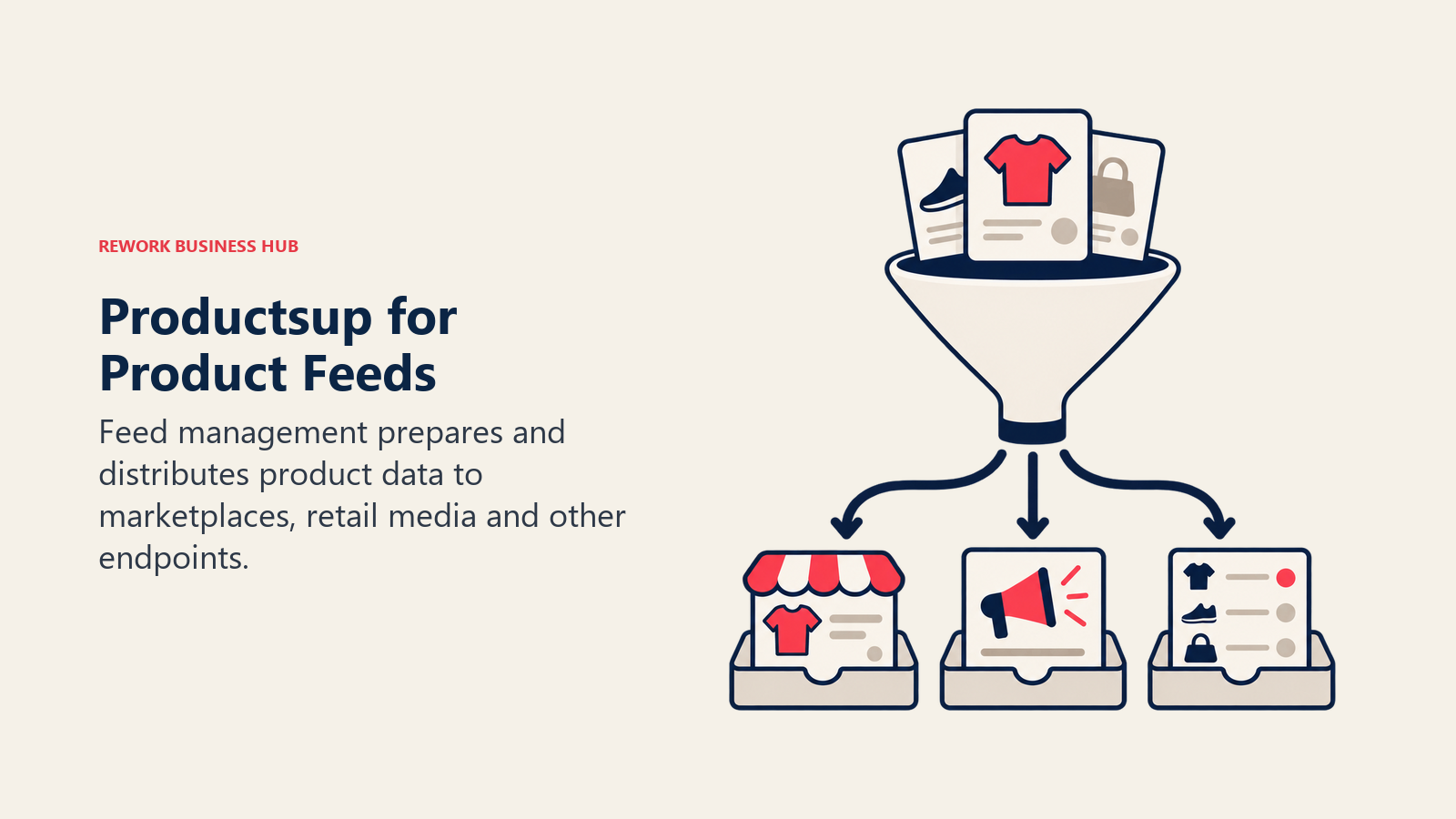
Productsup was founded in Berlin in 2010 and has grown into a large-scale feed management and syndication platform, serving more than 900 global brands and retailers including IKEA, Walmart, Superdry and Rakuten, and processing what it describes as over two trillion products a month across its network. Its core strength is genuinely upstream of most PIMs: getting product feeds correctly structured, enriched and delivered to marketplaces, comparison shopping engines and ad platforms like Amazon, Walmart, Google and Facebook at volume.
Productsup publishes no dollar figure, but its site is unusually direct about what actually drives the quote: the number of products, the number of feeds, the number of platform modules, sync frequency, number of seats, number of countries and any special requirements. That's a more honest quote-only page than most, even without a number on it.
| What you get | What you don't |
|---|---|
| Feed management and marketplace syndication at real scale | Any published price or range |
| Explicit, stated variables behind every quote | The deep data-governance and workflow depth Akeneo has |
| A track record with major global retail brands | A self-serve trial path |
| Proven volume: 2+ trillion products processed monthly | A core PIM feature set as the primary focus |
Pricing: No published price. The site names the exact variables a quote depends on: products, feeds, modules, sync frequency, seats, countries and special requirements. Best for: Sellers whose real bottleneck is feed and marketplace management rather than product-data governance. Not ideal for: Buyers who need Akeneo-level workflow and rights-management depth; that's not Productsup's core focus.
14. Jasper PIM: A Clear Monthly Price, Under New Ownership
Jasper PIM markets itself as a straightforward SaaS repository for product data: import, validate, enrich and export, synced two ways across the sales channels and storefronts a merchant already runs. It's aimed at scaling merchants and omnichannel retailers who want multistore, multilingual and multichannel support without the implementation weight of an enterprise platform. In a genuine ownership change worth knowing before you sign anything, Venzee Technologies agreed on 31 October 2025 to buy the Jasper PIM business from Digital Commerce Payments and closed the deal on 31 December 2025 for CAD$2.85 million in shares, with a proposed rename to JasperX Technologies. The product site now brands itself JasperX.
On pricing, Jasper is one of the few names on this list that states a monthly number outright. Growth runs $999/month in USD for 2 sales channels and 5 hours of onboarding. Professional runs $1,999/month for 8 sales channels, 10 hours of onboarding, API access, a staging environment and workflow tools. Enterprise is custom, for unlimited channels and 20 hours of onboarding. No SKU or seat cap is published at any tier.
| What you get | What you don't |
|---|---|
| A clear monthly USD price on two named tiers | More than 2 or 8 sales channels below Enterprise |
| No published SKU or seat limit | Deep workflow or rights-management maturity |
| Included onboarding hours at every tier | Long operating history under one owner (acquired end of 2025) |
| API access and a staging environment on Professional | Retailer syndication network depth |
Pricing: Growth $999/month (2 channels); Professional $1,999/month (8 channels); Enterprise custom. Best for: Smaller merchants who want a real monthly number and don't need dozens of sales channels. Not ideal for: Buyers who want assurance from a long, stable single-owner history; the business changed hands at the end of 2025.
Sizing and Persona Fit
| Company size | Typical catalog | Best-fit picks | Who owns it |
|---|---|---|---|
| 1 to 10 people | Under 5,000 SKUs | Plytix, Jasper PIM | Founder or marketing generalist |
| 10 to 50 people | 5,000 to 50,000 SKUs | Plytix, Struct PIM, Rework, Sales Layer | Ecommerce or product data manager |
| 50 to 200 people | 50,000 to 250,000 SKUs | Pimberly, Struct PIM, Bluestone PIM, Rework | Head of ecommerce or digital |
| 200+ people, retail-heavy | Any, syndication-critical | Salsify, Syndigo, inriver, Centric PXM | VP of digital or product experience |
| 200+ people, governance-heavy | Any, multi-domain | Stibo Systems, Pimcore Enterprise | IT director or data governance lead |
| Engineering-capable, any size | Any | Pimcore Community Edition, Bluestone PIM | Platform or data engineering team |
Stage Fit Matrix
| Stage you're in | What actually hurts | Where to look |
|---|---|---|
| Outgrowing spreadsheets and shared drives | No single source of truth for product content | Plytix, Jasper PIM |
| Adding marketplace channels fast | Manual re-entry per channel eats a role | Sales Layer, Pimberly, Struct PIM |
| Scaling toward hundreds of retail partners | Syndication depth becomes the bottleneck | Salsify, Syndigo, inriver |
| Product, customer and supplier data disagree | The problem is bigger than product content | Stibo Systems |
| Consolidating a messy commerce stack | Product data lives apart from orders, stock and the CRM | Rework |
| Self-hosted on v7.0, support ending this month | A real, dated migration deadline | Any published-price tool, or Pimcore if staying open source |
Why Teams Leave Akeneo (and Why Plenty Stay)
Akeneo earns its position honestly, worth saying before the complaints. Its data model is genuinely flexible, its Community Edition gives a real, actively maintained open-source path most enterprise PIM vendors don't offer at all, and for a brand that's already built workflows and integrations around it, the switching cost is real. Teams that have invested years into Akeneo's rules engine and channel configuration often price the alternative and stay.
The reasons teams look anyway:
The published price doesn't exist. Growth's "Starting at $0 Annually" is a free-trial framing, not a number you can budget against, and Advanced and Premium both route straight to a sales call. You can't put Akeneo on the same spreadsheet as Plytix, Pimberly or Jasper PIM when only the alternatives have numbers.
The tier names moved. Buyers researching "Akeneo Enterprise pricing" are searching for a tier that no longer exists; it's Growth, Advanced and Premium now. That alone sends people back to Google mid-evaluation.
Self-hosting the free edition carries real, ongoing cost. Community Edition wasn't discontinued, and anyone telling you it was is wrong, but only the latest release gets security and bug fixes, and Akeneo has warned since version 2026.1 that breaking changes can land in any release. That means real engineering time spent pinning versions and testing upgrades, not a one-time migration.
Version 7.0 has a real, dated deadline. Support ends September 30, 2026. If you're still self-hosting v7, that's an actual reason to move now rather than "eventually," whether the destination is a newer Akeneo release or a different vendor entirely.
Product data accuracy is the real stake, not the subscription line. 83% of shoppers say they'll abandon a page missing the information they need, per Syndigo's own research, and the average cart abandons at 70.22% industry-wide, per Baymard Institute. A migration that saves a few thousand dollars a year and introduces bad product data for a quarter has lost money on day one.
How to Choose: Decision Framework
| If you need... | Best pick |
|---|---|
| A real free tier you can run before committing budget | Plytix |
| Open-source PIM with no per-seat or per-product fee | Pimcore |
| Deep retailer syndication at enterprise scale | Salsify |
| Syndication paired tightly with DAM | inriver |
| Published seat and SKU ceilings without a full published price | Sales Layer |
| Product data unified with CRM, commerce and inventory | Rework |
| Enterprise-style tiers with every number public | Pimberly |
| Syndication to thousands of retailers and marketplaces | Syndigo |
| Unlimited SKUs, metered by language and user instead | Struct PIM |
| PIM, DAM and syndication for fashion, CPG or luxury | Centric PXM |
| True multidomain MDM beyond product data alone | Stibo Systems |
| A genuinely headless, usage-based architecture | Bluestone PIM |
| Feed and marketplace management as the core job | Productsup |
| A clear monthly number for a smaller catalog | Jasper PIM |
For the wider category view rather than a single incumbent, see Best PIM Software in 2026. If your bigger operational question is order management rather than product content, Best Order Management Software in 2026 covers that layer, and Best Inventory Management Software in 2026 is the right page if stock accuracy is the actual pain. For DAM specifically, see Best Digital Asset Management Software in 2026, Best Bynder Alternatives or Best Canto Alternatives.
What to Do Next
Write down the one thing that actually pushed you to search for an alternative. If it's the invisible price, shortlist the tools that publish their numbers, Plytix, Pimberly, Struct PIM, Jasper PIM and Pimcore, and price each against your real SKU count and language list, not a marketing example. If it's the September 30 deadline on a self-hosted v7 instance, treat that as fixed and work backward: decide within the next two weeks whether you're upgrading Akeneo itself or migrating out, because "later this year" is now "this month." If your actual complaint is that product data lives apart from your orders, stock and customer record, put Rework on the shortlist alongside a dedicated PIM. And if your bigger operational gap is on the order-management side of the same stack, Best Linnworks Alternatives covers that consolidation problem too. Whatever you pick, migrate one product family and one channel first, reconcile the data by hand, and only then move the rest, because the real cost of a PIM migration is never the subscription, it's the week your product pages go live with the wrong attributes.

Principal Product Marketing Strategist
On this page
- Key Facts
- Quick Comparison Table
- Understanding What You're Leaving: Akeneo's Price Wall and the September 2026 Deadline
- Which Alternatives Actually Replace Akeneo's Governance and Workflow Depth
- 1. Salsify: The Enterprise Peer With No Pricing Page At All
- 2. Plytix: The Real Free Tier in This Category
- 3. Pimcore: Free and Open Source, If You Can Run It
- 4. inriver: Syndication-First PIM With No Number on Any Tier
- 5. Sales Layer: The Quote-Only Vendor That Still Tells You the Ceiling
- 6. Rework: Product Data Next to the Order, the Stock Count and the Customer
- 7. Pimberly: Enterprise-Style Tiers With Every Number Published
- 8. Syndigo: The Retailer Network at the Top of the Category
- 9. Struct PIM: Unlimited SKUs, Metered by Language Instead
- 10. Centric PXM (formerly Contentserv): The Renamed Suite for Fashion, CPG and Luxury
- 11. Stibo Systems (STEP): When the Real Job Is Multidomain MDM, Not Just PIM
- 12. Bluestone PIM: Usage-Based Pricing, With the Catch Still a Quote
- 13. Productsup: Built for Feeds and Marketplaces First, Governance Second
- 14. Jasper PIM: A Clear Monthly Price, Under New Ownership
- Sizing and Persona Fit
- Stage Fit Matrix
- Why Teams Leave Akeneo (and Why Plenty Stay)
- How to Choose: Decision Framework
- What to Do Next