Best Avoma Alternatives in 2026: 14 Tools for Revenue Teams Beyond a Notetaker
Turn this article into takeaways for your work.


Each assistant summarizes the article only for you and suggests best practices for your work.
If you're shopping for an Avoma alternative, you're most likely leaving for one of two reasons: you want more, a full enterprise revenue intelligence stack like Gong or Clari, or you want less, a plain notetaker without a bill that quietly triples once you add the modules that made you buy a conversation intelligence tool in the first place. This guide covers 14 tools across both directions, evaluated for revenue teams specifically, not general meeting-notes buyers. Where a vendor doesn't publish pricing at all, that's stated plainly instead of guessed at.
Avoma's pitch is real: conversation intelligence, revenue intelligence, and meeting scheduling in one platform instead of three separate purchases. The problem buyers report isn't the pitch, it's the bill. Avoma's Startup plan starts at $19 per recorder seat a month billed annually, but the Conversation Intelligence and Revenue Intelligence add-ons that make Avoma worth buying over a plain notetaker run $29 per seat a month each, and Lead Router adds another $19. Stack the two intelligence add-ons onto the base plan and a team pays close to $77 per seat a month, roughly four times the number on the pricing page that got them to sign up. That gap, plus no standing free tier and only a 14-day trial, is what sends revenue teams shopping. If your team is still deciding whether it needs a revenue-focused tool at all versus a general meeting assistant, our Best AI Meeting Assistants and Notetakers roundup covers the broader category these 14 tools sit inside.
Key Facts
- Sellers who effectively partner with AI tools are 3.7 times more likely to meet quota than those who don't, per Gartner's September 2024 sales survey.
- By 2028, Gartner predicts AI agents will outnumber human sellers 10 to 1, yet fewer than 40% of sellers expect to report those agents actually improved their productivity, per Gartner's November 2025 prediction.
- 87% of sales organizations now use some form of AI for tasks like prospecting, forecasting, lead scoring, or drafting emails, per Salesforce's State of Sales 2026 report.
- Sales organizations that give sellers AI-enabled next-best-actions are 2.6 times more likely to achieve commercial growth, per Gartner's May 2026 survey.
- Growth leaders who embed AI directly into core sales workflows point to seller efficiency (59%) and better customer experiences (53%) as the top payoffs, per McKinsey's 2026 B2B Pulse Survey.
Quick Comparison Table
| Tool | Best For | Starting Price | Key Strength | Key Limitation |
|---|---|---|---|---|
| Gong | Enterprise revenue teams (50+ reps) wanting deal analytics at scale | Quote-only (reported $100-140/seat/mo) | Deepest coaching and deal-risk data in the category | No published pricing, six-figure annual floor is common |
| Clari | CROs and RevOps who need forecast accuracy more than call review | Quote-only (reported $100-310/seat/mo) | Revenue Copilot ties forecasting to actual pipeline signals | Module stack (Core, Copilot, Groove) hides true cost |
| ZoomInfo Chorus | Teams already paying for ZoomInfo who want one fewer vendor | Bundled, quote-only (reported $40-80/seat/mo standalone) | Contact and intent data from ZoomInfo lands next to the call | Analytics depth thins outside Salesforce/ZoomInfo stack |
| Salesloft | Teams wanting cadence, dialer, and call intelligence in one login | Quote-only (reported $100-165/seat/mo) | Conversation data feeds directly into the same engagement flow | Dialer is a separate add-on, implementation fees are real |
| Momentum | RevOps wanting AI-driven CRM hygiene without Gong's price tag | $69/user/mo (Business) | Auto-updates CRM fields and Slack deal rooms from calls | Conversation intelligence itself is a $30/user/mo add-on |
| Sybill | Deal desks wanting CRM autofill straight from the call | $30/user/mo (Pro, monthly) | 10-field CRM autofill and deal-risk signals in Ask Sybill | Autofill only unlocks on the $90/user/mo Business tier |
| Jiminny | Sales managers building a structured coaching culture | Quote-only (reported ~$85-100/user/mo) | Purpose-built coaching workflows and call scoring | No published pricing, 12-month minimum contract typical |
| Modjo | EMEA-based revenue teams wanting a Europe-native platform | Quote-only (reported ~$99-108/user/mo) | Strong GDPR posture and deep Salesforce/HubSpot sync | No free trial, typical seat minimum around 15 |
| Grain | Small revenue teams wanting affordable coaching, not just notes | $19/seat/mo (Starter) | Real coaching features at a fraction of Gong's price | Business-tier depth and pricing aren't public |
| Attention | Enterprise teams wanting calls to auto-fill CRM in real time | Quote-only (reported $25K-200K+/yr) | Live battlecards and CRM field automation during the call | No self-serve tier at any team size |
| Fireflies.ai | Budget-conscious sales orgs wanting CRM-synced call data | Free; Pro $10/seat/mo | Native Salesforce, HubSpot, Pipedrive, Zoho sync | AI Credits cap automations separately from transcription |
| tl;dv | Teams wanting real coaching scorecards without enterprise pricing | Free; Pro $18/user/mo | Business tier adds objection-handling and win/loss analysis | Business jumps to $59/user/mo, more than 3x Pro |
| Otter.ai | Teams wanting a searchable transcript archive company-wide | Free; Pro $8.33/user/mo | Deep full-text search across every meeting on record | Thinner native CRM sync than Fireflies or tl;dv |
| Fathom | Teams that want to try real AI notes before paying anything | Free; Team $15/user/mo | Unlimited free recording, 90-day money-back guarantee | CRM sync and coaching gated behind the $25/user/mo tier |
The True Cost: Sticker Price vs. What You Actually Pay
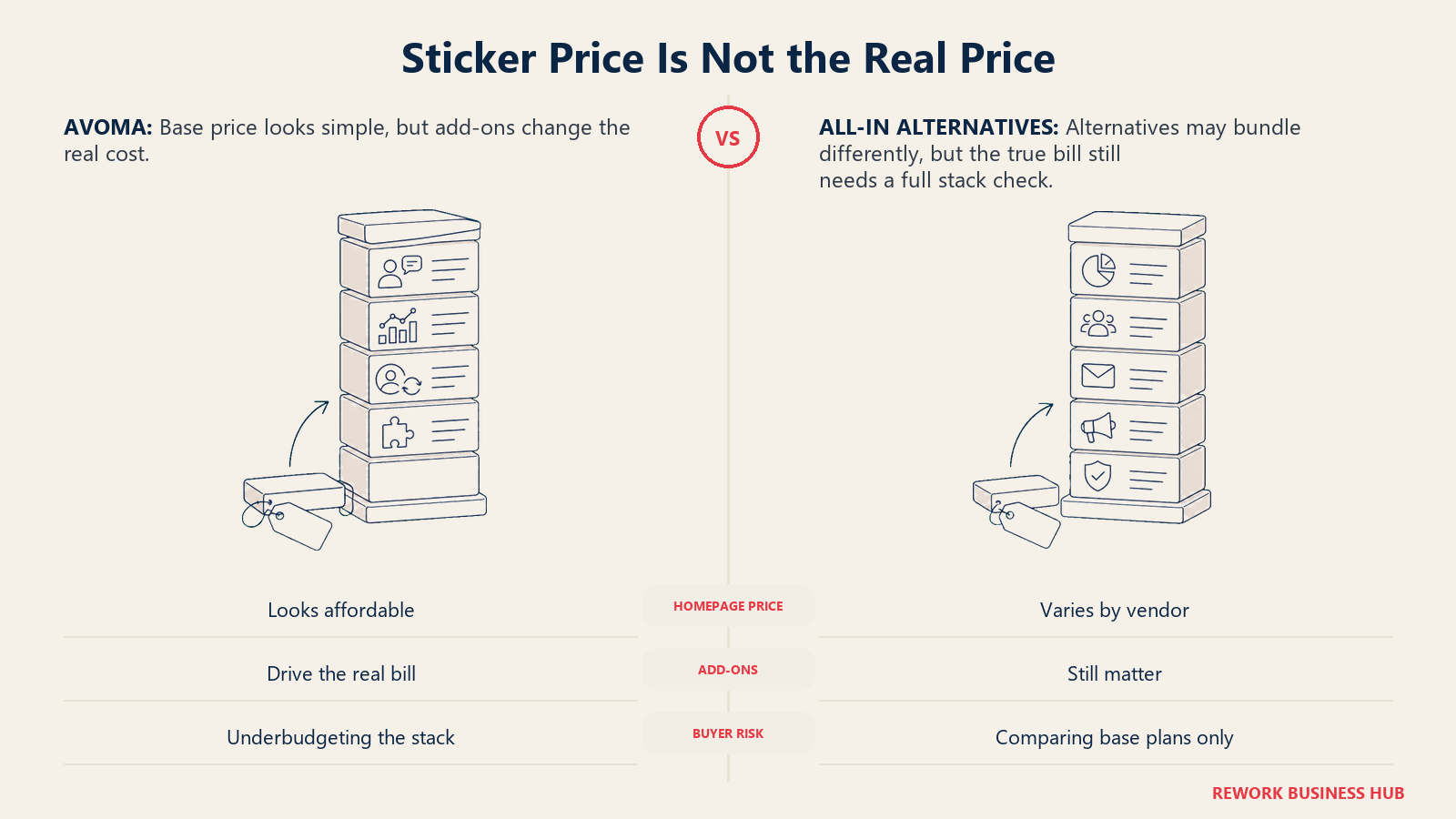
This is the table that matters most if you're leaving Avoma over its add-on stacking. Every tool in this category has a sticker price that looks reasonable on the homepage and a realistic cost once you add what a revenue team actually needs (coaching, CRM sync, deal intelligence). The gap between the two is the whole story.
| Tool | Sticker Price | Realistic All-In Cost | What Drives the Gap |
|---|---|---|---|
| Avoma (for reference) | $19/seat/mo (Startup) | ~$77/seat/mo | CI + RI add-ons at $29/seat/mo each on top of the base plan |
| Gong | "Contact sales" | ~$100-140/seat/mo + platform fee (reported) | Per-user license plus a separate platform fee, annual minimums |
| Clari | "Contact sales" | ~$100-310/seat/mo (reported) | Core, Copilot, and Groove are sold as separate modules |
| ZoomInfo Chorus | "Bundled" | ~$40-80/seat/mo if unbundled (reported) | Cost is invisible while ZoomInfo is under contract, real once it isn't |
| Salesloft | "Contact sales" | ~$100-185/seat/mo + $40-60 dialer add-on (reported) | Dialer, AI forecasting tier, and $5K-15K implementation stack on |
| Momentum | $69/user/mo (Business) | ~$99-129/user/mo | Transformation tier and the $30/user/mo CI add-on for coaching |
| Sybill | $30/user/mo (Pro) | $90/user/mo (Business) | CRM autofill, the reason most buyers want Sybill, is Business-only |
| Jiminny | "Contact sales" | ~$85-100/user/mo + setup fee (reported) | 12-month minimum contract and a one-time setup fee |
| Modjo | "Contact sales" | ~$99-108/user/mo, ~15-seat minimum (reported) | Seat minimum multiplies the bill even for a small team |
| Grain | $19/seat/mo (Starter) | ~$29 to $48/seat/mo (reported) | Coaching and deal-board features gated above Starter |
| Attention | "Contact sales" | $25K-200K+/year (reported) | No self-serve tier exists at any team size |
| Fireflies.ai | $10/seat/mo (Pro) | $19/seat/mo (Business) | AI Credits cap automations on Pro, Business is needed at real volume |
| tl;dv | $18/user/mo (Pro) | $59/user/mo (Business) | Coaching scorecards, the sales-specific reason to buy tl;dv, are Business-only |
| Otter.ai | $8.33/user/mo (Pro) | $19.99/user/mo (Business) | Per-meeting and monthly minute caps force an upgrade at real call volume |
| Fathom | Free | $25/user/mo (Business) | CRM field sync and AI scorecards only exist on the top paid tier |
Seven of these 14 tools, Gong, Clari, ZoomInfo Chorus, Salesloft, Jiminny, Modjo, and Attention, don't publish pricing at all. That's not unusual for enterprise revenue software, but it means every number in the "reported" rows above comes from third-party procurement data, not a vendor-confirmed rate. Get a real quote before you build a budget around any of them.
Team Size and Sales Maturity Fit
| Team Size | Sales Maturity | Best Fits |
|---|---|---|
| 1-10 reps | Founder-led, no formal process | Fathom, Grain, Fireflies.ai |
| 10-50 reps | Defined stages, first sales managers hired | Fireflies.ai, tl;dv, Otter.ai, Sybill, Grain |
| 50-200 reps | Structured coaching, RevOps function exists | Momentum, Jiminny, Modjo, Salesloft, ZoomInfo Chorus |
| 200+ reps | Multi-team, board-level forecast accountability | Gong, Clari, Salesloft, Attention |
| Already on ZoomInfo or Salesloft | Outbound-driven, reducing vendor count | ZoomInfo Chorus, Salesloft |
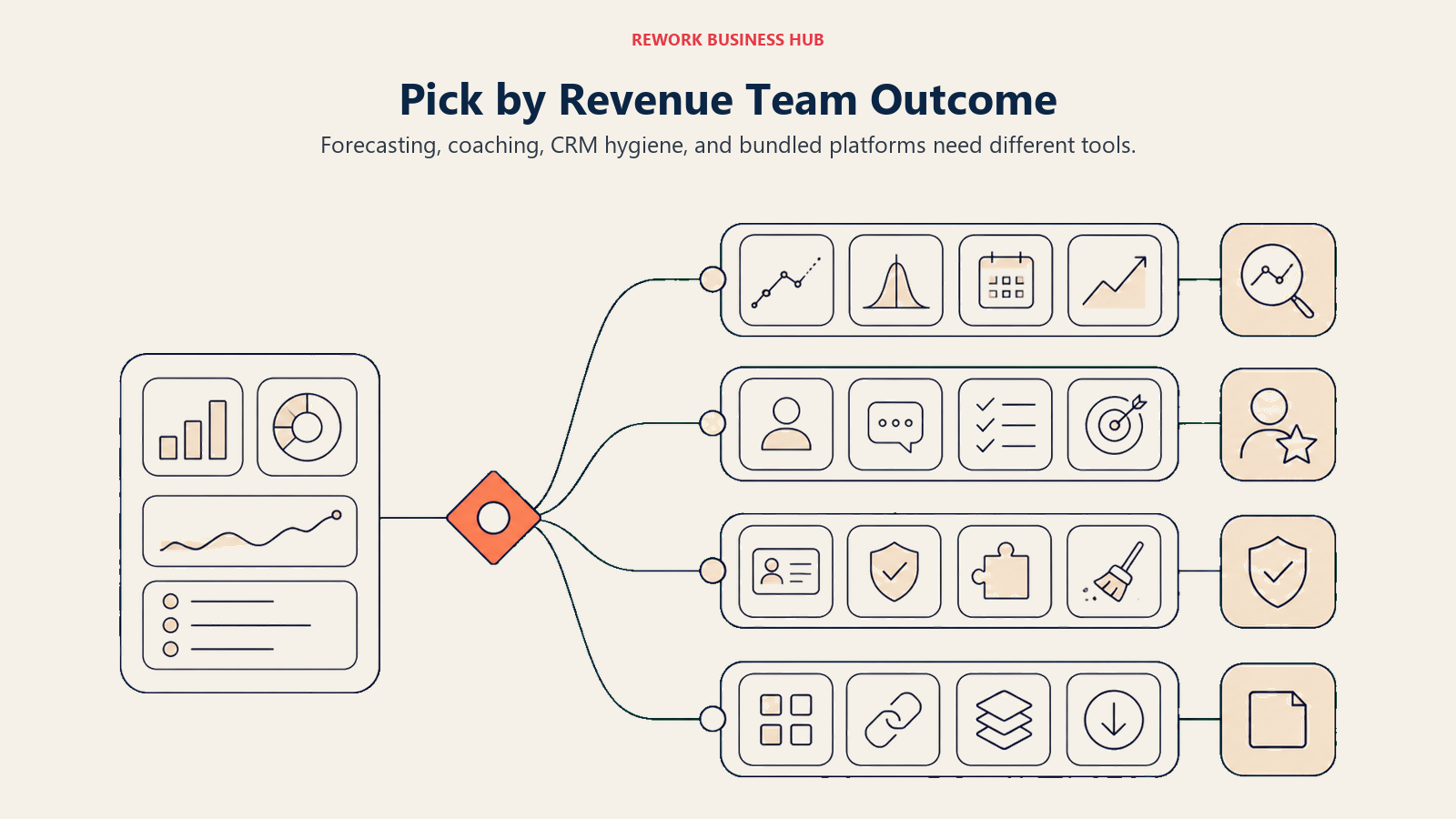
How to Choose: Framework by Primary Use Case
| Use Case | What Matters Most | Best Fits |
|---|---|---|
| Board-ready forecast accuracy | Pipeline risk signals tied to CRM data, not gut feel | Clari, Gong |
| Rep coaching at scale | Scorecards, call libraries, manager review workflows | Gong, Jiminny, Momentum |
| CRM fields updating themselves | No manual data entry after a call | Attention, Sybill, Momentum |
| One less vendor to manage | Bundled into a platform you already pay for | ZoomInfo Chorus, Salesloft |
| Coaching on a mid-market budget | Real coaching features, not enterprise pricing | tl;dv, Grain, Fireflies.ai |
| Fast recall with no coaching layer | Full-text search across a team's meeting history | Otter.ai, Fireflies.ai |
| Trying before committing to anything | A real free tier, not a disguised trial | Fathom, Grain, Fireflies.ai, Otter.ai |
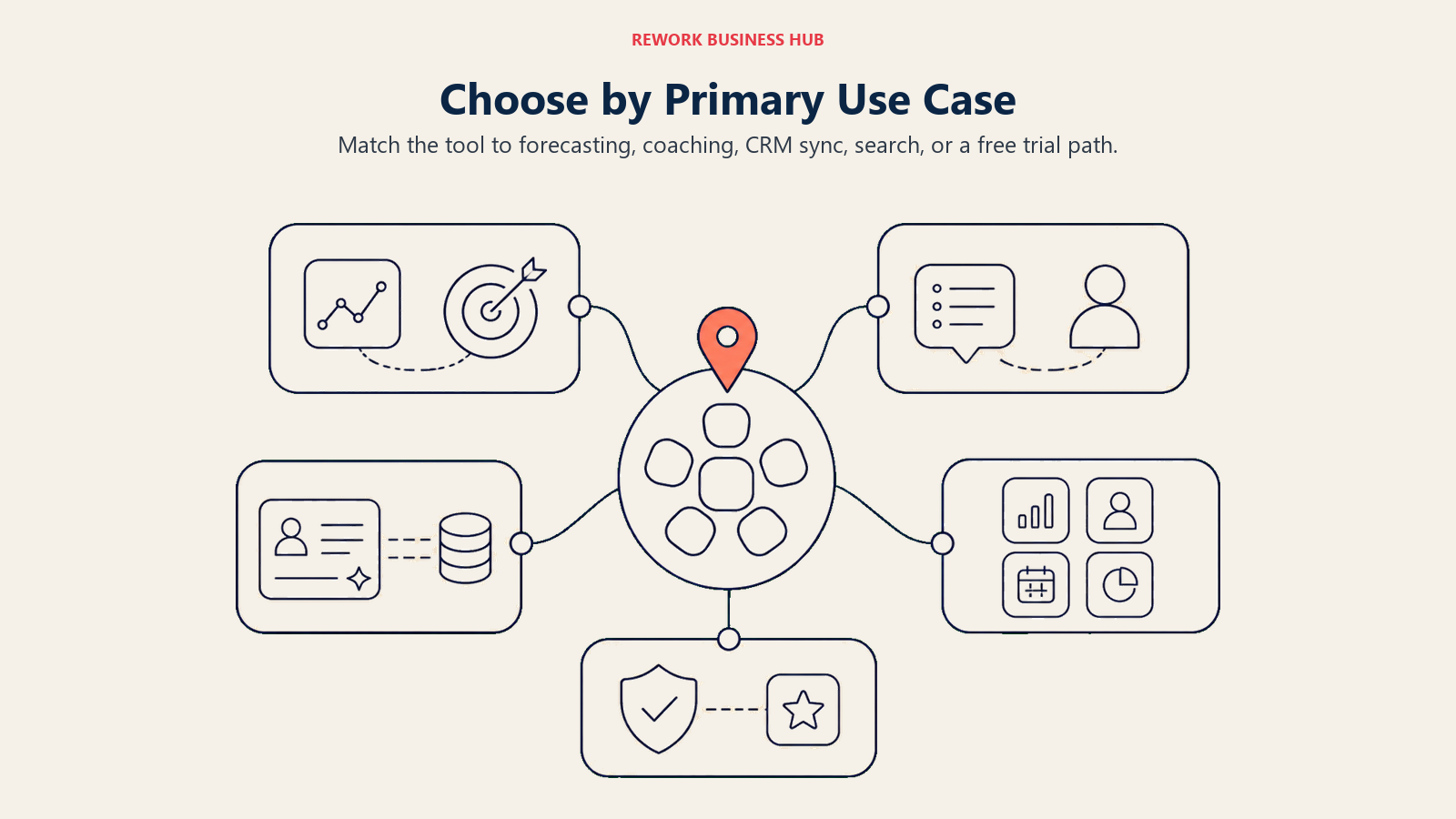
Before you evaluate any of these against Avoma, it helps to know where each one actually sits in the broader AI sales stack. Our Best AI Tools for Sales roundup covers how conversation intelligence fits alongside prospecting, forecasting, and outreach tools, and Best AI Tools for SDRs is worth a look if the reps doing the most calling are still ramping.
1. Gong: Enterprise Revenue Intelligence at Scale
Gong's whole design philosophy is that a call is data, and data compounds when you have enough of it. With years of call history across thousands of customers, Gong's deal-risk models, topic trackers, and market-intelligence features have a training-data advantage that newer entrants can't match yet. That shows up most clearly in coaching: managers work from AI-flagged moments (a buried pricing objection, a competitor mention nobody responded to) instead of randomly sampling calls.
The tradeoff is the one you already know if you're reading this guide: no published pricing, and the reported range of $100-140 per user a month on annual contracts sits on top of a separate platform fee. Enterprise deals commonly start in the $50,000-60,000 a year range even for smaller teams. For a full breakdown against two lighter competitors, see our Gong vs Chorus vs Fathom comparison, and if Clari's forecasting-first pitch is also on your shortlist, Gong vs Clari covers that head-to-head directly.
Sizing fit: 50-200+ reps, structured process, active manager coaching. Stage fit: growth to enterprise, not early-stage.
| What you get | What you don't |
|---|---|
| Deepest coaching and deal-risk data in the category | No published pricing, quote required for any number |
| Gong Deals shows engagement gaps tied to forecast risk | Platform fee stacks on top of per-user licensing |
| Real-time coaching prompts during live calls (Gong Assist) | Enterprise onboarding is CSM-led, not self-serve |
Pricing: Not published. Per-user licensing plus a platform fee based on team size, reported at $100-140/user/month on annual contracts; enterprise agreements often start near $50,000-60,000/year for smaller teams. Confirm directly with Gong.
Best for: Enterprise and upper-mid-market revenue teams (50+ reps) that need coaching and deal analytics at scale and have the budget to match.
2. Clari: Forecasting-First Revenue Intelligence
Clari's pitch is narrower than Gong's and, for a CRO whose board wants forecast confidence more than call transcripts, arguably sharper. Revenue Copilot ties pipeline data, deal signals, and forecast rollups together so a forecast reflects what's actually happening in deals instead of what a rep typed into a dropdown. Core covers the forecasting and pipeline layer; Copilot (formerly Wingman) adds the conversation intelligence piece; Groove adds sales engagement.
That modular structure is exactly why the true cost is hard to pin down before a call with sales. Reported pricing runs $100-310 per user a month depending on which modules you buy, with Core alone landing around $100-120 and a full Core-plus-Copilot stack pushing well past $200. If Gong's coaching depth is what you actually need more than forecast accuracy, our Gong vs Clari comparison walks through which one wins for which buyer.
Sizing fit: 50-200+ reps, RevOps function in place. Stage fit: growth to enterprise, forecast accountability is a board-level concern.
| What you get | What you don't |
|---|---|
| Forecast accuracy tied to real pipeline and deal signals | No published pricing for any module |
| Modular buying (Core, Copilot, Groove) fits the actual need | That same modularity hides the real total until a quote arrives |
| Revenue Copilot surfaces risk before it hits the forecast call | Coaching depth is thinner than Gong's dedicated scorecard system |
Pricing: Not published. Reported at $100-120/user/month for Core alone (annual), with Copilot and Groove modules adding roughly $60-190/user/month more depending on the mix; total blended cost commonly lands between $100 and $310/user/month.
Best for: CROs and RevOps teams whose primary pain is forecast confidence, not just call review.
3. ZoomInfo Chorus: Bundled Intelligence for ZoomInfo Customers
Chorus's advantage is structural, not feature-based. If your outbound motion already runs on ZoomInfo's intent data and contact enrichment, Chorus sits inside the same workflow: the account ZoomInfo told you to call becomes the call Chorus analyzes, without a separate integration project. For Salesforce-heavy teams already paying for ZoomInfo, that coherence is worth real money in reduced vendor sprawl.
The catch is that Chorus is rarely priced as a standalone product. Most teams get it bundled into a ZoomInfo renewal, which makes the incremental cost look artificially low, until ZoomInfo itself gets cut from the budget and Chorus disappears with it. Reported standalone-equivalent pricing runs $40-80 per user a month depending on the ZoomInfo tier it's attached to. Our Gong vs Chorus vs Fathom breakdown covers how Chorus stacks up against a heavier and a lighter option side by side.
Sizing fit: 10-200 reps, outbound-heavy. Stage fit: any stage already committed to ZoomInfo as its data platform.
| What you get | What you don't |
|---|---|
| Contact and intent data from ZoomInfo lands next to the call | Analytics depth thins noticeably outside Salesforce/ZoomInfo |
| One fewer vendor relationship for ZoomInfo-heavy teams | Rarely priced standalone, cost is opaque until renewal |
| Smart trackers and highlight clips cover the core CI basics | Roadmap has moved slower since the ZoomInfo acquisition |
Pricing: Not published standalone; typically bundled into a ZoomInfo contract. Reported standalone-equivalent cost is $40-80/user/month depending on ZoomInfo tier.
Best for: Teams already deep in a ZoomInfo contract that want conversation intelligence without adding a new vendor relationship.
4. Salesloft: Cadence and Conversation Intelligence in One Login
Salesloft's argument is workflow unification from the other direction: instead of bolting conversation intelligence onto a CRM, it's built into the same platform reps already use to run cadences, log activity, and manage their day (branded Rhythm). Call data flows straight into the same record as email and dialer activity, so a manager reviewing a rep's week sees everything in one place instead of stitching together two tools.
Salesloft doesn't publish pricing, and third-party procurement data puts list pricing at $125-165 per user a month before add-ons, with the Advanced tier around $100-140 and Premier (which adds AI forecasting) at $140-185. The dialer is a separate add-on at roughly $40-60 per user a month, and implementation fees commonly run $5,000-15,000. Mid-market buyers negotiating an annual deal often land closer to $100-130 per user a month after discounts, but get that in writing before you budget around it.
Sizing fit: 10-200 reps, sales engagement is the primary motion. Stage fit: growth stage teams standardizing outbound cadence.
| What you get | What you don't |
|---|---|
| Cadence, dialer, and call intelligence in one platform | Dialer is a separate add-on, not included in the base price |
| Call data lands in the same record as email and task activity | No published pricing, implementation fees add $5K-15K upfront |
| Premier tier adds AI-driven forecasting on top of engagement data | Premier's forecasting depth is behind Clari's dedicated product |
Pricing: Not published. Reported list pricing $125-165/user/month before add-ons; Advanced tier ~$100-140/user/month, Premier ~$140-185/user/month; dialer add-on ~$40-60/user/month; implementation $5,000-15,000.
Best for: Sales engagement teams that want cadence execution and conversation intelligence in a single login rather than two synced tools.
5. Momentum: AI-Native CRM Hygiene Without the Enterprise Price Tag
Momentum's bet is that most revenue teams don't actually need a coaching platform first, they need their CRM to stop lying. Momentum listens to calls and Slack threads and updates CRM fields, deal stages, and Slack-based deal rooms automatically, closing the gap between what's happening in a deal and what's recorded in the pipeline. That's a narrower job than Gong's, and it's priced like it.
Business tier runs $69 per user a month and covers the core CRM hygiene and deal-room features. Conversation intelligence itself, the note-taker and video library, is a separate $30 per user a month add-on, and Transformation tier ($99/user/month) adds executive briefs, AI coaching, and analytics on top of Business. Teams under 10 GTM staff can get a 50% startup discount on either tier. If CRM automation from calls is the specific job, our Best AI CRM Tools roundup covers where Momentum sits against dedicated CRM-native AI features.
Sizing fit: 10-200 reps, RevOps-led. Stage fit: growth stage, pipeline hygiene is a known pain point.
| What you get | What you don't |
|---|---|
| Automated CRM field updates and Slack deal rooms from calls | Conversation intelligence itself is a $30/user/mo add-on |
| 50% startup discount for teams under 10 GTM staff | Billing period (monthly vs. annual) isn't stated on the pricing page |
| Transformation tier adds AI coaching and executive briefs | Full stack (Transformation + CI) approaches Gong's price range |
Pricing: Business $69/user/month; Transformation $99/user/month; Conversation Intelligence add-on $30/user/month; Enterprise custom. 50% startup discount available for teams under 10 GTM staff.
Best for: RevOps teams whose main pain is CRM data quality, not coaching, and who want AI-native automation without Gong's price tag.
6. Sybill: CRM Autofill Straight From the Call
Sybill's headline feature is CRM autofill: instead of a rep or a manager copying deal details out of a call summary, Ask Sybill pushes up to 10 CRM fields directly from the conversation, plus deal-risk signals and AI-drafted follow-ups. For deal desks drowning in stale CRM data, that's a genuinely different value proposition than a transcript-and-summary tool.
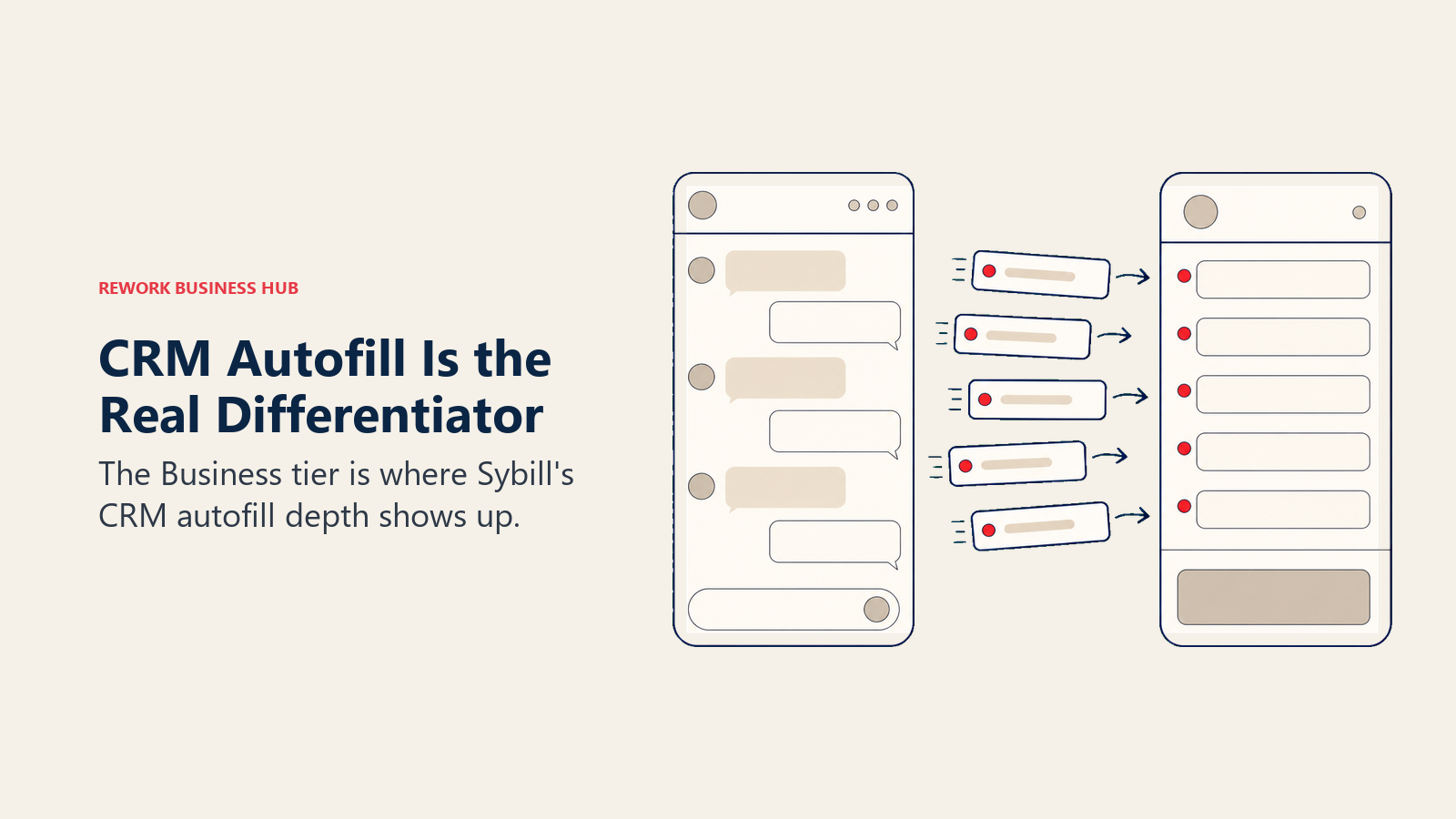
The catch buyers hit fast: that headline feature, full CRM autofill, only exists on the $90 per user a month Business tier. Pro at $30 per user a month gets you unlimited AI summaries and a basic CRM push, but not the autofill depth that's the actual reason most teams evaluate Sybill. Worth flagging directly: Sybill's own pricing page listed monthly billing ($30 Pro, $90 Business) as cheaper per seat than its stated annual rate ($36 and $108 respectively), the reverse of how most SaaS annual discounts work. Confirm current terms with sales before you commit to a billing cycle.
Sizing fit: 10-200 reps, deal desks feeling CRM data pain. Stage fit: growth stage, CRM hygiene is an active project.
| What you get | What you don't |
|---|---|
| 10-field CRM autofill and deal-risk signals in Ask Sybill | Autofill, the core reason to buy Sybill, is Business-tier only |
| Unlimited call recording and an invisible recorder on Free | Annual billing showed a higher per-seat rate than monthly on Sybill's own page |
| API and MCP access plus two-way Slack sync at Business | Business is $90/user/month, 3x the Pro tier |
Pricing: Free (500 credits/week); Pro $30/user/month; Business $90/user/month; Enterprise custom. Note: Sybill's pricing page showed annual billing ($36 Pro, $108 Business) priced higher per month than monthly billing; verify current terms before purchasing.
Best for: Deal desks and RevOps teams whose top priority is getting call data into CRM fields without manual entry.
7. Jiminny: Manager-Led Coaching Culture
Jiminny's product philosophy centers on the sales manager, not the individual rep. Call scoring, coaching workflows, and a dedicated customer success manager are built to help a frontline manager build a repeatable coaching cadence, not just review calls when something goes wrong. For mid-market teams building their first real coaching program, that focus matters more than raw feature count.
Jiminny doesn't publish pricing on its site. Third-party 2026 procurement research puts recording seats at roughly $85 per user a month on annual contracts and closer to $100 monthly, typically bundled with a 12-month minimum commitment and a one-time setup fee. A 14-day free trial is available, but budget for the setup fee and contract length before you sign.
Sizing fit: 10-200 reps, first-time formal coaching program. Stage fit: growth stage, manager enablement is the priority.
| What you get | What you don't |
|---|---|
| Purpose-built coaching workflows, not a bolted-on feature | No published pricing, reported figures aren't vendor-confirmed |
| Dedicated CSM support for building a coaching cadence | 12-month minimum contract and a one-time setup fee are typical |
| 14-day free trial to test the coaching workflow directly | Smaller analytics and forecasting layer than Gong or Clari |
Pricing: Not published. Reported at roughly $85/user/month on annual contracts, ~$100/user/month monthly, typically with a 12-month minimum and a one-time setup fee. Confirm directly with Jiminny.
Best for: Sales managers building a structured, repeatable coaching program for the first time.
8. Modjo: The Europe-Native Conversation Intelligence Platform
Modjo built its product and its compliance posture for the European market first, which shows up in GDPR handling and data residency options that some US-built competitors treat as an afterthought. Salesforce and HubSpot sync are deep, and the coaching and call-review features cover the same ground as Gong or Chorus for teams that want a vendor headquartered where their data actually needs to stay.
Pricing isn't published, and Modjo doesn't offer a free trial, a real difference from most of this list. Reported pricing runs around €99 per user a month (roughly $108 USD), sold almost exclusively on annual contracts with a typical seat minimum near 15, which means even a 10-person pilot often gets quoted at the 15-seat rate.
Sizing fit: 10-200 reps, EMEA-based or EU data residency required. Stage fit: growth stage, GDPR compliance is a hard requirement.
| What you get | What you don't |
|---|---|
| Strong GDPR posture and EU data residency options | No free trial to test before committing to an annual contract |
| Deep Salesforce and HubSpot sync | No published pricing, third-party estimates only |
| Coaching and call review on par with US-built competitors | Typical seat minimum (~15) inflates cost for small pilots |
Pricing: Not published. Reported at roughly €99/user/month (~$108 USD), annual contracts, with a typical seat minimum around 15 users. No free trial.
Best for: EMEA-based revenue teams that need EU data residency and GDPR-first vendor handling.
9. Grain: Real Coaching Features on a Small-Team Budget
Grain sits in the gap between a plain notetaker and an enterprise conversation intelligence platform. The free tier covers 20 meetings with real AI notes, and Starter at $19 per seat a month (annual) adds team performance insights, not just more storage, which is more than most tools offer at that price point. For a 10-30 person revenue team that's outgrown Fireflies or Otter but isn't ready for a five-figure Gong contract, Grain is the natural next step.
Business and Enterprise tiers add AI coaching, custom follow-up emails, and deeper team interaction insights, but Grain doesn't publish pricing for either on its site. Third-party sources put the Business tier anywhere from roughly $29 to $48 per seat per month, so treat any single figure as unconfirmed. Older procurement data reports it in the $29-35 per seat a month range. There's a 30-day money-back guarantee and no required annual contract, which lowers the risk of trying it.
Sizing fit: 1-50 reps. Stage fit: early growth, first real coaching program.
| What you get | What you don't |
|---|---|
| Real coaching features starting at $19/seat/month | Business and Enterprise pricing aren't published |
| 30-day money-back guarantee, no required annual contract | Free tier caps at 20 meetings, not unlimited |
| Zoom, Meet, Teams, Webex, and Slack huddle support | Coaching depth still trails Jiminny or Gong at scale |
Pricing: Free (20 meetings); Starter $19/seat/month (annual); Business and Enterprise pricing not published (reported at roughly $29 to $48/seat/month for Business, depending on source).
Best for: Small to mid-size revenue teams (1-50 reps) that want real coaching features without enterprise pricing.
10. Attention: Calls That Update Your CRM in Real Time
Attention's pitch is the most aggressive automation claim on this list: CRM fields update during the call, not after it, and reps get live battlecards surfaced in the moment based on what the prospect is saying. For sales orgs where CRM data entry is a chronic compliance problem, real-time automation solves a different problem than after-the-fact summaries do.
There's no self-serve tier and no published pricing at any team size, which puts Attention firmly in enterprise-only territory. Reported deployment costs range from $25,000 to $200,000-plus a year depending on team size and integration scope, a wide enough range that a real quote is the only way to know where you'd land.
Sizing fit: 50-200+ reps, CRM compliance is a known pain. Stage fit: enterprise, dedicated budget for real-time automation.
| What you get | What you don't |
|---|---|
| CRM fields update live during the call, not after | No self-serve tier at any team size |
| Real-time battlecards surfaced based on call content | No published pricing, reported range spans $25K-200K+/year |
| Purpose-built for CRM compliance at scale | Overkill for teams without a chronic CRM data problem |
Pricing: Not published, enterprise-only. Reported deployment cost $25,000-200,000+/year depending on team size and integration scope.
Best for: Enterprise teams with a chronic CRM data-entry problem that real-time automation would actually fix.
11. Fireflies.ai: Budget CRM Sync for Sales Teams
Fireflies earns its spot on a revenue-team shortlist for one reason: native, no-Zapier CRM sync to Salesforce, HubSpot, Pipedrive, and Zoho, at a fraction of what Gong or Clari charge. Call notes and action items land in the CRM record automatically, which is most of what a smaller sales team actually needs from a conversation tool before it's ready for a dedicated coaching platform.
The limitation buyers miss: "unlimited transcription and summaries" doesn't mean unlimited AI actions. A separate AI Credits system caps automations (20 credits on Free and Pro, 30 on Business), and heavy users burn through it well before the month ends. If Fireflies is on your shortlist alongside Otter and Fathom for a lighter buy, Otter vs Fireflies vs Fathom covers that three-way comparison directly, and Best AI Transcription Tools is worth checking if transcript accuracy across languages matters more than CRM sync. If Fireflies itself isn't quite right, our dedicated Best Fireflies Alternatives guide goes deeper on that specific comparison set.
Sizing fit: 1-200 reps. Stage fit: any stage not yet ready for dedicated coaching software.
| What you get | What you don't |
|---|---|
| Native CRM sync to 4 major platforms, no middleware | AI Credits cap automations separately from transcription |
| Business tier unlocks basic conversation intelligence | No dedicated coaching scorecards like tl;dv or Jiminny |
| Unlimited transcription and summaries on every tier | Free tier storage caps at 400 minutes for the whole team |
Pricing: Free $0; Pro $10/seat/month (annual, $18 monthly); Business $19/seat/month (annual, $29 monthly); Enterprise $39/seat/month (annual only).
Best for: Budget-conscious sales teams that want CRM-synced call data without paying for a coaching platform they're not ready to use.
12. tl;dv: Coaching Scorecards Without Enterprise Pricing
tl;dv splits into two different products under one name. Pro is a solid general-purpose meeting tool. Business is where the sales-specific value lives: AI coaching scorecards, customizable playbooks, and objection-handling analysis built for revenue teams that want to know why deals are won or lost, priced well under what Gong or Clari charge for similar coaching depth.
The gap buyers underestimate is the jump between tiers: Pro runs $18 per user a month annually, and Business jumps to $59, more than triple. If coaching is the actual reason you're evaluating tl;dv, budget for Business from the start rather than discovering the gap mid-negotiation. Our dedicated Best tl;dv Alternatives guide takes a closer look at that specific comparison set.
Sizing fit: 1-200 reps. Stage fit: growth stage teams wanting coaching without Gong-level spend.
| What you get | What you don't |
|---|---|
| AI coaching scorecards and objection analysis at Business | Business costs more than 3x Pro |
| Native Salesforce/HubSpot sync at Business tier | Pro only gets CRM sync through Zapier, not native |
| Genuinely useful free tier for occasional use | Free tier caps at 10 AI summaries for the account's lifetime |
Pricing: Free (10 AI summaries lifetime); Pro $18/user/month (annual, $22 monthly); Business $59/user/month (annual, $98 monthly, reported); Enterprise custom. tl;dv's own pricing page renders euro figures (Pro €18/user/mo annual, Business €29/user/mo annual) that don't reconcile with the widely reported USD rates above, so confirm your region's price with tl;dv before you budget.
Best for: Sales teams that want real coaching scorecards and deal analysis without paying enterprise prices for them.
13. Otter.ai: Company-Wide Searchable Transcript Archive
Otter wasn't built for sales specifically, and that's the point for some buyers: it's a general-purpose transcription and search layer that works the same way whether the meeting is a sales call, an all-hands, or a customer support escalation. Full-text search across every meeting a team has ever recorded is Otter's real strength, and it's deeper than what Fireflies or tl;dv offer.
The tradeoff for a revenue team specifically is native CRM depth, which is noticeably thinner than Fireflies. Otter is the right pick when the job is "find every call where a competitor got mentioned" more than "score this rep's objection handling." For teams weighing Otter specifically for transcription accuracy and language coverage, see Best AI Transcription Tools.
Sizing fit: 1-200 reps. Stage fit: any stage, especially teams that need cross-functional search, not just sales coaching.
| What you get | What you don't |
|---|---|
| Deep full-text search across a team's entire meeting history | Basic native CRM sync compared to Fireflies |
| Works across Zoom, Teams, Meet, and file imports | No coaching scorecards or deal-risk features |
| Business tier removes per-meeting minute caps entirely | Per-meeting caps on Pro limit back-to-back sales days |
Pricing: Basic free (300 min/month, 30-min meeting cap); Pro $8.33/user/month (annual, $16.99 monthly); Business $19.99/user/month (annual, $30 monthly); Enterprise custom.
Best for: Teams that want a searchable meeting archive across the whole company, not just a sales-specific coaching tool.
14. Fathom: Try Real AI Notes Before Paying Anything
Fathom's free tier is the most generous starting point on this list: unlimited recording and transcription, with only the AI summary count capped at five a month. For a revenue team that isn't sure conversation intelligence is worth paying for yet, that's a real way to find out before committing budget, not a disguised 14-day trial.
The CRM sync and coaching features that would make Fathom a genuine Avoma competitor for a revenue team live on the $25 per user a month Business tier, well above the $15 Team tier most small teams start with. The 90-day money-back guarantee across paid tiers is a real differentiator, most competitors on this list offer none at all. If you're weighing Fathom against Granola for a bot-free workflow instead, see Granola vs Otter for that specific comparison, and our dedicated Best Fathom Alternatives guide covers the wider field beyond just this list.
Sizing fit: 1-50 reps. Stage fit: early stage, evaluating whether conversation intelligence is worth paying for at all.
| What you get | What you don't |
|---|---|
| Genuinely unlimited free recording and transcription | AI summaries capped at 5/month on the free tier |
| 90-day money-back guarantee, best in this category | CRM field sync and coaching only exist on Business |
| Fast, clean AI summaries competitive with paid tools | No deal-risk or forecasting layer at any tier |
Pricing: Free (unlimited recording, 5 AI summaries/month); Team $15/user/month (annual, $19 monthly); Premium $16/user/month (annual, $20 monthly); Business $25/user/month (annual, $34 monthly); Enterprise custom.
Best for: Revenue teams that want to prove conversation intelligence is worth paying for before committing to anything heavier.
Buying Mistakes to Avoid
| Mistake | What It Looks Like | What to Do Instead |
|---|---|---|
| Comparing sticker prices, not real cost | Budgeting Avoma at $19/seat, then discovering the CI and RI add-ons you actually need | Use the true-cost table above; ask every vendor what the "full stack" price looks like |
| Assuming quote-only means expensive for everyone | Skipping Momentum or Grain because Gong scared you off the category | Published-price tools like Momentum, Sybill, Grain, and Fireflies cost far less than Gong or Clari |
| Buying coaching software when you need CRM hygiene | Paying for Gong's scorecards when reps just aren't logging calls | Momentum, Sybill, and Attention solve CRM data entry directly, often cheaper |
| Ignoring seat minimums on EU-focused vendors | Getting a Modjo quote for 10 seats and being billed at the 15-seat minimum | Ask about seat minimums before requesting a demo, not after |
| Treating "free" as risk-free forever | Building a workflow on Grain's 20-meeting free cap, then hitting it mid-quarter | Read the free tier's actual limit (monthly reset vs. lifetime cap) before relying on it |
| Skipping the setup fee and contract length question | Signing Jiminny's reported rate without asking about the 12-month minimum | Ask directly: minimum term, setup fee, and cancellation terms, before the demo ends |
Decision Framework
| If you need... | Pick... | Why |
|---|---|---|
| Board-ready forecast accuracy tied to pipeline data | Clari | Revenue Copilot ties forecasting to real deal signals, not gut feel |
| The deepest coaching and deal-risk data at any price | Gong | Years of call-history data power coaching and risk models nothing else matches |
| To reduce vendor count on an existing ZoomInfo contract | ZoomInfo Chorus | Bundled pricing and shared contact data, no separate integration project |
| Cadence and conversation intelligence in one login | Salesloft | Call data lands in the same record as email and dialer activity |
| CRM fields to update automatically without a coaching platform | Momentum | Purpose-built for CRM hygiene at a fraction of Gong's price |
| CRM autofill specifically, not just summaries | Sybill | 10-field autofill via Ask Sybill is the category's deepest automation |
| A structured coaching program for the first time | Jiminny | Built around the manager's coaching workflow, not just call review |
| EU data residency and GDPR-first vendor handling | Modjo | Europe-native platform with strong compliance posture |
| Real coaching on a small-team budget | Grain | Coaching features start at $19/seat/month, far below enterprise tools |
| Budget CRM sync without a coaching platform | Fireflies.ai | Native 4-platform CRM sync at $10/seat/month |
| Coaching scorecards without enterprise pricing | tl;dv | Business tier adds real scorecards at a fraction of Gong's cost |
| Zero cost to test conversation intelligence first | Fathom | Genuinely unlimited free recording, not a disguised trial |
Frequently Asked Questions about Avoma Alternatives
What is the best Avoma alternative in 2026?
There's no single best answer. Gong and Clari are the honest upgrades if you want more coaching and forecasting depth than Avoma offers. Momentum, Sybill, Jiminny, Modjo, and Grain sit in the mid-market gap Avoma occupies today, often at a lower real cost once add-ons are counted. Fireflies.ai, tl;dv, Otter.ai, and Fathom are the downgrade path if Avoma's pricing was the whole problem.
Why do revenue teams leave Avoma?
Mostly the gap between sticker price and real cost. Avoma's Startup plan starts at $19 per seat a month, but the Conversation Intelligence and Revenue Intelligence add-ons that make it worth buying run $29 each, pushing a full stack to roughly $77 per seat a month. There's also no standing free tier, only a 14-day trial.
Is there a free alternative to Avoma?
Fathom offers the most generous free tier in this category: unlimited recording and transcription with only AI summaries capped at five a month. Fireflies.ai, Grain, and Otter.ai also have free tiers, though each caps usage differently, so check whether the limit resets monthly or is a lifetime cap.
What's the difference between a conversation intelligence tool and a revenue intelligence platform?
Conversation intelligence (Fireflies.ai, tl;dv, Otter.ai, Fathom) records, transcribes, and summarizes calls. Revenue intelligence (Gong, Clari) adds forecasting, pipeline risk scoring, and deal analytics on top of that data, and typically costs several times more per seat as a result. Avoma, Momentum, and Sybill sit in between, offering some revenue-intelligence features without Gong or Clari's full price tag.
How much does Gong cost compared to Avoma?
Gong doesn't publish pricing, but reported rates run $100-140 per user a month plus a platform fee, with enterprise contracts often starting near $50,000-60,000 a year. Avoma's realistic all-in cost with its Conversation and Revenue Intelligence add-ons runs closer to $77 per seat a month, meaningfully less than Gong but still a stack of add-ons rather than one price.
Which Avoma alternative has the best CRM integration?
For automatic CRM field updates without manual entry, Sybill's 10-field autofill and Attention's real-time updates go furthest. For straightforward native sync without a premium price, Fireflies.ai covers Salesforce, HubSpot, Pipedrive, and Zoho at $10-19 per seat a month.
Do these tools charge for every viewer or only the person recording?
It varies by vendor. Avoma only charges for users who record and transcribe meetings, viewers and collaborators are free. Check this directly with each vendor on this list, since a per-viewer license model can multiply your real cost well beyond the per-seat sticker price.
Which Avoma alternative is best for a small revenue team under 20 reps?
Grain and Fireflies.ai offer real functionality at $10-19 per seat a month without enterprise contracts. Fathom's free tier is worth testing first if you're not yet sure conversation intelligence is worth paying for at all.
What to Do Next
Start with the true-cost table, not the sticker price. Pick one enterprise-tier option (Gong or Clari) and one mid-market option (Momentum, Sybill, or Jiminny) if you genuinely need more than Avoma offers, or one free tier (Fathom or Grain) if the add-on stacking was the real complaint. Run a real quote request for anything quote-only before you build a budget around a reported number, since seven of the 14 tools here don't publish pricing at all.
If CRM data quality is the actual problem behind your Avoma frustration, not coaching or forecasting, look at Momentum, Sybill, or Attention before a bigger conversation intelligence contract. And if you're still not sure conversation intelligence earns its keep at your team's size, Fathom or Grain's free tiers cost nothing to find out.

Principal Product Marketing Strategist
On this page
- Key Facts
- Quick Comparison Table
- The True Cost: Sticker Price vs. What You Actually Pay
- Team Size and Sales Maturity Fit
- How to Choose: Framework by Primary Use Case
- 1. Gong: Enterprise Revenue Intelligence at Scale
- 2. Clari: Forecasting-First Revenue Intelligence
- 3. ZoomInfo Chorus: Bundled Intelligence for ZoomInfo Customers
- 4. Salesloft: Cadence and Conversation Intelligence in One Login
- 5. Momentum: AI-Native CRM Hygiene Without the Enterprise Price Tag
- 6. Sybill: CRM Autofill Straight From the Call
- 7. Jiminny: Manager-Led Coaching Culture
- 8. Modjo: The Europe-Native Conversation Intelligence Platform
- 9. Grain: Real Coaching Features on a Small-Team Budget
- 10. Attention: Calls That Update Your CRM in Real Time
- 11. Fireflies.ai: Budget CRM Sync for Sales Teams
- 12. tl;dv: Coaching Scorecards Without Enterprise Pricing
- 13. Otter.ai: Company-Wide Searchable Transcript Archive
- 14. Fathom: Try Real AI Notes Before Paying Anything
- Buying Mistakes to Avoid
- Decision Framework
- What to Do Next