Best AI Tools for Retail in 2026
Turn this article into takeaways for your work.


Each assistant summarizes the article only for you and suggests best practices for your work.
If you run a retail operation with physical stores, most "best AI tools" roundups aren't written for you. They cover product descriptions and cart upsells for online-only shops and skip the problems that actually move a multi-location retailer's numbers: forecasting demand at the SKU-store level, planning assortment and shelf space, catching shrink before it hits the P&L, and scheduling a workforce against a demand curve that shifts by the hour. This guide covers 13 AI tools built specifically for that work, organized by store function.
Retail AI in 2026 splits into two very different worlds. Enterprise supply chain and merchandising platforms (Blue Yonder, RELEX, o9, Symphony RetailAI) sell into Fortune 500 retailers on custom, quote-only contracts. In-store computer vision and workforce tools (Trax, Standard AI, Trigo, Legion) are more accessible but still built for chains with real store counts, not a single location. If you're running an online-only store instead, Best AI Tools for Ecommerce Stores and Best AI Tools for Ecommerce cover product copy, cart personalization, and support chat, tools that don't apply to a physical store floor.
What Changed in 2026
- Standard AI pivoted away from autonomous checkout. After acquiring spatial intelligence company Pathr.ai in January 2026, Standard AI dropped its earlier "just walk out" checkout focus to concentrate on its VISION Analytics platform, now operating across 24 countries.
- Trigo expanded from checkout-free shopping into loss prevention. Its computer vision loss prevention product, launched mid-2025, marked a strategic shift toward shrink control and staff safety on top of its original cashier-free checkout technology.
- SymphonyAI released CINDE Assortment and Space in June 2026, connecting store clustering, assortment optimization, planogram automation, and live shelf intelligence into one workflow, built on 25 years of retail AI and deployed across 500-plus global CPG accounts.
- Aptos launched an AI Readiness program at NRF 2026, built around a Unified Data Foundation on the Snowflake AI Data Cloud plus "Super Agents," alongside Aptos ONE Country Box for faster international store expansion.
Key Facts
- US retail shrink totaled $112.1 billion in 2022, up from $93.9 billion in 2021, per the National Retail Federation's National Retail Security Survey.
- Retailers reported an 18% increase in average shoplifting incidents in 2024 versus 2023, per NRF's 2025 Impact of Theft and Violence report.
- 75% of retail and CPG leaders call AI a top strategic priority, yet only 7% to 10% have reached enterprise-wide deployment, per Deloitte's 2026 State of AI Adoption in Retail and CPG Executive Survey.
- 82% of retail and CPG leaders plan to increase AI investment within the next 12 months, even though roughly half currently spend less than 0.5% of revenue on AI, per the same Deloitte survey.
- Blue Yonder reports its AI-driven demand planning can lift forecast accuracy by up to 12% and improve planner efficiency by up to 75% (vendor-reported benchmark), per Blue Yonder.
- Trax reports its AI-powered shelf image recognition reaches 96% accuracy for on-shelf availability audits (vendor-reported benchmark), per Trax Retail.
Quick Comparison Table
| Tool | Retail Function | Best For | Starting Price | Free Tier? |
|---|---|---|---|---|
| Blue Yonder | Demand forecasting and supply chain planning | Large enterprise retailers needing SKU-store-level forecasting | Custom quote (enterprise) | No |
| RELEX Solutions | Forecasting, replenishment, pricing, and space planning | Grocery and specialty retailers wanting one connected planning platform | Custom quote (premium tier) | No |
| o9 Solutions | Enterprise planning and category management | Fortune 500 grocery and multi-category retailers | Custom quote (enterprise) | No |
| Symphony RetailAI (SymphonyAI Retail/CPG) | Assortment, pricing, and space optimization | Retailers and CPG brands running category reviews at scale | Custom quote | No (free trial) |
| Nextail | Fashion merchandise execution and allocation | Fashion and apparel retailers with multi-store inventory | Custom (Starter/Growth/Enterprise tiers) | No (free trial) |
| Daisy Intelligence | Explainable AI for pricing, demand, and assortment | Grocery and general merchandise retailers wanting explainable decisions | Custom quote | No |
| Trax Retail | Shelf monitoring and on-shelf availability | CPG brands and retailers auditing shelf compliance at scale | Custom quote | No |
| Standard AI | In-store spatial and shopper analytics | Multi-location retailers wanting store-floor behavior data | Custom quote | No |
| Trigo | Checkout-free shopping and computer vision loss prevention | Grocery chains piloting autonomous checkout or vision-based shrink control | Custom quote | No |
| Lily AI | Product attribute intelligence | Retailers with large, fast-changing catalogs needing richer product data | Custom (Standard tier reported near $200/mo) | Yes (30-day trial) |
| Legion Technologies | AI labor forecasting and scheduling | Retail, hospitality, and convenience chains with hourly workforces | ~$49/mo reported entry, real contracts are volume-based | No |
| Aptos | Unified commerce (POS, OMS, clienteling) | Large multi-brand and multi-country retail chains | Custom quote (enterprise) | No |
How to Choose AI Tools by Retail Function
Retail AI buying mistakes almost always come from buying the flashiest platform instead of mapping a tool to the function that's actually costing money. Before signing anything, answer three questions:
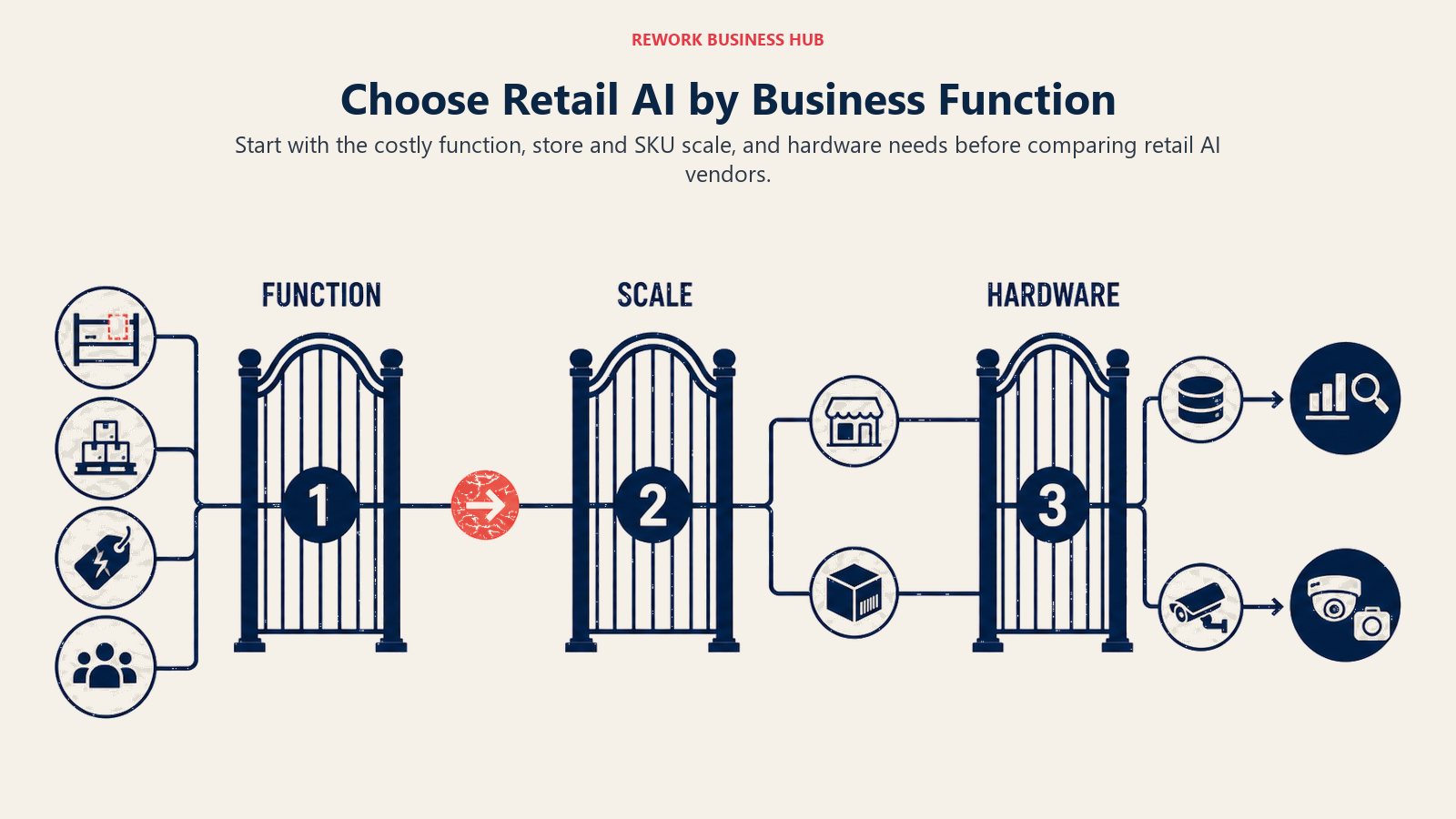
- Which function is bleeding money right now? Stockouts and overstock, shelf gaps, shrink, or scheduling waste are four different problems with four different tool categories below. A merchandising platform won't fix a labor-cost problem.
- How many stores and how much SKU depth do you actually have? Enterprise platforms like Blue Yonder, o9, and RELEX are built for chains with hundreds of locations and deep SKU catalogs. A 10-store regional chain doesn't need o9's Digital Brain; it needs a tool sized to its actual footprint.
- Does the tool need new hardware, or does it run on data you already have? Computer vision tools (Trax, Standard AI, Trigo) typically require cameras and in-store infrastructure. Planning and forecasting platforms (Blue Yonder, RELEX, Daisy Intelligence) run on data you're likely already capturing in your POS and ERP systems.
Demand Forecasting and Supply Chain Planning
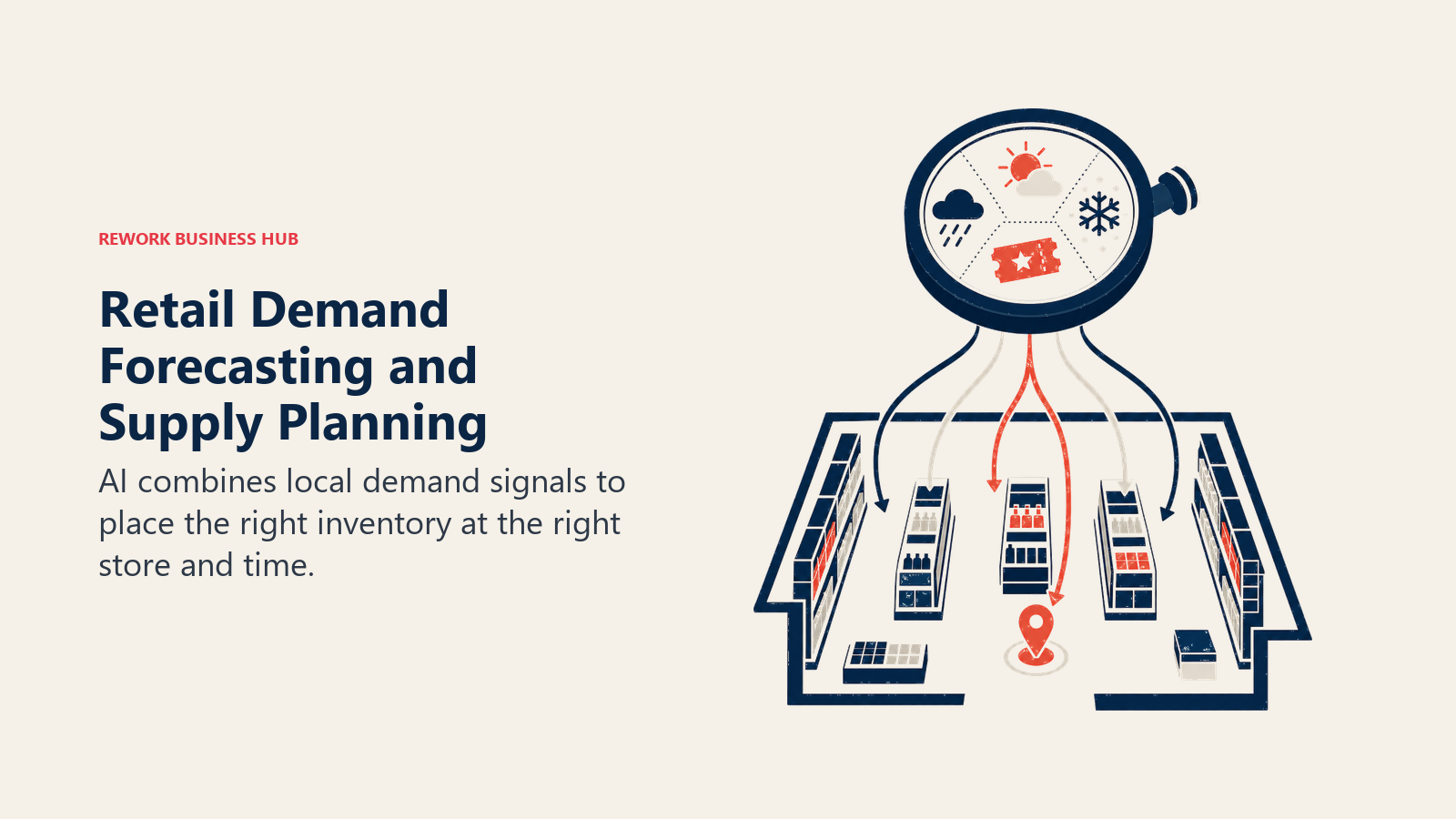
Getting the right inventory to the right store at the right time is the highest-leverage AI problem in retail, and it's also the most mature: these platforms have been refining forecasting models for over a decade, well before generative AI made headlines.
1. Blue Yonder
Blue Yonder's Demand Edge for Retail predicts demand at the most granular level available, every SKU in every individual store, by modeling hundreds of local causal factors (weather, local events, price elasticity) in real time rather than relying on historical averages alone.
Best for: Large enterprise retailers that need SKU-store-level demand forecasting tied to local causal factors
Key strengths:
- Models weather, local events, and price elasticity alongside historical sales data
- Vendor-reported forecast accuracy gains of up to 12% and planner efficiency gains of up to 75%
- Part of a broader Blue Yonder supply chain suite (fulfillment, pricing, workforce) if you need more than forecasting alone
Limitations:
- Pricing isn't published; contracts for this class of retailer typically run into six or seven figures annually
- Built for large, complex retail networks, not a regional chain with a handful of locations
- Implementation timelines run months, not weeks, given the depth of data integration required
Pricing: Not published. Blue Yonder targets large enterprise retailers and quotes custom contracts through direct sales. See blueyonder.com.
| What you get | What you don't |
|---|---|
| Granular SKU-store forecasting with local causal factors | No published pricing, sales-led only |
| Part of a full supply-chain-planning suite | Multi-month implementation for most deployments |
| Vendor-reported double-digit accuracy gains | Overkill for retailers without deep, complex networks |
2. RELEX Solutions
RELEX built its platform around one idea: forecasting, replenishment, pricing, promotion, and space planning shouldn't live in five different systems. Its AI-native platform now includes ten dedicated AI agents split across forecasting and replenishment on one side, pricing and promotion on the other.
Best for: Grocery, specialty, and multi-category retailers that want forecasting, replenishment, and pricing on one connected platform instead of stitched-together point tools
Key strengths:
- Single platform spans forecasting, inventory, pricing, merchandising, space, and workforce planning
- Ten purpose-built AI agents already in production across forecasting/replenishment and pricing/promotion
- 700-plus customers globally, with a track record specifically in grocery and retail supply chain planning
Limitations:
- Positioned at the premium end of the market, with licensing and implementation costs to match
- Pricing isn't published and is tailored per deployment scale
- Full platform value depends on integrating multiple functions, a heavier lift than a single-purpose tool
Pricing: Not published. RELEX uses a subscription model scaled to organization size and scope, quoted directly. See relexsolutions.com.
| What you get | What you don't |
|---|---|
| Forecasting, pricing, and space planning in one platform | No public pricing, premium-tier cost profile |
| Ten AI agents already live in production | Full value requires multi-function adoption, not one module |
| 700+ retail and grocery customers globally | Custom implementation scoped per deployment |
3. o9 Solutions
o9's Digital Brain is an enterprise planning platform used across 30-plus industries, and its Category Management solution for grocery retail connects merchandise financial planning, assortment planning, pricing and promotion planning, and vendor negotiation support into one workflow.
Best for: Fortune 500 grocery and multi-category retailers that need enterprise-wide planning connected end to end, not a departmental point solution
Key strengths:
- Connects financial planning, assortment, pricing, and vendor negotiation in one integrated model
- Built for organizations running planning across dozens of categories and thousands of locations
- Proven specifically in grocery category management, one of retail's hardest planning problems
Limitations:
- Exclusively serves large multinational and Fortune 500-scale organizations, not accessible to mid-market chains
- Pricing requires custom negotiation tied to implementation scope
- Deployment complexity and timeline reflect true enterprise software, not a self-serve tool
Pricing: Not published. Enterprise-tier pricing available on request, scoped to organizational needs and implementation. See o9solutions.com.
| What you get | What you don't |
|---|---|
| End-to-end planning across finance, assortment, and pricing | Built only for Fortune 500-scale retailers |
| Proven grocery category management use case | No public pricing, requires custom negotiation |
| Connected workflow across merchandising and vendor teams | Long, complex enterprise implementation |
Merchandising, Assortment, and Space Planning
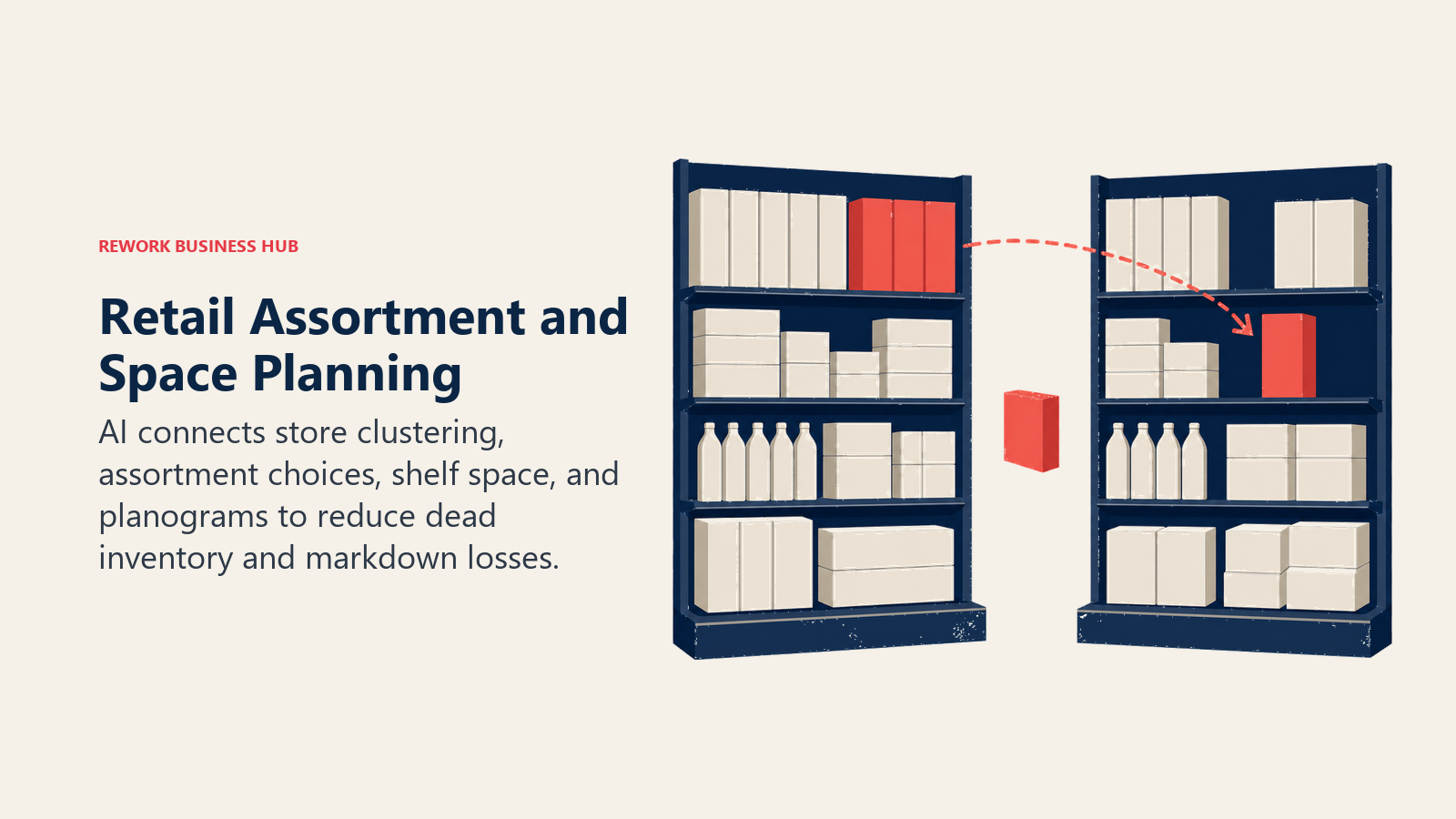
Once demand is forecasted, the next question is what to stock, where, and how much shelf space to give it. This is the function most "best AI tools" lists skip entirely, and it's where a bad decision shows up directly in markdown losses and dead inventory.
4. Symphony RetailAI (SymphonyAI Retail/CPG)
SymphonyAI's retail division built its reputation on assortment optimization, pricing and margin management, and promotional effectiveness, and its June 2026 CINDE Assortment and Space release connects store clustering, assortment optimization, planogram automation, and live shelf intelligence into a single end-to-end workflow.
Best for: Retailers and CPG manufacturers running category reviews and assortment decisions at scale across many stores or banners
Key strengths:
- 25 years of retail AI experience, with CINDE proven across 500-plus global CPG deployments
- Connects assortment, space, and planogram decisions into one workflow instead of separate tools
- Compresses category review cycles from weeks to days per the company's own 2026 product announcement
Limitations:
- No published pricing; every source points to a direct sales conversation
- Built for retailers running formal category review processes, overkill for a small chain without that structure
- Deep CPG-side positioning means some capabilities are most valuable when your suppliers use the platform too
Pricing: Not published. Custom quote through direct sales; a free trial is available but no free tier. See symphonyai.com/retail-cpg.
| What you get | What you don't |
|---|---|
| 25 years of retail AI and 500+ proven CPG deployments | No published pricing, sales-led |
| Assortment, space, and planogram decisions in one workflow | Best fit assumes a formal category review process |
| 2026 release compresses review cycles from weeks to days | Full value depends partly on supplier-side adoption too |
5. Nextail
Nextail is an AI-native merchandise execution platform built specifically for fashion and apparel retailers, focused on inventory allocation, replenishment, and optimization across a store network and ecommerce channel at once, aiming to replace the spreadsheet-based allocation most fashion retailers still run on.
Best for: Fashion and apparel retailers that need AI-driven allocation and replenishment across stores and ecommerce together
Key strengths:
- Purpose-built for fashion and apparel, not a generic retail merchandising tool retrofitted for the category
- Tiered plans (Starter, Growth, Enterprise) signal a path from small chains up to complex global operations
- Free trial with no credit card required, lowering the barrier to evaluate fit before committing
Limitations:
- Specific pricing for each tier isn't published, budgeting requires a sales conversation
- Fashion-specific focus means it's not the right fit for grocery, general merchandise, or hardline retailers
- Full value depends on connecting store and ecommerce inventory data, a real integration project
Pricing: Not published. Starter, Growth, and Enterprise tiers are quoted per deployment; a free trial is available. See nextail.co/plans-and-packaging.
| What you get | What you don't |
|---|---|
| Purpose-built fashion and apparel allocation AI | Tier pricing isn't published |
| Tiered path from small chains to enterprise | Narrow fit outside fashion/apparel |
| Free, no-credit-card trial to test before buying | Requires connecting store and ecommerce data |
6. Daisy Intelligence
Daisy Intelligence positions itself around explainability: its Decisions-as-a-Service platform for pricing, demand planning, assortment, and space planning is built to show the reasoning behind each recommendation, using what it calls Halo Effects, how one product's sale or price change influences related products, as a core part of its modeling.
Best for: Grocery and general merchandise retailers that want explainable AI recommendations for pricing and assortment, not a black-box model
Key strengths:
- Explainability is a core design principle, not an add-on, which matters for merchandising teams that need to justify decisions internally
- Halo Effects modeling accounts for cross-product impact that simpler forecasting tools miss
- Covers pricing, demand planning, assortment, and space planning as connected decisions rather than siloed tools
Limitations:
- No published pricing anywhere in the company's public materials
- Best documented fit is grocery and general merchandise; less evidence of depth in fashion or specialty retail
- Requires a sales conversation and likely a pilot to evaluate real-world fit
Pricing: Not published. Contact Daisy Intelligence's sales team directly for a quote. See daisyintelligence.com.
| What you get | What you don't |
|---|---|
| Explainable AI recommendations, not a black box | No published pricing anywhere |
| Halo Effects modeling for cross-product impact | Strongest evidence is grocery/general merchandise |
| Pricing, demand, and assortment as connected decisions | Sales conversation and pilot likely required |
For platform-level ERP and financial planning that connects to merchandising decisions, best AI tools for finance teams covers the adjacent budgeting and reporting layer.
In-Store Analytics and Shelf Intelligence
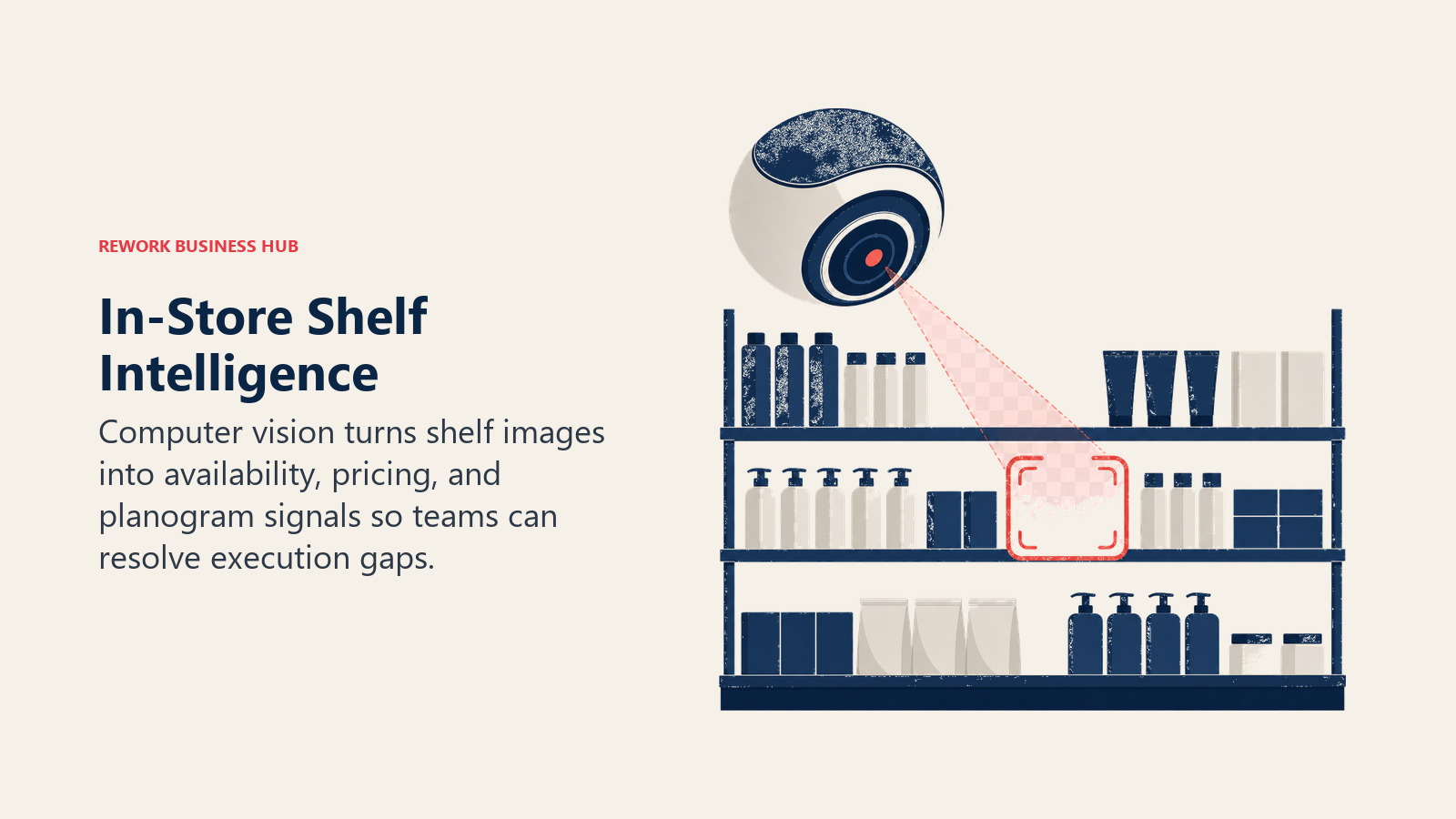
Once product is on the shelf, the question shifts to whether it's actually there, priced correctly, and displayed the way the plan intended. This is a computer-vision problem, and it's grown into its own category separate from merchandising software.
7. Trax Retail
Trax built a cloud-based retail execution platform around one core capability: computer vision that reads shelf images and turns them into structured data on product availability, share of shelf, pricing, and planogram compliance, replacing manual shelf audits with automated ones.
Best for: CPG brands and retailers that need real-time, automated visibility into on-shelf availability and compliance across many stores
Key strengths:
- Vendor-reported 96% accuracy in AI-powered shelf image recognition
- Combined with FORM's task management, teams can trigger and resolve in-store issues from the same platform
- Analyzes shelf images at billions-of-images scale, giving it deep pattern coverage across categories and store formats
Limitations:
- Pricing isn't published and scales with store count and geographic coverage
- Value depends on either store associate participation or dedicated shelf-imaging hardware
- Most proven in CPG-retailer shelf compliance use cases, a narrower job than full merchandising planning
Pricing: Not published. Custom-quoted based on store count and coverage. See traxretail.com/technology.
| What you get | What you don't |
|---|---|
| Vendor-reported 96% shelf image recognition accuracy | No published pricing |
| Task management and shelf-issue resolution in one platform | Needs associate participation or imaging hardware |
| Billions of shelf images analyzed for pattern coverage | Narrower scope than a full merchandising suite |
For broader data analysis AI beyond shelf-specific use cases, best AI tools for data analysis covers general-purpose analytics platforms.
8. Standard AI
Standard AI pivoted decisively in January 2026: after acquiring spatial intelligence company Pathr.ai, it moved away from its earlier autonomous, cashier-free checkout focus to concentrate on VISION Analytics, a platform for understanding shopper behavior and store-floor activity using existing camera infrastructure.
Best for: Multi-location retailers that want store-floor behavior and spatial analytics without rebuilding checkout infrastructure
Key strengths:
- Works with existing camera infrastructure rather than requiring a full "just walk out" hardware buildout
- Operates across 24 countries, giving it real deployment breadth for multi-region chains
- Strategic pivot toward analytics (rather than autonomous checkout alone) reflects where the broader market has moved in 2026
Limitations:
- Contract terms are entirely custom-quoted, with no public pricing reference point
- The January 2026 pivot means its analytics-first product is newer than its original checkout technology
- Full value requires a retailer with enough camera coverage and store count to make spatial analytics meaningful
Pricing: Not published. Custom-quoted contracts through direct sales. See Standard AI market coverage and vendor sales channels for current positioning.
| What you get | What you don't |
|---|---|
| Spatial and shopper analytics on existing camera infrastructure | No public pricing reference point |
| Deployment across 24 countries | Newer analytics-first product post-2026 pivot |
| No full checkout-hardware rebuild required | Needs meaningful store count and camera coverage to pay off |
9. Trigo
Trigo's original pitch was checkout-free grocery shopping: ceiling-mounted cameras and AI track what shoppers pick up so they can walk out without scanning anything. In 2025 it expanded into computer vision loss prevention, applying the same camera network to shrink control and staff safety instead of only checkout.
Best for: Grocery chains evaluating either checkout-free shopping or camera-based loss prevention, especially those already weighing shrink-reduction investments
Key strengths:
- Vendor-reported 99% accuracy processing over 60 million shopping activities a year
- Retrofits into existing stores rather than requiring new-build construction
- Real production partnerships with major grocers (Tesco, REWE, Shufersal) beyond pilot-stage deployments
- Capex-free deployment model available since mid-2025, lowering the upfront investment barrier
Limitations:
- Full checkout-free deployment is a significant infrastructure project regardless of the capex-free commercial model
- Pricing is entirely custom and not published anywhere
- Loss prevention is the newer half of the product; checkout-free remains the more established use case
Pricing: Not published. Custom enterprise contracts, quoted directly. See trigoretail.com.
| What you get | What you don't |
|---|---|
| Vendor-reported 99% accuracy at real production scale | No published pricing |
| Retrofits into existing stores | Checkout-free remains a real infrastructure project |
| Production deployments with major grocery chains | Loss prevention product is newer than checkout-free |
| Capex-free deployment option since mid-2025 | Custom quote required for either use case |
Personalization and Product Data
Personalization in a physical retail context starts upstream of any recommendation engine: with product data itself. If your catalog's attributes don't reflect how customers actually search and shop, no downstream AI can compensate.
10. Lily AI
Lily AI analyzes product images, descriptions, and clickstream behavior together, then enriches product data with the consumer-centric attributes shoppers actually search for, trained on more than 300 fine-grained classification models across 3 billion-plus retail and consumer data points.
Best for: Retailers with large, fast-changing catalogs (especially fashion and home) that need richer, search-aligned product attributes across their tech stack
Key strengths:
- Combines visual AI and clickstream data, not just text-based tagging, for more accurate attribute enrichment
- Attributes flow into search, personalization, and even Google Search performance, not one isolated tool
- 30-day free trial lowers the barrier to test attribute quality against your own catalog first
Limitations:
- Full published pricing isn't available; a Standard tier reportedly runs near $200/month, with Enterprise pricing custom-quoted
- Value depends heavily on catalog size and how outdated your current product attributes are
- Best documented in fashion and apparel; depth in other verticals is less publicly demonstrated
Pricing: Not fully published. A Standard tier reportedly starts around $200/month with a 30-day free trial; Enterprise pricing is custom. Confirm current terms directly with Lily AI. See lily.ai.
| What you get | What you don't |
|---|---|
| Visual AI plus clickstream-driven attribute enrichment | Full pricing isn't officially published |
| 30-day free trial to test against your own catalog | Value scales with catalog size and current data gaps |
| Attributes flow into search, personalization, and SEO | Deepest proof points are in fashion and apparel |
For AI tools focused on customer-facing personalization and cart recommendations in an online store, best AI tools for ecommerce stores covers Rebuy and Nosto in more depth.
Workforce Scheduling
Labor is usually a retailer's second-largest cost after inventory, and it's also the function most exposed to guesswork: over-scheduling wastes payroll, under-scheduling costs sales and burns out staff.
11. Legion Technologies
Legion's AI-powered workforce management platform generates fully automated labor forecasts down to 15-minute increments per location, then builds schedules that align staffing to that forecasted demand curve, aimed at hourly workforces in retail, hospitality, restaurants, and convenience stores.
Best for: Retail, hospitality, and convenience chains with 1,000-plus hourly employees that want AI-driven demand forecasting tied directly to scheduling
Key strengths:
- Vendor-reported 98% accuracy in location-specific, 15-minute-increment labor forecasts
- Covers scheduling, shift swapping, time-off requests, and overtime calculation in one workforce platform
- Vendor-reported 13x ROI from schedule optimization, reduced attrition, and productivity gains
Limitations:
- Built and priced for organizations with 1,000-plus employees, not a small independent retailer
- Entry pricing reportedly starts around $49/month, but real enterprise contracts are volume and module-based, confirm directly
- Vendor-reported accuracy and ROI figures haven't been independently audited
Pricing: Entry pricing reportedly starts around $49/month; actual enterprise pricing is quoted per employee count and module selection. See legion.co.
| What you get | What you don't |
|---|---|
| Vendor-reported 98% accuracy in granular labor forecasting | Built for 1,000+ employee organizations |
| Scheduling, time-off, and overtime in one platform | Real pricing requires a sales conversation |
| Vendor-reported 13x ROI from optimization | Accuracy/ROI figures are vendor-reported, not audited |
For broader people-management software beyond retail-specific scheduling, best HR software in 2026 covers platforms across HRIS, payroll, and performance management.
Unified Commerce and Point of Sale
The tools above each solve one function well. Unified commerce platforms try to solve the coordination problem underneath all of them: making sure POS, order management, inventory, and clienteling run on the same data instead of five disconnected systems.
12. Aptos
Aptos positions itself as the unified commerce layer connecting POS, order management, and clienteling for large retail chains, and its 2026 AI Readiness program centers on a Unified Data Foundation built on the Snowflake AI Data Cloud, designed to structure retailer data so both Aptos' own AI and a retailer's own models can run on it.
Best for: Large multi-brand or multi-country retail chains that need POS, order management, and store data unified before layering AI on top
Key strengths:
- Unified Data Foundation addresses a real, well-documented problem: Gartner reports 63% of organizations lack or are unsure they have the right data management practices for AI
- Aptos ONE Country Box specifically targets faster, lower-cost international store expansion, a distinct problem from single-market retailers
- "Super Agents" concept extends unified commerce into agentic AI workflows rather than treating AI as a bolt-on
Limitations:
- Pricing isn't published anywhere; this is enterprise unified-commerce software sold through direct sales
- Full value depends on migrating core POS and order management onto the platform, a major infrastructure decision, not a quick add-on
- Best fit assumes multi-brand or multi-country complexity; a single-market chain may not need the full platform
Pricing: Not published. Enterprise unified commerce contracts, quoted through direct sales. See aptos.com/unified-commerce.
| What you get | What you don't |
|---|---|
| Unified POS, order management, and clienteling data layer | No published pricing |
| AI-ready data foundation built on Snowflake | Requires migrating core POS/OMS infrastructure |
| Faster international expansion via Country Box | Best fit assumes multi-brand or multi-country scale |
Aptos' "Super Agents" concept is part of a broader shift toward agentic AI in retail operations; best AI agents in 2026 covers agentic AI platforms across functions beyond retail specifically.
A Note on Omnichannel Customer Conversations
Every tool above solves a specific operational function: forecasting, merchandising, shelf compliance, loss prevention, scheduling, or unified commerce infrastructure. None of them solve a different, increasingly common retail problem: a customer messaging a store on WhatsApp about a click-and-collect order, then following up on Instagram DM, with no shared history between the two conversations or with the loyalty program.
Rework is a unified CRM and Lead Ops platform with a multi-channel inbox (WhatsApp, Messenger, Instagram DM, Zalo, LINE, and web chat on one contact timeline), a genuine fit for multi-location and omnichannel retailers in Southeast Asia and similar markets that run high customer message volume across channels and want one shared view per customer. It is not a replacement for Blue Yonder's forecasting, Trax's shelf intelligence, or Legion's workforce scheduling, those solve different jobs entirely. The Marketing Engine (inbox and lead capture) runs $99/month billed yearly, or $115 month to month, with 5 marketing seats included, see rework.com/pricing. It isn't built for single-location shops or teams under 5 people. For CRM options more broadly, best CRM software in 2026 covers 15 platforms by team size and motion.
How to Choose: Decision Framework
| If you need... | Pick... | Why |
|---|---|---|
| SKU-store-level demand forecasting for a large chain | Blue Yonder | Models local causal factors down to the individual store SKU |
| Forecasting, replenishment, and pricing on one connected platform | RELEX Solutions | Ten production AI agents spanning forecasting through pricing |
| Enterprise-wide grocery category management | o9 Solutions | Connects financial, assortment, and vendor planning end to end |
| Assortment, space, and planogram decisions in one workflow | Symphony RetailAI | 2026 CINDE release compresses category reviews from weeks to days |
| AI-driven fashion allocation across stores and ecommerce | Nextail | Purpose-built for fashion, not a generic retail tool |
| Explainable pricing and assortment recommendations | Daisy Intelligence | Halo Effects modeling shows the reasoning, not a black box |
| Automated shelf compliance and on-shelf availability data | Trax Retail | Vendor-reported 96% shelf image recognition accuracy |
| Store-floor spatial analytics on existing cameras | Standard AI | VISION Analytics runs on infrastructure you likely already have |
| Checkout-free shopping or camera-based loss prevention | Trigo | Production deployments at Tesco, REWE, and Shufersal |
| Richer, search-aligned product attributes at catalog scale | Lily AI | Visual AI plus clickstream data, not just text tagging |
| AI-driven labor forecasting tied directly to scheduling | Legion Technologies | Vendor-reported 98% accuracy in 15-minute demand increments |
| Unified POS, order management, and clienteling data | Aptos | AI Readiness program built on a Snowflake data foundation |
Framework: By Store Count and Complexity
| Store Footprint | Budget Signal | Best Fits |
|---|---|---|
| 1-10 locations | Limited or no dedicated AI budget | Trax Retail (pilot scope), Legion (if 1,000+ hourly staff across locations); otherwise see best AI tools for small business |
| 10-50 locations | Structured merchandising or ops budget | Nextail, Daisy Intelligence, Standard AI, Trigo pilots |
| 50-200 locations | Dedicated supply chain or merchandising team | RELEX Solutions, Symphony RetailAI, Legion Technologies |
| 200+ locations / national chain | Enterprise supply chain and IT budget | Blue Yonder, o9 Solutions, Aptos |
| Multi-country / global | Enterprise budget with regional complexity | o9 Solutions, Aptos (Country Box), Blue Yonder |
AI Tool Buying Mistakes to Avoid in Retail
75% of retail and CPG leaders call AI a top strategic priority, per Deloitte's 2026 survey, but priority and payoff aren't the same thing when only 7% to 10% reach enterprise-wide deployment.
| Mistake | What It Looks Like | What to Do Instead |
|---|---|---|
| Buying enterprise forecasting before you have enterprise store count | Signing a Blue Yonder or o9 contract at 15 locations | Start with a scoped forecasting module or a lighter platform sized to your footprint |
| Treating computer vision as a checkout project only | Evaluating Trigo or Standard AI purely for "just walk out" checkout | Ask what the same camera investment can do for loss prevention and shelf analytics too |
| Skipping merchandising and space planning entirely | Buying forecasting and workforce AI but leaving assortment decisions manual | Evaluate Symphony RetailAI, Nextail, or Daisy Intelligence once markdown losses justify it |
| Ignoring product data quality before adding personalization | Assuming a recommendation engine will fix weak, generic product attributes | Fix attribute data (Lily AI or similar) before layering personalization on top |
| Underestimating vendor-reported accuracy and ROI claims | Budgeting against a vendor's 98% accuracy or 13x ROI figure at face value | Ask for a pilot or reference customer at your store count before committing |
| Fragmenting customer conversations across channels with no shared view | WhatsApp, Instagram, and loyalty each holding a different slice of the same customer | Consider a unified inbox or CRM layer once conversation volume outgrows single-channel tools |
| Buying point tools instead of automating the handoffs between them | Forecasting, merchandising, and workforce AI that never talk to each other | Evaluate best AI automation tools to connect the workflow between systems |
Pricing at a Glance
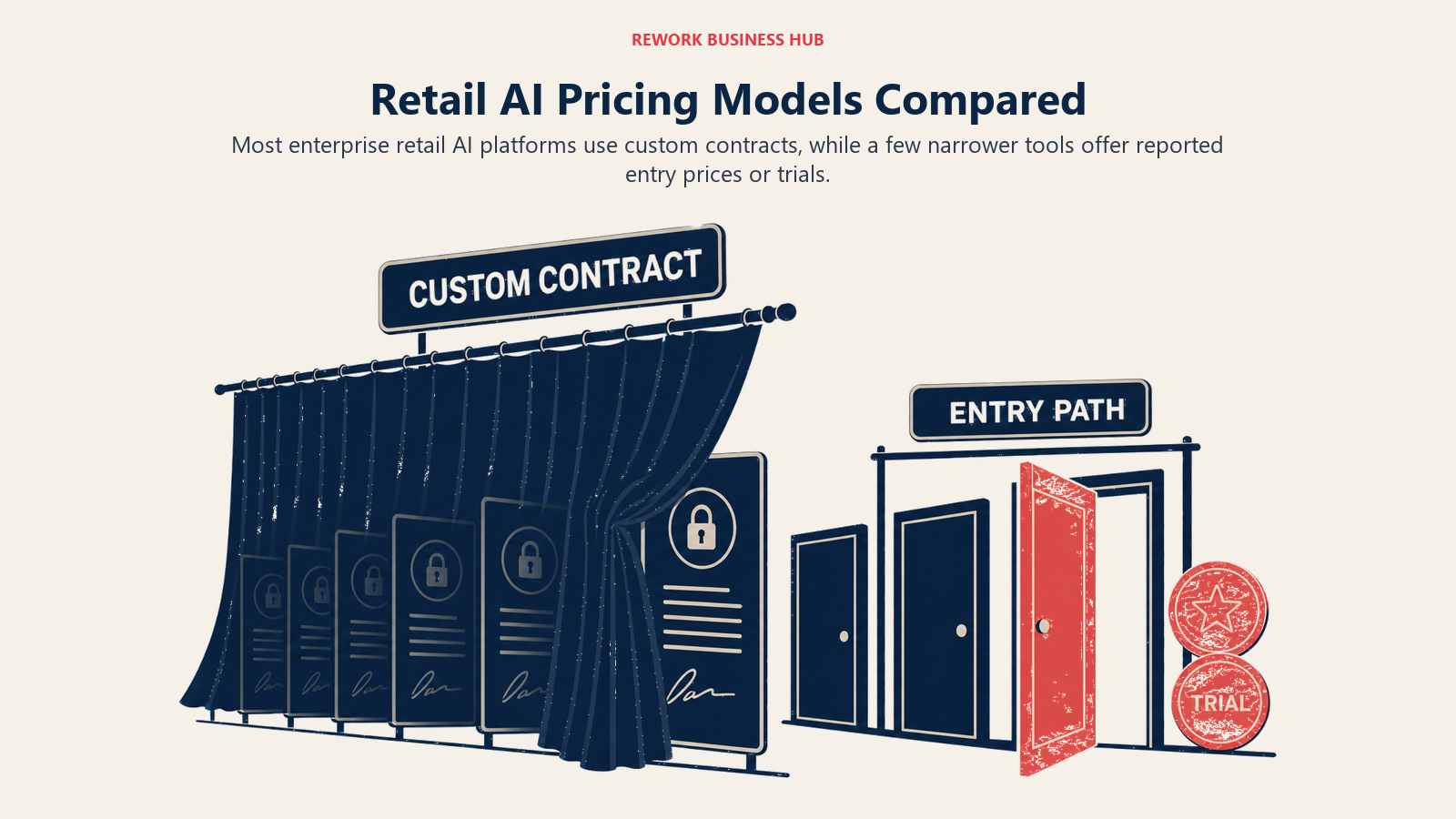
Most enterprise retail AI platforms use custom contracts, while a few narrower tools offer reported entry prices or trials.
| Tool | Entry Price | Pricing Model | Free Tier? |
|---|---|---|---|
| Blue Yonder | Custom quote | Enterprise contract | No |
| RELEX Solutions | Custom quote | Subscription, scaled to org size | No |
| o9 Solutions | Custom quote | Enterprise contract | No |
| Symphony RetailAI | Custom quote | Enterprise contract | No (free trial) |
| Nextail | Custom (Starter/Growth/Enterprise) | Tiered subscription | No (free trial) |
| Daisy Intelligence | Custom quote | Enterprise contract | No |
| Trax Retail | Custom quote | Scoped to store count/coverage | No |
| Standard AI | Custom quote | Enterprise contract | No |
| Trigo | Custom quote | Enterprise contract (capex-free option) | No |
| Lily AI | ~$200/mo reported (Standard) | Tiered + custom Enterprise | Yes (30-day trial) |
| Legion Technologies | ~$49/mo reported entry | Volume/module-based enterprise contract | No |
| Aptos | Custom quote | Enterprise contract | No |
What to Do Next
Pick the single store function costing you the most right now, forecasting misses, shelf gaps, shrink, or scheduling waste, and shortlist two tools against the decision framework above rather than trying to deploy AI across every function at once. Most of these vendors require a sales conversation and a pilot before a real contract, so use that pilot to test the vendor's claimed accuracy and ROI against your own store data before committing budget. And if the bottleneck turns out to be fragmented customer conversations across channels rather than a missing operational tool, Rework's pricing covers the Marketing Engine (from $99/month billed yearly, 5 seats) for retailers moving past disconnected WhatsApp and Instagram inboxes.

Principal Product Marketing Strategist
On this page
- What Changed in 2026
- Key Facts
- Quick Comparison Table
- How to Choose AI Tools by Retail Function
- Demand Forecasting and Supply Chain Planning
- 1. Blue Yonder
- 2. RELEX Solutions
- 3. o9 Solutions
- Merchandising, Assortment, and Space Planning
- 4. Symphony RetailAI (SymphonyAI Retail/CPG)
- 5. Nextail
- 6. Daisy Intelligence
- In-Store Analytics and Shelf Intelligence
- 7. Trax Retail
- 8. Standard AI
- 9. Trigo
- Personalization and Product Data
- 10. Lily AI
- Workforce Scheduling
- 11. Legion Technologies
- Unified Commerce and Point of Sale
- 12. Aptos
- A Note on Omnichannel Customer Conversations
- How to Choose: Decision Framework
- Framework: By Store Count and Complexity
- AI Tool Buying Mistakes to Avoid in Retail
- Pricing at a Glance
- What to Do Next