Best AI Tools for Ecommerce Stores in 2026
Turn this article into takeaways for your work.


Each assistant summarizes the article only for you and suggests best practices for your work.
If you're picking AI tools for ecommerce stores in 2026, the right starting point isn't a ranked list, it's your store's actual bottleneck. Shopify Magic and Photoroom cover product copy and imagery for free or near-free, Rebuy and Nosto lead personalization, Gorgias and Zipchat lead support automation, and Particl and Inventory Planner handle the pricing and stock-planning work most "best AI tools" lists skip entirely. This guide groups 15 real tools by the store function they actually solve.
Most ecommerce AI roundups rank tools by hype instead of by job. That's backwards if you're trying to fix a specific problem: a slow product page, a stale ad account, or a support inbox nobody can keep up with. Each section below covers one function your store already has, product descriptions, photography, personalization, chat and support, email and retention, ad creative, pricing, and inventory, and ranks the tools that actually solve it. If you want a straight ranked list instead, Best AI Tools for Ecommerce in 2026 covers the same category tool-by-tool rather than function-by-function.
Updated July 2026: What Changed
- Klaviyo's Customer Agent AI moved off its introductory rate. The $140/month launch price expired March 31, 2026. It now runs $200/month plus $0.70 per conversation beyond the 50 included monthly, on top of the base email/SMS plan.
- Support AI settled on pay-per-outcome pricing across vendors, not just one. Gorgias' AI Agent bills roughly $0.90 per resolved conversation, and Intercom's Fin bills $0.99 per outcome (resolution, handoff, or disqualification), both replacing flat per-seat AI add-ons.
- Salesforce agreed to acquire Intercom (trading as Fin) for roughly $3.6 billion in June 2026. The deal is signed but not yet closed as of July 2026, and Fin's per-outcome pricing hasn't changed, but it's worth watching once the acquisition closes.
- Shopify narrowed Sidekick's custom app-building to higher plan tiers. It was open to Basic-plan merchants through April 2026 and is now limited to Grow, Advanced, Shopify Plus, and Enterprise plans.
Key Facts
- AI agents drove roughly 20% of global online retail orders during the 2025 holiday season, worth about $262 billion in sales, per Salesforce's Shopping Index.
- Generative AI could unlock $240 billion to $390 billion in annual economic value for retailers, per McKinsey.
- 82% of retailers have piloted generative AI for customer service specifically, and 36% are already scaling it, per McKinsey.
- AI-driven product recommendations are projected to boost ecommerce sales by as much as 59%, per Shopify.
- 51% of ecommerce businesses currently use AI to build personalized shopping experiences, per Shopify.
- AI-driven demand forecasting can reduce supply chain forecast errors by 20% to 50% and cut warehousing costs by 5% to 10%, per McKinsey.
- 70% of large organizations will adopt AI-based supply chain forecasting to predict demand by 2030, per Gartner.
Quick Comparison Table
| Tool | Store Function | Best For | Starting Price | Free Tier? |
|---|---|---|---|---|
| Shopify Magic & Sidekick | Product descriptions and copy | Any Shopify merchant wanting AI at zero extra cost | Free on every Shopify plan | Yes (included) |
| Jasper | Product descriptions and copy | Teams writing product copy at volume across brands | $59/mo (Pro, annual) | 7-day trial |
| Photoroom | Product photography | Removing photoshoot cost from the catalog workflow | Free (250 exports/mo); Pro $7.99/mo | Yes |
| Vue.ai | Product photography and catalog | Large fashion/retail catalogs needing tagging and on-model imagery at scale | Custom, module-based quote | No |
| Rebuy | Personalization and recommendations | AI cart upsells and post-purchase offers on Shopify | Free (Monetize); paid from $25/mo | Yes |
| Nosto | Personalization and recommendations | Enterprise AI search and merchandising at scale | ~$500-$2,000/mo (GMV-based) | No |
| Gorgias AI Agent | Chat, support, and sales | Autonomous ticket resolution on Shopify | ~$0.90 per resolved conversation | No |
| Zipchat AI | Chat, support, and sales | Agentic sales/support chat that reads your live catalog | Free (120 replies/mo); $49/mo (Starter) | Yes |
| Intercom Fin | Chat, support, and sales | Outcome-based AI resolution across any helpdesk | $0.99 per outcome; $49/mo base (standalone) | 14-day trial |
| Klaviyo AI | Email and retention marketing | AI-driven email/SMS with a pay-per-conversation Customer Agent | Free (250 profiles); Customer Agent $200/mo | Yes |
| AdCreative.ai | Ad creative | Bulk, credit-based ad creative across platforms | ~$29-39/mo (10 credits) | 7-day trial |
| Pencil | Ad creative | AI ad variants tied to ROAS/CPA performance | $14/mo (Core, 50 generations) | 6 free ads |
| Particl | Pricing and competitive intelligence | AI-modeled competitor pricing and assortment data | $250/mo (Starter) | No |
| Prisync | Pricing and competitive intelligence | Automated competitor price monitoring and repricing rules | $99/mo (Professional, up to 100 products) | 14-day trial |
| Inventory Planner by Sage | Inventory and demand forecasting | AI-forecasted reordering and stock planning | ~$120/mo (Essentials) | No |
How to Choose AI Tools by Store Function
Most ecommerce AI buying mistakes happen because a team buys the flashiest tool instead of mapping it to an actual bottleneck. Before adding a new AI line item to your stack, answer three questions:
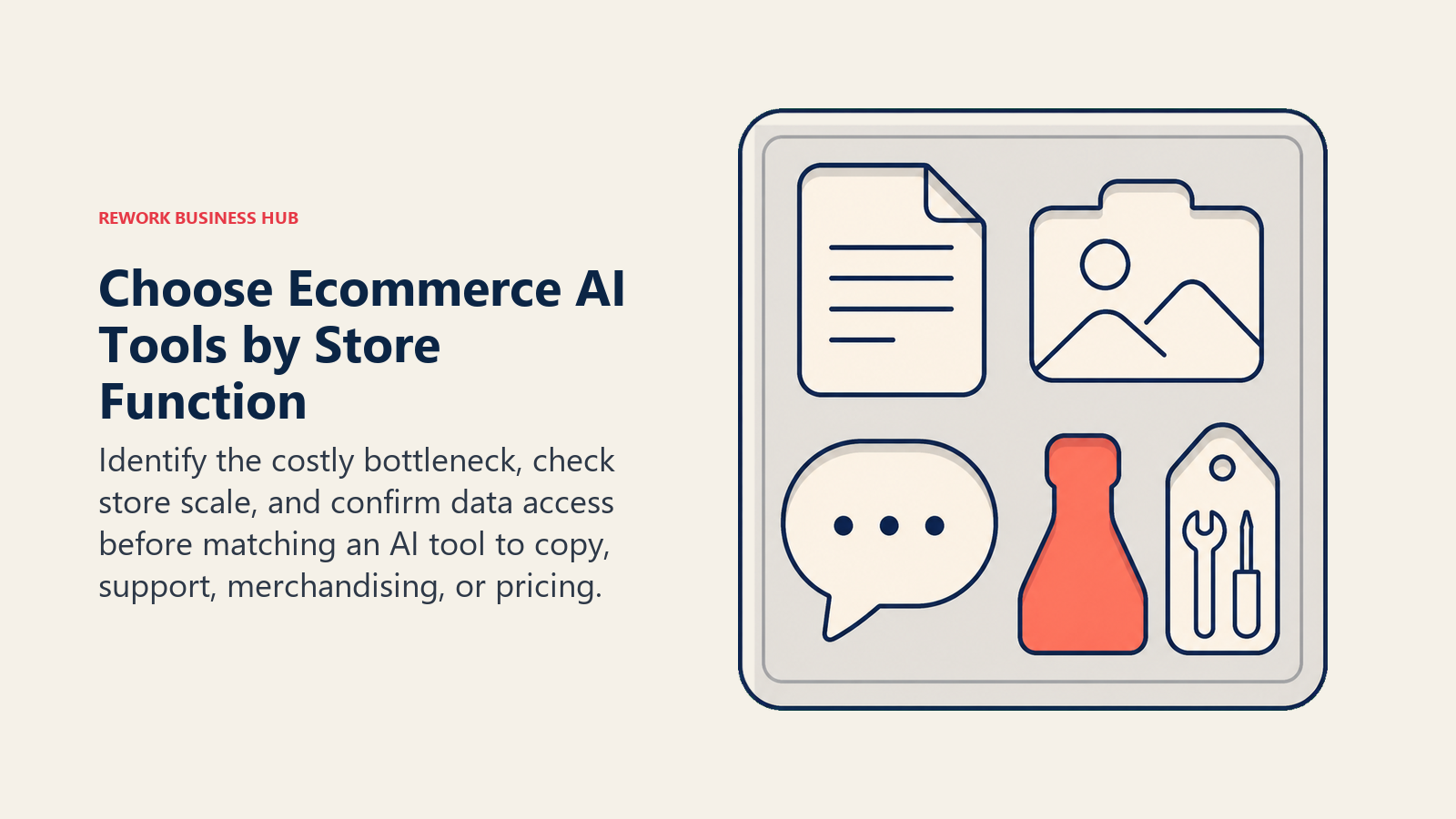
- Which function is actually costing you money right now? Thin product descriptions, a stale photo budget, a support backlog, and flat email revenue are four different problems, each with a different tool below. Don't buy a merchandising platform to fix a support backlog.
- What's your order volume and catalog depth? A $2M/year D2C brand and a $200M/year multi-brand retailer need different tools inside the same function. Nosto and Inventory Planner's higher tiers are built for catalog depth and GMV a small store doesn't have yet.
- Does the tool touch data you already have, or does it need a new integration? Tools that plug directly into Shopify's admin (Magic, Sidekick, Zipchat, Rebuy) have near-zero setup friction. Tools with their own data layer (Nosto, Particl, Inventory Planner) take longer to stand up but go deeper.
Product Descriptions and Copy
Product copy is usually the first AI job a store automates, and it's also the easiest to get wrong: fast, generic copy that reads like every other listing doesn't move conversion. The two tools below solve this at different scales.
1. Shopify Magic & Sidekick
Shopify's bet is that AI copy shouldn't be a paid add-on, it should be built into the platform every merchant already pays for. Magic covers AI-generated product descriptions, email copy, and image editing, while Sidekick is the conversational assistant that answers store questions and, on higher tiers, builds custom internal apps from a plain-English prompt.
Best for: Any Shopify merchant who wants AI-assisted product copy without adding a new vendor
Key strengths:
- Free on every Shopify plan, no separate AI subscription
- Covers the most common day-to-day copy tasks: descriptions, email drafts, image touch-ups
- Sidekick can query your own store data and answer operational questions directly
Limitations:
- Custom app-building through Sidekick is now limited to Grow, Advanced, Shopify Plus, and Enterprise plans
- Output still needs a human edit pass for brand voice consistency
- Not built for high-volume, multi-brand copy production
Pricing: Free on every Shopify plan for core Magic and Sidekick features. See shopify.com/sidekick.
| What you get | What you don't |
|---|---|
| AI copy and a store assistant at zero extra cost | Custom app generation gated to higher plan tiers |
| No new integration, it's already in your admin | Not built for high-volume, multi-brand copy runs |
| Fast to start using on day one | Needs a human review pass on brand-voice copy |
2. Jasper
Jasper's angle is volume and consistency: brand voice profiles, reusable knowledge assets, and campaign-level content generation for teams writing product copy, ads, and landing pages across multiple brands or a large catalog, not just one description at a time.
Best for: Ecommerce marketing teams writing product copy, ads, and campaigns at volume across a shared brand voice
Key strengths:
- Brand voice profiles and knowledge assets keep copy consistent across a large catalog
- Covers product descriptions, ad copy, and email in one workspace, not just one content type
- Business tier adds team collaboration and governance for larger content operations
Limitations:
- Pro plan is scoped to one seat and 3 brand voices, a real ceiling for multi-brand teams
- Business tier pricing isn't published and typically starts around $900/month for small teams
- No native connection to your store's live catalog or order data
Pricing: Pro is $59/month billed annually ($69/month billed monthly), for 1 seat, 3 brand voices, and 10 knowledge assets. Business is custom-quoted. See jasper.ai/pricing.
| What you get | What you don't |
|---|---|
| Consistent brand voice across a large product catalog | Pro tier's 1-seat, 3-voice cap limits multi-brand teams |
| Copy, ads, and email in one workspace | Business pricing requires a sales conversation |
| 7-day free trial to test fit | No native live catalog or order data connection |
For a broader look at AI writing tools beyond ecommerce specifically, see best AI tools for content writers.
Product Photography and Visual Merchandising
Photography is one of the most expensive line items in a growing catalog, and it's also where AI has moved fastest: background removal and touch-ups are now table stakes, and the harder problem, catalog-scale tagging and on-model imagery, has its own dedicated tools.
3. Photoroom
Photoroom's model is credit-based AI photo editing built specifically around catalog and listing workflows: background removal, AI-generated backgrounds, product staging, and a virtual model tool that replaces a portion of traditional product photoshoots.
Best for: Ecommerce sellers who want to cut photoshoot cost and turnaround without hiring a photographer for every SKU
Key strengths:
- Free tier includes 250 exports a month, enough to validate fit before paying
- Batch export and template features built for catalog-scale, not single-image, workflows
- Ultra tier scales cleanly from 5,000 to 50,000 batch exports a month for high-volume sellers
Limitations:
- AI generation credits are a separate consumption layer from exports, worth modeling before you commit to a tier
- Max and Ultra tiers are a real cost step up from Pro for teams that need advanced AI models
- Enterprise pricing (200,000+ images a year) requires a custom quote
Pricing: Free (250 exports/mo). Pro is $7.99/month. Max is $26.99/month. Ultra scales from $99/month (5,000 batch exports) to $990/month (50,000 batch exports). Enterprise is custom. See photoroom.com/pricing.
| What you get | What you don't |
|---|---|
| Real free tier before you pay anything | AI credits and exports are separate consumption layers |
| Batch and template tools built for catalog scale | Max/Ultra tiers are a meaningful cost step from Pro |
| Ultra scales predictably to 50,000 exports/mo | Enterprise volume requires a custom quote |
4. Vue.ai
Vue.ai's specialty is the operational side of a large fashion or retail catalog: computer-vision product tagging, visual search, and on-model product imagery generated through its VueModel tool instead of a traditional photoshoot, built for catalogs with thousands of SKUs where manual tagging doesn't scale.
Best for: Large fashion and retail catalogs that need AI tagging, visual search, and imagery automation at scale, not a single-image editing tool
Key strengths:
- Computer-vision tagging and visual search purpose-built for deep, fast-changing catalogs
- VueModel generates on-model product photography, cutting traditional photoshoot costs
- INTURN module extends the platform into inventory and off-price liquidation management
Limitations:
- Pricing isn't public, it's a module-based subscription quoted per retailer, not self-serve
- Built for catalog scale most small and mid-size D2C brands don't have yet
- Longer sales and implementation cycle than any app-store tool on this list
Pricing: Not published. Subscription is module-based, quoted per retailer's selected features. See vue.ai.
| What you get | What you don't |
|---|---|
| AI tagging and on-model imagery in one platform | No public pricing, sales-led, not self-serve |
| Built for large, fast-changing fashion catalogs | Not cost-effective for small or mid-size D2C catalogs |
| Photoshoot cost reduction via AI model imagery | Longer implementation than a plug-and-play app |
Personalization and Product Recommendations
Once your catalog and copy are in shape, the next lever is matching the right product to the right shopper, at the browse, cart, and post-purchase moments where a recommendation actually changes the outcome.
5. Rebuy
Rebuy's philosophy is that the highest-leverage moment for AI isn't the homepage, it's the cart and the thank-you page, where a shopper has already decided to buy and a well-timed recommendation directly lifts average order value. Its AI engine powers smart carts, dynamic bundles, and post-purchase upsells assembled from packages you mix and match.
Best for: Growth-stage Shopify brands that want AI-driven upsells and bundling without an enterprise merchandising platform
Key strengths:
- Modular pricing, pay only for the packages you actually use (cart, search, checkout, testing)
- A free "Monetize" tier turns the thank-you page into revenue from partner offers
- Order-volume-based pricing scales predictably as the store grows
Limitations:
- Choosing among modular packages takes initial setup thought versus one flat plan
- Premium support (CSM, quarterly reviews) is a real add-on cost at $499/month
- Platform One bundle pricing (~$534/month) is a meaningful step from the entry tier
Pricing: Free Monetize tier. Build Your Own starts around $25/month per package based on order volume. Platform One bundles everything for roughly $534/month. See rebuyengine.com/pricing.
| What you get | What you don't |
|---|---|
| Modular, pay-for-what-you-use pricing | Requires deciding which packages you actually need |
| Free tier that monetizes the post-purchase moment | Premium support is a $499/mo add-on |
| Predictable order-volume-based scaling | Full-platform bundle is a real cost step up |
6. Nosto
Nosto's Experience.AI engine automates site search, category merchandising, and product recommendations in real time, priced by gross merchandise value rather than search query volume, built for retailers who don't want costs to spike during a traffic surge or a big sale.
Best for: Established retailers doing $1M+ in annual revenue with a deep catalog that needs personalized search and merchandising across web, email, and ads
Key strengths:
- GMV-based pricing means predictable costs even during traffic spikes, unlike query-based models
- Real-time personalization spans site search, category pages, and recommendation widgets in one engine
- Recognized as a G2 Leader across ecommerce personalization categories in 2026
Limitations:
- Pricing isn't published, mid-market plans typically run $500-$2,000/month before enterprise negotiation
- Overkill for stores under roughly $1M in annual revenue
- Implementation and catalog setup take longer than a plug-and-play app
Pricing: Not published. Mid-market plans typically run $500-$2,000/month based on GMV, enterprise pricing is negotiated. See nosto.com.
| What you get | What you don't |
|---|---|
| GMV-based pricing that doesn't spike with traffic | No published pricing, requires a sales conversation |
| Real-time personalization across search and recs | Not cost-effective under roughly $1M in annual revenue |
| Recognized leader in ecommerce personalization | Longer setup than a single-purpose app |
Chat, Support, and Sales Conversations
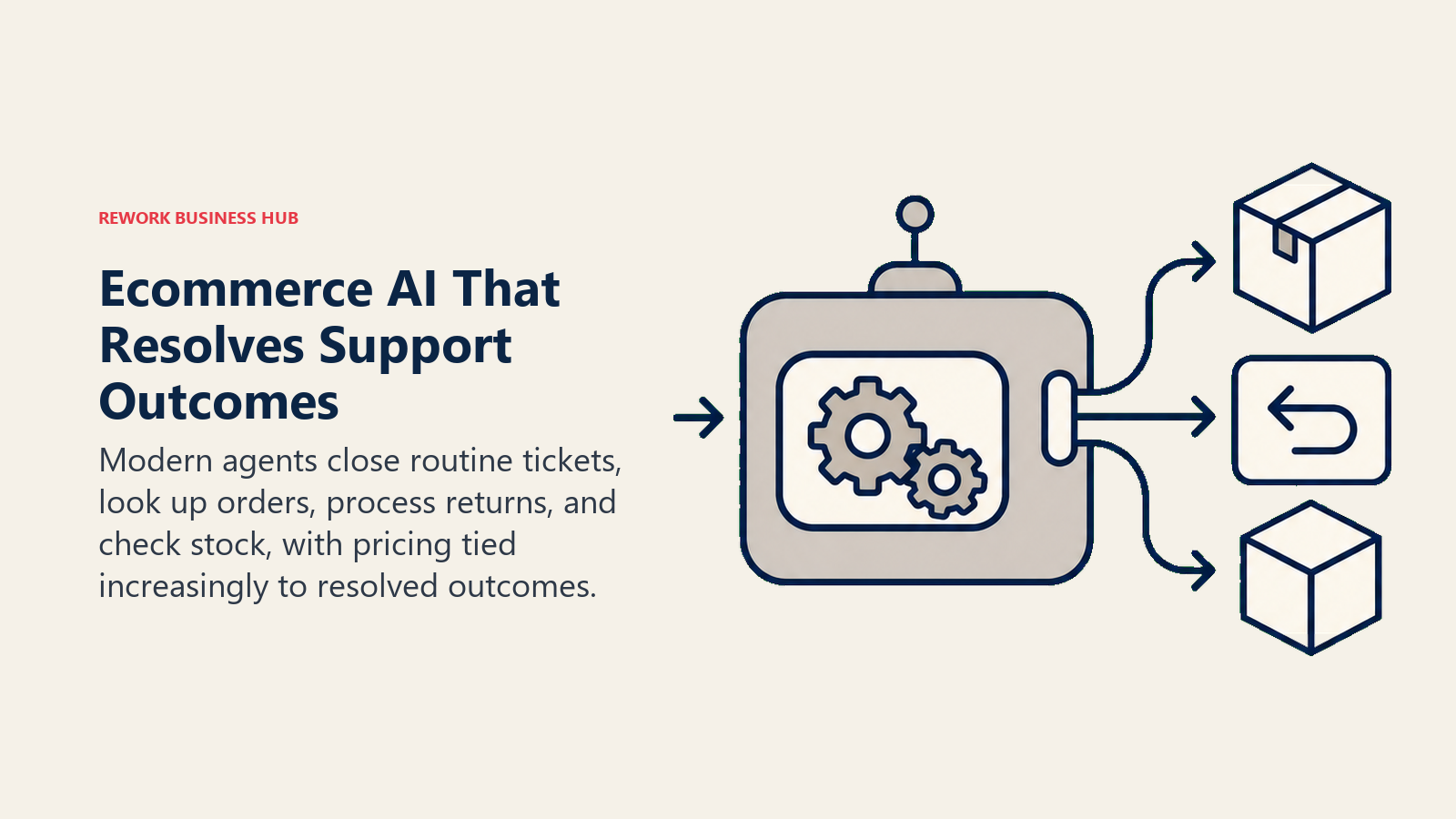
Support and sales chat is where AI's job has shifted fastest in 2026, from drafting replies to actually closing tickets and completing tasks, billed by what the AI resolves rather than by seat.
7. Gorgias AI Agent
Gorgias built its AI Agent around one principle: charge for AI that actually closes the ticket, not AI that merely assists a human. The AI Agent resolves conversations end-to-end across email, chat, and SMS, with tone-of-voice customization and multi-language support.
Best for: Shopify and Shopify Plus stores with meaningful ticket volume that want AI to fully close simple tickets
Key strengths:
- Billed only when the AI actually resolves a conversation, not per message or per seat
- Runs across email, chat, and SMS with the same resolution logic
- Actions capability looks up orders, processes returns, and checks stock within policy
Limitations:
- Requires an underlying Gorgias helpdesk plan, AI Agent isn't sold standalone
- Resolved AI conversations are billed on top of the ticket itself, a real double-cost to model
- Overage rates vary by tier and can surprise teams that don't track resolution volume
Pricing: AI Agent resolutions run roughly $0.90 per resolved interaction on most plans, with 90 to 2,500+ automated interactions included depending on tier. Requires a base Gorgias helpdesk plan. See gorgias.com/pricing.
| What you get | What you don't |
|---|---|
| Pay only for resolutions, not seats or messages | Requires a paid Gorgias helpdesk plan underneath |
| Works across email, chat, and SMS with one logic layer | Double-billed: ticket cost plus resolution cost |
| Order lookup and returns handled within your policy | Overage pricing needs active tracking as volume grows |
For the underlying helpdesk decision, best help desk software in 2026 covers platforms beyond Gorgias, and best Gorgias alternatives covers other chat-first options.
8. Zipchat AI
Zipchat's bet is that a chat widget shouldn't just answer questions, it should act: look up an order, process a return within policy, apply a discount code, or recommend a product, all inside one conversation. It installs from the Shopify App Store and reads your live catalog and order data directly.
Best for: Stores that want AI to handle most chat conversations end-to-end, not just triage before a human takes over
Key strengths:
- One-click Shopify install, reads live catalog and order data automatically
- Agentic Skills complete real tasks (returns, order lookup, discount checks), not just FAQs
- Reports a meaningful conversion lift when AI chat actively recommends and closes
Limitations:
- Reply-based pricing means a viral traffic spike can push you into overage fast
- Best value shows up at the Growth tier and above, Starter's 500 replies go quickly
- Smaller third-party integration ecosystem than established helpdesks
Pricing: Free tier includes 120 AI replies/month. Starter is $49/month (500 replies). Growth is $129/month (1,500 replies). Pro is $249/month, Scale is $499/month, with overage at $49 per additional 250 replies. See zipchat.ai.
| What you get | What you don't |
|---|---|
| Agentic actions, not just chat replies | Reply-based pricing can spike with traffic surges |
| Fast Shopify install with live catalog sync | Starter tier's reply cap is thin for busy stores |
| Reports strong AI-chat-to-conversion lift | Smaller integration ecosystem than established helpdesks |
9. Intercom Fin
Fin (Intercom's AI agent, now the company's primary brand) prices itself the same way Gorgias does, per outcome, but applies it more broadly: a resolution, a handoff to a human procedure, or a disqualification each cost $0.99, and a qualified lead costs $9.99. A standalone "Fin for platforms" option lets you run it on a non-Intercom helpdesk.
Best for: Stores on any helpdesk (not just Intercom's own) that want a single outcome-based AI pricing model across support and lead qualification
Key strengths:
- Works standalone on top of another helpdesk, not locked to Intercom's own ticketing system
- One pricing model covers resolutions, handoffs, disqualifications, and lead qualification
- $49/month standalone base tier includes 50 resolutions before per-outcome billing starts
Limitations:
- Minimum 50 outcomes a month even on the entry standalone tier
- Salesforce's pending acquisition of Fin (signed but not closed as of July 2026) adds roadmap uncertainty
- Full Intercom-native deployment requires the broader Intercom platform, a separate cost
Pricing: $0.99 per outcome (resolution, handoff, or disqualification); $9.99 per qualified lead. Standalone "Fin for platforms" is $49/month, including 50 resolutions, with a 50-outcome monthly minimum. See fin.ai/pricing.
| What you get | What you don't |
|---|---|
| Works standalone on a non-Intercom helpdesk | 50-outcome monthly minimum even at entry tier |
| One pricing model across support and lead qualification | Pending Salesforce acquisition adds roadmap uncertainty |
| $49/mo base includes 50 resolutions | Full native deployment needs the broader Intercom platform |
See best Intercom alternatives if the outcome-based pricing doesn't fit your ticket volume, or best live chat software in 2026 for a broader platform comparison.
Email and Retention Marketing
Email and SMS remain one of the highest-ROI channels a store owns outright, and AI's role here has shifted from subject-line suggestions to full campaign drafting and predictive customer segmentation.
10. Klaviyo AI
Klaviyo's product philosophy is that email and SMS marketing should run on the same unified customer profile as support and analytics, and its AI layer (Marketing Agent, predictive segments, and Customer Agent) is built on that same data model rather than bolted on separately.
Best for: D2C brands that already run email/SMS as a primary revenue channel and want AI layered directly on that data
Key strengths:
- Predictive analytics and AI-generated segments included in standard paid plans
- Marketing Agent drafts full campaigns and flows from a prompt, not just subject lines
- Customer Agent shares the same customer profile as your marketing data, no separate sync
Limitations:
- Customer Agent is a separate line item on top of your base plan, not included
- Base plan cost scales fast with list size, a 250K-contact list runs into five figures a year
- AI overage pricing ($0.70/conversation past 50 included) is easy to underestimate at scale
Pricing: Free up to 250 profiles. Paid plans scale with contacts, roughly $720/month at 50,000 contacts. Customer Agent AI starts at $200/month plus $0.70 per conversation beyond 50 included. See klaviyo.com/pricing.
| What you get | What you don't |
|---|---|
| Predictive segments and AI campaign drafting | Customer Agent AI is a separate paid add-on |
| One customer profile across email, SMS, and support AI | Base plan cost climbs quickly with list size |
| No new data silo, AI runs on data you already have | Per-conversation overage needs active monitoring |
For the platform decision itself, best email marketing software in 2026 and best Klaviyo alternatives cover that in more depth.
Ad Creative for Paid Social
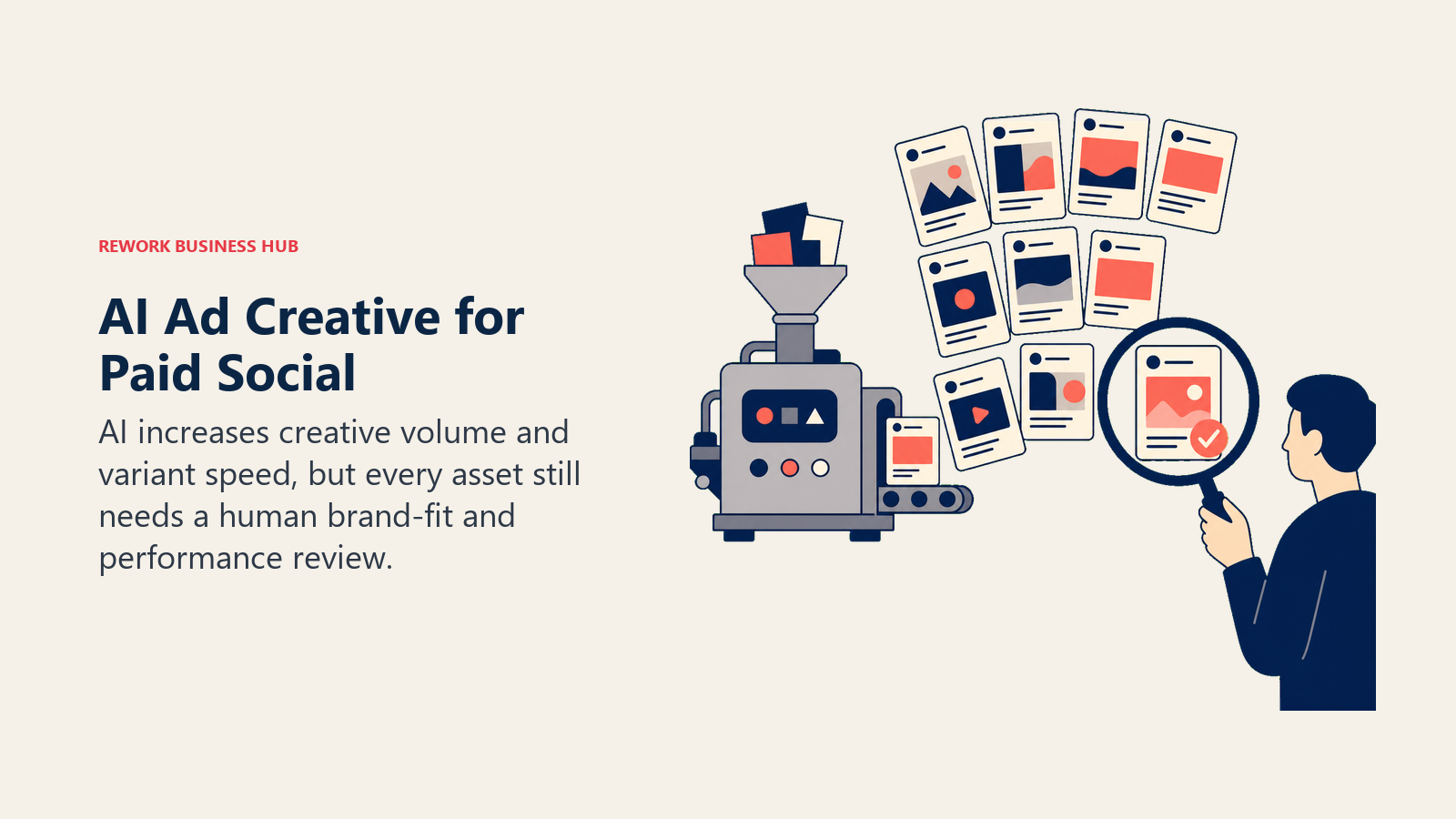
Feeding paid social with fresh creative is a volume problem AI is well-suited to, generating variants faster than a human designer can iterate, though every output still needs a brand-fit review pass.
11. AdCreative.ai
AdCreative.ai's model is volume: generate a large batch of on-brand ad creative and social assets from a credit pool, rather than iterating on one ad at a time, built for teams feeding multiple ad accounts and platforms on a recurring schedule.
Best for: Teams running paid ads across multiple platforms that need bulk, on-brand creative output on a recurring cadence
Key strengths:
- Credit-based tiers scale from a handful of assets to 500 per month at the top published tier
- Annual billing discount (up to 50% off) makes entry tiers meaningfully cheaper long-term
- 7-day free trial with 10 credits included, no charge until the trial ends
Limitations:
- Entry pricing varies by source (roughly $29-39/month depending on billing cycle)
- Higher tiers ($249-399/month) are a real jump for teams that need volume but not enterprise scale
- Output still needs a human review pass before an asset goes live
Pricing: Plans run from roughly $29-39/month (10 credits) up to $249-399/month (200-500 credits), with quarterly and annual discounts up to 50% off. See adcreative.ai.
| What you get | What you don't |
|---|---|
| Bulk, credit-based creative generation at scale | Entry pricing varies by billing cycle, confirm at signup |
| Meaningful annual-billing discount | Higher tiers are a real cost jump for high-volume teams |
| Free trial before any charge | Still needs a human QA pass before assets go live |
12. Pencil
Pencil's pitch is that ad creative should be generated and iterated against real performance data, not just produced and hoped for. Its GenAI engine creates ad variants aimed at lifting ROAS and cutting CPA, streamlining the path from a creative brief to a batch of testable variations.
Best for: Ecommerce marketing teams that need a steady volume of AI-generated ad variants without a full in-house creative team
Key strengths:
- Generation is tied to performance goals (ROAS, CPA), not just visual output
- Entry tier is genuinely affordable for a solo marketer or small team testing the category
- Six free guided ads before you need to subscribe
Limitations:
- Generation caps (50/month on Core) are tight for teams running frequent creative refreshes
- Growth tier jumps to $55/month for 250 generations, a meaningful step from Core
- Pro and Enterprise pricing isn't published
Pricing: Core is $14/month (50 generations). Growth is $55/month (250 generations). Pro and Enterprise are custom-quoted. See trypencil.com/pricing.
| What you get | What you don't |
|---|---|
| Performance-tied ad generation, not just visuals | Core tier's 50-generation cap is tight for frequent refreshes |
| Affordable entry point for solo marketers | Growth tier is a real cost step from Core |
| Six free guided ads to test fit before paying | Pro/Enterprise pricing is quote-only |
For a broader look at AI ad creative tools, see best AI ad creative tools in 2026, and for AI tools across digital marketing generally, best AI tools for digital marketing.
Dynamic Pricing and Competitive Intelligence
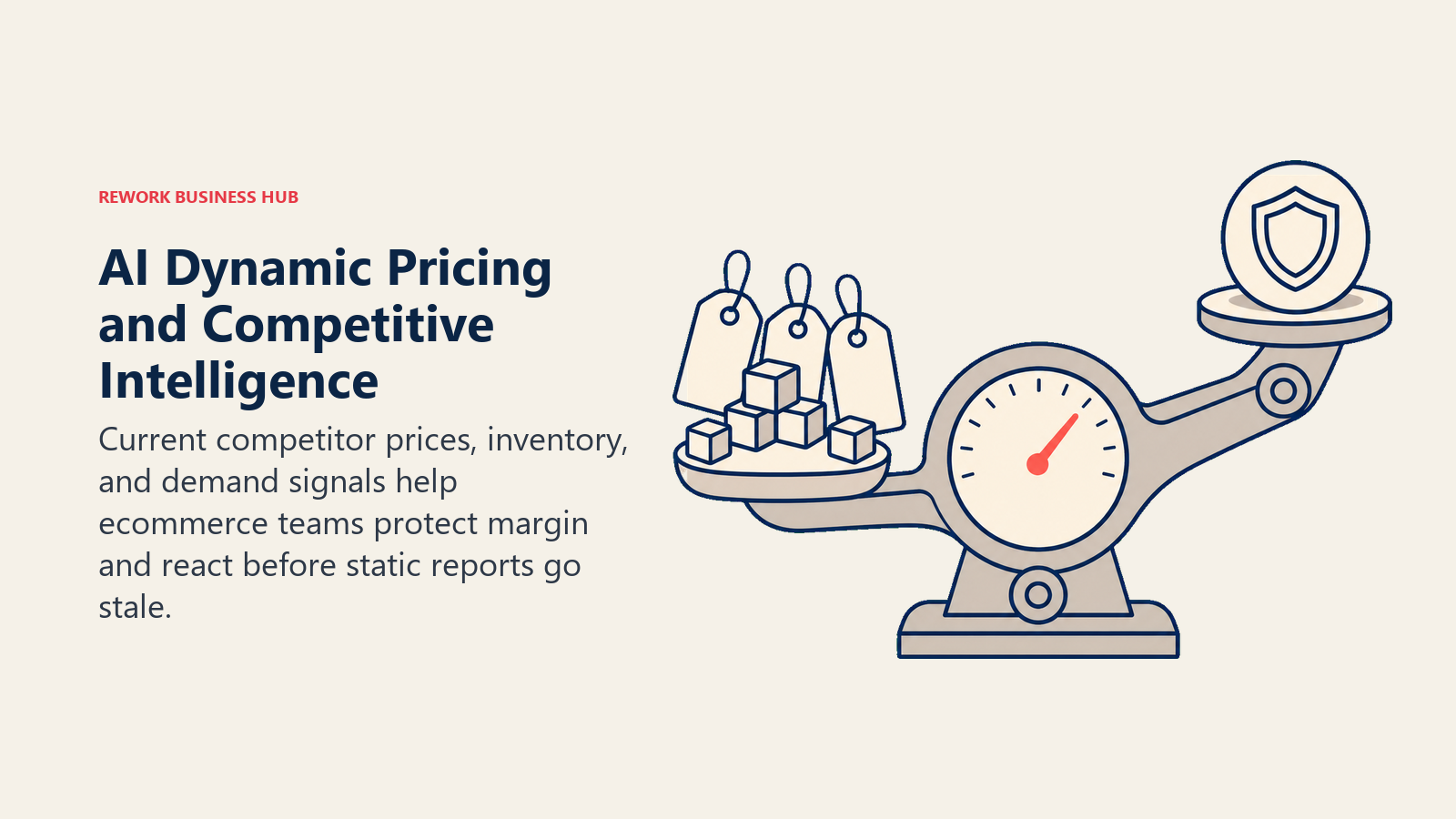
Pricing is the function most "best AI tools for ecommerce" lists skip entirely, but it's where AI-modeled data can move margin directly, if you know what competitors are charging and stocking right now, not last quarter.
13. Particl
Particl exists to answer a question most brands guess at: what are competitors actually charging, stocking, and promoting right now. Its AI models pricing, inventory, and sentiment signals across a database of over 100,000 brands and 600 million SKUs, and connects directly to Claude, ChatGPT, or any MCP-enabled AI client for natural-language queries.
Best for: Brands doing $10M+ in annual revenue, especially in apparel and beauty, that need AI-modeled competitive pricing and assortment data, not a static report
Key strengths:
- Tracks pricing, inventory, and sentiment across 20,000+ retailers and 600M+ SKUs
- Data is modeled, not just reported, so it supports dynamic, market-driven pricing decisions
- Native MCP connection lets you query competitor data directly from Claude or ChatGPT
Limitations:
- Built for brands with real assortment and pricing decisions to make, overkill under $10M revenue
- $250/month Starter tier covers monitoring only, real decision-support needs the $1,000/month Growth tier
- Narrow, single-purpose focus on competitive intelligence
Pricing: Starter is $250/month for focused competitor monitoring. Growth is $1,000/month for category managers making real assortment decisions. See particl.com.
| What you get | What you don't |
|---|---|
| AI-modeled pricing and assortment data, not static reports | Overkill for brands under roughly $10M in revenue |
| Coverage across 100,000+ brands and 600M+ SKUs | Real decision-support pricing starts at $1,000/mo |
| Native query access from Claude or ChatGPT via MCP | Single-purpose: competitive intelligence only |
14. Prisync
Prisync's job is narrower and cheaper than Particl's: automated, URL-based tracking of competitor prices and stock status, with rule-based repricing so you can react to a competitor's price change without checking manually every day.
Best for: Small to mid-size stores that need straightforward competitor price monitoring and repricing rules without an enterprise data platform
Key strengths:
- Unlimited tracked competitors on every plan, no per-competitor add-on fee
- URL-based monitoring is simple to set up compared to a full data-integration platform
- 14-day free trial with no credit card required
Limitations:
- Product caps (100 at Professional) mean larger catalogs need Premium or Platinum
- Channel-based and hybrid monitoring models cost meaningfully more than URL-based
- API access carries an additional cost on top of the plan price
Pricing: URL-based Professional is $99/month (up to 100 products). Premium is $199/month (up to 1,000 products). Platinum is $399/month (up to 5,000 products). Channel-based and hybrid monitoring cost more per tier. See prisync.com.
| What you get | What you don't |
|---|---|
| Unlimited competitor tracking on every plan | Product caps push larger catalogs to higher tiers |
| Simple URL-based setup | Channel-based/hybrid monitoring costs more |
| 14-day free trial, no credit card | API access is an added cost |
Inventory and Demand Forecasting
Stockouts and overstock are margin problems, not just operational ones, and this is the function where AI-driven forecasting has the clearest, most measurable payback of anything on this list.
15. Inventory Planner by Sage
Inventory Planner forecasts demand at the SKU level and generates purchase order recommendations, replacing the spreadsheet-and-gut-feel approach most growing stores start with. Pricing scales with your store's revenue rather than a flat seat count, and the Premium tier adds Sage Copilot, an AI assistant that prioritizes what to reorder first.
Best for: Growing ecommerce stores that have outgrown manual reordering and need AI-forecasted purchase recommendations tied to actual sales velocity
Key strengths:
- Essentials tier is genuinely affordable for stores near $2M GMV or under
- Premium's Sage Copilot AI assistant prioritizes reorder decisions instead of just surfacing raw data
- Forecasting and replenishment logic built specifically for ecommerce sales patterns, not generic ERP inventory
Limitations:
- Standard, Premium, and Enterprise tiers aren't published, budgeting requires a sales conversation
- Reported mid-market cost ($3,600-$7,200/year for a $15M-revenue retailer) is a real step up from the Essentials floor
- Enterprise tier requires a dedicated Sage sales relationship, not self-serve
Pricing: Essentials starts around $119.99/month for stores near $2M GMV or below. Standard, Premium, and Enterprise are quote-only and scale with revenue. See inventory-planner.com/pricing.
| What you get | What you don't |
|---|---|
| Affordable entry tier for smaller catalogs | Standard/Premium/Enterprise pricing isn't published |
| AI-prioritized reorder decisions at Premium | Mid-market cost is a real step up from Essentials |
| Forecasting built for ecommerce sales patterns | Enterprise requires a dedicated sales relationship |
A Note on Unified Inbox and CRM Tools
Most of the tools above are point solutions: each one solves one function well but adds its own data silo. If your actual bottleneck is that customer conversations are scattered across WhatsApp, Instagram DM, email, and live chat with no shared history, that's a different problem than any single AI tool on this list solves.
Rework is a unified CRM and Lead Ops platform with a multi-channel inbox (WhatsApp, Messenger, Instagram DM, TikTok, and web chat on one contact timeline), a genuine fit for D2C and ecommerce brands running high message volume across channels that want one place to see the full customer history. It is not a replacement for Klaviyo's email AI, Gorgias' ticket resolution, or Nosto's merchandising engine, those solve narrower jobs better. The Marketing Engine (inbox and lead capture) runs $99/month billed yearly, or $115 month to month, with 5 marketing seats included, see rework.com/pricing. It isn't the right fit for solo sellers or teams under 5 people. For CRM options more broadly, best CRM software in 2026 covers 15 platforms by team size and motion.
How to Choose: Decision Framework
| If you need... | Pick... | Why |
|---|---|---|
| AI product copy baked into your existing Shopify admin | Shopify Magic & Sidekick | Free on every plan, no new vendor or integration |
| Multi-brand product copy and ad copy at volume | Jasper | Brand voice profiles keep tone consistent across a large catalog |
| Photoshoot cost and turnaround cut from your catalog workflow | Photoroom | Credit-based AI editing built for batch, catalog-scale exports |
| AI tagging and on-model imagery for a large fashion catalog | Vue.ai | Purpose-built computer vision for fast-changing, deep catalogs |
| AI-powered cart upsells and post-purchase offers | Rebuy | Modular, pay-for-what-you-use pricing tied to order volume |
| Enterprise-grade AI search and merchandising at scale | Nosto | GMV-based pricing, real-time personalization across the store |
| Support tickets resolved autonomously, not just drafted | Gorgias AI Agent | Billed only when the AI actually closes the ticket |
| An AI sales/support chat that can act, not just answer | Zipchat AI | Agentic Skills complete real tasks inside the conversation |
| Outcome-based AI support on a non-Intercom helpdesk | Intercom Fin | Standalone deployment with one pricing model for resolutions and leads |
| AI-driven email/SMS flows and predictive segments | Klaviyo AI | Predictive analytics built on the same profile as your marketing data |
| Bulk, credit-based ad creative across platforms | AdCreative.ai | Highest published generation volume per tier on this list |
| AI ad creative generation tied to ROAS/CPA performance | Pencil | Generation aimed at performance goals, not just visual output |
| AI-modeled competitive pricing and assortment data | Particl | Tracks 600M+ SKUs, connects directly to Claude or ChatGPT |
| Straightforward competitor price monitoring and repricing | Prisync | Unlimited competitor tracking on every tier, simple URL-based setup |
| AI-forecasted reordering and stock planning | Inventory Planner by Sage | SKU-level forecasting built for ecommerce sales patterns |
Framework: By Store Revenue and Budget
| Revenue Stage | Budget Signal | Best Fits |
|---|---|---|
| Pre-revenue / just launched | Free or under $50/mo | Shopify Magic & Sidekick, Photoroom free tier, Zipchat free tier |
| $10K-$100K/mo | Under roughly $300/mo total AI stack | Klaviyo entry tier, Gorgias AI Agent, Photoroom Pro, Pencil Core |
| $100K-$1M/mo | Structured marketing/ops budget | Rebuy, Jasper Pro, AdCreative.ai, Prisync Professional, Inventory Planner Essentials |
| $1M-$10M/mo | Dedicated ecommerce/growth team | Nosto entry tier, Particl Starter, Vue.ai (fashion), Inventory Planner Standard/Premium |
| $10M+/mo / enterprise | Multi-brand or enterprise budget | Nosto Enterprise, Particl Growth, Vue.ai, enterprise Klaviyo contracts |
AI Tool Buying Mistakes to Avoid in Ecommerce
Generative AI could unlock $240 billion to $390 billion in annual economic value for retailers, per McKinsey, but most of that value goes to teams that buy the right tool for the right function, not the most AI features per dollar.
| Mistake | What It Looks Like | What to Do Instead |
|---|---|---|
| Buying a merchandising platform before you have the catalog for it | Signing up for Nosto or Vue.ai at $50K/year in revenue | Use Shopify's native recommendations and Rebuy until catalog depth justifies it |
| Ignoring per-resolution or per-outcome overage | Budgeting a flat number for Gorgias or Fin, then getting a surprise bill | Model your actual ticket volume against the plan's included cap before committing |
| Treating photo AI credits and exports as the same limit | Hitting an unexpected wall mid-month on Photoroom or a similar tool | Read the credit vs. export distinction before choosing a tier |
| Skipping pricing and inventory functions entirely | Buying copy, photo, and support AI but leaving margin decisions manual | Evaluate Particl, Prisync, or Inventory Planner once catalog depth justifies it |
| Underestimating GMV-based pricing at scale | Signing a Nosto contract without modeling cost as revenue grows | Run the GMV-based pricing formula against your 12-month revenue forecast |
| Stacking AI point tools with no shared customer view | Klaviyo, Gorgias, and Zipchat each holding a different slice of the same customer's history | Consider a unified inbox or CRM layer once conversation volume outgrows single-channel tools |
Pricing at a Glance
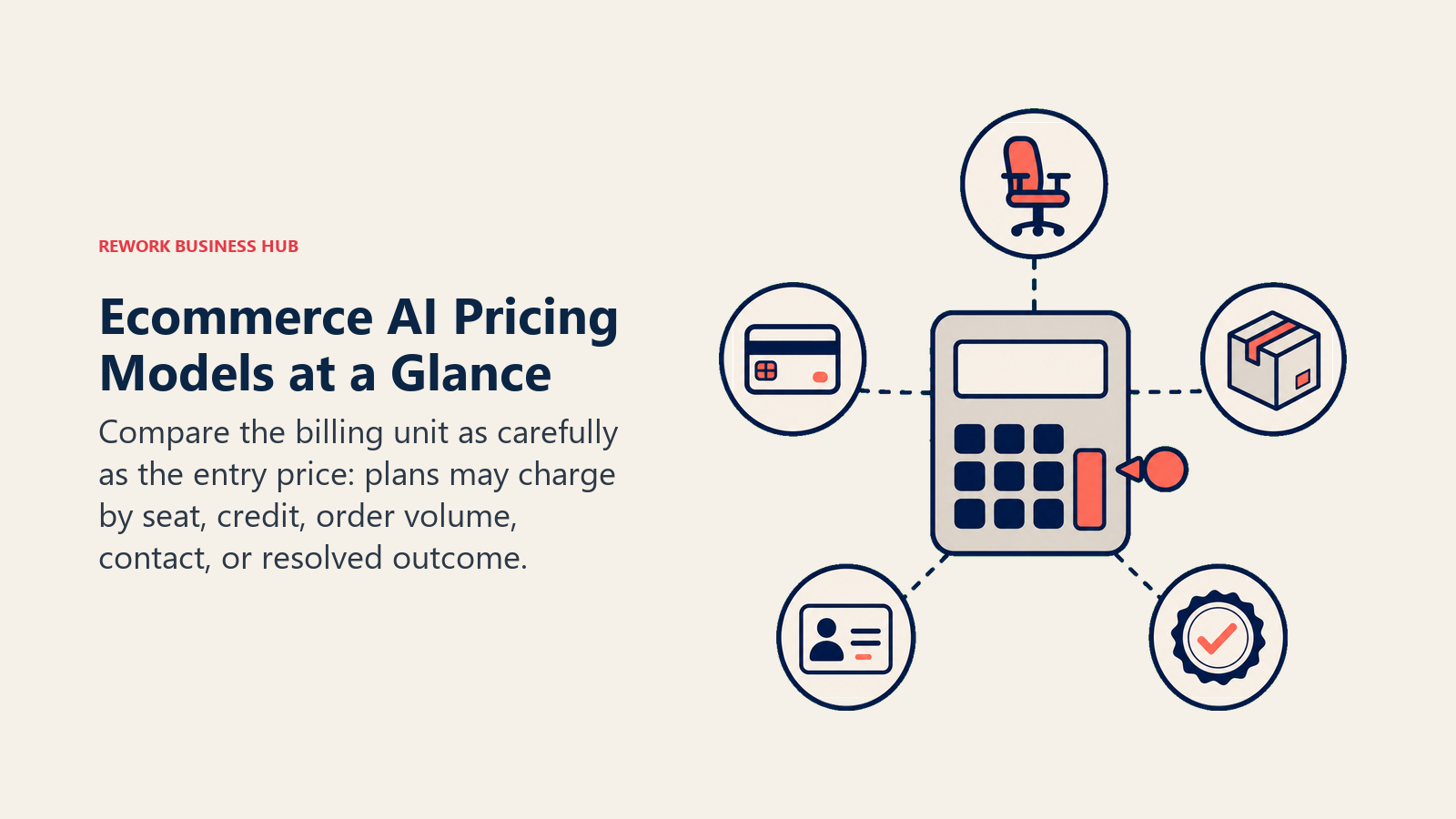
Pricing only becomes comparable when you look past the headline amount and identify the billing unit behind each plan.
| Tool | Entry Price | Pricing Model | Free Tier? |
|---|---|---|---|
| Shopify Magic & Sidekick | Free | Included with every Shopify plan | Yes |
| Jasper | $59/mo (Pro, annual) | Per-seat, tiered | 7-day trial |
| Photoroom | Free (250 exports/mo); $7.99/mo (Pro) | Export + AI credit tiers | Yes |
| Vue.ai | Custom quote | Module-based subscription | No |
| Rebuy | Free (Monetize); $25/mo (Build Your Own) | Modular, order-volume based | Yes |
| Nosto | ~$500-2,000/mo (est.) | GMV-based, custom quote | No |
| Gorgias AI Agent | ~$0.90/resolved conversation | Per-resolution, on top of base helpdesk plan | No |
| Zipchat AI | Free (120 replies/mo); $49/mo (Starter) | Reply-volume tiers | Yes |
| Intercom Fin | $0.99/outcome; $49/mo base (standalone) | Per-outcome, 50-outcome minimum | 14-day trial |
| Klaviyo AI | Free (250 profiles); Customer Agent $200/mo | Per-contact plan + per-conversation AI add-on | Yes |
| AdCreative.ai | ~$29-39/mo (10 credits) | Credit-based tiers | 7-day trial |
| Pencil | $14/mo (Core) | Generation-credit tiers | 6 free ads |
| Particl | $250/mo (Starter) | Flat tiers | No |
| Prisync | $99/mo (Professional, URL-based) | Product-count tiers | 14-day trial |
| Inventory Planner by Sage | ~$120/mo (Essentials) | Revenue/GMV-scaled tiers | No |
Frequently Asked Questions about AI Tools for Ecommerce Stores
What is the best AI tool for ecommerce stores in 2026?
There's no single best tool, it depends on the store function you're trying to fix. Shopify Magic and Sidekick cover the free baseline for product copy, Photoroom leads AI photography, Rebuy and Nosto lead personalization, and Gorgias or Zipchat lead support automation. Match the tool to your actual bottleneck, not a general ranking.
Is Shopify Magic and Sidekick actually free?
Yes, core Magic and Sidekick features are free on every Shopify plan. The one exception is Sidekick's custom app-building capability, now limited to Grow, Advanced, Shopify Plus, and Enterprise plans as of 2026.
What's the best AI tool for product photography?
Photoroom is the most accessible starting point, with a genuinely usable free tier and credit-based tiers that scale to batch, catalog-wide exports. Vue.ai is the better fit for large fashion or retail catalogs that need computer-vision tagging and on-model imagery at a scale Photoroom isn't built for.
What's the best AI tool for automating customer support in an online store?
Gorgias AI Agent, Zipchat AI, and Intercom Fin all automate support with different pricing models. Gorgias and Fin both bill per resolved outcome, while Zipchat bills by reply volume and can also handle sales conversations, not just support. Pick based on your existing helpdesk and whether you need standalone flexibility (Fin) or Shopify-native depth (Gorgias, Zipchat).
How much does AI-powered email marketing cost for an ecommerce store?
Klaviyo's base email/SMS plans are free up to 250 profiles and scale with list size, roughly $720/month at 50,000 contacts. Its dedicated Customer Agent AI is a separate add-on starting at $200/month plus $0.70 per conversation beyond 50 included monthly.
What AI tool should a small ecommerce store start with?
Start with what's already free: Shopify Magic and Sidekick for copy, Photoroom's free tier for photography, and a free tier of Zipchat if chat is your bottleneck. Add a paid tool only once a specific function, support volume, photoshoot cost, or upsell revenue, is costing you more than the tool would.
Do AI pricing and inventory tools actually pay for themselves?
The forecasting data suggests yes when matched to real catalog depth. AI-driven demand forecasting can reduce supply chain forecast errors by 20% to 50% and cut warehousing costs by 5% to 10%, per McKinsey, and 70% of large organizations will adopt AI-based supply chain forecasting by 2030, per Gartner. Tools like Particl, Prisync, and Inventory Planner apply that same logic at ecommerce scale, but they're overkill before your catalog and order volume justify the cost.
Do I need a separate CRM if I'm already using these AI tools?
Not always, but if customer conversations are scattered across WhatsApp, Instagram DM, email, and chat with no shared history, that's a gap none of the point tools above close on their own. A unified inbox or CRM layer, like Rework's Lead Ops product, is worth evaluating once that fragmentation starts costing you response time, not before.
What to Do Next
Pick the single store function costing you the most right now, whether that's photoshoot budget, a support backlog, flat email revenue, or manual reordering, and shortlist two tools against the decision framework above rather than trying to adopt AI across every function at once. Most of these have a real free tier or trial: use it before you pay. And if the actual bottleneck turns out to be fragmented customer conversations across channels rather than a missing point feature, Rework's pricing covers the Marketing Engine (from $99/month billed yearly, 5 seats) for stores moving past a founder answering every DM personally.

Principal Product Marketing Strategist
On this page
- Updated July 2026: What Changed
- Key Facts
- Quick Comparison Table
- How to Choose AI Tools by Store Function
- Product Descriptions and Copy
- 1. Shopify Magic & Sidekick
- 2. Jasper
- Product Photography and Visual Merchandising
- 3. Photoroom
- 4. Vue.ai
- Personalization and Product Recommendations
- 5. Rebuy
- 6. Nosto
- Chat, Support, and Sales Conversations
- 7. Gorgias AI Agent
- 8. Zipchat AI
- 9. Intercom Fin
- Email and Retention Marketing
- 10. Klaviyo AI
- Ad Creative for Paid Social
- 11. AdCreative.ai
- 12. Pencil
- Dynamic Pricing and Competitive Intelligence
- 13. Particl
- 14. Prisync
- Inventory and Demand Forecasting
- 15. Inventory Planner by Sage
- A Note on Unified Inbox and CRM Tools
- How to Choose: Decision Framework
- Framework: By Store Revenue and Budget
- AI Tool Buying Mistakes to Avoid in Ecommerce
- Pricing at a Glance
- What to Do Next