Best AI Tools for Patent Drafting in 2026: 13 Platforms Ranked by Use Case
Turn this article into takeaways for your work.


Each assistant summarizes the article only for you and suggests best practices for your work.
Patent drafting is not the same job as general legal writing, and a generic "best legal AI" list will steer you wrong here. A patent application lives or dies on claim scope, antecedent basis, and enablement, and the tools that actually help with that work are a distinct category: purpose-built drafting copilots like Solve Intelligence and Rowan Patents, Word-native assistants like DeepIP and ClaimMaster, prior art and novelty search engines like IPRally, and full-lifecycle platforms like Patlytics that stretch from drafting into invalidity analysis and claim charting. This guide ranks 13 AI tools patent attorneys, agents, and in-house IP teams are actually adopting in 2026, organized by where each one fits in the patent workflow rather than as one undifferentiated pile of "legal AI."
Every tool below was evaluated on real patent practice use (drafting, prior art search, office action response, and portfolio management). Most enterprise patent AI vendors do not publish list prices, so figures marked "quote-based" or "estimated" reflect reported ranges, not a rate card. Confirm the current number with the vendor before you budget.
What Changed in 2026
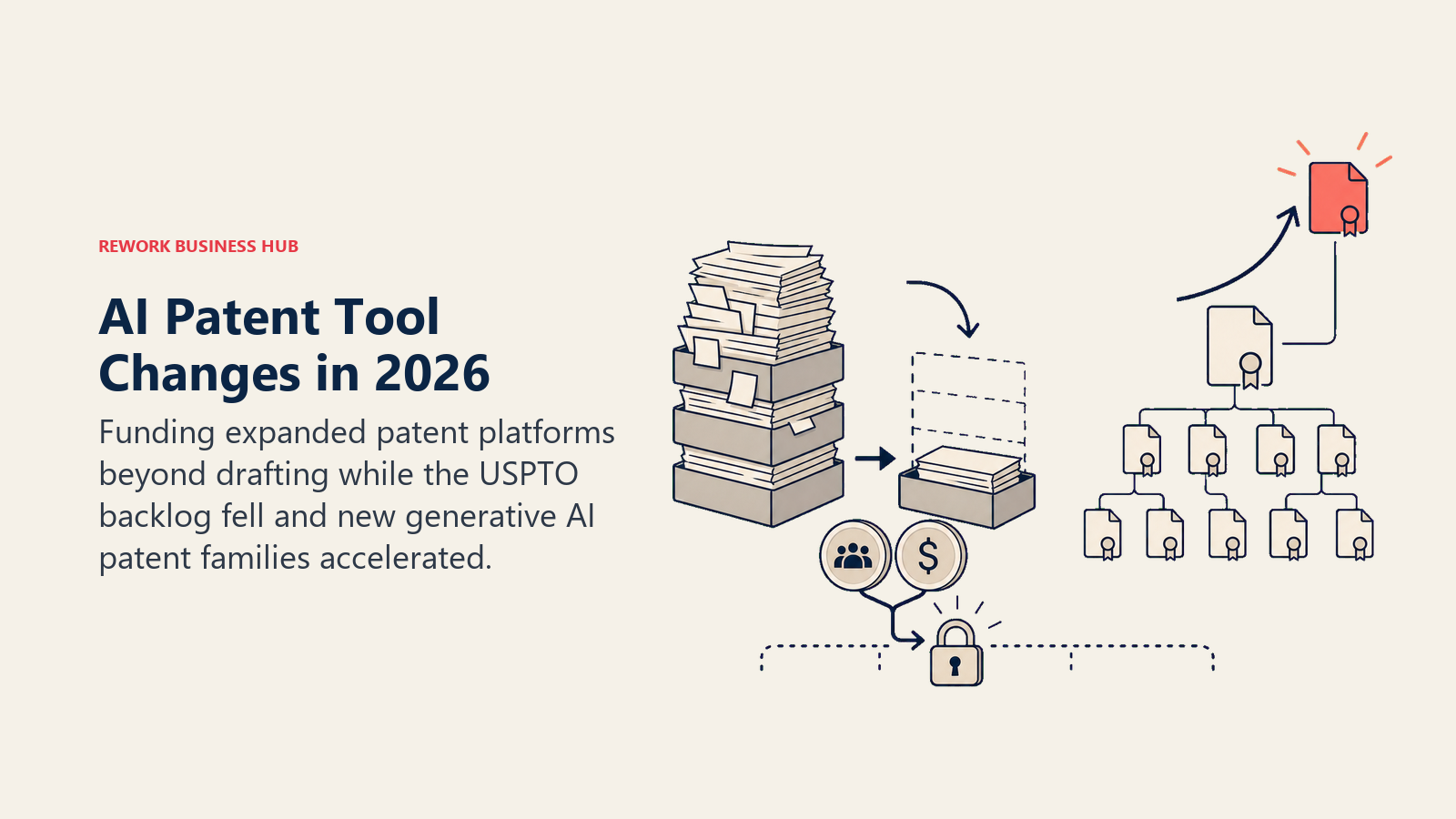
- Solve Intelligence closed a $40 million Series B led by Microsoft's M12 and Thomson Reuters Ventures in December 2025 and used it to launch a claim charting product for litigation and licensing workflows, pushing the platform beyond drafting into the broader patent lifecycle.
- Patlytics raised a $40 million round in April 2026 as AI-driven patent filing volume and IP litigation both climbed at once, funding expansion of its drafting, invalidity, and claim charting modules.
- The USPTO's unexamined patent application backlog fell from a peak of 837,928 in January 2025 to 776,995 by April 6, 2026, the first time in nearly a decade that first office actions issued within a fiscal year outpaced new applications filed in that same year.
- Generative AI patent filings kept climbing right alongside the tools built to draft them: more new AI patent families published in 2024 and 2025 combined than in the entire prior decade, adding fresh pressure on already-stretched patent teams.
Key Facts
- AI adoption among IP professionals across corporate and law firm environments surged from 57% to 85% over the past two years, per Clarivate's "The Evolution of AI in IP" report.
- Even at 85% adoption, 65% of attorneys still name governance, privacy, liability, and explainability as the critical barrier to expanding AI use further, per the same Clarivate report.
- Generative AI patent families published worldwide reached more than 37,800 in 2025 alone, and the 2024-2025 combined total of over 56,000 exceeded the entire 2014-2023 decade combined, per WIPO's 2026 report on generative AI patent activity.
- The USPTO's inventory of unexamined patent applications fell from a peak of 837,928 in January 2025 to 776,995 by April 6, 2026, per the USPTO's own subscription center update.
- Attorneys using DeepIP's AI drafting assistant report up to a 50% reduction in time spent drafting patent applications, freeing roughly two hours a day, per DeepIP (vendor-reported, based on roughly 8,500 patent applications drafted on the platform).
Quick Comparison Table
| Tool | Best For | Standout Capability | Starting Price | Free Tier / Trial? |
|---|---|---|---|---|
| Solve Intelligence | Firms and corporate IP teams wanting a full drafting-to-claim-charting platform | In-browser drafting editor with figure generation and claim charting | Estimated $199-$775+/user/mo, largely quote-based | Demo available; no public self-serve trial |
| Rowan Patents (Clarivate) | Firms standardizing AI drafting and prosecution across an entire practice | Integrated drafting environment reporting a 36% average productivity gain | Estimated ~$500/user/mo, quote-based | No; demo and quote required |
| DeepIP | Attorneys who want AI drafting without leaving Microsoft Word | Inline drafting assistant across software, mechanical, and life sciences patents | $350-$420/user/mo | Demo available; no public free tier |
| Qatent (Questel) | Multilingual filers needing claim generation with novelty diagnostics | AI claim generation trained on US, French, German, and Chinese patent data | ~$215/user/mo (€200) or ~$2,150/user/yr | Demo available |
| PatentPal / Edge | Solo inventors and small firms wanting a budget claim-to-draft workflow | One-click conversion of claims into a full draft with figures | $99-$599/mo | Free trial available |
| Patlytics | Teams wanting one platform across drafting, invalidity, and office actions | Full patent-lifecycle AI: drafting, claim charting, invalidity search | Estimated $800-$2,000/user/mo, quote-based | Demo required; NAPP member discount available |
| IPRally | Teams running prior art and freedom-to-operate search at scale | Graph AI and NLP search across 120M+ patents, bypassing Boolean logic | ~$200/mo self-serve; team plans $24,000-$72,000/yr | 3-day free trial |
| ClaimMaster | Solo and small-firm attorneys drafting and prosecuting inside Word | Claim proofreading, antecedent-basis checks, and AI office action response | $30-$75/user/mo | 30-day free trial |
| PatSnap | Corporate IP and R&D teams needing patent landscape and FTO analytics | Domain-specific LLM ("Hiro") over 180M+ patent documents across 172 jurisdictions | ~$15,000/yr single seat, up to $80,000+/yr enterprise | Demo required |
| Anaqua (AQX) | Large corporations managing 500+ active patents across jurisdictions | AI patent classification, generative summaries, and docketing automation | Estimated $40,000-$120,000/yr | No; enterprise sales cycle |
| Patentext | Pre-Series-A startups and inventors wanting professional-quality drafts on a budget | Mid-tier pricing between free tools and full law firm rates | Contact for current promotional pricing | Promotional discount for first year |
| Alt Legal | IP teams needing deadline and docket management alongside their drafting stack | Flat-rate docketing across 180+ IP offices with unlimited users | $60-$295/mo by matter volume | Free trial available |
| ChatGPT Enterprise / Claude | General drafting support and internal research alongside a dedicated patent tool | Lowest cost per seat and the AI lawyers already use most day to day | Roughly $50-$60/user/mo (Enterprise, 150-seat floor); Claude Team from ~$30/user/mo | Free consumer tiers exist but lack enterprise privacy/SSO |
Patent Workflow Fit Matrix
Patent work splits into distinct jobs, and almost no single tool covers all of them well. Use this to filter before you read the individual write-ups.
| Tool | Drafting | Prior Art / FTO Search | Office Action Response | Docketing / Portfolio |
|---|---|---|---|---|
| Solve Intelligence | Strong fit | Possible (claim charting) | Possible | - |
| Rowan Patents | Strong fit | - | Possible | Possible |
| DeepIP | Strong fit | - | Possible | - |
| Qatent | Strong fit | Possible (novelty diagnostics) | - | - |
| PatentPal / Edge | Strong fit | - | - | - |
| Patlytics | Strong fit | Strong fit | Strong fit | - |
| IPRally | - | Strong fit | - | - |
| ClaimMaster | Possible | - | Strong fit | - |
| PatSnap | - | Strong fit | - | Possible |
| Anaqua (AQX) | - | Possible | - | Strong fit |
| Patentext | Strong fit | - | - | - |
| Alt Legal | - | - | - | Strong fit |
| ChatGPT Enterprise / Claude | Possible (unverified drafts) | - | Possible (research only) | - |
Firm / Team Size Fit Matrix
| Tool | Solo (1) | Small Firm (2-20) | Mid-Size / In-House (20-100) | Enterprise (100+) |
|---|---|---|---|---|
| Solve Intelligence | Possible | Strong fit | Strong fit | Strong fit |
| Rowan Patents | - | Possible | Strong fit | Strong fit |
| DeepIP | Possible | Strong fit | Strong fit | Possible |
| Qatent | Strong fit | Strong fit | Possible | Possible |
| PatentPal / Edge | Strong fit | Strong fit | Possible | - |
| Patlytics | - | Possible | Strong fit | Strong fit |
| IPRally | Possible | Strong fit | Strong fit | Strong fit |
| ClaimMaster | Strong fit | Strong fit | Possible | - |
| PatSnap | - | Possible | Strong fit | Strong fit |
| Anaqua (AQX) | - | - | Possible | Strong fit |
| Patentext | Strong fit | Strong fit | - | - |
| Alt Legal | Strong fit | Strong fit | Strong fit | Possible |
| ChatGPT Enterprise / Claude | Possible | Possible | Strong fit | Strong fit |
1. Solve Intelligence: Broadest Drafting-to-Litigation Platform
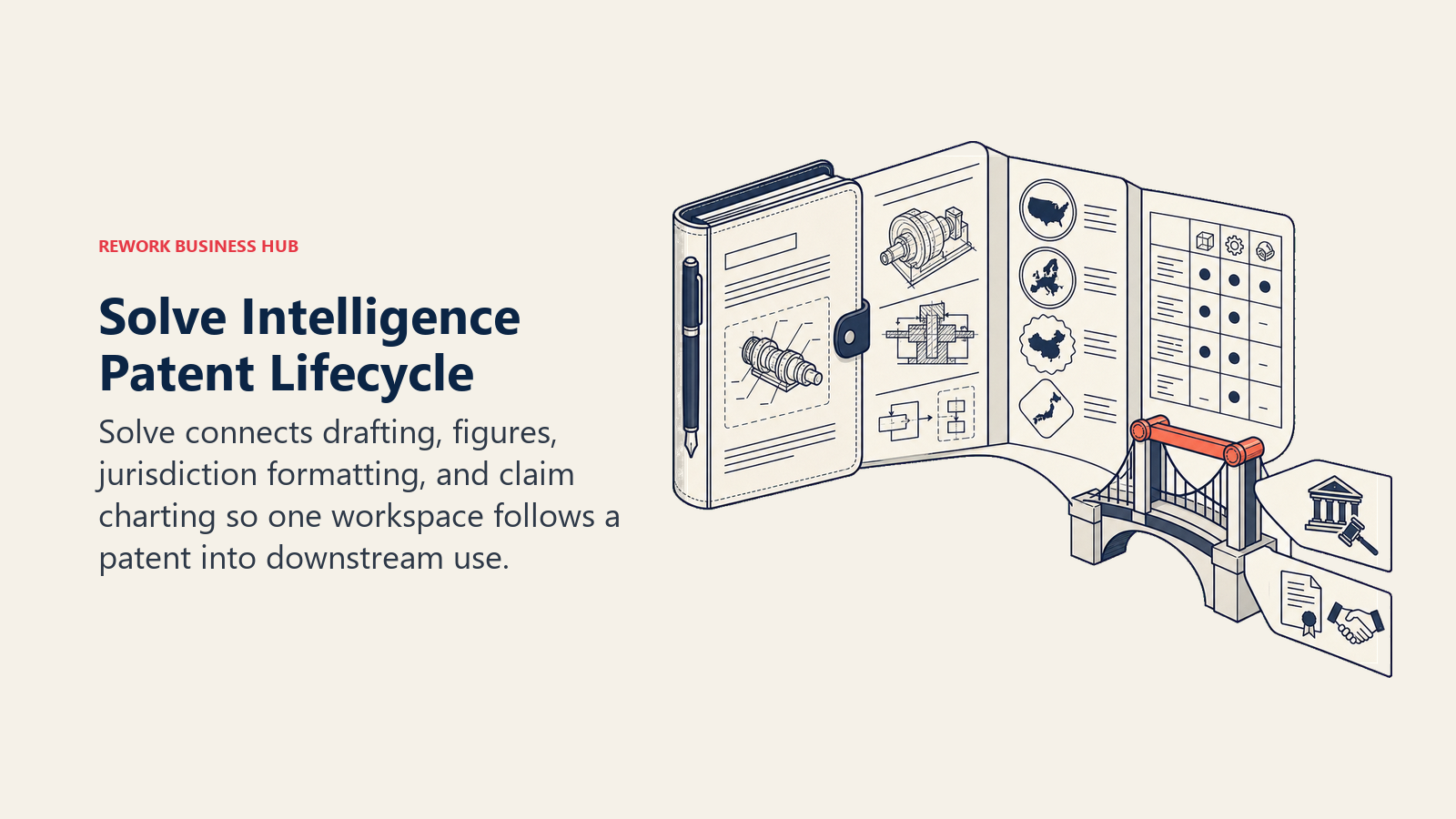
Solve Intelligence built its reputation on an in-browser patent editor that combines drafting, figure generation, and jurisdiction-specific formatting in one workspace, then extended it into claim charting for litigation and licensing after a $40 million Series B in December 2025 led by Microsoft's M12 and Thomson Reuters Ventures. It is the platform patent teams mention most often when they describe wanting one tool that follows an application from first draft through post-grant use.
Best for: Firms and corporate IP teams wanting a single AI platform that spans drafting, figures, and downstream claim charting, not just a first-draft generator.
| What you get | What you don't |
|---|---|
| In-browser editor covering drafting, figures, and formatting | Pricing is largely quote-based above entry tiers |
| Claim charting for litigation and licensing use cases | No permanent self-serve free plan |
| Backed by recent, well-capitalized funding round | Newer entrant versus incumbents like Rowan or Qatent |
Pricing: Estimates based on promotional pricing put individual seats around $199-$775+/user/month depending on tier and commitment, per third-party breakdowns from Patentext's comparison coverage and eesel AI's pricing guide. Solve does not publish a standard rate card; confirm current tiers directly.
Best for: Mid-size firms and corporate IP teams (5-200+ practitioners) wanting drafting and claim charting in one platform.
2. Rowan Patents (Clarivate): Integrated Drafting and Prosecution Environment
Rowan Patents, now part of Clarivate, pairs an integrated drafting environment with AI assistance built specifically for patent application preparation, review, and prosecution. It positions itself as a productivity layer around the practitioner's existing judgment rather than a replacement for it, and it reports meaningful efficiency gains from firms already running it in production.
Best for: Firms and corporate IP teams standardizing AI-assisted drafting and prosecution across their entire practice, not just a single attorney's workflow.
| What you get | What you don't |
|---|---|
| Integrated drafting and prosecution workspace | No published pricing; every deal is quoted |
| Reported 36% average productivity gain per user survey | Requires a demo and sales cycle before you see a number |
| Backed by Clarivate's broader IP data and search infrastructure | Less suited to a true solo practice on a tight budget |
Pricing: Contact-led pricing; reported reference pricing runs roughly $500/user/month, with an attorney license including support staff at no extra charge, per directory listings tracking Rowan's market pricing. Confirm current terms with Clarivate directly.
Best for: Firms and corporate legal departments of 20-500+ practitioners standardizing on one drafting platform.
3. DeepIP: AI Drafting Without Leaving Microsoft Word
DeepIP takes the opposite interface bet from Solve and Rowan: instead of asking attorneys to switch to a new editor, it lives inside Microsoft Word, the tool most patent practitioners already draft in all day. It targets the repetitive parts of drafting, claim-to-spec consistency, section generation, and formatting, and works across software, mechanical, electronic, pharmaceutical, and biotech patents.
Best for: Attorneys and agents who want AI drafting assistance without switching out of the Word-based workflow their firm already runs on.
| What you get | What you don't |
|---|---|
| AI drafting assistance inside native Microsoft Word | Scoped to drafting; not a search or docketing tool |
| Technology-agnostic across software, mechanical, and life sciences | Premium per-seat pricing versus budget alternatives |
| Vendor-reported up to 50% drafting time reduction | Annual per-seat commitments typical at this price point |
Pricing: $350-$420/user/month depending on plan, with per-seat licensing and annual commitments typical, per DeepIP's own product pages and third-party pricing trackers.
Best for: Firms and in-house teams of 5-200 attorneys who want to keep drafting inside Word rather than adopt a new editor.
4. Qatent (Questel): Multilingual Claim Generation with Novelty Diagnostics
Qatent, acquired by IP management provider Questel in March 2024, applies natural language generation trained on millions of real patent applications to claim drafting, with a genuinely useful twist: it was built by patent attorneys and trained on native French, German, and Chinese patent office data alongside US filings, not just English-language US patents. Its novelty diagnostics flag which AI-generated claim language is more likely to be novel before you spend review time on it.
Best for: Firms and companies filing across US, French, German, or Chinese jurisdictions who want claim generation grounded in each office's own data.
| What you get | What you don't |
|---|---|
| Claim generation across four jurisdictions' native data | Narrower brand recognition than Rowan or Solve in the US market |
| Novelty diagnostics on AI-generated claim language | Self-service model needs attorney oversight for filing-ready output |
| Backed by Questel's broader IP management platform | Diagram support is basic versus dedicated figure tools |
Pricing: Roughly $215/user/month (€200) or about $2,150/user/year (€2,000), per Questel's own product pages.
Best for: Solo practitioners through mid-size firms (1-50 people) filing internationally, especially across Europe or China.
5. PatentPal / Edge: Budget Claim-to-Draft Workflow
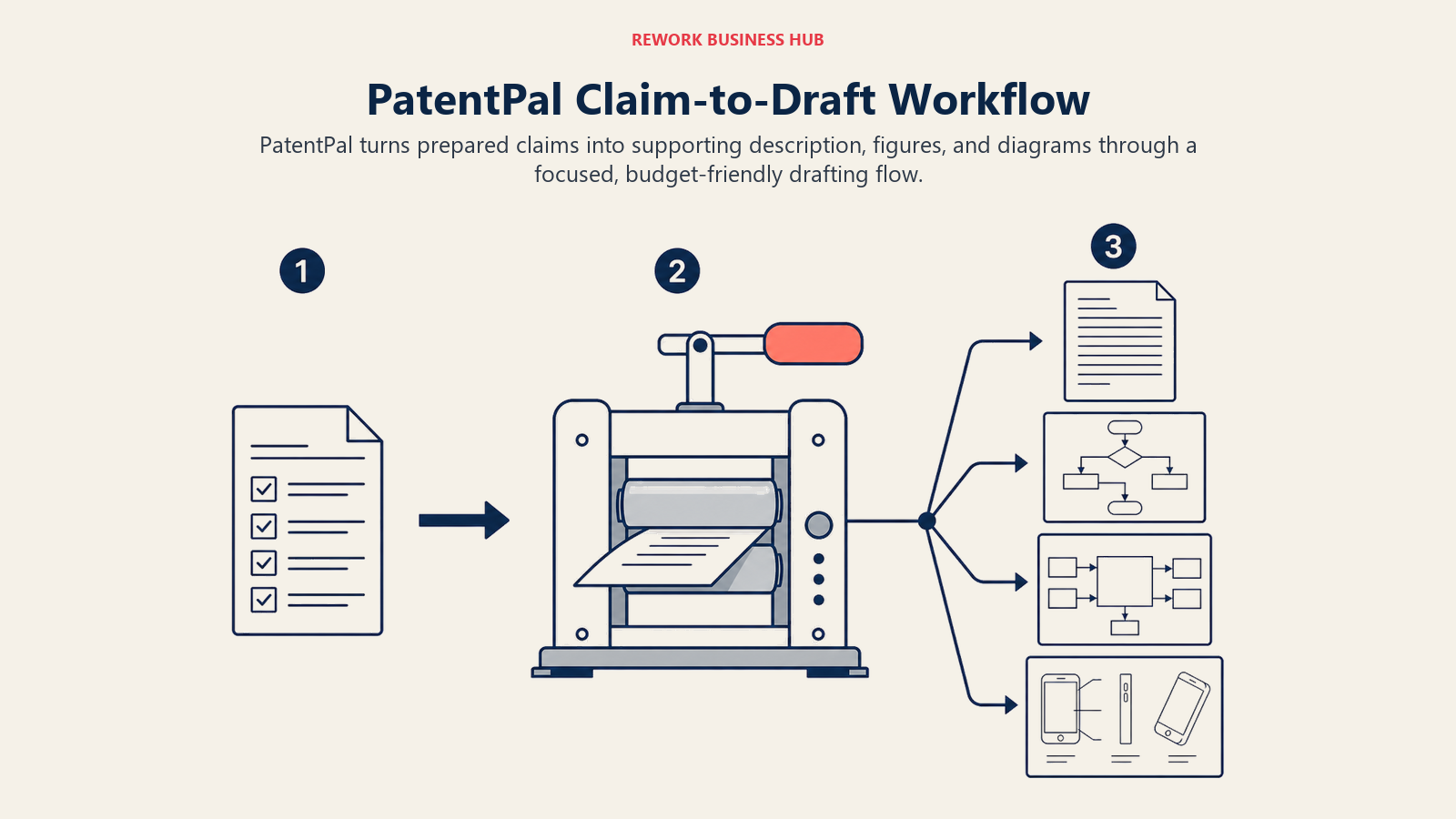
PatentPal (marketed under the Edge product line) takes a narrower, faster approach: upload your claims, and it generates the supporting draft content, flowcharts, block diagrams, and description language, in a one-click workflow. It is built for speed and a lower price point rather than the full-lifecycle ambitions of Solve or Patlytics.
Best for: Solo attorneys, small firms, and inventors who already have solid claim language and want the surrounding application drafted quickly and cheaply.
| What you get | What you don't |
|---|---|
| Fast claim-to-draft conversion with auto-generated figures | Narrower scope than full-lifecycle platforms |
| Multiple tiers starting well under $200/month | Limited public pricing transparency above the Starter tier |
| Free trial to test fit before committing | Less suited to complex, multi-inventor enterprise filings |
Pricing: Starter around $99/month for practitioners drafting their own applications, scaling up to roughly $599/month for higher tiers, per comparative pricing coverage tracking the category.
Best for: Solo practitioners and small firms (1-15 people) who want a fast, budget-friendly drafting assist rather than a full platform.
6. Patlytics: Full-Lifecycle Platform from Drafting to Litigation
Patlytics bets on breadth: drafting, invalidity search, claim charting, and office action response inside one platform, aimed at teams that want to consolidate multiple point tools. A $40 million raise in April 2026 funded expansion of that lifecycle coverage as both AI patent filings and IP litigation activity climbed simultaneously.
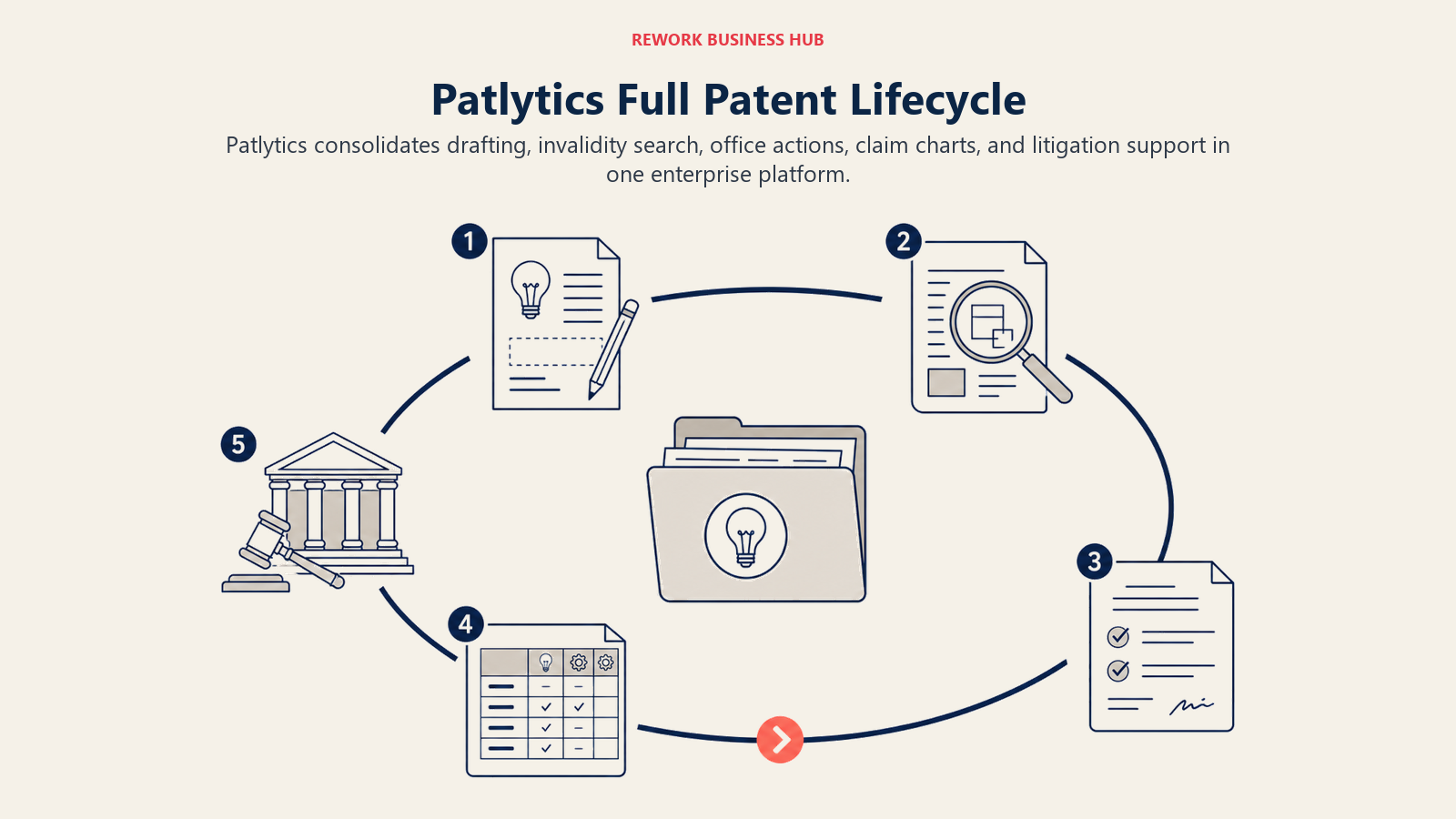
Best for: Mid-size to large IP teams that want drafting, invalidity analysis, claim charting, and office action support consolidated in one vendor relationship instead of three or four.
| What you get | What you don't |
|---|---|
| Drafting, invalidity search, and claim charting in one platform | Pricing sits at the premium end of this category |
| Free Office Action module for NAPP members | No public pricing; every deal requires a quote |
| Recently well-funded, with active product expansion | Enterprise implementation costs stack on top of subscription |
Pricing: Estimated $800-$2,000/user/month based on industry benchmarks for comparable platforms, with enterprise implementation adding $10,000-$50,000 and data/integration work adding another $10,000-$50,000, per third-party enterprise pricing analysis. NAPP members reportedly get 20% off list along with free Office Action module access.
Best for: IP teams of 20-500+ practitioners consolidating drafting, search, and litigation-support tools into one platform.
7. IPRally: Graph AI Prior Art and Freedom-to-Operate Search
IPRally is not a drafting tool, it is a search engine, and it earns its place on this list because prior art search is the single most time-consuming non-drafting task in patent practice. It uses proprietary Graph AI and NLP to search by meaning rather than Boolean keyword matching, covering more than 120 million patents with natural language, publication number, and image-based search, plus an "Agent" mode that turns an invention disclosure directly into a structured novelty report.
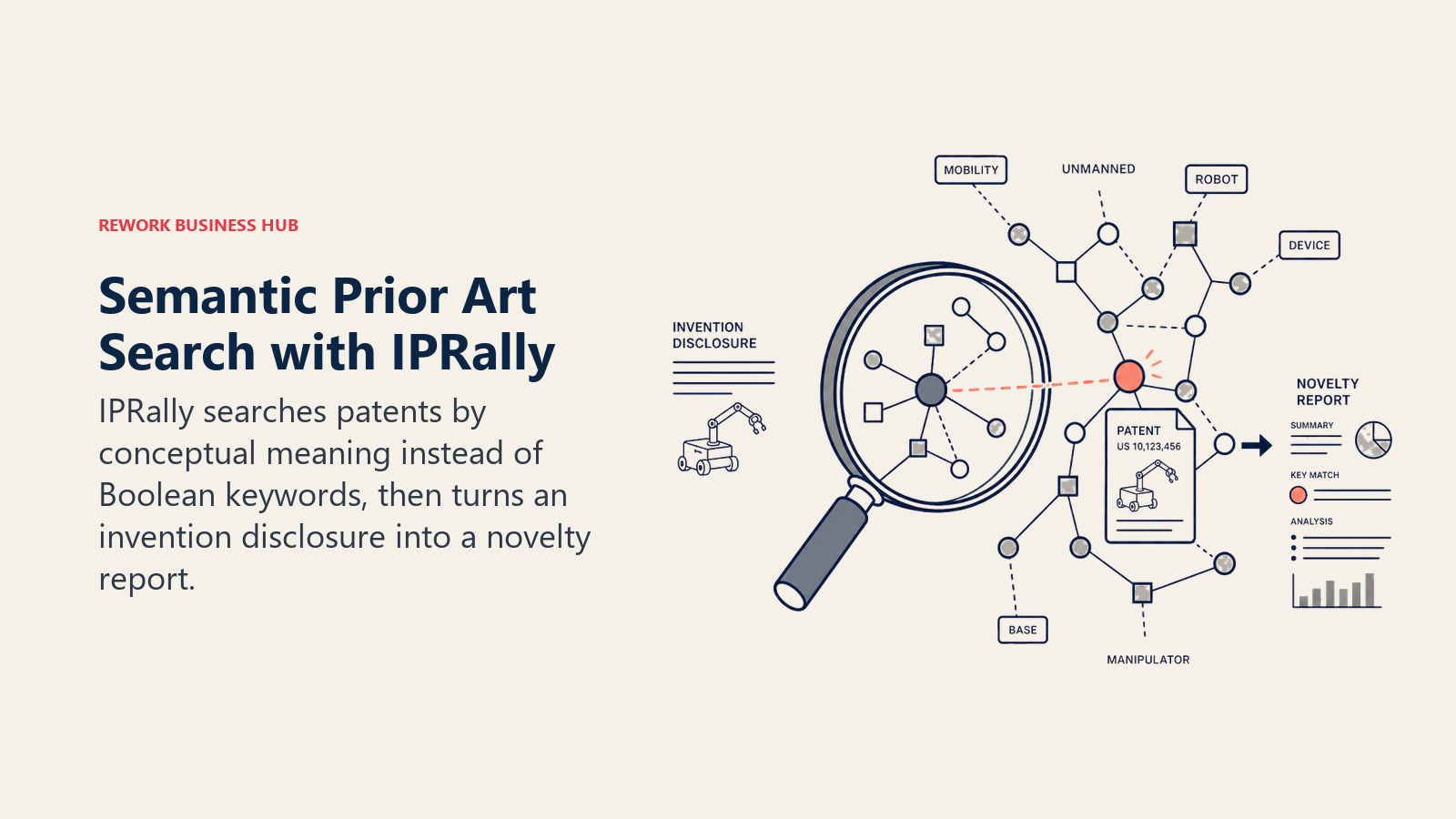
Best for: Teams running frequent prior art, novelty, or freedom-to-operate searches who are tired of keyword-based Boolean search missing conceptually similar prior art.
| What you get | What you don't |
|---|---|
| Graph AI semantic search across 120M+ patents | Not a drafting tool; pairs with a drafting platform, doesn't replace one |
| Natural language, image-based, and publication-number search | Team-tier pricing is a meaningful jump from the individual tier |
| Agent mode for disclosure-to-report novelty search automation | Requires search expertise to fully exploit relevance feedback tools |
Pricing: Self-serve individual plans start around $200/month; Team plans range $24,000-$72,000/year, with implementation estimated at $5,000-$15,000, per IPRally's own pricing page.
Best for: Firms, corporate IP teams, and search professionals of any size running prior art or FTO search as a core, recurring task.
8. ClaimMaster: Word-Native Claim Proofreading and Office Action Response
ClaimMaster has quietly become the workhorse Word add-in for the mechanical parts of patent quality control: claim numbering and amendment consistency, antecedent basis checks, missing specification support, and, with its 2026 +Drafting update, AI-assisted office action analysis and response generation through GPT-5 and Claude integration inside an interactive chat interface.
Best for: Solo attorneys and small firms drafting and prosecuting inside Word who want automated proofreading plus AI-assisted office action responses at a genuinely accessible price.
| What you get | What you don't |
|---|---|
| Automated claim proofreading and antecedent-basis checking | Not a full drafting platform; strongest as a quality and OA layer |
| AI office action analysis and response drafting (2026 update) | UI is a Word add-in, not a standalone modern editor |
| Published per-seat pricing under $100/month | Fewer enterprise integrations than Anaqua or PatSnap |
Pricing: Roughly $30-$75/user/month across licensing tiers, with a 30-day free trial, per ClaimMaster's own pricing and product pages.
Best for: Solo attorneys and small firms (1-25 people) wanting claim quality control and office action support without enterprise pricing.
9. PatSnap: Patent Landscape and Freedom-to-Operate Analytics
PatSnap operates one level above individual application work: it is built for patent landscaping, competitive analytics, and freedom-to-operate research across a company's entire technology space. Its domain-specific LLM, branded Hiro, runs over more than 180 million patent documents across 172 jurisdictions, aimed at R&D and IP strategy teams who need to understand a whitespace before anyone starts drafting.
Best for: Corporate IP and R&D teams needing patent landscape reports, competitive intelligence, and FTO analysis at a portfolio or technology-space level, not per-application drafting.
| What you get | What you don't |
|---|---|
| LLM-powered semantic search across 180M+ patent documents | Not a drafting tool; complements a drafting platform |
| Coverage across 172 jurisdictions with automated landscape reports | Enterprise pricing puts it out of reach for solo practitioners |
| API access and custom dashboards at higher tiers | Full feature depth requires the higher-priced enterprise tier |
Pricing: Roughly $15,000/year for a single-seat license, scaling to $80,000+/year for enterprise tiers with API access and custom dashboards, per aggregated third-party pricing coverage.
Best for: Corporate IP, R&D, and innovation strategy teams at mid-size to large organizations running ongoing landscape and FTO analysis.
10. Anaqua (AQX): Enterprise IP Management with AI Built In
Anaqua is IP portfolio management software first, with AI layered into the docketing and analysis workflow rather than a standalone drafting product: an AI patent classifier, generative AI patent summaries, and docketing automation across major patent offices. It is designed for the scale problem large corporations actually have, managing hundreds or thousands of active patents across dozens of jurisdictions, not the drafting problem a single attorney has.
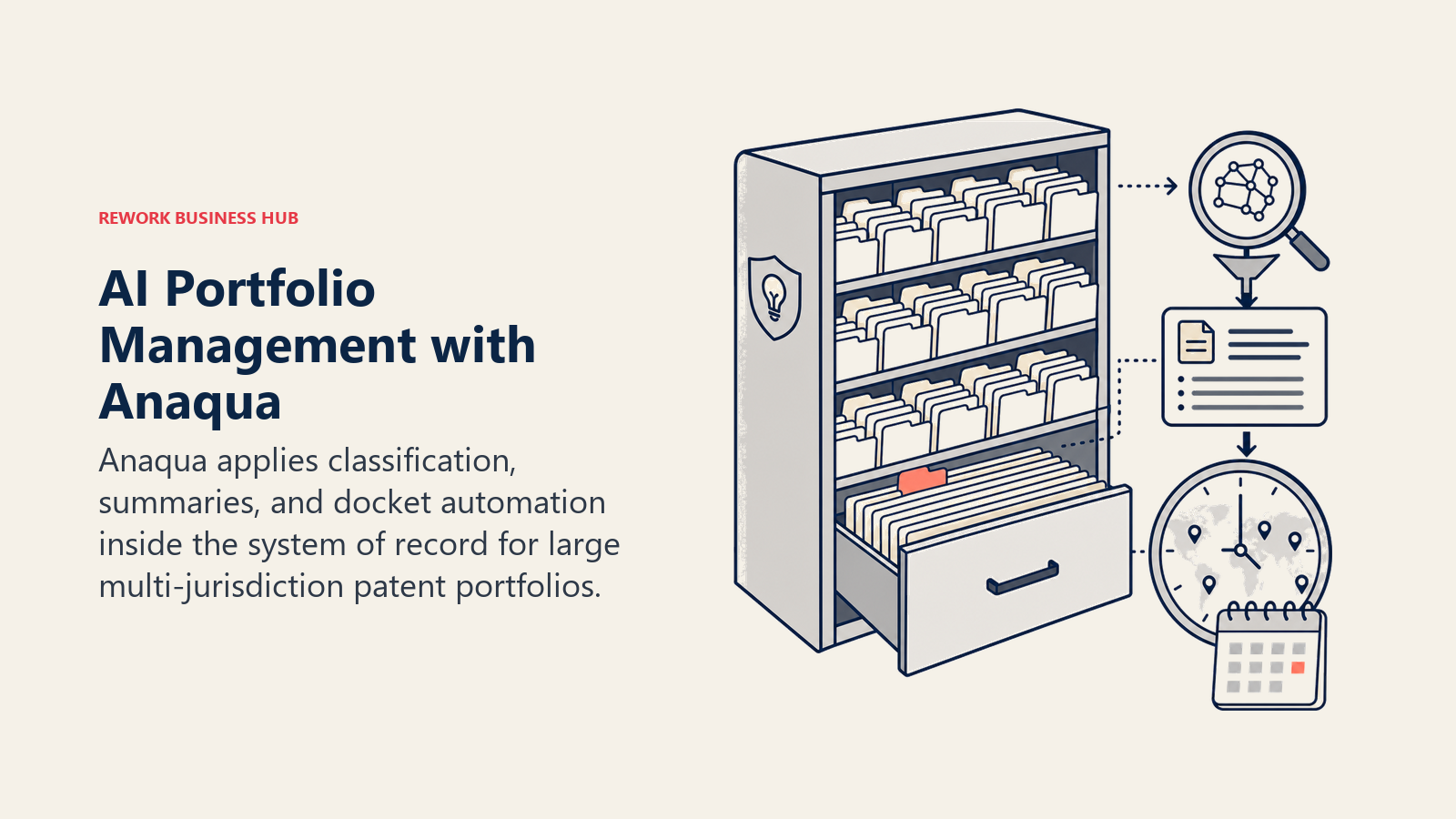
Best for: Corporations managing 500 or more active patents across multiple jurisdictions that need AI-assisted classification, summarization, and docketing baked into their system of record.
| What you get | What you don't |
|---|---|
| AI classification and generative summaries inside your IP system of record | Not a drafting tool for individual applications |
| Docketing automation across major patent and trademark offices | Enterprise-only pricing and sales cycle |
| Built for portfolios of hundreds to thousands of patents | Overkill for firms managing fewer than a few hundred active matters |
Pricing: Enterprise-only, with expected costs of $40,000-$120,000/year depending on portfolio size, user count, and modules required, per third-party analysis of Anaqua's pricing structure. Contact Anaqua's sales team for a portfolio-specific quote.
Best for: Large corporations and law firms managing 500+ active patents across multiple jurisdictions.
11. Patentext: Mid-Tier Drafting for Pre-Series-A Startups and Inventors
Patentext positions itself deliberately in the gap between free consumer AI tools and traditional law firm rates, which commonly run $8,000-$20,000 or more for a professionally drafted non-provisional application. It targets companies that have not yet raised a Series A and inventors who need professional-quality drafting without full law firm pricing.
Best for: Pre-Series-A startups, independent inventors, and small companies who need professional-quality patent drafts without paying full traditional law firm rates.
| What you get | What you don't |
|---|---|
| Pricing significantly below traditional law firm rates | Not positioned for large firms or high-volume enterprise filers |
| Designed specifically for the pre-funding startup budget gap | Less brand recognition and track record than incumbents |
| Promotional pricing available for new customers | Public rate card is limited; confirm current pricing directly |
Pricing: Patentext does not publish a full rate card publicly; it has offered promotions such as 60% off the first year for provisional and non-provisional drafting, positioned well below the $8,000-$20,000+ typical cost of attorney-drafted non-provisional applications, per Patentext's own pricing page.
Best for: Solo inventors and pre-Series-A startups (1-10 people) drafting their first few patent applications on a constrained budget.
12. Alt Legal: IP Docketing and Deadline Management
Alt Legal is not a drafting tool, it is the deadline safety net every patent workflow needs regardless of which drafting tool sits next to it. It tracks statutory and office deadlines across more than 180 IP offices worldwide, syncs to calendars, and gives clients and foreign associates their own access, all on flat-rate pricing with no per-user fees.
Best for: Any patent practice, solo through enterprise, that needs reliable deadline and docket management running alongside whichever drafting or search tool they use.
| What you get | What you don't |
|---|---|
| Flat-rate docketing across 180+ IP offices, unlimited users | Not a drafting or search tool; purely docketing and deadlines |
| Client and foreign associate access included at every tier | Portfolios above 1,000 matters need a custom quote |
| Straightforward tiered pricing with no per-seat surprises | Add-on "Assist" paralegal service is a separate cost |
Pricing: $60/month for up to 50 matters, scaling to $100/month (100 matters), $195/month (200 matters), and $295/month (400 matters); portfolios of 1,000+ matters require custom pricing, per Alt Legal's own pricing page.
Best for: Solo attorneys through mid-size firms and corporate IP teams (any size docket up to roughly 1,000 matters) needing reliable, flat-rate deadline tracking.
13. ChatGPT Enterprise / Claude: The General-Purpose Layer Most Teams Already Have
The honest data point here mirrors what general legal AI adoption research shows across the profession: general-purpose assistants like ChatGPT and Claude are already in near-universal informal use inside patent teams for internal research, first-pass explanations of prior art, and non-filing drafting support, even where a dedicated patent tool is also in place. Enterprise tiers add the data-training exclusions, SSO, and admin controls that make that use defensible for confidential invention disclosures, but neither tool is grounded in patent office data, and neither should touch claim language that goes into a filed application without a registered practitioner rewriting and verifying every word.
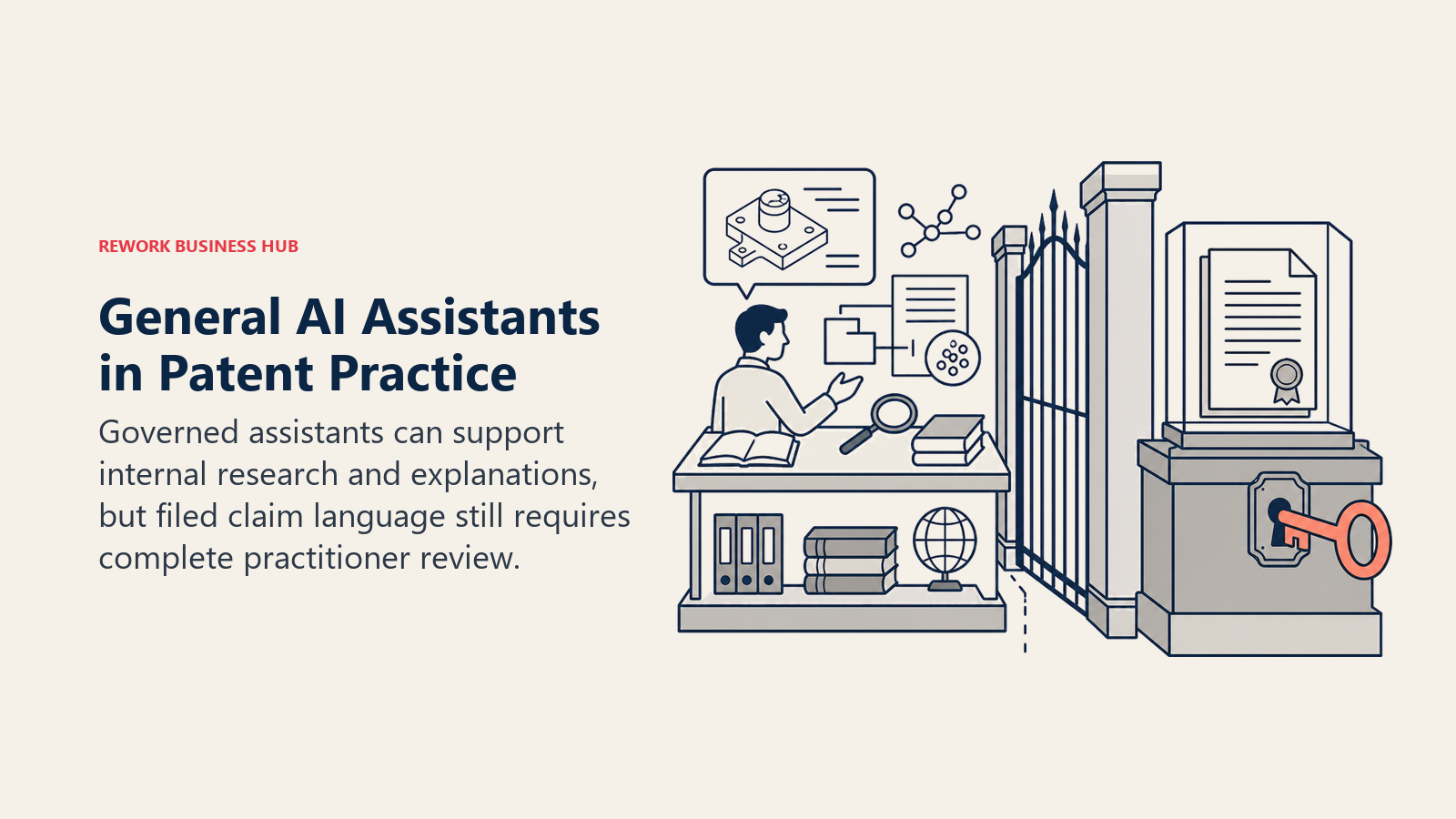
Best for: General research, internal explanations of technical concepts, and non-filing drafting support alongside a dedicated patent drafting or search tool, never as a standalone source of filed claim language.
| What you get | What you don't |
|---|---|
| Lowest cost per seat of any tool on this list | No patent-office database grounding or novelty checking |
| Enterprise-grade data privacy and SSO for confidential work | Real risk of confidently wrong claim language if used for filing text |
| Familiar interface most attorneys already use personally | No claim charting, docketing, or prosecution-specific tooling |
Pricing: ChatGPT Enterprise runs roughly $50-$60/user/month on annual commitments with a 150-seat floor; Claude's Team plan starts near $30/user/month at much lower seat minimums, per each vendor's published pricing pages. Confirm current tiers directly, as both change frequently.
Best for: Firms and IP teams of any size that already rely on a general AI assistant and want it governed properly alongside, not instead of, a dedicated patent tool.
How to Choose: Decision Framework
| If your biggest need is... | Pick... | Why |
|---|---|---|
| One platform spanning drafting through claim charting and litigation support | Solve Intelligence or Patlytics | Both cover the widest slice of the patent lifecycle in a single subscription |
| AI drafting and prosecution standardized across an entire firm | Rowan Patents | Purpose-built integrated environment with reported firm-wide productivity gains |
| Drafting assistance without leaving Microsoft Word | DeepIP | Lives inline in the editor attorneys already use all day |
| Claim generation across US, European, and Chinese filings | Qatent | Trained on native French, German, and Chinese patent office data, not just US |
| A fast, budget-friendly claim-to-draft workflow | PatentPal / Edge | Lowest-friction path from finished claims to a full draft with figures |
| Frequent prior art, novelty, or freedom-to-operate search | IPRally | Graph AI semantic search across 120M+ patents, built for exactly this task |
| Claim quality control plus AI-assisted office action responses | ClaimMaster | Word-native proofreading and OA drafting at accessible per-seat pricing |
| Patent landscape and competitive intelligence at scale | PatSnap | LLM-powered analytics across 180M+ documents and 172 jurisdictions |
| Managing 500+ active patents across many jurisdictions | Anaqua (AQX) | Enterprise IP management platform with AI classification and docketing built in |
| Professional-quality drafting on a pre-Series-A budget | Patentext | Priced deliberately between free tools and full law firm rates |
| Reliable deadline tracking regardless of drafting tool | Alt Legal | Flat-rate docketing across 180+ offices with unlimited users |
| The lowest-cost general AI layer for research and internal use | ChatGPT Enterprise / Claude | Cheapest per seat, but never a substitute for a grounded patent tool on filed claims |
By Budget
| Budget | Best Fits |
|---|---|
| Under $100/user/month | ClaimMaster, PatentPal Starter, IPRally individual plan |
| $100-$400/user/month | Qatent, DeepIP, PatentPal higher tiers |
| $400-$800/user/month | Solve Intelligence entry tiers, Rowan Patents |
| $800/user/month and up, or custom enterprise quote | Patlytics, PatSnap, Anaqua, Rowan and Solve enterprise tiers |
Accuracy, Confidentiality, and What This Guide Is Not
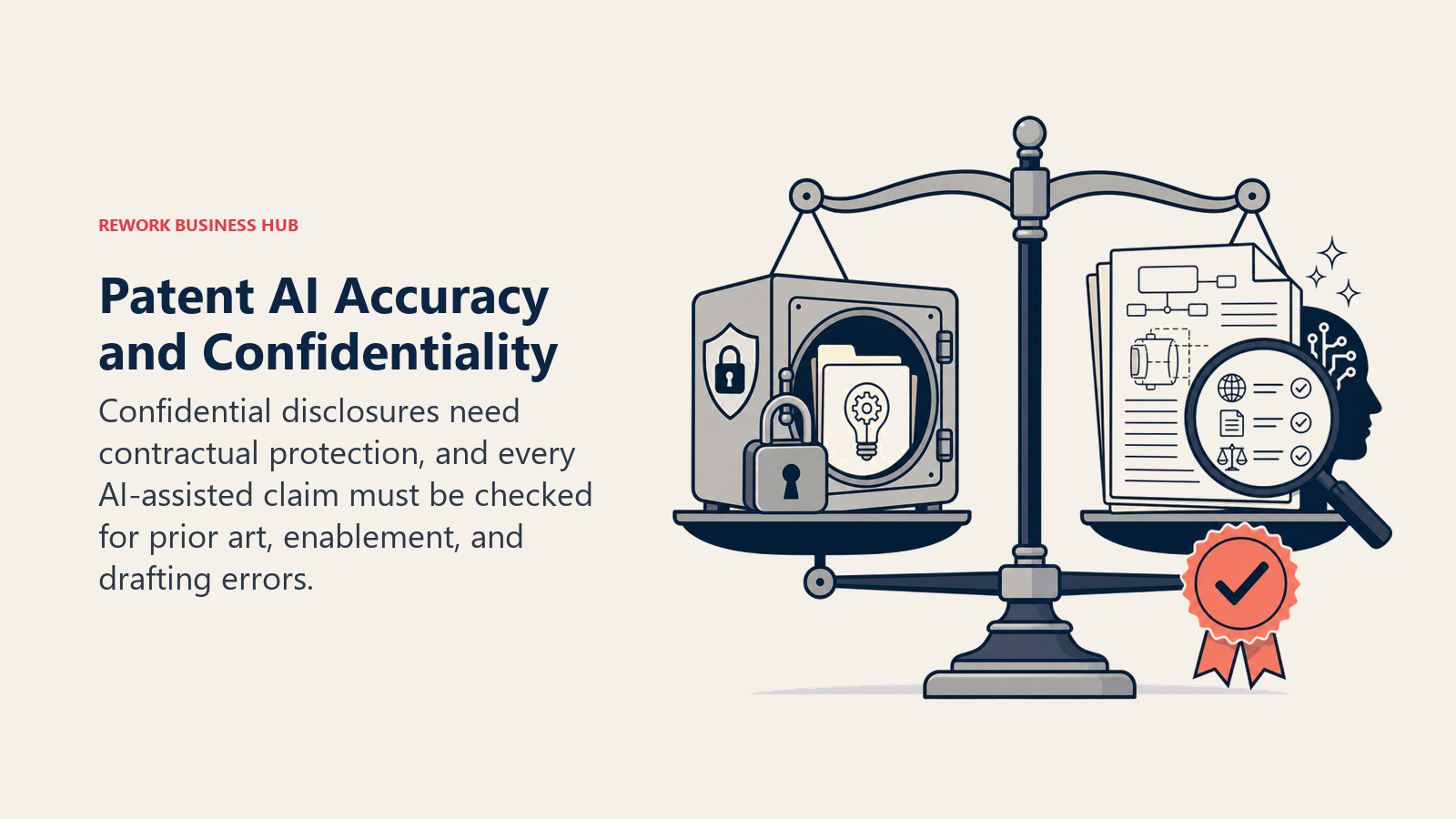
None of the tools above replace a registered patent attorney or agent's judgment, and this article is not legal advice. Claim scope, enablement, and written description are legal determinations with real consequences if they are wrong, and every AI-assisted draft needs a qualified practitioner's full review before it goes anywhere near a filing. Two risks deserve specific attention. First, confidentiality: an unfiled invention disclosure is often a client's most sensitive asset, and uploading it to a third-party AI tool without confirming the vendor's data-training and retention terms in writing can create real exposure, especially for tools without enterprise-grade contractual guarantees. Second, accuracy and the duty of candor: AI-generated claim language can look polished while missing prior art, misstating enablement, or introducing subtle antecedent-basis errors, and the practitioner of record remains fully responsible for what gets filed regardless of which tool drafted the first pass. Treat every tool on this list as a drafting accelerant that still requires full attorney review, not an autopilot.
Frequently Asked Questions about AI Tools for Patent Drafting
What is the best AI tool for patent drafting in 2026?
There is no single best tool for every practice. Solve Intelligence and Patlytics lead for teams wanting broad drafting-through-litigation platforms, Rowan Patents and DeepIP fit firms standardizing drafting inside an established workflow, Qatent covers multilingual filing, and PatentPal, Patentext, or ClaimMaster fit solo and small-firm budgets best.
Can AI actually draft a full patent application on its own?
No tool on this list is designed to file AI output unreviewed. Every platform here is built as a drafting accelerant that a registered patent attorney or agent must review, revise, and take full responsibility for before anything is filed with a patent office.
How much does patent drafting AI software cost in 2026?
Entry points range from about $30/user/month for a Word add-in like ClaimMaster up to $99-$599/month for budget drafting tools like PatentPal, $350-$800+/user/month for mid-tier platforms like DeepIP and Solve Intelligence, and $800-$2,000+/user/month or custom enterprise quotes for full-lifecycle platforms like Patlytics.
What is the difference between a patent drafting tool and a prior art search tool?
A drafting tool like DeepIP, Rowan Patents, or Solve Intelligence helps write the application itself, claims, specification, and figures. A search tool like IPRally or PatSnap helps you find and analyze existing patents before or during drafting, for novelty, freedom-to-operate, or landscape purposes. Most serious patent practices need both, and they are usually separate tools.
Is it safe to upload an unfiled invention disclosure to an AI patent drafting tool?
It depends entirely on the vendor's data-handling terms. Enterprise-grade platforms typically exclude customer data from model training by default and offer contractual confidentiality guarantees; free or unverified consumer AI tools often do not. Confirm data-training and retention terms in writing before uploading any confidential invention disclosure, and check your firm's or company's AI use policy first.
Should solo inventors and small firms use general AI tools like ChatGPT instead of a dedicated patent tool?
General AI is useful for early-stage brainstorming and understanding technical concepts, but it carries real risk if used to generate filed claim language, since it has no grounding in patent office data or novelty checking. Budget-tier dedicated tools like PatentPal, Patentext, and ClaimMaster are built specifically to reduce that risk while still keeping costs low for solo and small-firm budgets.
How is the USPTO backlog affecting patent drafting AI adoption?
The backlog dynamic cuts both ways. Examiner capacity constraints kept pendency elevated for years, pushing firms toward AI tools that speed up drafting and response cycles. At the same time, the USPTO's own data shows the backlog turning a corner in 2026, with first office actions outpacing new filings for the first time in nearly a decade, which may ease some of that pressure even as AI adoption keeps climbing.
How current is this pricing, and how often should I re-check it?
Re-check before every budget cycle, because most patent AI vendors either do not publish rates or change them without much notice, and several tools on this list are backed by recent, large funding rounds that tend to precede pricing changes. Re-verify directly with the vendor before committing budget, especially for any quote-based enterprise tier.
Related Reading
- Best AI Tools for Lawyers in 2026: 12 Legal AI Platforms Ranked by Use Case
- Best AI Tools in 2026: The Top 25 Across Every Category
- Claude vs ChatGPT vs Gemini: Which LLM Fits Your Business in 2026
- Perplexity vs ChatGPT Search vs Gemini: AI Research Tools for Executives
- Law Firm Business Development: Rainmaking, Referrals, and Thought Leadership
- Legal Practice Area Marketing: Positioning and Promoting Specialized Legal Services
- AI Productivity Tool Selection: 6-Criteria Framework
- AI Security and Compliance: Protect Your Business While Using AI Tools
- AI Document Processing: Extract Value from Unstructured Documents at Scale
Methodology
Every tool on this list was evaluated on real patent practice use cases, drafting, prior art and freedom-to-operate search, office action response, and portfolio docketing, not feature-sheet comparisons alone. Adoption and market statistics cited above come from Clarivate's "The Evolution of AI in IP" report, WIPO's 2026 generative AI patent landscape report, and the USPTO's own subscription center data, each linked at first mention.
What to Do Next
Start by separating your actual need from the category hype: drafting, prior art search, office action response, and docketing are four different jobs, and almost no patent practice needs all four covered by one platform on day one. If you are solo or small, start with a budget drafting tool like PatentPal, Patentext, or ClaimMaster and add IPRally or a similar search tool once search volume justifies it. If you are mid-size or larger and evaluating Solve Intelligence, Rowan Patents, or Patlytics, run a paid pilot on real applications with real practitioners before signing a multi-year contract, and get the confidentiality and data-training terms in writing regardless of which platform you pick. The patent teams getting real value from AI in 2026 are the ones that matched the tool to the specific workflow, not the ones that bought the platform with the longest feature list.

Principal Product Marketing Strategist
On this page
- What Changed in 2026
- Key Facts
- Quick Comparison Table
- Patent Workflow Fit Matrix
- Firm / Team Size Fit Matrix
- 1. Solve Intelligence: Broadest Drafting-to-Litigation Platform
- 2. Rowan Patents (Clarivate): Integrated Drafting and Prosecution Environment
- 3. DeepIP: AI Drafting Without Leaving Microsoft Word
- 4. Qatent (Questel): Multilingual Claim Generation with Novelty Diagnostics
- 5. PatentPal / Edge: Budget Claim-to-Draft Workflow
- 6. Patlytics: Full-Lifecycle Platform from Drafting to Litigation
- 7. IPRally: Graph AI Prior Art and Freedom-to-Operate Search
- 8. ClaimMaster: Word-Native Claim Proofreading and Office Action Response
- 9. PatSnap: Patent Landscape and Freedom-to-Operate Analytics
- 10. Anaqua (AQX): Enterprise IP Management with AI Built In
- 11. Patentext: Mid-Tier Drafting for Pre-Series-A Startups and Inventors
- 12. Alt Legal: IP Docketing and Deadline Management
- 13. ChatGPT Enterprise / Claude: The General-Purpose Layer Most Teams Already Have
- How to Choose: Decision Framework
- By Budget
- Accuracy, Confidentiality, and What This Guide Is Not
- Related Reading
- Methodology
- What to Do Next