Best AI Tools for Doctors in 2026: 12 Clinical AI Platforms Ranked by Use Case
Turn this article into takeaways for your work.


Each assistant summarizes the article only for you and suggests best practices for your work.
Most doctors don't need one AI tool that does everything. They need two or three tools that cover the work that actually eats the day: ambient documentation during the visit, a fast way to check evidence or dosing between patients, and (for health systems) a platform IT can actually govern. Abridge and Nuance DAX Copilot lead ambient scribing for large health systems, Heidi Health and Freed lead the self-serve, small-practice end of that same category, OpenEvidence and Doximity GPT are free clinical answer engines most physicians already have on their phone, and Corti is the API layer several of the other vendors on this list are quietly built on. This guide ranks 12 clinical AI platforms doctors are actually adopting in 2026, not a generic AI list repurposed for medicine.
Every tool below was evaluated on real clinical use (ambient scribing, coding support, evidence lookup, and clinical decision support). Most enterprise clinical AI vendors do not publish list prices, so figures marked "quote-based" or "estimated" reflect reported ranges, not a rate card. Confirm the current number with the vendor before you budget, and never take a vendor's own accuracy or time-savings claim as a substitute for the independent research cited below.
What Changed in 2026
Clinical AI plans changed quickly in 2026, with major price cuts, restructured tiers, and stronger evidence requirements.
- Microsoft retired the legacy "Physician Practice" DAX Copilot offer on May 1, 2026, moving all new customers to the standard per-user Dragon Copilot license and cutting its main per-user list price by 57% in the process.
- Heidi Health rebuilt its plans around a genuine free tier (unlimited basic consults, 10 "Pro Actions" a month) plus a $150/month Clinician tier, a meaningfully more generous free offer than most of the category.
- Freed split its old flat-rate plan into four tiers (Starter, Core, Premier, Groups), adding EHR push and ICD-10/CPT coding to its top Premier tier for the first time.
- Corti cut its API pricing 20% to 40% across text, speech, and its FactsR clinical-insight endpoint in May 2026, aimed squarely at the developers building custom clinical AI on top of its platform.
- A five-site JAMA study covering 8,581 ambulatory clinicians and a separate JAMA Network Open trial of 263 clinicians both published independent 2025-2026 evidence that ambient scribes measurably cut documentation time and burnout, giving buyers real outcome data to weigh against vendor marketing for the first time.
Key Facts
- 81% of physicians now use AI in their practice, up from 38% in 2023, a use rate that has more than doubled in three years, per the AMA's 2026 Physician Survey on Augmented Intelligence.
- A five-site JAMA study of 8,581 ambulatory clinicians found AI scribe adoption cut total EHR time by 13 minutes and documentation time by 16 minutes a day, with primary care clinicians saving nearly 25 minutes daily, the largest gain of any specialty group, per coverage of the study.
- Burnout among ambulatory clinicians dropped from 51.9% to 38.8% after 30 days of ambient AI scribe use in a multicenter quality-improvement study of 263 clinicians across 6 health systems, published in JAMA Network Open in October 2025, per PubMed.
- 57% of physicians use AI regularly, versus 41% of nurses, according to Elsevier's Clinician of the Future 2026 report, which surveyed 2,757 clinicians across 118 countries, per Elsevier.
- The Peterson Health Technology Institute's independent review of 8 health systems and 10 AI scribe vendors found the tools ease burnout and cognitive load, but did not find proven financial ROI as of its report, per PHTI.
Quick Comparison Table
| Tool | Best For | Standout Capability | Starting Price | Free Tier / Trial? |
|---|---|---|---|---|
| Abridge | Large health systems already on Epic | Deep Epic integration, broadest enterprise deployment | Custom, roughly $200-$1,200+/provider/mo | No; institutional contract only |
| Nuance DAX Copilot (Dragon Copilot) | Health systems already on Microsoft/Dragon | Deepest Microsoft ecosystem tie-in, ambient plus dictation | Roughly $150-$600/provider/mo, quote-based | No; sales-led enterprise deal |
| Ambience Healthcare | Health systems wanting real-time coding alongside scribing | AutoCDI live ICD-10/CPT suggestions during the visit | Custom, estimated $300-$500+/provider/mo | No; enterprise consultation required |
| Suki | Practices wanting a voice-first assistant, not just a scribe | Voice commands for ordering, navigation, and chart Q&A | ~$299-$399/provider/mo (reported) | No; demo and quote required |
| DeepScribe | Specialty and complex-encounter documentation (e.g., oncology) | Specialty-tuned templates for longer, denser visits | ~$350-$500+/provider/mo (reported) | No; enterprise sales only |
| Nabla | Mid-size practices wanting published, independently-studied pricing | One of two scribes tested in a 238-physician NEJM AI RCT | ~$119-$239/provider/mo (reported) | Yes, limited free tier |
| Heidi Health | Solo and small-practice clinicians on a budget | Genuinely usable free tier, allied-health friendly | Free; Clinician $150/user/mo | Yes, real free tier |
| Freed | Independent doctors wanting fast self-serve setup | No sales call required, live in minutes | $39-$119/mo depending on tier | 7-day free trial, no permanent free tier |
| OpenEvidence | Fast, evidence-cited answers between patients | Free for verified clinicians, PubMed-grounded citations | Free (ad-supported) | Yes, fully free for verified clinicians |
| Doximity GPT | Doctors already on the Doximity network | HIPAA-aware chat tied to a network 80%+ of US doctors use | Free | Yes, fully free for verified physicians |
| Glass Health | Structured differential diagnosis and assessment-and-plan drafting | AI-assisted clinical reasoning, not just note-writing | Free (Lite); Starter $20/mo | Yes, free Lite tier |
| Corti | Developers and vendors building custom clinical AI products | Usage-based API for speech, text, and clinical-insight workflows | Usage-based, $50 free credits to start | Yes, free starting credits |
Practice Size Fit Matrix
Use this as a first filter before you dig into individual tools. "Strong fit" means the pricing model and deployment path match how organizations that size actually buy software.
| Tool | Solo (1) | Small Group (2-20) | Mid-Size Clinic (20-100) | Hospital / Health System (100+) |
|---|---|---|---|---|
| Abridge | - | Possible | Possible | Strong fit |
| Nuance DAX Copilot | - | Possible | Possible | Strong fit |
| Ambience Healthcare | - | - | Possible | Strong fit |
| Suki | - | Possible | Strong fit | Strong fit |
| DeepScribe | - | Possible | Strong fit | Strong fit |
| Nabla | Possible | Strong fit | Strong fit | Possible |
| Heidi Health | Strong fit | Strong fit | Possible | - |
| Freed | Strong fit | Strong fit | Possible | - |
| OpenEvidence | Strong fit | Strong fit | Strong fit | Strong fit |
| Doximity GPT | Strong fit | Strong fit | Strong fit | Strong fit |
| Glass Health | Strong fit | Strong fit | Possible | Possible |
| Corti | - | Possible | Possible | Strong fit (via vendor build) |
Sizing and Persona Table
| Tool | Ideal Practice / Team Size | Primary Buyer Persona |
|---|---|---|
| Abridge | 100-10,000+ providers | CMIO, VP of Clinical Informatics, Epic governance team |
| Nuance DAX Copilot | 100-10,000+ providers | CMIO, IT Director, Microsoft/Dragon relationship owner |
| Ambience Healthcare | 100-5,000+ providers | CMIO, Revenue Cycle lead, Ambulatory Ops Director |
| Suki | 20-1,000+ providers | Medical Director, Practice Operations lead |
| DeepScribe | 10-1,000+ providers | Specialty practice administrator, Oncology/complex-care lead |
| Nabla | 5-500+ providers | Medical Director, small-to-mid group practice owner |
| Heidi Health | 1-50 providers | Solo physician, allied-health clinician, small clinic owner |
| Freed | 1-50 providers | Solo or independent physician, small-practice owner |
| OpenEvidence | Any individual clinician | Any verified US physician, NP, or PA |
| Doximity GPT | Any individual clinician | Any verified US physician, NP, PA, or medical student |
| Glass Health | 1-500+ clinicians | Individual clinician (Lite/Starter); Medical Director (Enterprise) |
| Corti | N/A (developer platform) | Health-tech founder, product engineer, digital health vendor |
1. Abridge: Broadest Enterprise Ambient Scribe, Deepest Epic Integration
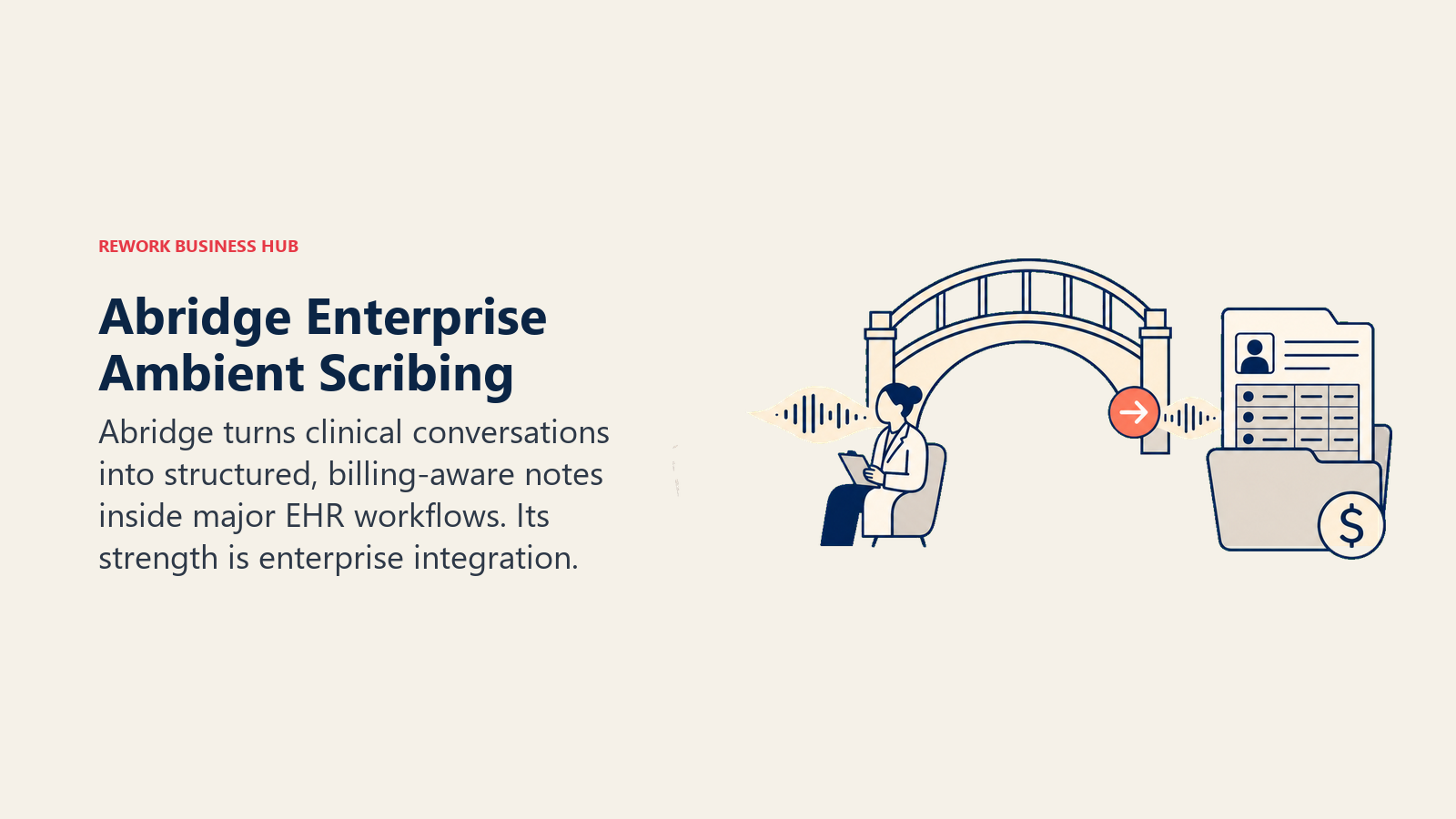
Abridge's bet is that a clinical documentation tool only earns trust at scale if it lives natively inside the EHR clinicians already spend their day in, not beside it. That's why it leads the large-health-system segment: deep, purpose-built Epic integration, structured notes that map to billing-relevant detail, and enough institutional deployments (Duke Health and UCI Health among them) that CMIOs treat it as the safe, proven default rather than a startup bet.
| What you get | What you don't |
|---|---|
| Deepest native Epic integration of any scribe on this list | No published pricing; every deal is custom-negotiated |
| Structured, billing-aware note output | Enterprise-only; no path for solo or small-practice buyers |
| Track record at large academic medical centers | Volume discounts favor big systems, not mid-size groups |
Pricing: No public list price. Independent cost analyses estimate enterprise licenses at roughly $200-$1,200+ per provider per month depending on health system size and negotiated volume, with a commonly cited midpoint near $600-$800 per provider per month, per Vero's Abridge review and Scribing.io's cost analysis. There is no self-serve signup; Abridge sells exclusively through institutional contracts.
Best for: Large health systems and academic medical centers already standardized on Epic that want a scribe backed by broad institutional adoption.
2. Nuance DAX Copilot (Microsoft Dragon Copilot): Deepest Microsoft Ecosystem Tie-In
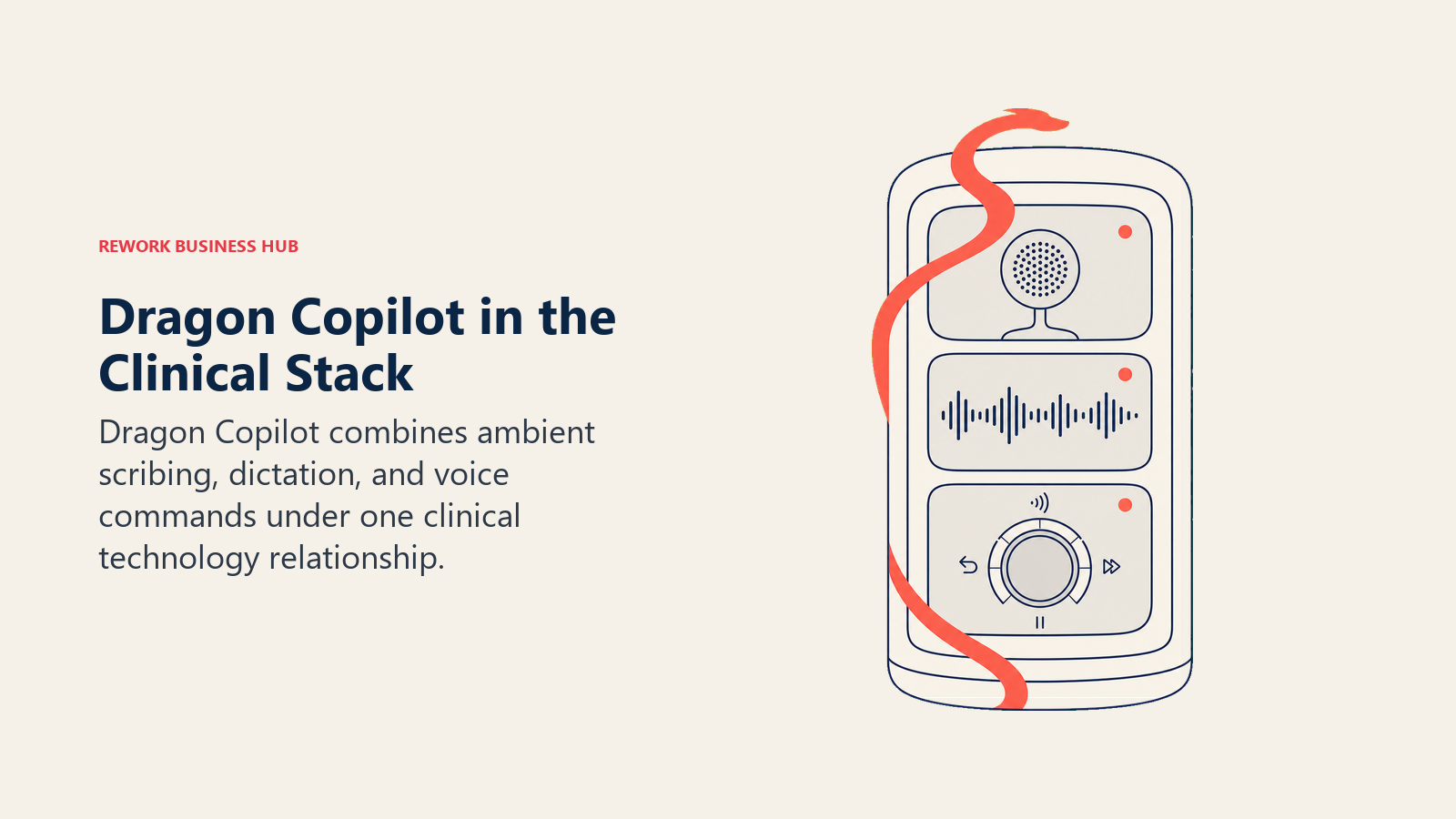
Nuance DAX Copilot, now unified under Microsoft's Dragon Copilot brand, combines ambient scribing with the dictation and command features clinicians already know from Dragon Medical One. For health systems that already run Microsoft's clinical and IT stack, the pitch is one vendor relationship covering both ambient documentation and legacy dictation workflows, rather than running two separate tools.
| What you get | What you don't |
|---|---|
| Combines ambient scribing with established Dragon dictation | No published self-serve pricing; sales-quoted only |
| Deep fit for health systems already on Microsoft/Azure | Legacy Physician Practice plan retired May 1, 2026, forcing repricing |
| Backed by Microsoft's scale and healthcare cloud investment | Reported pricing varies widely by deal size, hard to budget against |
Pricing: Microsoft does not publish a standard rate card. Third-party trackers place typical enterprise contracts at roughly $150-$600 per provider per month depending on volume and existing Microsoft relationship, while an official SaaS marketplace listing cites $7,200 per user per year for a one-year subscription, a figure that appears well above the negotiated range most mid-size buyers report, per Lime Health's pricing and ROI breakdown and Scribing.io's 2026 pricing breakdown. Confirm current terms directly with Microsoft or an authorized reseller; there is no public self-serve checkout.
Best for: Health systems and large practices already invested in Microsoft's Dragon dictation ecosystem wanting one vendor for both ambient and legacy dictation.
3. Ambience Healthcare: Real-Time Coding Alongside Scribing
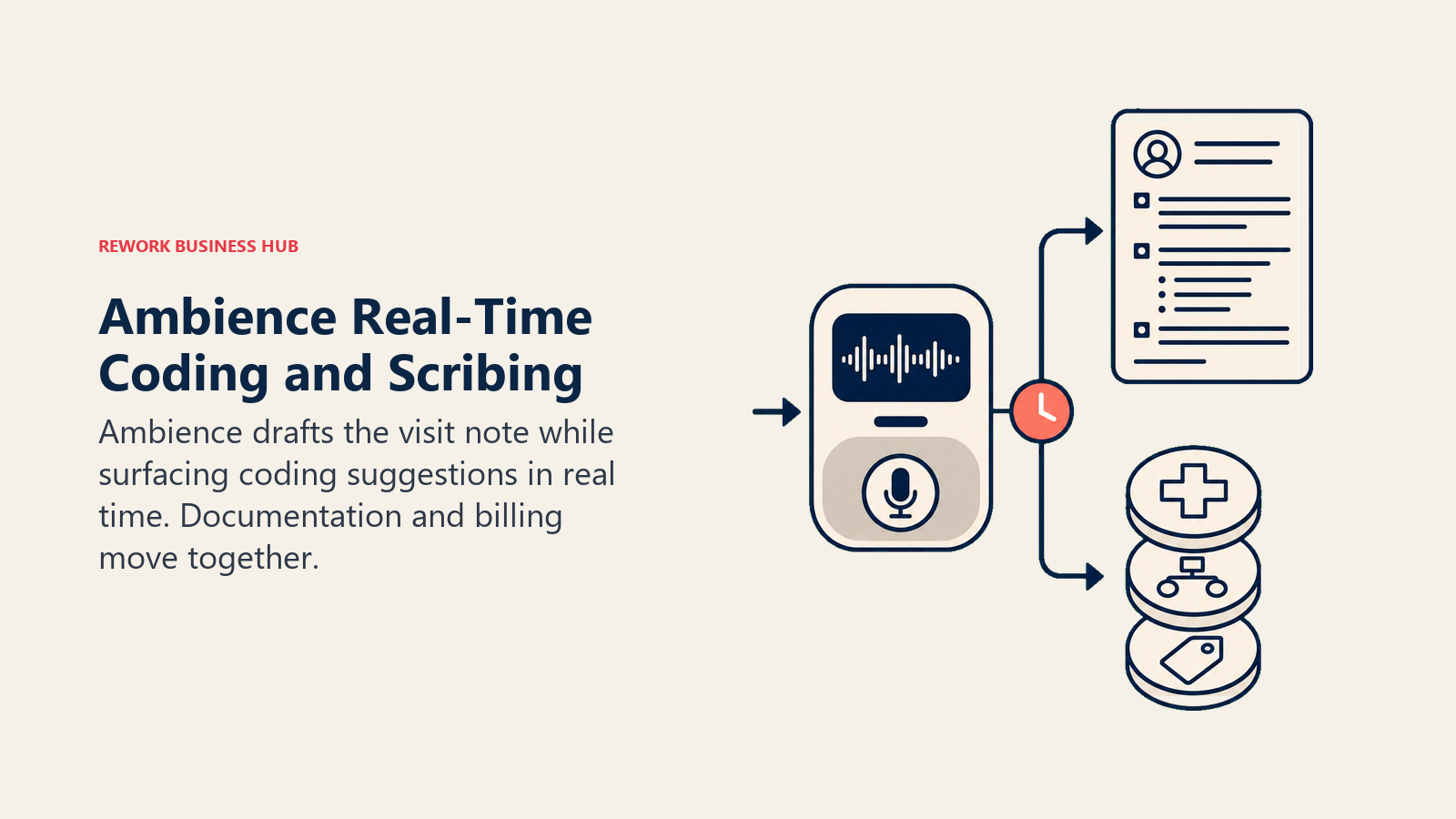
Ambience's differentiator is that it doesn't stop at the note. Its AutoScribe product drafts a structured note within about 90 seconds of the visit ending, and its companion AutoCDI module suggests ICD-10 and CPT codes in real time as the encounter happens, aimed at closing the gap between documentation and billing accuracy that a pure scribe leaves open.
| What you get | What you don't |
|---|---|
| Real-time coding suggestions (AutoCDI) alongside the note | No published pricing; fully custom-negotiated |
| Fast turnaround, notes drafted in roughly 90 seconds | Enterprise-only; not accessible to solo or small practices |
| Strong recent funding and health-system momentum | Newer entrant than Abridge or Nuance with a shorter track record |
Pricing: Ambience does not publish pricing; costs depend on health system size, provider count, and integration complexity. Third-party estimates place AutoScribe in the range of $300-$500+ per provider per month for enterprise deployments, including implementation and training, per SOAP Note Buddy's Ambience review and eesel AI's Ambience overview.
Best for: Mid-size to large health systems that want documentation and real-time coding support in the same workflow, not two separate tools.
4. Suki: Voice-First Clinical Assistant, Not Just a Scribe
Suki's positioning is broader than ambient scribing alone. Alongside note generation, it layers in voice commands for placing orders, navigating the EHR, and querying the chart hands-free, aimed at clinicians who want a spoken interface to their whole workflow, not just a transcript of the visit.
| What you get | What you don't |
|---|---|
| Voice commands for ordering, navigation, and chart Q&A | The most expensive standalone scribe reported on this list |
| Works across EHRs rather than being tied to one platform | No transparent self-serve pricing; sales call required |
| Established enterprise deployments and support model | Premium price point can be hard to justify for smaller groups |
Pricing: Suki does not publish standard pricing. Reported tiers place Suki Compose around $299 per provider per month and Suki Assistant around $399 per provider per month, plus custom enterprise pricing above that, per Scribing.io's Suki breakdown and DeepCura's Suki review.
Best for: Mid-size to large practices that want a voice-driven assistant across ordering and navigation, not just documentation, and can absorb a premium price point.
5. DeepScribe: Specialty-Tuned Documentation for Complex Encounters
DeepScribe built its reputation on complex, specialty-heavy visits, oncology among them, where a long, detail-dense encounter needs more than a generic ambient-note template. Its specialty-specific templates and structured output are aimed at practices where the visit itself is the hard part to capture accurately, not just the transcription.
| What you get | What you don't |
|---|---|
| Specialty-tuned templates for dense, complex visits | Sales-gated; no self-service signup or public pricing |
| Structured output built for high-acuity, longer encounters | Setup fees and annual contracts add cost beyond the subscription |
| Track record with cancer networks and specialty groups | Overkill for straightforward primary-care visit volume |
Pricing: DeepScribe does not publish pricing. Reported figures run roughly $350-$500+ per provider per month ($4,200-$6,000+ per year), plus setup fees of $500-$1,000 and typical annual contract terms, per Vero's DeepScribe review and Software Finder's DeepScribe pricing guide.
Best for: Specialty and complex-care practices (oncology, multi-specialty groups) where visit complexity, not visit volume, is the documentation challenge.
6. Nabla: Independently Studied, Mid-Market Pricing
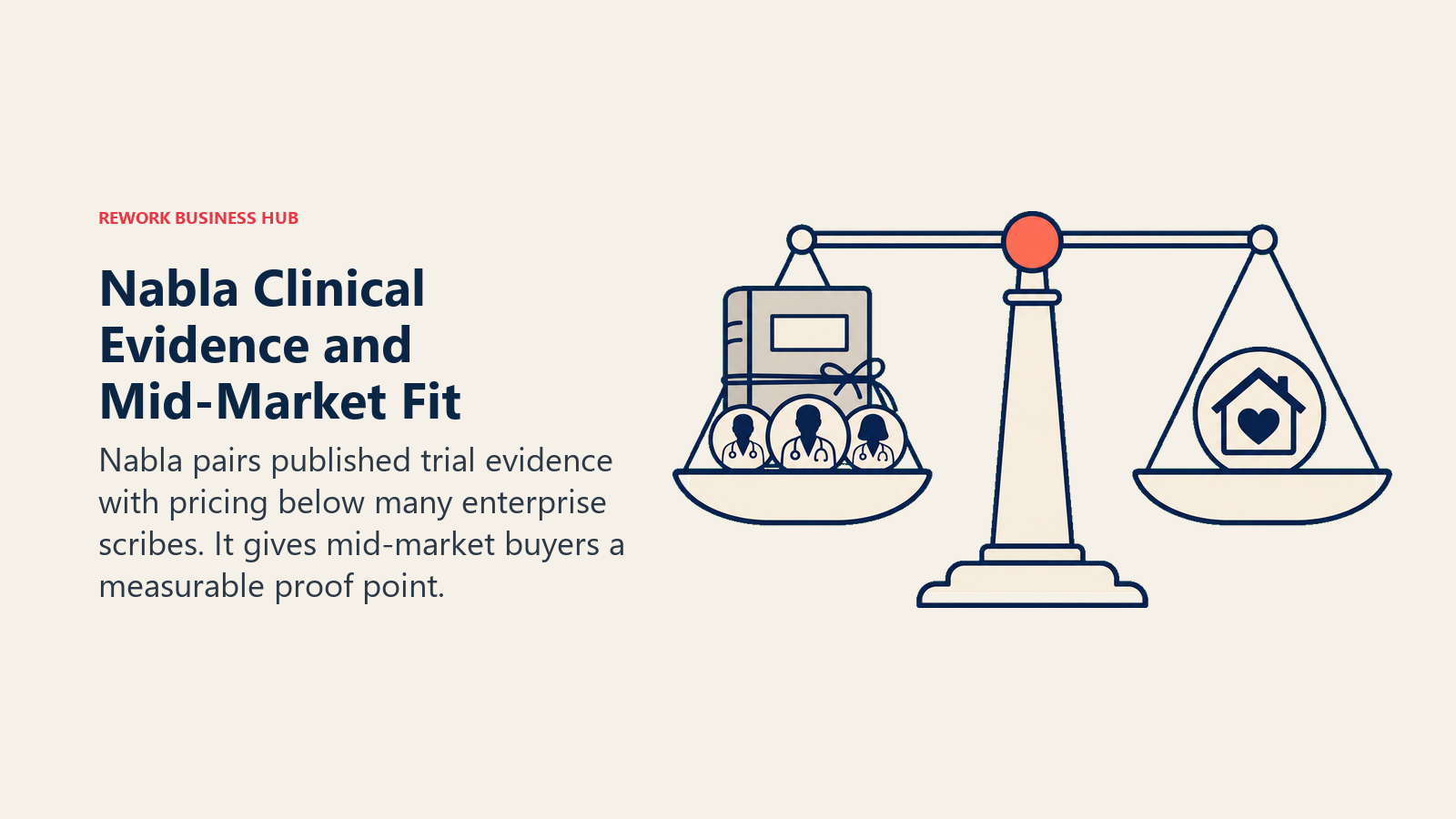
Nabla's standout credential isn't a marketing claim, it's a randomized trial. A 238-physician NEJM AI study assigned outpatient physicians to Nabla, Microsoft's DAX Copilot, or a usual-care control group and measured real note-writing time, giving Nabla a level of independent, peer-reviewed evidence most competitors on this list can only point to secondhand.
| What you get | What you don't |
|---|---|
| Independently studied in a published NEJM AI randomized trial | Pricing still not publicly listed; sales call required for a quote |
| Mid-market pricing between budget tools and enterprise scribes | Free tier is limited and note caps aren't published |
| Reasonable fit for practices between 5 and 500 providers | Fewer large-health-system reference deployments than Abridge |
Pricing: Nabla does not publish pricing online. Reported tiers place a Starter plan around $119 per provider per month and a Pro plan around $239 per provider per month, positioning it between budget self-serve tools and full enterprise scribes, per HealOS's Nabla pricing overview and Marvix's AI medical scribe pricing guide. Expect volume discounts, BAA terms, and SSO to be negotiated above roughly 25 clinicians.
Best for: Mid-size practices and small health systems that want a scribe with real published clinical-trial evidence behind it, not just vendor claims.
7. Heidi Health: The Most Usable Free Tier in the Category
Heidi Health rebuilt its pricing in 2026 around a free tier that actually holds up in daily use, not just a trial gate. Unlimited basic consults and dictation cost nothing; the meter only starts on "Pro Actions" like custom templates and advanced AI prompts, which makes Heidi a realistic starting point for solo clinicians and allied-health practitioners who can't justify an enterprise contract.
| What you get | What you don't |
|---|---|
| Genuinely usable free tier, not just a time-limited trial | Free tier's 10 Pro Actions/month runs out fast in daily use |
| Clinician plan at a fraction of enterprise scribe pricing | Not built for large-health-system governance or Epic-native deployment |
| Popular with allied health, not just physicians | Fewer large institutional reference deployments than Abridge or DAX |
Pricing: Free plan at $0/month (unlimited basic consults and dictation, 10 Pro Actions a month); Clinician plan at $150/user/month billed yearly (unlimited Pro Actions, custom templates); Evidence Plus tier at $40/user/month; 14-day free trial on paid plans, per Heidi Health's own pricing page.
Best for: Solo clinicians, small practices, and allied-health professionals wanting a real free option before committing budget.
8. Freed: Fastest Self-Serve Setup for Independent Doctors
Freed's whole pitch is speed to value: no sales call, no procurement process, a card on file and you're documenting with AI the same day. That self-serve model, restructured into four clearer tiers in 2026, makes it one of the few tools on this list an independent physician can actually buy without involving an IT department.
| What you get | What you don't |
|---|---|
| Fully self-serve; live in minutes, no sales call required | No permanent free tier, only a 7-day trial |
| Clear, published pricing across four tiers | Starter tier caps out at 40 notes a month |
| EHR push and coding support at the top Premier tier | Less enterprise governance depth than Abridge or DAX Copilot |
Pricing: Starter $39/month (40 notes/month cap); Core $79/month (unlimited notes); Premier $104/month annual or $119/month monthly (adds EHR push and ICD-10/CPT codes); Groups custom-quoted, per Freed's own pricing page.
Best for: Independent and solo physicians who want to start using an AI scribe today without a procurement cycle.
9. OpenEvidence: Free, Evidence-Cited Answers Between Patients
OpenEvidence answers a different question than the scribes above: not "what did the patient say," but "what does the evidence actually support." It's a free, PubMed-grounded clinical question-answering tool built specifically for verified physicians, and its growth curve, past 860,000 verified US clinicians as of May 2026, suggests it has become a default reach-for-your-phone habit between visits.
| What you get | What you don't |
|---|---|
| Fully free for verified US healthcare professionals | Not a documentation tool; doesn't touch the visit note |
| Citations traceable to PubMed and named studies | Ad-supported model funded by pharma and device advertising |
| Very fast growth and broad physician adoption | Enterprise, non-ad-supported tier still in development |
Pricing: Free for verified US healthcare professionals, monetized through pharmaceutical and medical-device advertising rather than subscriptions; a non-ad-supported enterprise tier for health systems is in development, per NBC News's coverage of OpenEvidence's business model and PYMNTS's coverage of its clinician growth.
Best for: Any verified physician wanting a fast, cited answer to a clinical question without leaving their phone.
10. Doximity GPT: Free AI Built Into a Network Most Doctors Already Use
Doximity GPT's advantage isn't the model, it's distribution. It's free, handles PHI within Doximity's existing verified-physician network, cites clinical guidelines from bodies like AHA, ACC, NCCN, and IDSA, and reaches a platform Doximity says over 80% of US doctors already use for other purposes, so adoption doesn't require learning a new tool from scratch.
| What you get | What you don't |
|---|---|
| Free for all verified US physicians, NPs, PAs, and medical students | Not a real-time ambient scribe for the visit itself |
| Built inside a network most US doctors already use daily | Long-term AI business model, beyond ads, still unproven |
| Guideline citations from AHA, ACC, NCCN, IDSA, and more | Less depth on complex differential-diagnosis reasoning than Glass Health |
Pricing: Free for all verified US physicians, nurse practitioners, physician assistants, and medical students, no subscription required, per Doximity GPT's own product page and coverage of the DocsGPT rollout.
Best for: Doctors already active on Doximity wanting a free, guideline-cited assistant for drafting and quick clinical questions without a new sign-up.
11. Glass Health: AI Clinical Decision Support, Not Just Documentation
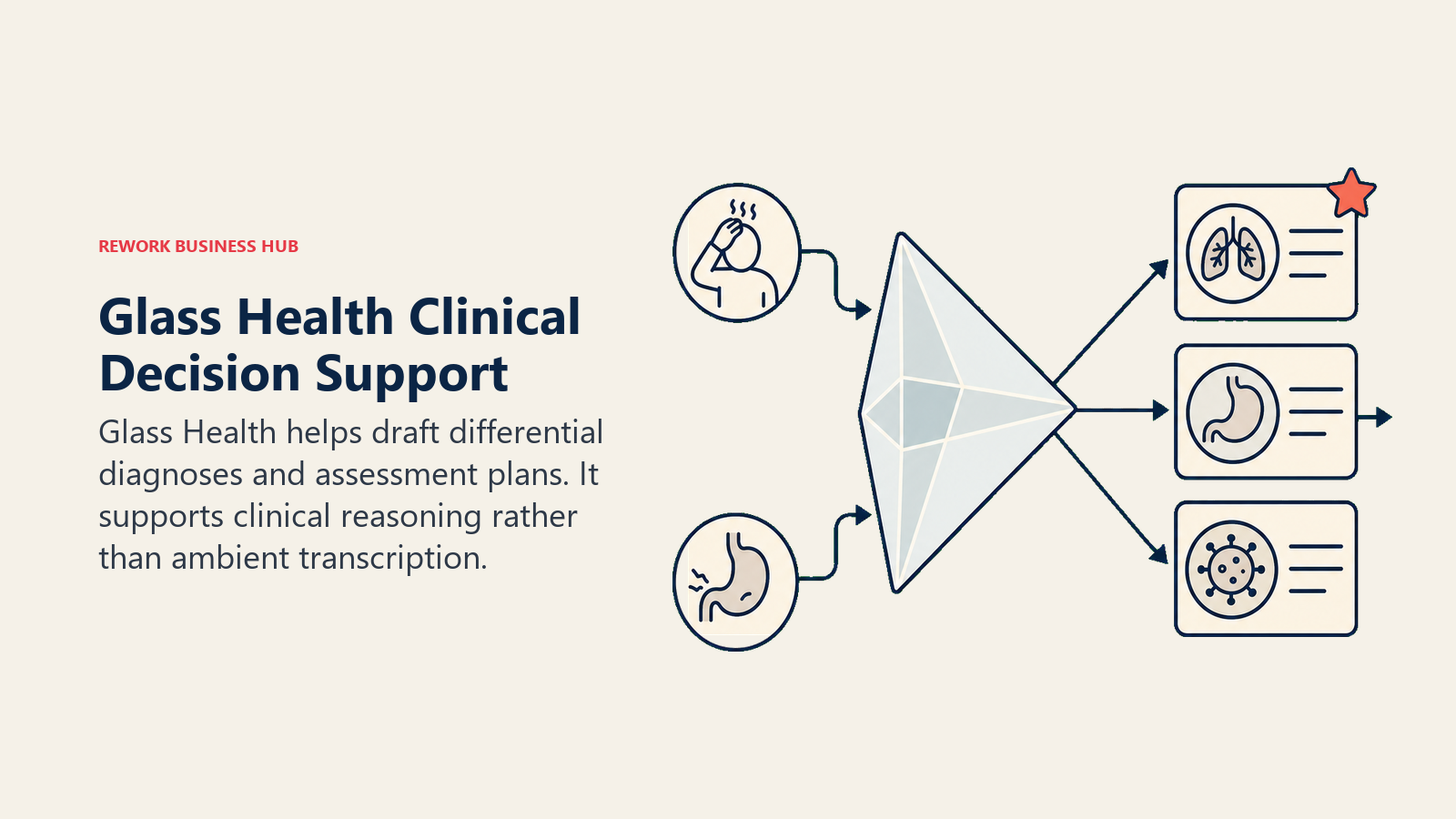
Glass Health sits in a different lane from the scribes above: it's built for the reasoning part of the visit, drafting differential diagnoses and assessment-and-plan language, not transcribing the conversation. For clinicians who want AI help thinking through a case, not just writing it up, Glass is the more direct fit, and its tiered pricing (including a genuinely free Lite plan) makes it approachable for individual use before any institutional buy-in.
| What you get | What you don't |
|---|---|
| AI-assisted differential diagnosis and assessment-and-plan drafting | Not an ambient scribe; doesn't record or transcribe the visit itself |
| Free Lite tier plus low-cost individual tiers ($20-$200/month) | Enterprise HIPAA-scoped EHR integration is a separate, custom tier |
| Useful alongside a scribe, not necessarily instead of one | Smaller footprint and brand recognition than Abridge or Nuance |
Pricing: Lite tier free; Starter $20/month; Pro $90/month; Max $200/month; Enterprise custom-priced for hospitals and health systems needing HIPAA compliance and EHR integration, per Glass Health's pricing as summarized by Healthcare Tools.
Best for: Individual clinicians who want AI support for clinical reasoning and note drafting, used alongside (not instead of) a dedicated ambient scribe.
12. Corti: The API Layer Behind Custom Clinical AI
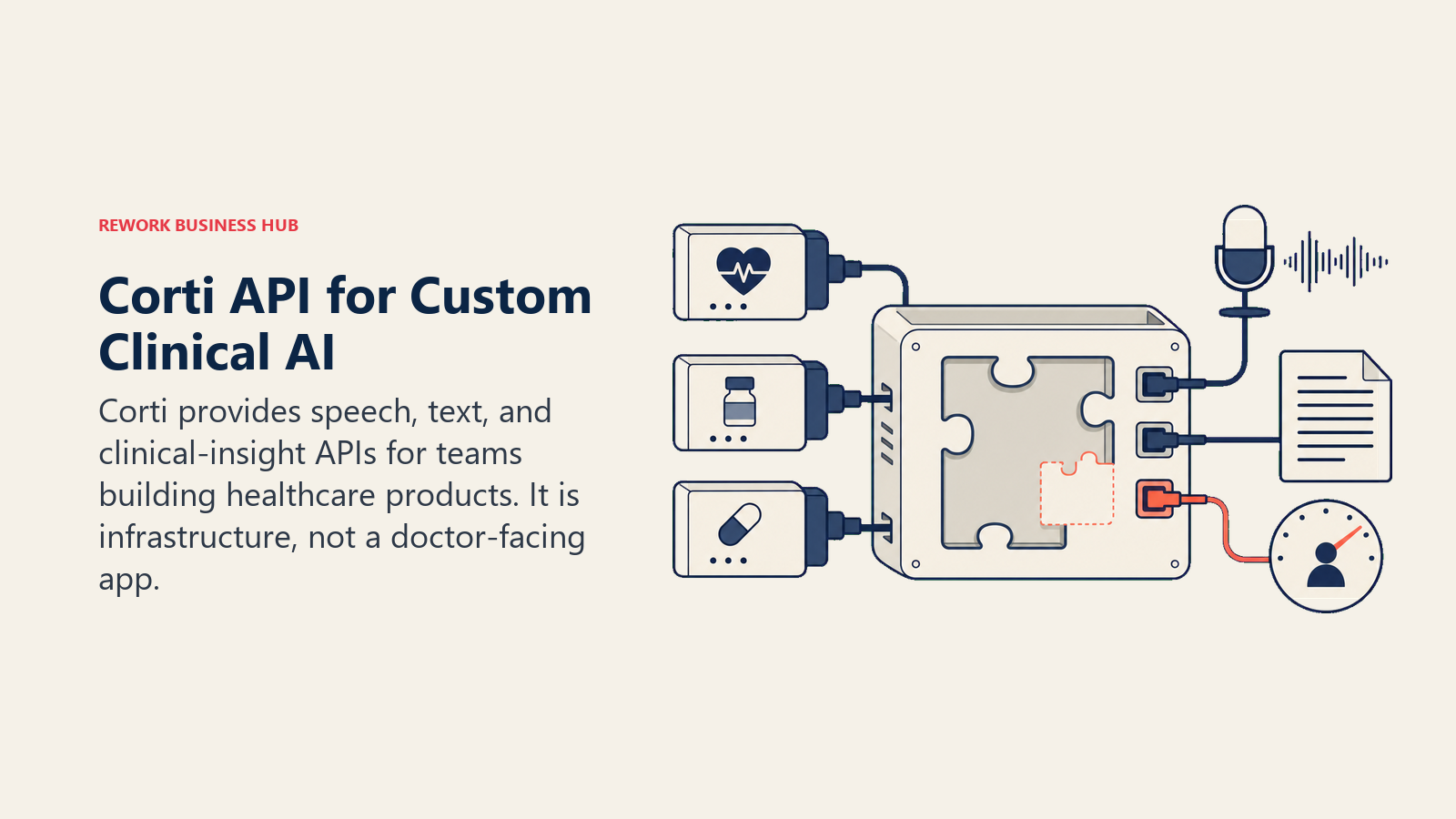
Corti isn't built for a clinician to open directly. It's a healthcare AI API platform, speech, text, and clinical-insight endpoints, that other vendors and health-tech teams build custom documentation and decision-support products on top of. If you're a digital health startup or a health system's internal engineering team building something the vendors above don't offer off the shelf, Corti is the infrastructure layer to evaluate, not a doctor-facing app.
| What you get | What you don't |
|---|---|
| Usage-based API pricing, not a per-seat subscription | Not a finished, doctor-facing app; requires engineering to deploy |
| $50 in free credits to start building and testing | Not a fit for a practice just wanting a scribe out of the box |
| Recent 20-40% price cuts across text, speech, and insight endpoints | Enterprise support requires a custom, rolling-commitment agreement |
Pricing: Usage-based credits across speech and text workflows, $50 in free credits to start; text input processing at $4 per million tokens and output at $16 per million tokens after a 20% cut in May 2026; its FactsR clinical-insight API also dropped 30-40% the same month; enterprise plans available with embedded engineering support, per Corti's own pricing page and its May 2026 pricing announcement.
Best for: Health-tech developers and vendors building custom clinical documentation or decision-support products, not individual clinicians shopping for an off-the-shelf scribe.
How to Choose: Decision Framework
| If your biggest need is... | Pick... | Why |
|---|---|---|
| Deep, native Epic integration at a large health system | Abridge | Broadest institutional deployment, structured billing-aware notes |
| One vendor covering both ambient scribing and legacy Dragon dictation | Nuance DAX Copilot | Ties into the Microsoft/Dragon stack most large systems already run |
| Real-time coding suggestions alongside the note | Ambience Healthcare | AutoCDI surfaces ICD-10/CPT codes as the visit happens |
| A voice-first assistant, not just a scribe | Suki | Handles ordering, navigation, and chart Q&A by voice |
| Documentation for long, complex specialty visits | DeepScribe | Specialty-tuned templates built for dense encounters like oncology |
| A scribe with independent, published clinical-trial evidence | Nabla | Tested head-to-head against DAX Copilot in a 238-physician NEJM AI RCT |
| A real free tier before spending anything | Heidi Health | Unlimited basic consults free; Pro Actions gate advanced features only |
| Fast self-serve setup with no sales call | Freed | Live same-day; four clear published tiers |
| Free, cited answers to clinical questions between patients | OpenEvidence | Free for verified clinicians, citations trace to PubMed |
| A free assistant inside a network you already use | Doximity GPT | Free for verified physicians, guideline citations built in |
| AI help with clinical reasoning, not just note-writing | Glass Health | Differential diagnosis and assessment-and-plan drafting, free Lite tier |
| Building a custom clinical AI product | Corti | Usage-based API for speech, text, and clinical-insight workflows |
By Budget
| Budget | Best Fits |
|---|---|
| Free | OpenEvidence, Doximity GPT, Glass Health (Lite), Heidi Health (Free), Nabla (limited free tier) |
| Under $100/provider/month | Freed (Starter/Core), Glass Health (Starter/Pro), Nabla (Starter) |
| $100-$400/provider/month | Heidi Health (Clinician), Freed (Premier), Nabla (Pro), Suki, DeepScribe |
| Custom enterprise quote required | Abridge, Nuance DAX Copilot, Ambience Healthcare, Corti (Enterprise) |
AI in the Exam Room: HIPAA, Accuracy, and Where the Risk Actually Sits
Adoption is running well ahead of governance in medicine, the same pattern showing up across every regulated profession right now. Per the AMA's own data, 81% of physicians already use AI, but the PHTI's independent review of eight health systems found that even organizations running full ambient-scribe deployments still can't prove a clear financial return, only reduced burnout and cognitive load. That gap matters when you're the one signing a contract: pick a tool because it measurably helps your day, documented in studies like the JAMA and JAMA Network Open trials above, not because a vendor's own case study says so.
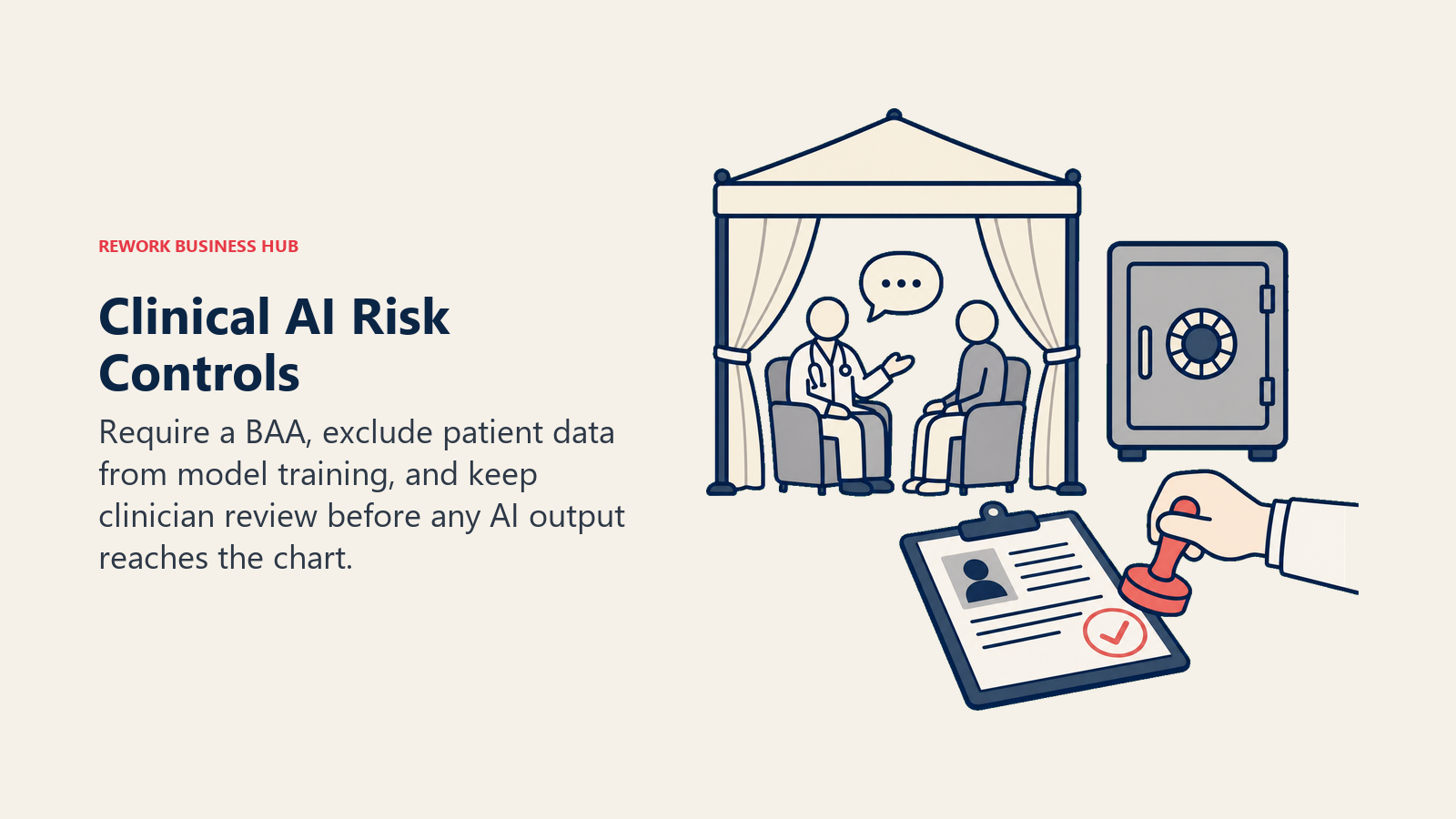
Two things are worth confirming before any patient conversation goes into a third-party AI tool. First, does the vendor sign a Business Associate Agreement and contractually exclude your data from model training? Enterprise tools built for health systems (Abridge, Nuance DAX Copilot, Ambience, Suki, DeepScribe) are built around this from the start; free consumer-facing tools may not offer the same guarantee, so check before you dictate anything identifiable into a general-purpose chatbot. Second, every AI-drafted note, differential, or coding suggestion still needs a clinician's sign-off. The efficiency gains in the studies above (13-25 fewer minutes a day) assume the doctor reviews and edits the draft, not that the AI output goes into the chart unread. If your broader AI rollout needs a governance framework beyond documentation tools specifically, AI security and compliance and AI ethics and data privacy cover the controls and policy questions worth answering before you sign anything. The AI tool selection framework is also a useful structure for comparing scribes against each other on more than price. And if you're weighing this purchase as part of a broader practice technology stack, the healthcare technology stack guide covers how documentation AI fits alongside your EHR, scheduling, and billing systems.
Legal and medical AI adoption are following remarkably similar curves in 2026: fast uptake, real productivity gains, and a governance gap that hasn't closed. Our best AI tools for lawyers guide covers the parallel story in another regulated profession, if you want to see how a different field is handling the same tradeoffs. And if evidence lookup and general-purpose AI chat are part of your stack alongside a scribe, Claude vs ChatGPT vs Gemini is worth reading before you default to whichever model your health system already licenses.
Frequently Asked Questions about AI Tools for Doctors
What is the best AI tool for doctors in 2026?
There's no single best tool for every practice. Abridge and Nuance DAX Copilot lead ambient scribing for large health systems, Heidi Health and Freed lead the self-serve, small-practice segment, Nabla sits in the middle with real published clinical-trial evidence, and OpenEvidence and Doximity GPT are the free evidence and Q&A tools most physicians already carry on their phone.
Are AI medical scribes HIPAA compliant?
It depends entirely on the vendor's terms, not the category. Enterprise tools built for health systems (Abridge, Nuance DAX Copilot, Ambience, Suki, DeepScribe) sign Business Associate Agreements and exclude PHI from model training as a baseline requirement. Confirm BAA terms and data-training policy in writing before dictating any identifiable patient information into any AI tool, including free consumer-facing ones.
How much does an AI medical scribe cost in 2026?
Self-serve, solo-friendly tools like Freed and Heidi Health run roughly $0-$150 per provider per month. Mid-market tools like Nabla run roughly $119-$239 per provider per month. Enterprise scribes built for health systems (Abridge, Nuance DAX Copilot, Ambience, Suki, DeepScribe) don't publish list prices; expect a custom quote in the $200-$1,200+ per provider per month range depending on volume.
What's the best free AI tool for doctors?
OpenEvidence and Doximity GPT are both fully free for verified US clinicians and don't require institutional buy-in. Heidi Health and Glass Health also offer real, usable free tiers rather than time-limited trials, though features are more limited than their paid plans.
Do AI scribes actually save doctors time, or is that just marketing?
The independent evidence says yes, with real limits. A five-site JAMA study of 8,581 clinicians found AI scribe adoption cut documentation time by 16 minutes a day on average, and a separate JAMA Network Open trial found burnout dropped from 51.9% to 38.8% after 30 days of use. The Peterson Health Technology Institute's review found the same burnout benefit but couldn't yet prove a clear financial ROI, so weigh clinician well-being and financial payback as two separate questions.
What's the difference between an ambient scribe and a clinical decision support tool?
An ambient scribe (Abridge, Nuance DAX Copilot, Ambience, Suki, DeepScribe, Nabla, Heidi Health, Freed) listens to the visit and drafts the note. A clinical decision support or answer tool (OpenEvidence, Glass Health, Doximity GPT) helps you reason through a diagnosis or check evidence, and doesn't record the conversation at all. Many practices end up using one of each rather than expecting a single tool to do both jobs well.
Is a solo or small practice actually able to afford these tools?
Yes. Freed, Heidi Health, Nabla's free tier, OpenEvidence, Doximity GPT, and Glass Health's Lite tier were all built with individual clinicians and small practices in mind, with self-serve signup and no procurement process. The enterprise-only tools (Abridge, Nuance DAX Copilot, Ambience, Suki, DeepScribe) are built for health systems and are not realistically accessible to a solo practitioner.
How current is this pricing, and how often should I re-check it?
Clinical AI pricing is moving fast: Nuance cut its main list price 57% in May 2026, Freed and Heidi Health both restructured their tiers in 2026, and several enterprise vendors on this list don't publish rates at all. Re-verify directly with the vendor before committing budget, especially for any quote-based enterprise tier.
Related Reading
- Best AI Tools in 2026: The Top 25 Across Every Category
- Best AI Transcription Software in 2026: 15 Tools for Interviews, Media, Legal, and Research
- Best AI Tools for Lawyers in 2026: 12 Legal AI Platforms Ranked by Use Case
- Best AI Meeting Assistants and Notetakers in 2026
- Claude vs ChatGPT vs Gemini: Which LLM Fits Your Business in 2026
- AI Security and Compliance: Protect Your Business While Using AI Tools
- AI Ethics and Data Privacy: Responsible AI Productivity Tool Adoption
- AI Productivity Tool Selection: 6-Criteria Framework
- Healthcare Technology Stack: Building an Integrated Practice Technology System
Methodology
Every tool on this list was evaluated on real clinical use (ambient documentation, coding support, evidence lookup, and clinical decision support), not feature-sheet comparisons alone. Adoption and efficacy statistics cited above come from the AMA's 2026 Physician Survey on Augmented Intelligence, a five-site JAMA study, a JAMA Network Open randomized trial, Elsevier's Clinician of the Future 2026 report, and the Peterson Health Technology Institute's independent scribe review, each linked at first mention.
What to Do Next
Start by separating the two jobs these tools actually do: documenting the visit and helping you reason through it. Almost no practice needs both covered by one platform on day one. If you're solo or small, start free: OpenEvidence or Doximity GPT for evidence and quick questions, Heidi Health's free tier or a Freed trial for documentation, and see what actually sticks in your workflow before spending anything. If you're a health system evaluating Abridge, Nuance DAX Copilot, or Ambience, run a paid pilot with real clinicians and real patient volume before signing a multi-year contract, and get the data-training and BAA terms in writing regardless of which vendor you pick. The practices getting real value from clinical AI in 2026 are the ones that matched the tool to the actual bottleneck, documentation time, evidence lookup, or clinical reasoning, not the ones that bought whichever platform had the flashiest demo.

Principal Product Marketing Strategist
On this page
- What Changed in 2026
- Key Facts
- Quick Comparison Table
- Practice Size Fit Matrix
- Sizing and Persona Table
- 1. Abridge: Broadest Enterprise Ambient Scribe, Deepest Epic Integration
- 2. Nuance DAX Copilot (Microsoft Dragon Copilot): Deepest Microsoft Ecosystem Tie-In
- 3. Ambience Healthcare: Real-Time Coding Alongside Scribing
- 4. Suki: Voice-First Clinical Assistant, Not Just a Scribe
- 5. DeepScribe: Specialty-Tuned Documentation for Complex Encounters
- 6. Nabla: Independently Studied, Mid-Market Pricing
- 7. Heidi Health: The Most Usable Free Tier in the Category
- 8. Freed: Fastest Self-Serve Setup for Independent Doctors
- 9. OpenEvidence: Free, Evidence-Cited Answers Between Patients
- 10. Doximity GPT: Free AI Built Into a Network Most Doctors Already Use
- 11. Glass Health: AI Clinical Decision Support, Not Just Documentation
- 12. Corti: The API Layer Behind Custom Clinical AI
- How to Choose: Decision Framework
- By Budget
- AI in the Exam Room: HIPAA, Accuracy, and Where the Risk Actually Sits
- Related Reading
- Methodology
- What to Do Next