What is Burn Rate? Your Startup's Financial Speedometer
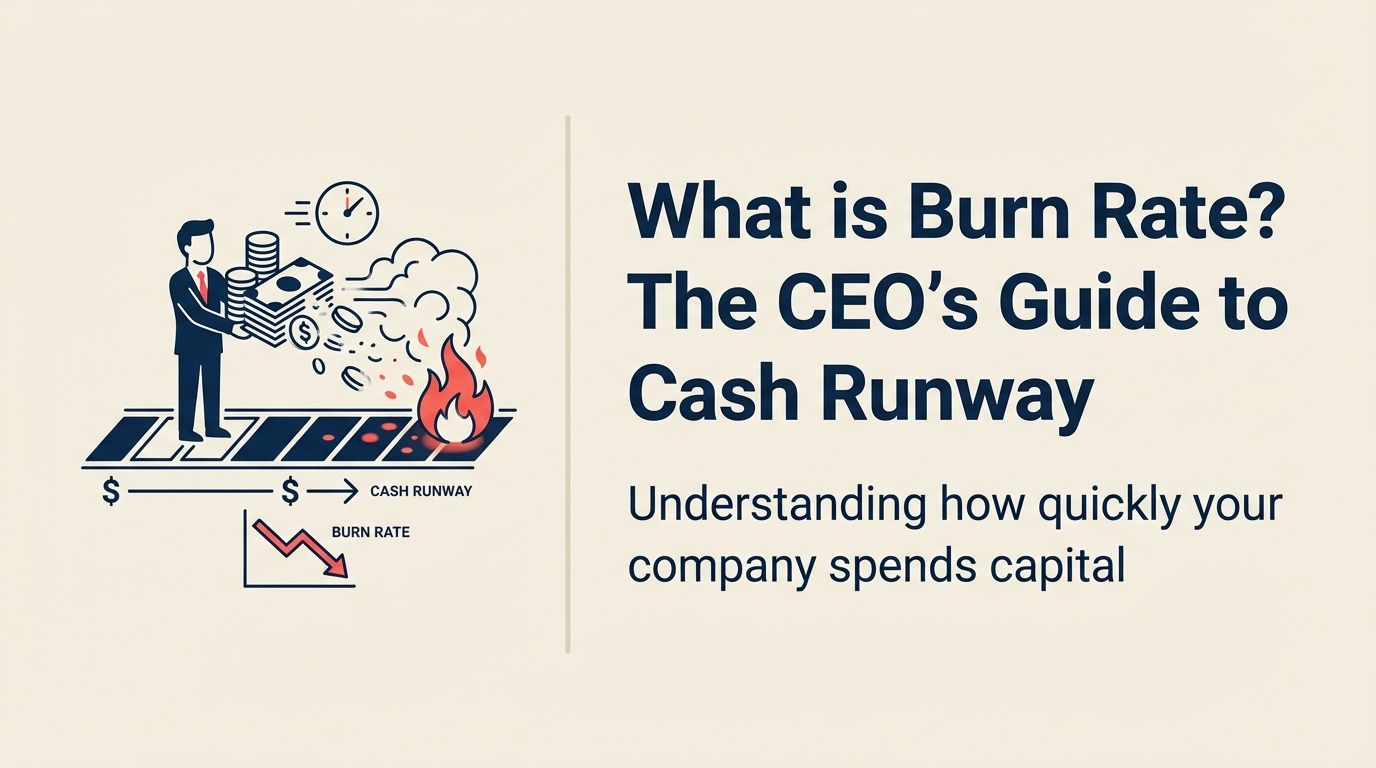
"We have 8 months of runway left." When a founder dropped this line during a pitch last month, half the room nodded knowingly while the other half looked confused. The difference? Understanding burn rate – possibly the most critical metric for any cash-conscious business.
Here's the thing: burn rate isn't just another financial term to impress investors. It's your business's survival clock, ticking away with every expense.
The Real Story Behind Burn Rate
Back in 2016, a promising edtech startup had $2 million in the bank. Their product was solid, users loved it, growth looked good. Eighteen months later? Gone. Not because the product failed – they simply ran out of money faster than expected.
This happens more than you'd think. And it's entirely preventable.
So what exactly is burn rate? Simply put: it's how fast your company spends its cash reserves each month. If you're spending $50,000 monthly and bringing in $20,000, your net burn rate is $30,000. At that pace, $300,000 in the bank gives you 10 months to either become profitable or raise more funds.
Think of it like fuel consumption in a car. You wouldn't start a road trip without knowing how much gas you're using per mile, right? Same principle here.
How Burn Rate Actually Works in Practice
Let me walk you through what happens in a typical startup:
Month 1: You raise $500,000. Everyone's excited. You hire two developers, rent an office, launch marketing campaigns. Monthly expenses hit $60,000. Revenue? Maybe $5,000 if you're lucky.
Month 6: Reality check. You're burning $55,000 net per month. That initial $500,000? Down to $170,000. Suddenly, you've got 3 months left instead of the 10 you planned for.
This is where it gets interesting. Smart founders track two types:
- Gross burn rate: Total monthly expenses ($60,000 in our example)
- Net burn rate: Monthly expenses minus revenue ($55,000)
But here's what most people miss – burn rate isn't static. It typically follows a pattern:
Early stage: High burn as you build the product
Growth stage: Even higher burn as you scale
Maturity: Burn decreases as revenue catches up
The trick is managing these transitions without running out of cash.
Burn Rate Benchmarks Across Industries
SaaS Companies Typically burn $50,000-$150,000/month in early stages Healthy runway: 12-18 months Red flag: Less than 6 months
E-commerce Startups Often burn $30,000-$80,000/month initially Inventory costs create spiky burn patterns Should reach profitability faster than SaaS
Service Businesses Lower burn rates: $20,000-$50,000/month Can often bootstrap longer Runway of 6-12 months usually sufficient
Deep Tech/Biotech Massive burn: $200,000-$1M+/month Need 24-36 month runways Require multiple funding rounds before revenue
Calculating Your Runway (And Why It Matters)
Here's the formula that could save your business:
Runway = Cash in Bank ÷ Net Burn Rate
Sounds simple? It is. But I've seen too many founders mess this up by:
- Forgetting about upcoming large expenses
- Assuming revenue will grow linearly
- Not accounting for seasonal fluctuations
- Ignoring the time it takes to raise money
Real example: A marketing agency I advised had $240,000 in cash, burning $40,000/month. Six-month runway, right? Wrong. They forgot about annual insurance ($30,000) and tax payments ($45,000) due in month 3. Actual runway? 3.5 months.
When High Burn Rate Makes Sense (And When It Doesn't)
Sometimes burning cash fast is strategic:
Go for it when:
- You're in a winner-take-all market
- Customer acquisition costs decrease with scale
- You have clear product-market fit
- Competitors are raising massive rounds
Pump the brakes when:
- You're still figuring out what customers want
- Unit economics don't work yet
- Market conditions are uncertain
- You're within 6 months of running out
Uber famously burned $2 billion in 2015. Crazy? Maybe. But they were buying market dominance. Your local app development agency trying the same strategy? That's a recipe for disaster.
Managing Burn Rate Without Killing Growth
Smart burn rate management isn't about cutting everything. It's about spending efficiently:
Quick wins:
- Switch from monthly to annual software subscriptions (20-30% savings)
- Hire contractors for non-core functions
- Negotiate payment terms with suppliers
- Sublease unused office space
Strategic moves:
- Focus on one market/product instead of three
- Delay nice-to-have features
- Prioritize revenue-generating activities
- Build partnerships instead of building everything
One B2B SaaS startup I know cut their burn from $120K to $70K/month without firing anyone. How? They killed three underperforming marketing channels, moved to remote-first (saving $15K/month in office costs), and renegotiated their AWS bill. Revenue actually grew during this period.
Red Flags That Your Burn Rate is Out of Control
Watch for these warning signs:
- The 40% Rule: If more than 40% of your burn goes to non-product costs, reassess
- The Growth Disconnect: Burn increasing faster than revenue growth
- The Fundraising Trap: Needing to raise money every 6-8 months
- The Pivot Burn: Changing direction without adjusting spend
A fintech startup learned this the hard way. They were burning $200K/month with only $50K in monthly revenue. The kicker? 60% of their burn was on a 30-person sales team... for a product that could have been self-service.
Your Burn Rate Action Plan
Time to get practical. This week:
- Calculate your exact burn rate (don't guess, use real numbers)
- Project your runway including all upcoming expenses
- Identify your top 3 expense categories
- Set burn rate targets for the next 6 months
Then ask yourself: If revenue stopped tomorrow, how long could we survive? If the answer makes you uncomfortable, it's time to act.
Look, burn rate isn't inherently good or bad. It's a tool. Use it wisely, and you'll build something incredible. Ignore it, and you'll join the 82% of startups that fail due to cash flow problems.
Your move? Calculate your burn rate today. Then decide if you're comfortable with how fast you're spending. Because knowing your burn rate isn't just about impressing investors – it's about keeping your business alive long enough to succeed.
Want to dive deeper? Check out our guide on financial metrics for startups or explore how to extend your runway during tough times.
Part of the [Business Terms Collection]. Last updated: 2026-01-21
On this page
- The Real Story Behind Burn Rate
- How Burn Rate Actually Works in Practice
- Burn Rate Benchmarks Across Industries
- Calculating Your Runway (And Why It Matters)
- When High Burn Rate Makes Sense (And When It Doesn't)
- Managing Burn Rate Without Killing Growth
- Red Flags That Your Burn Rate is Out of Control
- Your Burn Rate Action Plan