More in
Sales Tech News
AI Sales Teams Grow 2.6x Faster. Gartner Says Buyers Still Want a Rep
Jun 6, 2026
Aircall Bought Piper AI to Turn Every Sales Call Into Pipeline
Jun 6, 2026
Salesforce Just Handed Marketers AI Agents That Build Sales Pipeline
Jun 6, 2026
Revenue Intelligence Showed You the Risk. Revenue Execution Acts on It.
Jun 5, 2026
Meta Put an AI Agent in WhatsApp That Closes Sales for Any Business
Jun 4, 2026
VCs Poured Over $200M Into AI Sales Startups: The GTM Stack Signal
Jun 4, 2026
Are AI SDRs Worth It in 2026? The Data Says Build a Hybrid Team
Jun 3, 2026
GTM Engineering in 2026: The Sales Hire That Replaces Three Roles
Jun 3, 2026
ZoomInfo Feeds Verified Data to Your AI Sales Agents: The Single-Vendor Tradeoff
Jun 3, 2026
Salesforce Summer '26 Drops Multi-Agent Orchestration June 15. Here's the Sales Ops Audit Before Your Agents Start Handing Off
Jun 2, 2026
Salesforce Summer '26 Lets an AI Agent Qualify Inbound 24/7. Here's the 4-Step CRO Budget Audit Before You Cut BDR Headcount
Turn this article into takeaways for your work.


Each assistant summarizes the article only for you and suggests best practices for your work.
The salesforce summer 26 customer engagement agent isn't a chatbot upgrade. It's a headcount decision that will land in your FY27 budget review whether you invite it or not. The question isn't whether the technology works. The question is whether you've done the unit economics before your CFO asks.
According to Salesforce's Summer '26 release announcement, the release ships June 15, 2026 with three headline additions: the Customer Engagement Agent (inbound qualification, 24/7, across website and email), Multi-Agent Orchestration (agents working as a unified team across end-to-end workflows), and Momentum (auto-capture of calls, emails, and meetings with automatic CRM write-back). Taken individually, each is a productivity play. Taken together, they describe a top-of-funnel coverage model that doesn't require a human BDR in the first conversation.
That's the frame every CRO should bring into the next board cycle. Not "should we enable Agentforce?" but "how does the cost per qualified meeting from an AI agent compare to our current BDR fully-loaded cost, and what's the conversion-quality benchmark we'd need to see before we make a structural headcount call?"
Key Facts
- Salesforce Summer '26 Release ships June 15, 2026, with the Customer Engagement Agent, Multi-Agent Orchestration, and Momentum auto-capture (Salesforce, May 2026)
- Agentforce now runs at least two live pricing models: Conversations at $2 per conversation and Flex Credits at $500 per 100,000 credits (Salesforce; SaaStr coverage describes 3+ pricing models in market)
- Salesforce projects multi-agent adoption to surge 67% by 2027, citing unified architecture as the success factor (Salesforce Connectivity Report, May 2026)
Why This Is Different From the Old SDR Chatbot Pitch
The 2019-era SDR chatbot promised to capture leads after hours. It routed form fills to a sequence and called it qualification. The conversion rate was roughly what you'd expect from routing leads to a sequence: modest at best, misleading at worst, because "lead routed" and "lead qualified" are different things.
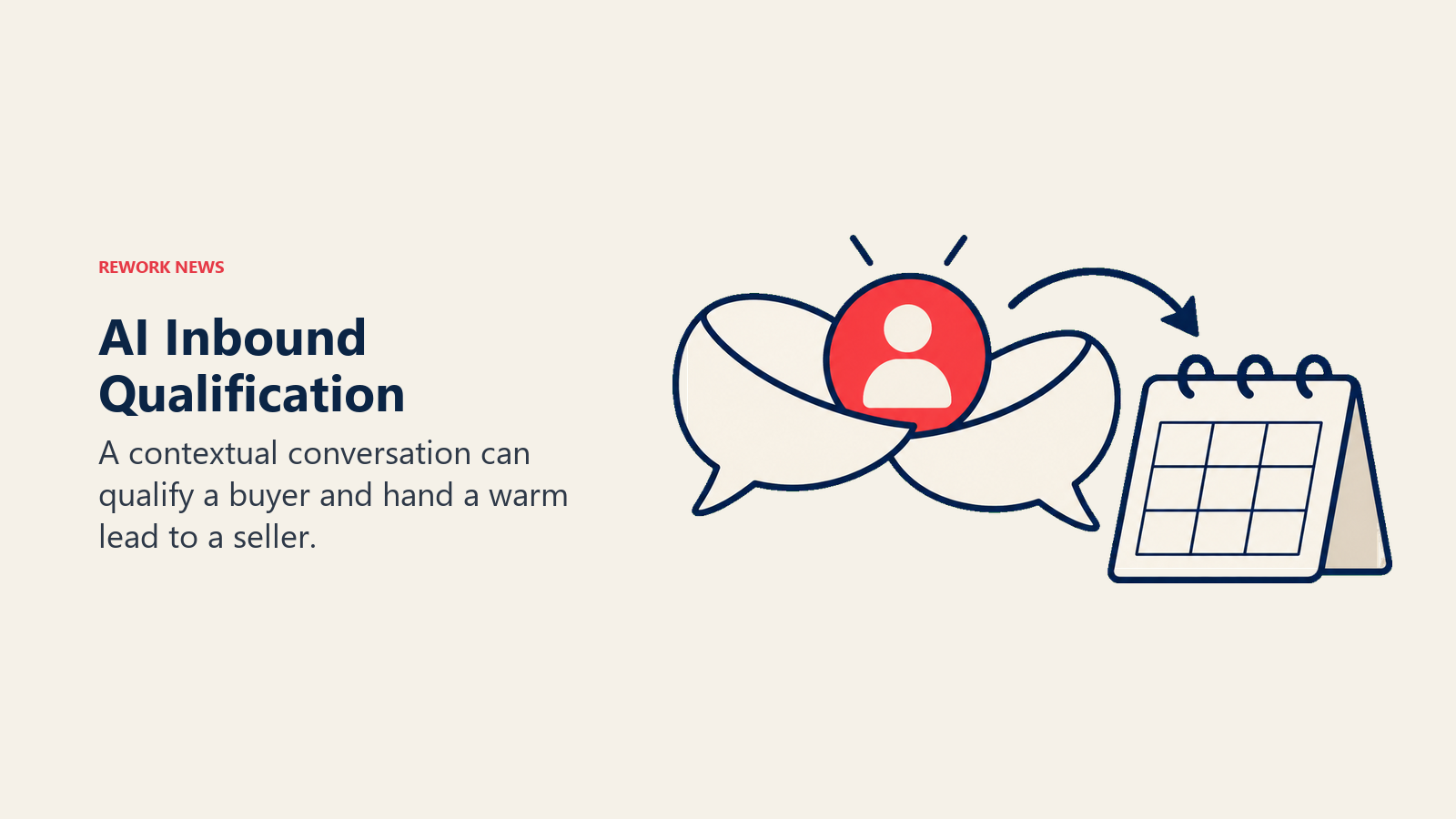
The Customer Engagement Agent in Summer '26 does something structurally different. It holds two-way natural conversations on the website and via email, responds to what the buyer actually says, and makes a qualification decision based on that exchange before handing the lead to a seller. Meta pushes the same capability into messaging, where its Business Agent qualifies leads and closes sales inside WhatsApp, Instagram, and Messenger. That's not a routing layer. That's the first conversation your BDR used to own.
Multi-Agent Orchestration makes it stickier. One agent qualifies, another schedules the meeting, another updates the deal record in Salesforce via Momentum auto-write. The handoff between steps is machine-to-machine. A BDR doesn't touch the workflow until the meeting is on the calendar. For CROs who've watched BDR pipeline coverage erode with headcount churn, the continuity argument is real: an agent doesn't give notice two weeks before a key segment push.
The honest caveat is that two-way natural conversation on complex enterprise deals still hits limits. Buyers with technical questions, procurement edge cases, or a preference for talking to a person will self-select out. The audit below accounts for that. Salesforce later shipped a marketing-cloud counterpart to this sales-cloud agent: agentic marketing agents that qualify inbound leads and run outbound prospecting, which raises a separate question of who owns the agent.
The Three Pricing Models Make Unit Economics the Audit, Not the Feature List
The pricing models force CROs to evaluate cost per qualified action, not just whether the agent feature looks useful in a demo.
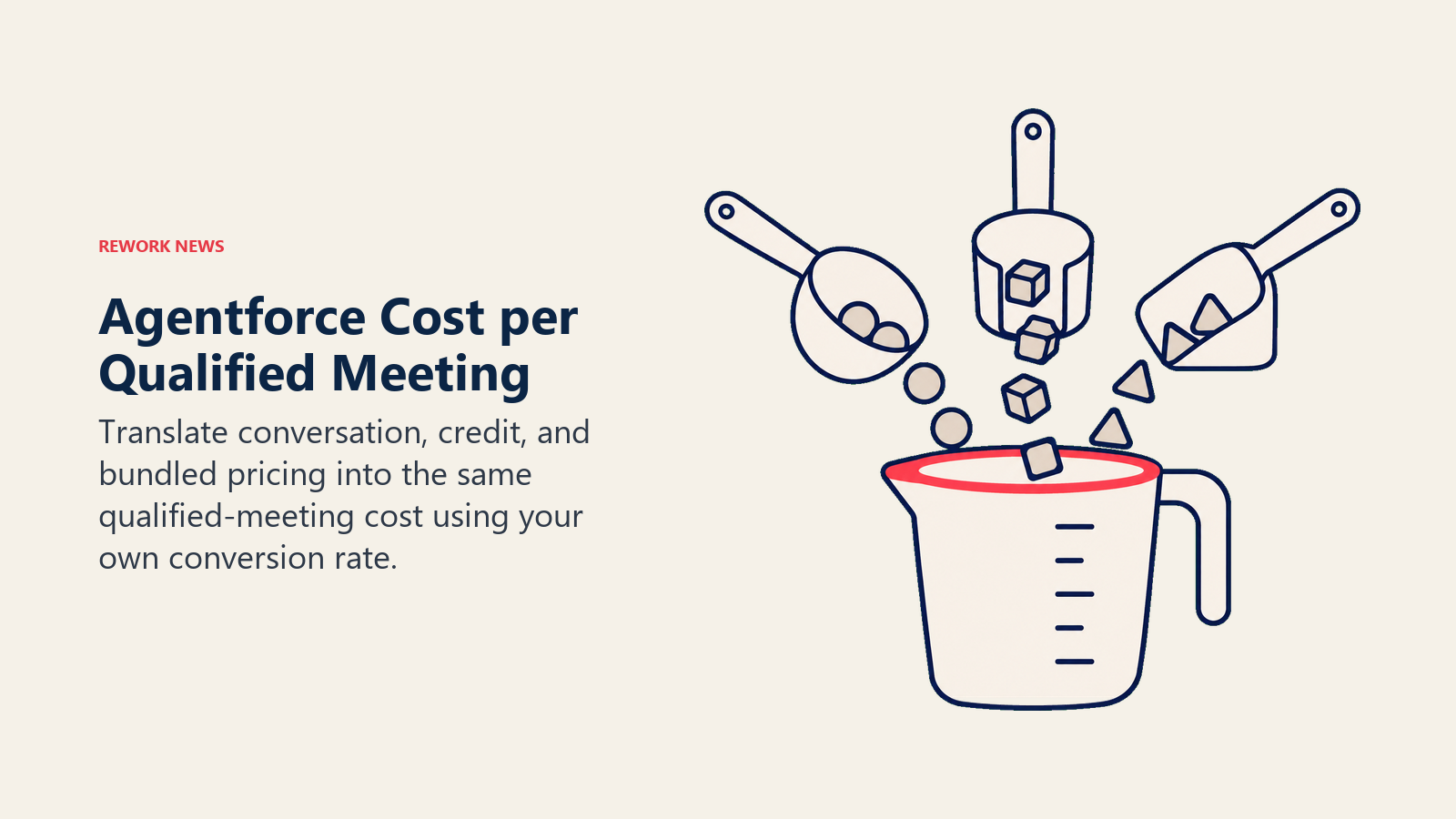
Agentforce currently ships with at least two live pricing structures, with a third emerging pattern that SaaStr's coverage flags as already in market: Conversations ($2 per conversation), Flex Credits ($500 per 100,000 credits, covering customer-facing agents, employee-facing agents, and Agentforce Voice), and a seat-bundled model folded into certain Salesforce product editions.
For CROs, this is the most important paragraph in the release. Three pricing models means three different unit economic calculations, and only one of them will map cleanly onto your current BDR cost structure.
Run the math at your actual inbound volume before you evaluate features. If your team closes 300 qualified meetings per quarter from 6,000 inbound conversations, your conversation-to-qualified rate is 5%. At $2 per conversation under the Conversations model, 6,000 conversations costs $12,000. That's $40 per qualified meeting in agent cost, before Salesforce platform fees. Compare that to a BDR at $90K OTE fully loaded to around $135K, generating 120 qualified meetings per year ($1,125 each). The gap is large. But your job isn't to confirm the gap is large. Your job is to figure out what conversion quality you get at that $40 per meeting and whether the pipeline velocity holds downstream.
Flex Credits shift the math again. At $500 per 100,000 credits, the per-unit cost depends entirely on how many credits each conversation consumes, which varies by workflow complexity and channel. Get that number from your Salesforce AE before you model FY27. The agentforce pricing flex credits structure is designed for teams running multiple agent types (customer-facing, voice, employee-facing) and wanting a single pool to draw from. If you're only running the Customer Engagement Agent, the Conversations model is simpler to audit.
The seat-bundled path is the one to watch for sales ops budget planning. If Agentforce capability is already bundled into your existing Salesforce licenses, the marginal cost per conversation approaches zero and the headcount math shifts dramatically.
The 4-Step CRO Budget Audit
This isn't a feature evaluation. It's a budget allocation decision, and it needs the same rigor you'd apply to any headcount request.
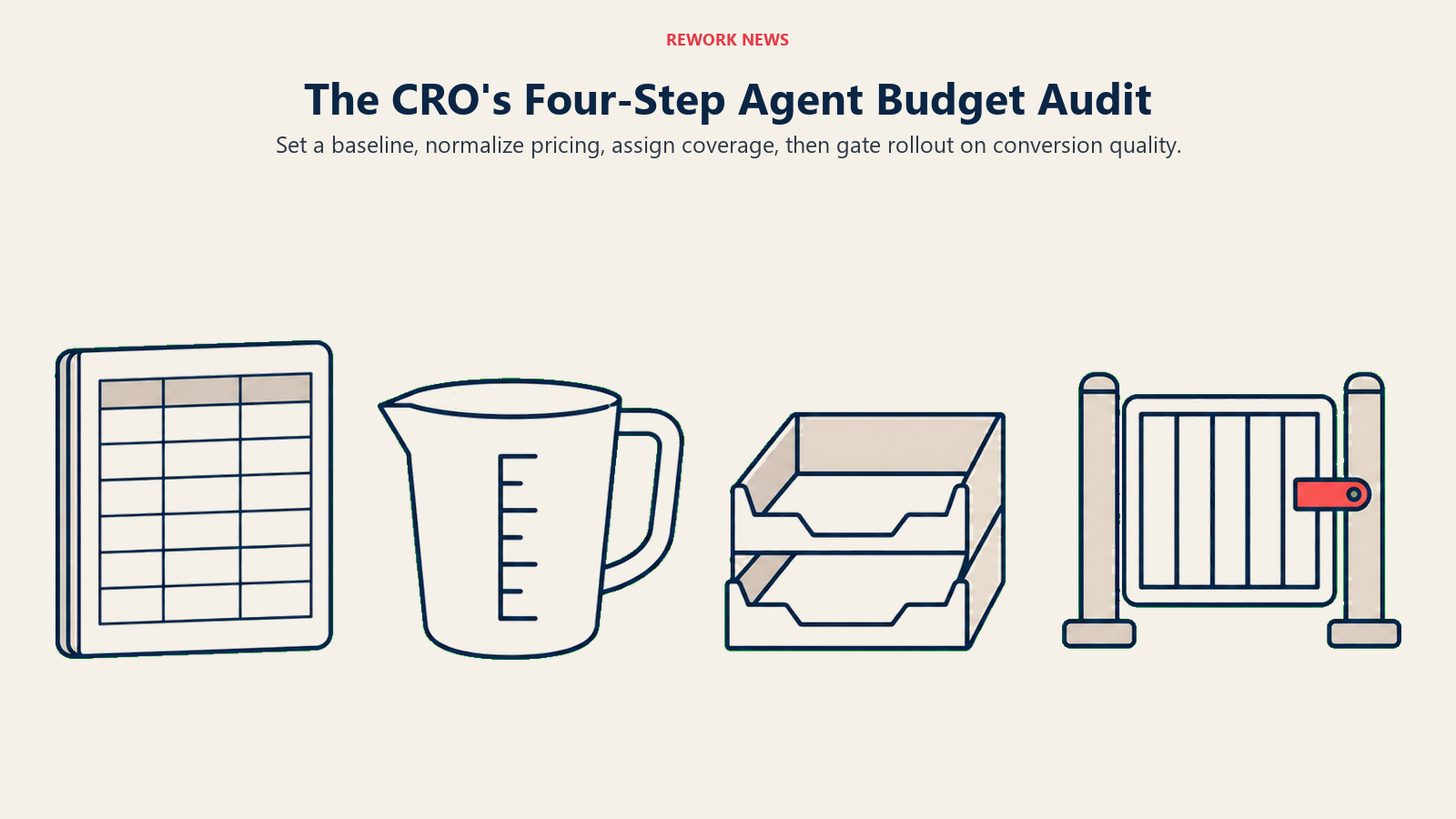
Step 1: Define your cost per qualified meeting target. Pull your current BDR program economics: total fully-loaded cost (base, variable, benefits, tools, management overhead), total qualified meetings generated last four quarters, and the downstream close rate from BDR-sourced pipeline vs. other sources. That gives you your current cost per qualified meeting and your current quality benchmark. Write both numbers down. Everything else in this audit is measured against them.
Step 2: Translate each Agentforce pricing model into that same unit. Use the conversation-to-qualified rate from your own inbound data, not Salesforce's. If you don't have it, tag 500 recent inbound conversations and score them. For most mid-market B2B teams, that rate runs 3-8%. At 5% and the $2 Conversations model: $2 x 20 conversations per qualified meeting = $40. At 2%: $2 x 50 = $100. The rate matters more than the per-conversation price.
Step 3: Define which top-of-funnel workflows the agent takes and which humans keep. Don't try to replace all BDR coverage at once. The highest-ROI agent coverage is typically high-volume, lower-complexity inbound: demo requests, pricing page visits, content download follow-ups. Complex enterprise accounts, competitive displacement deals, and high-ACV named accounts should stay with human BDRs. Segment your inbound by deal size and ICP fit score, then assign coverage accordingly. The ai-assisted lead routing decision is where the structural savings actually live.
Step 4: Gate the rollout on a conversion-quality benchmark before cutting headcount. This is the step most CROs skip in the excitement of the unit economics. Set a downstream benchmark: the agent-qualified meetings should produce pipeline at a close rate within 15% of BDR-sourced pipeline before you declare the model proven. Run the agent in parallel for one full quarter before making any headcount changes. The inbound lead triage at scale framework maps directly to how you'd structure that parallel test.
What Conversion-Quality Benchmark to Set Before Turning It On
The benchmark question is where CROs get burned. They evaluate the agent on cost per conversation and miss the downstream conversion rate.
A qualified meeting from an AI agent and a qualified meeting from a senior BDR are not the same asset until you've proven they convert at comparable rates through your pipeline. Set three benchmarks before go-live: meeting show rate (target within 10% of BDR baseline), stage-2 advance rate (the first real buying signal after discovery), and 90-day pipeline velocity (time from qualified meeting to closed-won or closed-lost).
Run the agent against a control group of BDR-worked inbound for one quarter. Don't blend the pipelines. Track the three metrics separately. If all three come in within 15% of your BDR baseline, the unit economics hold and you have a data-backed case for a structural reallocation in FY27 planning. If one metric lags, you know which part of the handoff process needs work before you make a headcount call.
For teams already tracking AI agents in the sales pipeline, this benchmark approach maps to the same conversion-quality framework. The tooling is different; the measurement logic is the same.
Where Multi-Agent Orchestration Changes the Pipeline-Coverage Equation
Multi-agent orchestration in Salesforce 2026 shifts the ROI conversation from individual task automation to end-to-end workflow coverage. One agent qualifies. A second schedules the meeting and sends confirmation. A third writes the call summary back to the opportunity record via Momentum. A fourth flags deal risk based on engagement patterns.
For CROs, the pipeline-coverage implication is this: orchestration reduces the number of handoffs where deals go dark. Every handoff in a human-run process is a dropout risk. The BDR qualifies but doesn't book the meeting before end of day; the AE doesn't see the CRM note before the discovery call; the deal goes cold between stages because nobody updated the next step. Orchestration compresses those gaps.
Salesforce's own data from the Connectivity Report 2026 projects multi-agent adoption growing 67% by 2027, with unified architecture cited as the differentiating factor. Teams running fragmented single-agent deployments see smaller gains than teams running coordinated agent workflows. That's the orchestration argument in one number.
The practical implication for FY27 planning: budget for orchestration infrastructure, not just a single agent license. The AI sales ops implementation roadmap covers the sequencing logic for teams that want to run orchestrated multi-agent workflows without rebuilding their entire RevOps stack.
What to Do This Week
Before June 15, do three things.
First, pull your inbound conversation-to-qualified meeting rate for the last two quarters. Break it down by source and deal size. This is the denominator that makes or breaks the unit economics calculation. If you don't have it, task your RevOps function with pipeline hygiene work to get it before the Summer '26 launch.
Second, ask your Salesforce AE for the Flex Credits consumption rate per conversation for the Customer Engagement Agent in your use case. The per-credit cost is published; the credits-per-conversation rate isn't. That number determines whether Conversations or Flex Credits is the better model for your inbound volume.
Third, identify the one segment of your inbound where the agent test makes the most sense: high volume, clear ICP fit criteria, lower ACV. Scope a 90-day parallel pilot. The outcome-based pricing and budget frameworks that other CROs have used to evaluate AI tools apply directly here. You want a clean control group before you make any structural claim about agent vs. BDR pipeline quality.
The Summer '26 release is a real capability shift. But the headcount decision it enables is only defensible if you've done the four-step audit first.
Related Reading
- Salesforce Agentforce Hits $800M ARR: What CROs Should Do Next
- Inbound Lead Triage at Scale
- AI Agents in the Sales Pipeline
Frequently Asked Questions
What is the Salesforce Customer Engagement Agent in Summer '26? The Customer Engagement Agent is an AI agent included in Salesforce's Summer '26 release (shipping June 15, 2026) that independently qualifies inbound buyers 24/7 via two-way natural conversations on your website and through email. It holds contextual exchanges with buyers, makes a qualification determination, and hands warm leads off to sellers. It's part of the broader Agentforce platform and works alongside Multi-Agent Orchestration so qualification, scheduling, and CRM write-back can happen without human intervention.
How does Agentforce pricing work for the Customer Engagement Agent? Agentforce currently ships with at least two live pricing models: Conversations, priced at $2 per conversation, and Flex Credits, priced at $500 per 100,000 credits (covering customer-facing agents, employee-facing agents, and Agentforce Voice). SaaStr coverage also identifies a seat-bundled model in certain Salesforce editions. CROs should calculate the cost per qualified meeting under each model using their own conversation-to-qualified rate before choosing a pricing structure. For most mid-market teams, the Conversations model is simpler to audit.
Should CROs cut BDR headcount after enabling the Customer Engagement Agent? Not before a 90-day parallel pilot. The correct sequence is: enable the agent alongside your current BDR coverage, track three conversion-quality benchmarks (meeting show rate, stage-2 advance rate, 90-day pipeline velocity), and compare them to your BDR baseline. If all three come in within 15% of your current numbers, the unit economics support a structural reallocation conversation in FY27 planning. Making headcount changes before that data exists is a one-way door with no conversion-quality proof to back it up.
Source: Salesforce Summer '26 Release Announcement. Pricing analysis from SaaStr. Multi-agent forecast from Salesforce Connectivity Report 2026.

Co-Founder, Rework.com
On this page
- Why This Is Different From the Old SDR Chatbot Pitch
- The Three Pricing Models Make Unit Economics the Audit, Not the Feature List
- The 4-Step CRO Budget Audit
- What Conversion-Quality Benchmark to Set Before Turning It On
- Where Multi-Agent Orchestration Changes the Pipeline-Coverage Equation
- What to Do This Week
- Related Reading
- Frequently Asked Questions