More in
Sales Tech News
AI Sales Teams Grow 2.6x Faster. Gartner Says Buyers Still Want a Rep
Jun 6, 2026
Aircall Bought Piper AI to Turn Every Sales Call Into Pipeline
Jun 6, 2026
Salesforce Just Handed Marketers AI Agents That Build Sales Pipeline
Jun 6, 2026
Revenue Intelligence Showed You the Risk. Revenue Execution Acts on It.
Jun 5, 2026
Meta Put an AI Agent in WhatsApp That Closes Sales for Any Business
Jun 4, 2026
VCs Poured Over $200M Into AI Sales Startups: The GTM Stack Signal
Jun 4, 2026 · Currently reading
Are AI SDRs Worth It in 2026? The Data Says Build a Hybrid Team
Jun 3, 2026
GTM Engineering in 2026: The Sales Hire That Replaces Three Roles
Jun 3, 2026
ZoomInfo Feeds Verified Data to Your AI Sales Agents: The Single-Vendor Tradeoff
Jun 3, 2026
Salesforce Summer '26 Drops Multi-Agent Orchestration June 15. Here's the Sales Ops Audit Before Your Agents Start Handing Off
Jun 2, 2026
VCs Poured Over $200M Into AI Sales Startups: The GTM Stack Signal
Turn this article into takeaways for your work.


Each assistant summarizes the article only for you and suggests best practices for your work.
The venture capital didn't go to "AI features added to existing software." It went to companies building go-to-market (GTM) infrastructure from scratch.
Three rounds closed in quick succession. Monaco raised a $50M Series B led by Benchmark. Netomi closed $110M led by Accenture Ventures. Actively secured a $45M Series B co-led by TCV and First Harmonic. That's over $200M in a matter of weeks, flowing to platforms built entirely around artificial intelligence (AI) agents doing GTM work, not assisting humans doing it.
According to Crunchbase News, sales, marketing, and customer relationship management (CRM) startups have raised roughly $3.7B globally in 2026, with the majority going to AI-focused companies. The pattern is consistent enough to be a signal, not just a trend.
What the Funding Actually Bought
The funding rounds point to different layers of the AI GTM stack rather than one single winner-take-all category.
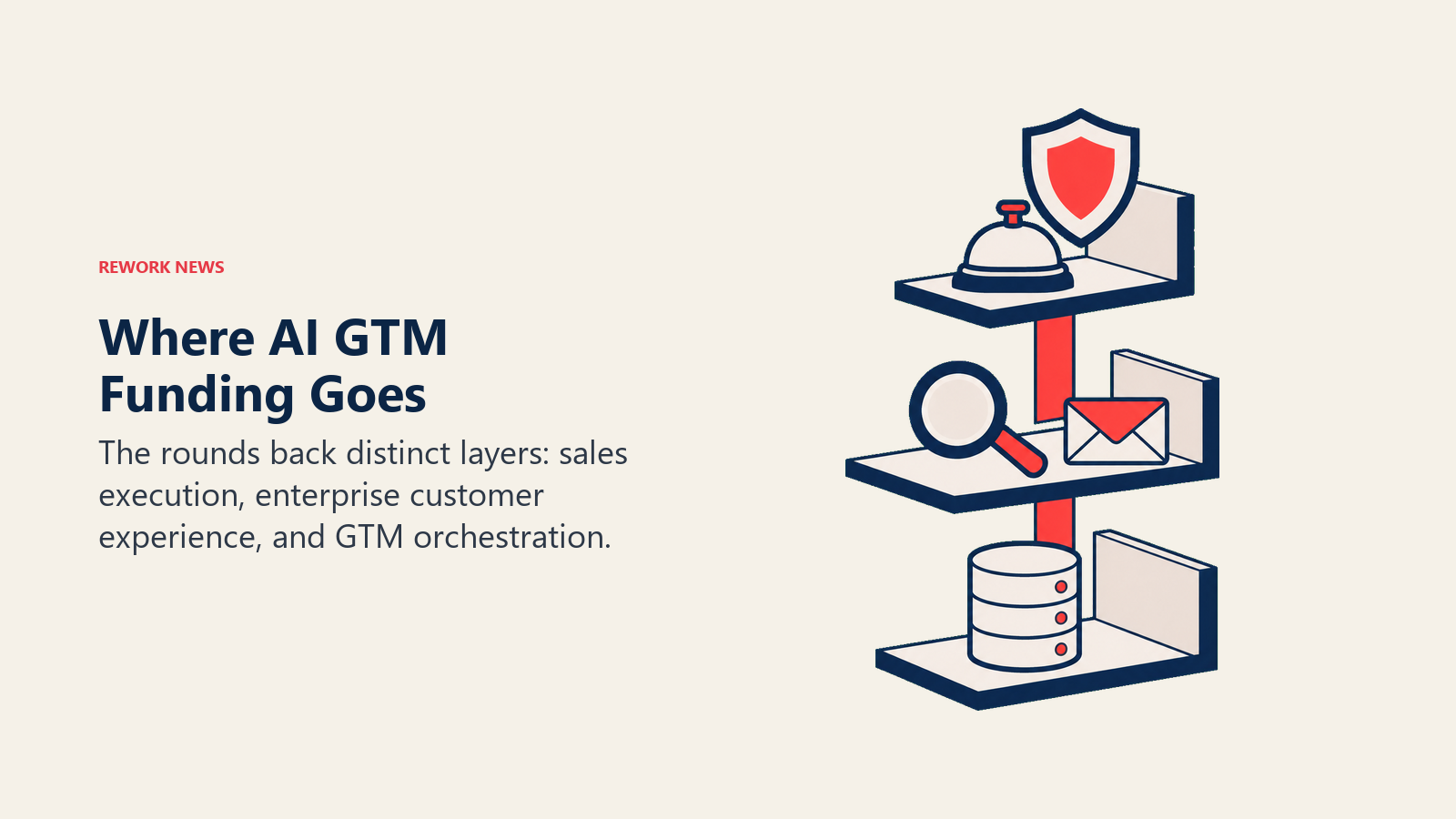
Each round backs a different layer of AI-native GTM infrastructure.
Monaco is the most striking case. It's an AI-native sales platform and CRM built from zero, targeting seed and Series A startups. It has a proprietary prospect database and puts experienced human salespeople in the loop to monitor and guide the AI. When Monaco left stealth in February 2026, it had zero revenue. By April 2026, it had crossed into seven-figure monthly recurring revenue (MRR). The $50M Series B brings its total funding past $85M, all from a standing start in under twelve months.
Netomi's $110M round targets the other end of the market: enterprises in high-stakes, regulated environments. Its agentic customer-experience platform is designed for the kind of compliance-sensitive industries where "just try the AI and see" isn't an option.
Actively, with its $45M Series B, builds agentic AI tools specifically for GTM teams: prospecting, qualification, and outreach work done by agents, not assisted by them.
And while not in the same two-week window, Hightouch's $150M Series D at a $2.75B valuation from Goldman Sachs and Bain Capital Ventures rounds out the picture. Hightouch builds agentic marketing infrastructure, specifically the data and orchestration layer under campaigns.
Key Facts
- Monaco raised a $50M Series B led by Benchmark and went from zero to seven-figure monthly recurring revenue in about eight weeks. (citybiz / TechCrunch, 2026)
- Sales, marketing, and CRM startups have raised roughly $3.7B globally in 2026, most of it into AI-focused companies. (Crunchbase News)
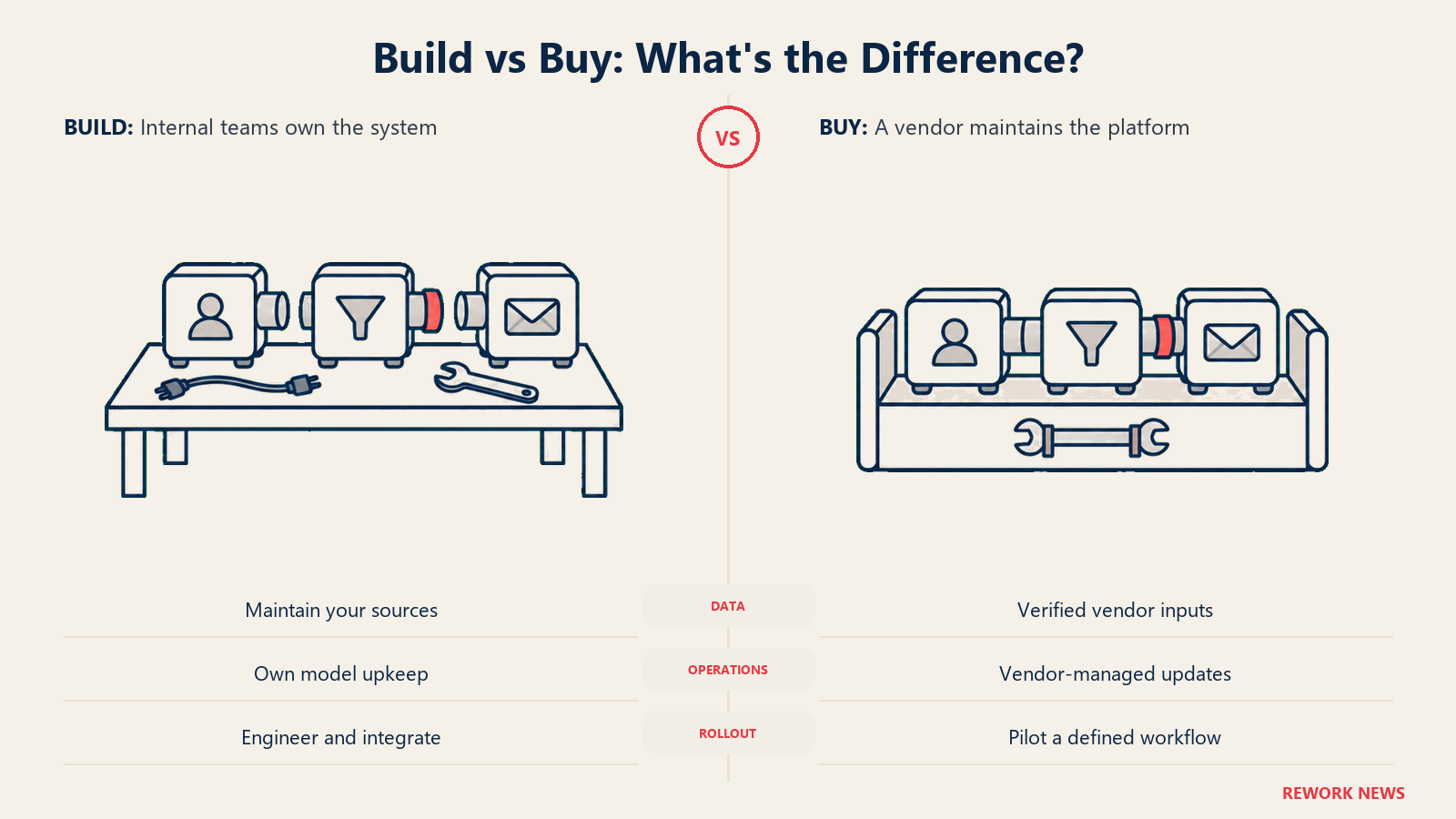
- Specialized, vendor-led AI deployments succeeded about 67% of the time versus about 33% for internal builds. (MIT 2025 GenAI Divide research)
The Build-vs-Buy Signal You Can't Ignore
These rounds are telling you something specific about the GTM software market. They're not funding better AI chatbots layered onto existing workflows. They're funding new workflows with AI at the center and humans in a monitoring role.
That's a distinct architecture from what most sales teams are running today. And it's worth asking what it means for your next CRM or sales engagement renewal.
MIT's 2025 GenAI Divide research (via Fortune) found something counterintuitive: specialized, vendor-led AI deployments succeeded roughly 67% of the time, compared to about 33% for internal builds. More than half of generative-AI budgets went to sales and marketing, but the biggest measured returns came from back-office automation. The lesson isn't that sales AI doesn't work. It's that purpose-built, vendor-managed implementations work about twice as well as homegrown ones.
Monaco's trajectory reinforces this. It didn't win by being cheaper than Salesforce. It won by being purpose-built: a database of prospects it owns and maintains, agents that do the prospecting work, and humans who review and guide what the agents produce. That's a different value proposition from "connect your CRM to an LLM API."
For a sales leader, the real question isn't whether to watch these companies. It's whether your current stack is built on the same underlying principles, or on a different architecture entirely. Compare what these startups have built against the evaluation criteria in AI-native CRM vs Salesforce: how the agent-first architecture changes the comparison.
The AI-Native GTM Test: Three Questions for Your Next Renewal
Here's a framework for evaluating any GTM tool at renewal, whether it's an incumbent or a challenger. Call it the AI-Native GTM Test. Score on three dimensions.
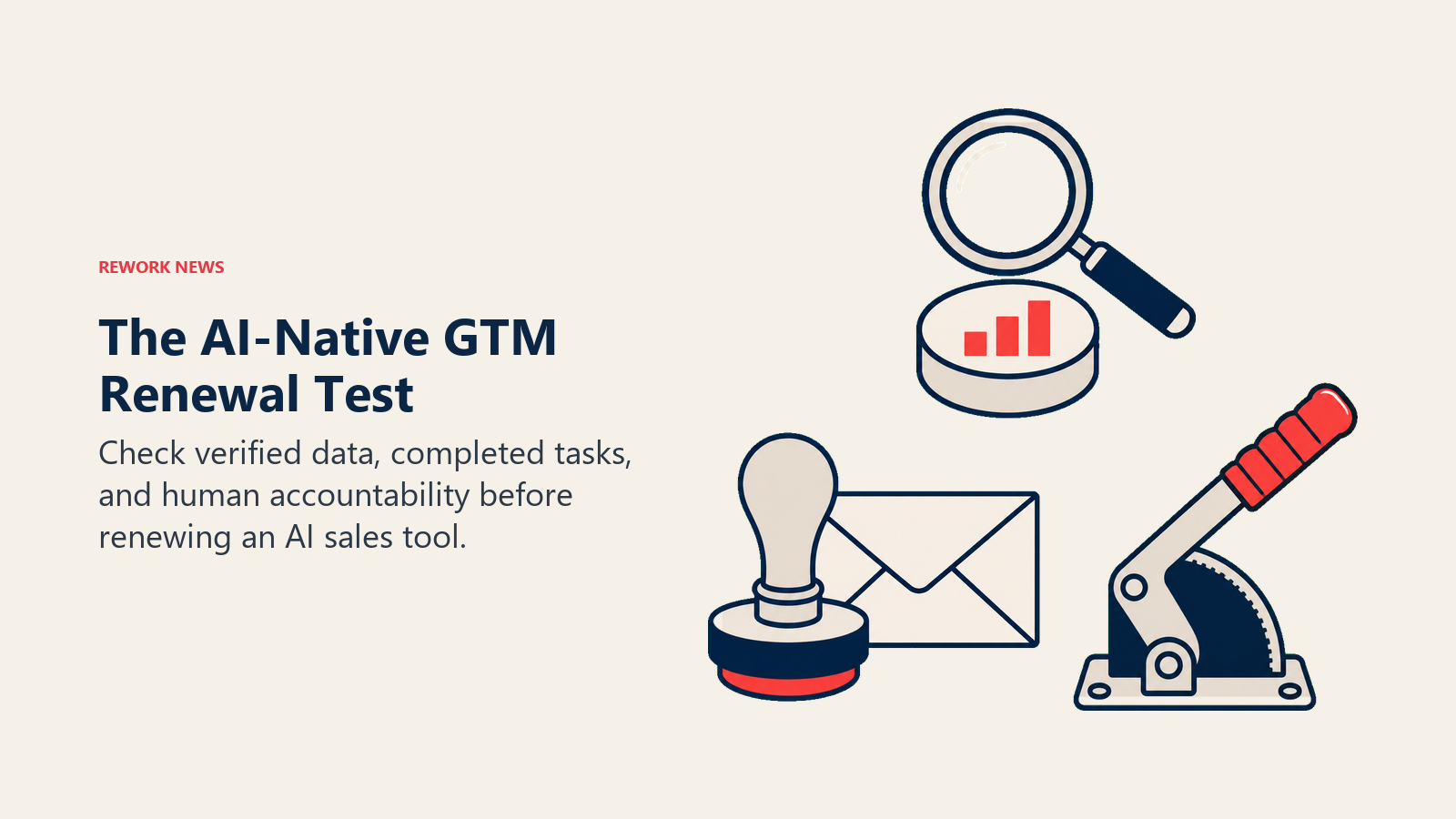
1. Data quality: does it run on proprietary or verified data?
Monaco built its own prospect database. Hightouch is the activation layer on top of your first-party data warehouse. Netomi's agents operate on structured, compliance-reviewed knowledge bases.
Contrast that with a setup where AI agents run on your CRM exports: duplicates, stale contacts, incomplete records. The agent is only as good as what it can read. Tools that own or verify the data layer have a durable advantage. Tools that depend on your data quality inherit your data problems.
Ask your vendor: where does the data come from, and who is responsible for its accuracy?
2. Agency: does the agent complete the task, or just suggest?
The market split is real. Some tools are "AI-assisted": they draft an email, you review and send. Others are "AI-native": the agent researches the prospect, writes the outreach, schedules the follow-up, and logs the activity, with a human reviewing the output rather than generating it.
Monaco's agents do the latter. Actively is built around the same model. The reason Monaco went from zero to seven-figure MRR so fast is that buyers felt the difference immediately: an agent that completes the work versus one that suggests the next step.
At renewal, ask: what does the agent actually do end to end, and what does a human still have to do manually?
3. Human-in-the-loop: who owns quality when the agent gets it wrong?
Monaco keeps experienced salespeople in the loop not as a concession but as a design feature. The agents handle volume; the humans handle judgment. That structure matters because AI agents make mistakes at scale, and when a mistake goes to a thousand prospects at once, the damage compounds.
Ask your vendor: what's the escalation path when an agent produces a bad output? Who reviews before it goes out? And what's the rollback mechanism?
Score any tool on these three. The results will tell you more about renewal risk than any analyst report. For more on where to draw the line between AI-native challengers and legacy CRM layers, see the ROX AI-layer vs replace-CRM evaluation.
The Incumbent Risk Is Real, But It's Not Immediate
Don't read this as "replace your CRM now." Read it as "your CRM is now in a competitive market it wasn't in twelve months ago."
Salesforce and HubSpot aren't standing still. Salesforce's Agentforce is a direct response to the same market pressure. HubSpot's Breeze AI adds agent-like automation to its existing platform. But neither company built its foundation for agentic workflows: they're retrofitting. The question is whether retrofitting fast enough will be sufficient.
The Apollo agentic GTM platform evaluation covers a useful middle case: a platform that started as data/intelligence and is now moving toward full agentic orchestration. It's not AI-native in Monaco's sense, but it's further along the spectrum than a traditional CRM vendor.
For AI-native sales development representative (SDR) tooling specifically, the AI SDR analysis for 2026 covers when the agent model makes financial sense and when it doesn't. The short version: it depends heavily on whether you have clean data and a defined playbook to give the agent.
Sierra's $1.5B raise for customer agents is the enterprise version of the same bet. That analysis at Sierra AI and the $1.5B customer agent bet covers what it means for post-sale GTM.
What to Do Before Your Next Renewal
A four-step checklist that fits any sales stack review:
Run the three-question test on your current stack. Data quality, agency depth, human-in-the-loop design. Score each of your current tools honestly. You're not looking for a reason to switch; you're looking for an accurate picture of where you're exposed.
Pilot one AI-native challenger on a contained workflow. Pick something where you have clear metrics: a specific segment, a defined sequence, a measurable outcome. Monaco's growth suggests buyers validate fast when the agent is working. You'll know within a quarter whether the architecture difference is real for your context.
Insist on vendor-led implementation over a DIY internal build. MIT's data makes this point clearly: about a 2-to-1 success rate difference between vendor-managed and internally built AI deployments. If your team is building custom AI on top of your CRM, that's a red flag worth examining, not a point of pride. It's also why the GTM engineer who replaces three traditional sales hires is in such demand: wiring these systems well takes a dedicated technical owner.
Protect a human-in-the-loop checkpoint. For any agent you deploy at scale, define who reviews output before it reaches customers and what the escalation path is when the agent produces something wrong. This isn't AI skepticism; it's AI operations discipline. The platforms winning funding right now all have this by design.
The capital flowing into AI-native GTM infrastructure isn't predicting the future. It's responding to buyers who are already switching. The $3.7B raised in 2026 reflects revenue that existing platforms are losing, or are at risk of losing. That's the signal worth acting on.
Frequently Asked Questions
What is an AI-native GTM stack?
An AI-native GTM stack is built from the ground up around AI agents completing go-to-market tasks, not assisting humans doing them. The key differences from traditional stacks are: agents run on proprietary or verified data (not your messy CRM exports), they complete work end to end (prospecting, qualifying, outreach, logging), and experienced humans monitor and guide the agents rather than doing the work themselves. Monaco, Netomi, and Actively are examples of companies building this architecture.
Should I replace my CRM with an AI-native sales platform?
Not yet, in most cases. The right move is to run the AI-Native GTM Test on your current stack first (see the three questions above), then pilot one AI-native tool on a contained workflow with clear success metrics. Wholesale replacement carries integration risk and switching cost. A focused pilot gives you real data on whether the architecture difference matters for your specific sales motion before you commit.
Is it better to build AI sales tools internally or buy from a vendor?
MIT's 2025 GenAI Divide research found specialized, vendor-led AI deployments succeeded about 67% of the time, versus about 33% for internal builds. That's roughly a 2-to-1 advantage for buying purpose-built tools over building your own. The main reasons: vendors maintain the data layer, handle model updates, and own the implementation accountability. Internal builds inherit your data quality problems and require ongoing ML engineering capacity most sales teams don't have.
Source: Crunchbase News | TechCrunch, February 2026 | Fortune, 2025 (MIT GenAI Divide)
