More in
Sales Tech News
AI Sales Teams Grow 2.6x Faster. Gartner Says Buyers Still Want a Rep
Jun 6, 2026
Aircall Bought Piper AI to Turn Every Sales Call Into Pipeline
Jun 6, 2026
Salesforce Just Handed Marketers AI Agents That Build Sales Pipeline
Jun 6, 2026 · Currently reading
Revenue Intelligence Showed You the Risk. Revenue Execution Acts on It.
Jun 5, 2026
Meta Put an AI Agent in WhatsApp That Closes Sales for Any Business
Jun 4, 2026
VCs Poured Over $200M Into AI Sales Startups: The GTM Stack Signal
Jun 4, 2026
Are AI SDRs Worth It in 2026? The Data Says Build a Hybrid Team
Jun 3, 2026
GTM Engineering in 2026: The Sales Hire That Replaces Three Roles
Jun 3, 2026
ZoomInfo Feeds Verified Data to Your AI Sales Agents: The Single-Vendor Tradeoff
Jun 3, 2026
Salesforce Summer '26 Drops Multi-Agent Orchestration June 15. Here's the Sales Ops Audit Before Your Agents Start Handing Off
Jun 2, 2026
Salesforce Just Handed Marketers AI Agents That Build Sales Pipeline
Turn this article into takeaways for your work.


Each assistant summarizes the article only for you and suggests best practices for your work.
The job title "Sales Development Representative" just got a lot more complicated to justify.
At Salesforce Connections 2026, its annual marketing conference held June 3-4 at McCormick Place in Chicago, Salesforce announced a suite of AI agents it's calling the "agentic marketing team." The headline capabilities aren't marketing-adjacent anymore. They're core sales development work: qualifying inbound visitors, prospecting new contacts, running email nurture sequences. And they're now generally available inside the marketing cloud, not just the sales cloud.
For a sales leader, this isn't a press release to skim. It's a staffing question, an ownership question, and a handoff question arriving at the same time.
What Salesforce Actually Shipped
According to Salesforce, the suite includes four components at varying availability stages.
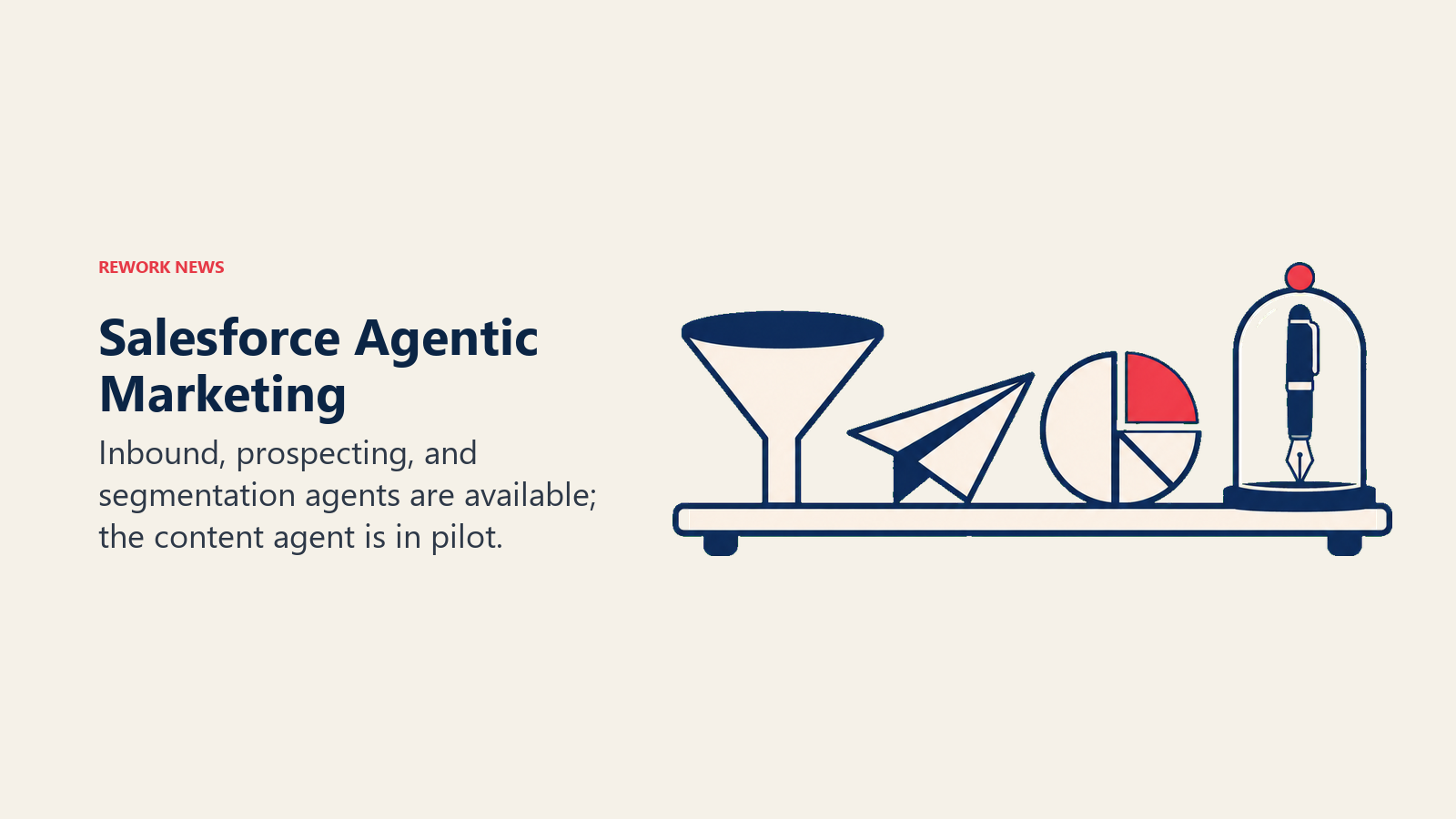
An inbound SDR agent identifies and qualifies website visitors in real time, around the clock. It routes warm prospects to sales automatically, without a human reviewing the queue first. This is generally available now. A separate prospecting agent autonomously discovers new contacts, launches outreach campaigns, and runs email nurture sequences through to a booked meeting or a disqualified lead. Also generally available.
Both agents are built on Qualified's technology. The inbound agent was previously marketed under a product name that overlaps with an unrelated revenue intelligence tool acquired recently by Aircall (covered in a separate article). For clarity here, it's the Salesforce inbound qualification agent. The prospecting agent is marketed as "Hunter." Worth noting as a category label: that's autonomous outbound prospecting running inside a marketing platform.
Two more pieces round out the suite. Agentic Segmentation (generally available) lets marketers build campaign-ready audience segments from natural-language prompts, without SQL or a data engineering queue. An Agentforce Content Agent (in pilot) generates omnichannel content for email, SMS, rich communication services (RCS), and mobile from a campaign description, grounded in brand guidelines.
Context worth keeping: Salesforce reported that its Agentforce business has crossed $1 billion in annual recurring revenue. That's the commercial signal behind the feature velocity.
Key Facts
- Salesforce's Agentforce business has crossed $1B in annual recurring revenue (Salesforce, June 2026)
- The inbound SDR agent and prospecting agent are both generally available, built on Qualified's technology (Salesforce)
- Trade commentators including Salesforce Ben and CX Today have flagged "agent proliferation" as a growing concern as Salesforce adds agents faster than buyers can evaluate them
The Boundary That's Disappearing
The boundary is disappearing because AI agents can qualify, route, and nurture in the space that used to sit between Marketing and Sales.
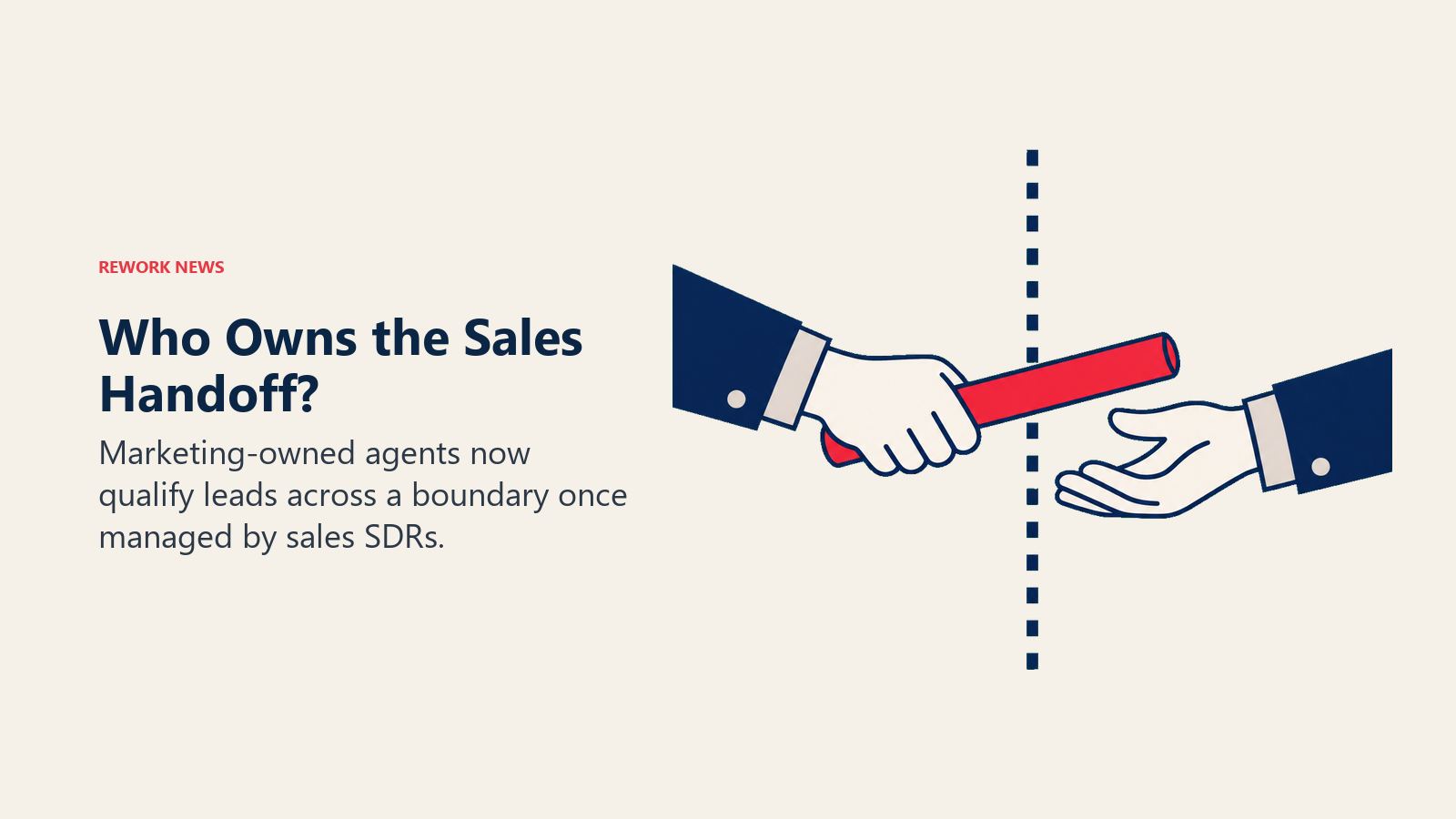
For the last decade, the SDR/BDR function sat firmly in the sales org. Marketing generated awareness and passed marketing qualified leads (MQLs) to sales, which used human SDRs to qualify and convert them to sales qualified leads (SQLs). The MQL-to-SQL handoff was the explicit boundary between two departments, two budgets, and two sets of metrics.
Salesforce just put an agent on both sides of that boundary, and it lives in the marketing cloud.
The agent that qualifies your website visitor isn't reporting to a VP of Sales. It's sitting in the marketing product suite, funded by the marketing budget, configured by marketing ops. The agent running outbound sequences is doing what an SDR would do, but marketing owns it.
What an AI sales operator actually does is worth reading before evaluating whether these agents replace or just augment your current team. The short version: AI agents are strong at high-volume, rules-based tasks at any hour. They're weaker when a buyer is skeptical, off-script, or wants a real conversation before committing.
Salesforce's inbound qualification agent is genuinely strong at speed-to-lead. A buyer shows up at 11pm and gets an immediate, relevant conversation instead of a form and a 48-hour wait. The research on five-minute response SLA is consistent: speed is the biggest driver of inbound conversion. An always-on agent solves that problem.
But when the buyer signals they're comparing you against two competitors or wants to negotiate on the spot, the agent's ceiling appears fast. Most buyers at serious deal sizes still want a human for the real conversation.
The Three Questions You Need to Answer Before Acting
This announcement reopens three decisions that most sales leaders thought they'd already made.
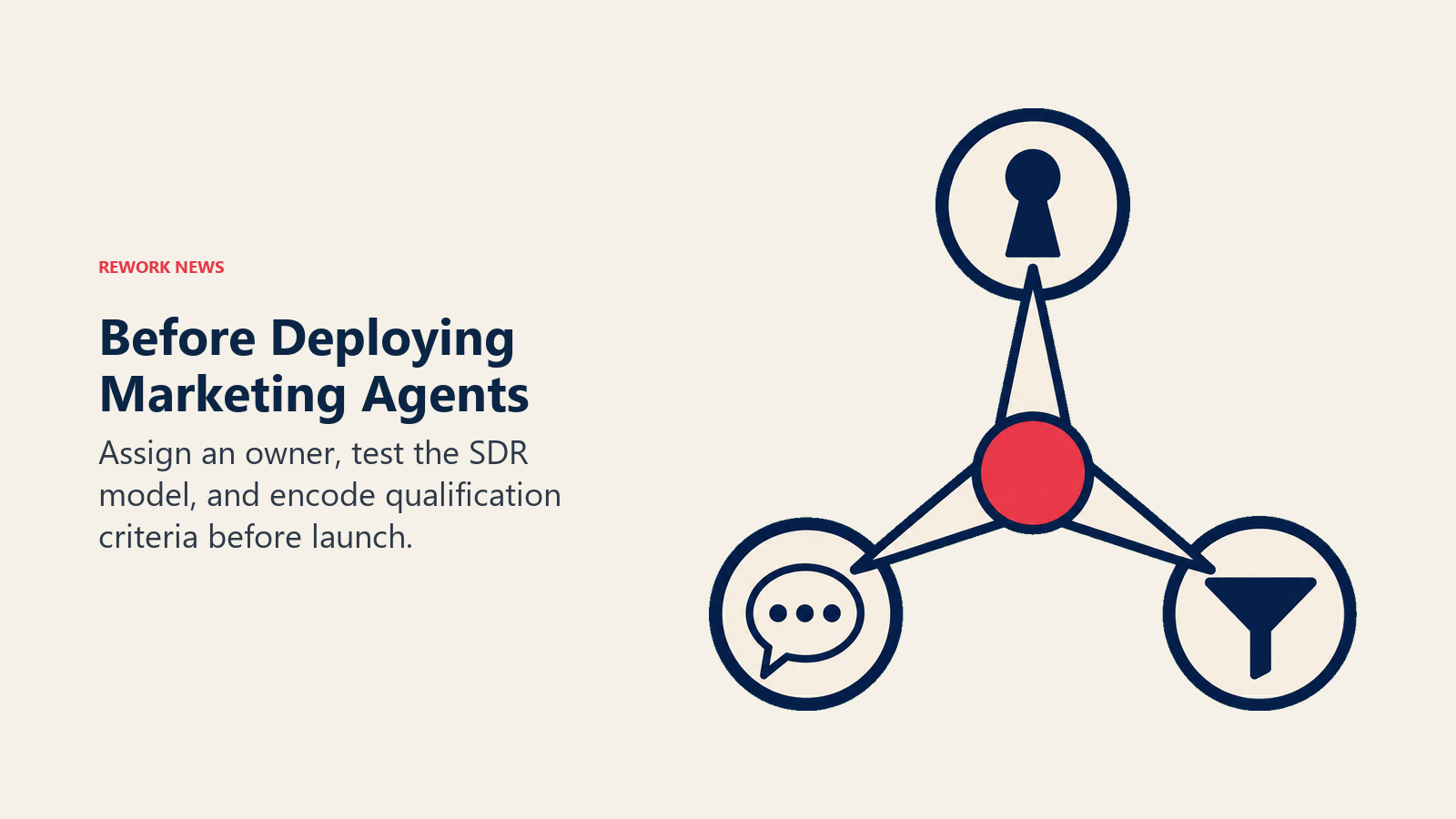
Who owns the agent? If the inbound SDR agent lives in the marketing cloud and marketing's budget funds it, does marketing now own pipeline generation for inbound? Or does sales retain accountability for the outcomes even though it doesn't control the tool? The agent doing both sides of that boundary means the old org-chart logic no longer maps cleanly. You need an explicit owner before the agent goes live, not after the first missed quota conversation.
What does this do to your SDR model? The honest answer is: probably not what the headlines suggest, at least not yet. The AI SDR hybrid model analysis is useful here. The pattern that's emerging in 2026 isn't "replace SDRs with AI." It's "use AI agents for coverage and speed, keep humans for qualification depth and relationship initiation." Cutting SDR headcount on the strength of a generally-available announcement, without a controlled pilot, is the kind of decision that looks decisive and costs you a quarter.
What happens to lead qualification when an agent is doing it? Your BANT or MEDDIC criteria need to be operationalized as agent logic, not just team training. That's a different kind of work. If the agent qualifies on the wrong signals, it's routing the wrong prospects to your AEs and burning their time. Your inbound lead triage process needs to be re-spec'd for agent execution before you hand it off.
A 90-Day Pilot Rubric
Before reorganizing your go-to-market motion around these agents, run a bounded pilot. Here's a practical rubric.
Scope it to one channel. Start with inbound qualification only, on a single high-traffic product page or pricing page. Don't launch the prospecting agent and the inbound agent simultaneously. You won't be able to isolate what's working.
Instrument three metrics. Speed-to-first-engagement (did the agent beat your old response SLA?), conversation-to-MQL rate (is the agent qualifying at the same threshold a human would?), and MQL-to-meeting rate (are the leads it passes actually converting downstream?). If you don't have baseline numbers for all three before you start, the pilot won't tell you anything useful.
Define ownership in writing. Who reviews agent conversation logs weekly? Who updates the qualification criteria when they drift? Who escalates when an agent mishandles a high-value prospect? These aren't edge cases. Write them down before day one.
Ninety days gives you enough data to see conversion rates stabilize and enough incident history to know where the agent fails. Then make the staffing and budget decision with evidence, not assumptions.
The Agent Proliferation Problem
There's a legitimate concern in the trade commentary worth surfacing.
Salesforce has been adding agents at a pace that's difficult to evaluate. Commentators at Salesforce Ben and CX Today have flagged the pattern: each announcement introduces a new named agent, and buyers are expected to configure, govern, and integrate the full list. From this event alone: the inbound qualification agent, the prospecting agent, Agentic Segmentation, and the content agent are all live or in pilot.
The risk for a sales leader isn't that any individual agent fails. It's that you end up with five agents each doing 70% of a job, governed by different teams, generating five separate data streams, and nobody has a clear picture of top-of-funnel performance.
The Salesforce Agentforce $1.2B ARR audit covers the governance and ROI questions in more depth. The short version: the commercial traction is real, but the governance discipline required to get value from a multi-agent stack is not trivial. And the Salesforce Summer '26 customer engagement agent announced separately was a sales cloud agent for inbound. This announcement is the marketing cloud version. If you're running both Salesforce Marketing Cloud and Sales Cloud, you may now have two inbound qualification agents in the same org, with different owners and different handoff logic. That's worth resolving before both are live.
What to Do Right Now
Don't cut SDR headcount. Don't expand it either. Here's what actually moves the needle in the next 30 days.
Pull your current inbound lead conversion data: time from form fill to first human contact, MQL-to-SQL conversion rate, speed-to-lead by time of day. These are your baselines. Without them, you can't evaluate whether an agent outperforms or just looks faster in a demo.
Get a scoped demo that shows the inbound qualification agent handling a skeptical visitor and a competitor-comparing visitor, not just an easy inbound inquiry. Those edge cases reveal the ceiling.
Settle the ownership question with your marketing counterpart before any procurement conversation. "Who owns the agent" should be answered before "should we buy it." And if your org already has data on AI's revenue impact from the Gartner research covered in our earlier piece, now is the time to map that against where Salesforce's agents sit in your funnel.
The broader pattern is clear: AI-generated personalized outreach at scale is becoming table stakes. The question now is whether you get there through a focused point solution or a platform that bundles outreach, segmentation, and content generation. Salesforce just made that choice more concrete. A concrete option isn't the same as a proven choice for your funnel.
Frequently Asked Questions
Does this mean marketing now owns SDR functions? Not automatically, but it creates the conditions for that shift. The inbound SDR agent and prospecting agent live in the marketing cloud, so marketing can fund and configure pipeline-generating activity without sales involvement. Whether that's an opportunity or a coordination problem depends on how clearly your two functions have defined pipeline ownership. Most orgs haven't made that explicit at the agent level.
Should I start cutting SDR headcount now? No. Pilot first, then decide. Run a scoped inbound use case for 90 days, measure it against your current SDR baseline, and make the headcount call with real data. Agents cover speed and always-on capacity well. Humans still win at navigating skeptical buyers and enterprise discovery.
What's the risk of moving too slowly on this? Speed-to-lead is a real competitive variable. If a competitor deploys an always-on qualification agent and you don't, buyers who arrive at 8pm may be farther down a competitor's funnel by morning. But deploying an agent with poorly defined criteria or unclear ownership creates a different risk: unqualified leads routed to AEs, wasted rep time, and a governance mess that's expensive to unwind. Scoped and measured beats fast and sloppy.
Learn More
- What is an AI sales operator
- Inbound lead triage at scale
- AI-generated personalized outreach
- AI sales operator vs. sales engagement platform
- Lead qualification frameworks
- MQL-to-SQL handoff process
- Marketing and sales alignment
- AI SDR: is it worth it in 2026?
- Salesforce Agentforce $1.2B ARR: CRO audit
- Gartner AI next-best-action: 2.6x sales growth
- Salesforce Summer '26 customer engagement agent (sales cloud). That was the sales cloud inbound agent; this article covers the marketing cloud version
Source: Salesforce Connections 2026: Agentic Marketing Teams Announcement - Salesforce, June 2026. Trade context: Salesforce Ben, CX Today.
