More in
Sales Tech News
AI Sales Teams Grow 2.6x Faster. Gartner Says Buyers Still Want a Rep
Jun 6, 2026
Aircall Bought Piper AI to Turn Every Sales Call Into Pipeline
Jun 6, 2026
Salesforce Just Handed Marketers AI Agents That Build Sales Pipeline
Jun 6, 2026
Revenue Intelligence Showed You the Risk. Revenue Execution Acts on It.
Jun 5, 2026
Meta Put an AI Agent in WhatsApp That Closes Sales for Any Business
Jun 4, 2026
VCs Poured Over $200M Into AI Sales Startups: The GTM Stack Signal
Jun 4, 2026
Are AI SDRs Worth It in 2026? The Data Says Build a Hybrid Team
Jun 3, 2026
GTM Engineering in 2026: The Sales Hire That Replaces Three Roles
Jun 3, 2026
ZoomInfo Feeds Verified Data to Your AI Sales Agents: The Single-Vendor Tradeoff
Jun 3, 2026
Salesforce Summer '26 Drops Multi-Agent Orchestration June 15. Here's the Sales Ops Audit Before Your Agents Start Handing Off
Jun 2, 2026
Salesforce Says 87% of Sales Teams Now Use AI. The Real Sales Ops Number Is the 34% Research Cut
Turn this article into takeaways for your work.


Each assistant summarizes the article only for you and suggests best practices for your work.
The headline number is 87%. The operational number is 34%. And for sales operations (Sales Ops) professionals, only one of them actually tells you whether your artificial intelligence (AI) investment is working.
Salesforce published its State of Sales 2026 report, surveying more than 4,000 sales professionals across multiple regions. The announcement leads with the adoption headline: 87% of sales organizations currently use some form of AI. But buried in the same data, sellers say fully implemented AI agents will cut prospect research time by 34% and email drafting time by 36%. That second number is the one Sales Ops should be tracking, because it's the only one tied to an actual business outcome.
The gap between "we use AI" and "we measured what AI did to our research cycle" is where most sales organizations live right now. Closing that gap is the Sales Ops job.
What Salesforce Actually Reported
The Salesforce State of Sales 2026 report, detailed further in Salesforce's 40 Sales Statistics for 2026, covers a range of signals from the 4,000-plus professionals surveyed.
On adoption: 87% of sales organizations now use some form of AI across the sales cycle, spanning prospecting, forecasting, lead scoring, and email drafting. The same percentage of sellers say AI makes their day-to-day work less stressful. On agents specifically: 54% of sellers have used AI agents already, and nearly nine in ten plan to be using them by 2027.
The productivity data is where the report shifts from survey sentiment to something closer to operational measurement. Sellers expect fully deployed AI agents to cut prospect research time by 34% and email drafting time by 36%. And among sales leaders who have already deployed AI agents, 94% call them critical for meeting current business demands.
Key Facts
- 87% of sales organizations currently use some form of AI (Salesforce State of Sales 2026, 4,000+ respondents)
- 54% of sellers have used AI agents; nearly 9 in 10 plan to by 2027 (Salesforce State of Sales 2026)
- Sellers expect fully implemented AI agents to cut prospect research time by 34% and email drafting time by 36% (Salesforce State of Sales 2026)
Those are the numbers the report surfaces. What the report doesn't do, and what Sales Ops has to do, is test whether any of them are true inside your own customer relationship management (CRM) system.
Why "87% Adoption" Is a Vanity Number for Sales Ops
The 87% adoption figure means something. But it doesn't mean what the headline implies.
"Uses some form of AI" is a binary measure. An organization that has enabled one Einstein email-draft suggestion in Salesforce counts the same as an organization that has a fully deployed forecasting agent running on live pipeline data. Both check the box. Neither outcome is the same.
Adoption is binary. Productivity is continuous. Sales Ops doesn't get paid to count the organizations using AI. It gets paid to measure what AI is doing to quota attainment, cycle time, pipeline conversion, and rep capacity.
The 87% number is useful for vendor narratives and investor calls. It tells Sales Ops almost nothing about where AI is actually creating value inside your team's workflow. The number that does that is 34%, and even that number carries a qualification: "once fully implemented." Which means the reduction isn't guaranteed. It's a ceiling, not a floor.
The Operational Number Is 34% -- But Only If You Can Measure It
The productivity claim is useful only if Sales Ops can instrument the before-and-after workflow rather than accepting the headline metric.
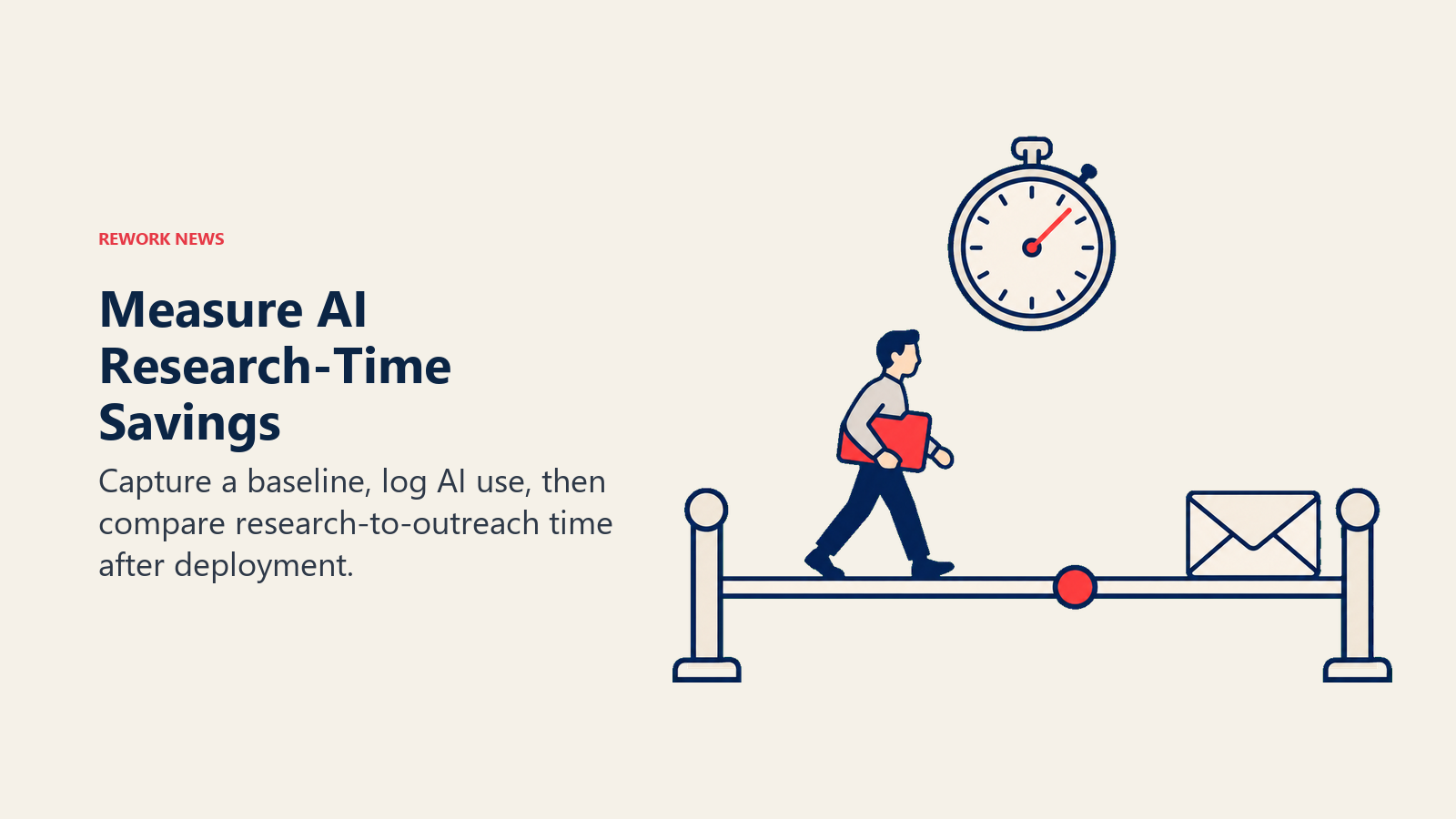
Think about what a 34% reduction in prospect research time actually looks like at the rep level. A sales development representative (SDR) who was spending 45 minutes researching an account before first outreach, pulling from LinkedIn, the company website, recent news, and CRM history, would theoretically spend about 30 minutes on the same account with AI assistance. That's 15 minutes back per account.
If that SDR runs 10 research cycles a day, that's 150 minutes, or 2.5 hours, of daily capacity freed up. Over a quarter, that's a meaningful number. But none of it shows up in your forecast or your capacity plan unless you measured the 45-minute baseline before you deployed the AI.
That's the measurement problem Sales Ops needs to solve. Most organizations don't have a pre-AI research-time baseline. They know reps are spending time on research. They don't know exactly how much, or how it varies by account type, territory, or rep. Without that baseline, the 34% projection from the Salesforce report is an external benchmark you can't compare against your own data.
Here's how to build the measurement:
Baseline first. Before expanding AI tool access, run a time-audit on a sample of reps for two weeks. Track research time per account by stage and account type. Even a rough log in a shared sheet gives you a reference point.
Instrument the AI-assisted workflow. When you roll out the AI research tool, define what "AI-assisted research" looks like in your CRM. Log the tool-usage event. If the platform doesn't emit that event automatically, create a simple rep-logged checkbox that triggers on first outreach. You need a clear before/after split in the data.
Attribute the savings. Time-to-first-contact is a proxy you can pull from your CRM without asking reps to self-report. If AI-assisted research is working, that metric should compress. So should research-to-outreach cycle time. Pair those with rep-level activity data and you get a picture that's actually comparable to the Salesforce benchmark.
If you can't run this measurement, the 34% figure is still useful, as a budget justification and a target. But it shouldn't go into a business case as a projected outcome until you have your own baseline.
The Sales Ops AI Adoption Audit (5 Questions)
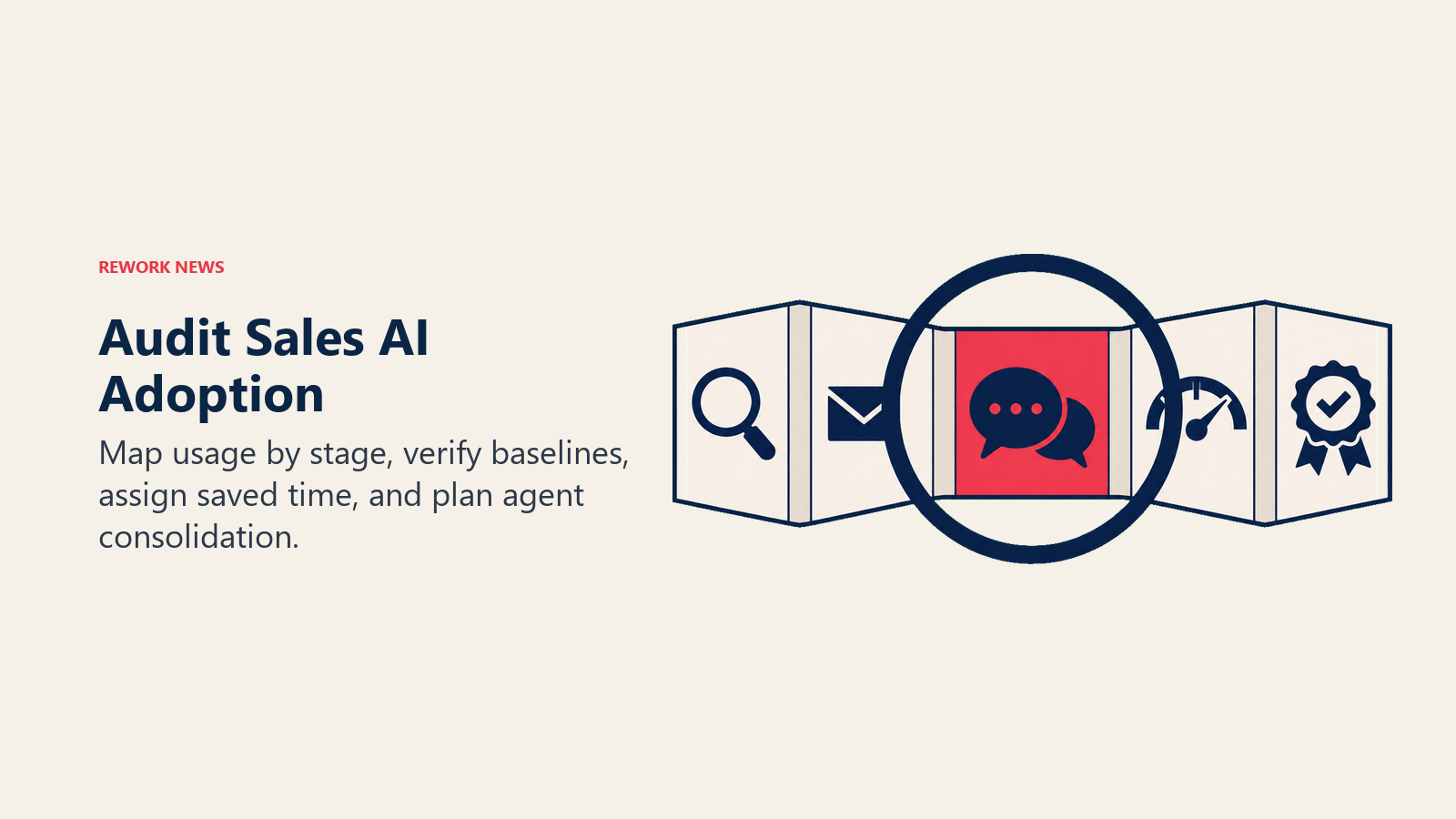
Before your team reports AI adoption numbers upward, or before you approve the next agent license expansion, run this audit. We call it the Sales Ops AI Adoption Audit.
Question 1: Where is AI actually being used?
Map current AI usage by stage: prospecting, outreach, discovery, forecasting, and close. Which stages have active tool deployments? Which ones have licenses that aren't being used? Adoption rates that aren't stage-mapped tell you nothing about where value is or isn't accruing.
Question 2: What is the baseline time being replaced?
For each AI-assisted task, do you have pre-AI time data? If not, you can't claim savings. Set up a 30-day baseline measurement for any AI deployment that's still in early rollout. This is non-negotiable if you want defensible ROI numbers.
Question 3: Who owns the time-saved-versus-quota equation?
When reps get 34% of their research time back, where does that time go? More calls? More deals in flight? More administrative cleanup? Or does it just become unstructured slack? Sales Ops should define the productivity reinvestment expectation before the AI tool goes live. Otherwise the productivity gain disappears into the noise of an unmanaged workday.
Question 4: Are we double-counting agent and non-agent AI?
The Salesforce report says 54% of sellers have used AI agents. That means the remaining 33% who are counted in the 87% adoption figure are using non-agent AI, things like Einstein suggestions, AI-assisted email templates, or predictive scoring. These are not the same capability, and they don't produce the same outcomes. If your internal adoption report lumps both categories together, you're measuring a mixed signal.
Question 5: What is our plan if nine in ten sellers use agents by 2027?
The 2027 projection is 18 months out. If your organization's agent adoption goes from 54% to 90%, that's a stack consolidation event. Redundant point tools, overlapping licenses, and training gaps all surface at scale. Sales Ops should be building the consolidation plan now, not waiting for the 90% to arrive and then reacting.
Frequently Asked Questions
What does the Salesforce State of Sales 2026 report actually say about AI?
The report, based on a survey of more than 4,000 sales professionals, found that 87% of sales organizations currently use some form of AI, and the same percentage of sellers say AI reduces job stress. On AI agents specifically, 54% of sellers have used them and nearly nine in ten plan to by 2027. The productivity projection most relevant to Sales Ops is that fully implemented AI agents are expected to cut prospect research time by 34% and email drafting time by 36%.
Is the 87% AI-adoption figure a reliable number for internal benchmarking?
It's a directional signal, not a precise benchmark for your own operation. The figure captures organizations using "some form of AI," which ranges from a single AI-assisted feature to fully deployed multi-agent pipelines. The more useful internal benchmark is your own stage-by-stage adoption map. Build that before comparing your numbers to the Salesforce survey.
How should Sales Ops measure the 34% research-time reduction from the Salesforce report?
Start with a baseline. Run a two-week time audit on a sample of reps to capture current research time per account. Then instrument your AI-assisted research workflow so CRM logs the tool-usage event. After 30 to 60 days of AI-assisted operation, compare average research-to-outreach cycle time against the baseline. Time-to-first-contact is a CRM-native proxy that doesn't require rep self-reporting. Without a baseline, the 34% projection is a target, not a verified outcome.
What Sales Ops Should Do This Week
Pull your internal adoption map by stage. Don't report a single adoption percentage. Segment it by prospecting, outreach, discovery, forecasting, and close. That map shows where AI is actually embedded versus where it's just licensed.
Start the baseline measurement for any recent AI deployment. If you've rolled out an AI research or email tool in the last 90 days without a pre-deployment time baseline, start the measurement now. A two-week rep time-log is enough to establish a reference point.
Define how the 34% gets reinvested. Before the next agent license renewal conversation, write down what the expected use of freed-up research time is. More calls? Deeper discovery? Larger territory coverage? Anchor it. Otherwise the productivity gain has no accountability target.
Learn More
- What is an AI Sales Operator: 4 patterns shaping modern Sales Ops
- AI Sales Ops vendor landscape 2026: tools, agents, and platform picks
- AI account research before first touch: what actually works
- Salesforce Agentforce as a coworker: what Sales Ops needs to know
- Enterprises miss revenue targets despite AI spend: the data problem

On this page
- What Salesforce Actually Reported
- Why "87% Adoption" Is a Vanity Number for Sales Ops
- The Operational Number Is 34% -- But Only If You Can Measure It
- The Sales Ops AI Adoption Audit (5 Questions)
- Frequently Asked Questions
- What does the Salesforce State of Sales 2026 report actually say about AI?
- Is the 87% AI-adoption figure a reliable number for internal benchmarking?
- How should Sales Ops measure the 34% research-time reduction from the Salesforce report?
- What Sales Ops Should Do This Week
- Learn More