Professional Referral Exchange: Building Reciprocal Patient Referral Systems
Turn this article into takeaways for your work.


Each assistant summarizes the article only for you and suggests best practices for your work.
Every practice has providers they refer to. But how many of those relationships are truly reciprocal? If you're sending 10 patients a month to a specialist and receiving 2 in return, that's not a partnership. It's a one-sided dependency.
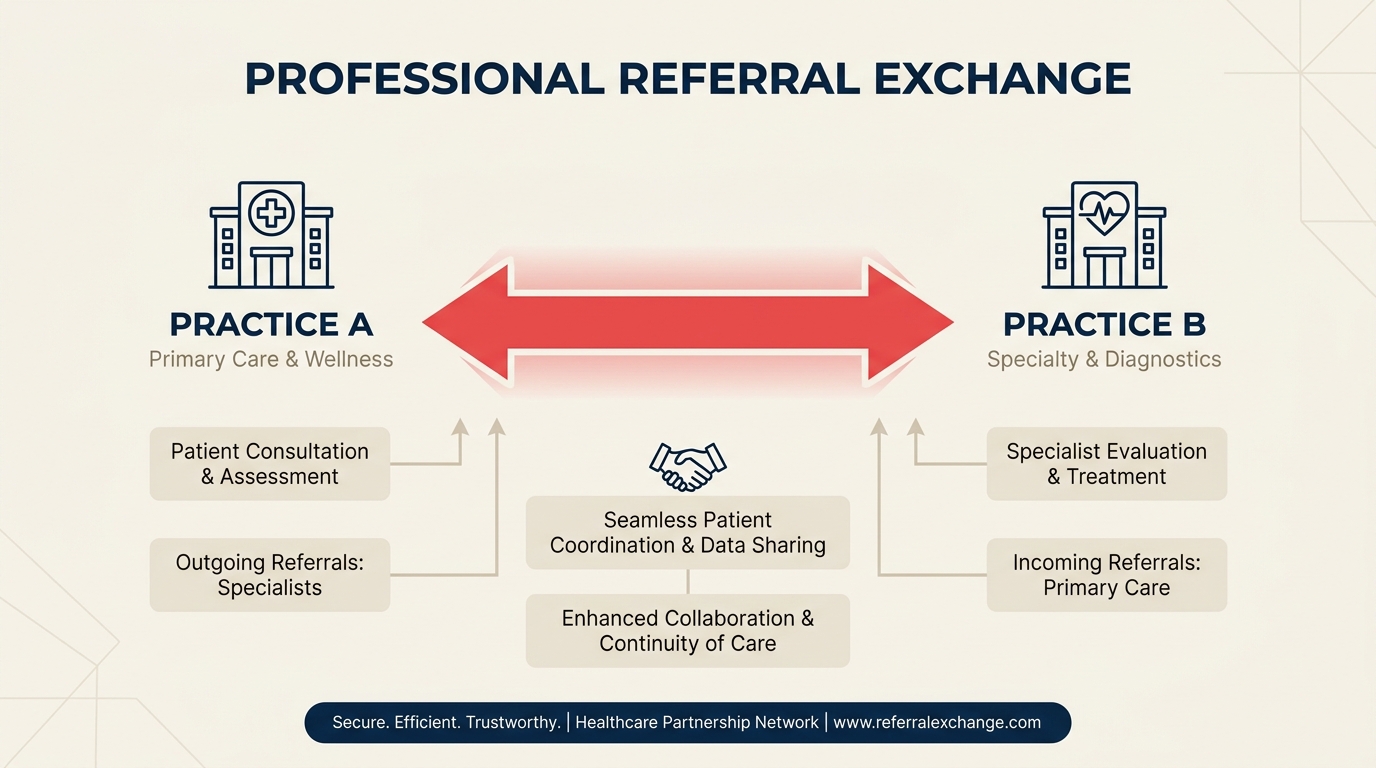
A professional referral exchange is a structured, mutual referral relationship where both parties systematically send appropriate patients to each other. It turns informal gestures into reliable, trackable systems that benefit both practices and, more importantly, serve patients better through coordinated care.
This isn't about artificial reciprocity or transactional arrangements. It's about building genuine clinical partnerships where the patient routing happens because it's the right care match, and where both practices invest in making the relationship work.
The Difference Between Referrals and a Referral Exchange
Most practices have referral relationships that work in one direction. You refer to someone because they're good. If they happen to send patients back, great. But there's no explicit structure, no tracking, and no accountability.
A referral exchange is different in three ways.
It's explicit. Both parties agree to maintain a mutual referral relationship, understand each other's patient profiles and service capabilities, and actively look for appropriate referral opportunities.
It's tracked. Both practices monitor referral volume to and from each partner. When volume drops on one side, someone asks why and addresses it.
It involves investment. Both parties spend time educating each other's staff about the right referral triggers, communicating about patient outcomes, and resolving problems when handoffs don't go smoothly.
That investment is what makes a referral exchange durable rather than one that fades after the initial enthusiasm.
Identifying Exchange Partners
The right referral exchange partners have complementary, non-competing patient bases. You're serving the same general population with different services, so routing between practices naturally makes clinical sense.
Classic healthcare exchange pairs:
- Primary care and all specialties (family medicine, internal medicine with cardiology, endocrinology, orthopedics)
- Dentistry and sleep medicine (sleep apnea, TMJ)
- Physical therapy and orthopedics or sports medicine
- Mental health and primary care, OB/GYN, or pain management
- Nutrition and endocrinology or primary care managing metabolic conditions
- Pediatric dentistry and pediatric medicine
- Chiropractic and physical therapy or sports medicine (where services are complementary rather than competing)
Less obvious but valuable exchange pairs:
- Occupational therapy and geriatric care
- Speech-language pathology and ENT or neurology
- Podiatry and endocrinology (diabetic foot care)
- Ophthalmology and primary care (diabetic eye screening)
The test for a good exchange partner is whether you can honestly say, "When my patient needs X, this is genuinely the best place for them." That clinical integrity is what makes the relationship sustainable.
Establishing the Exchange Structure
A good referral exchange starts with a conversation about expectations, not with a formal contract. Contracts can create legal complications; mutual understanding creates alignment.
Initial partnership conversation
Meet with the target provider (not just their office manager) for 30-60 minutes. Cover:
- Each practice's patient profile: who you see, what conditions are most common, what insurance you accept
- Clear referral triggers: what makes one of your patients appropriate for them, and vice versa
- Operational details: referral process, expected response time, who calls whom when there's a question
- Communication preferences for sharing patient information (HIPAA-compliant methods, urgency levels)
- Mutual expectations: approximate volume expectations, how often you'll touch base on the relationship
This conversation builds the shared understanding that makes day-to-day referral exchange work.
Referral process design
Every referral should have a clear process on both ends. For outgoing referrals:
- Who in your practice initiates the referral (provider vs. front desk vs. nurse)
- What information goes with the referral (clinical notes, insurance info, urgency level)
- How the patient is prepared (who explains why they're being referred, what to expect)
- How you track that the referral was received and an appointment was made
For incoming referrals:
- How quickly your team contacts the referred patient
- What you communicate back to the referring practice about the appointment
- How and when you send clinical notes back to the referring provider
- Process for urgent referrals vs. routine ones
The practices that lose referral exchange partners most often do so through sloppy execution on incoming referrals. The partner sends a patient, never hears what happened, and eventually stops sending.
First contact process quality for referred patients matters even more than for direct-source patients. Referred patients come in with an expectation set by their referring provider. Slow response time or a rough intake experience reflects on the referring practice, and they'll remember that.
Managing the Exchange Long-Term
Referral exchange relationships require ongoing maintenance. They don't run on autopilot.
Regular touchpoints
Schedule brief quarterly check-ins with key exchange partners. This doesn't need to be formal. A 15-minute coffee or phone call to discuss how the relationship is going, whether there are any operational issues, and whether both parties see mutual flow is usually sufficient.
These touchpoints catch problems early. If a partner's referral volume has dropped, the check-in surfaces why. Maybe they're seeing a different patient population now. Maybe a staff member who handled referrals left. Maybe there's a clinical mismatch you can address.
Reciprocity monitoring
Track referral volume in both directions. Your practice management system or a simple spreadsheet should show monthly referral counts to and from each key partner.
You're not looking for exact balance. Some relationships are naturally asymmetric: a primary care practice may send 20 patients a month to an orthopedic group that sends 3-4 back, because the orthopedic group serves a narrower slice of the primary care patient panel. That's appropriate.
What you're watching for is a relationship where you're consistently sending patients but receiving nothing. Either the clinical fit doesn't work for them to refer back, or something is wrong with how you handle their referrals, or the relationship has stopped being mutual.
Education and capability updates
When you add new services, update your referral partners. If your physical therapy practice adds aquatic therapy for post-surgical rehabilitation, tell the orthopedic surgeons who refer to you. If you start accepting a new insurance plan, let your referral network know.
Similarly, stay updated on your partners' capabilities. When a partner adds a new specialist or service line, that might create new referral opportunities. The practices that benefit most from referral exchanges stay actively informed about each other's evolution.
Compliance Framework
Healthcare marketing compliance principles apply to referral relationships. The core rules:
No compensation for referrals. The exchange has value to both parties, but that value is clinical access and mutual patient benefit. Any arrangement that involves payment, free services, discounted rent, or anything else of value in exchange for referrals raises Anti-Kickback concerns.
Referrals must be based on clinical need and patient appropriateness. Sending patients to a partner because they send you patients rather than because they're the right provider for that patient crosses the line. Every referral should be one you'd make regardless of the exchange relationship.
Patient choice is paramount. Patients have the right to choose their providers. When making a referral, inform patients that they have options and your recommendation is based on your clinical judgment about what's best for them.
Document the relationship properly. Keep records of exchange partner discussions and any written agreements (even informal ones) about how the exchange works. If a compliance question ever arises, documentation of the legitimate clinical nature of the relationship is essential.
Handling Exchange Problems
Referral exchanges break down for predictable reasons. Most are recoverable if caught early.
Volume drops on their side
Before assuming the relationship has cooled, investigate. Common causes: staff turnover, patient panel shift, a new partner relationship they're prioritizing, operational issues. Ask directly and listen to the answer.
Quality concern on their side
If a referred patient reports a bad experience at your exchange partner's practice, you have a responsibility to address it. How you address it depends on severity. For minor issues, a direct conversation with the partner. For patterns of poor experience, a serious discussion about whether the exchange still serves your patients well.
A referred patient refuses
Some patients won't see a referred provider for various reasons (insurance, location, personal preference). That's fine. Document that you offered the referral and the patient chose differently. Don't pressure patients to see specific providers.
Asymmetry becomes uncomfortable
If you're consistently sending significantly more than you receive, raise it in your quarterly check-in. There may be a good reason, or it may be something you can address. "We've been sending you about 15 patients a month and we're seeing about 2-3 come back. Is there something we can do to make it easier to refer to us?" That directness is appropriate.
Integration with Your Broader Referral Strategy
A professional referral exchange works best as part of an overall referral strategy that includes both physician and non-physician relationships.
The physician referral network you maintain with your traditional referring partners is strengthened when you turn the best one-directional relationships into true exchanges. The professional network development work you do with non-physician professionals creates additional exchange opportunities with wellness coaches, employers, and legal professionals.
Together, these create a referral ecosystem rather than a collection of individual relationships. That ecosystem is more resilient because volume shortfalls in any one relationship are offset by strength in others.
Use healthcare practice metrics to see referral exchange contributions to patient acquisition in context with all other channels. When exchange relationships are working well, they're typically among your lowest-cost and highest-quality patient sources.
Key Facts
- Referral exchanges differ from standard referral relationships by being explicit, tracked, and supported by mutual investment from both practices.
- The most common reason referral exchanges fail is poor follow-through on incoming referrals: the partner sends a patient and never hears what happened.
- Anti-Kickback principles prohibit compensation for referrals; the exchange relationship must be based entirely on clinical appropriateness and mutual patient benefit.
- Quarterly check-ins between exchange partners prevent slow drift and catch operational problems before they end the relationship.
Frequently Asked Questions about Professional Referral Exchange
How many referral exchange partners should a practice maintain?
Quality matters more than quantity. Most practices benefit most from 5-15 well-maintained exchange relationships rather than 50 loose connections. Focus on partners whose patient profiles genuinely complement yours and who have the operational capacity to follow through on the exchange.
What's the best way to propose a referral exchange to a potential partner?
Be direct. "We send a number of patients who need your services and we'd like to establish a more formal mutual referral relationship. Can we sit down and talk through how that might work?" Providers who are interested will say yes. Those who aren't will decline, which saves you time.
Is a written referral exchange agreement needed?
Not necessarily, and in some cases a formal written agreement can create legal complexity. A documented record of the mutual understanding (even meeting notes) is more important than a signed contract. Consult with healthcare legal counsel if your practice wants a formal agreement.
How do we handle situations where a patient referred by an exchange partner has a bad experience at our practice?
Address it directly with the partner. Explain what happened, what steps you're taking to prevent recurrence, and apologize for the impact on their patient relationship. Transparency keeps exchange relationships intact even after problems; silence or defensiveness ends them.

Senior Operations & Growth Strategist