Recall & Reactivation Programs: Bringing Patients Back to Your Practice
Turn this article into takeaways for your work.


Each assistant summarizes the article only for you and suggests best practices for your work.
Your patient database contains one of your most valuable and underutilized assets: patients who already know your practice, have received care from you, and just need the right prompt to schedule their next visit. They don't require expensive marketing to attract, lengthy education to convert, or time to build trust. They simply need systematic contact.
Yet most practices have hundreds or thousands of patients overdue for care, with no organized system to bring them back. They focus marketing dollars on new patient lead generation while letting existing ones slip away through simple neglect. It's like pouring water into a leaky bucket and ignoring the hole.
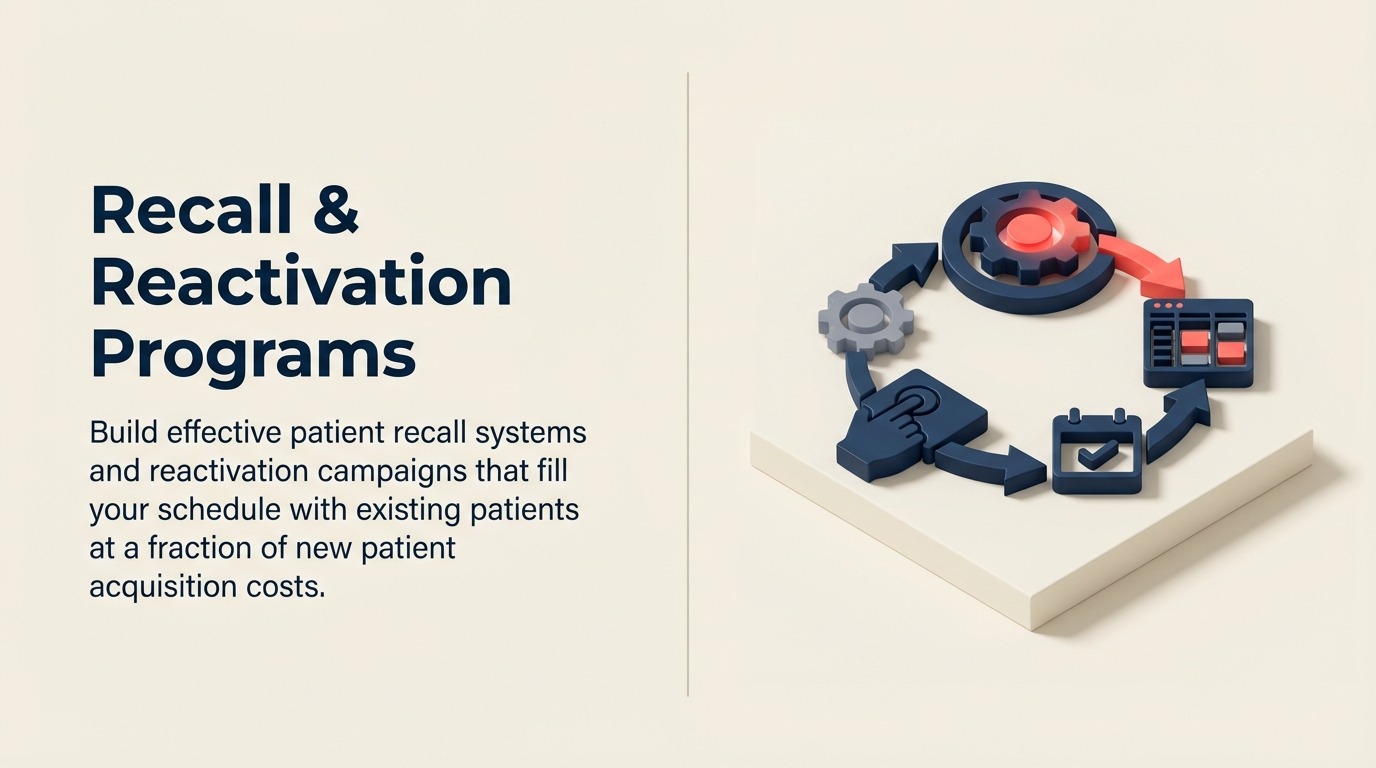
The practices that maximize this opportunity build two complementary systems: recall programs that keep regular patients on schedule for preventive and ongoing care, and reactivation campaigns that win back patients who've lapsed. Together, these programs can fill 30-50% of your schedule while costing a fraction of new patient acquisition.
Understanding Recall vs. Reactivation
These terms are often used interchangeably, but the distinction matters for effective program design.
Recall systems maintain relationships with active patients by prompting them to schedule regular care before they fall off your radar. This includes annual physicals, six-month dental cleanings, quarterly chronic disease management, periodic screening tests, and regular therapy sessions. The patient relationship is healthy - you're simply facilitating the next scheduled touchpoint.
Reactivation campaigns target patients who've already lapsed - they missed their expected visit and haven't rescheduled despite previous reminders. The relationship has grown cold, and you need more compelling outreach than standard recall messaging to bring them back.
Think of recall as relationship maintenance and reactivation as relationship repair. Both are critical, but they require different approaches, messaging, and expectations.
Designing Effective Recall Programs
Recall success starts with clear standards for when different patient types should return. Without defined intervals, you can't systematically identify who's due for care.
Specialty-specific recall intervals provide the foundation:
Primary Care:
- Annual wellness visits for healthy adults
- Quarterly visits for chronic disease management (diabetes, hypertension, heart disease)
- More frequent monitoring for complex or unstable conditions
- Age and gender-specific screening schedules following USPSTF recommendations (mammograms, colonoscopies, etc.)
Dental:
- Six-month cleanings and exams for most patients
- Three-month periodontal maintenance for gum disease patients
- Annual x-rays or as clinically indicated
- More frequent visits for active treatment plans
Physical Therapy:
- As prescribed by treatment plan (often 2-3 times weekly initially)
- Periodic check-ins post-discharge (3, 6, 12 months) for injury prevention
- Immediate scheduling of next visit before leaving current appointment, following appointment scheduling optimization principles
Specialty Care:
- Varies widely by condition and specialty
- Follow established clinical guidelines for specific conditions
- Coordinate with primary care for co-managed patients
Document these standards and train staff on them. Your recall system is only as good as the intervals you're working from. Consider building these into your practice management software so they automatically trigger reminders.
Pre-scheduling strategies dramatically improve recall effectiveness. Before a patient leaves your office, schedule their next appointment. This single practice change can increase recall compliance by 40-60%.
The psychology is simple: a scheduled appointment in their calendar is far more likely to happen than a vague intention to call in six months. Even if they need to reschedule later, you've established the expectation and have a specific date to confirm. According to MGMA research on patient engagement, pre-appointment scheduling is one of the highest-impact strategies for preventive care compliance.
Pre-scheduling works best when:
- Clinical staff advocates for it as part of care plan, not just front desk pushing appointments
- You're flexible about rescheduling if needed (no-penalty policy for changes with notice)
- Confirmation reminders go out well in advance so changes can be made smoothly
- You explain why the interval matters for their health, not just that "we want to see you every six months"
Reminder sequences maintain contact with pre-scheduled patients and prompt those who didn't pre-schedule. An effective sequence typically includes:
60-90 days before due date: Educational reminder about why this visit matters for their health (email or portal message)
30 days before: Invitation to schedule with convenient online booking link (email/text)
7 days before scheduled appointment: Confirmation request with easy reschedule option (text preferred)
Day before appointment: Final reminder with practice details and what to bring (text)
After missed appointment: Same-day follow-up to reschedule if they no-showed
Each message should provide value, not just demand action. "Your six-month cleaning is due - remember, regular cleanings prevent gum disease and catch problems early" works better than "It's time for your appointment."
Confirmation workflows reduce no-shows while providing opportunities to fill cancelled slots. Your system should:
- Request confirmation 2-3 days before appointment
- Make rescheduling as easy as confirming
- Automatically add confirmed patients to no-show prevention tracking
- Flag unconfirmed appointments for phone follow-up if high-value
- Fill cancelled slots immediately through waitlist or opportunistic outreach
The goal isn't just confirming appointments but also managing your schedule proactively. A cancelled slot with 48-hour notice can be filled; one discovered when the patient doesn't show up is wasted capacity.
Multi-Channel Communication Strategy
Patients have strong preferences about how they're contacted, and using the wrong channel dramatically reduces response rates. Your recall system needs flexibility to meet patients where they are.
Text messaging protocols work exceptionally well for appointment reminders and confirmation. Texts have 98% open rates compared to 20% for email, and most people check texts within minutes of receipt.
Best practices for recall texts:
- Keep messages under 160 characters when possible
- Include patient name, appointment date/time, location
- Provide simple confirmation method (reply YES or click link)
- Make rescheduling easy with phone number or link
- Respect quiet hours (no texts before 8am or after 8pm)
- Allow easy opt-out and honor preferences immediately
Sample: "Hi Sarah, this is ABC Dental. You're due for your 6-month cleaning. Schedule at [link] or call 555-1234. Reply STOP to opt out."
Email campaigns allow longer messages with more context, education, and visual elements. Email works well for:
- Initial recall notifications with explanation of why visit is due
- Educational content about the type of care needed
- New service announcements to patients due for related care
- Newsletters that include recall messages alongside value-add content
Segment email lists based on recall category (annual preventive, chronic disease management, specialty-specific) so messaging is relevant. Generic "come see us" emails get ignored.
Phone call scripting provides a personal touch for high-value patients or those who haven't responded to digital outreach. Not every patient needs a phone call, but strategic calling converts holdouts and addresses barriers digital messages can't.
Your phone scripts should:
- Start with relationship building, not appointment pushing
- Ask about their health and any concerns since last visit
- Explain why the recommended visit interval benefits them
- Address common barriers proactively (cost, time, anxiety)
- Make scheduling easy by offering specific options
Train staff on these scripts but allow personality and authenticity. Reading robotically from a script defeats the purpose of personal contact.
Direct mail options still work for certain demographics and practice types. While expensive compared to digital channels, physical mail has value for:
- Older patients less engaged with email/text
- High-value patients where the investment is justified
- Practices with premium positioning where quality mail reinforces brand
- Specialty services that benefit from visual education (dental before/after photos, aesthetic procedures)
Combine direct mail with digital follow-up for best results. Mail creates awareness and credibility; digital provides easy action path.
Reactivation Campaign Design
Lapsed patients require different messaging and strategy than regular recall. They've already ignored standard reminders, so you need to understand why they lapsed and address it directly.
Defining "lapsed" status varies by practice type and expected visit frequency:
- Regular preventive care: Lapsed after missing their interval by 3+ months (e.g., 9 months for six-month dental cleaning)
- Chronic disease management: Lapsed after missing one expected visit without rescheduling
- Acute care: Lapsed if they didn't complete treatment plan or follow-up as recommended
- General practice: No visit in 18-24 months for someone who was previously active
Your practice management system should automatically flag lapsed patients based on these criteria. This shouldn't require manual review - automated reports drive systematic outreach. Understanding your patient retention strategy helps prevent patients from lapsing in the first place.
Segmentation strategies allow personalized messaging based on why patients likely lapsed:
Recently lapsed (3-6 months overdue): Gentle reminder with easy scheduling. They probably just got busy or forgot. Low-pressure message: "We noticed it's been a while since your last visit. We're here when you're ready to schedule."
Medium-term lapsed (6-12 months): More direct value proposition. Address likely barriers and remind them what they're missing. "Regular care helps catch problems early. We've missed seeing you and want to make sure your health stays on track."
Long-term lapsed (12+ months): Treat almost like new patient acquisition but reference previous relationship. Consider incentive to lower barrier to return. "It's been over a year since we've seen you. We'd love to welcome you back with a complimentary consultation."
Incomplete treatment: Specific to what they didn't finish. "We noticed you didn't complete your treatment plan for [condition]. Let's discuss how we can help you achieve the health outcomes you were working toward."
Insurance changes: Many patients lapse when insurance changes and they don't know if you're still in-network. "Even if your insurance changed, we may still be able to see you. Call us to verify coverage."
Win-back messaging acknowledges the gap without being guilt-inducing. Never make patients feel bad about being gone - remove barriers to returning instead.
Avoid: "You've missed multiple appointments and your health is at risk." (Accusatory, fear-based)
Better: "We know life gets busy. We're here whenever you're ready to focus on your health again." (Understanding, welcoming)
Best: "We've missed seeing you, and we'd love to help you get back on track with your [specific health goal]. Here's how we can make it easy..." (Personal, specific, solution-oriented)
Include specific value propositions:
- New services or providers they might not know about
- Improved scheduling options (online booking, extended hours, telehealth)
- Educational content about health risks of delayed care for their specific situation
- Testimonials from patients who returned after lapsing
- Clear statement that you want to help, not judge
Incentive considerations can lower barriers to returning, but use carefully:
Appropriate incentives:
- Waived consultation or exam fee for lapsed patients
- Complimentary screening or assessment
- Extended appointment time to catch up on health status
- Flexible payment plans for outstanding balances
Inappropriate incentives:
- Anything that could be seen as inducement for unnecessary care
- Aggressive discounting that cheapens your services
- Offers that violate insurance contracts or regulations
Incentives work best for long-lapsed patients or high-value patients you particularly want back. Don't condition every reactivation on incentives or you'll train patients to lapse intentionally.
Automation and Technology Integration
Manual recall and reactivation programs don't scale. You need technology that identifies patients, triggers outreach, tracks responses, and measures results without consuming massive staff time.
Patient communication platforms designed for healthcare provide comprehensive automation. Selecting the right patient communication platforms is crucial for recall success.
Key features to look for:
- Two-way texting with conversation management
- Email campaign builder with templates
- Automated triggers based on appointment status and patient data
- HIPAA compliance and security
- Integration with your practice management system
- Multi-channel campaigns (text + email sequences)
- Reporting on delivery, open, click, and conversion rates
Leading platforms include Weave, Solutionreach, Lighthouse 360, and Reputation.com. Most practice management systems also include basic recall functionality.
Don't just buy the software - actually implement it fully. Many practices pay for these tools but use only 20% of functionality, essentially paying for expensive text messaging.
EHR integration ensures your recall system has accurate, current data on which patients need what services when. Integration should:
- Pull appointment history automatically to identify due/overdue patients
- Sync patient contact preferences and demographics
- Update when appointments are scheduled through recall outreach
- Track which campaigns patients responded to
- Feed response data back to patient record
Poor integration means staff manually updating lists, missing patients, or sending irrelevant messages because data is stale. Proper integration makes recall largely automatic.
Workflow automation transforms recall from a time-consuming staff task to a systematic background process:
Automated workflow example:
- System identifies patients due for six-month cleaning
- Automatically sends email 90 days before due date with educational content
- Sends text message 30 days before with scheduling link
- Staff review list of non-responders, make phone calls to high-value patients
- System generates daily report of scheduled appointments from recall outreach
- Process repeats monthly for new cohorts of due patients
Staff intervention is needed only for exceptions and high-touch cases. Everything else runs automatically.
Performance tracking shows what's working and where to optimize:
Metrics to track:
- Recall compliance rate (percentage of due patients who schedule)
- Response rate by channel (text vs. email vs. phone)
- Time from outreach to appointment scheduled
- Show rate for recall appointments vs. general appointments
- Revenue generated from recall program
- Reactivation rate for lapsed patients
Segment these metrics by patient type, provider, and recall category. You might find six-month dental recall gets 85% compliance while annual physical recall gets only 50%, suggesting different approaches are needed.
Staff Training and Execution Excellence
Technology enables recall, but staff execution determines success. Your team needs training on both the "how" and the "why" of recall programs.
Call scripts and talking points give staff confidence when reaching out to patients. Scripts shouldn't be read robotically but provide structure for consistent, effective communication.
Example reactivation call script:
"Hi [Name], this is [Staff Name] from [Practice]. How are you today?
I'm calling because we noticed it's been about [timeframe] since we last saw you, and we wanted to check in. Dr. [Name] really values the relationship with you and wants to make sure you have the support you need with your [health concern/regular care].
[If they mention barrier]: I understand [barrier]. Many patients have faced that. Here's how we can help: [solution]
Would you like to schedule an appointment? I have some options that might work with your schedule: [offer specific times]
[If not ready]: That's completely fine. We're here whenever you're ready. Is there anything we can help with in the meantime?"
Objection handling training prepares staff for common reasons patients haven't returned:
"I can't afford it right now" Response: "I understand budget concerns. Let's talk about what's most important for your health right now. We also have payment plans that might make it more manageable. Would you like to explore options?"
"I'm too busy" Response: "I hear you - everyone's schedules are packed. That's actually why we're reaching out - to help you schedule before things get even busier. We have early morning and evening appointments, and the visit typically only takes [duration]. What day of the week typically works best for you?"
"I haven't had any problems, so I didn't think I needed to come in" Response: "That's great that you're feeling well! The purpose of regular visits is to keep it that way by catching small issues before they become big problems. Think of it like maintaining your car - you change the oil before it breaks down. A quick visit now helps us make sure everything stays on track."
"I'm not sure if you take my new insurance" Response: "Let me check that for you right now. What's your insurance provider? [Check] [If yes] Great news, we do! [If no] We may still be able to see you. Many patients choose to continue care with us even if we're out of network because [value proposition]. Let's discuss your options."
Scheduling optimization ensures recall efforts translate to filled appointments. Implementing schedule optimization best practices:
- Dedicated recall blocks: Reserve specific times for recall appointments so you're not constantly "fully booked"
- Flexible scheduling: Offer evening/weekend options for working patients
- Buffer time: Don't pack recall patients so tight there's no flexibility
- Online scheduling: Give patients 24/7 access to book their own appointments
Track show rates for recall appointments separately. If they're consistently lower than regular appointments, you might need stronger confirmation processes or different messaging.
Follow-up protocols close the loop on outreach campaigns:
- Non-responders: After 2-3 outreach attempts with no response, flag for personal phone call or remove from active campaign
- Scheduled appointments: Confirm 24-48 hours before with standard reminder process
- Rescheduled: Track patients who repeatedly reschedule - may indicate barrier worth discussing
- Permanently inactive: After exhausting reactivation efforts, mark inactive to avoid wasting resources on continued outreach
Managing lapsed patients often uncovers process issues worth fixing. If many patients cite the same barrier, that's a signal to adjust your practice operations, not just your messaging. Understanding no-show reduction helps you keep recalled patients engaged once scheduled.
Measuring Program ROI
Recall and reactivation programs should be measured as rigorously as any marketing investment. The advantage is they're highly trackable - you know exactly which patients were contacted and which scheduled.
Recall compliance rate is your primary effectiveness metric:
Recall Compliance Rate = Appointments Scheduled / Patients Due for Care
Industry benchmarks:
- Dental six-month recall: 75-85%
- Annual preventive care: 55-70%
- Chronic disease management: 70-85%
- Specialty follow-up: 60-75%
If you're significantly below benchmark, your program needs work. Common issues include poor messaging, wrong channels, insufficient staff follow-through, or access/convenience barriers.
Reactivation success rate measures win-back effectiveness:
Reactivation Rate = Lapsed Patients Who Scheduled / Lapsed Patients Contacted
Realistic expectations:
- Recently lapsed: 25-35% conversion
- Medium-term lapsed: 15-25% conversion
- Long-term lapsed: 8-15% conversion
These rates are much higher than new patient conversion from cold marketing, which often runs 2-5%. This is why reactivation is so cost-effective.
Revenue attribution shows financial impact:
- Track revenue from appointments scheduled through recall/reactivation
- Include downstream revenue if recall visit leads to treatment
- Compare to cost of program (staff time + technology + incentives)
- Calculate ROI as (Revenue - Cost) / Cost
Many practices see 10-20x ROI on recall programs because the cost is so low compared to new patient acquisition.
A robust dental hygiene recall system can generate 40-60% of a dental practice's hygiene production while costing just a fraction of new patient marketing. The American Dental Association emphasizes systematic recall as a cornerstone of preventive dental care and practice sustainability.
Cost per appointment scheduled helps you optimize channel mix:
- Automated text recall: $2-5 per scheduled appointment
- Email campaigns: $3-7 per scheduled appointment
- Phone calls: $15-30 per scheduled appointment (including staff time)
- Direct mail: $25-50 per scheduled appointment
Use expensive channels (phone, mail) for high-value patients or those who don't respond to digital outreach. Use automated digital channels for the majority of patients.
Building Your Recall Engine
Effective recall and reactivation programs don't happen by accident. They require deliberate design, appropriate technology, trained staff, and continuous optimization.
Start by auditing your current situation:
- What percentage of due patients are you successfully recalling?
- How many lapsed patients do you have in your system?
- What's your current process (if any) for outreach?
- What technology are you using or could implement?
- What's the potential revenue from improving recall by 10-20%?
Then build systematically:
- Define standards: Establish recall intervals for all patient types
- Implement technology: Get proper communication and automation platform
- Create messaging: Develop channel-specific templates for recall and reactivation
- Train team: Ensure staff understand process and can execute effectively
- Launch and monitor: Start program and track key metrics weekly
- Optimize: Refine messaging, timing, and channels based on response data
Many practices focus entirely on new patient acquisition while ignoring the revenue sitting in their patient database. Those who build systematic recall and reactivation programs often discover they can fill 30-50% of their schedule with existing patients at a fraction of the cost of acquiring new ones.
Your patient database is one of your practice's most valuable assets. The question is whether you'll systematically activate that value or let it sit dormant while you spend marketing dollars chasing strangers. Complementing this with preventive care reminders creates a comprehensive patient retention and engagement system.
The practices that master recall and reactivation create sustainable competitive advantage - they're filling their schedules more efficiently, building stronger patient relationships, and spending less on acquisition while growing faster than competitors who haven't figured this out.

Senior Operations & Growth Strategist