Handling Disagreement and Conflict Across Cultures
Turn this article into takeaways for your work.


Each assistant summarizes the article only for you and suggests best practices for your work.
Updated August 2026
Conflict across cultures is rarely a disagreement about facts. It is a disagreement about what disagreeing is supposed to look like. One colleague raises their voice in a meeting because that is how you show you care about getting it right. Another goes quiet and agrees to everything in the room, then quietly stops delivering, because that is how you register a problem without wrecking the relationship. Both are handling conflict. Neither is being difficult. They are running different, internally consistent systems for the same job.
What "Handling Conflict Across Cultures" Actually Means
Every culture has disagreement. What varies is whether open, visible conflict is treated as a sign the team is engaged or a sign something has gone wrong. Get that assumption wrong on a mixed team and you will misread your best people as either combative or checked out, when they are just running their culture's normal operating procedure.
Erin Meyer's Disagreeing Scale
The clearest research tool for this question is Erin Meyer's Disagreeing scale, one of 8 scales in her book The Culture Map. It runs from Confrontational, where open disagreement is normal and even expected, to Avoids confrontation, where visible disagreement is treated as damaging to the relationship or the group. Cultures toward the confrontational pole in Meyer's research include France, Germany, Israel, and Russia. Cultures toward the avoids-confrontation pole include Japan, Thailand, Indonesia, and most of Southeast Asia. We cover all 8 of Meyer's scales, including how Disagreeing relates to Evaluating and Deciding, in The Culture Map explained.
In a confrontational culture, a heated debate in a meeting is not a crisis, it is what a functioning meeting looks like. Two colleagues can argue forcefully about a decision at 10am and go to lunch together at noon, because the disagreement was about the idea, not the relationship. Pushing back hard on a proposal reads as a form of respect: you cared enough to engage with it seriously instead of nodding along.
In an avoids-confrontation culture, the same behavior reads as an attack. Open disagreement, especially in front of a group, threatens the group's harmony and the other person's standing, so it gets avoided, deferred, or handled through a private channel instead. Silence in the room does not mean agreement. It usually means the disagreement moved somewhere you cannot see it.
The Decoupling: Why Disagreeing Is Not the Same as Being Loud
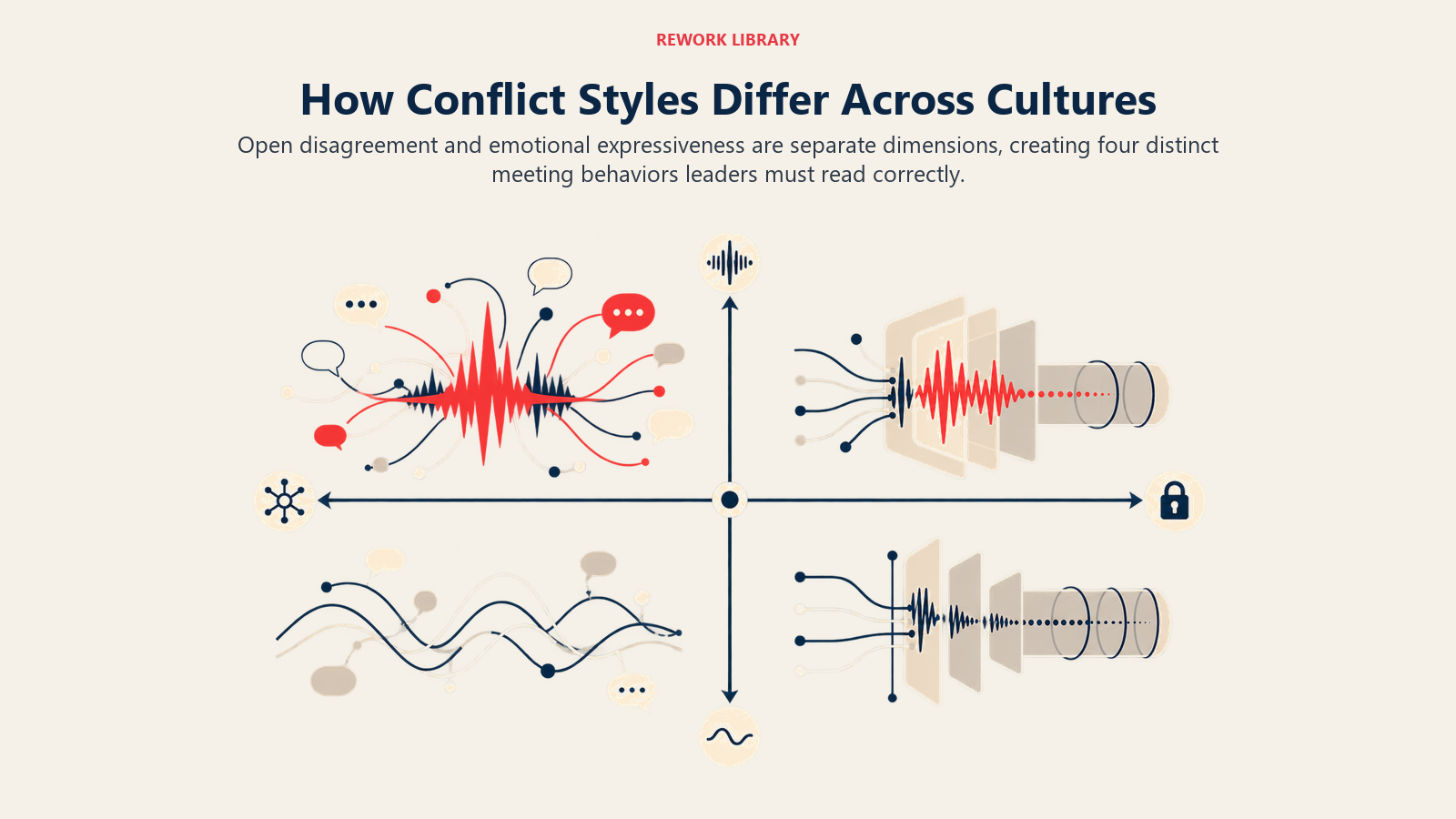
Here is the part that trips up most leaders: Disagreeing measures whether open conflict is acceptable, not how loudly or emotionally a culture communicates in general. Those are two separate questions, and Meyer keeps them on two different scales for a reason.
France is the case that breaks the assumption fastest. French business culture is emotionally expressive, gestures, raised voices, and visible passion in a meeting are all normal, and France also sits toward the confrontational end of Disagreeing, so volume and open clash both run high, which fits the stereotype. Pair France with Germany and the pattern breaks. Germany is far more reserved and controlled in tone day to day, yet it sits just as far toward the confrontational end of Disagreeing. A German colleague can deliver a flat, calm, completely unemotional statement that directly contradicts you in front of the whole team, and mean nothing personal by it.
The reverse pairing shows up too: some emotionally expressive cultures still avoid open confrontation, softening disagreement through warmth or humor rather than volume. The takeaway is that volume tells you almost nothing. Whether open disagreement is treated as normal or as damaging is the axis that actually predicts what happens in a hard meeting.
The Confrontational x Emotionally Expressive Quadrant
Because these are two separate axes, plotting a culture on both at once explains behavior a single scale cannot. Four rough combinations show up in practice.
| Quadrant | Disagreeing | Emotional expressiveness | What it looks like in a meeting | Example cultures |
|---|---|---|---|---|
| Loud and open | Confrontational | Expressive | Visible passion, raised voices, open clashes that end without residue | France, Israel, Southern Europe |
| Calm and open | Confrontational | Reserved | Flat tone, direct contradiction, no visible heat at all | Germany, the Netherlands, Nordic countries |
| Loud but avoidant | Avoids confrontation | Expressive | Warmth and animation used to soften or deflect, rarely a direct clash | Parts of Latin America, some Middle Eastern contexts |
| Calm and avoidant | Avoids confrontation | Reserved | Quiet agreement in the room, disagreement surfaces later or elsewhere | Japan, Thailand, Indonesia, much of Southeast Asia |
The dangerous pair for a global leader is "calm and open" read as passive, and "loud but avoidant" read as genuinely upset. A German colleague's calm, direct pushback can look like a minor comment when it is actually a firm no. An animated, warm objection from a colleague in Southeast Asian business culture can look like a real fight when it is closer to a polite no dressed up in enthusiasm. Reading the wrong axis is the single most common misfire in cross cultural conflict.
Key Facts
- Erin Meyer's Disagreeing scale, one of 8 scales in The Culture Map, places France, Germany, Israel, and Russia toward the confrontational pole, and Japan, Thailand, and Indonesia toward the avoids-confrontation pole. Source: Harvard Business Review, "Navigating the Cultural Minefield," May 2014
- Meyer treats Disagreeing as independent from a culture's general emotional expressiveness, which is why Germany and France can sit close together on Disagreeing while sitting far apart on how much emotion they show day to day. Source: erinmeyer.com, "The Cultural Guide to Confronting Employees"
- Google's two-year Project Aristotle study of more than 180 teams found psychological safety, the ability to take a risk like voicing disagreement without fear of punishment, was the top factor separating its highest-performing teams from the rest. Source: Google re:Work
- A 2025 Stanford and BetterUp study of 1,150 U.S. desk workers found roughly 40% had received AI-generated "workslop," polished but substance-light output that shifts unacknowledged rework and friction back onto colleagues. Source: BetterUp Labs, "Workslop: The Hidden Cost of AI-Generated Busywork"
Where Cultural Conflict Styles Collide at Work
The Disagreeing gap does not stay theoretical. It shows up in three specific places almost every mixed team runs into.
In Meetings
A confrontational-culture employee who challenges a proposal in front of the group is doing what their culture considers normal engagement. An avoids-confrontation colleague in the same room can read that challenge as a personal attack on the person who proposed the idea and quietly disengage rather than say so. Meanwhile the confrontational colleague, hearing no pushback, assumes the room agrees, when several people actually disagreed and simply never said it. This is the same mechanism covered in why teams stay silent in meetings: silence gets misread as consensus far more often than leaders assume.
In Open Debate
Confrontational cultures often treat vigorous debate as the mechanism by which a team reaches its best decision, on the theory that an idea that survives a hard argument is stronger than one never tested. Avoids-confrontation cultures more often reach decisions through private consultation before the meeting even starts, so the meeting itself ratifies agreement rather than forging it. A leader who imports the "debate it out loud" model onto a team that decides the other way will find the room going quiet, then discover afterward that half the team never actually agreed.
In Saving Face
In many avoids-confrontation cultures, being publicly contradicted, especially by a junior person or in front of a client, does lasting damage to a colleague's standing regardless of whether the correction was accurate. The information might be exactly right; the delivery, in front of an audience, is what causes the harm. A correction that lands as helpful in private can humiliate the same person in a group setting, which is why so much genuine disagreement moves to a side conversation, a written note, or a trusted intermediary instead of the meeting itself.
How to Run Productive Disagreement on a Mixed Team
Running conflict well on a mixed team is not about picking one national style and applying it everywhere. It means building explicit norms that let both systems function without one silently overriding the other.
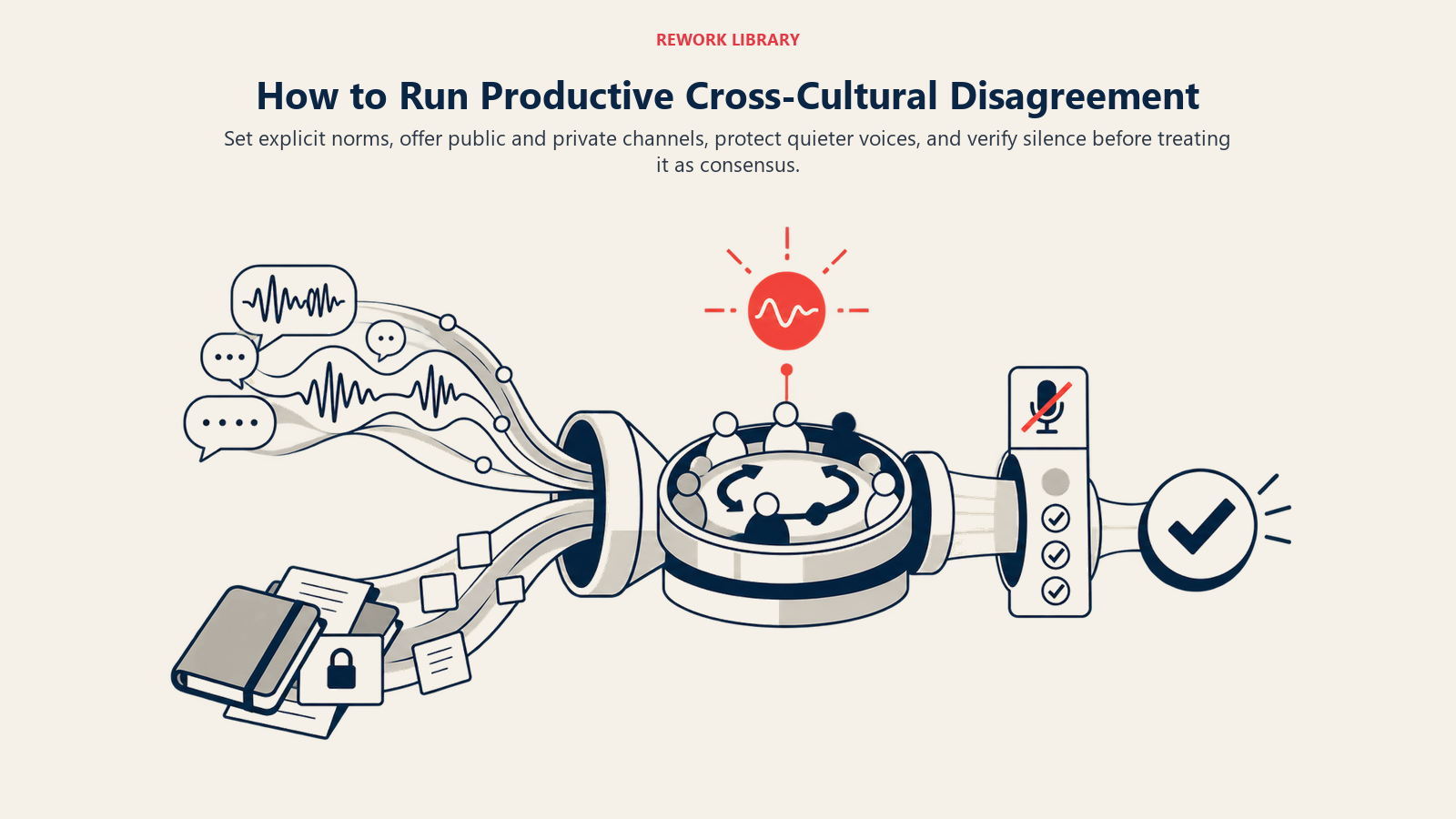
Set an explicit disagreement norm instead of assuming one. Most teams never state how they expect disagreement to happen, so everyone defaults to their own cultural instinct and reads everyone else's as either aggressive or evasive. Naming the norm out loud, "we push back on ideas directly here, and it is not personal," or "we raise concerns privately first, then bring agreed points to the group," gives people from either style a shared script instead of a guess.
Separate the channel from the content, and use structure to protect quieter voices. The substance of a disagreement rarely needs to change across cultures; the channel it travels through does. A private one-on-one, a written comment on a shared document, or a round-robin at the start of a meeting where each person states their view before open debate begins, all let a genuine objection reach the decision without forcing an avoids-confrontation colleague into a public clash they will experience as damaging. Structure does not stop the debate that follows, it just makes sure everyone's actual position gets on the record first.
Distinguish public from private correction on purpose. Save the sharpest, most direct pushback for a private conversation with colleagues from an avoids-confrontation culture, and reserve open group debate for decisions where the team has already agreed that format works for everyone. This single adjustment, covered further in managing a multicultural team, prevents more damage than any other habit change.
Check for silent disagreement before calling it consensus. After a meeting produces apparent agreement, a quick private check-in with quieter participants, "is there anything you didn't get a chance to raise in there," surfaces objections a confrontational reading of the room would have missed. Treat unanimous silence as a signal to verify, not a result to trust.
Managing Conflict as a Leader
A leader sits at the center of every one of these gaps, because their own default style becomes the room's implicit rule whether they intend that or not.
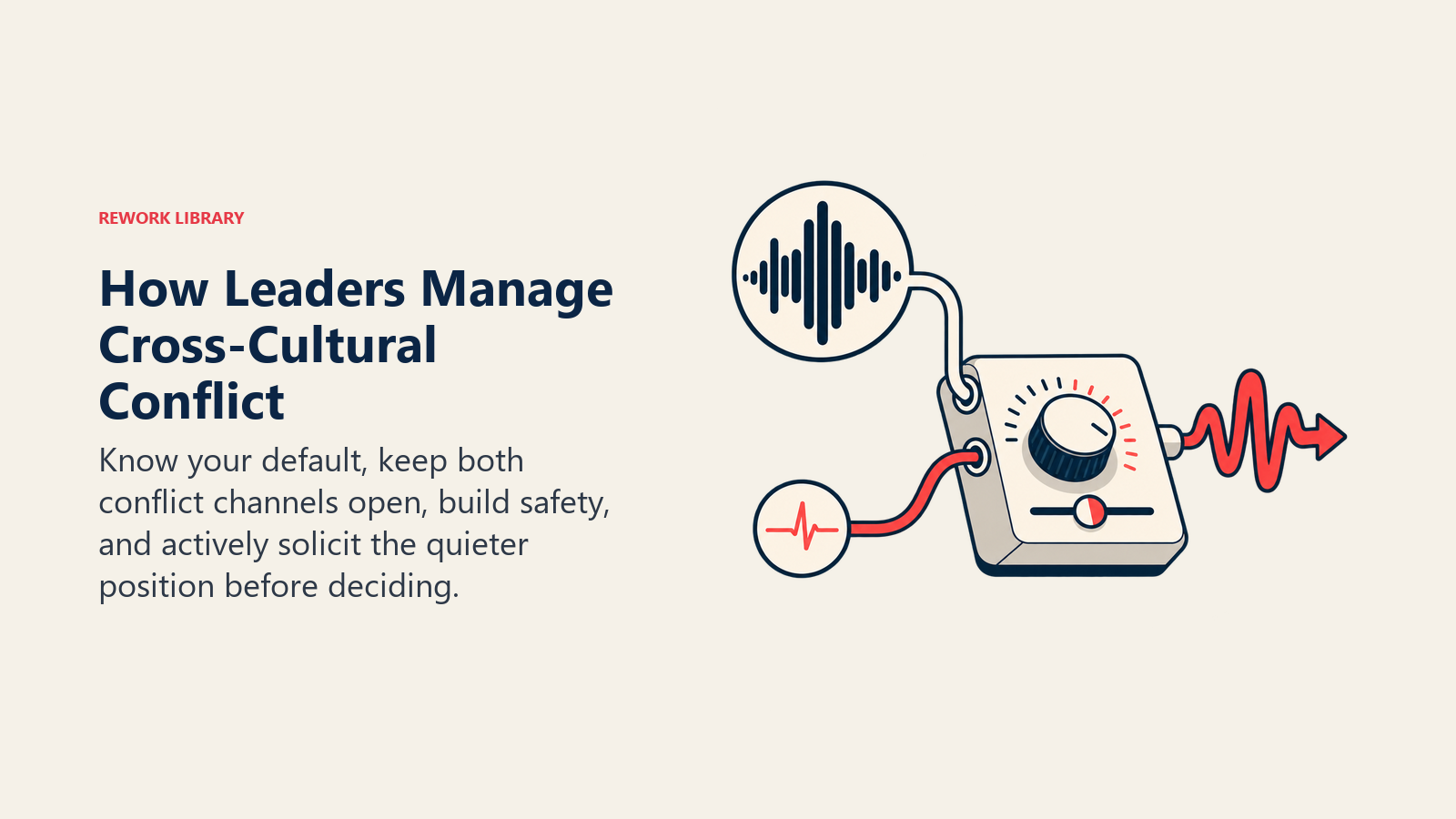
Diagnose your own default first. Most leaders assume their instinct for handling conflict is simply "how conflict works," rather than one cultural style among several equally valid ones. A confrontational leader who never adjusts trains an avoids-confrontation team to go silent and route real concerns around them; an avoids-confrontation leader who never adjusts can leave confrontational team members feeling like real problems get smoothed over instead of solved.
Model both channels visibly, and address conflict early. Openly welcome direct pushback from people who give it, and openly create private, low-risk channels for people who need one, in the same team, at the same time. The goal is not uniformity, it is making sure every real disagreement has a path to reach you before it hardens: an unresolved disagreement in an avoids-confrontation culture rarely disappears, it goes underground and resurfaces later as disengagement or someone quietly leaving. Catching it early, the same discipline behind building trust in the workplace, is far cheaper than catching it after it has curdled.
Build genuine psychological safety, not just permission to speak. It is the one condition that lets a naturally quieter colleague raise a real concern without waiting for it to become a crisis, and it matters more on a mixed-conflict-style team than almost anywhere else. Announcing an open-door policy is not the same as building it; people from an avoids-confrontation culture will test whether raising a concern actually costs them something before they believe it does not.
Watch for the leader-as-tiebreaker trap. On a team split between confrontational and avoids-confrontation members, the loudest voice in the room can start to look like the correct one by default, simply because it is the only voice you can hear. Actively soliciting the quieter position before deciding, not just leaving the floor open to whoever takes it, keeps the decision quality from silently degrading to "whoever argues hardest wins."
Handling Conflict and AI
AI drafting tools introduce a new version of the same mismatch. A tool trained on generic, moderately assertive Western defaults tends to write pushback that reads as reasonably direct in a confrontational culture and unacceptably blunt in an avoids-confrontation one, because it has no model of the specific relationship it is being sent into. That flattening is a specific case of the broader workslop problem: content that looks like a considered position but was never calibrated to the person receiving it, which people notice and quietly discount.
The fix is not avoiding AI-drafted messages, it is treating a draft as a first pass that a human who knows the recipient adjusts before sending, the same discipline covered in what AI-native culture actually looks like. As more disagreement flows through AI drafts, and eventually through agents flagging their own concerns, the same question follows the technology: something still has to decide how loudly to disagree, and getting it wrong costs the same trust it always did.
Where to Go Next
Handling conflict across cultures connects directly to a few other pieces of this collection. From here:
- The Culture Map explained, for all 8 of Erin Meyer's scales, including Disagreeing
- Direct vs indirect feedback across cultures, for the closely related Evaluating scale
- Why teams stay silent in meetings, for what happens when disagreement never surfaces at all
- How business culture differs across the world, for the wider map of national culture differences
- How to manage a multicultural team, for the full playbook this article's tactics fit into
Frequently Asked Questions about Handling Conflict Across Cultures
What is cross cultural conflict?
Cross cultural conflict happens when people from different cultural backgrounds disagree, not just about the issue at hand, but about what a normal, acceptable way of disagreeing looks like. One side may treat open debate as engaged and respectful, while the other treats the same behavior as damaging or disrespectful, which turns an ordinary disagreement into a relationship problem.
What is Erin Meyer's Disagreeing scale?
The Disagreeing scale is one of 8 scales in Erin Meyer's The Culture Map, measuring whether a culture treats open, visible disagreement as normal and even valuable (confrontational) or as something that damages relationships and group harmony (avoids confrontation). France, Germany, Israel, and Russia sit toward the confrontational pole; Japan, Thailand, and Indonesia sit toward the avoids-confrontation pole.
Does a confrontational culture mean people are louder or more emotional?
No. Disagreeing measures whether open conflict is acceptable, which is a separate question from how emotionally expressive a culture is day to day. Germany is reserved and unemotional in general communication but sits firmly on the confrontational end of Disagreeing, while France is emotionally expressive and also confrontational, showing the two traits can pair in different combinations.
Why do some employees never speak up in meetings even when they disagree?
In avoids-confrontation cultures, open disagreement in a group setting risks damaging the relationship or the other person's standing, especially in front of an audience. Silence usually is not agreement; the disagreement more often moves to a private conversation, a written note, or a trusted intermediary instead of surfacing in the room.
How should a leader run a meeting with both confrontational and avoids-confrontation team members?
Set an explicit norm for how disagreement should happen instead of assuming everyone shares one, use structure like a round-robin so quieter voices get a low-risk slot before open debate takes over, and check in privately after apparent consensus to surface objections a confrontational reading of the room might have missed.
What is the biggest mistake leaders make with cross-cultural conflict?
Reading someone's volume or emotional tone as the signal for whether they are truly upset or truly fine, instead of watching whether their culture treats open disagreement as normal or as damaging. A calm, quiet objection from a reserved but confrontational colleague can be a firm no, while an animated, warm objection from an avoids-confrontation colleague can be a polite no dressed up in enthusiasm.
Can conflict styles change, or are they fixed by nationality?
They can shift. Individuals vary widely within their own country's typical range, and years spent on a globally mixed team, a strong company culture, or direct coaching can shift someone's comfort with open disagreement significantly. National tendency is a starting hypothesis to test against the actual person, not a fixed label.
Does AI-drafted communication handle cross-cultural disagreement well?
Not by default. Most AI tools default to a generic, moderately assertive style that can read as too blunt for an avoids-confrontation culture or too weak to register in a confrontational one, since the tool has no model of the specific relationship or room. Treating any AI-drafted pushback as a first pass a human adjusts before sending is safer than sending it unedited.
Conflict across cultures is not a problem to eliminate. It is a signal system, and every culture has built its own version of one. The leaders who handle it well do not try to make everyone argue the same way. They learn to read which system a colleague is running, build channels wide enough for both, and make sure that when someone disagrees, wherever and however quietly they do it, the disagreement actually reaches the decision instead of disappearing into the room.

Co-Founder, Rework.com
On this page
- What "Handling Conflict Across Cultures" Actually Means
- Erin Meyer's Disagreeing Scale
- The Decoupling: Why Disagreeing Is Not the Same as Being Loud
- The Confrontational x Emotionally Expressive Quadrant
- Key Facts
- Where Cultural Conflict Styles Collide at Work
- In Meetings
- In Open Debate
- In Saving Face
- How to Run Productive Disagreement on a Mixed Team
- Managing Conflict as a Leader
- Handling Conflict and AI
- Where to Go Next