Communication Styles Across Cultures: A Practical Guide
Turn this article into takeaways for your work.


Each assistant summarizes the article only for you and suggests best practices for your work.
Communication style across cultures is the set of unwritten rules a culture uses to decide how directly people speak, how much meaning gets carried by context instead of words, how disagreement gets voiced, and what silence actually signals. It is not one variable. It is several that stack together, and most cross-border friction at work comes from mixing them up.
If you manage or work on a global team, you have already felt this without the vocabulary for it. A "yes" in one meeting turns out to mean something closer to "I heard you" three weeks later when the deadline slips. A blunt email meant as efficient reads as cold, or worse, hostile. A room goes quiet after you ask "any objections?" and you walk out assuming agreement, only to learn in a private message the next day that half the room disagreed and never said so out loud. None of this is a personality clash. It is several different, internally consistent communication systems colliding without a translation step in between.
This guide is the practical umbrella for that whole picture. The deep dives on each individual dimension already live in this collection: high-context vs. low-context culture, The Culture Map, hierarchical vs. egalitarian culture, consensus vs. top-down decision-making, relationship-first vs. task-first culture, and why teams stay silent in meetings. What follows ties those pieces together into one working picture and one playbook, without repeating what those articles already cover.
What "Communication Style" Actually Means at Work
Most people use "communication style" loosely, as a stand-in for "how blunt someone is." In practice it is a bundle of separate variables a culture tends to set together, though not always in the same direction. A culture can be high-context on meaning and still fairly direct on feedback. A culture can be hierarchical and still decide by open debate once the boss invites it. Treating the bundle as one thing is exactly how a well-meaning manager misreads a room: they notice one signal, a soft "maybe," assume it explains everything, and miss the other signals stacked underneath it.
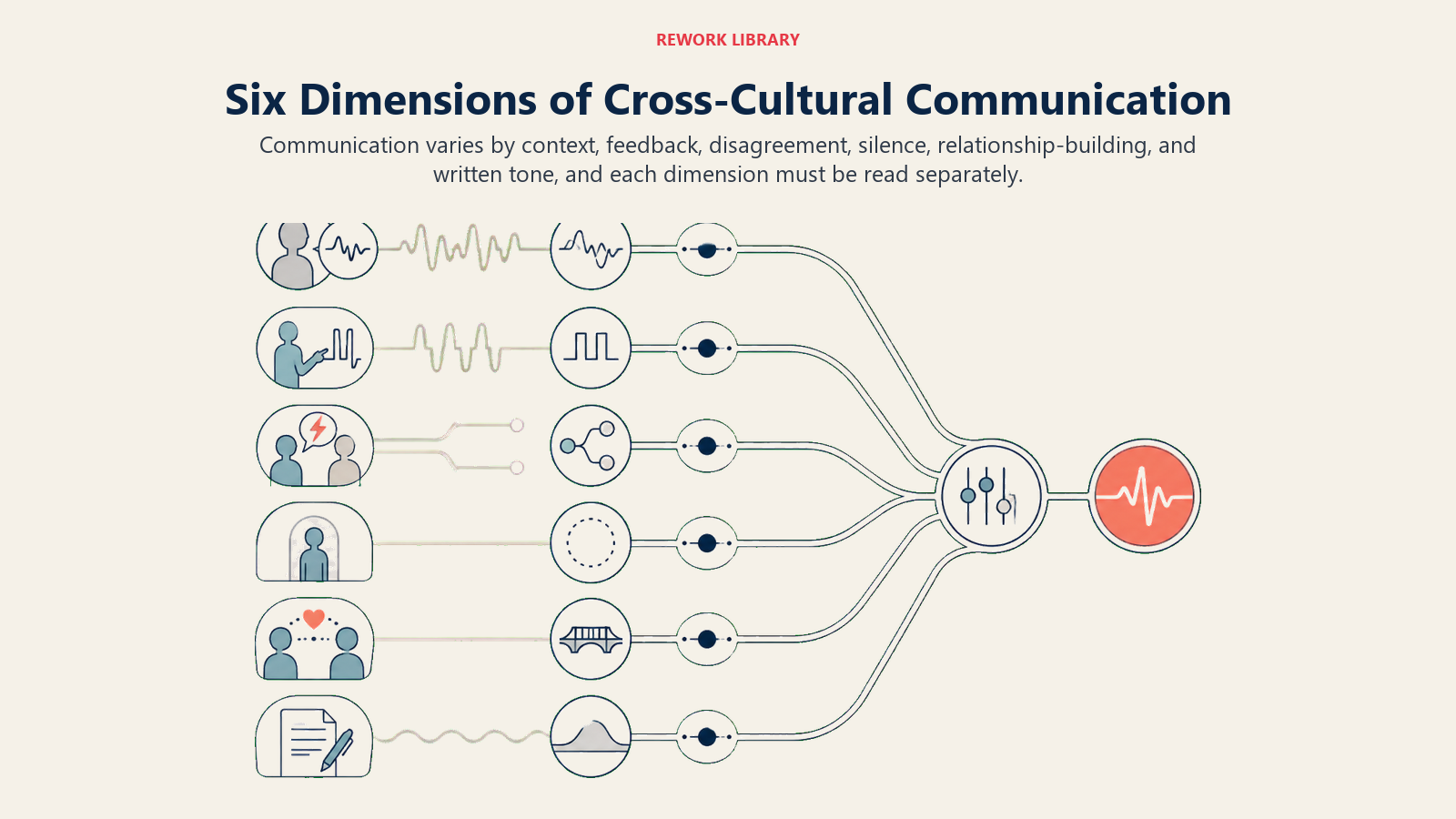
The bundle worth tracking has six parts: how much meaning lives in the words versus the context, how directly feedback gets delivered, how openly disagreement gets voiced, what silence means in a given room, how much relationship-building precedes business, and how tone shows up in writing. Each has its own research base and country pattern. None predicts a specific person. All of them predict, reasonably well, what a room full of strangers from a given culture will default to before anyone has adjusted to each other.
The Six Dimensions Where Communication Style Actually Varies
Context: How Much Meaning Lives in the Words
Anthropologist Edward T. Hall's high-context and low-context framework is the foundation almost everything else here builds on. In a low-context culture, the words carry the message: say what you mean, and expect it taken at face value. In a high-context culture, a large share of the message lives in tone, timing, relationship, and what both sides already understand without saying it out loud. The United States, Germany, and the Nordic countries sit toward the low-context end. Japan, Vietnam, Indonesia, and most Arab and Gulf cultures sit toward the high-context end. The full framework and country table live in high-context vs. low-context cultures at work.
Feedback: Direct vs. Indirect
Erin Meyer's Evaluating scale in The Culture Map captures a related but separate axis: whether negative feedback gets delivered plainly and in the moment, or softened and routed through a private conversation. This is not the same as context. The Netherlands and Russia both score as fairly direct on feedback yet sit far apart on context, which is why the same blunt sentence lands so differently depending on which axis is doing the work. A leader who defaults to one script for hard feedback will read as harsh to some teams and strangely vague to others. Building a feedback culture covers designing a system that works across that gap.
Disagreement: Confrontational vs. Avoiding
Some cultures treat open debate as a sign a team is engaged. Others read the same behavior as a threat to group harmony, something to smooth over rather than air in front of an audience. Meyer's Disagreeing scale sits alongside her Deciding scale, and the two get confused constantly: a culture can be steeply hierarchical and still decide by consensus, the way Japan does through nemawashi, while a nearly flat culture can still decide top-down once the right person weighs in, the way the United States often does. Consensus vs. top-down decision-making across cultures separates these two axes, because assuming they move together is a common misread.
Silence: What It Actually Signals
Silence is the dimension leaders misread most, because it looks identical from the front of the room no matter what is causing it. In a low power-distance, low-context culture, silence after "any objections?" usually does mean no objection. In a high power-distance or collectivist culture, the same silence often means disagreement is being routed somewhere safer: a private conversation, a message sent after the meeting ends. Why teams stay silent in meetings breaks down the specific causes, and hierarchical vs. egalitarian cultures covers the power-distance research behind why some rooms default to quiet regardless of how safe the leader believes it is.
Small Talk and Relationship-Building
How much personal conversation has to happen before business starts is its own axis, and one of the fastest ways a cross-cultural meeting goes sideways in the first five minutes. In a task-based trust culture, competence and a track record earn confidence, so skipping to the agenda reads as efficient, not rude. In a relationship-based trust culture, people need to know and like you before trusting your work, so the same fast start reads as presumptuous or cold. Relationship-first vs. task-first business cultures covers this gap in sales and hiring, not just meetings.
Email, Tone, and Written Communication
Writing strips away the tone of voice and body language that carry a lot of the message in a high-context culture, which is why written communication is where mismatches surface fastest and get remembered longest. A low-context email states the ask in the first line and uses bullets for anything with more than two parts. A high-context email often opens with a relationship check-in and expects the reader to infer urgency from context rather than a bolded deadline. Neither writer is careless. They are applying the rules that work at home to an inbox that includes people running a different rule set, and high-context vs. low-context covers this failure mode further.
A Practical Matrix: Reading Communication Style at a Glance
Treat this as a working hypothesis for a first meeting, not a scorecard for judging someone once you know them.
| Dimension | Explicit-style default | Implicit-style default | Typical explicit-leaning cultures | Typical implicit-leaning cultures |
|---|---|---|---|---|
| Context | Meaning is in the words | Meaning is in tone, timing, and relationship | US, Germany, Netherlands, Nordics | Japan, Vietnam, Indonesia, most Arab and Gulf cultures |
| Feedback | Direct, specific, delivered in the moment | Indirect, softened, often delivered privately | Netherlands, Israel, Russia, Germany | Japan, Thailand, much of Southeast Asia |
| Disagreement | Open debate is normal and expected | Disagreement is muted or routed privately | France, Israel, Germany | Japan, Indonesia, most East and Southeast Asian cultures |
| Silence in a meeting | Usually means no objection | Often means disagreement held for later | US, UK, Northern Europe | Japan, Vietnam, much of East and Southeast Asia |
| Relationship-building | Business first, rapport can follow | Rapport first, business follows | US, Germany, Nordics | Middle East, Latin America, much of Southeast Asia |
| Written tone | Terse and bulleted reads as competent | Terse and bulleted can read as cold | US, Germany, Netherlands | Japan, most of Southeast Asia, Latin America |
Two things this table cannot do: tell you where a specific colleague sits (individuals vary widely inside every country), or tell you where a strong company culture has already shifted someone's default. Use it to form a hypothesis, then update it once you know the actual person.
Real Workplace Scenarios (These Happen Every Week)
The "Yes" That Means No
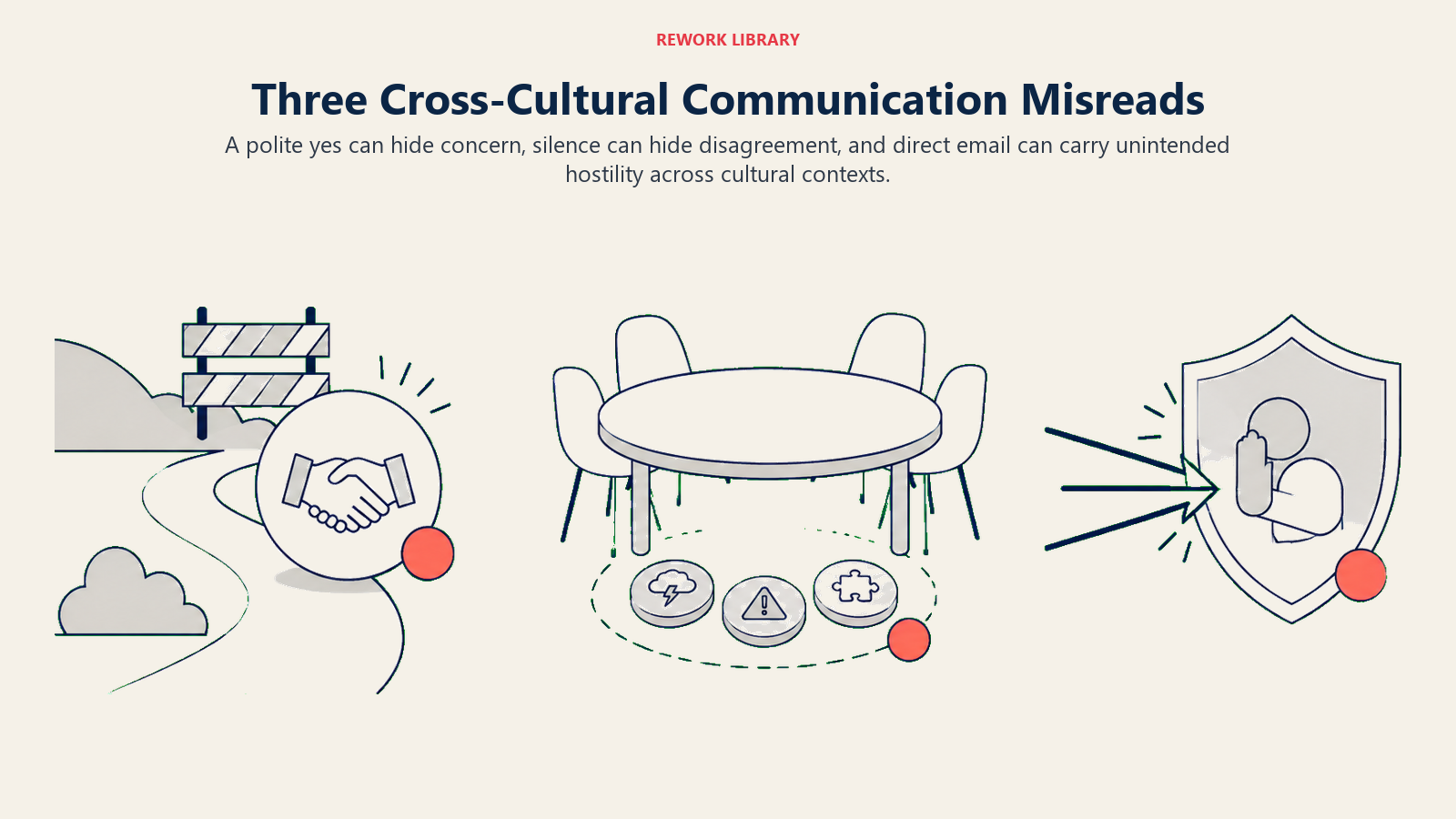
A manager asks a team member in Jakarta whether the timeline is realistic. The answer comes back "yes, we can try." The manager hears a commitment. What was actually communicated was closer to "I don't want to say no directly, but I have real concerns." Two weeks later the deadline slips, and the manager is the only one surprised. The fix is not to distrust every "yes." It is to follow one with a process question: "walk me through how the first week would go," which reveals hesitation long before anyone would say "no" out loud.
The Silence That Isn't Agreement
A leader runs a decision meeting, asks "any concerns before we move forward?", hears nothing, and takes the plan live. A week later, three people mention in 1:1s that they had real doubts and assumed someone else would raise them, or that raising a concern about a senior colleague's plan in front of the group was not their place. The room was never in agreement. It was quiet for reasons that had nothing to do with the plan's merits, a pattern covered fully in why teams stay silent in meetings.
The Over-Direct Email That Reads as an Attack
A manager trained in a low-context, direct-feedback culture sends a two-line email: "This draft isn't working. Redo sections two and three by Friday." Efficient by the sender's own standards. To a recipient from a high-context, indirect-feedback culture, the same email reads as a public dressing-down with no room to save face, even though nobody else saw it. The recipient disengages quietly rather than pushing back, and the manager never learns why the next few drafts came back worse, not better. The substance of the feedback was fine. The delivery format was calibrated for the wrong audience.
A Playbook for Clearer Cross-Cultural Communication
None of this requires years of cultural training. A handful of habits close most of the gap.
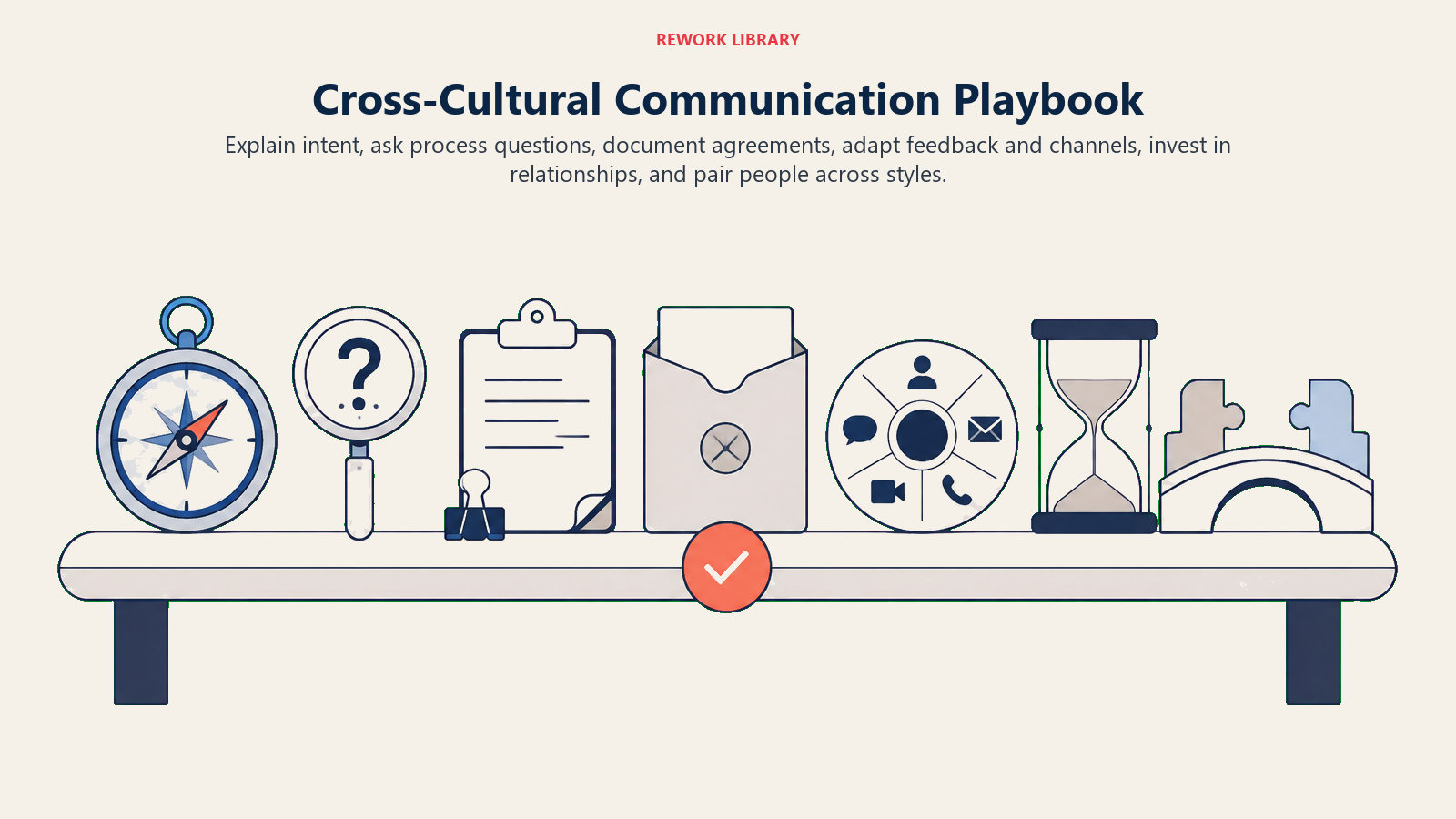
Over-communicate intent, not just content. State the "why" behind a request, not only the "what." "I need this by Friday because the client review is Monday morning" gives a high-context colleague the context a low-context colleague already assumes is obvious, and gives everyone a reason to flag a real conflict instead of quietly nodding and missing the deadline.
Check understanding with process questions, not yes-or-no ones. Replace "does that make sense?" with "walk me through how you'd approach the first two days." A yes-or-no question invites a polite yes from almost every culture. A process question reveals the real plan, and any hesitation buried inside it, long before a deadline is missed.
Put verbal agreements in writing, every time. After any meeting with a mixed-context team, send a short written recap: what was decided, who owns what, by when. This gives explicit-style colleagues the record they already expect, and gives implicit-style colleagues a low-stakes chance to quietly flag a misread before it turns into a missed commitment.
Separate the substance of feedback from its delivery. Keep the content honest and specific for everyone. Adjust only the packaging: private versus public, immediate versus scheduled, blunt versus softened through a trusted colleague. Diluting the message to avoid discomfort helps no one improve, but delivering the right substance in the wrong format guarantees it does not land either.
Adapt the channel to the person, not just the message. A quick decision that works fine as a Slack message for one colleague may need a phone call for another, because tone and pacing carry meaning plain text strips out. For a high-stakes ask, default to a richer channel until you know the person well enough to downgrade it.
Build in relationship time before the ask, deliberately. In relationship-first markets, skipping straight to business on a first call reads as presumptuous no matter how good the pitch is. Ten unhurried minutes before the agenda starts is not wasted time. It is the actual first step of the negotiation in a lot of the world, covered further in relationship-first vs. task-first business cultures.
Pair people across styles instead of training the gap away in a workshop. Putting a high-context and a low-context colleague on the same account gives each one a live translator for the other's signals. How to manage a multicultural team covers this pairing approach across all six axes at once.
Communication Styles Across Cultures in the Age of AI
Worth naming honestly: AI translation and AI-drafted writing are good at literal meaning and noticeably worse at everything context carries alongside it. A message run through machine translation usually gets the words right and strips the hedge or deliberate ambiguity a high-context sender built in on purpose, sometimes reversing the actual intent. A performance review or client email polished by an AI writing tool tends to come out clearer and colder at once, flattened toward a generic, low-context default regardless of who is reading it.
That is not an argument against using either tool. It is a reason to treat AI-assisted communication as a first draft that still needs a human tone pass when the recipient's style is not your own, especially for feedback, disagreement, or a first relationship-building conversation. AI cultural debt covers the broader pattern this sits inside: tools optimized for clarity quietly eroding the cultural texture a working relationship depends on.
Key Facts
- Edward T. Hall introduced the high-context and low-context distinction in his 1976 book Beyond Culture. Source: EBSCO Research Starters
- Erin Meyer's The Culture Map (2014) maps workplace behavior across 8 scales, including Communicating, Evaluating (feedback), and Disagreeing, and the meaningful signal is always the relative gap between two cultures, not either position alone. Source: Harvard Business Review, "Navigating the Cultural Minefield," May 2014
- A Harvard Business Review analysis found 89% of white-collar workers surveyed across 90 countries said they at least occasionally work on global virtual teams that cross national boundaries, exactly the setting where communication-style mismatches surface most. Source: HBR
- Geert Hofstede's original national culture research surveyed more than 100,000 IBM employees across 40 countries between 1967 and 1973, work that later shaped how researchers including Hall and Meyer framed communication as a measurable cultural variable. Source: geerthofstede.com
- On Hofstede's Power Distance Index, Malaysia scores 104 versus 40 for the United States, a gap that predicts how much silence versus open disagreement a leader should expect in a group setting. Source: Hofstede Insights
- Gallup research found only 3 in 10 U.S. employees strongly agree their opinions count at work, and estimates that moving that ratio to 6 in 10 could cut turnover by 27%. Source: Gallup
Where to Go Next
This guide sits on top of six deeper dives. From here:
- High-context vs. low-context cultures at work, for the full framework, country table, and email and meeting implications
- The Culture Map, explained, for Erin Meyer's 8 scales, including Evaluating and Disagreeing in full
- Hierarchical vs. egalitarian cultures, for the power-distance research behind who speaks first and who stays quiet
- Consensus vs. top-down decision-making across cultures, for why "settled" can mean two different things in the same meeting
- Relationship-first vs. task-first business cultures, for how much rapport has to precede business, and where
- Why teams stay silent in meetings, for a full diagnostic and playbook on the silence dimension specifically
- How to manage a multicultural team, for a tactic-by-tactic playbook across all six axes at once
Communication style is not a soft skill leaders can skip past on the way to the "real" work. It is the layer every decision, every piece of feedback, and every negotiation travels through, and a mismatch here produces the same downstream cost as a strategy mistake: missed deadlines, disengaged people, decisions that looked settled but were not. None of the fixes require months of training. They require noticing which dimension is in play, then adjusting the delivery, not the substance, to match the person across the table.

Co-Founder, Rework.com
On this page
- What "Communication Style" Actually Means at Work
- The Six Dimensions Where Communication Style Actually Varies
- Context: How Much Meaning Lives in the Words
- Feedback: Direct vs. Indirect
- Disagreement: Confrontational vs. Avoiding
- Silence: What It Actually Signals
- Small Talk and Relationship-Building
- Email, Tone, and Written Communication
- A Practical Matrix: Reading Communication Style at a Glance
- Real Workplace Scenarios (These Happen Every Week)
- The "Yes" That Means No
- The Silence That Isn't Agreement
- The Over-Direct Email That Reads as an Attack
- A Playbook for Clearer Cross-Cultural Communication
- Communication Styles Across Cultures in the Age of AI
- Key Facts
- Where to Go Next