Nordic Business Culture: Sweden, Denmark, Norway, and Finland
Turn this article into takeaways for your work.


Each assistant summarizes the article only for you and suggests best practices for your work.
Updated August 2026
Nordic business culture, spanning Sweden, Denmark, Norway, and Finland, is defined by very low power distance, decision-making by consensus, a deep cultural discomfort with self-promotion, and a level of trust between employer and employee that lets most work run on autonomy rather than oversight. Titles carry little weight in a meeting room. The most senior person in the building might arrive by bicycle, sit anywhere at the table, and expect to be argued with.
That combination surprises leaders who arrive expecting a European variant of a top-down culture. A Stockholm team that spends forty-five minutes debating a decision a Houston office would have made in five. A Copenhagen employee who leaves at 4pm without a hint of guilt, then delivers the work on time regardless. An Oslo manager who cannot instruct a direct report to do something they see no reason for, only persuade them. None of this is disorganization; it is a different, internally consistent operating system, and this guide covers what that system is, where the four countries sit on it, and a working playbook for leading across it.
A scope note: these four countries share enough on the dimensions that matter most to business that treating them as one regional pattern is useful, not lazy. But they remain distinct countries with their own languages and habits, and the differences matter once you are actually running a team inside one. Iceland shares much of the same pattern but is left out here for lack of separately published Hofstede scores.
The Shared Pattern: Flat, Consensus-Driven, High Trust
Culturally, the Nordic countries score close to the extreme low end of Hofstede's Power Distance Index (PDI), close to the extreme low end of Masculinity (MAS, the dimension measuring competitive, achievement-driven values against caring, cooperative ones), and toward the individualist end of the Individualism (IDV) scale, though notably less individualist than the US or UK. That combination produces a business culture built on a few consistent defaults.
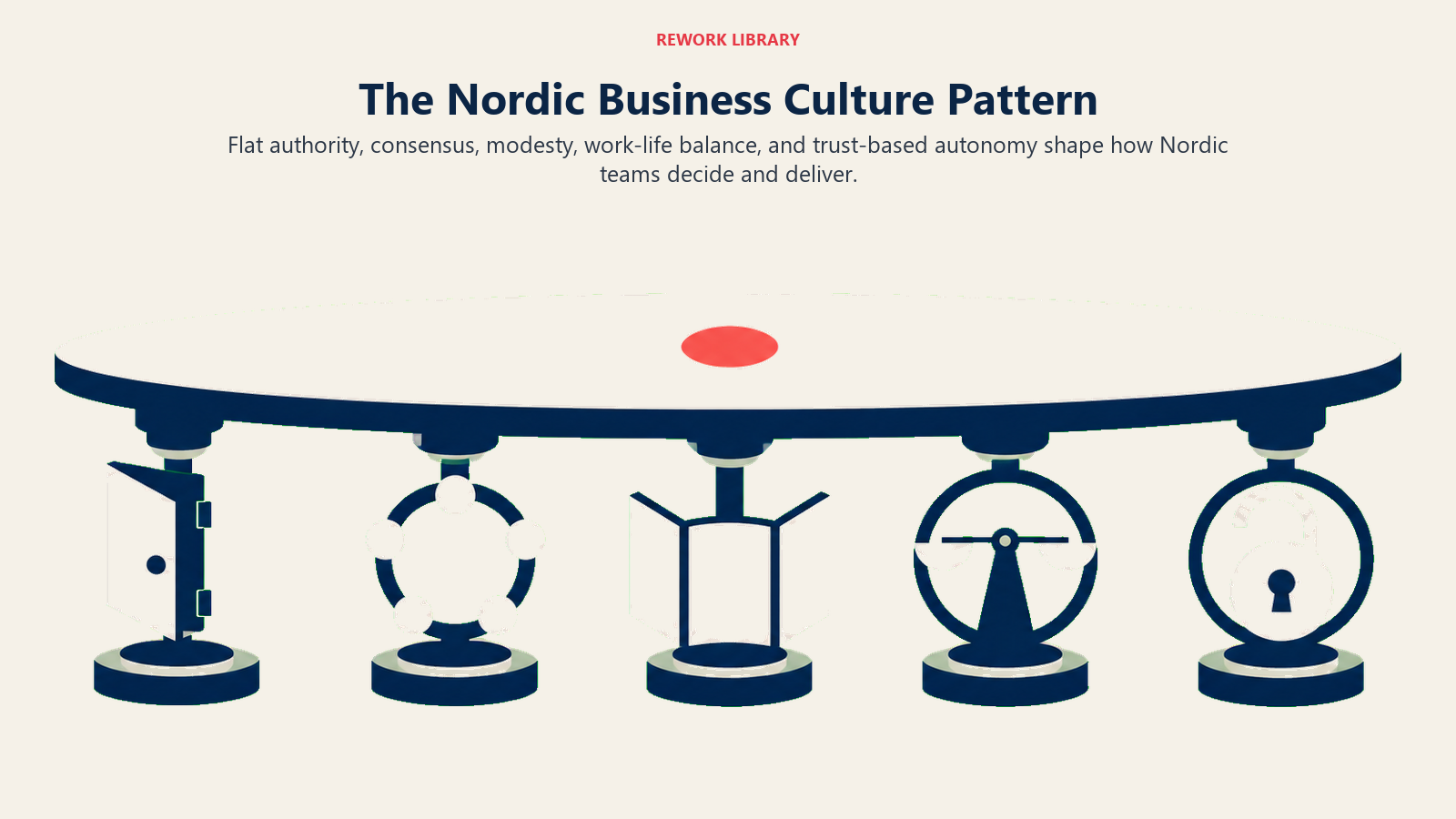
Authority is functional, not personal. A manager's job is to remove obstacles and hold the frame for a decision, not to be obeyed because of rank. Junior employees are expected to question a plan they think is wrong, in the room, by name, and a manager who reacts badly to that is the one seen as behaving unprofessionally.
Decisions move by consensus, and that takes real time. Before a decision is considered final, the people who have to carry it out are expected to have had a genuine say, not a token comment period. This is slower up front than a top-down call, and it is one of the most common frustrations foreign leaders report about the region. It is also why execution tends to be fast once a Nordic team commits: nobody is quietly resisting a decision they never bought into.
Status-seeking behavior is actively discouraged. Bragging about a win, name-dropping a title, or visibly outshining a colleague reads as a character flaw here in a way it does not elsewhere. The safest way to be seen as competent is to let the work speak and let colleagues do the crediting.
Work-life balance is a structural expectation, not a perk. Long parental leave, protected vacation time, and a genuine end to the working day are built into how these economies function, backed by labor law and social norms both sides take seriously. An employee who regularly works late is more often read as poorly organized than impressively committed.
Trust substitutes for supervision. Flat hierarchies and long working relationships mean employees are given real autonomy over how they get to an outcome, and micromanaging that autonomy is one of the fastest ways an outside manager damages trust with a Nordic team.
Two Ideas That Explain the Rest: Jante Law and Lagom
Two concepts, one Scandinavian-wide and one specifically Swedish, do more to explain daily Nordic business behavior than any single Hofstede score.
Janteloven, usually translated as the Law of Jante, comes from a 1933 Danish-Norwegian novel that satirized a fictional small town's unwritten social code: you are not to think you are better than anyone else, smarter than anyone else, or more important than anyone else. It has since become shorthand across Denmark, Norway, and to a real degree Sweden and Finland, for the cultural instinct to downplay individual achievement and avoid standing out. Nobody in the region enforces it as a literal rulebook, and plenty of Nordic professionals will roll their eyes at the term, but the underlying discomfort with visible self-promotion it describes is real and shows up constantly: in how people describe their own work in a performance review, in how rarely someone interrupts to take credit in a meeting, and in how odd an American-style highlight-reel LinkedIn post reads to a Nordic audience.
Lagom, a specifically Swedish word with no exact English equivalent, means something close to "just the right amount, not too much, not too little." It shows up in Swedish workplace behavior as a preference for balance and moderation over maximizing anything: a reasonable workday over a heroic one, a good-enough decision reached together over a perfect decision imposed from the top, a fair outcome over a winner-take-all one. Where Jante Law is mostly a social brake on standing out, lagom is closer to a positive operating philosophy: it is not just "don't show off," it is "the right amount is usually the better goal than the maximum."
Together, these two ideas explain why a strong individual performer in a Nordic office is often more effective being generous with credit and understated about their own role than by advocating loudly for themselves, and why decisions here tend to converge on solid, broadly acceptable outcomes rather than bold, individually championed ones.
The Hofstede Scores
| Country | Power Distance (PDI) | Individualism (IDV) | Masculinity (MAS) |
|---|---|---|---|
| Sweden | 31 | 71 | 5 |
| Denmark | 18 | 74 | 16 |
| Norway | 31 | 69 | 8 |
| Finland | 33 | 63 | 26 |
Source: geerthofstede.com, Hofstede's published country data. For the full six-dimension model behind these scores, see Hofstede's cultural dimensions explained. For how this region compares to the rest of the world, see how business culture differs across the world.
Sweden's Masculinity score of 5 is one of the lowest ever recorded by Hofstede's research anywhere in the world, the single number that best captures the region's caring-over-competing orientation. Every country in the table sits far below the global PDI midpoint of roughly 50 and far below the global MAS midpoint, which is why the shared "flat and cooperative" read holds across all four even before the country-level detail.
Key Facts
- Sweden's Masculinity score of 5 is among the lowest Hofstede has measured for any country, reflecting an unusually strong cultural preference for cooperation and quality of life over competition and status. Source: geerthofstede.com
- Denmark's Power Distance score of 18 is one of the lowest in the world, lower than every other Nordic country and far below the US (40) or UK (35). Source: Hofstede Insights country comparison tool
- Sweden mandates 480 days of paid parental leave per child, shared between parents, one of the most generous parental leave policies of any country, reflecting how deeply work-life balance is embedded in Nordic labor law rather than left to individual company policy. Source: Sweden.se, the official site of Sweden
- Finland has ranked first in the World Happiness Report for multiple consecutive years, with researchers citing high social trust and work-life balance among the contributing factors most relevant to how Finnish workplaces are organized. Source: World Happiness Report
- A Harvard Business Review analysis found 89% of white-collar workers surveyed across 90 countries said they at least occasionally work on global virtual teams that cross national borders, the exact setting where the Nordic region's consensus-driven pace most often collides with a faster-moving foreign counterpart. Source: hbr.org
How the Four Countries Differ
The shared pattern is real, but treating Stockholm, Copenhagen, Oslo, and Helsinki as interchangeable will get a leader into trouble. Each has its own texture.
Sweden: The Most Consensus-Driven
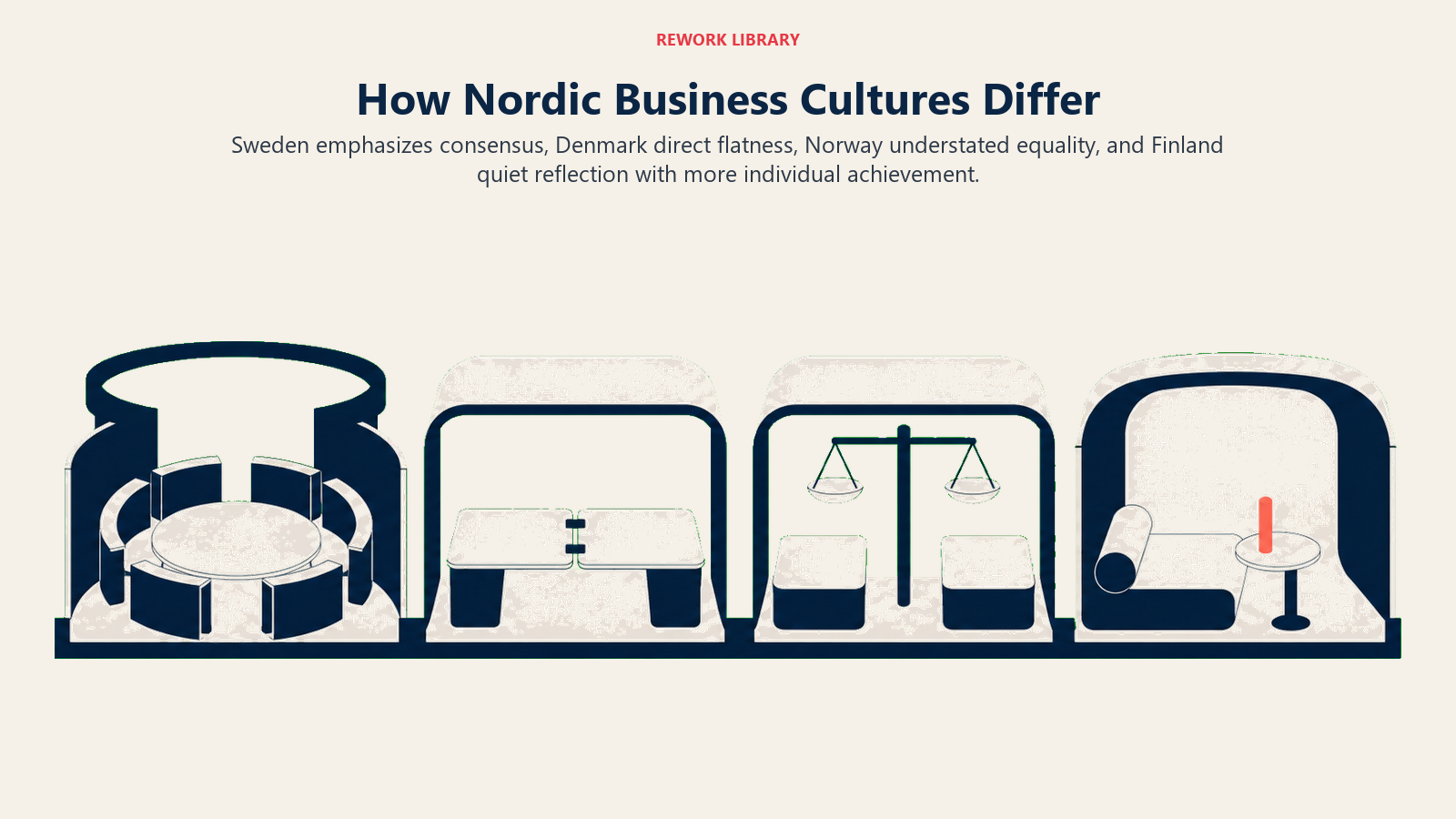
Sweden's near-zero Masculinity score and its attachment to lagom make it the most process-heavy consensus culture of the four. Swedish organizations are known for fika, a structured coffee break built into the workday that doubles as informal team alignment time, and for decision processes that can look painfully slow because so much genuine effort goes into building agreement before a decision is called final. Once that agreement exists, though, Swedish teams tend to execute with unusual cohesion, since almost nobody involved was quietly opposed to the plan.
Denmark: The Flattest and Most Direct
Denmark's PDI of 18, the lowest in the region, corresponds to workplaces that are almost aggressively informal by outside standards: first names for everyone regardless of title, open floor plans with no separate executive offices, and a willingness to disagree with a boss directly rather than working around them. Danish communication style also tends to be more direct and lower-context than Swedish or Finnish norms, closer in some ways to Dutch or German directness, which can read as blunt to a Norwegian or Finnish colleague before it reads as refreshingly clear to an American one.
Norway: Wealth Without Hierarchy
Norway pairs a PDI and IDV nearly identical to Sweden's with one of the world's highest per-capita levels of national wealth, largely from its sovereign oil fund, without the hierarchy or status display that wealth often produces elsewhere. Norwegian business culture places real weight on janteloven as a lived expectation, and conspicuous displays of wealth or seniority are more likely to draw quiet social cost than admiration. Decision-making in Norway follows the same consensus pattern as Sweden, often with slightly less formal process around it.
Finland: Quieter, More Reserved, Slightly Higher Masculinity
Finland is the outlier of the four on Masculinity, at 26, still low globally but noticeably higher than its neighbors, showing up as a somewhat greater tolerance for individual achievement and competitive framing. Finnish communication style is also distinct: comfortable with long silences in a meeting, sparing with small talk, and reluctant to fill quiet space just to seem sociable. A pause after a question in a Finnish meeting usually means someone is genuinely thinking before answering, and interrupting it too quickly is a common mistake foreign leaders make.
A Leader's Playbook for Managing Nordic Teams
Understanding the pattern only matters if it changes what happens in your next meeting, your next decision, and your next piece of feedback.
Stay Flat, and Mean It
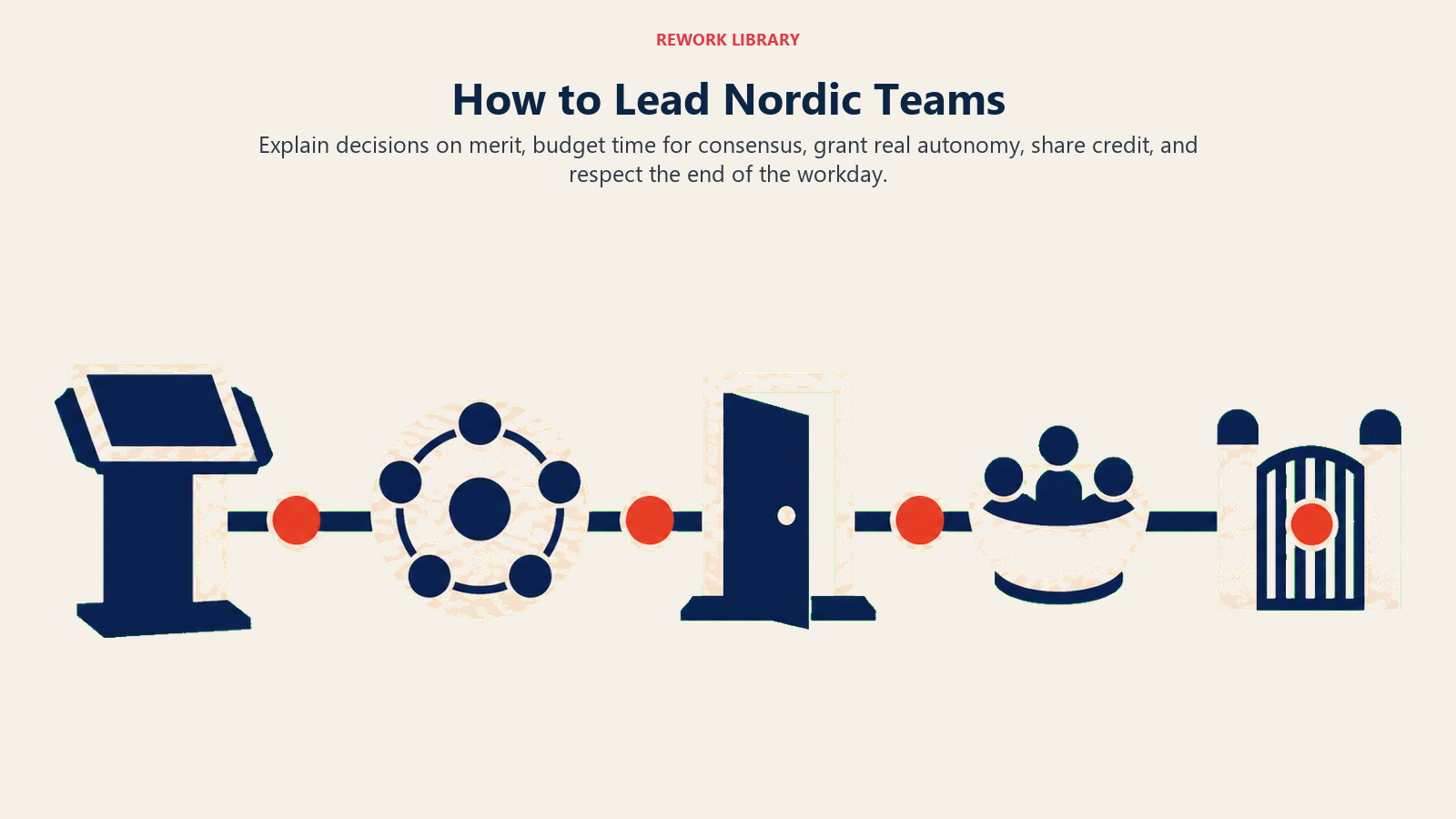
Do not lead with title, org chart position, or seniority as the reason a decision should stand. In a very low power distance culture, that reads as insecure rather than authoritative. State the reasoning behind a call and be prepared to defend it on the merits, because a Nordic team will test it regardless of who is asking. This is the same dynamic covered in hierarchical vs egalitarian cultures, and the Nordic region sits close to the egalitarian extreme on that spectrum.
Build in Real Time for Consensus
A decision process that looks slow by a top-down culture's standard is often the entire mechanism that makes Nordic execution reliable. Bring a draft, not a finished decision, to the people who will carry it out, and expect genuine debate before anything is considered locked. Rushing this step to hit an external deadline is one of the most common ways a foreign leader damages trust with a Nordic team, since it signals the consultation was never real. See consensus vs top-down decision cultures for the fuller mechanics.
Let Autonomy Do the Work Supervision Would Elsewhere
Once a Nordic employee understands the outcome expected of them, close oversight of how they get there tends to read as distrust rather than support. Set the destination clearly, check in at agreed points, and resist monitoring the process closely in between. Building trust in the workplace here is less about relationship-building rituals and more about proving, through restraint, that granted autonomy will not quietly be taken back.
Give Credit Generously, and Take It Sparingly
Praise a Nordic colleague's individual contribution in a group setting with care; the more effective move is often to credit the team and let the individual's role become apparent through the work itself. When describing your own contribution, understatement lands better than a confident self-summary would in a more individualist culture. Direct vs indirect feedback across cultures is useful background, though the Nordic style is direct in content but modest in self-reference, a combination that does not map cleanly onto either end of that spectrum.
Respect the End of the Workday, and Watch for Common Mistakes
Scheduling a call after normal working hours or treating a 4pm departure as a lack of commitment will cost more trust with a Nordic team than almost anything else on this list; the boundary is a structural, broadly shared labor-market norm, not a personal preference. Beyond that, pulling rank to force a decision through without consultation produces compliance without commitment, treating a quiet, understated team member as less capable than a vocal one is a frequent misread with Finnish and Norwegian colleagues, and assuming Denmark's directness extends to the whole region overlooks real differences that matter once you are running a cross-Nordic team.
Nordic Business Culture in the Age of AI
The Nordic region's low-hierarchy, high-trust model gives it an unusual starting position as AI tools and AI agents take on more day-to-day work. A culture that already grants employees real autonomy over how they reach an outcome tends to extend that same instinct to an AI teammate: judge the output, not the method, and trust the system to flag a problem rather than waiting to be checked on.
That trust-based default is not automatically an advantage. The consensus process that makes Nordic decision-making durable also takes time, and a market needing real-time AI-assisted decisions can find that too slow, an open tension the region has not resolved. There is also a Jante Law wrinkle worth naming: a culture that discourages standing out can make it harder for one person to advocate loudly for a new AI workflow or push back when an AI teammate gets something wrong, the same social brake that curbs individual ego working against initiative here instead. Leaders building ai-native culture on a Nordic team should watch for this: the region's comfort with autonomy is a real asset for human-agent teams, but its discomfort with individual visibility can slow the vocal experimentation early AI adoption often needs. Left unaddressed, that gap is one of the quieter ways AI cultural debt can build up in a culture that otherwise looks like a model environment for it.
For organizations running distributed teams that include Nordic offices alongside faster-decision-cycle markets, the operational side, consistent onboarding, visible time-off records, and clean handoffs between HR and local managers, is easier to run well when it respects those local norms by default. That is the kind of unglamorous consistency Rework's People app is built to support; it does not replace the cultural judgment above it.
Where to Go Next
This regional overview sits alongside the broader cross-cultural pillar in this collection. From here:
- How business culture differs across the world, for the full global map and a general leader's playbook
- Hofstede's cultural dimensions explained, for all six dimensions and scores across more countries
- Business culture in Western Europe, for how the Nordic pattern compares to its immediate European neighbors
- Hierarchical vs egalitarian cultures, for the fuller spectrum the Nordic region sits at the far end of
- Managing a multicultural team, for leading across the Nordic pattern alongside other regional styles
Frequently Asked Questions about Nordic Business Culture
What do Sweden, Denmark, Norway, and Finland have in common in business culture?
All four score very low on Hofstede's Power Distance and Masculinity dimensions, producing a shared pattern of flat hierarchy, decision-making by consensus, discomfort with individual self-promotion, and a strong structural commitment to work-life balance backed by labor law rather than left to individual companies.
What is Jante Law and why does it matter for business?
Janteloven, the Law of Jante, is a Scandinavian social norm discouraging people from acting as though they are better, smarter, or more important than others. In business, it shows up as understated self-description, generous crediting of the team over the individual, and discomfort with visible self-promotion, all of which change how feedback, performance reviews, and personal advocacy should be handled with Nordic colleagues.
What does lagom mean and how does it show up at work?
Lagom is a Swedish concept meaning roughly "just the right amount, not too much, not too little." In a Swedish workplace it favors balance and moderation over maximizing, a reasonable workday over a heroic one, a broadly acceptable decision reached together over a perfect one imposed from the top.
How are Sweden, Denmark, Norway, and Finland different from each other?
Sweden is the most consensus-process-driven, with structured rituals like fika. Denmark has the flattest hierarchy and the most direct communication style. Norway pairs Sweden-like consensus with a strong lived expectation around Jante Law despite significant national wealth. Finland is the most reserved, comfortable with silence, and has a slightly higher tolerance for individual achievement than its neighbors.
How should a leader make decisions with a Nordic team?
Bring a draft rather than a finished decision, involve the people who will carry it out before calling it final, and expect real debate rather than a token comment period. This takes longer up front than a top-down call, but Nordic teams tend to execute what they helped decide with unusual cohesion once the decision is made.
Is it rude to disagree with a manager in a Nordic workplace?
No, the opposite is often true. In a very low power distance culture, staying silent when you disagree is more likely to be read as unhelpful than as respectful. Employees are generally expected to raise disagreement directly and by name in the room, and a manager who reacts badly to that is usually the one seen as behaving unprofessionally.
Does Nordic work-life balance mean Nordic teams work less hard?
No. Protected working hours and generous parental leave describe how time is structured, not how much effort or output is expected within it. Treating a colleague who leaves at a fixed hour as less committed than one who stays late is a common and costly misread of the culture.
How is AI changing Nordic business culture?
The region's existing comfort with employee autonomy extends naturally to trusting AI tools and AI agents to handle parts of the work without close supervision. The open tension is that the same consensus process that makes Nordic decisions durable can be too slow for fast-moving AI-assisted work, and the same social discomfort with standing out that curbs individual ego can also make it harder for someone to push visibly for a new AI workflow or flag a problem loudly.
The Nordic region is not one flat culture wearing four flags, but the pattern holds tightly enough that a leader who understands consensus, trust-based autonomy, and the quiet discomfort with standing out will get more right walking into Stockholm, Copenhagen, Oslo, or Helsinki for the first time than one who expects a European variant of a top-down culture. The pattern is the starting hypothesis. The specific team in front of you will fill in the rest.

Co-Founder, Rework.com
On this page
- The Shared Pattern: Flat, Consensus-Driven, High Trust
- Two Ideas That Explain the Rest: Jante Law and Lagom
- The Hofstede Scores
- Key Facts
- How the Four Countries Differ
- Sweden: The Most Consensus-Driven
- Denmark: The Flattest and Most Direct
- Norway: Wealth Without Hierarchy
- Finland: Quieter, More Reserved, Slightly Higher Masculinity
- A Leader's Playbook for Managing Nordic Teams
- Stay Flat, and Mean It
- Build in Real Time for Consensus
- Let Autonomy Do the Work Supervision Would Elsewhere
- Give Credit Generously, and Take It Sparingly
- Respect the End of the Workday, and Watch for Common Mistakes
- Nordic Business Culture in the Age of AI
- Where to Go Next