Business Culture in South Asia: India and Beyond
Turn this article into takeaways for your work.


Each assistant summarizes the article only for you and suggests best practices for your work.
Updated August 2026
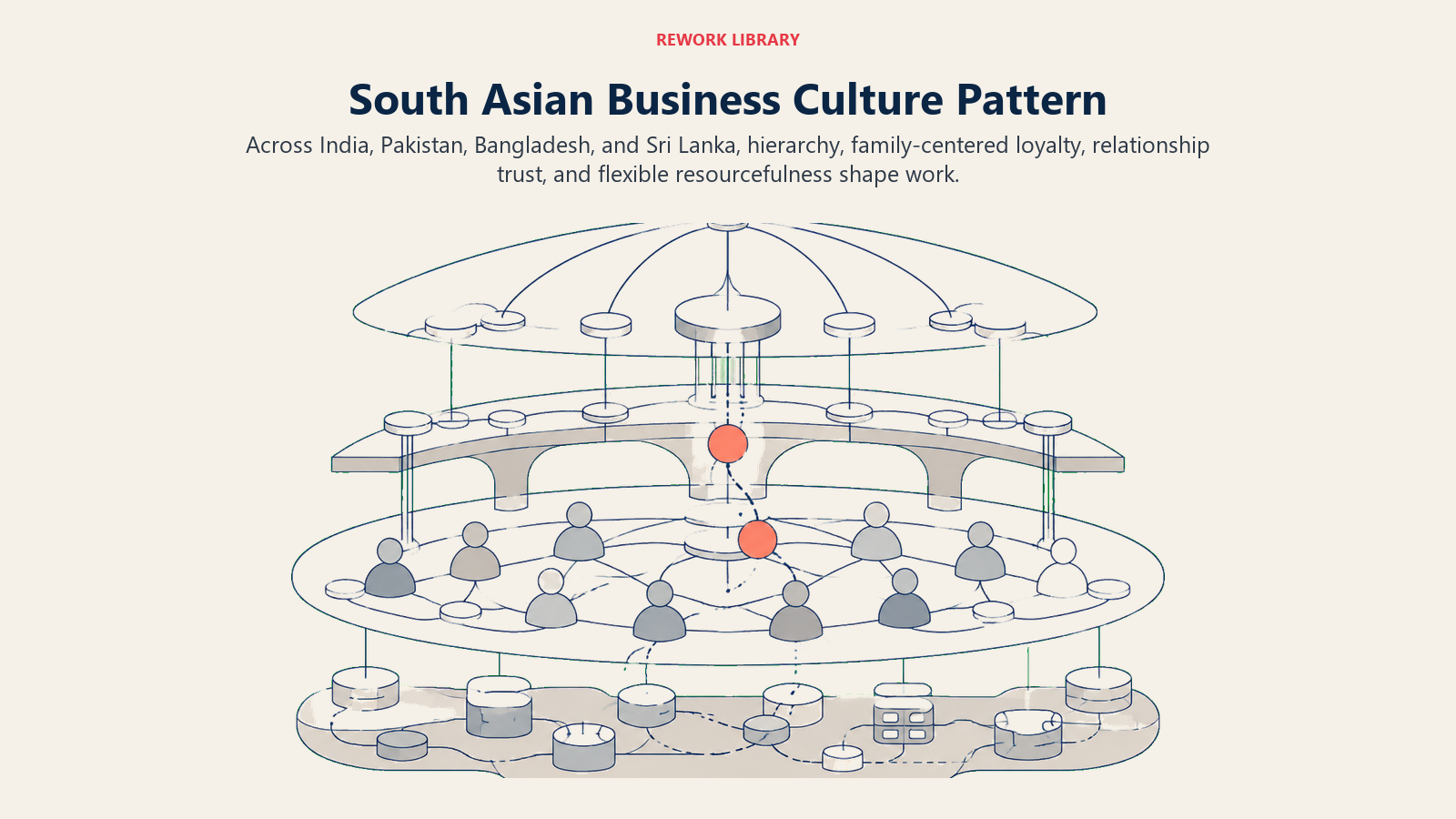
Business culture in South Asia, led by India as the region's largest economy and workforce, follows a recognizable pattern: high power distance, family-centered collectivism, relationship before transaction, and a flexible, resourceful approach to problems and deadlines known in India as jugaad. Pakistan and Bangladesh share the same hierarchical, group-first defaults with their own local texture, and Sri Lanka runs on a similar logic even without formal Hofstede scores of its own.
That pattern shows up constantly in how global companies experience the region. A Bangalore engineering team that says "yes, no problem" to a deadline that later slips by two weeks. A Karachi vendor who wants a shared meal before signing anything. A Dhaka report that routes every real concern through the department head rather than straight to the client. None of these are random. They are the same regional default surfacing in different offices, and a leader who understands it gets ahead of the friction instead of reacting to it after the fact.
This guide focuses mainly on India, by far the largest market in the cluster, while touching on how Pakistan, Bangladesh, and Sri Lanka fit the same broad pattern and where they diverge. It also carries a caveat that matters more here than almost anywhere else in this collection: India's internal diversity is so large that "Indian business culture" is itself a simplification worth handling carefully.
The Shared Pattern: Hierarchy, Family, and Flexibility
South Asia is not one culture. India alone spans dozens of languages, several major religions, and norms that shift between a Mumbai finance firm and a Chennai manufacturing plant. Still, the countries in this cluster, India, Pakistan, Bangladesh, and Sri Lanka, sit closer together than they do to Western or East Asian defaults on the dimensions that shape how work gets done.
| Country | Power Distance (PDI) | Individualism (IDV) | Pattern |
|---|---|---|---|
| India | 77 | 48 | High hierarchy, moderate individualism |
| Bangladesh | 80 | Low (collectivist) | High hierarchy, family-centered |
| Pakistan | 55 | 14 | Moderate-high hierarchy, strongly collectivist |
| Sri Lanka | No official Hofstede score | No official Hofstede score | Regionally similar in practice |
Source: geerthofstede.com for India; Hofstede Insights country comparison tool for Pakistan and Bangladesh. Hofstede's original research did not independently score Sri Lanka, so treat its position as directional, based on the same regional and religious threads that shape its neighbors, not a published statistic. For the full six-dimension model behind these scores, see Hofstede's cultural dimensions explained. For how the region compares globally, see how business culture differs across the world.
India's full profile is unusually distinctive within the pattern. Alongside a high PDI of 77, India scores 48 on individualism (roughly the global midpoint, higher than almost every other Asian economy), 56 on motivation toward achievement, a notably low 40 on uncertainty avoidance, an intermediate 51 on long-term orientation, and a restrained 26 on indulgence. That mix, high hierarchy paired with comfort around ambiguity and an achievement-oriented work ethic, helps explain why India runs both rigid family businesses and famously improvisational startups at the same time. Pakistan and Bangladesh sit closer to the fully collectivist end, tracking with how much more decision-making there flows through extended family and community rather than the individual.
Why the Pattern Runs Deep
The shared thread has less to do with any single religion (Hinduism, Islam, and Buddhism are all dominant somewhere in this cluster) and more to do with centuries of joint-family social structure, colonial-era administrative hierarchy, and economies built around large family-owned conglomerates rather than diffuse shareholder capitalism. A career choice is still commonly a family decision, not a purely individual one, and a boss is expected to look after a team's welfare closer to a senior family member than a Western manager's arm's-length professionalism. That paternalistic-but-caring dynamic is the emotional core a Western leader most often misreads as weakness or overreach, when it is neither.
The India Caveat: One Country, Many Cultures
Before applying anything below uniformly, it is worth sitting with how large India's internal variation actually is. India's Constitution recognizes 22 scheduled languages, and the 2011 Census recorded 121 languages and 270 distinct mother tongues. A team in Bangalore, working in English and Kannada with a strong engineering culture, can differ meaningfully from a family business in Ahmedabad or a team in Kolkata. Religion (a large Hindu majority alongside the world's third-largest Muslim population, plus Sikh, Christian, Jain, and Buddhist communities), state-level history, and urban-versus-rural background all shape how the national pattern plays out in a given office. Treat what follows as the center of gravity, not a fixed rule, and adjust once you know the specific city, industry, and company you are working with.
Key Facts
- India's Hofstede profile combines a high Power Distance score of 77 with a moderate Individualism score of 48, a combination that is unusual in Asia and helps explain why hierarchy and personal initiative coexist more comfortably in Indian workplaces than in most neighboring cultures. Source: geerthofstede.com
- Pakistan (Individualism 14) and Bangladesh score among the more strongly collectivist cultures Hofstede has measured, reflecting how much decision-making in both countries runs through extended family and community rather than the individual. Source: Hofstede Insights country comparison tool
- India's Constitution lists 22 officially scheduled languages, and the 2011 Census of India recorded 121 languages and 270 mother tongues spoken nationwide, the scale of internal linguistic diversity behind the caveat that "Indian business culture" is a simplification. Source: Department of Official Language, Ministry of Home Affairs
- India was home to roughly 1,760 Global Capability Centers by the end of 2025, employing more than 1.9 million professionals in global engineering, AI, and product roles, with the sector projected to grow past $100 billion by 2030. Source: Zinnov
- The GLOBE study, one of the largest cross-cultural leadership research projects ever conducted, surveyed roughly 17,000 middle managers across 950 organizations in 62 societies, including India and other South Asian nations, to map how culture shapes leadership expectations. Source: globeproject.com
The Business Norms That Follow From the Pattern
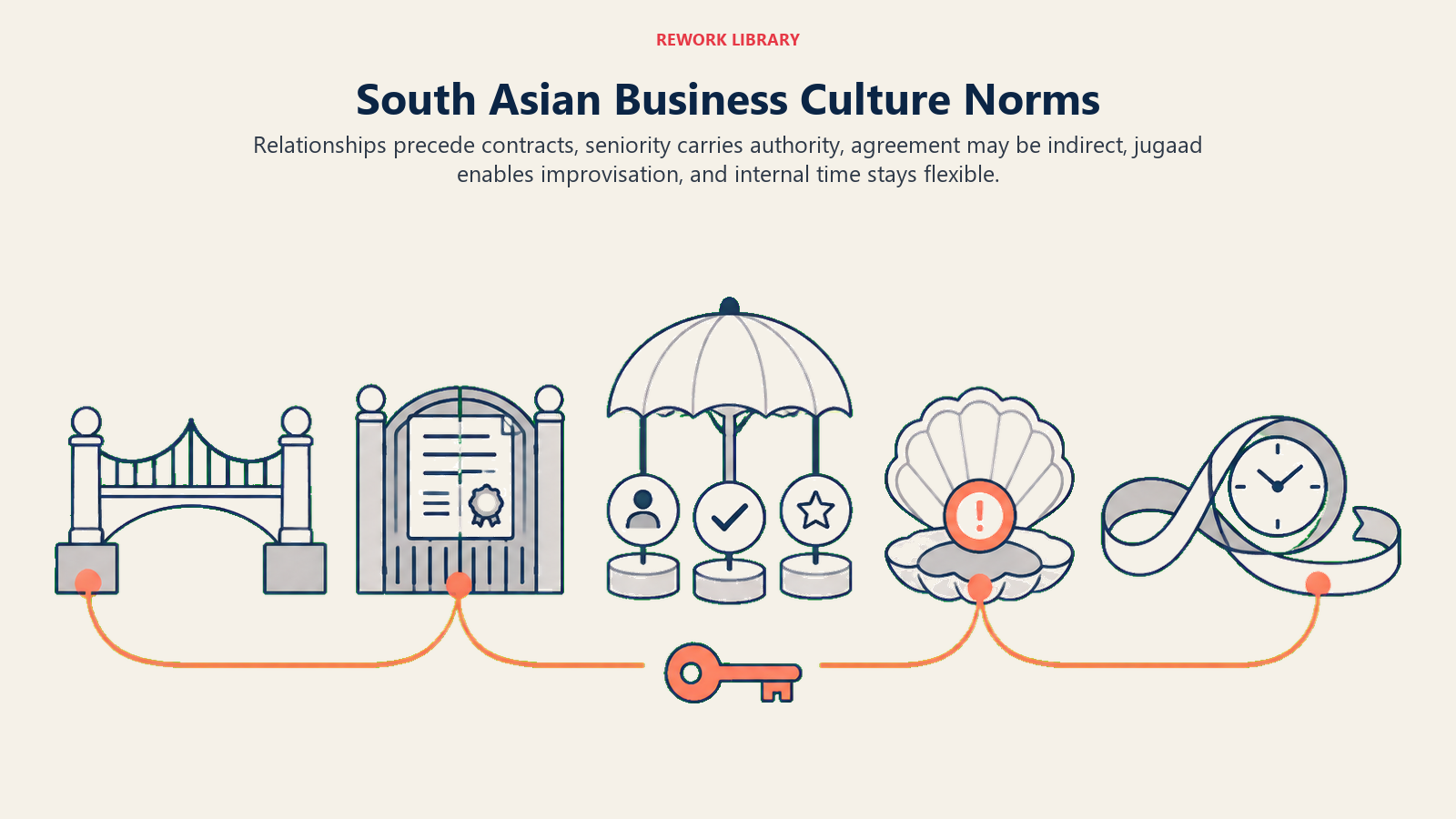
Once the scores are in view, a specific set of workplace habits follows almost automatically, and these are the ones that most often surprise a leader new to the region.
Relationships Come Before the Contract
A business relationship is expected to have some personal foundation before the transactional part begins in earnest. A first meeting that is mostly small talk, questions about family, and general goodwill is not a delay, it is the mechanism by which two parties decide they can trust each other. Vendors frequently expect a call or an in-person visit before a contract, not just an email thread, and skipping straight to terms can read as cold. See relationship-first vs. task-first cultures for the full spectrum India sits on.
Hierarchy and the Boss's Word
Seniority carries real, visible weight. The most senior person present is expected to have the final say even if they spoke last, and a decision without visible sign-off from the right level of seniority is often treated as provisional even after it was technically approved. This produces a workplace where a junior employee's job is partly to protect a senior person from bad news arriving too bluntly. For the mechanics across meetings and reporting lines, see hierarchical vs. egalitarian cultures.
The Indirect Yes
This is the single habit that causes the most friction for Western managers working with Indian, Pakistani, or Bangladeshi teams. A verbal "yes," "sure," or "no problem" in a meeting often signals a wish to keep the relationship smooth rather than a firm commitment. The real signal is what happens next: does a follow-up message confirm specifics, does a date get written down, does the person ask a clarifying question that shows real intent to act. Leaders who ask "walk me through how you'll do that" instead of "can you do that by Friday" get a more honest answer, because it invites detail instead of a reflexive agreement. This connects to why teams stay silent in meetings and the broader research on direct vs. indirect feedback across cultures.
Jugaad: Resourceful, Flexible Problem-Solving
Jugaad is a Hindi-Urdu term, widely used across Indian business, for an improvised, resourceful fix built from whatever is available rather than the textbook-correct solution. It shows up in engineering workarounds, sales tactics, and how a small team stretches a limited budget to hit a target anyway. Researchers Navi Radjou, Jaideep Prabhu, and Simone Ahuja popularized the concept for a global audience in their book Jugaad Innovation, framing it as a legitimate innovation model rather than a shortcut to train out of people. To a process-first leader, jugaad can look like corner-cutting. In practice it is usually why a resource-constrained team still hits the outcome, so the tension worth managing is knowing when its flexibility helps and when a firmer process needs to wrap around it (compliance, security, anything with legal exposure).
Time Is Negotiable
Punctuality expectations run looser than in Germany, Japan, or the US, outside client-facing roles. The self-deprecating phrase "Indian Standard Time" describes meetings routinely starting ten or fifteen minutes late without anyone treating it as disrespectful. That is not the same as missing a hard external deadline, which Indian professionals, especially in IT and services, generally treat seriously. A leader who conflates loose internal start times with client-facing delivery dates will either over-tolerate real slippage or over-police harmless flexibility.
India as a Global Services and AI Hub
India's scale as a destination for outsourced and now AI-augmented knowledge work is central to why this cluster matters so much to global leaders. The country built the world's largest IT services and business-process outsourcing industry over three decades, a base that has evolved into roughly 1,760 Global Capability Centers, in-house global teams for multinational corporations spanning software engineering to finance to AI research, employing more than 1.9 million professionals by the end of 2025, with the sector on track to cross $100 billion by 2030.
That scale means a huge share of global companies now manage at least part of their engineering, support, or operations function through an Indian team, a dedicated GCC, an outsourced vendor, or a hybrid of both. The cultural pattern above, hierarchy, the indirect yes, relationship-building, jugaad, is not an abstract curiosity for these leaders. It is the operating environment a meaningful share of their own headcount already works inside.
The honest AI-era note is that India is positioning itself as a leader in applied AI delivery, not just traditional services, with a growing share of new Global Capability Centers built AI-first. That shift does not erase the underlying cultural pattern. An AI agent doing a first pass on code review or a support ticket still gets deployed inside a human team that expects hierarchy respected and a "yes" checked rather than taken at face value. Leaders building ai-native culture into an Indian team should expect people to describe an AI teammate's mistakes through the same softened language used for a human colleague's. The risk of AI cultural debt, unclear norms about when an agent's output gets double-checked, compounds where junior staff are already less likely to flag that something looks wrong. For the broader shift toward blended human-agent teams, see the Frontier Firm and the agent boss.
A Leader's Playbook for Managing or Outsourcing to India
Understanding the pattern only pays off once it changes what you actually do in a meeting, a status update, or a vendor negotiation. Here is how to apply it.
Build a Real Feedback Channel, Not Just an Open-Door Policy
An open invitation to "raise concerns anytime" will not surface much in a high-power-distance culture, because the invitation itself does not remove the social cost of using it. Set up a specific, lower-cost channel: a private message after a call, a one-on-one where concerns are explicitly solicited, or an anonymous form for anything sensitive. Treat silence in a group setting as a structural signal, not a personality trait, the same conclusion this collection reaches in why teams stay silent in meetings.
Verify Commitments, Don't Just Collect Agreement
Replace "can you have this by Friday?" with "walk me through the steps to get this done by Friday." The second question invites the detail a reflexive "yes" skips over, and gives a team member an easy, face-saving way to flag a real obstacle. Following up in writing with a specific date and owner, rather than relying on the verbal agreement, closes the gap between a polite yes and an actual commitment.
Deliver Feedback Through the Hierarchy, Privately
Direct, public correction that works in a low-power-distance culture can cost real standing here. Give the same substantive feedback, but privately, and where the org chart makes it natural, through the person's direct manager rather than skipping a level. Lead with what is genuinely working before addressing the gap. The framework in direct vs. indirect feedback across cultures applies directly here.
Invest Relationship Time Before the Ask
Budget real time, a call that starts with genuine catch-up, an in-person visit before a major deal, a shared meal with a long-term vendor, before the transactional agenda. This is the mechanism that makes the rest of the relationship function smoothly, and skipping it tends to slow everything that follows. See relationship-first vs. task-first cultures for how this trades off against a task-first default.
Give Jugaad Room, With Guardrails Around What Cannot Bend
Resourceful, improvised problem-solving is a genuine strength across the region, and standardizing it out entirely tends to remove the adaptability that made a team effective under real constraints. Draw an explicit line around the handful of things that cannot flex, security, compliance, anything with legal exposure, and let flexibility operate everywhere else.
Common Mistakes to Avoid
Treating a quick "yes" as a firm, unverified commitment leads to deadlines that quietly slip without anyone having technically lied. Correcting someone publicly, even gently, costs more trust here than in most Western contexts. Assuming all of India behaves like the one city or company you have worked with before ignores how much the country's internal diversity matters. And treating relationship-building time as a delay to minimize, rather than the foundation the relationship rests on, tends to slow deals down rather than speed them up.
Where to Go Next
This regional overview sits alongside the broader cross-cultural pillar in this collection. From here:
- How business culture differs across the world, for the full global map and a general leader's playbook
- Hofstede's cultural dimensions explained, for all six dimensions and scores across more countries
- Business culture in Southeast Asia, for the neighboring region's own high-hierarchy, relationship-first pattern
- Managing a multicultural team, for leading across several of these patterns at once
- The Culture Map, explained, for Erin Meyer's framework on reading feedback and communication style
- Country-specific guides for India's states and for Pakistan, Bangladesh, and Sri Lanka individually are planned as this collection expands
Frequently Asked Questions about Indian and South Asian Business Culture
What are the main traits of Indian business culture?
Indian business culture combines high power distance (deference to seniority and hierarchy), moderate individualism, relationship-first dealmaking, an indirect communication style around disagreement and commitments, and jugaad, a resourceful, improvised approach to solving problems within real constraints.
What is jugaad in Indian business culture?
Jugaad is a Hindi-Urdu term for an improvised, resourceful fix built from whatever is available rather than a textbook-correct solution. It is widely used across Indian engineering, sales, and operations, and management researchers have written about it as a legitimate innovation model rather than a shortcut to eliminate.
Why do Indian employees say yes even when they mean maybe?
In a high power-distance, relationship-focused culture, a verbal "yes" often signals a wish to keep the interaction smooth rather than a firm commitment. Leaders get a more accurate answer by asking for the steps involved in meeting a deadline rather than a yes-or-no confirmation, and by confirming specifics in writing afterward.
How similar are Pakistan, Bangladesh, and Sri Lanka to Indian business culture?
All four countries share a broadly hierarchical, collectivist pattern, high power distance and strong group-first decision-making, but they are not interchangeable. Pakistan and Bangladesh score even more strongly collectivist than India on Hofstede's individualism scale, and Sri Lanka has no official Hofstede score at all, so its position is inferred from the same regional and religious threads rather than measured directly.
Is Indian business culture the same across the whole country?
No. India's Constitution recognizes 22 scheduled languages, and the 2011 Census recorded 121 languages and 270 mother tongues nationwide. Religion, state-level history, industry, and urban-versus-rural background all shape how the shared national pattern plays out in a specific team, so treat the national pattern as a starting hypothesis rather than a fixed rule.
Why does India matter so much for global outsourcing and Global Capability Centers?
India built the world's largest IT services and outsourcing industry over three decades, evolving into roughly 1,760 Global Capability Centers employing more than 1.9 million professionals by the end of 2025, with the sector projected to cross $100 billion by 2030. A large share of global companies now run part of their engineering, support, or operations work through an Indian team.
How should feedback be delivered to teams in India or South Asia?
Keep the substance direct but change the delivery. Give feedback privately rather than in front of peers, lead with what is working before addressing what needs to change, and route it through the person's direct manager where the hierarchy makes that the expected channel, rather than skipping a level of seniority.
How is AI changing business culture in India?
India is positioning itself as a leader in applied AI delivery, with a growing share of new Global Capability Centers built AI-first. The underlying cultural pattern carries over rather than disappearing: teams still describe an AI teammate's mistakes through the same indirect, face-preserving language they use for a human colleague's mistakes, so leaders should build explicit norms for when AI output gets double-checked rather than assuming the pattern resolves itself.
What is the biggest mistake a Western leader makes managing an Indian team?
Treating a quick verbal "yes" as a confirmed commitment without checking for follow-up detail is the most common and most costly habit, closely followed by correcting someone publicly in front of peers and assuming one city's or company's culture represents the entire country.
India is not one culture behind one border, and the differences between a Bangalore product team, a Karachi trading house, and a Dhaka garment exporter are real. But the shared pattern, hierarchy that expects respect, relationships before the deal, a "yes" that needs a second look, and a resourcefulness that gets the job done even when the process does not quite fit, holds well enough across the region to be worth learning before your next call, not after the deadline you thought was confirmed quietly slips.

Co-Founder, Rework.com
On this page
- The Shared Pattern: Hierarchy, Family, and Flexibility
- Why the Pattern Runs Deep
- The India Caveat: One Country, Many Cultures
- Key Facts
- The Business Norms That Follow From the Pattern
- Relationships Come Before the Contract
- Hierarchy and the Boss's Word
- The Indirect Yes
- Jugaad: Resourceful, Flexible Problem-Solving
- Time Is Negotiable
- India as a Global Services and AI Hub
- A Leader's Playbook for Managing or Outsourcing to India
- Build a Real Feedback Channel, Not Just an Open-Door Policy
- Verify Commitments, Don't Just Collect Agreement
- Deliver Feedback Through the Hierarchy, Privately
- Invest Relationship Time Before the Ask
- Give Jugaad Room, With Guardrails Around What Cannot Bend
- Common Mistakes to Avoid
- Where to Go Next