Business Culture in Latin America: A Leader's Guide
Turn this article into takeaways for your work.


Each assistant summarizes the article only for you and suggests best practices for your work.
Updated August 2026
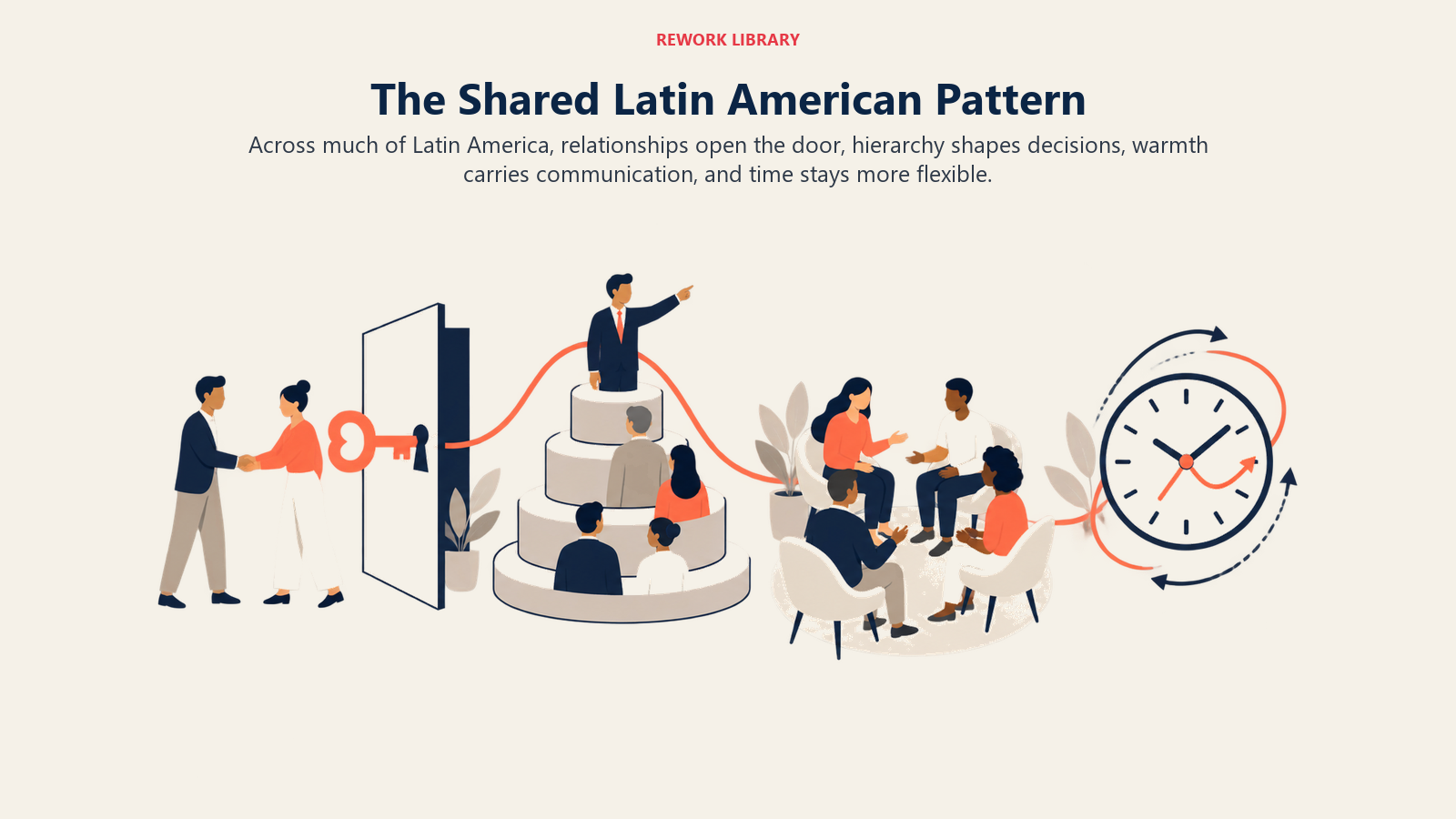
Business culture in Latin America shares a recognizable pattern across Brazil, Mexico, Argentina, and Colombia: relationships come before transactions, hierarchy is respected more than it is questioned, warmth and personal connection shape how business gets done, and time is treated as flexible rather than fixed. Argentina leans more egalitarian and direct than its neighbors, but the region still clusters far closer together than it does to the United States or Northern Europe.
That single pattern explains more than most outside leaders expect going in. A Sao Paulo client who wants to talk about your family before the contract, a Mexico City meeting that starts twenty minutes late without anyone treating that as a problem, a Bogota manager who routes a disagreement through a private conversation instead of raising it in the room: these are not isolated quirks. They are the same regional default surfacing in different offices. This guide covers the shared pattern, where four of the region's largest economies sit on it, the local concepts behind it, how Brazil, Mexico, and Argentina differ in practice, and a working playbook for leading across the region.
A note on scope. Latin America is not one culture. It spans Portuguese-speaking Brazil and eighteen Spanish-speaking countries, indigenous, African, and European heritages in wildly different proportions market to market, and economies ranging from commodity-driven Argentina to manufacturing-heavy Mexico. This is a regional map built around four of its largest economies, not a substitute for local knowledge. Treat what follows as the starting hypothesis, not the final word on any single market.
The Shared Pattern: Relationship-First, Hierarchical, Warm, and Flexible on Time
Cross-cultural researchers describe Latin America's dominant business orientation with a term that shows up across the literature: personalismo, the idea that business is conducted between people who trust each other personally, not between abstract institutions or job titles. Trust is earned face to face, decisions concentrate at the top even where org charts look flat, and the emotional register of a meeting, warmth, humor, genuine interest in the other person, matters as much as the agenda.
Layered on top of personalismo is a second thread: collectivism rooted in family. Extended family and close personal networks function as the primary unit of loyalty in most of the region, and that logic extends into how businesses are run and staffed. A family-owned company is not an exception in Latin America; across much of the region it is closer to the default model for mid-size and even large businesses.
| Country | Power Distance (PDI) | Individualism (IDV) | Pattern |
|---|---|---|---|
| Mexico | 81 | 30 | Hierarchical, collective |
| Brazil | 69 | 38 | Hierarchical, collective |
| Colombia | 67 | 13 | Hierarchical, collective |
| Argentina | 49 | 46 | More egalitarian, more individualist, still relationship-driven |
Source: geerthofstede.com, Hofstede's published country data. For the full six-dimension model behind these two scores, see Hofstede's cultural dimensions explained. For how this region compares to the rest of the world, see how business culture differs across the world.
Three of the four countries sit well above the global PDI midpoint of roughly 50 and well below the global IDV midpoint, the same hierarchical, collectivist combination found across much of Southeast Asia and East Asia, though the underlying mechanism, personalismo and family loyalty rather than face and group harmony, plays out differently. That combination produces defaults a leader from a low-PDI, individualist culture should expect walking into Mexico City, Sao Paulo, or Bogota:
Decisions concentrate at the top, and often in one family. Even with a modern org chart, the real decision often rests with a founder or a small inner circle whose authority does not fully show up on paper.
Warmth is not small talk, it is the mechanism of trust. A meeting that opens with personal conversation before the agenda is not wasted time; it is how two people decide whether they can rely on each other.
Time is treated as flexible, not fixed. Meetings starting late and several things happening at once are closer to the norm than the exception, a pattern Edward T. Hall classified as polychronic time, in contrast to the fixed, sequential, monochronic time common in the US, Germany, and the UK.
Hierarchy shapes how disagreement gets voiced. Open pushback against a superior is less common than in egalitarian cultures; concerns travel through private conversation or a trusted intermediary instead.
Why the Region Clusters This Way
A shared colonial history explains a meaningful part of the pattern. Spanish and Portuguese administration exported hierarchical, centralized governance across the region for roughly three centuries, and the Catholic Church's communal, family-centered ethic reinforced collectivist norms across nearly every country Spain and Portugal colonized. Neither cause fully explains the pattern alone, and each country layered its own indigenous, African, and immigrant influences on top at different rates. What matters for a working leader is that the pattern is consistent, and different enough from Anglo-American and Northern European defaults, to plan around deliberately.
Argentina: The Regional Outlier
Argentina sits in a genuinely different spot than its neighbors: a PDI of 49, close to the global midpoint and closer to the US (40) than to Mexico (81), paired with an IDV of 46, the highest of the four countries here. Heavy European, mostly Italian and Spanish, immigration in the late nineteenth and early twentieth centuries shaped an Argentine business culture that still values relationships and warmth in the regional style but tolerates far more open debate and direct disagreement than Mexico, Brazil, or Colombia typically do. A leader who treats Buenos Aires the way they treat Mexico City, expecting the same deference to hierarchy and reluctance to disagree openly, will consistently misread the room.
Key Facts
- Mexico's Power Distance score of 81 is among the highest Hofstede has measured in the Americas, while Colombia's Individualism score of 13 places it among the most collectivist cultures in his global dataset. Source: geerthofstede.com
- Argentina's Individualism score (46) is more than three times Colombia's (13), the widest gap in this comparison, and a concrete reason "Latin America" is not one interchangeable market. Source: Hofstede Insights country comparison tool
- Latin America and the Caribbean's combined population exceeds 650 million people across more than 30 countries and territories. Source: World Bank
- The GLOBE study surveyed roughly 17,000 middle managers across 950 organizations in 62 societies, including several Latin American nations, and consistently found the region clustering high in both power distance and in-group collectivism. Source: globeproject.com
- A Harvard Business Review analysis found 89% of white-collar workers surveyed across 90 countries said they at least occasionally work on global virtual teams, the exact setting where Latin America's relationship-first pattern most often meets an unprepared task-first manager. Source: hbr.org
The Local Concepts Behind the Pattern
The shared regional pattern is real, but these four countries are not interchangeable. Each has its own vocabulary for how trust, warmth, and hierarchy actually operate day to day, and a leader who learns even one of these concepts will read a room more accurately than one who only knows the Hofstede scores.
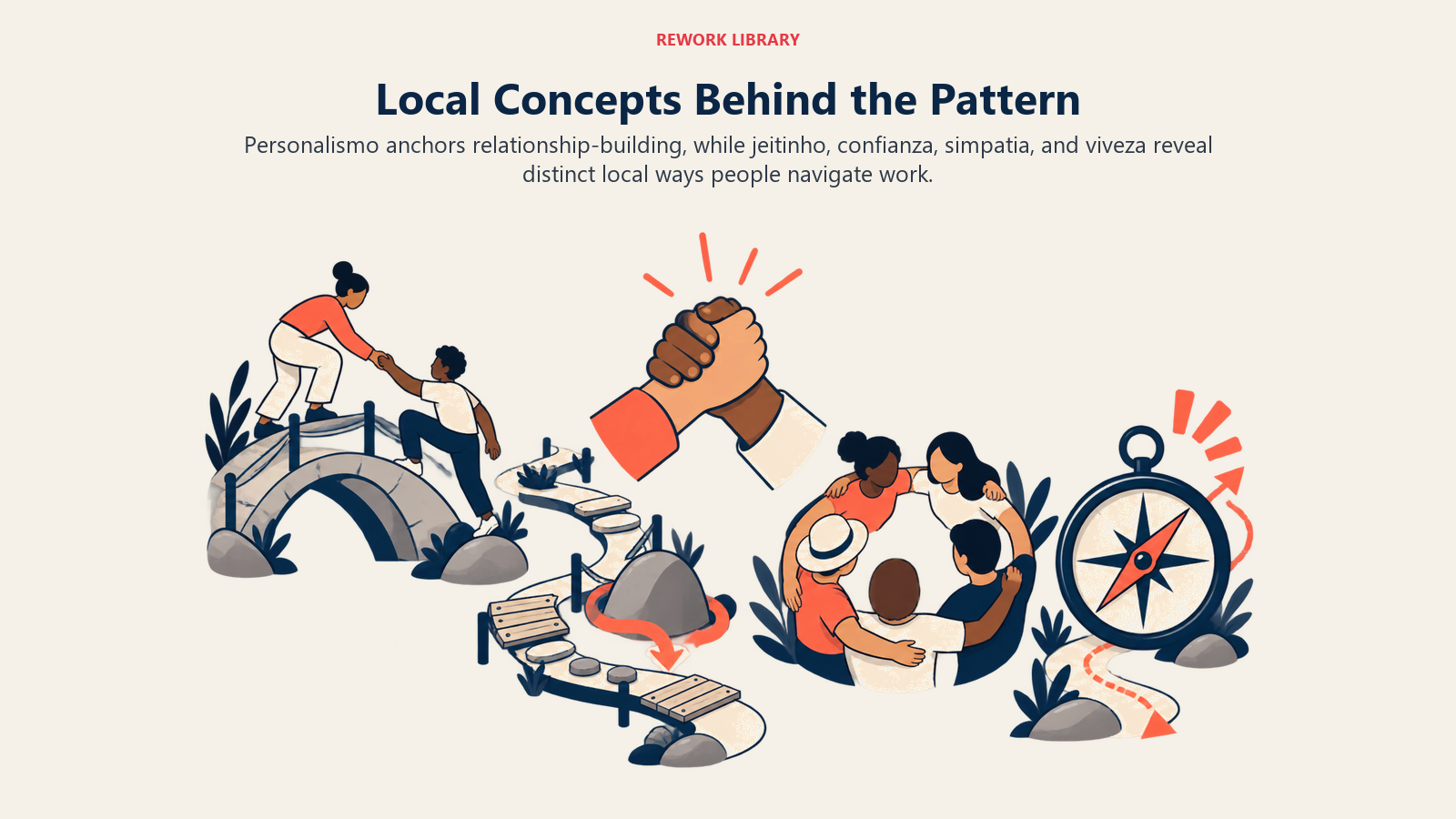
Across nearly the whole region, personalismo is the master concept: business relationships run through personal trust in an individual, not through the institution that person represents. A contract does not replace a relationship in Latin American business culture; it formalizes one that already needed to exist first.
In Brazil, the closest everyday expression is jeitinho brasileiro, a resourceful, informal way of working around a rigid rule through personal connections and creative improvisation, affectionately embraced as a national trait and occasionally criticized as a shortcut around process.
In Mexico, confianza (trust) and simpatía (a valued warmth in how people treat each other) are the two qualities a counterpart is quietly evaluating in every early interaction. Confianza is not assumed by default; it is built deliberately over repeated, often informal, contact before someone is treated as a true insider.
In Argentina, the closer analogue is a cultural comfort with vigorous, opinionated debate, discutir, that is not read as hostility the way it might be elsewhere. Disagreeing openly in a meeting is closer to a sign of engagement than a breach of etiquette, a real departure from the more indirect norms found elsewhere in the region.
In Colombia, compadrazgo, the tradition of godparent and extended-kinship ties, extends naturally into business as an expectation that meaningful professional relationships carry the same loyalty as family ties. Colombian business culture is also frequently described as unusually warm even by regional standards.
These concepts are not local flavor text. They are the actual mechanisms that produce the shared regional pattern above, and understanding even one tends to make the logic behind the other three easier to recognize.
How They Differ: Brazil vs Mexico vs Argentina
Brazil runs on warmth, flexibility, and improvisation. Meetings are animated, physical proximity in conversation is more common than in Mexico or Argentina, and jeitinho means a counterpart may propose a creative workaround to a problem a foreign partner assumed was fixed. Hierarchy is real but expressed more through personal deference than rigid process, and punctuality is looser than almost anywhere else in the region.
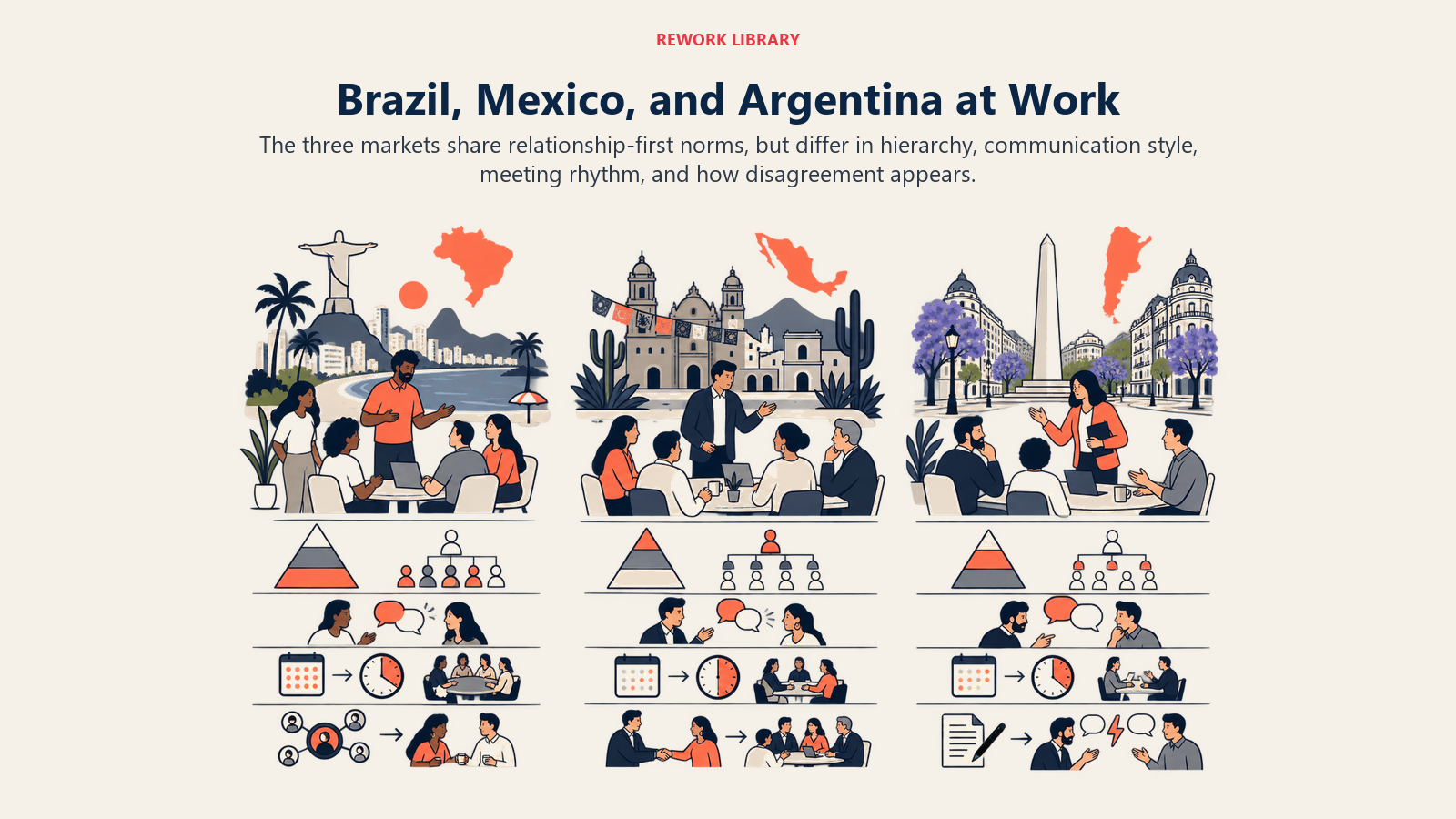
Mexico runs on hierarchy layered with personal warmth. Titles and seniority matter more visibly than in Brazil, family-owned businesses are common even among large national companies, and confianza has to be earned before a counterpart speaks candidly about problems or timelines. Indirectness is more pronounced than in Brazil: a "no" rarely arrives outright.
Argentina runs closer to Southern Europe than to the rest of Latin America on hierarchy and individualism. Debate is welcomed rather than avoided and formal hierarchy carries less day-to-day weight than in Mexico or Colombia. Relationship-building and flexible time still apply, but a leader who over-adjusts toward the region's usual indirectness in Buenos Aires risks reading as evasive rather than respectful.
A single "Latin America playbook" gets a leader most of the way in Bogota or Mexico City, but Argentina needs its own calibration, and even Brazil and Mexico run on meaningfully different mixes of formality, directness, and pace.
Business Norms and a Leader's Playbook
Four norms carry the most weight across the region, and knowing them only helps if it changes what happens in your next meeting, your next piece of feedback, and your next negotiation.
Relationships and Personal Trust Come Before the Deal
Across nearly every market, the relationship has to exist before the transaction does. Rushing to the proposal, efficient in a task-first culture, reads as presumptuous here. Budget real, unhurried time for it: a meal, a genuine question about someone's family. That is the process by which relationship-first cultures like most of Latin America decide who can be trusted, and skipping it costs more than it saves.
Hierarchy Shapes Who Can Say What, and Who Decides
Formal titles carry real weight, particularly in Mexico and Colombia, less so in Argentina. Org charts also understate how much authority sits with a founder or a small trusted circle, so ask directly who else needs to be comfortable with a decision before treating it as final. A junior employee raising a concern in an open meeting is less common than in egalitarian cultures, mirroring the gap between visible process and real approval chain in consensus versus top-down decision cultures.
Indirectness Protects the Relationship, Not the Truth
A flat "no" is rare outside Argentina. Reluctance shows up as a vague answer or an enthusiastic "yes" that never turns into action, a preference for indirect communication over blunt clarity. Deliver difficult feedback privately in Mexico, Brazil, and Colombia, the approach covered in why teams stay silent in meetings for other high-hierarchy cultures; Argentina tolerates far more open debate.
Time Is Genuinely More Flexible, and Mistakes to Avoid
Meetings starting late and several things happening at once are closer to the norm than the exception, particularly in Brazil. Build real buffer rather than treating every late start as a broken commitment. The costliest habits: skipping relationship-building to reach the agenda faster, treating a warm "yes" as a guaranteed commitment, and applying Argentina's tolerance for debate to Mexico or Brazil (or the reverse).
Business Culture in Latin America in the Age of AI
Latin America, particularly Brazil, Mexico, Colombia, and Argentina, has become one of the fastest-growing nearshore hubs for US and global companies, spanning software development, customer support, and back-office operations, driven in large part by time-zone overlap with North America. A growing share of the region's professionals now work inside distributed teams alongside colleagues in the US and Europe, increasingly with AI tools and AI agents handling part of the work.
That shift does not erase the region's cultural defaults; it relocates them. A written message in a shared Slack channel can carry the same relationship-preserving warmth and reluctance to deliver a flat no that a Brazilian or Mexican colleague brings to an in-person conversation, and an AI teammate that responds with blunt, task-first efficiency can read as cold to someone operating inside a personalismo-driven culture, even with no intention behind its tone. Leaders building ai-native culture across a Latin American team should expect the region's warmth-and-relationship norms to resurface in async and human-AI interactions, not disappear because a human is no longer delivering the message. The risk of AI cultural debt, unclear expectations about when an AI agent should soften a message the way a human colleague instinctively would, is a real, underexamined risk in relationship-first cultures specifically. For the broader shift toward human-agent collaboration, see the Frontier Firm and the agent boss.
For organizations running distributed teams across the region, the operational side of this, consistent onboarding across time zones, visible attendance records, and clean handoffs between HR and local managers, is easier to run well when it is not scattered across a different tool per country office. That is the kind of unglamorous consistency Rework's People app is built to support; it does not replace the cultural judgment above it.
Where to Go Next
This regional overview sits alongside the broader cross-cultural pillar in this collection. From here:
- How business culture differs across the world, for the full global map and a general leader's playbook
- Hofstede's cultural dimensions explained, for all six dimensions and scores across more countries
- The Culture Map, explained, for Erin Meyer's framework on reading feedback and communication style
- Relationship-first vs task-first cultures, for the deeper mechanics behind personalismo
- Business culture in Southeast Asia, for a comparable high-hierarchy, collectivist pattern built on a different mechanism
- Country-specific guides for Brazil, Mexico, Argentina, and Colombia are planned as this collection expands
Frequently Asked Questions about Business Culture in Latin America
What do Latin American business cultures have in common?
Brazil, Mexico, Colombia, and, to a lesser degree, Argentina share a relationship-first pattern often called personalismo: trust is built with the individual before the deal, hierarchy is respected more than challenged openly, warmth shapes how meetings unfold, and time is treated more flexibly than in task-first, monochronic cultures.
Is Latin American business culture the same across every country in the region?
No. Mexico, Brazil, and Colombia cluster on Hofstede's high Power Distance, low Individualism pattern, but Argentina sits much closer to the global midpoint on both, with a culture that tolerates far more open debate. Each country also has its own concepts, jeitinho brasileiro in Brazil, confianza and simpatía in Mexico, compadrazgo in Colombia, that shape how the shared pattern plays out.
Why is Argentina different from the rest of Latin America?
Argentina's Power Distance score (49) is close to the global midpoint and its Individualism score (46) is the highest of the four countries covered here, shaped in part by heavy European immigration in the late nineteenth and early twentieth centuries. The result values relationships in the regional style but is far more comfortable with open, vigorous debate than Mexico, Brazil, or Colombia.
How should a leader build trust with a Latin American business partner or team?
Budget real, unhurried time for relationship-building before the business case. A meal, genuine conversation, and a first meeting that is not rushed to an agenda are not delays; they are the mechanism by which confianza or personalismo gets established, especially in Mexico, Brazil, and Colombia.
How should feedback be delivered across Latin American cultures?
Calibrate by country. In Mexico, Brazil, and Colombia, deliver difficult feedback privately with no audience and lead with genuine appreciation. In Argentina, direct, energetic disagreement is more culturally accepted and read as engagement rather than disrespect.
Does Latin America's flexible relationship with time mean deadlines are not taken seriously?
Not exactly. Meetings starting late and schedules shifting on short notice reflect a genuinely different, polychronic relationship with time, not a lack of commitment. Leaders get better results building schedule buffer than treating every late start as a broken promise.
How is AI changing business culture in Latin America?
Latin America, especially Brazil, Mexico, Colombia, and Argentina, has become a major nearshore hub for US and global companies, so a growing share of the region's professionals now collaborate asynchronously with international teams and, increasingly, AI agents. The region's warmth-driven communication norms carry over into written and human-AI interactions rather than disappearing.
What is the biggest mistake an outside leader makes doing business in Latin America?
Skipping relationship-building to get straight to the agenda, and applying one country's norms to the whole region, particularly assuming Argentina's directness applies to Mexico or Brazil, or Mexico's indirectness applies to Argentina. Both cost more trust here than in a low-context, individualist culture.
Latin America is not one culture across four flags, but it is close enough to one pattern, personalismo, hierarchy, warmth, and flexible time, that a leader who understands it will get more right walking into Sao Paulo, Mexico City, Bogota, or Buenos Aires for the first time than one who treats the region as a total unknown. The pattern is the starting hypothesis. The specific country and person in front of you will always fill in the rest.

Co-Founder, Rework.com
On this page
- The Shared Pattern: Relationship-First, Hierarchical, Warm, and Flexible on Time
- Why the Region Clusters This Way
- Argentina: The Regional Outlier
- Key Facts
- The Local Concepts Behind the Pattern
- How They Differ: Brazil vs Mexico vs Argentina
- Business Norms and a Leader's Playbook
- Relationships and Personal Trust Come Before the Deal
- Hierarchy Shapes Who Can Say What, and Who Decides
- Indirectness Protects the Relationship, Not the Truth
- Time Is Genuinely More Flexible, and Mistakes to Avoid
- Business Culture in Latin America in the Age of AI
- Where to Go Next